Tag Archives: Fred Clarke

A Goat and a Dog

9 Jul

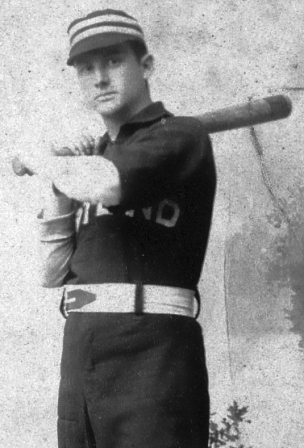
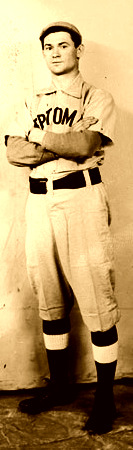
Edward John “Goat” Anderson played just one season in the major leagues, hitting .205 for the Pittsburgh Pirates in 1907.  He also played 10 seasons in the Central, Eastern and Western Leagues.

Described as eccentric, he made an impression on The Fort Wayne Sentinel in 1903, his first professional season with the South Bend Greens:

“’Goat’ Anderson who made it a rule during the games here to leave his post and come into the infield to argue every point raised by the umpire’s decisions, has stamped himself as the prize rowdy of the association.”

The Pittsburgh Leader said Pirate outfielder Tommy Leach had recommended the team sign Anderson, and told a reporter in the spring of 1907 that Anderson made the team because he was willing to stand up to Manager Fred Clarke while training in Hot Springs, Arkansas:

“(Clarke) had told Anderson to bunt at the signal from a man on first…The ball was pitched five feet outside, and of course, the catcher flagged the man going to second.  Anderson made no move to bunt or even to strike at the ball.  Clarke started to call him.  ‘Shut up,’ you don’t know all there is in the books,’ Anderson replied.  The answer made Clarke gasp…’All right, son,’ grinned Clarke.  ‘I guess you haven’t got stage fright when you can give it to your manager that way.’”

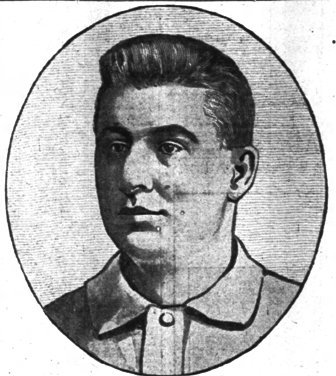
Edward John “Goat” Anderson

Edward John “Goat” Anderson


His excellent fielding, .343 on base percentage and 27 stolen bases with the Pirates impressed the local press, if not the fans.  George Moreland of The Pittsburgh Press said:

“Some fans are of the opinion that “Goat” Anderson, the hustling little right fielder of the Pittsburgh team, is not much of a general use to the Pirates, and that a good move would be made to get another man for the job.  These same fans are the ones who believe that a ballplayer is not worth his salt unless he is a slugger of the Wagnerian stripe…Manager Fred Clarke knows how to win games, and he also knows where to place a player in the batting order to get the most out of him.  That is the reason that the ‘Goat’ has been put at the top of the list to lead off.  It is not that Anderson makes a large number of hits.  Even when he does hit, he has difficulty in getting the ball out of the diamond.  But, somehow or other he manages to get to first base just about as often as any of them and when he does get there he is not slow about getting around the circuit.”

The Leader was even more enthusiastic about the new outfielder:

“The way little Goat Anderson has been hitting the ball and running bases insures him a permanent berth in the outfield.  Anderson has proved one of the finds of the season.  If there ever was another Wee Willie Keeler it is Anderson.  He is a ‘drop hitter’ of the Keeler style, and can run bases and bunt with the star of the New York Highlanders.  As a matter of fact, Anderson is of more value to the team than Keeler, because the latter’s star seems to be sinking.”

Despite the praise, Anderson was sold to the Rochester Bronchos of the Eastern League in January of 1908.

While with Rochester, Anderson attempted to get a patent on a sliding pad he invented; there is no record of a patent being awarded.  He also suggested a novel idea for improving his batting average.

The Lexington Herald said Anderson, who trained in Kentucky with the Bronchos before the 1909 season made this recommendation:

“Cut down the size of the home plate and I’ll hit .500 as long as the season lasts.  Where the front of the home plate is seventeen inches wide make it 10 or 12.  Then the batter will be able to get an even break with the pitcher, who now has everything in his favor.  With a home base half its present size a pitcher would need perfect control to get the ball over.  All this business of cutting across the inside and outside would be a thing of the past.  There wouldn’t be enough of the plate to give the pitcher the advantage of feeding outside low ones that can only be hit into someone’s hands…With a home base ten inches wide the ball would have to look pretty good right from the start, and if it didn’t a batter could easily pass it up.  There would be more bases on balls at the start, and that would mean a base on balls or a hit, or a hard liner that would bring a fine fielding play.  A smaller plate seems to me to be the thing.”

The small plate was the wish of a man who hit .222, .201 and .138 from 1908-1910 in Rochester.

Goat Anderson saved his greatest moment for his final season in professional baseball.  As the manager and leftfielder for the Terre Haute Terriers (or Terre-iers) in the Central League, he filed one of the most unusual game protests in history.

Goat Anderson (2), with the Terre Haute Terriers.

Goat Anderson (2), with the Terre Haute Terriers.

The Terriers were leading the Fort Wayne Champs 6 to 0 in the bottom of the seventh inning during the first game of a doubleheader.  Fort Wayne had a runner on first base with no outs with catcher Harry Martin at the plate.  The Fort Wayne Daily News picks up the story:

“Martin poked a drive into left field.  The ball rolled almost to the club house with ‘Goat’ Anderson in full cry after it.  Then came the cause for the protest in the person of Don.”

“Don” was a Great Dane who belonged to a Fort Wayne man named Ed Longfield.

“Don can’t bite, and wouldn’t if he could, but Anderson didn’t for sure know that, so ‘Goat’ hesitated a second in chasing the ball and Martin got a triple, Ted Anderson scoring. “

Fort Wayne went on to score six runs in the inning to tie the game and scored a run in the 10th to win 7 to 6.

The Fort Wayne Journal Gazette said:

“Toothless Don, Ed Longfield’s dog, is supposed to be harmless.  Goat Anderson, Terre Haute manager and left fielder evidently doesn’t think so and because dog Don jumped at him during the seventh inning romp in the first game yesterday Goat will file a protest with President (Louis) Heilbroner, requesting the game be played over.”

Heilbroner ruled against Anderson’s protest saying the play did not have a sufficient impact on the outcome of the game, but he did order that Don would no longer be allowed on the field during games.

Terre Haute finished fifth in the six-team league with 60-79 record.  Anderson was rumored to be considering offers from Federal League teams for 1914, but never signed with a team and his career was over.

He returned to his home in South Bend, Indiana.  He died of stomach cancer 10-years later at age 43.
“This Wealth of Mr. Gertenrich has cost the Game an A-1 Player”

7 Jul

Sportswriter William A. Phelon said Louis Wilhelm “Lou” Gertenrich “is not a ball player because he has to be, but because he wants to be.”

The son of a successful candy maker, Gertenrich was rumored to be one of Chicago’s wealthiest young men.  He was also an excellent ballplayer and sprinter, but spent a great deal of time focused on business rather than sports.  Phelon said:

“Gertenrich hasn’t played ball, even when he desired to play the game, because his business interests would not allow him the leisure time.  In other words, Mr. Gertenrich, being a man of income and financial substance, cannot dally with the ball and bat as he would like, and this wealth of Mr. Gertenrich has cost the game an A-1 player.”

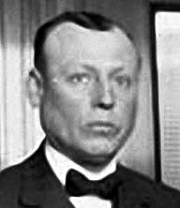
Lou Gertenrich

Lou Gertenrich

He began to be noticed as a ballplayer in 1891 as a 16-year-old pitcher with a team called the American Boys (later called the Mystics), the following year he joined the Clybourn Juniors.

At 19, in 1894 he joined Chicago’s City League, first with the Brands and then the Garden Cities, pitching and playing shortstop and outfield.  As local clubs found they could do better as independents than as members of a league the City League went from an eight, to six to finally a four-team league before disbanding at the close of the 1895 season.

Gertenrich remained a popular figure in semi-professional circles in Chicago, playing primarily for the Maroons and the Auburn Parks.

In 1898 The Sporting Life said Hank O’Day thought Gertenrich “is a sure comer.”

On September 15, 1901 the last place Milwaukee Brewers were in Chicago for a doubleheader, the final two home games for the first place White Sox.  Brewers Outfielder/Manager Hugh Duffy, and another outfielder, Irv Waldron, were injured.  As a result, The Chicago Daily News said:

“Manager Duffy gave Louis Gertenrich, a city league star, a trial.”

Starting the first game in right field, Gertenrich singled in his first big league at bat and scored a run on a home run hit by another player making his debut; Leftfielder Davy Jones.  Gertenrich was 1 for 2 before being removed in the fifth inning of a 5 to 4 loss.

In the second game he pinch hit for pitcher Ned Garvin and grounded out in the bottom of the ninth of a 9 to 4 loss to Chicago.

Gertenrich returned to the Auburn Parks with a .333 major league batting average.

He got a big league call again in 1903.  On July 21 the first place Pittsburgh Pirates were in Chicago to playing the Cubs.  Pirates Manager Fred Clarke, who was injured, had allowed outfielder Jimmy Sebring three days off to return to Williamsport, Pennsylvania for his wedding.

Gertenrich was brought in to play right field; he went 0 for 3 with a sacrifice bunt and handled two fly balls.  He returned to the Auburn Parks’ lineup the following day.

He spent most of the next decade playing in the re-formed Chicago City League—spending time with the Logan Squares, Gunthers, the Roger Parks, the West Ends, the Riverviews and Anson’s Colts.  He also coached baseball  at the Morgan Park Academy on Chicago’s South Side.

The Daily News said:

“Gertenrich is recognized as one of the heaviest hitters in local semi-pro ranks, and there is no batter more feared by the pitchers than this speedy fielder.”

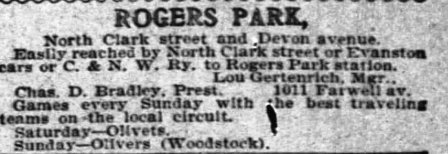
1906 advertisement for the Rogers Parks, when Gertenrich played for and managed the team

1906 advertisement for the Rogers Parks, when Gertenrich played for and managed the team

William A. Phelon wrote for The Chicago Journal when Gertenrich left Chicago briefly in 1905, at age 30,  to join the Springfield Babes in the Central League and the Decatur Commodores in the Three-I League.  Phelon told a story about Gertenrich’s stay in Springfield:

“Mr. Gertenrich was able to arrange his affairs for a lay-off of three months (in order to play for Springfield, and) the rich man negotiated with (Manager Jack) Hendricks for a position…The very next afternoon beheld Mr. Gertenrich, free from business care and happy as a proverbial lark, capering in the Springfield pasture and slamming that old ball like seven Cobbs and a Lajoie thrown in for luck.

“On his first day out he got three singles.  Next day he amassed two triples and a double.  The third day he whacked a home run and a single.  On his fourth day he drew three passes and connected for a triple.  On the morning of the fifth day Mr. Hendricks summoned him to headquarters.

“’Mr. Gertenrich,’ said Mr. Hendricks, pausing to wipe away a tear ‘you are a great batsman and a good fellow.  You are setting this league afire.  You are the wonder of the Twentieth Century.  But you are breaking the hearts of my younger players.  They cannot bat like you.  They are losing their ambition.  A few more games with you among them and they will pine away and die…Moreover Mr. Gertenrich, you have money.  You do not need this job.  The boys whom you are shoving into obscurity have little families and need the coin.  I hate to say it Mr. Gertenrich,’—and the manager again wiped away a tear—‘but you and I must part.  Here is your release.  Goodbye, Mr. Gertenrich, and good luck be with you.  Please go away, for I weep every time I look at you.”

Gertenrich also appeared in several games for Decatur after his release from the Springfield Babes, against Springfield’s other team, the Senators, and the Peoria Distillers.

For the next four seasons, Gertenrich remained one of Chicago’s best local athletes.  At 33-years-old in 1908 he was still a good enough runner to win the City League Field Day title of fastest player; The Daily News said he rounded the bases in 14 and 1/5 seconds.

The Chicago Eagle called him:

“(O)ne of the best known and most popular players in Chicago.”

In 1909 he hit .318 (5th in the league) and The Sporting Life said the Brooklyn Superbas were trying to sign Gertenrich and made an offer “which he has taken under consideration.”  The deal was never completed.

Gertenrich hit .350 in 1910 (3rd in the league), playing for Rogers Park.

In 1912 he returned to professional baseball as a member of the Chicago Green Sox in the United States League.  William C. “Billy” Niesen, a long-time City League operator had initially been one of the organizers of another proposed outlaw organizations, the Colombian League, but when then venture failed, and after one of the proposed New York team dropped out of the United States League in late March Niesen was awarded a Chicago franchise; Niesen was a good fit for the fledgling league because already had a ballpark on the North Side of Chicago at the corner of Clark Street and Leland Avenue–called Gunther Park, also referred to frequently in the Chicago press as Niesen’s Park.

The Sporting Life said “Base ball men are still betting that the new league doesn’t open the season,” but Niesen had high hopes.  He hired Burt Keeley, a long-time City League figure who had pitched in 30 games for the Washington Senators in 1908 and 1909.

He also signed Gertenrich, who had played for Niesen’s Gunthers in the City League the year before, and according to The Chicago Examiner had hit a home run off of Bill Lindsay of the Chicago American Giants that was “the longest hit ever seen at Niesen’s Park.”

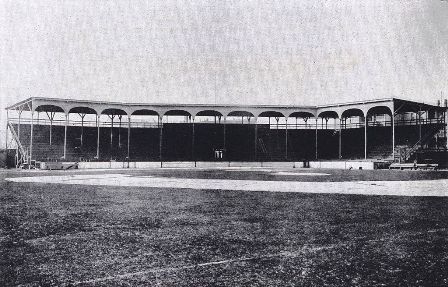
gunther

Gunther Park, where The Examiner said Gertenrich was responsible for “the longest hit ever seen at Niesen’s Park.”

An ambitious 126-game schedule was announced, but the upstart league was under-capitalized and low attendance doomed it to failure.  The league folded after just more than a month of play.  The Green Sox were 10-12.  Gertenrich returned to the candy business and semi-pro ball.

On March 8 of 1913 the Federal League rose out of the ashes of the United States League and was incorporated in Indianapolis.  Keeley was named manager, and many of the same players, including Gertenrich, who played for the Green Sox signed with the new club.

The Chicago Inter Ocean said:

“Gertenrich will be the mainstay of the outfield and is a heavy hitter.  He has made final arrangements for joining the club by procuring a competent manager for his candy business.  He will devote his time to the interests of the club.”

The team won their opener on May 6 against the St. Louis Terriers, and got off to a 7-1 start.  Chicago led the league until the middle of June when they were overtaken by Indianapolis.  They faded quickly after that; at the same time the team’s front office was in chaos, the team’s president was removed  and a new set of directors were elected in July.

On August 16 The Chicago Tribune said the team, hopelessly out of the pennant race, ten games behind Indianapolis, released Gertenrich “on the ground of cutting down expenses.”

Individual records are scare, but the 38-year-old Gertenrich was called “one of the classiest outfielders” in the league by The Associated Press.  In March of 1914 The Daily News said Gertenrich “was batting .413” at the time of his release, but had not received an offer from one the Federal League teams for 1914.

While Gertenrich relinquished some of the responsibilities of his company during 1912 and 1913 he had time to receive two United States patents for inventions for his candy company, including one described as a “corn confection” called the “Ball Tosser.”

Gertenrich was finished with professional baseball after his release in 1913, but continued playing semi-pro ball for several teams in and near Chicago, and formed a team called the Gertenrich Stars which played in Chicago through 1917.

He was a regular sponsor and attendee of alumni events for semi-pro and professional ballplayers in Chicago and played on the German Club of Chicago’s baseball team until his death from a cerebral hemorrhage in 1933.

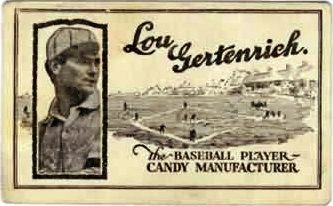
As a candy maker he had one more connection with professional baseball.  An advertisement for his company appears on the back of a baseball card set.  The 120 card set–the more common version advertises American Caramel on the back (E121)—was issued in 1922.  The Gertenrich variations are extremely rare.

The Gertenrich back variation of an E-121

The Gertenrich back variation of an E-121 card

Baseball’s “Fountain of Youth”

16 Apr

John Brinsley “J.B.” Sheridan wrote for several St. Louis newspapers and The Sporting News from 1888-1929.

In 1917 he asked in The St. Louis Globe-Democrat:

“How is it that two young chaps come up together, one lasts a year or two, the other keeps on playing until he meets his sons and the sons of his pals coming up?”

Sheridan noted that Bobby Wallace was 43-year-old and in his twenty-fourth season–albeit as a reserve who appeared in just eight games for the Cardinals–while contemporaries like Jimmy Collins were out of the game for nearly a decade.  (Sheridan failed to mention or notice that Wallace was three years younger and started his professional career at age 20 while Collins began his at 23):

“Wallace has had a great career in baseball.  Only one man, A. C. (Cap) Anson has played longer than Wallace in the major leagues (Sheridan didn’t mention Deacon McGuire who also had Wallace beaten in years of service with 26—but he only played a total of 20 games in his final eight “seasons”) Anson did twenty-seven seasons, but had he not been his own manager he would not have done so many.  The old man could hit to the end, but for the last ten years of his major league career Anson was so slow and stiff that it is doubtful if any manager, other than himself would have employed him.”

Booby Wallace

Booby Wallace

Sheridan neglected to mention that “slow and stiff” Cap Anson managed to play in more than 1100 games in those last ten seasons when no manager “other than himself would have employed him,” and hit better than .330 in five of them–and would contradict himself on the “slow and stiff” part later in the same article.

He said, “Jack O’Connor did twenty-two years in the majors and was useful to the end.” (O’Connor only hit better .250 twice in his last ten seasons, never appearing in more than 84 games during that period)”

Despite the many misstatements, Sheridan’s article included interesting character sketches of several 19th and early 20th Century players (the veracity of those sketches can be judged with the above misstatements in mind).

“O’Connor was a really wonderful man.  He always retrained his diet during the playing season, but gave it full rein during the off season.  O’Connor had some appetite, too.  Usually he put on 20 pounds of extra weight every winter and regularly took it off every spring.  O’Connor must have taken off 500 pounds of flesh in the twenty-two years of his baseball playing.  He ate and drank like Gargantua during the winter, but denied himself like a monk in the spring, summer and fall.

(Napoleon) Lajoie, who did his 20 years [sic 21] in the majors, was like Wallace and (Jake) Beckley, an iron man.  (Lajoie) came from Breton peasant stock…The Bretons lived off the rocks and fishing grounds of Brittany, beaten by Atlantic spray long before the dawn of history.  No wonder then, that Lajoie is a hardy man (who) needed no conditioning in his youth.  He threw a couple, hit a couple and was ready for the fray.”

Sheridan said O’Connor’s former battery-mate Cy Young was “another physical wonder” despite being “rather soft and inclined to obesity later in life.”

“Cy never cared much for beer, the beverage of the old-time ballplayer, but he did not mind a little ‘red eye’ now and then In fact, the old boys say the farmer could pack more whiskey about him than any man they had ever known.”

As an example of Young’s prowess Sheridan said O’Connor told him a story about a night out in Boston:

“I drank beer while Cy drank whiskey. Drink for drink with me, but the last thing I remembered that night was that Cy put me to bed.

“I got up the next morning looking for sedlitz powder and something cooling.  I got the powder and I went into the breakfast room to get a grapefruit.  Then I saw Young behind a big plate of beefsteak with onions.  I turned and ran for the fresh air…Cy ate the entire steak, all the onions, a lot of bread and butter, stuck a strong cigar in his mouth and joined me on the sidewalk.

“What made you quit so early last night, Jack?  I was just getting’ goin’ good, when you said ‘Let’s go home I’m sleepy.’”

Jack O'Connor

Jack O’Connor

Sheridan compared Young’s career to that of Bill Dinneen:

“Dinneen came into the game seven [sic–nine] years after Young, was Cy’s teammate for four years [sic–five and part of a sixth] then dropped out (Dinneen played three more seasons with the St. Louis Browns, but his career was over after 12 seasons at age 33)

“Dinneen ate too well, and what ballplayers call the ‘old uric acid’ got him in the arm.  Yet Dinneen was one of the finest physical specimens that ever played ball.

“Some big fellows look strong but prove to be soft and unenduring.  Jack Chesbro was one of these.  Chesbro had three great years as a pitcher, and then broke down.  Jack was a soft-boned boy, with bad ankles and could not stick the route.

“Some men hold out in arm, legs and bone, but lose the keenness of vision essential to good batting, Willie Keeler, was one of these.  Keeler’s legs were good to the end and his arm worked all right, but his eyes went back on him and he had to quit…(Art) Devlin was one of the three great third basemen of his time.  He was a star, but endured only a few years.  Bad Digestion stopped him when he was at the height of his fame, and when he should have been good for many more years.”

Sheridan claimed to know the secret of a ballplayer’s longevity: the waters of Hot Springs, Arkansas.

“Each January 1 for twenty-two years saw (Young) at Hot Springs…O’Connor and (Jake) Beckley were always at Hot Springs, too.  These three men never missed a season at the Arkansas resort, while they were playing ball…Fred Clarke, too, was a great advocate of Hot Springs as a training resort, and the Pirates always fitted in there when Clarke was manager.  That took (Honus) Wagner, another long liver, there too.

“Anson always took a season at Hot Springs.  It is pretty well established that the Arkansas resort is the location of Ponce de Leon’s famous “Fountain of Youth.”  It may or may not be a coincidence, but the fact remains that Young, O’Connor, Beckley, Anson, Clarke, Wallace and Wagner, men who played from seventeen to twenty-two years of major league baseball, have all been frequenters of or habitues of Hot Springs.”

Cy Young, third from left, with Bill Carrigan, Jake Stahl and Fred Anderson at Hot Springs in 1912

 Cy Young, third from left, with Bill Carrigan, Jake Stahl and Fred Anderson at Hot Springs in 1912

The St. Louis sportswriter was certain the springs were a magic “Fountain of Youth, “and said he was only aware of one exception to his rule:

“Every iron man of baseball, except Lajoie, has been a yearly visitant.”

“Father isn’t Disappointed because I took up Dancing”

4 Apr

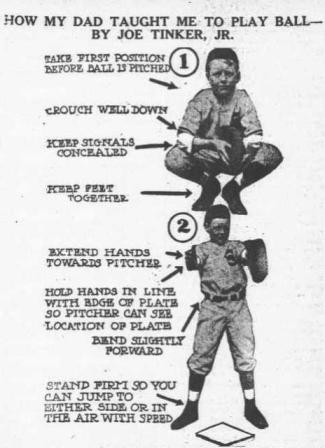
In the spring of 1916 Joe Tinker Jr., ten-year-old son of Chicago Cubs Manager Joe Tinker “wrote” a series of articles that appeared in newspapers across the country.  Tinker’s articles provided tips for playing each position:

“To be a winning pitcher you must have control…The best way to gain control is to get another boy to get in position as a batter then pitch to him.  Don’t throw at a stationary target.”

“(Catchers) Stand up close to the batter and don’t lose your head if the pitcher becomes wild.  Try to steady him with a cheerful line of talk.  Practice every spare moment.”

“Stand close to the plate when batting.  Don’t lose your nerve if the pitcher tries to bean you. Some fellows like to choke their bats or grip the handles about four inches from the end.  My father don’t approve of the style…Don’t argue with the umpire.  If you are hot-headed you hurt your chances to connect with cool-headed pitching.”

“Learn to start in a jiffy.  That is the first point emphasized by my dad in teaching me to run bases.”

“Playing short offers many chances for individual star plays and the work of a good man will have a great effect on the score card.”

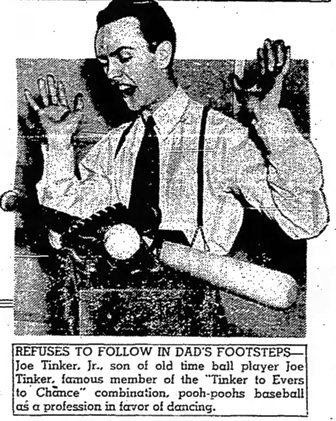
Photos of Joe Tinker Jr. demonstrating what his dad taught him

Photos of Joe Tinker Jr. demonstrating what his dad taught him

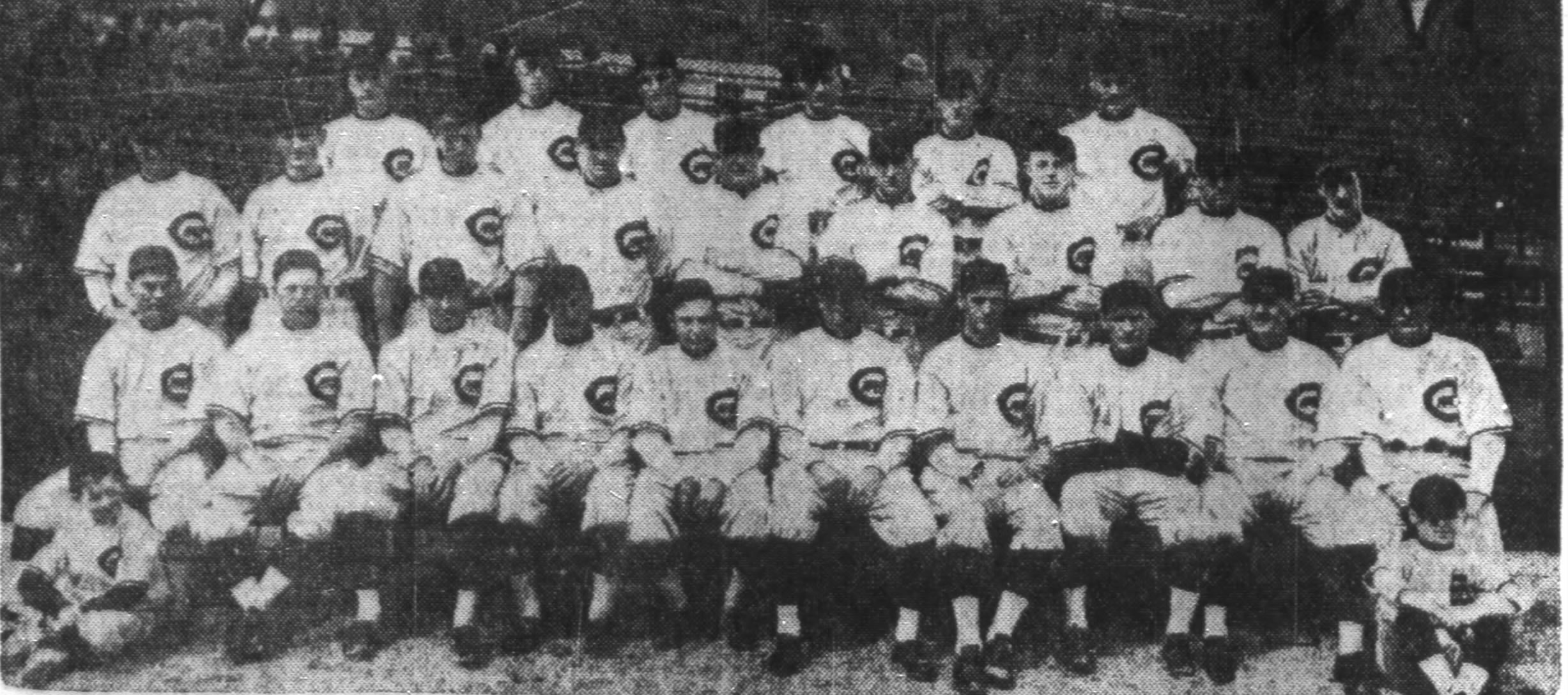
Joe Tinker Jr. and his younger brother Roland were the Cubs mascots during their father’s season as manager in 1916.  In 1924 Chicago newspapers reported that Tinker Jr. was headed to the University of Illinois to play baseball for Coach Carl Lundgren, the former Cub pitcher.  There is no record of Tinker ever playing at the school.

1916 Chicago Cubs.  Joe Tinker Jr. seated right, Roland Tinker seated left.

1916 Chicago Cubs. Joe Tinker Jr. seated right, Roland Tinker seated left.

Younger brother Roland played for two seasons in the Florida State League.

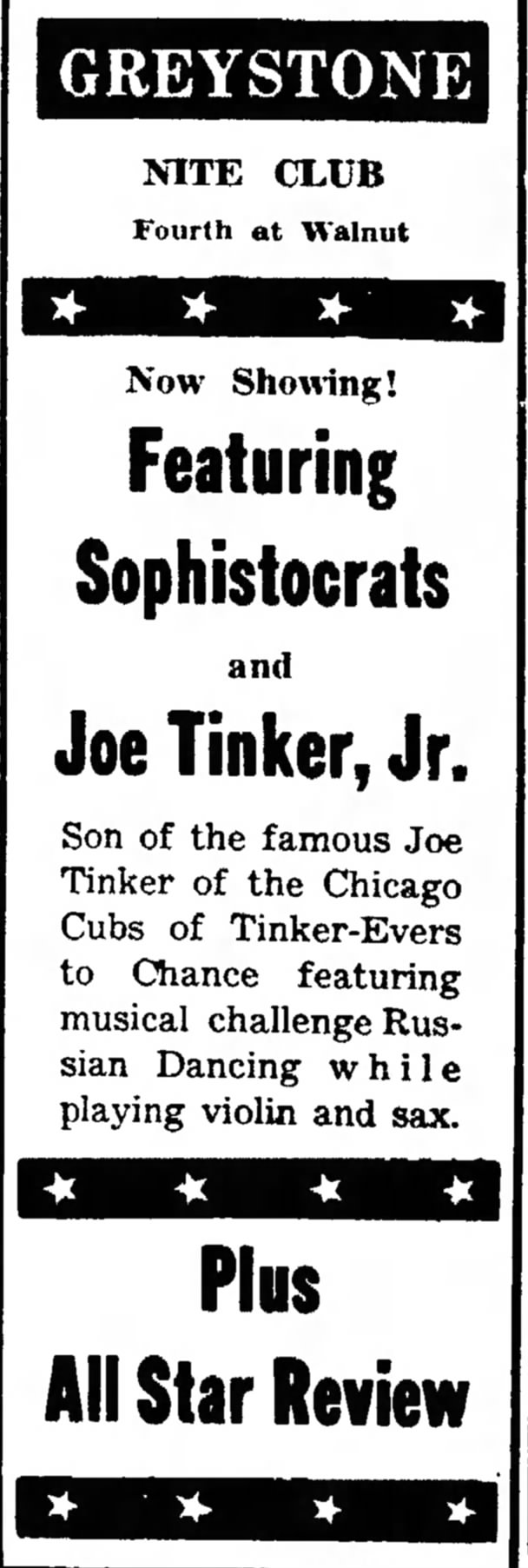
In 1938 newspapers reported that Joe Tinker Jr. had become a dancer with a vaudeville group called the Sophistocrats.  Tinker Jr. told reporters:

“Father isn’t disappointed because I took up dancing.  In fact he approves.”

It’s unclear whether “Joe Tinker Jr.” was actually Joe Tinker Jr.  The newspaper articles all said he was 22-years-old.  Joe Tinker Jr. would have been in his thirties; however his brother William Jay Tinker would have been 22 in 1938.


joetinkerjrdance


joetinkerjr1938

When Joe Tinker was elected to the Hall of Fame he compiled his all-time team for Ernest Lanigan, then curator of the Hall:

Pitchers: Mordecai Brown, Grover Cleveland Alexander, Christy Mathewson and Ed Walsh

Catchers: Johnny Kling and Roger Bresnahan

First Base: Frank Chance

Second Base: Eddie Collins

Third Base: Harry Steinfeldt

Shortstop: Honus Wagner

Outfield: Artie “Solly’ Hofman, Ty Cobb, Fred Clarke, and Sam Crawford.

Though he named several Cubs, Tinker did not include his former teammate Johnny Evers.  In 1914 Evers had famously slighted Tinker, with whom he was engaged with in a long-term feud, after Evers and his Boston Braves teammates won the World Series. William Peet wrote in The Boston Post :

“(Walter “Rabbit” Maranville’s) the best shortstop the game has ever known.

“Better than Joe Tinker; your old side partner?

“Yes, he’s better than Tinker.”

While the two finally broke their silence at Frank Chance’s deathbed in 1924, they never reconciled.

Evers died in 1947, Tinker in 1948.

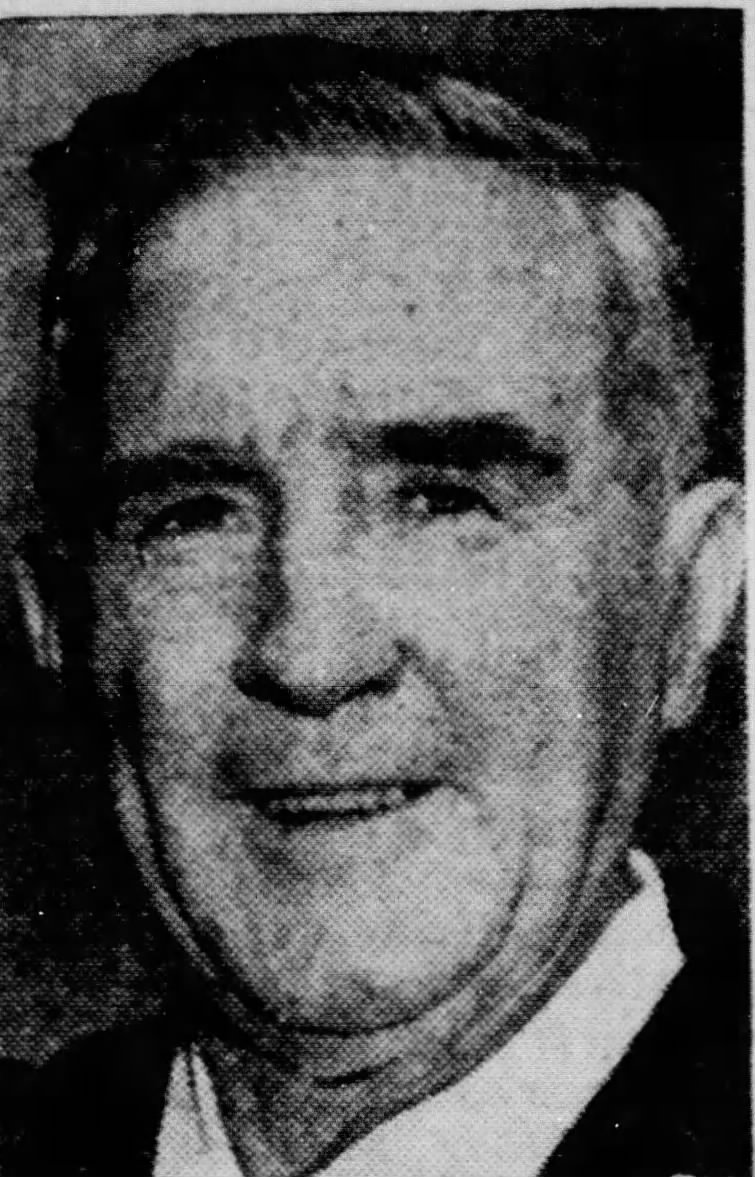
Joe Tinker circa 1946

Joe Tinker circa 1946

Joe Tinker Jr. died in 1981, Roland “Rollie” Tinker died in 1980, and William Tinker died in 1996.


Bowerman by TKO

5 Nov

“The Popular Magazine,” a literary magazine that billed itself as a “magazine for men and women who like to read about men,” was published by Street & Smith from 1903 until 1931.

In 1904, the magazine told the story of a fight the previous season involving New York Giants catcher Frank Bowerman.

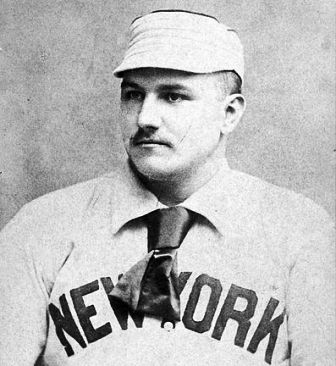
Frank Bowerman

Frank Bowerman

Bowerman was not kept by Fred Clarke when the Pirates and Louisville Colonels merged after the 1899 season; his contract was assigned to the  Giants.  Apparently some bad blood remained into 1903, and according to the magazine, Giants manager John McGraw used Bowerman’s grudge and some comments made by Clarke to try to light a fire under his team:

“When the Giants were in Pittsburgh (on June 1) last season McGraw noticed that there was bad feeling in the team.  The men stood in little knots in the hotel corridor glowering at other players; they rode to the field in a bus without exchanging a word; the preliminary practice, usually so brilliant, was dull and lifeless.  This worried McGraw.”

John McGraw

John McGraw

The article said McGraw had figured out the cause a few days later in Chicago; Bowerman had sat in the grandstand for that June 1 game, being unable to play due to an injured thumb.  Jack Warner caught Christy Mathewson that day.  What McGraw discovered was that Clarke said Bowerman was overheard criticizing Warner’s work behind the plate, blaming his teammate for one of the two runs scored off of Mathewson:

“This, of course, was tantamount to Bowerman’s asserting his superiority over Warner, a boast that ballplayers are rarely guilty of.”

McGraw cornered Bowerman who insisted Clarke had told “the meanest lie that ever was told, and I told Jack Warner so, but he don’t believe it.”  McGraw told him to keep quiet about it until the Pirates visited New York on June 26.

“(McGraw) proceeded to reinject that esprit de corps by a measure so drastic that it horrified ball patrons all over the country, who, however, thought it merely an incident of the brutality of ballplayers.  Instead of that, it was a well-planned scheme of a crafty general.”

When the Pirates arrived at the Polo Grounds on the morning of the 26th, McGraw took Bowerman aside:

“’Frank, have you got a good right swing?’  The Michigan Lumberman smiled grimly and clenched a fist knotted and as hard as Hercules’ war club.  ‘Well, it’s up to you, then,’ advised McGraw, “to put life in the team. Don’t lose any time.’ Bowerman understood.

“”’I’d like to speak to you a minute,’ he said to Clarke, as the Pittsburgh captain was passing through the gate on his way to the clubhouse.  They went into the stuffy box office; where there was hardly room to swing a cat.  Three times Bowerman demanded an explanation, offering to bring McGraw and Warner in as witnesses…Clarke went down three times and finally admitted he had enough…The Giants played that day, to use the expression of a rooter, as though they were ‘fighting their weight in wildcats.’  Bowerman and Warner coached each other with pet names, and walked lovingly from the victorious field arm in arm, while Fred Clarke was buying a pound of raw beef.”

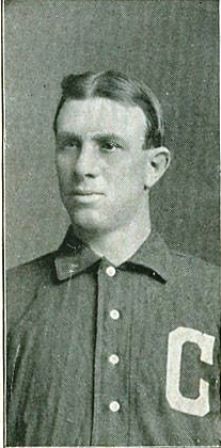
Fred Clarke

Fred Clarke

“The Popular Magazine” story added an element that differed from the coverage in New York and Pittsburgh newspapers—while each town pointed fingers at the other (in Pittsburgh Bowerman was an out of control thug, while in New York, Clarke got what he deserved for stirring up trouble) no one else suggested that McGraw engineered the fight to motivate his club against the first place Pirates.

The Giants weren’t able to catch Pittsburgh, finishing in second place six and a half games behind the Pirates.

National League President Harry Pulliam initially announced that there would be no punishment for either player because the fight did not take place on the field, three weeks later, under pressure from Pirates owner Barney Dreyfuss, Pulliam fined Bowerman $100.

Jimmy Rogers

16 Sep

In January of 1897 owner Barney Dreyfuss and the directors of the Louisville, Colonels met to determine the future of the club.  The Louisville Courier-Journal said:

“The most important meeting in the history of the Louisville Base-ball club was held last night at the Louisville Hotel.  It was marked by more liberality than had been shown by the club during all the years since it became a member of the big league.”

No one was surprised that Dreyfuss’ protégé, team secretary Harry Clay Pulliam was named team president, nor was it surprising that Charles Dehler was retained as vice president.

But no one had predicted the Colonel’s choice to replace Bill McGunnigle as manager.

McGunnigle had succeeded John McCloskey, and the two combined for a 38-93 record and a twelfth place finish.

James F. “Jimmy” Rogers would be a first-time manager; three months short of his 25th birthday and only 110 games into his major league career.  The Courier-Journal knew so little about the new manager that the paper got his age and place of birth wrong, and also reported incorrectly that he had minor league managerial experience.

While he had only played 72 games with Louisville in 1896 and only 60 at first base, The Courier-Journal called Rogers “the best first baseman the Colonels ever had.”  Even so, the paper acknowledged that “as a manager he is yet to be tried.”

Just why was he the right man to manage the team?

“One of the chief reasons Rogers was selected was that he is sober.”

Jimmy Rogers

Jimmy Rogers

Despite being “the best first baseman the Colonels ever had,” Rogers opened the season as the team’s starting second baseman; thirty-five-year-old minor league home run king Perry Werden, acquired from the Minneapolis Millers of the Western League played first base for Louisville.

The team won five of their first seven games, and then went 12-22 through June 16 when Rogers was fired as manager and released; he was hitting .144 and made 16 errors in forty games at second base.

Rogers was replaced as manager by Fred Clarke; the future Hall of Famer was two weeks shy of his 24th birthday.

The Cincinnati Post said the outgoing manager was not only to blame for the team’s poor performance but also for center fielder Ollie Pickering’s slump; Pickering hit .303 after joining Louisville in August of 1896 but was hitting .243 on the day Rogers was let go:

“The claim is made that Jimmy Rogers is responsible for the decline of Pickering.  The Virginian created a sensation last fall, but “Manager Jimmy” tacked the title “Rube” to Pick, and it broke his heart.”

Ollie "Rube" Pickering

Ollie “Rube” Pickering

Pickering was released in July, signed with the Cleveland Spiders, and apparently recovered from his broken heart, hitting .352 in 46 games for Cleveland.

Rogers would never play another major league game.  He was signed by the Pittsburgh Pirates the day after Louisville released him, but became ill with the flu and never played for them.  A month later he joined the Springfield Ponies in the Eastern League and finished the season with them.  Rogers played for East Coast minor league teams until in August of 1899 when he became ill while playing with the Norwich Witches in the Connecticut League.

In January of 1900, Rogers died at age 27.  Two different explanations for his death appear in various newspapers; both may be wrong.  The Courier-Journal and several other newspapers said his death was the result of the lingering effects of “being struck on the head by a pitched ball several years ago while playing in the National League.”

The New Haven (CT) Register repeated the story about Rogers being hit by a pitch, and said that while that injury contributed to his death, he had died of Bright’s disease—a kidney ailment now referred to as nephritis.

Rogers’ Connecticut death certificate listed the cause of death as a bacterial inflammation of the brain.

Baseball’s “Growing Evil”

24 Jun

By 1913 newspaper articles under the byline of a famous player were common in newspapers across the country, and most of the game’s biggest stars were represented.

Most fans of that era assumed the players did their own writing until an expose appeared in The Washington Herald in March of 1913.  Sports Editor William Peet wrote:

“The dear old public fell for this stuff and swallowed hook, bait and sinker.  An article under the signature of Christy Mathewson led three-fourths of the fans to believe that the great pitcher himself wrote it.”

According to Peet, players were paid between $250 and $1000 for each story “and not one of them wrote a single word,” but it was still a good investment:

“The newspapers themselves regarded these feature articles as good investments, for the reason that the stories were syndicated to 25 or more outside publications and the revenues derived not only paid the amount guaranteed the baseball player for the use of his name, but left a handsome profit.”

Peet exposed the writers behind the articles “written” by the game’s biggest stars:

Christy Mathewson and Jeff Tesreau/John Wheeler, The New York Herald

Walter Johnson/Ralph MacMillan, The Boston Journal/The Boston Herald

John McGraw/Walter Turnbull, The New York Evening Sun

John “Chief” Meyers/Jim McBeth, The New York American

Richard “Rube” Marquard/Bill Farnsworth, The Atlanta Georgian/Hearst Newspapers

Denton “Cy” Young/Sam Carrick, The Boston Post

Tris Speaker/Tim Murnane, The Boston Globe

“Smokey” Joe Wood/Jim O’Leary, The Boston Globe

Ty Cobb/Roger Tidden, The New York World

Hughie Jennings/George “Stoney” McLinn, The Philadelphia Press

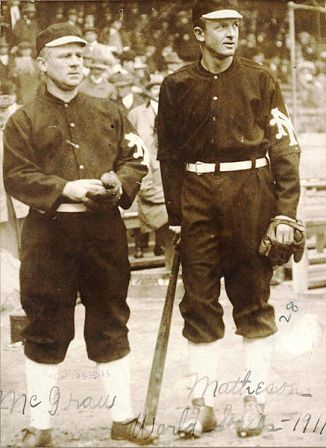
John McGraw and Christy Mathewson

John McGraw and Christy Mathewson

Peet called the practice dishonest, and said it had gone too far, and in New York and Boston the practice   had “become a mania.”  Peet singled out an article “written” by John McGraw criticizing “Chief” Myers that caused an “explosion,” and said the articles featuring “Rube” Marquard’s byline, and written by Farnsworth got Marquard “in bad with his teammates, for Farnsworth spared no one is his scathing criticisms.”

Pittsburgh Pirate manager Fred Clarke disagreed with the practice, telling Peet:

“I do not think it is any ball player’s place to butt into the newspaper end of the game…I think it is foolish for any player, especially those who take part in the world’s Series, to write about the games.”

As a result of Peet’s revelations the American League club owners condemned the practice of players’ names appearing on articles they did not write, but came just short of officially banning the practice. In September, the Baseball Writers Association petitioned the National Commission to end the “growing evil” of players authoring or appearing to author articles during the upcoming World Series.

The commission agreed, and American League President Ban Johnson informed Philadelphia Athletics manager Connie Mack on the eve of the World Series that star players Eddie Collins and Frank Baker “have been instructed not to write baseball stories or give the impression they are writing them.  If they ignore this request, a way of punishing them would be found. “

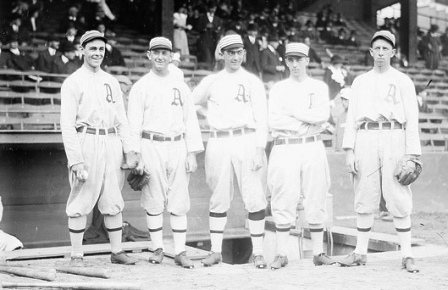
Frank Baker, center, Eddie Collins, far right,

Frank Baker, center, Eddie Collins, far right,

Johnson even threatened “Collins and Baker would not be permitted to take part in the World Series,” if they wrote articles or permitted their names to be attached to articles.

At one point Johnson and National Commission Chairman August Hermann said they would consider calling off the series if players refused to comply.  Dave Fultz, the former player, practicing attorney, and president of the Fraternity of Baseball Players, said members of the commission could be personally liable for damages if the series was cancelled.  Johnson and Herman’s threat to cancel the series as a whole was put to rest.

Mack argued that the players had contracts with newspapers and that Johnson had said earlier that players who were “capable” of writing their own articles would be permitted to do so, but as he prepared his team to play the New York Giants, he prepared for the worst, telling The Associated Press:

“(I)f the commission decides the players must not write under any conditions and players decide not to abide by the ruling, I will be prepared to put a team on the field,” The AP speculated that utility infielder John “Doc” Lavan  would play second base  and outfielder Rube Oldring would be moved to third base, with Amos Strunk taking Oldring’s place in the outfield.

Mack’s adjustments weren’t required.  Collins was allowed to write for The Philadelphia Record because his deal with the paper predated the commission’s ruling, and Baker did not write articles.  Together they led the Athletics to a 4-1 Series win, hitting .421 and .450.

Ghost written articles, and articles actually written by players never disappeared, but the practice became much less popular after the revelations and battles of 1913.

“The Deterioration in the Morale of the Players”

10 Jun

The Chicago Tribune had had enough:

“The deterioration in the morale of the players has been followed by deterioration in that of the spectators.  The latter relish the obscene profanity and the slugging exploits of the hulking brutes of the baseball field.”

The Tribune provided an “account of the more disgraceful of the many rows witnessed by spectators of baseball games,” during the just-ended 1899 season:

“May 2—Row at Pittsburgh—St. Louis game.  (Frank) Bowerman was put out of the game.  (Jack) O’Connor was taken off the field by the police, and the crowd chased umpires (Tom) Burns and (William) Smith.

May 19—Umpire Burns put (Giants’ William “Kid”) Gleason out of the game at St. Louis.  Gleason’s protest was so strong Burns forfeited the game to St. Louis.

June 1—Row on the grounds at Washington.

June 16—After a long wrangle and continued rowing on the field at New York.  Umpire Burns forfeited the game to Brooklyn.

June 16—(Fred) Clarke and (Clarence “Cupid”) Childs fight on the field in Louisville.

June 27—Rowdy action of players caused the crowd at the Pittsburgh game to mob umpire (James “Chippy”) McGarr.

July 18—(Tommy) Corcoran slugged (John) McGraw at Baltimore after being first attacked, and his action started a riot.

July 26—(Emerson “Pink”) Hawley, (Fred) Tenney, and (Hugh) Duffy engaged in a game of fisticuffs at Cincinnati.

Aug 16—(Oliver “Patsy”) Tebeau, McGraw and (George “Candy”) LaChance fought at Baltimore

Aug 18—Riot at Baltimore game started by (Tim) Donahue throwing a handful of dirt at (Steve) Brodie’s face.

Sept 1—Childs and Aleck Smith fight on the field in Louisville.

Sept 7—Riots at St. Louis and Brooklyn.

Sept 15—Clarke taken off Philadelphia grounds by police.

Sept 16—Chicago players jerked (Ed) Swartwood around the diamond because he called the game in the eighth inning on account of darkness.

Oct 9—(George “Win”) Mercer assaulted (Al) Mannassau at Washington.

Oct 14—(Jimmy) Scheckard assaulted umpire (John) Hunt, refused to retire, and Hunt forfeited the game to Brooklyn.”

Cupid Childs, repeat offender

Cupid Childs, repeat offender

Al Mannassau, assaulted by Win Mercer in Washington

Al Mannassau, assaulted by Win Mercer in Washington

In addition to the fans, The Tribune blamed team owners:

 “For the multifarious minor acts of blackguardism and rowdyism of which the hired men of the club owners were guilty there is no room.  It is sufficient to say that they, like the graver offenses mentioned above, did not wound the feelings or jar on the nerves of the proprietors of these baseball roughs.  Those proprietors seem to have come to the conclusion that audiences like these ruffianly interludes.”

Like hundreds of predictions before and thousands more to come over the years, The Tribune saw dire consequences for baseball given the current state of the game:

“There was a time when Chicagoans went to see the games of the Chicago club because they had a feeling of proprietorship in that organization.  That day is over.  Men do not go to see games out of local pride, nor do they go to see fine playing.  They go to listen to the language of the slums and to witness the horseplay and brutalities of the players or performers.  When these have lost their attractions professional baseball will disappear. “

“The Speed of Rusie”

30 May

Hall of Famer Amos Rusie “The Hoosier Thunderbolt,” was famous for his fastball; it’s been estimated that he threw in the high 90s.  In only nine full seasons he led National League pitchers in strikeouts five times.

Amos Rusie

Amos Rusie

Sports writer William A. Phelon contended that Rusie was the fastest pitcher he had seen, and in 1913 he told a story by James Tilford Jones who played for the Louisville Colonels in 1897, and was still a fairly well-known minor league player.

The likely apocryphal story (Jones only had one at bat as a pinch hitter that season, and did not strike out)  appeared in The Cincinnati Times Star, and according to Phelon, Jones said:

“ Don’t tell me that Walter Johnson, or any other pitcher of the present time, is faster than Rusie, or even that any man has the speed that Rusie used to throw…That man was unique and individual –there was never one like him before his time, and none since.  I don’t think there ever will be.

“My first experience with Rusie happened a long, long time ago, when he was in full swing and I was playing with Louisville, then a member of the big circuit.  I was warming the bench that particular afternoon, and wasn’t specially noticing the work of the other side, when our manager (Fred Clarke) beckoned me.  ‘Joensey’ said he, ‘you go up and bat for the pitcher.  Two on, two down—we just gotta have this game.  Go up there and lay the bat against the leather.’

“’All right sir’ I assented.  I’ll pickle one outside the lot if he puts it over.’  And up I strode, with a fat bat in my hands.  I saw a very large, red-faced man standing out there on the pitching line and I saw him raise his right arm.  I was wondering why on earth he didn’t throw it, when heard something go POW, just like that, behind me.  I looked around.  It was the thud of the ball ramming into the big mitt, and the umpire said, ‘One strike.’

“I watched the big man keenly, and again he raised his arm while I set myself to annihilate the ball.  An instant later I saw a ball going by me, and swung at it.  It was the ball being returned by the catcher, and I thought it was coming up instead of going away.

“By this time I was furious, also desperately determined.  So I set myself almost upon the plate, with the bat jutting out, and watched the big man very closely.  Then something crashed into my bat, ripped it from my hands, and drove it round against the back of my neck—and I knew no more.

“Two or three days later, the situation was exactly the same—Rusie pitching, our pitcher up, and dire need of a pinch hitter.  Again the manager beckoned me. ‘Go up and hit him, Jonesey’ growled he.

“I marched up to the plate, but went up empty-handed— didn’t even pick up my bat—and calmly stood there in the batter’s box, with nothing but my bare hands.  ‘Hey you,’ yelled the manager, ‘where’s your bat.’

“’Don’t need it,’ I shouted back.  ‘I can’t see them anyway, and it is a whole lot safer with nothing in my hands than be up here with a chunk of timber that he might drive clear through my head!’

“Oh, yes, yes.  Rusie had some speed when he wanted to use it, and I never remember seeing him any time when he wasn’t inclined to use it, either.”

Jones only appeared in two games during the 1897 season; in his first game he pitched 6 2/3 innings in relief in a 36-7 loss to the Chicago Colts, giving up 22 runs, 14 earned—the Colts’ 36 runs are still the Major League record.

Jimmy Jones

Jimmy Jones

Jones became a full-time outfielder in 1900 and returned to the National league with the New York Giants in 1901; he appeared in 88 games for the 1901-02 Giants, hitting .209 and .237.

He returned to the minor leagues and continued playing until 1914, and finished his career managing the Maysville (KY) Burley Cubs in the Ohio State League in 1916.  He served as Laurel County Clerk for twenty years, and died in London, Kentucky in 1953.

Rusie retired with a 245-174 record, striking out 1,934 and walking 1.704.  He died in 1942 and was elected to the Hall of Fame by the Veterans Committee in 1977.

“Bill Abstein Denies he is a Bonehead”

20 Feb

Pittsburgh Pirate owner Barney Dreyfuss and manager Fred Clarke felt all they needed to win a World Series was a first baseman.  Since winning the National League Pennant with Kitty Bransfield in 1903, only one Pirate first baseman hit better than .260 (Del Howard .292 in 1905).

In 1908 the Pirates finished second with four different first basemen, Harry Swacina, Alan Storke, Jim Kane and Warren Gill; none played more than 50 games, none hit better than .258 and they combined for 29 errors.

The man who took over in 1909, and was with the Pirates for their World Series victory, might have preferred to have never been given the job.

Bill Abstein had played eight games at second base and in the outfield for the Pirates in 1906, before returning to minors.

-Abstein had put up respectable, but by no means spectacular, numbers with the Shreveport Pirates in the Southern Association and Providence Grays in the Eastern League from 1906 to 1908—but as early as August of 1908 The Pittsburgh Press said he was the answer to the Pirates problem at first base:

“Fred Clarke is very eager to secure Bill Abstein from Providence.  Bill is rated the best first baseman in the Eastern League, and he would no doubt strengthen the Pirates where they are weak.”

When Abstein joined the Pirates before the 1909 season The Press said:

“The acquisition of bill Abstein has rounded our infield nicely.  He’s the best first baseman we have had in years and he certainly fits in nicely.”

???????????????????????????????

Abstein, Providence 1908

In a letter sent to Dreyfuss with his contract, Abstein told the Pirate owner:

“Fred Clarke will not have to worry about a first baseman after he sees this big German hustling around the bag.”

In keeping with his career performance, Abstein had a respectable season for the pirates.  He hit .260 and drove in 70 runs.  His 27 errors were only a slight improvement over 1908’s first baseman by committee.

The Pirates won 110 games and won the National League Pennant by six and half games over the Chicago Cubs and met the Detroit Tigers in the World Series.  The series would be the beginning of the end of Abstein’s Major League career.

09pirates

1909 World Champion Pittsburgh Pirates, Abstein 11th from left.

Abstein struggled at the plate (6 for 29 with nine strikeouts) and in the field (5 errors total, 2 each in games 3 and 4).  The Pirates won the series in seven games, but despite the victory, Abstein quickly became the subject of ridicule in Pittsburgh.

An Associated Press article after the series said:

“During the games with Detroit Abstein appeared to forget all that he knew about base ball.  He ran the bases foolishly, made a number of costly errors, failed to hit and disobeyed orders.  In fact, his playing was worse than that of any other man on either team.  The other Pirates, seeing that Abstein was the ‘goat’ for the combination, kept up the cry against him…Before the series was ended many of the Pirates shunned Abstein and it was reported he would be traded.”

The Pittsburgh Press was less generous:

“Bill Abstein denies he is a bonehead and says baseball is largely a case of ‘if-you-can-get-away-with-it,’ well it’s a cinch that Bill couldn’t in the National League.”

The Pirates were unable to trade Abstein and finally put him on waivers.  He was claimed by his hometown St. Louis Browns.

Even though the Pirates had actually won the Worlds Series and even though Abstein was gone, that didn’t mean the Pirates, and The Pittsburgh Press, wouldn’t continue to pile on.

Barney Dreyfuss told The Associated Press shortly after Abstein was claimed by St. Louis:

“We have discarded the weakest offensive player we had—Abstein—and hope to improve the team by doing so.”

Dreyfuss also claimed:

“Fred (Clarke) told me as early as last June that we should get someone else for Abstein’s place in 1910, as Bill mixed up the team’s plays too frequently.”

The Pittsburgh Leader said:

“(Abstein) had deplorable batting weaknesses which the opposing pitchers were certain to fathom in time.”

The Pittsburgh Press was even less generous:

“Bill Abstein is reported to be making a hit with the Browns by his work in the spring practice.  Just wait about three months friends, before declaring Bonehead Bill a wonder.”

When the Pirates sold pitcher Vic Willis the St. Louis Cardinals in February of 1910, newspapers reported that Willis and Abstein had “engaged in a bitter fight,” during the series.

Abstein quickly wore out his welcome in his own hometown of St. Louis.  Abstein made 11 errors in 23 games at first base and hit .149; he was released on June 2, 1910.  It appears Abstein was no more popular with Browns Manager Jack O’Connor than he was in Pittsburgh.  O’Connor was quoted in The St. Louis Times in May:

“How did Abstein get away with it last year?  How could he make plays like he has been making for me and get away with it all year for Pittsburgh?  I never dreamed that some of the plays made by him were even possible.”

His Major League career over, Abstein returned to the minor leagues for seven seasons.  He had one above average year with the Los Angeles Angels in the Pacific Coast League in 1914; in 202 games he hit .308, with 234 hits and 40 doubles.

Abstein moved on, Pittsburgh apparently did not.  For years, Pittsburgh newspapers took every opportunity to take a shot at the first baseman.  In 1915 The Pittsburgh Press, in an article about the revolving door the Pirates still had at first base–in the five post-Abstein seasons, the Pirates had four different starting first baseman–(emphasis theirs):

“No one will ever forget the way Bill did NOT play the bag in the Worlds Series.  In fact, Bill did NOT play the bag all the time he was stationed there.”

Pittsburgh finally seemed to move on by the time they won their next world Championship in 1925.  Abstein died in St. Louis in 1940.