Tag Archives: Honus Wagner

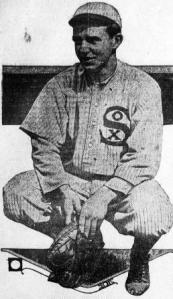
Ray Schalk on “Baseball Brains”

1 Feb

After the Chicago White Sox defeated the New York Giants in the 1917 World Series, Sox catcher Ray “Cracker” Schalk took to the pages of “Baseball Magazine” with his opinion of statistics:

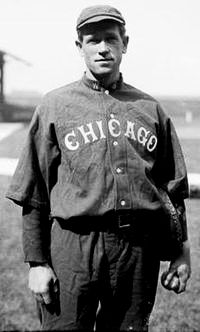
Ray Schalk

Ray Schalk

“Offhand I would say that fielding averages are pretty bad, pitchers’ averages rather punk, batting averages merely fair.  But the worst of all are catchers’ averages.

“How are you going to tell a good catcher?  By his batting average?  By his fielding average?  By the runs he scores?  Of course all these things are important.  But they haven’t any direct connection with good, bad or indifferent catching as such.  A catcher may or may not be a good batter or base runner.  And whatever his hitting or run getting ability he may be a great or mediocre catcher.”

Schalk said it was “easy…from the records” to determine an outfielder or shortstop’s ability:

“But a man might be the best catcher the world ever saw or the worst, and there would be no way under heaven to gain that information from the season’s statistics.

“First of all, a catcher must have baseball brains.  It isn’t enough to say brains; you must add the adjective ‘baseball’ to describe what you mean.”

Schalk noted that many of his contemporaries were educated:

“I admit this is the day of the college player in baseball.  I admit that the better education a man has, other things being equal, the better ball player he will be.  But he might know a lot of philosophy or Greek literature and be a frost on foul flies.  Ty Cobb has the ideal baseball brains.  But Ty isn’t a college man.  On the other hand I used to play in the minors with a graduate of a well-known university who was a brilliant scholar and a good natural athlete.  But he was positively the limit in playing baseball.  He would do the most incomprehensible things.  In fact, he was impossible.

Hans Wagner and Nap Lajoie are not college men, have not enjoyed as liberal an education, perhaps, as most of the rest of us.  But if any medical laboratory wants a sample of a real baseball brain, let him open negotiations with the Dutchman or the Frenchman for the use of his skull when he is thru with it.

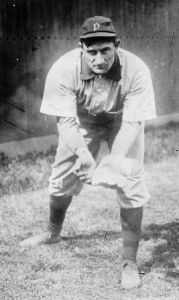
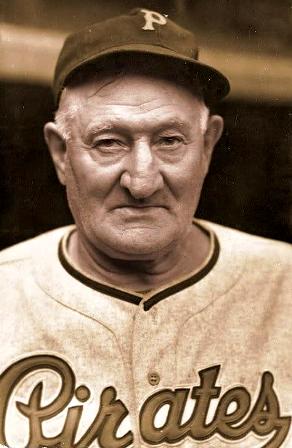
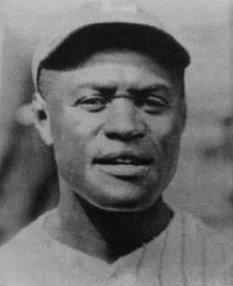
Honus Wagner

Honus Wagner

“I believe there are fellows with a natural born instinct to play baseball.  They invariably do the right thing at the right time.  That is what I mean by baseball brains.  Furthermore, such a brain must above all act quickly.  There are many thousands of people, even in the stands, who understand good baseball and could dope out the proper thing for a fielder or a batter to do under given conditions.  But that isn’t enough.  The man with a baseball brain must not only do the right thing but he must do it instantly.  It is quickness of thought quite as much as correctness which marks the star player.  Hal Chase and Ty Cobb are scintillating examples of quick thought on the diamond.”

And, said Schalk, “quick thought” was most important behind the plate:

“Now the catcher, above all men, must have a good baseball brain.  Most of his work, the most important part of his work, is hidden from the spectators’ eye.  The man in the stands can seldom follow what is going on in the catcher’s brain.  But the catcher, much more than the pitcher, holds the game in the hollow of his hand.  The catcher, much more than the pitcher, is the keystone of the baseball arch.”

The man who thought statistics didn’t have “any direct connection” to a catcher’s value made it into the Hall of Fame in 1955.  He has the lowest career average (.253) among enshrined catchers.

Honus Wagner, “How I Win”

14 Dec

As part of a series of syndicated articles which asked some of baseball’s biggest stars to talk about “How I Win,” Joseph B. Bowles, a Chicago journalist, interviewed Honus Wagner before the 1910 season.

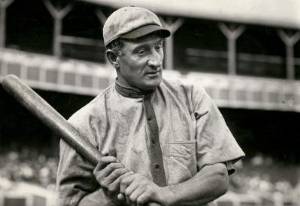
Honus Wagner

Honus Wagner

Wagner said it was simple:

“The secret of winning at baseball is to be found in the first order given to a new ballplayer.  it is ‘Keep your eye on the ball.’  I believe there is such a thing as the instinct for playing the game, but the greatest success comes from quick eyesight and from never taking the eye off the ball for a moment, whether batting fielding or running bases.”

But, he admitted he hadn’t given the subject much thought:

“I never have written anything about baseball, and never have thought much about why a team wins or why a player is a winning player (until now).  It is hard for a player to explain how he wins than it is to win.  I think, however after thinking it over, that the eyesight has more to do with it than anything else.  It is the quick eye and the steady one that makes a man a winner.”

Wagner said this was especially true at bat:

“The batter who faces a clever pitcher is certain to be outguessed by him the majority of times. There is no way to overcome the pitcher’s advantage except to have an eye quick enough to see either from the way the pitcher wings or from the way the ball comes, what is pitched, and then have an eye quick enough to enable him to follow the course of the ball.”

As for his approach at the plate:

“In batting a player should stand firmly on both feet.  It does not matter what his position at bat is, and he ought to take his most natural position, but he must stand on the balls of both feet to get the force of his body, arms and shoulders into the swing of the bat.  Every batter has a different style, but the good ones swing with a steady drive, backed up by the whole body.  I think there is a lot in the way a man holds his bat.  It is impossible to tell a young player how to hold his bat.  He must use his own motion and grip.  He can, however, learnt o shift his feet in hitting.”

On defense, Wagner said:

“(T)he quick eye saves many hits…Perhaps one in five ground balls hit to an infielder bound crooked or shoot in unexpected directions, and a quick eye and a good pair of hands will save the team.”

Wagner was also quick to credit his teammates:

“I think the big reason for Pittsburgh’s success has been first that we’ve played together a long time and know each other and second, and greater, that every man is there to win for the team, no matter what he may do himself.  Last year (George) Gibson caught the greatest ball of any catcher living, and he enabled all the rest of us to play team ball all the time because he was in the team work every minute.  Besides (Fred) Clarke is the greatest manager in the business and a great leader.  No one knows how good Clarke is until he has played with him.”

Bowles spoke with one other Pirate player for his series.   Second baseman John “Dots” Miller was the 22-year-old rookie second baseman who played alongside Wagner on the 1909 World Champions.  His answer to “How I Win:”

“I win by watching Wagner.

“When asked to tell how I won I was going to refuse because it does sound ‘swelled’ for a young fellow to tell such things or claim to win until I remembered how it was.

Dots Miller

Dots Miller

“I win because Honus Wagner taught me the game, showed me how to play it something after his own style, so in telling how I win I am only praising the teacher and the man I think is the greatest ballplayer of them all.”

Lost Pictures–The Best Eyes in Baseball

4 Dec

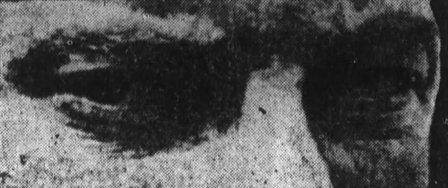
eyeszimmerman

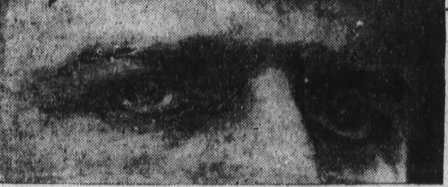
eyesdaubert

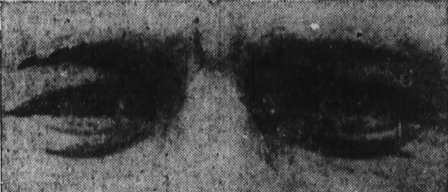
eysspeaker

Above, three sets of eyes, 1916.

Harold “Speed” Johnson of The Chicago Herald said:

“It’s the eye and not the wallop that counts in the national Pastime.  Some eyes are more durable than others.  Larry Lajoie possesses such a pair; so does Hans Wagner, Terry Turner, Tris Speaker, Jake Daubert, Frank Schulte, Larry Doyle, Heine Zimmerman, Tyrus Cobb, Joe Jackson and Bill Hinchman.”

Johnson informed his readers that “Most of these birds refrain from reading during the offseason, thereby sparing their eyes.”

As for the three sets pictured above, Jonson said:

“Heine Zimmerman is another notable example of the batter who possesses the keen optics.  He eccentric third sacker of the Chicago Cubs, when at peace with the world, is one the greatest natural sluggers of all time.  His eyes never have troubled him but his temperament frequently has caused him to slump, swinging frantically at any old pitch.  Right now Heinie is seeing in exceptionally good form as witness his average of .336 for 48 combats.”

[…]

“There is nothing wrong with Jake Daubert’s glims as a slant at the latest averages will indicate…His heavy cannonading has been a principal factor in the upward climb of the Robins…For a pair of eyes that have been in use as long as Jake’s in the big set they’re holding out famously.”

[…]

 “Nine seasons of big league milling haven’ dulled the lamps of Tristram Speaker who right now is going better than he did in his banner years with the Boston Red Sox.  Not only is the big Texan rattling fences  at Dunn Field, Cleveland, where for seven years he averaged .381 on visits with the Bostonese, but he is keeping up his terrific pace abroad.”

Zimmerman’s temperament caught up with him again.  He wore out his welcome in Chicago in August of 1916, was traded to the New York Giants and finished the season with a .286 average.

Daubert’s eyes held out.  He hit .316 and led Brooklyn to the National League pennant.

Speaker kept hitting at Dunn Field and everywhere else, finishing the season with a major league-leading .386 average.

Murphy’s “Billion Dollar Team”

17 Aug

“Money will not buy a pennant winner;” so said William George “Billy” Murphy, the sports editor of The St. Louis Star.  In 1914, he set out to select a team that not even “John D. Rockefeller… (With) all his wealth could buy a club that would win a World’s championship from the one we have picked…The Billion Dollar Team.”

Murphy said:

“You fans of towns that have never won a flag, how would you feel to wake up some morning and find that Dame Fortune had so arranged matters that this club had suddenly been picked to represent your fair city.”

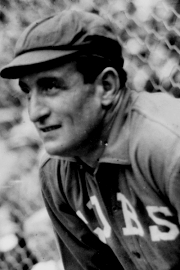
Jimmy Archer, catcher

Behind the plate he acknowledged “There are many who would doubtless pick (John) Chief Meyers…but considering the Indian’s slowness of foot and propensity for clogging up the bases and stealing when the bags are full, we must remark we cannot see the “Chief” for a minute with Jimmy Archer, who, although not so good a hitter, is faster, a quicker thinker, greater fielder and better pegger.”

Jimmy Archer

Jimmy Archer

Murphy was in the minority questioning the baseball intelligence of Meyers, who was widely considered one of the most intelligent and articulate players of his era.  He also rated Ray Schalk and Wally Schang as superior, saying:

“In the writer’s humble opinion they are much more valuable men to their team than Meyers.”

Walter Johnson, pitcher

“There will hardly be a dissenting vote cast against Walter Johnson.  Unquestionably he is the greatest of all the pitchers.

(Charles Chief) Bender and (Christy) Mathewson are also great—great when they should show class—in championship games.  Every nerve, every fiber of their brains, every muscle necessary to their craft, is at its best when big games are being fought.

“Wonderful as they are, we must pick Johnson, who also has class and is game to the core.”

Hal Chase, first base

“For first base, there is only Hal Chase.  He is a great hitter, marvelous fielder, can run the sacks, and is a brilliant tactician.

(John) ‘Stuffy’ McInnis, Jake Daubert, Eddie Konetchy, Fred Merkle, and Jack (Dots) Miller are all stars, but they are ‘also rans’ in the class with Prince Hal of the White Sox.”

Prince Hal of the White Sox

Prince Hal of the White Sox

Eddie Collins, second base

“At second base, Eddie Collins in the potentate.  Johnny Evers, Larry Doyle, and Larry Lajoie occupy seats in the second sackers’ hall of fame, but Collins rules over the roost.”

Honus Wagner, shortstop

“At short, notwithstanding his age, the palm goes to Hans Wagner.  Taken all in all he is still the greatest man at the position in the game.  He can do everything and does it better than any of his contemporaries.  When will we look upon his like again?”

Frank Baker, third base

“At third base, there is that wonderful silent son of swat, Frank Baker, the conqueror of the wonderful Mathewson and Richard (Rube) Marquard.”

Joe Jackson, right field

“In right field we have Joe Jackson, the young Southerner with the Cleveland club.  He is one of the greatest batsmen in the game today and is a fielder and base runner of unusual ability.”

Joe Jackson

Joe Jackson

Ty Cobb, center field

“In center, there is Tyrus Raymond Cobb, the Royston, Georgia marvel, who is the greatest player baseball has ever known.”

Tris Speaker, left field

“And in left field, there is Tris Speaker of the Boston Red Sox—second only to Cobb.”

Grantland Rice’s “All-Time All-Star Round up”

10 Aug

In December of 1917, thirty-eight-year-old sportswriter Grantland Rice of The New York Tribune enlisted in the army–he spent fourteen months in Europe.  Before he left he laid out the case, over two weeks, for an all-time all-star team in the pages of the paper:

“As we expect to be held to a restricted output very shortly, due to the exigencies and demands of the artillery game, this seemed to be a fairly fitting period to unfold the results.”

Grantland Rice

Grantland Rice

Rice said the selections were “not solely from our own limited observation, extending over a period of some eighteen or twenty years,” but included input from players, managers and sportswriters, including  “such veterans” as Frank Bancroft and Clark Griffith, and baseball writers Joe Vila of The New York Sun, Bill Hanna of The New York Herald and Sam Crane, the former major league infielder turned sportswriter of The New York Journal.

Rice said only one of the nine selections “(S)eems to rest in doubt.  The others were almost unanimously backed.”

The selections:

Pitcher:  Christy Mathewson

A. G. Spalding, John (Montgomery) Ward, Larry Corcoran, Charley Radbourn, John Clarkson, (Thomas) Toad Ramsey, Tim Keefe, Bill Hoffer, Amos Rusie, (Mordecai) Miner Brown, Addie Joss, Ed Walsh–the array is almost endless.

“In the matter of physical stamina, Cy Young has outclassed the field.  Cy won more games than almost any others ever pitched.

“(But) For all the pitching mixtures and ingredients, stamina, steadiness, brilliancy, brains, control, speed, curves, coolness, courage, is generally agreed that no man has ever yet surpassed Christy Mathewson…there has never been another who had more brains or as fine control.”


[…]

“It might be argued that Radbourn or (Walter) Johnson or (Grover Cleveland) Alexander was a greater pitcher than Mathewson.

But we’ll string with Matty against the field.”

Radbourn was the second choice.  Bancroft said:

“Radbourn was more like Mathewson than any pitcher I ever saw.  I mean by that, that like Matty, he depended largely upon brains and courage and control, like Matty he had fine speed and the rest of it.  Radbourn was a great pitcher, the best of the old school beyond any doubt.”

Catcher:  William “Buck” Ewing

“Here we come to a long array—Frank (Silver) Flint, Charley Bennett, (Charles “Chief”) Zimmer, (James “Deacon”) McGuire, (Wilbert) Robinson, (Marty) Bergen(Johnny) Kling, (Roger) Bresnahan and various others.

“But the bulk of the votes went to Buck Ewing.”

Buck Ewing

Buck Ewing

[…]

“Wherein did Ewing excel?

“He was a great mechanical catcher.  He had a wonderful arm and no man was surer of the bat…he had a keen brain, uncanny judgment, and those who worked with him say that he had no rival at diagnosing the  weakness of opposing batsman, or at handling his pitchers with rare skill.”

Kling was the second choice:

“Kling was fairly close…a fine thrower, hard hitter, and brilliant strategist…But as brilliant as Kling was over a span of years, we found no one who placed him over the immortal Buck.”

1B Fred Tenney

First Base was the one position with “the greatest difference of opinion,” among Rice and the others:

“From Charlie Comiskey to George Sisler is a long gap—and in that gap it seems that no one man has ever risen to undisputed heights… There are logical arguments to be offered that Hal Chase or Frank Chance should displace Fred Tenney at first.

But in the way of batting and fielding records Tenney wins….Of the present array, George Sisler is the one who has the best chance of replacing Tenney.”

2B Eddie Collins

 “There was no great argument about second base.

“The vote was almost unanimous.

“From the days of Ross Barnes, a great hitter and a good second baseman on through 1917, the game has known many stars.  But for all-around ability the game has known but one Eddie Collins.”

Rice said the competition was between Collins, Napoleon Lajoie and Johnny Evers:

“Of these Lajoie was the greatest hitter and most graceful workman.

“Of these Evers was the greatest fighter and the more eternally mentally alert.

“But for batting and base running, fielding skill, speed and the entire combination, Collins was voted on top.”

 SS Honus Wagner

“Here, with possibly one exception, is the easiest pick of the lot.  The game has been replete with star shortstops with George Wright in 1875 to (Walter “Rabbit”) Maranville, (George “Buck”) Weaver…There were (Jack) Glasscock and (John Montgomery) Ward, (Hardy) Richards0n, (Hugh) Jennings, (Herman)Long, (Joe) Tinker and (Jack) Barry.

“But there has been only one Hans Wagner.”

Honus Wagner

Honus Wagner

Jennings and Long were rated second and third,  “But, with the entire list  considered there is no question but that Wagner stands at the top.”

3B Jimmy Collins

Rice said:

“From the days of (Ned) Williamson(Jerry) Denny, and (Ezra) Sutton, over thirty years ago, great third basemen have only appeared at widely separated intervals.

“There have been fewer great third basemen in baseball than at any other position, for there have been periods when five or six years would pass without an undoubted star.”

The final decision came down to “John McGraw vs. Jimmy Collins.”  McGraw was “a great hitter, a fine bunter and a star base runner,” while “Collins was a marvel and a marvel over a long stretch…he was good enough to carve out a .330 or a .340 clip (and) when it came to infield play at third he certainly had no superior…So taking his combined fielding and batting ability against that of McGraw and Collins wins the place.  McGraw was a trifle his superior on the attack. But as a fielder there was no great comparison, Collins leading by a number of strides.”


OF Ty Cobb

“The supply here is overwhelming…Yet the remarkable part is that when we offered our selection to a jury of old players, managers and veteran scribes there was hardly a dissenting vote.”

[…]

“Number one answers itself.  A man who can lead the league nine years in succession at bat.

“A man who can lead his league at bat in ten out of eleven seasons.

“A man who can run up the record for base hits and runs scored in a year—also runs driven in.

“Well, the name Ty Cobb answers the rest of it.”

OF Tris Speaker

 “The man who gives Cobb the hardest battle is Tris Speaker.  Veteran observers like Clark Griffith all say that Speaker is the greatest defensive outfielder baseball has ever exploited…Speaker can cover more ground before a ball is pitched than any man.  And if he guesses incorrectly, which he seldom does, he can go a mile to retrieve his error in judgment…And to this impressive defensive strength must be added the fact he is a powerful hitter, not only a normal .350 man, but one who can tear the hide off the ball for extra bases.”

Tris Speaker "hardest hit"

Tris Speaker 

OF “Wee Willie” Keeler

Mike Kelly and Joe KelleyJimmy Sheckard and Fred Clarke—the slugging (Ed) Delehanty—the rare Bill LangeBilly Hamilton.

“The remaining list is a great one, but how can Wee Willie Keeler be put aside?

“Ask Joe Kelley, or John McGraw, or others who played with Keeler and who remember his work.

“Keeler was one of the most scientific batsmen that ever chopped a timely single over third or first…And Keeler was also a great defensive outfielder, a fine ground coverer—a great thrower—a star in every department of play.

“Mike Kelly was a marvel, more of an all-around sensation, but those who watched the work of both figure Keeler on top.”

Rice said of the nine selections:

“The above is the verdict arrived at after discussions with managers, players and writers who have seen a big section of the long parade, and who are therefore able to compare the stars of today with the best men of forgotten years.

“Out of the thousands of fine players who have made up the roll call of the game since 1870 it would seem impossible to pick nine men and award them the olive wreath.  In several instances the margin among three or four is slight.

“But as far a s deductions, observations, records and opinions go, the cast named isn’t very far away from an all-time all-star round up, picked for ability, stamina, brains, aggressiveness and team value.

“If it doesn’t stick, just what name from above could you drop?”

“I mentioned Satchel and Josh and Cool Papa, I told Him he was Missing the boat”

18 May

After Heywood Broun’s remarks at the 1933 Baseball Writers Association dinner about integrating the game, The Pittsburgh Courier initiated a campaign to push the issue.  Despite some support inside baseball and from well-known newspapermen, the effort fell flat by opening day.

That summer, after the first East-West Game—won by the West All-Stars 11 to 7—at Comiskey Park, Henry L. Farrell of The Chicago Daily News suggested several “(M)ajor league club owners who are now on their knees might have their prayers answered,” by signing some the Negro League stars.

In the fall, The Chicago Defender briefly picked up the mantle from The Courier.  The paper asked their readers:

“How would you like to see the great baseball players of the Race performing in the major leagues? Wouldn’t you like to see Willie Foster, Satchel Paige and (Sam) Streeter pitch to Babe Ruth?”

If so:

“Sit down and write K.M. Landis commissioner of baseball, 333 N. Michigan Ave., Chicago.”

The following week, the paper reported that Landis’ office had refused to comment.  When baseball’s winter meetings commenced in Chicago in December, The Defender promised readers that the letters they had sent:

“(A)re not being passed on lightly as many suggested would be the case.  On the contrary, the club owners are downright concerned and from the inside word leaked out that some action would be taken.”

The optimism was tempered later that week when their reporter was barred from covering a meeting where he was told “vital points were discussed.”  The Defender reporter was told no newspapermen would be admitted, but:

“That sinister moves were being made against your author’s admission became a certainty when a well-known writer from one of the downtown papers came along, gave the high sign and was admitted.”

When 1933 came to a close, integration was no closer to being a reality than it was 11 months earlier as Broun stood to deliver his remarks to the baseball writers.

Four years later, Sam Lacy from The Baltimore Afro-American met with Washington Senators owner Clark Griffith in an attempt to revive the subject:

“I mentioned Satchel and Josh and Cool Papa, I told him he was missing the boat.”

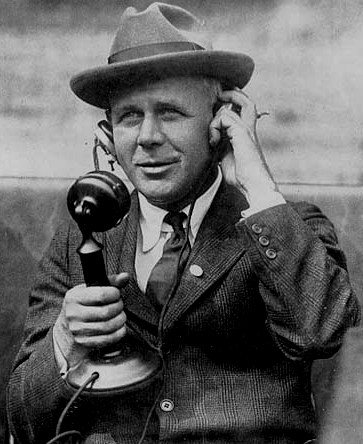
Sam Lacy

Sam Lacy

Griffith, he said, told him the timing was wrong, and that Southern-born players would not accept integration.

The next major effort came in 1939.

Political support had generally been limited to socialist and communist organizations—the Young Communist League spent the summer of ’39 gathering signatures to present to Commissioner Landis.  But, in July of that year, the Illinois House of Representatives adopted a resolution which read in part:

“Resolved, by the House of Representatives of the Sixty-first General Assembly.  That the owners of all professional baseball teams in the United States, both in the major and minor leagues be strongly urged to give baseball players of the colored race the same opportunity of becoming players on their respective teams as is accorded to such players of the white race.”

Another push came from Pittsburgh as well.

Wendell Smith, who was playing baseball at West Virginia State College when Broun made his speech in 1933, was now a reporter for The Courier. In July, he promised readers:

“The most exclusive, startling and revealing expose, of the attitude of the major league players and managers themselves, ever written.”

Wendell Smith

Wendell Smith

Over the course of several weeks Smith asked 40 players and eight managers as they passed through Pittsburgh, “Are Negro ballplayers good enough to ‘crash’ the majors?”

The Courier’s Chester Washington said in a column to introduce the series of articles:

“One of the major reasons why Mr. Smith’s discovery is so revolutionary is that the club owners, in trying to pass the buck, have blamed the ban on the players themselves.  They claimed that the injection of colored stars into the clubs would bring about friction and dissention… (Smith) practically disproves this contention.

“Fearlessly buttonholing the managers and outstanding players of all the National League clubs, Mr. Smith received scores of testimonials which should be a revelation to the owners.”

A sampling of the statements collected by Smith:

Ernie Lombardi, Cincinnati Reds:  “(Satchel) Paige is as good as (Dizzy) Dean.”

Johnny Vander Meer, Cincinnati Reds:  “I wouldn’t object.”

James “Doc” Prothro, Philadelphia Phillies: “If given permission I would jump at the opportunity to sign up a good Negro ballplayer.”

Leo Durocher, Brooklyn Dodgers:  “(Satchel) Paige, (Bill “Cy”) Perkins, (Mule) Suttles and (Josh) Gibson are good enough to be in the majors right now…I certainly would use a Negro ballplayer if the bosses said it was all right.”

Gabby Hartnett, Chicago Cubs:  “I am sure that if we were given permission to use them, there would be a mad scramble between managers to sign them.”

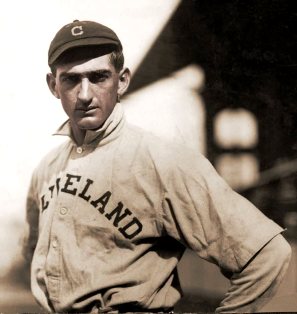
Gabby Hartnett

Gabby Hartnett

Dizzy Dean, Chicago Cubs: “If some of the colored players I’ve played against were given a chance to play in the majors they’d be stars as soon as they joined up.”

Pepper Martin, St. Louis Cardinals: “Some of the big league players would object, but on the whole I think they would be accepted.”

Pie Traynor, Pittsburgh Pirates: “believe me when I say I have seen countless numbers of Negro ball players who could have made the grade in the majors.  Only their color kept them out.  If given permission, I would certainly use a Negro player who had the ability.”

Honus Wagner, Pittsburgh Pirates:  “Yes, down through the years I have seen any number of Negro players who should have been in big league baseball.”

Over the next five years, Smith would interview more than 150 additional major leaguers, who would echo the sentiments of his original 40, keeping the pressure on professional baseball to desegregate.

“The Game is Stricter and Better now”

8 May

Honus Wagner was an exception.  Unlike most of his contemporaries, he didn’t spend his later years complaining that the game was just not the same and that current players would not be able to compete with the stars of his era.

Financially strapped as a result of the Depression, Wagner was offered a job by the Pittsburgh Pirates to join Manager George Gibson’s staff.   While in California with the team for spring training he spoke to Russell Newland of The Associated Press.   Wagner said:

“We’ve got more good players than we ever had.  That’s because there are more strong leagues.  The game is stricter and better now.  You can’t bully the umpire any more.  The boys used to be a rough and ready lot.  Now the umpire is a real authority and it’s all for the best.”

Wagner

Pirates Coach Honus Wagner

Wagner also felt that pitchers had to work harder than they did when he played:

“Our pitchers had the advantage of a dead ball and used the spitter, the shine ball and the emery ball.  They worked the old bean ball overtime.  All that’s out now.  Nowadays a pitcher has to throw a lot more balls.  He has to work the corners because that lively ball sure sails when the boys get one in the groove.  Actually he pitches a couple of games in nine innings, compared to the chuckers of my day.”

Wagner had no complaints about the comparatively large money stars like Babe Ruth were paid either:

“That $50,000 they’re offering the Babe reads like a lot of money to me, but if he can get them to raise it, I say ‘more power to him.’”

Wagner was also optimistic about baseball’s future:

“’Baseball is O.K.,’ he said as he crossed the most famous pair of bow legs in the history of the pastimes.  ‘They’ll be playing it a long time from now.”

Humpy Badel

27 Apr

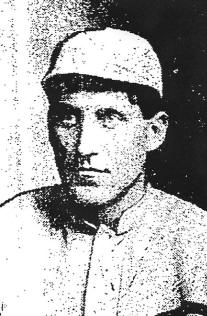
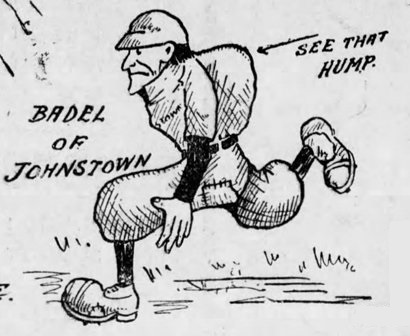
Fred Badel was the first player in professional baseball (and most likely the only one) who suffered from Kyphosis, the over-curvature of the upper back.  In less sensitive times, the first decade of the 20th Century, this led to his nickname: Humpy.

Badel was born in Carnegie, Pennsylvania, March 6, 1881, although contemporary newspaper accounts implied he was much older.  He never learned to read or write, and despite his medical condition developed into a solid ballplayer.

The Altoona Tribune said:

“He is a little left-handed hitter, fast on his feet, and an excellent baserunner.”

The Tribune also said he was “(A) protegé of (Honus) Wagner.”

The Pittsburgh Press said he was:

“[E]xtremely fast on his feet, can hit like a fiend, and fields his position in a most finished manner.”

That description of Badel’s abilities appeared in an article about “The assertion…there are three classes of men who do not succeed in fast company in baseball, namely Hebrews, hunchbacks and Negroes,” the article failed to mention the concerted effort of organized baseball to keep at least two of those “classes” out of the game.)

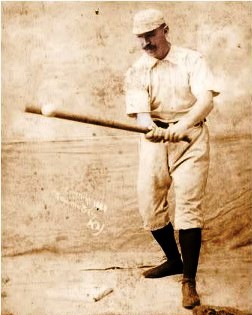
Fred “Humpy” Badel

His professional career began in 1905 with Johnstown in the independent “outlaw” Tri-State League, although earlier he appears to have played for the Youngstown team in the Ohio-Pennsylvania League, and independent teams in Pennsylvania.

No statistics survive, but Badel appears to have played well.  He was described variously by Pennsylvania papers as a “picturesque character” and “odd,” but there seemed to be general agreement that he was destined for the big leagues.  He also had a reputation for playing dirty, The Williamsport Sun-Gazette said he had “a nasty trick of trying to spike basemen.”

At the close of the 1905 season, Badel was signed by the Buffalo Bisons in the Eastern League, managed by George Stallings.  Stallings, who had managed the Bisons since 1902, took the team south for spring training for the first time.

George Stallings

The trip was so successful that Stallings said he’d never again hold spring training in a northern climate—a regular practice at that time.

When the Bisons stopped in Cincinnati for an exhibition game with the Reds on April 10, Badel made an impression.

The Cincinnati Enquirer said:

“Humpy Badel was the bright particular star of the game…Badel is humpback, but a great athlete, with great speed and a fine arm.  An outfielder who cuts into two double plays in one game is going some.  He also made a fine catch on (Jim) Delahanty‘s drive in the second, which would have gone on for three bags…Badel was the main Bison slugger, securing two of the four hits off (Orville) Overall and one of the three off (Leo) Hafford.  Toward the end of the game, the bleacherites were cheering him on with cries of ‘good work, Humpy,’ and applauding every move he made.”

The Enquirer reported that Stallings turned down a  $4000 offer from Cincinnati–it was later reported to be $5000– to purchase Badel’s contract; the paper said Reds Manager Ned Hanlon badly wanted Badel.

Within months everything changed.  He was with Buffalo until July, 6, when without notice he jumped the team and returned to Johnstown.

badel

A cartoon from The Harrisburg Telegraph featuring Badel.


The Buffalo Courier blasted Badel; under the headline “Humpy Badel is a Foolish Man” the newspaper detailed how well he had been treated in Buffalo.  While acknowledging that Badel “Has the makings of a great player in him,” the paper repeatedly mentioned his illiteracy, claimed he “Lacked common sense,” missed or ignored signs, refused Stallings’ attempts to help him,  and was the subject of ridicule from his teammates who considered him ignorant.

The Buffalo Times summed up their view in verse:

“There was an outfielder named Humpy.

Whose work was decidedly lumpy;

So one bright summer day

He asked George for his pay,

And went back to the farm rather grumpy.”

Badel’s hometown papers in Pittsburgh and Sporting Life were somewhat less harsh, but all said that Badel’s leaving Buffalo probably ended a sure chance at a major league career.  Rumors that he jumped because oil had been found on his Pennsylvania land and he no longer needed to play ball were quickly dismissed.

There is no record of Badel ever having been asked for an explanation for why he left Buffalo and effectively ended any chance he had to play in the major leagues.

Badel hit over .300 in Johnstown during the second half of 1906.  He did not play professional ball in 1907, some reports said he had been blacklisted, others claimed he was ill–The Washington Herald said he was “in the grip of consumption,” although that report was likely false.

He appeared briefly with Johnstown again in 1908, but it appears he was not the same player.  The Harrisburg Star-Independent said:

“‘Humpy’ Badel has degenerated.  The eccentric one is no longer the valuable player which he showed himself to be in 1906.”

Badel is listed on the rosters of several independent, C and D league teams between 1910 and 1914, including the “outlaw” United States League in 1912 and the Federal League in 1913.  As was the case throughout his career, there are few extant statistics for Badel during this period.

The last mention of Badel in the press was the report of  his release from Maysville in the Ohio State League in June of 1914.  According to census records and his World War I registration card, he lived in Cincinnati, then Akron and worked as a carpenter until 1919.

 After 1919, there are no records of Badel, a suitable, enigmatic end to the story of an enigmatic man.

A shorter version of this post was published on August 21, 2012

Nick Maddox

9 Feb

Nicholas “Nick” Maddox burst on the National League scene in 1907. Born in Maryland on November 9, 1886, Maddox’ was born Nicholas Duffy, but adopted his stepfather’s name Maddox.

In 1906 the 19-year-old was given a trial in the spring with the providence Grays in the Eastern league.  He was released before the season began and signed with the Cumberland Rooters in the Pennsylvania-Ohio-Maryland League (POM).  Maddox had played in 1905 for the Piedmont team in the semi-pro Cumberland and Georges Creek League.

He was the best pitcher in the POM; The Sporting Life said Maddox was 22-3 for the Rooters who finished the season in fourth place with a 50-45 record, and was “the fastest pitcher in the league.”
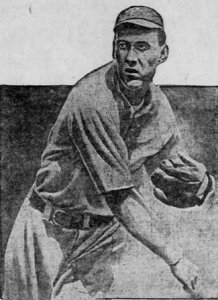
Nick Maddox

Nick Maddox

Maddox spent most of 1907 with the Wheeling Stogies of the Central League.  He posted a 13-10 record and no-hit the Terre Haute Hottentots on August 22.  Maddox was purchased by the Pirates the following month and made his big league debut on against the St. Louis Cardinals.

The Cumberland Times noted that he faced a “double-jointed hoodoo of commencing his National League career on Friday, September the 13th.”

The Pittsburgh Press said:

“Nick was ‘on the job’ yesterday from start to finish, and acted more like a man with many years’ major league experience than like a minor leaguer who has been in the business but a few seasons.”

Maddox shut the Cardinals out on just five hits, struck out 11 and got his first hit, a single in his first at bat.

Eight days later Maddox threw the first no-hitter in Pirates’ history, beating the Brooklyn Superbas 2 to 1—Brooklyn scored on two fourth-inning errors.   Years later, Maddox said of his own throwing error that put Emil Batch on base:

 “They scored me with an error, but hell man, I threw it straight to the first baseman (Harry) Swacina.  Sure it went over his head but he should have jumped for it.”

Batch scored on an error by shortstop Honus Wagner.  Maddox said:

“I don’t hold that against Honus, he saved my no-hitter in the ninth.  A ball was hit right over my head and ‘pfft’ Wagner was over there to get it.  I don’t think he ever held the ball, he just swooped it over to first.”

The rookie started six games Pittsburgh, won his first four, and finished with a 5-1 record with a 0.83 ERA.

The Pittsburgh Leader said Pirates’ President Barney Dreyfuss claimed Maddox would be “the sensation” of 1908.  He wasn’t far off.

The 21-year-old was an impressive 23-8 with a 2.28 ERA with five shutouts.  Despite his success there was concern about control—he walked 90 batters while striking out just 70 in 260 innings, and hit 11 batters.

After three second and one third-place finish the four previous seasons, Pittsburgh, and Maddox, came into 1909 with high expectations.  The Pittsburgh Press said:

“Nick Maddox is facing a very successful summer, and with an even break and barring accidents he ought to push any other twirler in the National League for first honors.  He has everything a pitcher needs, and youth with it.”

The Press also said he would “start out with good control” based on his performance in March games in Hot Springs, Arkansas.

The Pirates lived up to expectations, taking over first place on May 5 and cruising to the pennant; Maddox did not.

The 22-year-old struggled for the first half of the season.  The Leader said he was having “a hard time getting into condition,” and was wild as a March Hare.”  Maddox got on track in July pitching a 2-hit shout against the Cincinnati Reds on the 6th, and four-hit shutouts against the Brooklyn Superbas and Boston Doves on the 14th and 23rd.

He ended the season 13-8 with a 2.21 ERA—overshadowed by teammates Howie Camnitz (25-6), Vic Willis (22-11), Albert “Lefty” Leifield (19-8) and rookie Charles “Babe” Adams (13-3 as a reliever and spot starter).
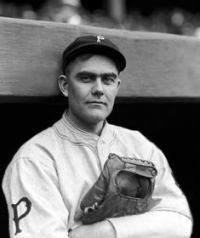
Babe Adams

Babe Adams

Despite going into the World Series against the Detroit Tigers with such a strong pitching staff, Manager Fred Clarke opted for the rookie Adams in game one and he responded with a 4 to 1 victory.

The Tigers beat Camnitz 7 to 2 in game 2.

Three years later, Fred Clarke spoke to James Jerpe of The Pittsburgh Gazette-Times about his decision on a pitcher for game three:

“I was in an awful predicament.  Adams had been used up.  It was had been raining, and it was very cold.  The chilly drizzle was something frightful.  The ball would get wet and water-logged and the problem was to get a pitcher who could handle the wet ball.  I looked the gang over.  Adams was out of the question.  He had been used up.

“I was figuring on the others, and I asked ‘Who can go out there today and handle a wet ball and win?’  Poor Maddox, sitting in a corner of the bench all bundled up with sweaters and other stuff, shed his extra clothes and jumped up.  Grabbing a ball, he said: ‘Gimme a catcher till I warm up.  I’ll handle this wet ball and beat them or break a leg.’  His confidence gave me a hunch, and I acted on it.”

Ring Lardner said of the game:

“Detroit’s record crowd, 18,277, saw the Tigers beaten by the Pirates 8 to 6, today in one of the most exciting and most poorly played world’s series games in baseball history.”

The Pirates scored five runs in the first inning off Detroit’s Ed Summers, and Maddox shut the Tigers down for the first six innings.  Detroit scored four runs in the seventh, aided by two Pirate errors.  Clarke said:

“Maddox wouldn’t have been in so much trouble if we had played ball behind him.”

The Pirates took a 8 to 4 lead into the ninth–Detroit scored two more runs, helped by another error—but Maddox held on and picked up the win.

He did not appear in another game during the series.  The Pirates won in seven; with Adams picking up complete game wins in games five and seven.
09pirates

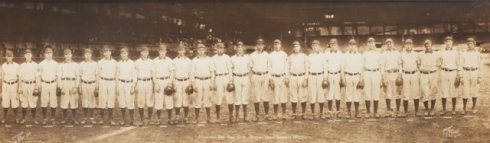
1909 World Series Champion Pirates, Maddox is ninth from left.


The defending champions got off to a quick start again, but Maddox again started slow.  By July, The Leader said:

“Nick Maddox should have rounded into form..He is big and strong this year, but does not seem able to pitch good ball for nine rounds.”

He never “rounded into form.”  Maddox struggled all season.  He started just seven games, pitched in relief in 13 others, and was 2-3 with 3.40 ERA.

By August, with the Pirates in second place, six games behind the Chicago Cubs, The Pittsburgh Gazette asked “what was the matter?” with Maddox and why the Pirates had not cut him loose.

He made his last appearance on September 12, giving up a run, a hit and walking two batters in two innings of relief during a 4-0 loss to the Reds.  He was sold to the Kansas City Blues in the American Association 10 days later.

Maddox won 22 games for the Blues the following season, but continued to be plagued by wildness and arm trouble.  His major league career was over, and he was finished professionally in July of 1914 at 27-years-old when he was released as manager and pitcher for the Wichita club in the Western League after posting a 3-13 record.

Fred Clarke was convinced Maddox’ career really came to an end on that rainy day in Detroit.  James Jerpe of The Pittsburgh Gazette-Times said that in 1910 Dreyfuss asked Clarke to release Maddox long before he sold the pitcher to Kansas City:

“’Why don’t you let Maddox go? You aren’t pitching him.’

“’No,’ replied the Pirate Chief sadly.  “I’m not pitching him.  He ruined his arm helping Adams win the world’s series.’

“And Fred narrated (to Dreyfuss) more of Nick’s gameness on that bleak and drizzly October day in Detroit when he gave his arm for a championship.  Nick was carried for a whole year and the club has been interested in his welfare ever since.”
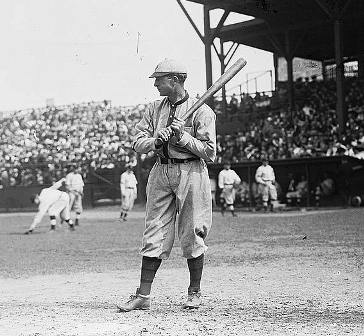
Fred Clarke

Fred Clarke

Maddox, who lived in Pittsburgh, and worked for the Fort Pitt Brewing Company, after his retirement, lived long enough to listen on the radio to the last two innings of the next no-hitter thrown by a Pirate pitcher—Cliff Chambers defeated the Boston Braves 3-0 on May 6, 1951.

Nick Maddox died in 1954 at age 68.

“If we had a Veritable Ty Cobb among us, and no one Cared to See him, what would it Matter?”

7 Jan

At the beginning of the 1914 baseball season, Andrew Bishop “Rube” Foster believed baseball’s color line was on the verge of being broken.

Rube Foster

Rube Foster

He talked about it with The Seattle Post-Intelligencer while touring the West Coast with the Chicago American Giants:

“Before another baseball season rolls around colored ball players, a score of whom are equal in ability to the brightest stars in the big league teams, will be holding down jobs in organized baseball…They’re taking in Cubans now, you notice and they’ll let us in soon.”

Billy Lewis, a writer for The Indianapolis Freeman did not share Foster’s optimism:

“It goes without saying it emphatically, that Foster’s opinion sounds mighty good to the ‘poor down-trodden’ colored players who have to do so much ‘tall’ figuring in order to make ends meet.  But the plain fact of the matter is that Rube has drawn on his imagination for the better part of his opinion.  For as much as I hope and as colored players and people hope for better days for the colored players there’s nothing to warrant what he had to say. Foster is having the time of his life, riding about in special cars out west, and naturally enough with the distinguished consideration paid him and his bunch of players, he feels to give out something worthwhile.

“Rube Foster nor the rest of us should expect to see any change in the baseball situation until there’s a general change…fact is, that our people are not breaking into the big leagues, and there’s no talk of them breaking into the big leagues, and there is not the slightest indication that they are needed.  This sounds rather severe, yet it is the truth, and that’s what we need even if we should not want it.  It may not make us free as it is so often insisted on.”

[…]

“As severe as the foregoing appears it has nothing to do with the playing ability of colored baseball men.  Expert sport writers long ago conceded that there were colored baseball players who played the game equal to the ‘high browed’ white players who drew their $3,000 plus per annum. It’s an old story why these competent men are not registered in the great leagues.  Really there is less opportunity for Negroes to play with the big leagues in the last few years than formerly. “

Lewis said Foster was wrong to claim that the acceptance of light-skinned Cuban players was positive sign:

“It is generally known that the Negroes stand last in the list of acceptability, hence it is rather poor diplomacy to speak of the preference shown for the Cubans.  It is right, all right.  Nevertheless, Cubans, Indians, Filipinos and Japanese have the right-of-way so to speak.  Of course they are not wholly persona grata, but they are not in the class with the colored players, who are absolutely without friends at court.”

Additionally, Lewis said fans were not ready for integration:

“If the management were inclined to take on the good ones among the colored players, they could not do so with impunity.  The box office is more often the dictator of terms than we think.  If we had a veritable Ty Cobb among us, and no one cared to see him, what would it matter?

“Foster is positive that he has the greatest player in the world in (John Henry) Lloyd.”

Foster had said of the shortstop:

“If you don’t believe it, wait until he gets into the big league—then watch the (Jack) Barrys, the (Honus) Wagners and the (Joe) Tinkers sweat to keep their jobs.”

Lewis said:

“It’s a fine boost for Lloyd, coming as it does from the famous Rube himself, yet we all know that if Lloyd was twice himself he would be no good unless it were the general sentiment that a man was a man.”

John Henry lloyd

John Henry Lloyd

Lewis felt Foster was deluded by the large percentage of white fans who watched him play when the American Giants barnstormed on the West Coast:

“The far west at this time seems ideal in the matter of patronizing games where colored and white teams are engaged.  But in spite of this there is no disposition in that seemingly fair country, to put colored men on the greater teams.  So it is not less than an iridescent dream.”

Lewis told his readers he did not disagree with what Foster desired, but said the great pitcher was basing his optimism on the of the wrong people:

“Much of the foregoing doubtless appears as an argument against mixed clubs.  It is not that way.  The object is to show up the true situation, the further object being to make the most of it. We will not be able to make the most of it as long as we fail to have the proper conception of things.  There are white managers who would gladly take on Negro players if it meant something by way of advancing their clubs.  But as said before it is the box office that dictates…the man on the bleachers and the man in the grand stand are together, and the manager must come by them…What have these to say about colored players entering the big league?  That’s the question.”

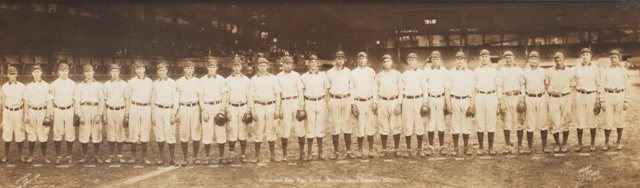
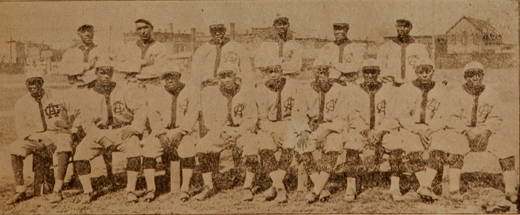
1915amgiants

The 1915 Chicago American Giants–Rube Foster is standing third from left, John Henry Lloyd is standing fifth from left. A year after Foster’s prediction, white baseball wasn’t calling.