Tag Archives: John McGraw

Jennings “Hurled an Unmentionable Epithet at him”

2 Feb

In April of 1896, the reigning National League Champion Baltimore Orioles traveled to Petersburg, Virginia for a pair of exhibition games with the Petersburg Farmers of the Virginia League.

The Baltimore Sun noted that it had been a tough spring for the Orioles.  Third baseman John McGraw “the brainiest and pluckiest little infielder that ever trod a diamond,” was in an Atlanta hospital suffering from typhoid fever; he would miss most of the season.

Additionally, catcher William “Boileryard” Clarke was sent back to Baltimore with a sprained ankle, pitchers John “Sadie” McMahon and Arlie Pond had injured hands and both would be out for at least a week,  and shortstop Hughie Jennings was also slowed by a hand injury.

Hughie Jennings

Hughie Jennings

A light rain fell as the hobbled team arrived in Petersburg on the morning of April 6, the day of the first game—which ended in a 7 to 7 tie.  The Baltimore American said:

“Why the team did not trounce the Petersburgs is an open question, but whether it was because of the game on Saturday (in Richmond) or the rain, or the umpire, the Champions walked out of the gates with the humiliation of having made eight errors and feeling the added sting of having just escaped being beaten by a minor league team.”

Third-string catcher Frank Bowerman made two of Baltimore’s errors and had a passed ball.  He would be relegated to umpiring duties in the second game, scheduled for April 8.  On the seventh the Orioles defeated another Virginia League team, the Richmond Bluebirds, 4 to 3.

The American said the morning of April 8 “had been a pleasant one,” with local officials taking the Orioles for a tour of the Petersburg Civil War battlefield.  And, with the rain gone, “The warm sun put life into each club, and a pretty, snappy game was being put up by each side.”  Bowerman and Petersburg player Michael “Doc” Powers alternated as umpires for the game.

Doc Powers

Doc Powers

Petersburg was leading 1 to 0 in the seventh inning when Powers called Orioles third baseman Jim Donnelly out on strikes.  What happened next, and who was responsible, depended on whether you read the accounts in the Baltimore papers or those in Petersburg and the surrounding Virginia towns.

The Sun said:

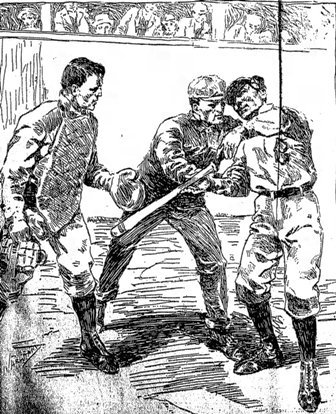
“Several promising runs had been cut off by similar umpiring and the birds were getting very ‘sore’ at such outrages.  Donnelly objected and (Hugh) Jennings went up to Powers, who was standing behind the pitcher, and said something to him.  Just then (Charles) Sholta, who had also run up, struck Jennings a stinging blow on the side of the head without warning.  The blow drew blood.”

The American said:

“While Hughey was expostulating rather forcibly with Powers, Sholta struck him on the cheek.”

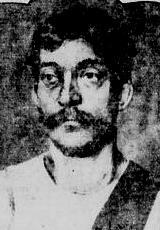
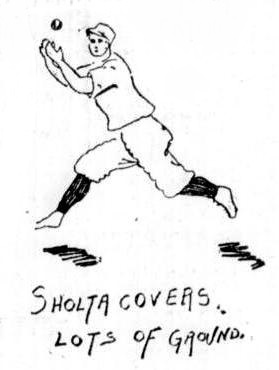
Charles Sholta--drawing from Richmond newspaper

Charles Sholta–drawing from Richmond newspaper
The Baltimore papers agreed that the punch Sholta threw was unprovoked.  Every Virginia newspaper disagreed.

The Petersburg Index-Appeal said, “Jennings resented Sholta’s interference by very foul and abusive language and was promptly struck in the face.”

Papers in Richmond, Roanoke and Norfolk agreed that Jennings provoked Sholta—The Virginia League correspondent for The Sporting Life said Jennings “hurled an unmentionable epithet at him—an epithet which does not go here.”

Everyone generally agreed with what happened next.  Orioles’ first baseman Jack Doyle punched Sholta, knocking him to the ground and Petersburg fans poured on the field and began attacking Doyle and other members of the Baltimore club.

At this point, there was more disagreement.  The Baltimore papers said Doyle was struck in the head from behind, knocked down and kicked by multiple fans.  While “Wee Willie” Keeler was allegedly “choked and beaten,” five other Orioles, Joe Kelley, Wilbert Robinson, Steve Brodie, Bowerman, and Jennings “were more or less beaten.”

The Orioles, according to The American were forced to flee the ballpark.

The Richmond Dispatch called the Baltimore accounts of the incident:

 “(S)o greatly exaggerated and so grotesquely inaccurate as to cause amazement, not to say indignation, here.  Not a man of the Baltimore team was hurt, and the grossly obscene language uttered by one of the Orioles on the park during the game, caused all of the trouble.”

After the Orioles returned to Petersburg’s Appomattox Hotel, another fight broke out between several members of the Orioles—including Brodie and Kelley—and local fans, one of whom was thrown through a glass door.   After the second fight, the Orioles were accompanied by police to the train depot and departed for Norfolk.

Arrest warrants were issued for Doyle, Kelley, and Brodie, but the three “left their team in Norfolk and (went) beyond the jurisdiction of the state courts.”  Only ten Orioles were available for the final exhibition game in Virginia, a 7 to 5 victory over the Norfolk Braves.
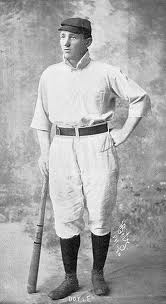
Jack Doyle

Jack Doyle

Sholta appeared in Petersburg’s “Mayor’s Court” along with two fans who said to have assaulted members of the Orioles.  All were released with no charges filed as a result of Doyle, Brodie and Kelley failing to appear—they were sought both as suspects and witnesses against the local defendants.

At the hearing, Petersburg’s Mayor Charles Fenton Collier said Sholta “had only acted as any other gentleman would have,” by hitting Jennings, and the mayor said he would have done the same “under similar circumstances.”

The Washington Times said the only thing unusual about the Orioles’ battle in Virginia was that it happened so early in the season:

“The Orioles are starting their rowdy tactics early.  Perhaps the champs think it just as necessary to train for ruffianly conduct as other points.  And to think that ‘college-bred’ Hughey Jennings started the riot.”

McGraw remained out of the lineup for most of the season—he did not return until August 25.  The fighting Orioles hit .328 as team—Jennings hit .401, Keeler .386 and Kelley .364—and went 90-39 cruising to their third straight National League Pennant.
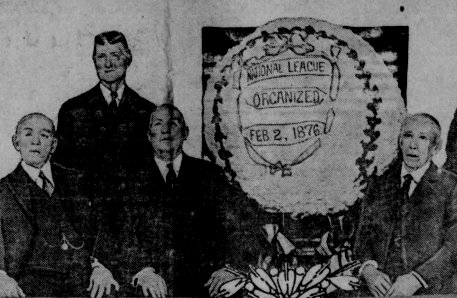
“Boys of ’76”

5 Jan

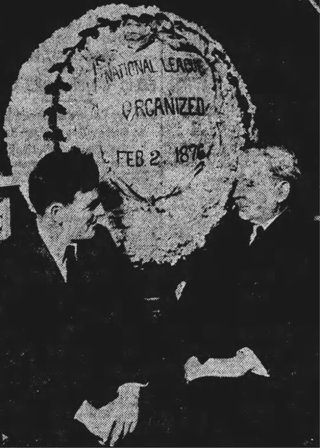
On February, 2, 1925, The National League magnates “paused in (their) schedule deliberations” to honor the league’s past, and kick-off the diamond Jubilee celebration.

Thomas Stevens Rice, of The Brooklyn Eagle said:

“In the very same rooms in which it was organized on Feb. 2, 1876, the National League of Professional Baseball Clubs met again yesterday.  These rooms are in what is now called the Broadway Central Hotel, then called the Grand Central Hotel.”

The Associated Press said:

“In the same room in which Morgan G. Bulkeley, of Hartford, Conn., was elected the first president of the National League, the baseball men, paid tribute to the character and courage of those pioneers a half century ago.”

Dozens of dignitaries were on hand, including, John McGraw, Christy Mathewson, John Montgomery Ward, and Governor John Tener

But, the stars that day were six of the surviving players who appeared during the league’s inaugural season:

George Washington Bradley, 72, who won 45 games for the St. Louis Brown Stockings; John “Jack” Manning, 71, who hit .264 and won 18 games as an outfielder and pitcher for the Boston Red Stockings; Alonzo “Lon” Knight, 71, an outfielder and pitcher for the Philadelphia Athletics in 1876 and hit .250 and won 10 games, and three members of the Hartford Dark Blues, Tommy Bond, 68, a 31-game winner; Tom York, 74, who played leftfield and hit .259, and John “Jack” Burdock, 72, an infielder who hit. 259. Also present was the only surviving umpire from the 1876 season–Calvin J. Stambaugh.

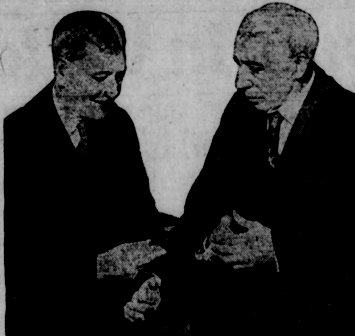
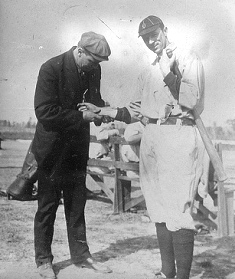
Calvin Stambaugh, right, the last surviving umpire from 1876 and Frank Wilson, a national League umpire from 1923 until his death in 1928.

Calvin Stambaugh, right, the last surviving umpire from 1876 and Frank Wilson, a national League umpire from 1923 until his death in 1928.

Other surviving 1876 players, including George Wright and and Al Reach cited “advancing age” for their inability to attend.

feb21925pix

Seated from left: York, Bradley, and Manning. Standing: Bond.

 Bozeman Bulger of The New York World said, in relating a conversation between too of the attendees, the event was notable for another reason as well:

“(S)everal of us younger men, moving over closer, discovered a contradiction of a tradition long cherished, that old-timers never could admit any improvement in the game or in the quality of the players.

“‘Have you seen this young fellow, Babe Ruth?’ Bradley asked of Manning.

“‘Yes, indeed,’ admitted Mr. Manning, ‘and don’t let anybody tell you that we ever had a man who could hit a ball as hard as that boy.  I doubt if there will ever be another one.'”

Bulger said the “Boys of ’76” also talked about how they “fought crookedness when a salary of $1,800 a year was considered big pay for a star.”  Bradley, who after baseball became a Philadelphia police officer, said:

“‘Oh, we had crooked fellows following us around back in ’76.  They pretended to make heroes out of us and would hang around the hotels.’

“‘One day Mr. (Chicago White Stockings President, William) Hulbert, a very learned man, advised me to keep away from these men.  He explained how they could ruin a boy and lead others into temptation . I was often approached, but thanks to that wise counsel, I kept myself straight, and I thank God for it today.  It’s worth a lot to me to look you younger men in the eye and feel that in turning the game over to you, we gave you something that was honorable.  It’s up to the players to keep it honorable.”

Tom York summed up his feelings about the game in 1876:

“‘Say, do you remember how proud we used to be after winning a game, when we walked home still wearing our uniform and carrying a bat–and the kids following us?  Ball players–all except Babe Ruth–miss that nowadays.”


bondmanning

Bond and Manning talk pitching at the Golden Jubilee kickoff event in 1925.


McGraw’s “Rubber”

2 Jan

In 1903 and ’04 the Boston Beaneaters finished sixth, and seventh, while the New York Giants followed a second place finish in 1903 by winning the pennant in ’04.

Jacob Charles “Jake” Morse of The Boston Herald said he it wasn’t just talent that made the Giants more successful:

“It is astonishing that so little attention is paid to the care of baseball players during the training season and the playing campaign, especially the former.  It is in the spring that arms need the most careful cultivation and a first-class expert is almost indispensable.

“A first-class ‘rubber’ ought to be taken by every club that goes South, and if this were done sore arms and muscles would be reduced to a minimum.

“Here in Boston neither club has what is called a trainer or a ‘rubber.’ The New York National League club has had the services of the well-known ‘rubber’ Gus Guerrero, for several seasons, and he has given satisfaction.”

Before coming to the Giants as the team “Rubber,” Guerrero had made a name for himself as a competitive walker and runner.  The San Francisco Call said of him:

“Back in the late (eighteen) seventies Guerrero was the one best bet when it came to a foot race, whether for one or for 500 miles, six-day match, or even if the proposition called for a jaunt from the Pacific to the Atlantic coast.  Anything went with Guerrero; he ran for 48 hours, making 300 miles flat in that time, and once in 1884 he trundled a wheelbarrow from San Francisco to New York City.”

Gus Guerrero

Gus Guerrero

Guerrero, often billed as “The Mexican,” and “The best athlete Mexico ever produced,” was actually born in Northern California.  He became an athletic trainer in New York in the 1890s and began working for the Giants in 1900.

John McGraw inherited Guerrero when he came to New York in 1902, and swore by his “Rubber.”

The Associated Press said, in 1904 when McGraw, trying to rehabilitate his injured knee, took Guerrero on the spring training trip south:

“Last year (McGraw) depended on local massage men to rub and bandage the bad knee, but they did not understand the job.  Guerrero, a professional, has been spending several hours per day solely on McGraw’s weak muscles and has succeeded in hardening them so that the joint is fairly protected and does not spring at a critical moment.”

The New York Press said of Guerrero:

“(He) wears a baseball shirt labeled ‘New York’ all the time.  McGraw says he believes Gus sleeps in it. As the men come in he looks them over, particularly the pitchers.  If a box man complains of a stiff arm the trainer attends to it as carefully as a physician looks after the throat of an operatic prima donna.  He makes the player strip, steams him, puts him on a slab, massages him, and then rubs in a liniment of his own concoction which he declares would take the stiffness out of a telephone pole.  It is equal parts of witch hazel and alcohol to a quart; with half a teaspoon of oil of wintergreen and a dash of something else that Guerrero says is his secret.”

While McGraw seemed impressed with Guerrero, it appears some of his players were not.

When the team was training in Birmingham, Alabama during the spring of 1904, The New York Globe’s Allen Sangree, who was traveling with the Giants, wrote about an exchange between Guerrero and Christy Mathewson:

“Mathewson, in particular, was feeling grouchy yesterday.  ‘How’s your arm?’ asked Gus Guerrero, the rubber, as he put the finishing touches on him…’Arm alright,’ said Matty, ‘but I don’t feel good.’

“’Well, what’s the matter?’ pursued the rubber.

“’Nothing, didn’t I tell you!’ yelled the big fellow, in exasperated tones.  ‘Just nothing, only I don’t feel good; and don’t bother me either.’”

Just after Jake Morse wrote about the advantage McGraw’s “Rubber” had given the Giants, it was announced that he would no longer be the team’s trainer.

The New York Herald said:

“Gus and the players could not get along well, so he resigned.”

McGraw, who remained “a strong believer in massage treatment for pitcher’s arms before and after the game,” and replaced Guerrero with Harry Tuthill—Tuthill had trained several fighters, including William “Young Corbett II” Rothwell, and “Mysterious” Billy Smith.   Tuthill was with New York until 1908 when he joined the Detroit Tigers.

Harry Tuthill, with Tigers pitcher Del Gainer

Harry Tuthill, with Tigers pitcher Del Gainer

Guerrero never worked for another major league club. He continued to participate in races, and eventually returned to California where he died in 1914.

“Take a Chance, any time, and Fight all the Time”

19 Dec

John W. McConaughy was just 19 when he became the sports editor of The St. Louis Post-Dispatch in 1903.  Over the next 30 years he worked as the Washington Correspondent for The New York Evening Journal, was the production manager for William Randolph Hearst’s film company, Cosmopolitan Productions, and was a member of the Creel Committee, created by President Woodrow Wilson to influence public opinion at home and abroad during World War I.  He also published several books on crime, politics and sports, including: “From Cain to Capone,” “Who rules America?: A Century of Invisible Government,” and “Big Jim Jeffries: His Twelve Greatest Battles.”

But, he continued to write about baseball long after he left St. Louis, including a profile of New York Giants Manager John McGraw on the eve of the 1913 World Series for The Evening Journal:

“The most distinctive and aggressive personality in baseball—this is John J. McGraw, the wonderful leader of the Giants.  He has been at one and the same time the most abused and most admired man in the national game.

John McGraw

John McGraw

“He has been called a rowdy and a Napoleon in equal parts.  He has been mixed up in more rows than any big league manager; but he has also been mixed up in more pennants… (Connie)Mack is his only rival for the title of greatest manager in the game and no two men in the world were ever more widely apart in character and methods than these two.  The old fox of Philadelphia has been dealt with elsewhere.  His system is carefully constructive work, leaving nothing to chance.

“McGraw’s motto is:

“’Take a chance, any time, and fight all the time.’

“He believes especially in fighting, but he is of the mind of Polonius in not advocating fighting as an end.  It is always a means with McGraw.  There is method in his mixing.  He has been represented as running amuck through baseball for the love of a rough-house.  Nothing is further from the truth.  When McGraw has a row on the ball field he figures that he is going to win something material at some time as a result.

“For instance, you never hear of any of the Giants being suspended or fined for battling with the umpires these days.  Why?  Because McGraw discovered that the magnates meant business in their manifestos against bully-ragging the arbiters and the chief of the Giants decided that a star on the field was worth six on the bench, recovering from the effects of ea sing their mind to an umpire.

“’I’ll do all the kicking from now on,’ he told his warriors.  ‘If any man is benched by an umpire I’ll fine him myself.  Let ‘em put me out of the game.  I’m not out there playing.’”

McConaughy said the two things McGraw looked for when evaluating players was “speed and brains,” but only the first one was non-negotiable:

“’It is possible to get good baseball out of a bonehead,’ he said once, ‘if you never expect him to think. Whenever there is any thinking to be done do it for him, and land on him with both feet if he tries to do any himself.

“By following this system he has actually made popular heroes out of notoriously slow-witted athletes.  He is out there on the coaching line thinking for them.”

McGraw, he said, was the “quickest and most daring thinker” in the game:

“It is characteristic of his aggressive mind that he is the only baseball leader who has no use for the sacrifice hit.  There is no doubt that he has lost many ball games by not using it, but there is also no doubt that he has won many a game by discarding it.  He follows offensive tactics of the dashing kind.  He is all for the hit-and-run and the double steal.  He believes in hitters and always has at least one a better than average hitting club, and his argument is that there is no sense in getting .300 hitters and ordering them to chuck away a one-in-three chance for a clean hit to advance a man a base at the cost of an out.”

McConaughy said McGraw was the ultimate player’s manager:

“He is the boss-he gives the orders and takes the blame.  He never breaks into print with anything like criticism of any man on his team no matter how much to blame any man may be for any disaster.

“He demands strict obedience and whole-hearted loyalty from his men, and he stands by them against all comers all the time and under all circumstances.  It doesn’t make any difference if every fan and sporting writer on the circuit has turned down his thumbs on a ballplayer.  This is usually a good reason, in McGraw’s system for moving him up a few places in the batting order and making him a regular player in a prominent position.

“There is scarcely a manager in the country who would have clung to (Fred) Merkle under the terrific panning that unfortunate man was let in for by his historic play at second base.  McGraw’s answer to the storm of abuse was to make him regular first baseman of the club, a place he has filled with credit.”

While McGraw did always defend Merkle for “his historic play, “he did not make him the “regular first baseman,” during “the storm of abuse” immediately following “Merkle’s Boner” in September of 1908, but  rather after the release of Fred Tenney following the 1909 season.

McConaughy summed up McGraw:

“His men are always looking for a chance to swear by him, and the fans around the circuit are equally keen for a chance to swear at him.”

Connie Mack, who McConaughy said was McGraw’s “only rival” for the title of baseball’s best manager, guided his Philadelphia Athletics to a four games to one victory over McGraw’s Giants in the 1913 world Series.

McGraw and Mack two years earlier at the 1911 World Series.

McGraw and Mack two years earlier at the 1911 World Series.

Hughie Jennings’ “Doctor”

10 Dec

On October 6, 1898, Hughie Jennings, who, for the fifth straight season was the National League’s leading hits batsman, faced Jouett Meekin, the New York Giants’ notoriously wild pitcher —Meekin hit 89 batters in nine major league seasons and walked 1056 while striking out 901.

Hughie Jennings

Hughie Jennings

The New York Times said:

“Meekin began the game by hitting (John) McGraw on the head.  It was only a glancing blow, however.  Jennings followed McGraw, and the first ball pitched struck him on the nose, breaking it.  Jennings, after he was hit, staggered and then fell.  It was a swift in-curve, and the players on both teams rushed to the plate thinking he had been fatally injured”

The concern was warranted.  In June of 1897 Jennings was hit in the head with a pitch thrown by Meekin’s’ teammate Amos Rusie during the first inning of a game.  While the Rusie beaning was serious, it was likely not as serious as some sources claim–it has been said he was unconscious for three or four days, and near death.  These claims are belied by contemporary news reports, as early as the next day that said, while serious, the injury was neither life-threatening nor caused a days-long coma.

A newspaper rendering of Jennings' beaning by Rusie. The catcher is Jack Warner, Hank O'Day is the umpire.

A newspaper rendering of Jennings’ beaning by Rusie. The catcher is Jack Warner, Hank O’Day is the umpire.

The New York Sun:

“Last night the doctor said he was suffering from a slight concussion of the brain and a temporary paralysis of the right arm, but he declared his injuries would not prove serious and that Jennings would be able to play again in a few days.”

Jennings was back in the Orioles lineup in a week.

Still, there was reason for concern, Jennings had been hit by nearly 200 pitches since 1894, and according to The Sun, “his face was covered in blood.”  The previous season he had “pluckily continued in the game” after the Rusie beaning, until the second inning; this time he was immediately taken to the clubhouse.

It was there that his broken nose was attended to in an unusual way.

Enter John Joseph “Dasher” Troy, a major league infielder in 1880s, a member of the 1884 American Association champion New York Metropolitans.

Dasher Troy

Dasher Troy

In 1891, Troy had been granted a liquor concession, “running the bar under the grandstand” at the Polo Grounds.  Three years later The Sun said Giants owner Edward Talcott “quietly ousted Troy,” after the former player’s “attack on a grandstand gatekeeper and his threatened attack on Mr. Talcott.”

Despite being ousted from the business, Troy remained a fixture at Giants games—and would eventually reclaim the business after Talcott sold his interest in the Giants to Andrew Friedman, running it until 1900.

The New York Telegraph picks up the story:

“(Troy) was at the Polo Grounds when Jennings, of the Baltimores, had his nose broken by a pitched ball. Jennings was assisted to the clubhouse and a physician summoned.  The ‘Dasher’ followed in after the doctor, and pushing the latter aside, said to Jennings:

“‘Hughie, will you let me fix that for you?’

“Hughie looked embarrassed and said:

‘Yes, Dash, but here’s the doctor.’

“’Oh, to hell with him,’ answered Johnny, with his usual impetuosity.  “I can fix that nose in two minutes.  I have fixed noses before, and broken ‘em too,’ said Troy as he threw out his chest and glanced severely at the doctor.

“’Here boy, go out and get me a couple of pebbles.’

“The (doctor) brought back two small stones, and Troy put one on each side of Jennings’ injured nasal organ, and began to press.  The damaged nose was one sided, the cartilage being badly out of place.  Jennings said he could feel the grating as Troy gradually pressed on the stones and, sure enough, when the pebbles were removed the nose was as straight as it ever was.

“’There,’ said Troy, looking again fiercely at the doctor, ‘could you do better that that?  You doctors make me tired.’

“The doctor, however, when he had collected himself, said Jennings had better go to a hospital for further treatment, apparently not being fully satisfied with Troy’s treatment, or possibly his winning ways.

“Jennings did not follow the doctor’s advice that night, but (the following day) he went to Mt. Sinai Hospital.  A physician then examined the injured nose, felt of it carefully and said:

“’There is nothing out of place there.  Who set it for you?’

“’Oh, some doctor up at the Polo grounds,’ answered Jennings.

“’Well, said the hospital physician, ‘I never saw a cleaner or better piece of work in my life.”

Regardless of having his nose successfully fixed by Troy, Jennings’ all-time record for being by pitches 287 times took a toll.  He had turned 30 years-old just a month before the 1888 broken nose, but only played more than 100 games  once more—in 1900—and was, essentially finished as a player by 1902.

Another story about Jennings’ “doctor” Dasher Troy on Friday

“The Best First Sacker in the Game”

27 Nov

Raymond V. Wilson was one of the biggest stars of early black baseball. The Freeman said the captain and manager of the Philadelphia Giants was, at the plate, “styled the colored Hans Wagner,” and “in his heyday the best first sacker in the game.”  The paper also said he was one of the game’s best base runners:

“Ray Wilson gives no indication of speed or race, but he possesses these two qualities in a surprising degree, and his stealing is magnificent.  His strong point, however, is avoiding the man with the ball.  He has a slide which carries him outside the base and around, his spikes clinging to the base.”

Ray Wilson

Ray Wilson

It is unclear where Wilson was born, but he lived for a time in Harrisburg, Pennsylvania before he became a member of the Cuban X-Giants in 1898.  The Harrisburg Telegraph said, the following season, in announcing that local catcher Clarence “Wax” Williams had joined the X-Giants “Ray Wilson, of this city, is playing first base on this crack team.”

The Telegraph said that Wilson played for several teams in Harrisburg, initially as a second baseman, “but his ability was soon learned and he was sent for.”

Wilson remained with the X-Giants through 1906, and then joined the Philadelphia Giants where he played for the remainder of his career.

It came to an end in the mid summer of 1910.

In a game at Bronx Oval, Wilson and the Giants were playing the Brooklyn Royal Giants.  The New York Age said Wilson was at bat, facing Brooklyn’s Harry Buckner and “was hit on the head near the temple and received a fracture which necessitated his retirement from baseball.”

By late July he began exhibiting strange behavior.

Other sources, including The Associated Press, said he received the injury earlier in his career, as a result of being “hit on the head by a swift line drive.”

The Freeman attributed some of the reason for Wilson’s becoming “somewhat demented” on his reaction to the death of his friend, Giants pitcher Sy “Bugs” Hayman, who was hit by a car on his way to a game, and died on July 4, 1910.

Bugs Hayman

Bugs Hayman

The injury, regardless of how it happened, as well as any other contributing factors, left Wilson nearly incapacitated, and he was sent to his mother’s home in Pittsburgh.

Just a week after arriving in Pittsburgh, The Associated Press reported that he had disappeared:

“(H)is relatives have asked the police to find him. Warning is given by the relatives that Wilson is insane and that he may not be captured without trouble.”

According to those relatives he was suffering from hallucinations:

“One of Wilson’s hallucinations was that someone batted a ball at him and that it broke through his hand and hit his head.  On such occasions he would lie down for hours, helpless from pain from the imaginary blow.”

On the day he disappeared, Wilson “picked up a newspaper to look at the ball scores.  He saw something which stirred him, and dashed from the house shouting that his head was hurting.”

Several days later he turned up in Tyrone, Pennsylvania, more than 100 miles from Pittsburgh.  The Tyrone Daily Herald said he had been arrested by railroad police “after insisting on going on to Harrisburg without paying his fare.”  Wilson was held in the Tyrone city jail until his identity was determined.  The paper said it was unlikely he would be prosecuted because he was “temporarily deranged, this accounting for his strange actions on the train.”

He was committed to the Pennsylvania State Hospital in Harrisburg where he died in September of 1912.  Most sources give Wilson’s year of birth as 1870, which would have made him 42 years-old at the time of his death, The Harrisburg Telegraph, in their brief death notice, listed his age as 35.

There was an intriguing claim made by Wilson’s hometown newspaper during his 1910 disappearance—although it was probably a conflation of the story of Charlie Grant.   The Telegraph said:

“While (John) McGraw was manager of the Baltimore team he endeavored to get Wilson into the major league by claiming the Negro was an Indian.  The subterfuge was discovered and Wilson was forced to remain in the Negro nines.”

With statistics being incredibly scarce, it is impossible to judge just how good Wilson was.  But, 15 years after his death, George “Chappie” Johnson—who had been in the game for more than 30 years was interviewed by W. Rollo Wilson of The Pittsburgh Courier:

“You want an all-time team you say?  I’ll pick you one and will challenge anyone to name a better outfit.  On this team of my choosing will be nothing but smart men. Every one will be able to hit, to bunt, to think…Here is your team, and note that old-timers are few and far between:

Chappie Johnson

Chappie Johnson

“Catchers (James “Biz”) Mackey, (Bruce) Petway, (George “Tubby”) Dixon; pitchers George Wilson of the Page Fence Giants, Nip Winters, Joe Williams, (Charles) Bullet Rogan;  first base, Ray Wilson of the Cuban X-Giants, second base John Henry Lloyd;  shortstop Dick Lundy;  third base Oliver Marcelle, utility, John Beckwith;  outfield Pete Hill, Oscar Charleston, Jess Barbour, (Cristobal) Torriente.”

Note:  While it seems unusual that John Henry Lloyd, almost unanimously considered the greatest shortstop in Negro League history, was placed at second, Johnson told The Courier:

“Among the men John Henry Lloyd stands out as the greatest second baseman of all time, and he is supreme at that bag yet.  Of course he made his greatest reputation as a shortstop, but I always thought second base was where he belonged.”

Things I Learned on the Way to Looking up other Things #12

3 Nov

The Cost of Superstitions, 1913

John Phalen “Stuffy” McInnis his .324 and drove in 90 runs for the 1913 Philadelphia Athletics, but the first baseman hit just .118—2 for 17—during the World Series.

Stuffy McInnis

Stuffy McInnis

The Washington Post told how one superstition among the athletics players might have contributed to McInnis’ slump:

“Those boys believe that they can change the luck at a crucial moment by hurling their bats in the air and letting them fall where they will.  Probably you fans have often seen them do it.  They also believe that they can keep up their good luck by continuing this practice.

“During the first game, in which (Frank “Home Run”) Baker hit a home run, the Athletics started tossing their bats the minute the ball was hit.  As the bats came down Stuffy McGinnis couldn’t get out of the way in time and one of them struck him in the ankle, causing a painful bruise.  He limped to first base and for a while (Connie) Mack was afraid he couldn’t go on with the game.”

Despite McInnis’ slump, the Athletics beat the Giants four games to one.

The Case against the Spitball, 1905

Baseball’s greatest pitcher hated the games most controversial pitch.  In 1905 Denton True “Cy” Young was quoted in The Sporting Life saying it wouldn’t be long before the pitch disappeared entirely:

“I don’t think the ‘spit ball’ is going to cut a much a figure as was thought early in the season.  Many of the pitchers that were using it at the start of the campaign have cut it now, and from now on the twirlers that use it will be dropping it one by one.  I used it against Philadelphia and Washington and had it working nicely, but it hurt my arm and I have cut it altogether.  An old pitcher like myself has no business using it at all.”

Cy Young

Cy Young

Young said the pitch injured his forearm and said he was not alone.  He claimed Jack Chesbro, George Mullin, (Guy) “Doc” White all received similar injuries.   And Washington’s Case Patten, who a year earlier so loved the pitch The St. Louis Republic said he was often “giving the ball a shower bath preparatory to flinging,” was now saying the pitch “lamed his arm.”

Young said even for those who weren’t injured, the spitter would ultimately lead to pitchers losing “control of his curve ball and his fast ones.”

While Chesbro disagreed with Young’s claim that his arm problems were the result of throwing spitballs, his effectiveness diminished greatly after the injury.

Young’s prediction of the demise of the pitch was premature.  At the time of his statement, Chicago White Sox pitcher “Big Ed” Walsh was perfecting the pitch, which he learned from teammate Elmer Stricklett—who had also been instrumental in Chesbro’s use of the spitter.   Walsh started throwing the spitball regularly in 1906.

Ed Walsh circa

Ed Walsh circa

A month before his death, on his 78th birthday and bed-ridden, Walsh remained an advocate for the pitch Cy Young detested.  He told a reporter for The Associated Press:

“I admire the pitchers today who throw the pitch.  Some people call ‘em cheaters.  They’re not.  They’re just guys doing everything they can to win.”

Wahoo Sam’s Scouting Report, 1914

Coming off of the New York Giants off-season world tour with the Chicago White Sox, the consensus opinion seemed to be that Giants Manager John McGraw did not make a mistake in signing Jim Thorpe, the world’s greatest all-around athlete, to a three-year contract worth–depending on the source—from $5,000 to $6,500 per season.  Many doubted Thorpe’s prospects after he hit just .143 in 19 games for the Giants in 1913.

Jim Thorpe

Jim Thorpe

But, not to worry, said McGraw:

“All Thorpe needed was every day action, instead of idleness, although of course sitting on the bench all summer gave him a chance to learn lots of things that will stand him in good stead later on.”

The baseball world generally agreed with McGraw’s assessment.

Hugh Fullerton predicted Thorpe would be “the most sensational baseball player of 1914.”

Damon Runyon declared Thorpe was “now a star.”

Gustave (G.W.) Axelson, Sports Editor of The Chicago Record-Herald, who traveled with the teams, said of Thorpe’s development during the trip:

“The fans in the United States will see an entirely different kind of player when Thorpe Lines up for the season. “

White Sox pitcher Joe Benz, who played against Thorpe on the tour, agreed saying Thorpe “improved greatly” and would be of “great assistance to the Giants,” in 1914.

But, “Wahoo” Sam Crawford, the Detroit Tigers outfielder who traveled with the tour as a member of the White Sox disagreed with all the glowing accounts of Thorpe’s progress.  The Detroit Times said:

“Thorpe’s speed is all that commends him, according to Sam.  He is not a particularly good fielder, and he cannot hit.  He is not a natural hitter at all, but he gives the bat a little upward chop as he swings at the ball in a way that Crawford never saw any man do before.

“Furthermore Thorpe doesn’t seem to have that baseball instinct that is so necessary for a big league player, say Crawford.  He is a very chesty fellow for a man who has yet to prove that he is of big league caliber, is the assertion made by Wahoo Sam.”

Sam Crawford

Sam Crawford

Crawford’s assessment was the most accurate.  Despite the fanfare that accompanied Thorpe’s return from the tour, Thorpe was never better than a mediocre outfielder (career .951 fielding percentage) and he hit just .252 over parts of nine major league seasons.

“Women have been the cause of Ruin of more Good Clubs than Anything Else”

17 Oct

In 1907 Hugh Fullerton wrote in The Chicago Herald about the outside influences that he felt did the most damage to a ballclub:

Hugh Fullerton

Hugh Fullerton

“There are dozens of things that happen to keep a team from landing a pennant about which the general public is entirely ignorant and which never can be explained clearly.

“For instance, one of the mysteries of baseball was the breaking up of the famous White Stockings team.

“Hundreds and thousands of people cursed the management of the Chicagos for selling off star players and wrecking the club—and few ever knew why it was.  The management felt worse over it than the fans possibly could feel—but it was inevitable.  A scandal in the club concerning two members and the wife of one of them started the trouble.  Threats to kill each other were made—and the disruption of the club became absolutely necessary.  The sale of (Mike “King”) Kelly (1887) and (John) Clarkson (1888) was the beginning –and after a time all parties to the scandal were let out—and Chicago was given a decade of losing clubs.”

Mike "King" Kelly

Mike “King” Kelly

He claimed the reason for the breakup of the White Stockings was a common one.

“Women have been the cause of ruin of more good clubs than anything else.  They need not necessarily be bad women.  There was one club in the old twelve-club National League which, for two years, was knocked out of all chances of winning merely because the wife of one of the players was an inveterate gossip.  She knew everything that went on in the club and retained it until she had half the players up in arms against each other.

“One of the best manager s in the country today frowns upon all women and his players, under his direction, forbid their wives to mention the subject of baseball to each other.  The result is that there is the best feeling in the club.  Almost every member of the team is married, their wives meet socially at all times—and baseball is tabooed by common consent.

“I know a catcher, one of the toughest, hardiest fellows in the business, who nearly was ruined as a catcher by the women of the club.  He was so strong and tough that you couldn’t have dented him with an ax, but one day he split his hand a little bit.  He thought nothing of it, and was ready to catch the next day when the women got to pitying him and telling him he ought to take good care of it.  When he left the grounds he had tied up the injured place with a rag—and was all right.  By the next morning he was ready to go to the hospital—and he did lay off for two weeks, all because the women made a martyr of him.”

But, according to Fullerton, there was something almost as bad for a baseball team as women:

“Horse racing, however, has ruined almost as many clubs as women have.  Once a team gets interested in horse racing, and so far as winning goes, it might as well disband.

“One of the greatest troubles in the present New York National League team is the devotion of some of the players to the racing game.  (John) McGraw himself has been so successful at it that baseball has become sort of a side issue.  Many of his players have followed his example, and the result is they think more of horse racing than of baseball.

“Racing did more to wreck (Ned) Hanlon’s championship Brooklyn team than any other thing.  The Washington Park grounds are so close to the Brighton and Sheepshead tracks that players could see two or three races before the game.  Eventually baseball was forgotten and the conversation in the clubhouse dwelt only on horse racing.

(Cap) Anson had a crowd of horse race fans for several years, and the result on the work of the team was something frightful.  They talked horse racing even on the field, and had the telegraph operators throwing out messages telling what horses had won.”

And, he said, gambling in general had been detrimental to the Giants during the years Andrew Freedman owned the club (1895-1902):

“There always was a crap game or a poker game in the clubhouse, and the stakes were so high that bitter feeling was endangered.”

While Fullerton, for the most part, avoided naming names, he did single out one former Chicago manager, who had died five years earlier, for presiding over teams that were “ruined” by gambling:

“The Chicago team the second year under Tom Burns (1899) was wrecked by the same sort of deal, the manager setting a bad example in that respect.  Burns also was charged by the Pittsburgh owners with ruining their club, when he was manager (1892), by permitting and encouraging gambling.”

Tom Burns

Tom Burns

Things I Learned on the Way to Looking up other Things #11

22 Sep

Floto on Baseball’s Most Powerful Men

Otto Clement Floto was one of the more colorful sportswriters of the late nineteenth and early twentieth century’s.  The Denver Post’s Woody Paige said of the man who was once worked for that paper:

“In the early 1900s Floto was The Denver Post’s sports editor and a drunk, barely literate, loud-mouthed columnist–sounds like a description of that guy in my mirror–who didn’t believe in punctuation marks, wrote about fights he secretly promoted on the side, got into shouting matches with legendary Wild West gunman–turned Denver sportswriter–Bat Masterson.”

Otto Floto

Otto Floto

Floto, in 1910, provided readers of The Post with his unvarnished opinion of baseball’s most powerful figures:

John T. Brush—The smartest man in baseball, but vindictive.

Garry Herrmann—Smart, but no backbone; the last man to him has him.

Ban Johnson—Bluffs a great deal and makes it stick.  Likes to talk.

Charles Comiskey—Shrewd as can be.

Connie Mack—Shrewd and clever; knows the game better than anyone.

Charles Murphy—A hard fighter, but backs up at times.

George Tebeau—More nerve than any other man in baseball, very shrewd.

Barney Dreyfus—Smart, but always following, never leading.

As for John McGraw, Floto allowed that the Giants’ manager was “Pretty wise,” but attributed his success to the fact that he “has lots of money to work worth.”

Too Much Money for Players, 1884

The Cleveland Herald was not happy when pitcher Jim McCormick jumped his contract with the Cleveland Blues in the National League to the Union Association’s Cincinnati franchise.  Although teammates Jack Glasscock and Charles “Fatty” Briody also jumped to Cincinnati, the paper saved most their anger for the first big leaguer to have been born in Scotland.

Jim McCormick

Jim McCormick

The paper noted that McCormick, who was paid $2500 by the Blues, had received a $1,000 bonus to jump:

“(A) total of $3,500 for joining the Cincinnati Unions to play the remainder of the season.  This is equal to $1750 a month, which again divided makes $437.50 a week.  Now McCormick will not play oftener than three times a week which makes his wages $145.83 per day for working days.  The game will average about two hours each, so that he receives for his actual work no less than $72.91 an hour, or over $1.21 a minute for work done.  If he was not playing ball he would probably be tending bar in some saloon at $12 a week.”

McCormick was 21-3 with a 1.54 ERA in 24 games and helped pitch the “Outlaw Reds” to a second place finish in the struggling Union Association.  After the Association collapsed was assigned to the Providence Grays, then was sold to the Chicago White Stockings.  From July of 1885 through the 1886 season McCormick was teamed with his boyhood friend Mike “King” Kelly—the two grew up together in Paterson, New Jersey and were dubbed “the Jersey Battery” by the Chicago press—and posted a 51-15 record during the season and a half in Chicago, including a run of 16 straight wins in ‘86.

He ended his career with a 265-214 record and returned home to run his bar.  In 1912 John McGraw was quoted in The Sporting Life calling McCormick “the greatest pitcher of his day.”

The pitcher who The Herald said would otherwise be a $12 a week bartender also used some of the money he made jumping from Cleveland in 1884 the following year to purchase a tavern in Paterson.

Not Enough Money for Owners, 1885

In 1885 J. Edward “Ned” Allen was president of the defending National League Champions –and winners of baseball’s first World Series—the Providence Grays.  He told The New York Sun that baseball was no longer a profitable proposition:

“The time was when a man who put his money into a club was quite sure of coming out more or less ahead, but that is past.  When the National League had control of all the best players in the country a few years ago, and had no opposition, salaries were low, and a player who received $1,500 for his season’s work did well.  In 1881, when the American Association was organized in opposition to the league, the players’ salaries at once began to go up, as each side tried to outbid the other.  When the two organizations formed what is known as the National Agreement the clubs retained their players at the same salaries.

“Several other associations were then organized in different parts of the country and were admitted under the protection of the National Agreement.   This served to make good ball-players, especially pitchers, scarce, and forced salaries up still higher, until at the present time a first-class pitcher will not look at a manager for less than $3,500 for a season.  (“Old Hoss”) Radbourn of last year’s Providence Club received the largest amount of money that has ever been paid to a ball-player.  His wonderful pitching, which won the championship for the club, cost about $5,000 (Baseball Reference says Radbourn earned between $2,800 and $3,000 in 1884), as did the work of two pitchers and received the pay of two.

The Providence Grays--Champions and unprofitable

The Providence Grays–Champions and unprofitable

“Some of the salaries which base-ball players will get next season are; (Jim) O’Rourke, (Joe) Gerhardt, (Buck) Ewing and (John Montgomery) Ward of the New York Club, $3,000 each.  (Tony) Mullane was to have played for the Cincinnati Club for $4,000 (Mullane was suspended for signing with Cincinnati after first agreeing to a contract with the St. Louis Browns).  (Fred) Dunlap has a contract with the new League club in St. Louis for $3,400.  These are only a few of the higher prices paid, while the number of men who get from $2,000 to $3,000 is large.  At these prices a club with a team costing only from $15,000 to $20,000 is lucky, but it has not much chance of winning a championship.  To this expense must be added the ground rent, the salaries of gate-keepers, and the traveling expenses, which will be as much more.

“As a high-priced club the New York Gothams leads, while the (New York) Metropolitans are nearly as expensive.  The income of these two clubs last year was nearly $130,000, yet the Metropolitans lost money and the New York Club (Gothams) was only a little ahead.  The first year the Metropolitans were in the field(1883) their salary list was light, as were their traveling expenses, and at the end of the season they were $50,000 ahead.”

The Grays disbanded after the 1885 season.

“This Fellow has about as much Judgment of Balls and Strikes as a Six-year-old Kid”

10 Sep

Umpire baiting was an art form for managers like John McGraw.  In 1906 Tim Murnane wrote in The Boston Globe about the way McGraw, and his players, intimidated a first-year umpire named John Conway during a game between the New York Giants and Boston Beaneaters.

On May 1 the Giants had defeated the Beaneaters 7 to 5, and according to Murnane:

“I was very much interested with the tactics of the Giants in a game here, when they found the clever Irvin Young in the box, and knew it would take extra work to defeat the local team.

“Umpire Conway was behind the bat in this game, and the New York boys went after the young umpire from the first ball pitched until the last man went out.  Conway was consistently giving Young the small end of the decisions on balls and strikes, and yet the New York men tried to make it appear that he was giving them a terrible roast.  The Giants worked like sailors, never letting up;  in fact, their good work with the stick and on the bases was commendable in every way, and what they were saying to the umpire could only be heard in the front seats, and perhaps that was a good thing for the game.”

Tim Murnane

Tim Murnane

Murnane said the actions of the Giants were reminiscent of those of McGraw and other members of the Baltimore Orioles in the 1890s, but “this time it was umpire and not their fellow players,” who were the target:

“As each man passed the umpire they would make some remark, until finally (Dan) McGann, (Roger) Bresnahan and McGraw were put out of the grounds by Conway.  Note the four names, all of Celtic origin, every man out for a salary, the umpire doing his best to please, and doing it certainly in a fair way to the visitors, and yet the trio must be doing something for effect, perhaps to give the umpire something to think of when he went to New York, or perhaps to affect his work in the next game.  There was an object in the uncalled-for nagging.  The result was that Pitcher Young was actually affected, and put up a weak all-round game as the contest went along, the Giants finally winning out as a result of his poor work.”

The Giants doubled-down on their harassment of Conway after the game was over.  Murnane said Fred Knowles, the Giants Secretary,

“(I)nformed me that the New York players complained of Conway’s breath, saying that he had been drinking and was under the influence of liquor during the game.  What are the honest facts?  A friend of mine at the same hotel with Conway and Bob Emslie (the other umpire) told me that he was with the umpires the night before, as well as that morning, and heard them refuse to take a drink of any kind.  I was speaking to Conway just before the game, and took pains to note if he had been drinking, and I can say positively that he had not.”

Murnane’s comments are curious, given that he said Knowles informed him of the accusation after the game, yet he claims he “took pains” to confirm whether Conway was drinking before the game began.

“Now, doesn’t it seem unfair to pass around cold-blooded lies about an umpire doing his duty, to a management who naturally listens to stories of this kind, and then tries to make it easy for players?  I could forgive every act of the New York men, as they are out for blood, and are fine ballplayers, but I must pass up players who will try to harm a good, honest fellow, for Conway is a good umpire and had the nerve to pick the big fellows out, and no two men in the business need the call-downs that McGann and Bresnahan do.”

Murnane’s Boston colleague, Jacob Charles Morse of The Herald, called the Giants actions “reprehensible,” but said the umpire was partially to blame:

“Had Conway started in at the very first a lot of trouble might have been obviated, but it was not until he had allowed the New Yorks to kick at strikes and decisions, to leave their places, something strictly forbidden by the rules, and to bellow like bulls.  Bresnahan could be heard all over the field telling the umpire to ‘get out.’  Early in the game a bunch gathered around the umpire without the least expostulation, and went back to their places when the seemingly felt like it.”

Despite McGraw, McGann and Bresnahan receiving three-game suspensions for their actions, Morse said “The penalty imposed for the actions of the individuals was ridiculously light; not at all commensurate with the gravity of the offense.”

Things did not get any easier for Conway.

He had another run-in with the Giants at the end of June which resulted in another McGraw ejection.

He was also assaulted by two different St. Louis Cardinals; William “Spike” Shannon in June, and Mike Grady in August.  The August incident, during a game in Boston, required police to escort Conway from the field and resulted in a three game suspension for Grady.

Mike Grady had two altercations with Conway

Mike Grady had two altercations with Conway

After a second incident with Grady; this time in Pittsburgh on September 4, The Pittsburgh Press took the side of the Cardinals catcher, and harshly criticised Conway:

 “Umpire Conway officiated the game at Exposition Park yesterday afternoon.  To be more exact, a man named Conway attempted to imitate a real umpire, but the attempt was a failure…this fellow has about as much judgment of balls and strikes as a six-year-old kid, and he makes some of the weirdest mistakes ever seen.  To make matters worse, Conway thinks he is funny and laughs at his poor decisions…The Press never condones umpire baiting, but Conway called one strike on Grady that was not within two feet of the plate, and it is little wonder indeed that Michael was exasperated.

“It is to be hoped that Conway’s career as an umpire in the National League will end with the present season.  There are a score more competent men umpiring in the minor leagues today.  Conway is not fit for the position he occupies.  He takes trouble with him wherever he goes, owing to his inefficiency.”

National League President Harry Pulliam apparently agreed; Conway was not retained for the 1907 season.

He joined the Eastern League in 1907, but trouble continued to follow him.  In June he was assaulted by Toronto Maple Leafs second baseman Tim Flood—which resulted in Flood serving 10 days in jail.

Tim Flood

Tim Flood


Less than a week later, after the Jersey City Skeeters scored a run in the ninth inning to beat the Newark Sailors 2 to 1, Conway was attacked by fans in Newark’s Wiedenmayer Park.  The New York Times said:

 “A mob waited after the game until Umpire Conway left the dressing room on the grounds for the train, and when he appeared in the street the mob hooted, hissed and threw mud at him.”

He was escorted to the train station by “a squad of policemen.”

Just weeks into the 1908 season Conway decided he had enough, and resigned.  The Sporting Life said he “quit umpiring to go into business.”

Conway never worked a professional game again, although he worked several Ivy League games before giving it up all together in 1910.  He died in Massachusetts in 1932–the same year McGraw, too ill to continue baiting umpires, resigned as manager of the Giants.