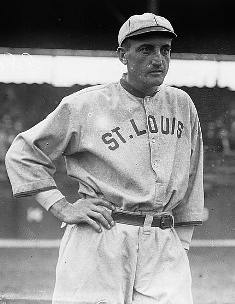
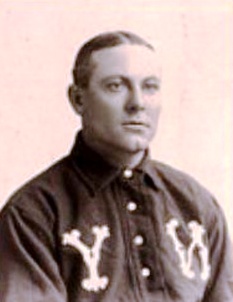
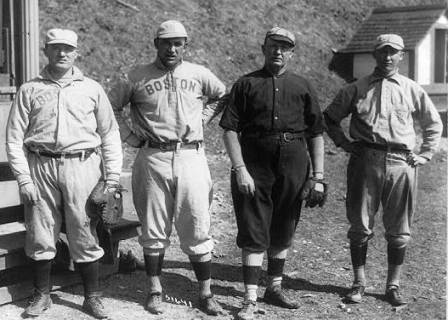
Tag Archives: Nap Lajoie

Polchow and Starnagle

13 Aug

At the close of the 1902 Three-I League season two unlikely candidates for the big leagues were signed by Cleveland Bronchos Manager Bill Armour.

Pitcher Louis William “Polly” Polchow and catcher George Henry Starnagle (born Steurnagel) did not put up impressive numbers.   Neither the Reach or Spalding Guides included Polchow’s won-loss record, but both said the 22-year-old’s winning percentage was just .414 in 32 games for the Evansville River Rats.  Starnagle hit just .180 with 13 passed balls and eight errors in 93 games for the Terre Haute Hottentots.

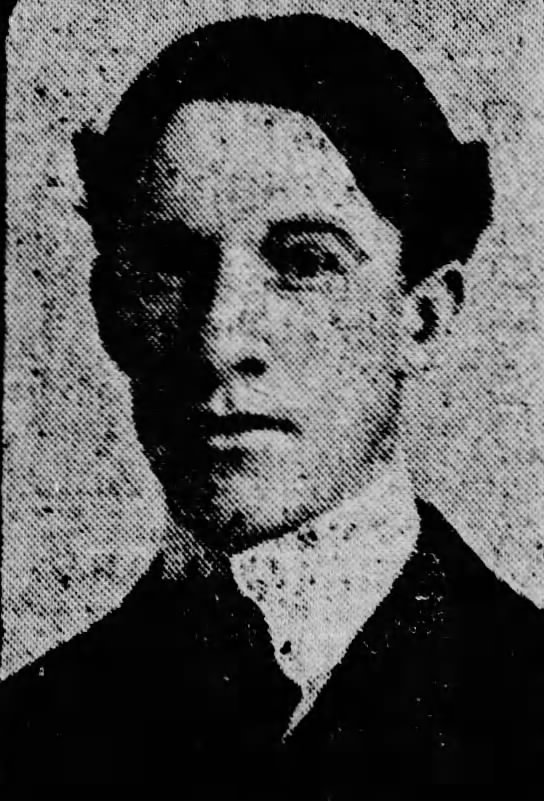
Louis Polchow

Louis Polchow

The two joined the fifth place Bronchos in St. Louis on September 13.  The following day both made their major league debuts in the second game of a doubleheader against the second place Browns.

The St. Louis Republic said:

“Captain (Napoleon) Lajoie decided to try his new Three-Eye League battery, which reported to him yesterday.  Starnagle, the former Terre Haute catcher, was as steady as a veteran, but Polchow wobbled at the drop of the hat, and before he steadied himself the damage was done.

“Five runs in the first two innings gave the Browns a good lead, and it was well they made hay while the sun shone, for Polchow handed them six ciphers for dessert.”

Starnagle made an error in the seventh when he overthrew Lajoie on an attempted steal of second by Bobby Wallace—Wallace advanced to third on the error, but Polchow retired the side without a run.

George Starnagle

George Starnagle

In Cleveland’s half of the seventh Starnagle and Polchow had the opportunity to get them back in the game.  With two runs in, and a runner on first and one out Starnagle came to the plate.  The Republic said:

 “Starnagle tried to put on a Three-Eye League slugging scene.  He dislocated two ribs going after (Bill) Reidy’s slow ones and finally fanned.  Polchow forced (Jack) McCarthy.”

Starnagle was lifted in the ninth for a pinch hitter.  Cleveland lost 5-3.  Polchow gave up nine hits and walked four, striking out two, and was 0 for 4 at the plate.  Starnagle was 0 for 3, with one error behind the plate.  Neither would ever appear in another big league game.

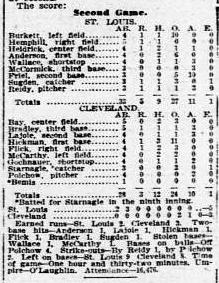
The Box Score

The Box Score

Starnagle was 28-years-old, and had only played two seasons of pro ball before his game with Cleveland—he was semi-pro player with teams in Danville and Sterling, Illinois for nearly a decade before he joined Terre Haute in 1901.  He was considered a solid defensive catcher, but during 10 minor league seasons he only hit better than .230 three times.  When he played with the Toronto Maple Leafs and Montreal Royals in 1909 The Montreal Gazette said:

“Starnagle has been drafted every year by big league clubs, all of whom have been pretty well supplied with seasoned catchers; hence his failure to be kept.”

Polchow was just 22 when he pitched his only big league game.  Plagued by wildness, he spent three mediocre seasons with teams in the Southern Association and South Atlantic League (he was 36-45 for the Montgomery Senators, Macon Highlanders and Augusta Tourists), then pitched five seasons in the New York State League.

In 1906 he helped lead the Scranton Miners to the New York State League championship (the team’s leading hitter was Archibald “Moonlight” Graham), although The Scranton Republican said his first start with the team was nearly his last.  Polchow lost 12 to 2 to the Utica Pent-Ups, walking 10 and giving up 10 hits.  After the game Polchow accused catcher “Wilkie Clark of throwing the game.  A fight followed and Clark and Polchow never worked together after that.   Andy Roth was Polchow’s battery partner during the remainder of the season.”

Starnagle retired after the 1910 season.  He returned to Danville, Illinois where he died in 1946; he was 72.

Polchow played through the 1911 season, and then became ill.  He died of Bright’s Disease at 32-years-old in August of 1912

In addition to Polchow and Starnagle, the Bronchos signed two other Three-I League players in September of 1902—both had somewhat more success.

Rock Island Islanders catcher George “Peaches” Graham made his debut the same day as Polchow and Starnagle, during the first game of the doubleheader; he struck out as a pinch hitter in the ninth inning of a 3 to 1 loss. He spent parts of seven seasons in the major leagues, and hit .265.  Decatur Commodores pitcher Augustus “Gus” Dorner made his debut three days later beating the Chicago White Sox 7 to 6.  He pitched for parts of six big league seasons, compiling a 35-69 record.


“It will be a Local Patriotic Game for Blood”

4 Aug

In 1902, John Montgomery Ward was asked to predict the future.  He wrote about what baseball would look like in 1922 in an article that appeared in a number of East Coast and Midwest newspapers:

“What will the game of baseball be two decades hence?  Frankly I don’t know.  But believe me if it has withstood what it has during the last few years it will still be here.  I believe it is going through the fire now, but it will come out whole in the end…No other game has the same hold on the public from a spectator point of view, and that is why I am confident that it will last.”

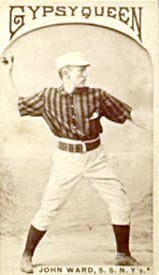
John Montgomery Ward

John Montgomery Ward

Ward envisioned a system in which all the players on each team would be natives of the area the teams represented:

“Two decades from now it may be no longer a mere exhibition—for that is all it is now—an exhibition of the ability of a clever manager, with more money and more tact in managerial council to get together the best players in the market—it will be a locally patriotic game for blood.

“The time is coming when the players instead of being bought to play in any team that calls them, irrespective of where they live and whence the team is located, will belong to the locality from which the team hails.

“There is a tendency in that direction already.

“The Brooklyn management is an instance of one that appreciates the value of a player who has a local following.  They have retained (Wee Willie) Keeler, though the offers of other clubs have forced them to pay him a very large salary.  But they have their reward in his great popularity with the Brooklyn patrons of the game.  He was born there.  The people know him, know his history and they feel that he is always doing his best for his town and their town.

"Wee Willie" Keeler

“Wee Willie” Keeler

“Not only is this state of affairs characteristic of this team, but it is to be seen in one or two other teams in both leagues.  The managers appreciate the money value of a ‘local attraction,’ as they call it, and they want more men of the same kind.  They can’t find them but that is due to the mistaken system of buying and selling players for their worth as players, which has killed the local end of the game and stunted the development of the town boy on the town lot.  As soon as the new system of localizing the players comes into vogue there will be a revival of general interest in the game among the ‘town boys’ and players will be made to meet the demand.

“This revitalization of the game must come, and come it will in the next twenty years because baseball as an exhibition has reached it height.  It can be developed no further, and something must be done to advance or there will be a deterioration.

“Of course, if this is done, there will be some work for the Rules Committee to do.  It will be necessary to have some sort of legislation to apportion the territory fairly among the teams.  New York being the largest city in the United States will have the advantage of a smaller city, like Boston or Baltimore, and to even up matters it would be necessary for the committee to give the smaller town enough territory to make all available population the same.  The details must be decided by the events of the future.  But I believe that something like that is about to come and will be a feature of the game of baseball in 1922.”

Ward, who engaged in, and encouraged contract jumping in order to establish the Players League just more than decade earlier, now, because of the changes in the economics of baseball, saw the practice as the greatest threat to the game:

“There will be no ‘contract jumping’ which has given the national pastime such a setback in the last two years.  And much depends upon the decision of the courts.  This contract jumping is a two-edged sword.  It will someday cut back at the American League when their players start to jump.

“Every successful game nowadays and in the future must have money invested in it. Look at the progress the game of baseball has made in the last twenty years and that will give you an idea of what we might expect.

“Twenty years ago each team had about $1,000 invested in it to put it on a working basis.  Some did not have even that much.  To-day, in Philadelphia, there is a plant which is values at about $350,000.  They own a lot in the residence section of the town and the ground is daily growing more valuable for building purposes.  In twenty years it will have tripled in value.  There is also a substantial brick wall around it and a valuable iron grand stand.

“Twenty years from now we may expect to find the conditions in Philadelphia existing all over the country, and there will be a hundred million dollars invested in the sport.  All this if the contract-jumping business is made impossible for the future.

“Take it as a fair business proposition.  Would any sane man invest his money in an enterprise which could be ruined at any moment by the failure of any outside party to fulfill his end of the contract?

“In baseball the ruin may come at any time, for if a man can ‘jump’ in March he can jump in May or June, just when his help is needed most, and there is no redress for the man who invests.  The courts, for the most part, claim that, if there is any damage done, the laws are open for redress and the manager can sue the player for damages.  But whom can he sue and from whom get redress?  Yhe contract-jumper has nothing and is generally irresponsible.  If a coal company contracts to deliver so many tons of coal to you in so many months, and you, in turn contract to deliver so many tons to other parties in so many months, and you are made to lose money because the coal company breaks the contract and fails to deliver the goods, you can get legal redress in an action for damages.  But not so with the baseball manager.

“If contract-jumping is allowed, the future of baseball is a future full of small things and a lack of progress.  But contract-jumping will not be heard of twenty years hence.  Already one state in the Union has declared against it legally—the state of Pennsylvania.  They have good lawyers down there, and they know what they are talking about.  And the crucial test and the future of baseball—a future full of big things as yet undreamed of, is now in the hands of the Circuit Court of the United States.

“If the Circuit Court of the United States falls in line with the Pennsylvania decision (Philadelphia Ball Club v. (Napoleon) Lajoie) there will be no more contract-jumping, and the manager, after signing his contracts with his players, can invest his whole fortune, safe in the belief that he will not risk it subject to loss at the whim of his players or through the wiles of a rival organization.

“Then the game will take on a luxury which has not heretofore been possible, and the game of twenty years from now will see as much improvement as it saw in the last twenty years.”

Ward predicted no major rule changes, saying they “seem to have reached perfection” but conceded “Still, there is a Rules Committee, created to make rules, and it naturally feels it must do something to earn its salary.”  Ward said he endorsed two major rule changes during the past decade; the rule to “move the catcher up under the bat,” (adopted in 1901 in the National League and ’02 in the American), and the 1893 change that increased the pitching distance to 60’ 6”.

“It gives the batter a better chance to fix his attention on hitting the ball, because he does not need to be afraid of an inshoot or know when he takes the bat in his hand that he is also taking his life in his hand.  I tell you it was a serious matter in those days to get hit by a ball from the strong arm of one of those fast pitchers, as my own experience can testify.”

As with every era of baseball, Ward said some of his contemporaries thought the game had already changed so much as to no longer resemble the game they played twenty years earlier:

“I was talking to one the other day in Philadelphia (Arthur Irwin).  He is of the old school you know (and said) ‘Oh, it’s not like the old days, when I played on the Philadelphia team for four years without men being changed.  All we had were (Jack) Clements and (Deacon) McGuire as catchers, (Charlie) Ferguson, (Charlie) Buffington and (Dan) Casey as pitchers, (Joe) Mulvey, (Charlie) Bastian, (Sid) Farrar and myself in the infield and (George) Wood and (Jim) Fogarty in the outfield.

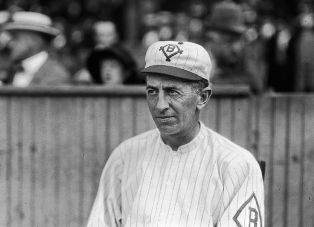
Arthur Irwin

Arthur Irwin

“’We didn’t need to be nervous every time we made an error, and look to have one or more of a half dozen substitutes take our place.  And we played ball, we did, and no mistake, for we knew our jobs were safe.’”

Irwin’s recollection was fuzzy—the lineup as he described was only in place in 1887  (but even that season Barney McLaughlin played more games at second than Bastian) –but he insisted the lack of competition for a roster spot made players better:

“’We could give these boys who are playing now cards and spades on lots of things, inside work and out, and best them.  We had the hit and run, and we didn’t bunt as much as they do now.  I can’t see how runs can be made by so much bunting.  Oh, for the good old time back again when the swatting game was the thing.  I believe the public would rather see the boys slug the ball and run.  Shades of Roger Connor, ‘Buck’ Ewing and Jim O’Rourke!  What would they think of this bunting business?  It makes me sick to think of it.’”

Buck Ewing

Buck Ewing

Ward said Irwin was one of many “old-style players who feel the same way,” but he was more optimistic, but still managed to take a shot at current, and future,  players:

“I have great hopes for the future of the game, and I believe that all that has been done in the past to make it take the place it occupies to-day will not be a circumstance to what will be done in the next twenty years to make it take the place in the heart of the nation which has not been dreamed of heretofore.

“The players may not be as good as the players of the past, and this especially true of the local player idea becoming a fact, but the interest will be great, and after all, the interest in the game is the fountain source of its life.”

“This Wealth of Mr. Gertenrich has cost the Game an A-1 Player”

7 Jul

Sportswriter William A. Phelon said Louis Wilhelm “Lou” Gertenrich “is not a ball player because he has to be, but because he wants to be.”

The son of a successful candy maker, Gertenrich was rumored to be one of Chicago’s wealthiest young men.  He was also an excellent ballplayer and sprinter, but spent a great deal of time focused on business rather than sports.  Phelon said:

“Gertenrich hasn’t played ball, even when he desired to play the game, because his business interests would not allow him the leisure time.  In other words, Mr. Gertenrich, being a man of income and financial substance, cannot dally with the ball and bat as he would like, and this wealth of Mr. Gertenrich has cost the game an A-1 player.”
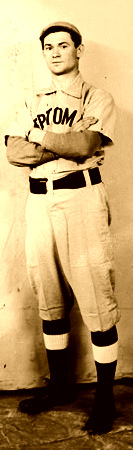
Lou Gertenrich

Lou Gertenrich

He began to be noticed as a ballplayer in 1891 as a 16-year-old pitcher with a team called the American Boys (later called the Mystics), the following year he joined the Clybourn Juniors.

At 19, in 1894 he joined Chicago’s City League, first with the Brands and then the Garden Cities, pitching and playing shortstop and outfield.  As local clubs found they could do better as independents than as members of a league the City League went from an eight, to six to finally a four-team league before disbanding at the close of the 1895 season.

Gertenrich remained a popular figure in semi-professional circles in Chicago, playing primarily for the Maroons and the Auburn Parks.

In 1898 The Sporting Life said Hank O’Day thought Gertenrich “is a sure comer.”

On September 15, 1901 the last place Milwaukee Brewers were in Chicago for a doubleheader, the final two home games for the first place White Sox.  Brewers Outfielder/Manager Hugh Duffy, and another outfielder, Irv Waldron, were injured.  As a result, The Chicago Daily News said:

“Manager Duffy gave Louis Gertenrich, a city league star, a trial.”

Starting the first game in right field, Gertenrich singled in his first big league at bat and scored a run on a home run hit by another player making his debut; Leftfielder Davy Jones.  Gertenrich was 1 for 2 before being removed in the fifth inning of a 5 to 4 loss.

In the second game he pinch hit for pitcher Ned Garvin and grounded out in the bottom of the ninth of a 9 to 4 loss to Chicago.

Gertenrich returned to the Auburn Parks with a .333 major league batting average.

He got a big league call again in 1903.  On July 21 the first place Pittsburgh Pirates were in Chicago to playing the Cubs.  Pirates Manager Fred Clarke, who was injured, had allowed outfielder Jimmy Sebring three days off to return to Williamsport, Pennsylvania for his wedding.

Gertenrich was brought in to play right field; he went 0 for 3 with a sacrifice bunt and handled two fly balls.  He returned to the Auburn Parks’ lineup the following day.

He spent most of the next decade playing in the re-formed Chicago City League—spending time with the Logan Squares, Gunthers, the Roger Parks, the West Ends, the Riverviews and Anson’s Colts.  He also coached baseball  at the Morgan Park Academy on Chicago’s South Side.

The Daily News said:

“Gertenrich is recognized as one of the heaviest hitters in local semi-pro ranks, and there is no batter more feared by the pitchers than this speedy fielder.”
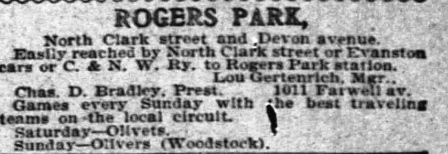
1906 advertisement for the Rogers Parks, when Gertenrich played for and managed the team

1906 advertisement for the Rogers Parks, when Gertenrich played for and managed the team

William A. Phelon wrote for The Chicago Journal when Gertenrich left Chicago briefly in 1905, at age 30,  to join the Springfield Babes in the Central League and the Decatur Commodores in the Three-I League.  Phelon told a story about Gertenrich’s stay in Springfield:

“Mr. Gertenrich was able to arrange his affairs for a lay-off of three months (in order to play for Springfield, and) the rich man negotiated with (Manager Jack) Hendricks for a position…The very next afternoon beheld Mr. Gertenrich, free from business care and happy as a proverbial lark, capering in the Springfield pasture and slamming that old ball like seven Cobbs and a Lajoie thrown in for luck.

“On his first day out he got three singles.  Next day he amassed two triples and a double.  The third day he whacked a home run and a single.  On his fourth day he drew three passes and connected for a triple.  On the morning of the fifth day Mr. Hendricks summoned him to headquarters.

“’Mr. Gertenrich,’ said Mr. Hendricks, pausing to wipe away a tear ‘you are a great batsman and a good fellow.  You are setting this league afire.  You are the wonder of the Twentieth Century.  But you are breaking the hearts of my younger players.  They cannot bat like you.  They are losing their ambition.  A few more games with you among them and they will pine away and die…Moreover Mr. Gertenrich, you have money.  You do not need this job.  The boys whom you are shoving into obscurity have little families and need the coin.  I hate to say it Mr. Gertenrich,’—and the manager again wiped away a tear—‘but you and I must part.  Here is your release.  Goodbye, Mr. Gertenrich, and good luck be with you.  Please go away, for I weep every time I look at you.”

Gertenrich also appeared in several games for Decatur after his release from the Springfield Babes, against Springfield’s other team, the Senators, and the Peoria Distillers.

For the next four seasons, Gertenrich remained one of Chicago’s best local athletes.  At 33-years-old in 1908 he was still a good enough runner to win the City League Field Day title of fastest player; The Daily News said he rounded the bases in 14 and 1/5 seconds.

The Chicago Eagle called him:

“(O)ne of the best known and most popular players in Chicago.”

In 1909 he hit .318 (5th in the league) and The Sporting Life said the Brooklyn Superbas were trying to sign Gertenrich and made an offer “which he has taken under consideration.”  The deal was never completed.

Gertenrich hit .350 in 1910 (3rd in the league), playing for Rogers Park.

In 1912 he returned to professional baseball as a member of the Chicago Green Sox in the United States League.  William C. “Billy” Niesen, a long-time City League operator had initially been one of the organizers of another proposed outlaw organizations, the Colombian League, but when then venture failed, and after one of the proposed New York team dropped out of the United States League in late March Niesen was awarded a Chicago franchise; Niesen was a good fit for the fledgling league because already had a ballpark on the North Side of Chicago at the corner of Clark Street and Leland Avenue–called Gunther Park, also referred to frequently in the Chicago press as Niesen’s Park.

The Sporting Life said “Base ball men are still betting that the new league doesn’t open the season,” but Niesen had high hopes.  He hired Burt Keeley, a long-time City League figure who had pitched in 30 games for the Washington Senators in 1908 and 1909.

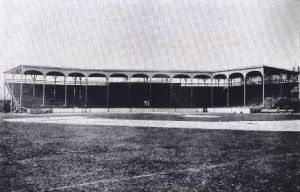
He also signed Gertenrich, who had played for Niesen’s Gunthers in the City League the year before, and according to The Chicago Examiner had hit a home run off of Bill Lindsay of the Chicago American Giants that was “the longest hit ever seen at Niesen’s Park.”
gunther

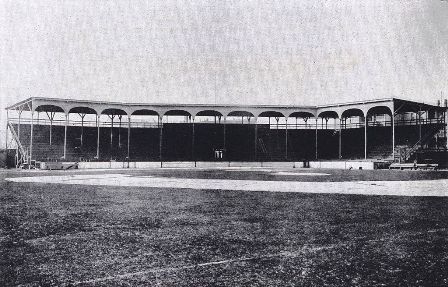
Gunther Park, where The Examiner said Gertenrich was responsible for “the longest hit ever seen at Niesen’s Park.”

An ambitious 126-game schedule was announced, but the upstart league was under-capitalized and low attendance doomed it to failure.  The league folded after just more than a month of play.  The Green Sox were 10-12.  Gertenrich returned to the candy business and semi-pro ball.

On March 8 of 1913 the Federal League rose out of the ashes of the United States League and was incorporated in Indianapolis.  Keeley was named manager, and many of the same players, including Gertenrich, who played for the Green Sox signed with the new club.

The Chicago Inter Ocean said:

“Gertenrich will be the mainstay of the outfield and is a heavy hitter.  He has made final arrangements for joining the club by procuring a competent manager for his candy business.  He will devote his time to the interests of the club.”

The team won their opener on May 6 against the St. Louis Terriers, and got off to a 7-1 start.  Chicago led the league until the middle of June when they were overtaken by Indianapolis.  They faded quickly after that; at the same time the team’s front office was in chaos, the team’s president was removed  and a new set of directors were elected in July.

On August 16 The Chicago Tribune said the team, hopelessly out of the pennant race, ten games behind Indianapolis, released Gertenrich “on the ground of cutting down expenses.”

Individual records are scare, but the 38-year-old Gertenrich was called “one of the classiest outfielders” in the league by The Associated Press.  In March of 1914 The Daily News said Gertenrich “was batting .413” at the time of his release, but had not received an offer from one the Federal League teams for 1914.

While Gertenrich relinquished some of the responsibilities of his company during 1912 and 1913 he had time to receive two United States patents for inventions for his candy company, including one described as a “corn confection” called the “Ball Tosser.”

Gertenrich was finished with professional baseball after his release in 1913, but continued playing semi-pro ball for several teams in and near Chicago, and formed a team called the Gertenrich Stars which played in Chicago through 1917.

He was a regular sponsor and attendee of alumni events for semi-pro and professional ballplayers in Chicago and played on the German Club of Chicago’s baseball team until his death from a cerebral hemorrhage in 1933.

As a candy maker he had one more connection with professional baseball.  An advertisement for his company appears on the back of a baseball card set.  The 120 card set–the more common version advertises American Caramel on the back (E121)—was issued in 1922.  The Gertenrich variations are extremely rare.
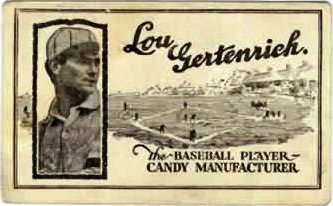
The Gertenrich back variation of an E-121

The Gertenrich back variation of an E-121 card

“Monte’s Baseball Religion”

27 Jun


Even in a game dominated by superstitions some stood out.  The St. Louis Star reported on what Philadelphia Phillies shortstop Montford Montgomery “Monte” Cross thought was necessary for a rally—to the annoyance of some teammates– during a game with the St. Louis Cardinals in May of 1900:

Monte Cross

Monte Cross

“One of Monte Cross’ queer hobbies is that the bats must not be crossed when they lie in front of the bench…just as (Harry) Wolverton, the first man up in the fifth inning, stepped to the plate,  Cross looked at the pile of bats, and at one jumped into the air, shouting: ‘Four runs this time.  It’s a cinch.  Never failed yet.’

“’Sit down, you’re crazy,’ said (Al) Maul.

“’I tell you we’re going to get four runs this time.  Do you see that?’ he asked, pointing to the pile of bats.

“’See what?’

“’Why those four bats sticking out further than the rest.  That means we’ll get just as many runs.  Just you wait and see.’  Everybody laughed, but Monte was evidently very much in earnest, so they waited, all thinking how they’d kid him when the side was out.  Then Wolverton made a hit.

“’It’s a starter!’ cried Cross. ‘Now watch me.’ But Cross aired to (Mike) Donlin.  Then the next man walked.

“’There’s four hits coming sure,’ said Cross.  Just then (Roy) Thomas cracked a single scoring Wolverton.  Then (Napoleon) Lajoie and (Elmer) Flick got in their work, and the five runs were scored.

“’Whenever you see bats fixed that way look out for runs,’ observed Cross, triumphantly.

“’All right,’ replied (Ed) McFarland.  ‘Shove out about six of those sticks and we’ll win sure.’

“’That doesn’t go.  Don’t touch them for heaven’s sake!’  Fairly screamed Cross.  ‘The bat boy has to do it when he isn’t thinking.’

“The players all had a good laugh over the circumstance, and no doubt some of them became converts to Monte’s baseball religion.”

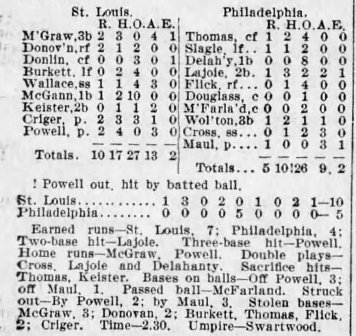
While the Phillies scored five runs during Cross’ “lucky” inning, it didn’t seem to matter to him that he failed to contribute to the rally, and the Phillies lost the game 10 to 5.

The Box Score

The Box Score

“What Right has Hanlon to Show me How to Hit?”

23 Jun

How are hitters created?  Bozeman Bulger of The New York Evening World attempted to answer the question, and described the hitting styles of some of the game’s biggest stars in 1906:

“Batting is a natural gift and to be a success the player must be allowed to swing the willow in his own sweet way.”

Bulger said John McGraw who “For nine years…had a batting average of .330” (actually .346 from 1893 to 1901) was asked his secret:

“Don’t know, I simply used my eye and my arms and figured it out.”

When McGraw played for the Baltimore Orioles, Manager Ned Hanlon tried to show him “how to hit (and) on one occasion he corrected him sharply.”  McGraw said:

“That set me to thinking, and I went to my room and dug up a lot of old records.  In these I saw that Hanlon had never hit as good as .300, that is for a period of two or three seasons (Hanlon hit .302 in 1885) while I had been hitting over .300 right along.  Therefore, I asked myself ‘what right has Hanlon to show me how to hit?’”

Ned Hanlon

Ned Hanlon

Bulger said

“In the past few years Yale and Harvard and Princeton and other colleges have employed coaches to teach them how to hit.  The experiment was futile, and no hitters were developed that did not already possess the gift.

“Take the great batters of to-day and you will find that no two of them stand at the plate alike.  Long since astute managers have found that it is a useless waste of time to attempt a correction of habits easily acquired.  To be successful a ball player must do everything in a perfectly natural manner.  This is paramount in batting.”

Bulger then wrote about the “peculiarities” of some contemporary hitters:

Sam Mertes of the Giants invariably pulls his left foot back as he swings at the ball.  Mertes also crouches with somewhat of a forward lean and keeps his feet wide apart.

Roger Bresnahan and Mike Donlin, two of the greatest hitters in the world, are what are called vicious swingers.  Bresnahan has absolutely no fear.  He never thinks of being hit, but runs squarely into the ball, and when he plants his bat squarely against it a scorching line drive follows.  Nobody hits a ball with more force than Bresnahan.

“Donlin stands with his feet about one foot apart and usually holds the bat perfectly rigid at his waist, slanting at an angle of about 45 degrees.  He can either ‘chop’ or swing hard with the same degree of accuracy.  Donlin is said to be the greatest natural hitter in the business.  He says he has no idea how he does it.

George Stone, one of the most remarkable batters of the age, has a (boxer Jim) Jeffries  crouch at bat which has caused experienced baseball managers to say George wouldn’t last as soon as the pitchers got next to him.  Stone puts a terrific amount of weight into one of his blows, swinging with his shoulders and smashing a line with fearful force.

George Stone

George Stone

“His position has been termed awkward, inelegant, and not conducive to good hitting, but Stone to-day leads the American League with a better average than the great (Napoleon) Lajoie.

“Larry is the personification of grace and elegance at bat.  He has that careless indifferent method which attracts, is devoid of nervousness but active and alert.  Infielders will tell you that there is a force in the balls smashed by Lajoie which makes them unpleasant to handle.  Lajoie is the finished artist.

“His great rival in the National League Honus Wagner is just the opposite.  Hans grabs his stick at the end, holds it high about his shoulders, and when he swings his legs are spread from one end of the batter’s box to the other.  Wagner is awkward standing almost straight and goes after outcurves and drops with equal avidity.  Hans often reaches to the far outside of the plate for a low outcurve and plants it into right center field.

Charlie Hickman stands at the outer edge of the box and swings with his body and shoulders His fondness for the balls on the outside of the pan are known to opposing pitchers.  Lave Cross puts his two feet into the angle of the batter’s box nearest the catcher, while (Dave) Altizer usually spreads out, varying this position with a crouching posture, from which he runs up on a ball.”

Lost Advertisements–“Lajoie Endorses Heptol Splits”

9 May

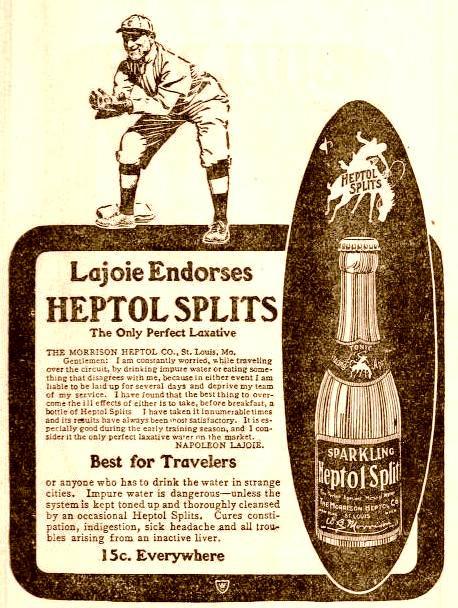
lajoieheptol

Cleveland Naps second baseman Napoleon Lajoie appeared in as many advertisements as any of his contemporaries during his career, including one for a “sparkling laxative.” This is a 1906 advertisement for Heptol Splits “The only perfect Laxative.”

“Gentlemen:  I am constantly worried, while traveling over the circuit, by drinking impure water or eating something that disagrees with me, because in either event I am liable to be laid up for several days and deprive my team of my service.  I have found that the best thing to overcome the ill effects of either, is to take, before breakfast, a bottle of Heptol Splits.  I have taken it innumerable times and its results have always been most satisfactory.  It is especially good during the early training season, and I consider it the only perfect laxative water on the market.”

The image of the cowboy on the bronco used for Heptol Splits’ logo was created by artist Charles Marion Russell.

Lajoie’s endorsement does not appear to have done much good for the brand which appears to have disappeared from drug store shelves within a couple of years.

A version of the advertisement appeared in the inaugural, 1906 edition of Napoleon Lajoie’s Official Base Ball Guide— an attempt  to compete with the Spalding and Reach Guides.

The 1906 Lajoie Guide

The 1906 Lajoie Guide


The Cleveland Press said upon the publication of the 1906 guide:

“”Lajoie’s Guide is especially interesting because it is the first work of this kind that has ever been attempted by a ball player while still in active service on the diamond…Lajoie is the champion batsman of the world and a great authority on the national game.  His book should find a ready sale.”

When Lajoie’s Guide ceased publication after the 1908 edition The Press said:

“After two years as editor of the American League Publishing Company, getting out the Lajoie Guide, he declares the others are too strong for competition, and only farm life for him in the winter months from now on.”

Baseball’s “Fountain of Youth”

16 Apr

John Brinsley “J.B.” Sheridan wrote for several St. Louis newspapers and The Sporting News from 1888-1929.

In 1917 he asked in The St. Louis Globe-Democrat:

“How is it that two young chaps come up together, one lasts a year or two, the other keeps on playing until he meets his sons and the sons of his pals coming up?”

Sheridan noted that Bobby Wallace was 43-year-old and in his twenty-fourth season–albeit as a reserve who appeared in just eight games for the Cardinals–while contemporaries like Jimmy Collins were out of the game for nearly a decade.  (Sheridan failed to mention or notice that Wallace was three years younger and started his professional career at age 20 while Collins began his at 23):

“Wallace has had a great career in baseball.  Only one man, A. C. (Cap) Anson has played longer than Wallace in the major leagues (Sheridan didn’t mention Deacon McGuire who also had Wallace beaten in years of service with 26—but he only played a total of 20 games in his final eight “seasons”) Anson did twenty-seven seasons, but had he not been his own manager he would not have done so many.  The old man could hit to the end, but for the last ten years of his major league career Anson was so slow and stiff that it is doubtful if any manager, other than himself would have employed him.”

Booby Wallace

Booby Wallace

Sheridan neglected to mention that “slow and stiff” Cap Anson managed to play in more than 1100 games in those last ten seasons when no manager “other than himself would have employed him,” and hit better than .330 in five of them–and would contradict himself on the “slow and stiff” part later in the same article.

He said, “Jack O’Connor did twenty-two years in the majors and was useful to the end.” (O’Connor only hit better .250 twice in his last ten seasons, never appearing in more than 84 games during that period)”

Despite the many misstatements, Sheridan’s article included interesting character sketches of several 19th and early 20th Century players (the veracity of those sketches can be judged with the above misstatements in mind).

“O’Connor was a really wonderful man.  He always retrained his diet during the playing season, but gave it full rein during the off season.  O’Connor had some appetite, too.  Usually he put on 20 pounds of extra weight every winter and regularly took it off every spring.  O’Connor must have taken off 500 pounds of flesh in the twenty-two years of his baseball playing.  He ate and drank like Gargantua during the winter, but denied himself like a monk in the spring, summer and fall.

(Napoleon) Lajoie, who did his 20 years [sic 21] in the majors, was like Wallace and (Jake) Beckley, an iron man.  (Lajoie) came from Breton peasant stock…The Bretons lived off the rocks and fishing grounds of Brittany, beaten by Atlantic spray long before the dawn of history.  No wonder then, that Lajoie is a hardy man (who) needed no conditioning in his youth.  He threw a couple, hit a couple and was ready for the fray.”

Sheridan said O’Connor’s former battery-mate Cy Young was “another physical wonder” despite being “rather soft and inclined to obesity later in life.”

“Cy never cared much for beer, the beverage of the old-time ballplayer, but he did not mind a little ‘red eye’ now and then In fact, the old boys say the farmer could pack more whiskey about him than any man they had ever known.”

As an example of Young’s prowess Sheridan said O’Connor told him a story about a night out in Boston:

“I drank beer while Cy drank whiskey. Drink for drink with me, but the last thing I remembered that night was that Cy put me to bed.

“I got up the next morning looking for sedlitz powder and something cooling.  I got the powder and I went into the breakfast room to get a grapefruit.  Then I saw Young behind a big plate of beefsteak with onions.  I turned and ran for the fresh air…Cy ate the entire steak, all the onions, a lot of bread and butter, stuck a strong cigar in his mouth and joined me on the sidewalk.

“What made you quit so early last night, Jack?  I was just getting’ goin’ good, when you said ‘Let’s go home I’m sleepy.’”

Jack O'Connor

Jack O’Connor

Sheridan compared Young’s career to that of Bill Dinneen:

“Dinneen came into the game seven [sic–nine] years after Young, was Cy’s teammate for four years [sic–five and part of a sixth] then dropped out (Dinneen played three more seasons with the St. Louis Browns, but his career was over after 12 seasons at age 33)

“Dinneen ate too well, and what ballplayers call the ‘old uric acid’ got him in the arm.  Yet Dinneen was one of the finest physical specimens that ever played ball.

“Some big fellows look strong but prove to be soft and unenduring.  Jack Chesbro was one of these.  Chesbro had three great years as a pitcher, and then broke down.  Jack was a soft-boned boy, with bad ankles and could not stick the route.

“Some men hold out in arm, legs and bone, but lose the keenness of vision essential to good batting, Willie Keeler, was one of these.  Keeler’s legs were good to the end and his arm worked all right, but his eyes went back on him and he had to quit…(Art) Devlin was one of the three great third basemen of his time.  He was a star, but endured only a few years.  Bad Digestion stopped him when he was at the height of his fame, and when he should have been good for many more years.”

Sheridan claimed to know the secret of a ballplayer’s longevity: the waters of Hot Springs, Arkansas.

“Each January 1 for twenty-two years saw (Young) at Hot Springs…O’Connor and (Jake) Beckley were always at Hot Springs, too.  These three men never missed a season at the Arkansas resort, while they were playing ball…Fred Clarke, too, was a great advocate of Hot Springs as a training resort, and the Pirates always fitted in there when Clarke was manager.  That took (Honus) Wagner, another long liver, there too.

“Anson always took a season at Hot Springs.  It is pretty well established that the Arkansas resort is the location of Ponce de Leon’s famous “Fountain of Youth.”  It may or may not be a coincidence, but the fact remains that Young, O’Connor, Beckley, Anson, Clarke, Wallace and Wagner, men who played from seventeen to twenty-two years of major league baseball, have all been frequenters of or habitues of Hot Springs.”

Cy Young, third from left, with Bill Carrigan, Jake Stahl and Fred Anderson at Hot Springs in 1912

 Cy Young, third from left, with Bill Carrigan, Jake Stahl and Fred Anderson at Hot Springs in 1912

The St. Louis sportswriter was certain the springs were a magic “Fountain of Youth, “and said he was only aware of one exception to his rule:

“Every iron man of baseball, except Lajoie, has been a yearly visitant.”

The Tribune’s First All-Star Team

21 Feb

In 1933 The Chicago Tribune underwrote the first All-Star game, created by Arch Ward, the  paper’s sports editor,  to coincide with the Century of Progress World’s Fair—more than 30 years earlier The Tribune published one of the earliest  sportswriter selected “all-star teams.”

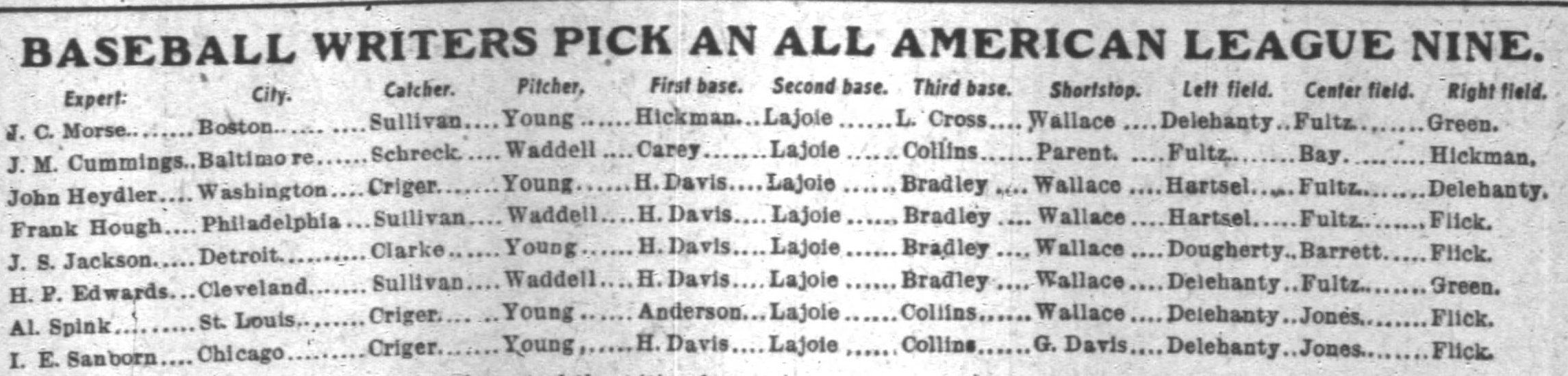
Near the end of the 1902 season, The Tribune polled sportswriters from American League cities to pick “An all American League Nine.” (No similar poll was done for the National League)

The writers polled:

Jacob Charles Morse—The Boston Herald

Joseph M. Cummings—The Baltimore News

John Arnold HeydlerThe Washington Post

Frank Leonardo HoughThe Philadelphia Inquirer

Joseph Samuel Jackson—The Detroit Free Press

Henry P. Edwards—The Cleveland Plain Dealer

Alfred Henry SpinkThe St. Louis World

Irving E. (Sy) Sanborn—The Chicago Tribune

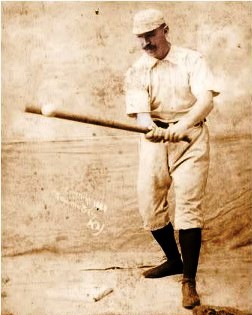
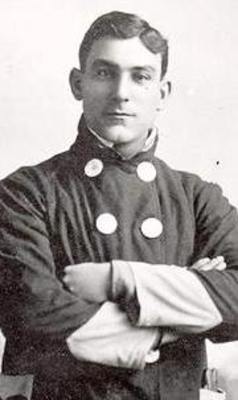
The only unanimous choice was Cleveland Bronchos second baseman Napoleon Lajoie—Lajoie appeared in just 86 games, but hit .379.

Napoleon Lajoie --the only unanimous choice

Napoleon Lajoie –the only unanimous choice

The most disagreement was behind the plate; four different catchers received votes:  Billy Sullivan of the Chicago White Sox and Lou Criger of the Boston Americans received three votes each;  Freeman Ossee Schrecongost who played 18 games with Cleveland and 79 with the Philadelphia Athletics, and William “Boileryard” Clarke of the Washington Senators each received one vote.

Cy Young of Boston led pitchers with five votes, with Philadelphia’s Rube Waddell being the choice of the other three.

Four first basemen were also chosen, but Harry Davis of the Philadelphia Athletics was the consensus choice with five votes.  Cleveland’s Charlie “Piano Legs” Hickman, Washington’s George “Scoops” Carey, and “Honest John” Anderson of the St. Louis Browns all received one vote.

Cleveland’s Bill Bradley edged Boston’s Jimmy Collins four to three, with Philadelphia’s Lafayette “Lave” Cross getting the remaining vote.

Bobby Wallace of St. Louis was the shortstop consensus with six votes, Boston’s Freddy Parent and Chicago’s George Davis received one vote each.

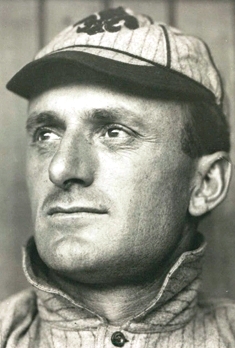
Booby Wallace, the choice at shortstop

Bobby Wallace, the choice at shortstop

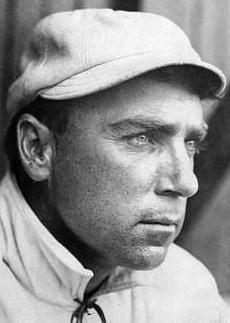
Washington’s Ed Delehanty got four votes in left field, Philadelphia’s Tully “Topsy” Hartsell two; one vote each went to Boston rookie Patsy Dougherty and Philadelphia’s Dave Fultz (who played center field)

With or without his vote as a left fielder, Fultz was the consensus in center field.  He received four votes at that position; Chicago’s Fielder Jones got two votes, Jimmy Barrett, the only Detroit Tiger to make the list received a single vote (from Joseph Samuel Jackson of Detroit) and Harry “Deerfoot” Bay of Cleveland received one vote.

Jimmy Barrett, the only Tiger

Jimmy Barrett, the only Tiger

Right field included a couple more out of position players, Charlie Hickman picked up one vote despite being primarily a first baseman and playing just 27 games in the outfield in 1902.  Delehanty, almost exclusively a left fielder in 1902, received one vote in right.  Elmer Flick of Cleveland was the consensus with four votes.  Danny Green of Chicago received two votes.

The Results

The Results

The 1902 effort was not repeated by the paper.

Lost Advertisements–Ready! Lajoie Baseball Guide

25 Oct

lajoieguide

Above is a 1906 advertisement for an Atlanta hardware store offering the inaugural edition of “Napoleon Lajoie‘s Baseball Guide.”  The Lajoie Guide was intended to compete with the well established Spalding and Reach Guides, and sold for 10 cents, but despite Lajoie’s popularity the guide failed to catch on and was only published for three years.

In addition to the standard recap of professional baseball leagues across the country, and many photos, the Lajoie guide included a significant amount of information specific to its name sake.  An advertisement for the Cincinnati-based Queen City Tobacco Company said:

Lajoie Chews Red Devil Tobacco

Ask him if he don’t

reddevil

Grantland Rice wrote for the guide, and the first edition included a Rice-penned poem called “For Lajoie’s in Town:”

We’ve gazed on Mr. Roosevelt,

Who rules this whole wide land.

We’ve looked at Carrie Nation, 

And shook Jim Corbett’s hand

We’ve eaten bread with Robert Fitz

And chummed with George Tebeau.

We’ve drank out beer with Mr. Schlitz.

Great notable we know.

We’ve interviewed Friend Morgan,

Thrown talk at old John D.

We’ve opened wine with Sullivan

And seen Prince Hennery.

King Edward is a bosom pal,

Langtry our school-day girl.

Dick Croker smiles in our face,

We’ll give Boss Fame a whirl

*     *     *     *     *     *     *     *

Around the shrine of heroes

There’s little we’ve not seen.

We’ve talked to all, both great and small,

Of high and lowly mien.

But this group pales beneath the looks

Of one of far renown.

Hats off!The greatest comes today,

For Lajoie’s in town.

T. Roosevelt’s backed off the boards,

A plater is king Ed.

Langtry a chorus lady now,

The others are all dead.

For Lajoie, pride of several leagues!

Lajoie, the mighty man!

Lajoie, his bat and fielding glove

Knocks out the wholes blamed clan.

The 1906 Lajoie Guide

The 1906 Lajoie Guide

Hap Myers

29 Jul

When the 6’ 3” 175 pound Ralph Edward “Hap” Myers was let go by the Boston Braves after the 1913 season a reporter told Braves shortstop Rabbit Maranville he was sorry to see Myers go.  Maranville joked:

“Well, you might be, but I’m not.  Do you know that guy is so thin that every time I picked up a grounder I had to shade my eyes with my gloved hand to locate him before throwing the ball.”

Myers began his professional career after graduating from University of California, Berkeley in 1909, where he also played baseball.  The San Francisco native hit a combined .311 playing for the Sacramento Sacts in the Pacific Coast League, and the San Jose Prune Pickers and Santa Cruz Sand Crabs in the California League.

Myers went east in 1910 after being purchased by the Boston Red Sox, but became ill, with scarlet fever, and as a result appeared in only six games in Boston before being  sent first to the Toronto Maple leafs in the Eastern league, then the Louisville Colonels in the American Association.

Despite hitting just .240 with Louisville, Myers was selected by the St. Louis Browns in the Rule 5 draft.  The Red Sox claimed Myers still belonged to them and his contract was awarded to Boston, where he began the season, was sold to the St. Louis Browns, who quickly released him despite hitting .297 in 11 games, then back to the Red Sox where he hit .368 in twelve games before being sent to the Jersey City Skeeters in the Eastern League.

It was never clear why, in spite of hitting .333 in 81 at bats in 1910-1911, Myers couldn’t stick in the American League.

In 1912 he returned to the West Coast to play for the Spokane Indians in the Northwestern League where he led the league in hits, and runs, hit .328, and led all of professional baseball with 116 stolen bases.  The Portland Oregonian said:

“Myers base stealing smashes any previous performance in Northwestern League history.  You have to go back 20 years in official guide books to find any record to compare…and that includes every league in organized baseball.”

Spokane owner Joe Cohn went overboard in his praise of Myers in The Spokane Spokesman-Review:

“Best ballplayer in the Northwestern League by a long shot.  He is the greatest ballplayer I ever saw.  Boy I tell you this Myers is a wonder.  Ty Cobb, Hans Wagner, Tris Speaker and all of them have nothing on Myers…I think Myers has it on Cobb, Wagner, Lajoie, Jackson and the whole bunch.”

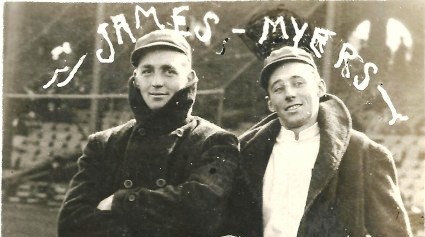
Myers, and Portland catcher Rex DeVogt were purchased by the Braves from Portland, Devogt would only last for three games, and six hitless at-bats in April of 1913.  Myers would become the Braves starting first baseman.  Another Pacific Coast League player, pitcher “Seattle Bill” James also joined the Braves.

hap3

“Seattle Bill” James and “Hap” Myers

Myers got off to a slow start; he was hitting just .224 in early July, but was leading the National League in steals.  An article in The Tacoma Times said:

“When Hap Myers, recruit first baseman of the Boston Braves is in full stride stealing bases, he covers nine feet…the average stride of a sprinter is six feet. “

The article said the average player took 13 steps, roughly seven feet per step, between bases but Myers took only ten steps:

“Myers is something of a baseball curiosity, and his work is watched with interest by the fans.  If the time comes that the big fellow climbs into the .300 class as a batter, he is apt to become a veritable terror of the paths.”

He was also said to use “a bat of unusual length,” but the size was never mentioned.

After the slow start, Myers hit well in the second half of the season, ending with a .273 average and 57 stolen bases (second to Max Carey of the Pittsburgh Pirates who stole 61).  Despite his strong finish, Myers was replaced at first base for 22 games in August and September by Butch Schmidt, who was purchased from the Rochester Hustlers in the International League.

"Hap" Myers

“Hap” Myers

At the end of the season Myers was sold to the Hustlers, the deal was, in effect, a trade for Schmidt.  The Boston press simply said Myers did not get along with manager George Stallings; Myers told a reporter in San Francisco that there was another reason; baseball’s labor unrest:

  “I was assigned by the fraternity to get as many Braves as possible into the fraternity, and succeeded in enrolling nearly the entire team.  The powers that be evidently didn’t relish my actions for soon my every move began to bring calldowns and I was not surprised to read in the newspapers a little later that I had been sent to Rochester.”

Myers jumped Rochester to join the Federal League; his signing was reported months before he actually signed.  The Associated Press said in March of 1914:

“Although it has been generally understood that Hap Myers, last season’s first baseman of the Boston National has been under a Federal League contract for some time, the elongated first sacker did not put his name to a contract until yesterday afternoon.  Myers originally expected to play with Larry Schlafly on the Buffalo Federals, but was transferred to Brooklyn, and seemed altogether pleased with the move.”

Myers got off to a strong start, and The Sporting Life said:

“Brooklyn fans cannot understand why Hap was passed out of the National League. They have had a chance already to give his successor at first base on the Boston team (Butch Schmidt) the once over, and the general opinion is that- Hap Myers “lays all over.”

His success in Brooklyn didn’t last; in 92 games Myers hit just .220.

Hap’s story continued tomorrow.