Tag Archives: National League

Boston’s Horseshoe

9 Jan

Boston Beaneaters Manager John Morrill told The Washington Star in 1886:

“Yes, sir, it’s a fact, that professional ball-tossers are as a rule very superstitious.  It is nothing more than natural though, and is not as much due to the ignorance of the men as is sometimes supposed.  You see, so much chance enters into every game of ball that the boys who play game after game gradually become impressed with the belief that they can read in advance certain signs or omens which will have more or less effect upon their individual play, if not upon the result of the game.”

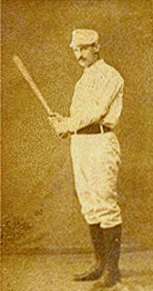
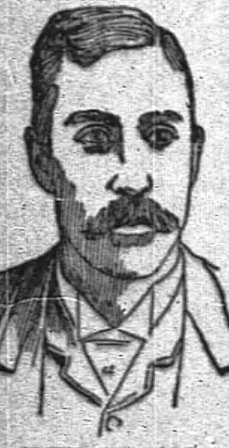
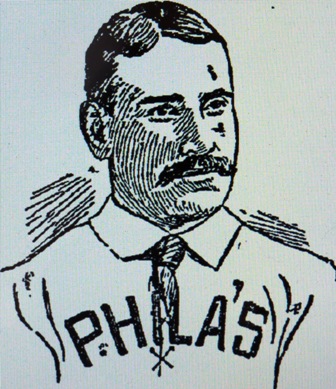
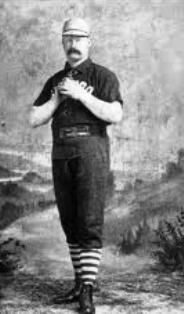
John Morrill

John Morrill

Morrill said that “on the whole” he thought his player’s superstitions were “a very good thing,” as long as “bad signs do not outnumber the good one.”  Morrill felt players were more inclined to look for good signs, which would encourage them to play “with more confidence.”

Morrill was also a supporter of mascots:

“Mascots are good things to encourage the boys.”

Morrill even attributed his greatest success as a manager to the power of superstition.  He took over the reins of the fourth place Beaneaters in July of 1883, and the team won 33 of their last 44 games and won the National league pennant.

“When we were way behind in the race for the championship, one of the members of our nine saw a horseshoe in front of the hotel in Detroit.  He stepped into the street and picked it up.  On it was the mark ‘O Winn.’  It was only the name of the Detroit blacksmith who had made the shoe, but as we won the game that day, the members of the nine began to regard the shoe as a good-luck sign, and the first thing we knew we were winning games right and left, and ended the season in the lead.  Our players attributed out success to the horseshoe, and so did Mr. O. Winn, who never fails to call upon us when we are in Detroit.”

More than 40 years later, William Braucher, columnist for the Newspaper Enterprise Association, resurrected the story of the horseshoe—although he embellished some of the details of Boston’s winning season.

He said the player who had found the horseshoe was outfielder Paul Radford. According to Braucher, “Radford’s father had it gilded and framed and it was presented to the Boston National League club.”

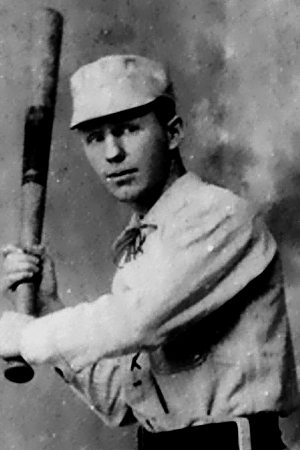
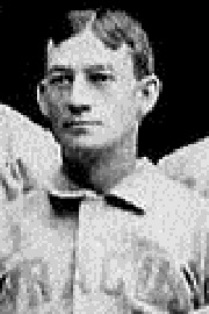
Paul Radford--found the horseshoe

Paul Radford–found the horseshoe

The horseshoe hung at the South End Grounds until the ballpark was destroyed by fire on May 15, 1894

Baucher said Red Sox owner James Aloysius Robert “Bob” Quinn, whose club had been a perennial doormat since he took ownership in 1923, was so desperate for a winner that he was trying to locate the missing horseshoe.

“Bob Quinn would like to know what happened to that horseshoe.  The president of the Red Sox even went so far as to put an ad in the Boston papers the other day offering a reward for the shoe stamped with the name of ‘O. Winn.’  Bob is trying every possible means to give Boston a winning ballclub.  And if a horseshoe will help he wants it.”

Bob Quinn

Bob Quinn

Quinn never found the horseshoe, and never had a  winning Red Sox team.

“Boys of ’76”

5 Jan

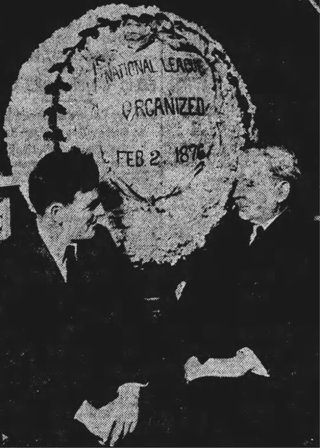
On February, 2, 1925, The National League magnates “paused in (their) schedule deliberations” to honor the league’s past, and kick-off the diamond Jubilee celebration.

Thomas Stevens Rice, of The Brooklyn Eagle said:

“In the very same rooms in which it was organized on Feb. 2, 1876, the National League of Professional Baseball Clubs met again yesterday.  These rooms are in what is now called the Broadway Central Hotel, then called the Grand Central Hotel.”

The Associated Press said:

“In the same room in which Morgan G. Bulkeley, of Hartford, Conn., was elected the first president of the National League, the baseball men, paid tribute to the character and courage of those pioneers a half century ago.”

Dozens of dignitaries were on hand, including, John McGraw, Christy Mathewson, John Montgomery Ward, and Governor John Tener

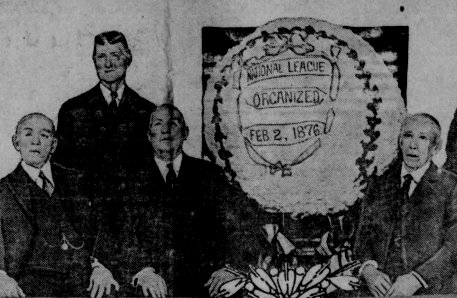
But, the stars that day were six of the surviving players who appeared during the league’s inaugural season:

George Washington Bradley, 72, who won 45 games for the St. Louis Brown Stockings; John “Jack” Manning, 71, who hit .264 and won 18 games as an outfielder and pitcher for the Boston Red Stockings; Alonzo “Lon” Knight, 71, an outfielder and pitcher for the Philadelphia Athletics in 1876 and hit .250 and won 10 games, and three members of the Hartford Dark Blues, Tommy Bond, 68, a 31-game winner; Tom York, 74, who played leftfield and hit .259, and John “Jack” Burdock, 72, an infielder who hit. 259. Also present was the only surviving umpire from the 1876 season–Calvin J. Stambaugh.

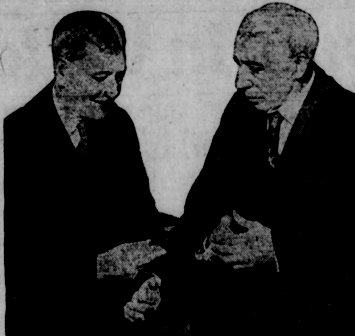
Calvin Stambaugh, right, the last surviving umpire from 1876 and Frank Wilson, a national League umpire from 1923 until his death in 1928.

Calvin Stambaugh, right, the last surviving umpire from 1876 and Frank Wilson, a national League umpire from 1923 until his death in 1928.

Other surviving 1876 players, including George Wright and and Al Reach cited “advancing age” for their inability to attend.

feb21925pix

Seated from left: York, Bradley, and Manning. Standing: Bond.

 Bozeman Bulger of The New York World said, in relating a conversation between too of the attendees, the event was notable for another reason as well:

“(S)everal of us younger men, moving over closer, discovered a contradiction of a tradition long cherished, that old-timers never could admit any improvement in the game or in the quality of the players.

“‘Have you seen this young fellow, Babe Ruth?’ Bradley asked of Manning.

“‘Yes, indeed,’ admitted Mr. Manning, ‘and don’t let anybody tell you that we ever had a man who could hit a ball as hard as that boy.  I doubt if there will ever be another one.'”

Bulger said the “Boys of ’76” also talked about how they “fought crookedness when a salary of $1,800 a year was considered big pay for a star.”  Bradley, who after baseball became a Philadelphia police officer, said:

“‘Oh, we had crooked fellows following us around back in ’76.  They pretended to make heroes out of us and would hang around the hotels.’

“‘One day Mr. (Chicago White Stockings President, William) Hulbert, a very learned man, advised me to keep away from these men.  He explained how they could ruin a boy and lead others into temptation . I was often approached, but thanks to that wise counsel, I kept myself straight, and I thank God for it today.  It’s worth a lot to me to look you younger men in the eye and feel that in turning the game over to you, we gave you something that was honorable.  It’s up to the players to keep it honorable.”

Tom York summed up his feelings about the game in 1876:

“‘Say, do you remember how proud we used to be after winning a game, when we walked home still wearing our uniform and carrying a bat–and the kids following us?  Ball players–all except Babe Ruth–miss that nowadays.”


bondmanning

Bond and Manning talk pitching at the Golden Jubilee kickoff event in 1925.


“I’ll Break your Head if I ever get out Again”

8 Dec

Before a game against the Philadelphia Quakers in 1883, Providence Grays outfielder Samuel “Cliff” Carroll was drinking from a hose.  He then turned the hose on a Providence fan named Jimmy Murphy.

After the game, an 8 to 4 Grays victory, Murphy returned to the Messer Street Grounds with a gun.

Cliff Carroll

Cliff Carroll

The Providence Evening Press said:

“Shortly after the ball game, Wednesday afternoon, the neighborhood of Messer Street was thrown into a state of great excitement by the announcement that a member of the Providence baseball club had been shot.”

The paper said the initial hysteria included reports that the player had been killed.

“A well-known baseball crank named “Jimmy” Murphy, has been in the habit, for some time past, of frequenting the ball grounds during the hours of practice, and imagining himself to me a player of extraordinary merit.  Owing to his eccentricities he was a source of great amusement to the players, and was made by them the butt of many practical jokes.  ‘Jimmy,’ who is said to be slightly ‘off’ mentally speaking, occasionally resented his treatment, but never until Wednesday did he report to violent means.”

The Evening Press said after Carroll “thoroughly drenched” Murphy with the hose:

“Murphy immediately departed, nursing his wrath, and in the afternoon returned, and waited outside the grounds until the players issued, after the game.  Carroll came out with a number of men, among whom was (Joe) Mulvey, the change shortstop, and ‘Jimmy’ at once drew a pistol and deliberately fired at Carroll, but owing no doubt to his excitement, he missed his man, and the bullet struck Mulvey in the right shoulder, inflicting a painful, though not dangerous wound.”

Murphy, the shooter, fled from the scene, and was pursued by police, citizens, and Grays second baseman Jack Farrell.  He managed to escape, but was arrested later in the evening.  Neighbors told the paper “Murphy is a ‘crank’ in other matters besides baseball, and is not considered responsible for his actions.”

It was later learned that the wound to Mulvey was superficial, the ball never penetrating his skin:

“Mr. Mulvey quietly walked to his home on Crary Street, congratulating himself upon his narrow escape.”

The following day in court, Murphy was found “probably guilty in the justice court,” and “bound over to the court of common pleas.”  While being led out of the courtroom, Murphy spotted Carroll and said:

“I will get even with you yet, I’ll break your head if I ever get out again.”

The eventual adjudication of Murphy’s case is lost to history.

Carroll was part of the 1884 “World Champion” Grays team, and remained with Providence until the club folded at the end of the 1885 season. He played with five more National League teams through 1893; although he sat out the 1889 season to operate a farm in Bloomington, Illinois.

There is no record of Murphy having ever having the opportunity to “get even.”

Carroll died in 1923 in Portland, Oregon.  The Oregonian said:

“One of the greatest baseball players of the game died in Portland recently, but so modest was he that few even knew he had been spending his last years here.”

The Providence Morning Star reported on the day of the shooting that Grays Manager Harry Wright had agreed to “loan” Mulvey to the Quakers.    Mulvey joined Philadelphia in early July.  He was switched to third base, and was a member of the Quakers through 1889, he played until 1895

Joe Mulvey

Joe Mulvey

Mulvey remained in Philadelphia after his playing days and worked as a watchman at Shibe Park.  The Associated Press said on August 20, 1928, the man who had a brush with death at a ballpark in 1883, “attended a boxing show at the ballpark,” and “was found dead of heart failure in the club locker room,” the following morning.

“It would increase the Batting, both in a Scientific and Slugging way”

5 Dec

After finishing in second place with a 73-38 record in 1884, the Boston Beaneaters slipped to 46-66 with a fifth place finish the following year; among the reasons for the decline was the team’s batting average which dropped from .254 to .232.

The Sporting Life’s Boston Correspondent said local fans had proposed numerous “wild ideas for proposed changes in the way the game is played,” to remedy the hitting woes.  Of those, one was “worthy of consideration.”

The paper said many “prominent base ball men and a number of players and all have expressed approval.”  Among those consulted were John Morrill, the Beaneaters’ manager, and Arthur Irwin, shortstop for the Providence Grays, both who said the plan would result in more “safe hitting.”

John Morrill

John Morrill

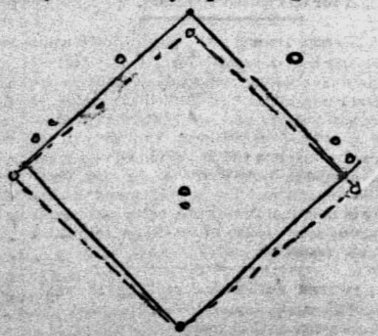
The Sporting Life said “The idea is to make what is now called a diamond but is actually a square a true diamond,” and included a crude diagram:

The Sporting Life's rendering

The Sporting Life’s rendering

 “(T)he catcher would be brought ten feet nearer second base, which would prevent free stealing, and would also enable the second baseman to return a thrown ball to the catcher in time to cut off a base runner.  The pitcher would be placed back five feet, thus reducing the distance between him and second base…the batsman is five feet further from the pitcher, and could therefore more easily hit the ball, thus reducing the number of strikeouts considerably and making livelier fielding by giving more chances.

“The distance from third to first would be increased, thus giving scientific batters and good runners a better chance to beat the ball to base.  The change of foul lines would lessen the number of tedious foul balls; would give more chances to drive the ball between the infielders; would save many pretty hits now called foul; would spread the outfielders more, thus increasing the number of safe hits, and, besides, enable them to make, with the increased territory, more difficult running catches; would give chances for longer hits; it would lessen the damage from errors and make more earned runs, as base runners would have to hug their bases more closely, depending on hitting to score.

“It would but slightly reduce the effectiveness of pitchers without laming them, and give the catcher a better chance to play his position as it should be played.

“To sum up, it would increase the batting, both in a scientific and slugging way; lessen the work of the battery without seriously affecting effectiveness; compel runners to exercise good judgment with speed and increase the work of the fielders over fifty percent.”

The Sporting News suggested that Albert Spalding would “introduce the plan at the League meeting this week and doubtless it will be given thorough consideration,” but none of the coverage of the meeting included any mention of the plan being considered.

Like the “the proposed new diamond,” briefly championed by Chicago Colts President James Aristotle Hart, seven years later, the 1885 plan went the way of dozens of other 19th Century “innovations.”

“This kind of Argument is the Veriest kind of Twaddle”

1 Dec

After just one season in the National League—a 24-36 record and a fifth place finish in 1878–the Indianapolis Blues disbanded.  Four members of the Blues joined the Chicago White Stockings—Silver Flint, Joe Quest, Ned Williamson, and Orator Shafer.
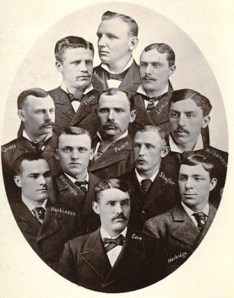
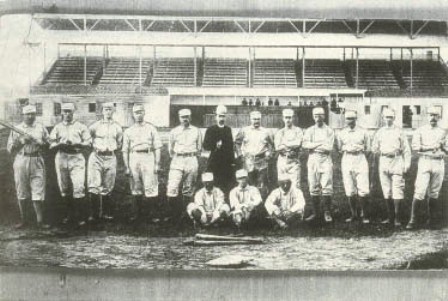
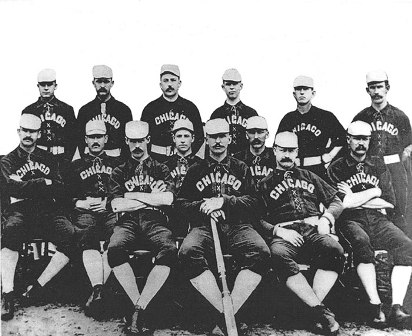
The 1879 White Stockings

The 1879 White Stockings

The White Stockings had been a disappointment in 1878, finishing in fourth place with a 30-30 record under Manager Bob Ferguson.  President A.G. Spalding, who had named Ferguson as his successor when he retired from the field, announced that first baseman “Cap” Anson would replace Ferguson for 1879.

The changes gave the Chicago press high hopes for 1879.

But, The Cincinnati Enquirer did not agree.  The paper said while the Chicago club was “greatly strengthened where it was very weak,” they would still finish no better than fourth place unless they were “properly managed.”  Boston Red Stockings Manager “Harry Wright could take this team and run it up to second place at least.”

In January The Enquirer implied that in addition to questionable management, Chicago’s new players were going to be a detriment:

“A prominent baseball official of Boston, in a private letter written recently, sententiously remarks: ‘Look out for the Indianapolis element in the Chicago Club next year.’  There’s a text for everybody’s thoughts.”

The Chicago Tribune quickly fired back with an article under the headline:

“Harmony” vs. Energy

 “There has been a great deal said at one time and another concerning ‘harmony’ in nines, and those who had the most to say on the subject contended that it was an essential point to be carefully looked after in the formation of any club which hoped for success on the diamond field.  Now The Tribune does not wish to set itself up in opposition to the judgment of men who have made baseball and the management of those who play it a study and a business venture, but it does say that many of them have harped so long upon this matter of ‘harmony’ that it has become a kind of second nature, whereby their judgment has been sadly warped.  Of late a paragraph, started in Cincinnati, has been going the rounds, in which the general public is solemnly warned to ‘look out for the Indianapolis element in the Chicago Club’ during 1879.

“Now the President and Manager of the Chicago Club are probably about as astute and far-seeing as any in the business and in view of this fact and reflection on their judgment or sagacity is in bad taste, and the parties who make ill-advised criticisms on the course of any club in hiring men, are very apt to undergo the unpleasant experience of persons not brought up in New Zealand who indulge in the pastime of throwing boomerangs; their weapons may come back and inflict considerable damage on those who threw them.  Whether or not the White stocking nine of next season will be a ‘harmonious’ one, it is doubtful if anybody knows, and still more doubtful if anybody cares.

“At the risk of being howled at by several papers, the baseball columns which are presided over by young men whose practical ignorance of the game is exceeded only by their ability to construct tables which not even themselves can understand when printed.”

One of the “Young men” referred to was The Enquirer’s sports Editor Oliver Perry “O.P.” Caylor.
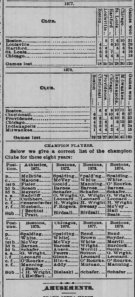
One of O.P. Caylor's tables "which not even themselves can understand when printed.”

One of O.P. Caylor’s tables “which not even themselves can understand when printed.”

The Tribune will say that the question of whether or not the Chicago nine of next season ‘harmonizes’ will probably make very little difference with its play.  Some of the men who enjoy the reputation of being first-class kickers and disorganizers are nevertheless very handy individuals to have around when a base hit or good field play in wanted.  Without intending either to arouse the wrath or flatter the vanity of the very amiable and stalwart young man, Anson, it may be said that his reputation as an experienced and prolonged kicker is one that any man might be proud of; but, in spite of those who preach that harmony is everything, he is acknowledged to be one of the best and most useful ball-players in the country.  (Cal) McVey, of the Cincinnatis, can also make quite a conspicuous kick, even when not specially called upon to do so; still he is a good ball-player.

Lip Pike is a disorganizer of the first water, but last season, when he used to hoist a ball out among the freight cars on the lake shore, people who were presumed to know a good player yelled themselves hoarse in his praise.  The list could be extended indefinitely, but such action is not necessary.  Those who organize nines on the basis of ‘harmony’ alone will never grow rich at the baseball business.  It is not possible to get together nine men who could travel around the country eating, sleeping, and playing ball together that would never get out of tune.  Nine angels could not do it, much less nine mortals, subject to the little idiosyncrasies that human nature is afflicted with. “

The Tribune likely assumed the “prominent baseball official of Boston,” was Manager Harry Wright, and next turned its attention to him, his brother, and his championship teams.

“Harry Wright has always been the prophet whom the ‘harmony’ men delighted to honor, and the success of the Cincinnati and Boston Clubs under his management has been laid entirely to the dove-like dispositions of the men engaged by him.  This kind of argument is the veriest kind of twaddle, and the history of the Boston Club proves the truth of this assertion.  George Wright and Tommy Beals went many a day without the interchange of a friendly word, and George and (Charlie) Gould did the same thing.  For one whole season Ross Barnes and Gould never exchanged a word, and glared at each other like opposing game chickens, but the Boston’s won the pennant that year (1872—National Association) all the same harmony or no harmony.

“Other instances of like character could be adduced were there any necessity therefore, but these, from the fountain head of ‘harmony,’ will suffice.  If a club wins the championship it will be because its men play ball, not because they are ‘goody-goody’ boys.  Your man who gets hot at something during a game, and then relieves his feelings by making a two or three base hit, is much more valuable than one who, although possessed of a Sunday-school temperament at all times, manifests a decided aversion to reaching first base., when the occupancy of that particular bag of sawdust would be of some value to the men who pay him high wages for playing ball.”
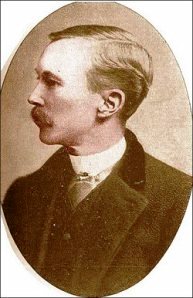
O.P. Caylor

O.P. Caylor

Caylor would not let the insult to him and to Harry and George Wright, go unchallenged:

The Chicago Tribune published some strange statements against the argument that in harmony there was always strength.  To prove that harmony was not always necessary to create strength in a baseball club, the writer made bold to say among other things that Tommy Beales [sic] when a member of the Boston Club, went many a day without the interchange of a friendly word with George Wright, and that the same feeling existed between George and Gould.  The writer knew from the first these statements were fiction, but in order to crush the fallacious argument our reporter left it to George Wright himself for an answer.  The letter is before us from which we quote, though we half suspect George would demur to its publication out of modesty if he knew it. “

Wright wrote to Caylor:

“(The Tribune) said Tommy Beales [sic] and I went many a day without the interchange of a friendly word, and that Gould and I did the same thing.  While they were with the Boston nine they were about my best friends.  Most of the time Beales [sic] boarded at my house, while Charley and I roomed together on trips.  I think the reporter was wrong in his argument against ‘Harmony’ as it was the great cause of the Boston Club’s success.  The credit for this mostly belonged to Captain Harry Wright.”
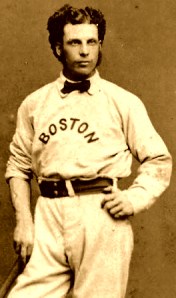
George Wright

George Wright

Although it appears Wright spelled the name of his good friend Tommy Beals incorrectly, he got the spelling right 12 months later when he named his son—tennis Hall of Fame member –Beals Wright after his former teammate.
The Tribune allowed Wright, and Caylor, the last word, and dropped the dialogue regarding “harmony.”

Despite Caylor’s prediction, the White Stockings, under Manager Cap Anson, led the National League from opening Day through August 15.  Anson became ill during July, and as his performance slipped, so did the team’s fortunes.

Suffering from what The Tribune called “an acute affection of the liver…that had sadly impaired his strength and capacity for play,” Anson left the club on August 26 with a 41-21 record, in second place, just a game and a half back.

With Silver Flint serving as manager, and without Anson’s bat—he led the team with a .317 average—the White Stockings were 5-12 in the last 17 games, and a fourth place finish.

Harry Wright’s Boston Red Stockings finished second; his team, winners of the previous two National League championships lost some of the “harmony” that made them winners when his brother George Wright and Jim O’Rourke signed with the Providence Grays.  George Wright, in his only season as a manager, led the Grays to the 1879 National League championship.

“Women have been the cause of Ruin of more Good Clubs than Anything Else”

17 Oct

In 1907 Hugh Fullerton wrote in The Chicago Herald about the outside influences that he felt did the most damage to a ballclub:

Hugh Fullerton

Hugh Fullerton

“There are dozens of things that happen to keep a team from landing a pennant about which the general public is entirely ignorant and which never can be explained clearly.

“For instance, one of the mysteries of baseball was the breaking up of the famous White Stockings team.

“Hundreds and thousands of people cursed the management of the Chicagos for selling off star players and wrecking the club—and few ever knew why it was.  The management felt worse over it than the fans possibly could feel—but it was inevitable.  A scandal in the club concerning two members and the wife of one of them started the trouble.  Threats to kill each other were made—and the disruption of the club became absolutely necessary.  The sale of (Mike “King”) Kelly (1887) and (John) Clarkson (1888) was the beginning –and after a time all parties to the scandal were let out—and Chicago was given a decade of losing clubs.”

Mike "King" Kelly

Mike “King” Kelly

He claimed the reason for the breakup of the White Stockings was a common one.

“Women have been the cause of ruin of more good clubs than anything else.  They need not necessarily be bad women.  There was one club in the old twelve-club National League which, for two years, was knocked out of all chances of winning merely because the wife of one of the players was an inveterate gossip.  She knew everything that went on in the club and retained it until she had half the players up in arms against each other.

“One of the best manager s in the country today frowns upon all women and his players, under his direction, forbid their wives to mention the subject of baseball to each other.  The result is that there is the best feeling in the club.  Almost every member of the team is married, their wives meet socially at all times—and baseball is tabooed by common consent.

“I know a catcher, one of the toughest, hardiest fellows in the business, who nearly was ruined as a catcher by the women of the club.  He was so strong and tough that you couldn’t have dented him with an ax, but one day he split his hand a little bit.  He thought nothing of it, and was ready to catch the next day when the women got to pitying him and telling him he ought to take good care of it.  When he left the grounds he had tied up the injured place with a rag—and was all right.  By the next morning he was ready to go to the hospital—and he did lay off for two weeks, all because the women made a martyr of him.”

But, according to Fullerton, there was something almost as bad for a baseball team as women:

“Horse racing, however, has ruined almost as many clubs as women have.  Once a team gets interested in horse racing, and so far as winning goes, it might as well disband.

“One of the greatest troubles in the present New York National League team is the devotion of some of the players to the racing game.  (John) McGraw himself has been so successful at it that baseball has become sort of a side issue.  Many of his players have followed his example, and the result is they think more of horse racing than of baseball.

“Racing did more to wreck (Ned) Hanlon’s championship Brooklyn team than any other thing.  The Washington Park grounds are so close to the Brighton and Sheepshead tracks that players could see two or three races before the game.  Eventually baseball was forgotten and the conversation in the clubhouse dwelt only on horse racing.

(Cap) Anson had a crowd of horse race fans for several years, and the result on the work of the team was something frightful.  They talked horse racing even on the field, and had the telegraph operators throwing out messages telling what horses had won.”

And, he said, gambling in general had been detrimental to the Giants during the years Andrew Freedman owned the club (1895-1902):

“There always was a crap game or a poker game in the clubhouse, and the stakes were so high that bitter feeling was endangered.”

While Fullerton, for the most part, avoided naming names, he did single out one former Chicago manager, who had died five years earlier, for presiding over teams that were “ruined” by gambling:

“The Chicago team the second year under Tom Burns (1899) was wrecked by the same sort of deal, the manager setting a bad example in that respect.  Burns also was charged by the Pittsburgh owners with ruining their club, when he was manager (1892), by permitting and encouraging gambling.”

Tom Burns

Tom Burns

“We didn’t have any High-Faluting Baseball Paraphernalia”

15 Oct

The Seattle Star said of Dan Dugdale:

“No man in the Northwest can rival the experiences in baseball that Daniel E. Dugdale has had in the national game.”

In his 1934 obituary, The United Press called Dugdale “the father of organized baseball in Seattle.”

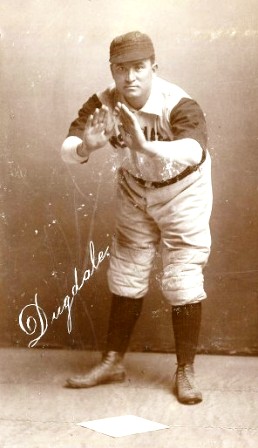
Dan Dugdale

Dan Dugdale

Primarily a catcher, Dugdale played professional ball for more than a decade; including two stints in the National League with the Kansas City Cowboys in 1886 and the Washington Senators in 1894.  He retired after the 1897 season and made what was intended to be a brief stop in Seattle on the way to Alaska for the Klondike Gold Rush.  He never made it to Alaska, and in Seattle, he organized most of the city’s early professional teams and built two ballparks.

Dan Dugdale 1894

Dan Dugdale 1894

Forty years after he began playing he shared his reminiscences about in the early 1880s in his hometown of Peoria, Illinois with Seattle reporter Leo Lassen:

“We didn’t have any high-faluting baseball paraphernalia for the deciding game of the Peoria, Illinois city championship in the summer of 1883.  I can remember that we used a piece of the curbstone for home plate.  Nobody except the catcher used glove, and he only had a fingerless glove of thin leather over both hands.

“Oh yes!  Of course my team, the Double Browns, won, or it wouldn’t start this story out right.  It was in that game that I got my start as a catcher.

“I had been playing shortstop, but the regular receiver split a finger and there wasn’t anyone else to catch, so I tried it.

“We stood back for the pitches except on the third strike, and except with men on bases, catching the ball on the first bounce when standing back.

Ted Kennedy, who later helped pitch one of Pop Anson’s Chicago teams into the championship, was hurling for our side that day, and baby but he could throw that ball with plenty of swift.

“’Don’t catch if you want to keep your health,’ Ted warned me before taking up my receiving duties…Kennedy was right.  The first time I stood up close to catch, the ball hit that curbstone plate and crashed into my mouth, knocking out teeth by the wholesale and putting me on queer street.

“But in those days no one considered quitting as long as it was possible to stand up and catch the ball.

“I finished the game and we won the championship, and I felt well repaid for it.

“That game started me on my baseball career as a catcher, after which I was to serve for 15 years as a receiver for clubs throughout the country.”

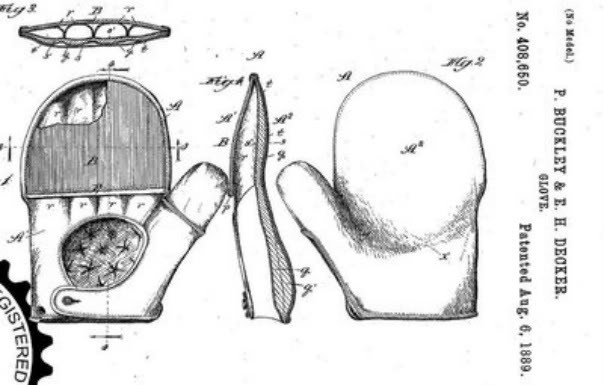
Kennedy wasn’t the only major leaguer Dugdale played with while in Peoria.  In 1885, he played with one of the claimants to the title of invention of the catcher’s mitt—Harry Decker—and Dugdale talked about some of the attempts his teammate made to protect his hands four years before Decker was awarded the patent for the Decker Safety Catcher’s Mitt:

“(Catchers) had no shin guards, masks or big gloves in those days, and a fellow had to be almost a martyr to go behind the plate with fellows like John Clarkson, Amos Rusie and those old stars doing the pitching.

“The big catcher’s pad now in use in baseball, is the same glove that Harry Decker, a teammate of mine on the Peoria team in 1885, invented.

“Harry had been troubled with split fingers and he kept tinkering around with leather trying to figure out how to protect his left hand, which does the big work for all catchers.

“He had a thin, fingerless glove to start with and one day he slipped a piece of raw beefsteak between the glove and his hand and that glove gave him his first idea.  He used this protection for almost a season, using a fresh piece of meat each day.

“Then he tried shot in the pocket of the glove and put a piece of leather on top of the shot, leaving it between the two pieces of leather.

“This gave him the idea of building the mitt up bigger and lacing fingers on the back of the glove.

“One day he hit upon the idea of stuffing the glove with rags in the mitt for protection, and finally got some good felt and used that.  It has been in use ever since.”

Decker Safety Catcher’s Mitt

Decker Safety Catcher’s Mitt

Dugdale remained the most prominent figure in Seattle baseball until he was hit by a truck and killed in 1934.

Accounts vary over how much Decker received from the sale of the mitt patent to A.G. Spalding.   He  is one of the enigmatic 19th Century players for whom there is no information on the date or location of his death.

After his career ended in 1891 he was convicted of numerous crimes—most involving forgery, but also including larceny and bigamy; several of his crimes involved other ballplayers.

Throughout his career Decker had a reputation as a womanizer; The Philadelphia Inquirer called him “The Don Juan of the Diamond,” but by 1890, perhaps exacerbated by his being hit in the head by a pitch, he went from lovable rogue to serial offender.  He racked up arrests and convictions in at least six states and an involuntary commitment to the Elgin State Hospital in Illinois over the next 25 years.

Victims of his crimes included Dugdale, and Al Reach, both of whose names appeared on forged checks in separate cases, and Jack Horner and Pat Pettee, teammates of Decker’s in 1891 during his brief stay with the New Haven Nutmegs in the Eastern Association.  Decker was convicted of stealing property worth $150 from Horner and $55 from Pettee after the two had allowed him to stay in the apartment they shared.

Decker’s trail goes cold after he was released from California’s San Quentin Prison in 1915.

Leo Lassen, the reporter Dugdale spoke to, went on to become the radio voice of the Seattle Rainiers of the Pacific Coast League from 1931 through the 1961 season.  Some surviving audio can be found here.

Bad Bill Eagan

6 Oct

William “Bad Bill” Eagan was just 35-years-old when he died from tuberculosis in 1905, but many people didn’t believe it when the news was first reported. The hard-living Eagan’s demise had been predicted and reported several times. In 1901, the year after his professional career ended, The Fort Wayne Sentinel said:

“’Bad Bill’ Eagan who died two or three times last year, is running a poker room in Detroit. Eagan dies on the average of three times a year and is about due for the first of this year’s series. Eagan captained and played first base for Youngstown before his second demise last season.”

Bad Bill

Bad Bill

In 1899 Connie Mack told The Philadelphia North American:

“Eagan would be one of the best second basemen in the business if he would keep in condition.”

He quickly wore out his welcome during all three of his brief stints in the big leagues. The first, with the St. Louis Browns in the American Association in 1891, ended, according to The Syracuse Standard after an incident with team owner Chris von der Ahe:

“(Eagan) was a jolly fellow and not afraid of discipline. The Browns got on a train at St. Louis to come East…von der Ahe’s nasal organ was rather large and red for its age and ‘Bad Bill’ determined to have some sport.

“Walking up to his employer, he caught the nose between his fingers, and said: ‘Say, Chris, how much did it cost to color that?’

“The owner of the cerise nose was furious with rage. He released Eagan at once. The train was ninety miles east of St. Louis, and at von der Ahe’s order the conductor put the nose twirler off the train.”

Two years later Eagan joined ‘Cap’ Anson’s Chicago Colts. Hugh Fullerton told the story of how he wore out his welcome there after just six games:

“Anson was a quick thinker on the ball field, but once he released the best second baseman that ever wore a suit for thinking a little quicker than anybody else on the nine.

“The second baseman in question was “Bad Bill’ Eagan. Everybody who remembers ‘Bad Bill’ will admit his supremacy on the second bag. When the play we celebrate came up there was a base runner on second. Chicago was one run to the good, and it was in the last half of the ninth inning.

(Bill) Dahlen was playing third base for Chicago. The man hit a sharp liner down to second. ‘Bad Bill’ started for it and at the same instant the man started for third base.

Bill Dahlen

Bill Dahlen

“The liner was a clipper and the ball struck ‘Bad Bill’s’ hands and bounded out. It struck the ground ten feet away, with ‘Bill’ right after it. Once he got his hands on it and without stopping to look where he was throwing. ‘Bill’ let the ball fly to third base.

“Most ball players after fumbling the ball would have tossed it to the pitcher or thrown it home if, after looking around, they saw that the base runner had started to try to score.

“In this case the base runner, after touching third, went on for twenty feet and then stopped for an instant to see what had become of the ball. He saw it coming straight as a die for third base, and went back there like a flash. But the ball beat him by ten feet. Unfortunately for the game, and also for “Bad Bill,’ Dahlen had taken it for granted that Eagan would throw the ball to the home plate, and was not looking for it to be thrown to him. Consequently the ball went by him, going within four inches of his nose, and striking the grand stand far behind.

“The result was that both base runners got safely home before Dahlen recovered himself and the ball, and the game was lost to Chicago.

“Anson was furious and immediately after the game gave ‘Bad Bill’ his release for making that throw. As a matter of fact, it was the best possible play under the circumstances, and Dahlen, rather than “Bad Bill’ was to blame for it not coming out as planned. If ‘Dal’ had thought as quickly as ‘Bill’ the game might have been settled right then and there.”

Eagan received one more trial with a major league team in 1898. He started the season on the bench for the Pittsburgh Pirates, but was given the opportunity to start when regular second baseman Dick Padden left the team over a dispute with Manager Bill Watkins in May.

Eagan hit .328, but committed 10 errors in 19 games. He was sold to Louisville Colonels on June 5. The Louisville Courier-Journal said:

“He is a clever fielder, a fair batsman, extremely aggressive and absolutely fearless (and will) certainly strengthen the team in one of its weakest spots.”

But he never appeared in a game for Colonels. The following day The Courier-Journal said the deal was off, and Manager Fred Clarke would only say, via telegram:

“Called deal for Eagan off for good reasons.”

The Colonels passed on Eagan despite being a team badly in need of a regular second baseman—Clarke tried nine different men there during the season, and his primary second baseman, Heine Smith hit .190 and committed 16 errors in 26 games.

Eagan finished the 1898 season with the Eastern League’s Syracuse Stars, where he had played from 1894 to 1897. He finished the year of 1898 in jail in his native Camden New Jersey.

That story Wednesday

Tom Lynch’s Broom

24 Sep

In 1905 Chicago White Sox outfielder Jimmy “Nixey” Callahan talked about his first season in Chicago in 1897 in an article distributed by “Newspaper Enterprise Association” to several newspapers across the country:

“’Bill’ Lange, who is now a prosperous real estate dealer in Frisco, and former Umpire Tom Lynch, who is a theatrical magnate in New Britain, Conn., were sworn enemies of the diamond.  On the ball field Lynch insisted on being addressed as ‘Mr. Lynch’ and was probably the strictest disciplinarian that ever wore a mask.

“We were playing in Boston with the old Chicago club, under (Cap) Anson, and noticed that the broom used to brush the plate was always kept or thrown over to our side, due to some superstition of other on the part of the Boston players to have it on the visitors’ side.  Lange was leading off about the fifth inning and as he walked to the plate he picked the broom up and threw it over on the Boston side.  (Hugh) Duffy, who was then captain of the Boston nine, threw it back.  One of our players ran from the bench and hurled the broom over to the Boston side.  The large crowd began to see the humor of the situation and began cheering the players as the broom passed back and forth.  Lynch stopped the game and as a truce umpired the rest of the game with the broom in his possession.  The next day the broom was missing and Mr. Lynch carried a small whisk broom in his pocket.”

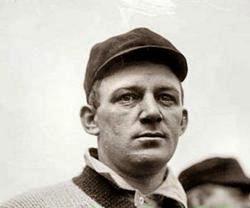
National League President Thomas Lynch

National League President Thomas Lynch

During the same series, Callahan said:

“Lange’s method of annoying Lynch was artistic.  When at bat or passing Lynch he would say” ‘Don’t you think Boston will win today Mr. Lynch? Or ‘Don’t you think Boston will win the pennant Mr. Lynch? Would you as a disinterested party like to see Boston win, Mr. Lynch?’  Never giving Lynch a chance to fine him by being vulgar or noisy, Lange would not stop walking when addressing him, ever.

“He would have Lynch furious, but as he kept within the bounds Lynch was forced to take his medicine.”

Five years later, after Lynch had been named president of the National League; Lange retold the broom story to a reporter and said:

“After the damage had been done I suggested that we compromise by allowing one half the handle to lie on one side of the plate and the other half on the other.”

Years later, another National League umpire, George Barr, told a reporter for The Associated Press that the umpire’s whisk broom was “The most important thing, he possessed on the field:

“That little whisk-broom which most of the fans and players, too, believe is carried around to keep the plate free from dust is actually the symbol of authority the umpire has over the game.

“So when you are working behind the plate, stride up to the old pan and give her a vigorous dusting, even if the thing’s as clean as a whistle.  That’s to let the fans and players know you’re in charge of the game—that you’re the official representative of the league which, in fact, you are.”

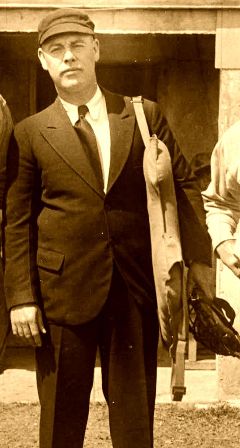
George Barr

George Barr

Things I Learned on the Way to Looking up other Things #11

22 Sep

Floto on Baseball’s Most Powerful Men

Otto Clement Floto was one of the more colorful sportswriters of the late nineteenth and early twentieth century’s.  The Denver Post’s Woody Paige said of the man who was once worked for that paper:

“In the early 1900s Floto was The Denver Post’s sports editor and a drunk, barely literate, loud-mouthed columnist–sounds like a description of that guy in my mirror–who didn’t believe in punctuation marks, wrote about fights he secretly promoted on the side, got into shouting matches with legendary Wild West gunman–turned Denver sportswriter–Bat Masterson.”

Otto Floto

Otto Floto

Floto, in 1910, provided readers of The Post with his unvarnished opinion of baseball’s most powerful figures:

John T. Brush—The smartest man in baseball, but vindictive.

Garry Herrmann—Smart, but no backbone; the last man to him has him.

Ban Johnson—Bluffs a great deal and makes it stick.  Likes to talk.

Charles Comiskey—Shrewd as can be.

Connie Mack—Shrewd and clever; knows the game better than anyone.

Charles Murphy—A hard fighter, but backs up at times.

George Tebeau—More nerve than any other man in baseball, very shrewd.

Barney Dreyfus—Smart, but always following, never leading.

As for John McGraw, Floto allowed that the Giants’ manager was “Pretty wise,” but attributed his success to the fact that he “has lots of money to work worth.”

Too Much Money for Players, 1884

The Cleveland Herald was not happy when pitcher Jim McCormick jumped his contract with the Cleveland Blues in the National League to the Union Association’s Cincinnati franchise.  Although teammates Jack Glasscock and Charles “Fatty” Briody also jumped to Cincinnati, the paper saved most their anger for the first big leaguer to have been born in Scotland.

Jim McCormick

Jim McCormick

The paper noted that McCormick, who was paid $2500 by the Blues, had received a $1,000 bonus to jump:

“(A) total of $3,500 for joining the Cincinnati Unions to play the remainder of the season.  This is equal to $1750 a month, which again divided makes $437.50 a week.  Now McCormick will not play oftener than three times a week which makes his wages $145.83 per day for working days.  The game will average about two hours each, so that he receives for his actual work no less than $72.91 an hour, or over $1.21 a minute for work done.  If he was not playing ball he would probably be tending bar in some saloon at $12 a week.”

McCormick was 21-3 with a 1.54 ERA in 24 games and helped pitch the “Outlaw Reds” to a second place finish in the struggling Union Association.  After the Association collapsed was assigned to the Providence Grays, then was sold to the Chicago White Stockings.  From July of 1885 through the 1886 season McCormick was teamed with his boyhood friend Mike “King” Kelly—the two grew up together in Paterson, New Jersey and were dubbed “the Jersey Battery” by the Chicago press—and posted a 51-15 record during the season and a half in Chicago, including a run of 16 straight wins in ‘86.

He ended his career with a 265-214 record and returned home to run his bar.  In 1912 John McGraw was quoted in The Sporting Life calling McCormick “the greatest pitcher of his day.”

The pitcher who The Herald said would otherwise be a $12 a week bartender also used some of the money he made jumping from Cleveland in 1884 the following year to purchase a tavern in Paterson.

Not Enough Money for Owners, 1885

In 1885 J. Edward “Ned” Allen was president of the defending National League Champions –and winners of baseball’s first World Series—the Providence Grays.  He told The New York Sun that baseball was no longer a profitable proposition:

“The time was when a man who put his money into a club was quite sure of coming out more or less ahead, but that is past.  When the National League had control of all the best players in the country a few years ago, and had no opposition, salaries were low, and a player who received $1,500 for his season’s work did well.  In 1881, when the American Association was organized in opposition to the league, the players’ salaries at once began to go up, as each side tried to outbid the other.  When the two organizations formed what is known as the National Agreement the clubs retained their players at the same salaries.

“Several other associations were then organized in different parts of the country and were admitted under the protection of the National Agreement.   This served to make good ball-players, especially pitchers, scarce, and forced salaries up still higher, until at the present time a first-class pitcher will not look at a manager for less than $3,500 for a season.  (“Old Hoss”) Radbourn of last year’s Providence Club received the largest amount of money that has ever been paid to a ball-player.  His wonderful pitching, which won the championship for the club, cost about $5,000 (Baseball Reference says Radbourn earned between $2,800 and $3,000 in 1884), as did the work of two pitchers and received the pay of two.

The Providence Grays--Champions and unprofitable

The Providence Grays–Champions and unprofitable

“Some of the salaries which base-ball players will get next season are; (Jim) O’Rourke, (Joe) Gerhardt, (Buck) Ewing and (John Montgomery) Ward of the New York Club, $3,000 each.  (Tony) Mullane was to have played for the Cincinnati Club for $4,000 (Mullane was suspended for signing with Cincinnati after first agreeing to a contract with the St. Louis Browns).  (Fred) Dunlap has a contract with the new League club in St. Louis for $3,400.  These are only a few of the higher prices paid, while the number of men who get from $2,000 to $3,000 is large.  At these prices a club with a team costing only from $15,000 to $20,000 is lucky, but it has not much chance of winning a championship.  To this expense must be added the ground rent, the salaries of gate-keepers, and the traveling expenses, which will be as much more.

“As a high-priced club the New York Gothams leads, while the (New York) Metropolitans are nearly as expensive.  The income of these two clubs last year was nearly $130,000, yet the Metropolitans lost money and the New York Club (Gothams) was only a little ahead.  The first year the Metropolitans were in the field(1883) their salary list was light, as were their traveling expenses, and at the end of the season they were $50,000 ahead.”

The Grays disbanded after the 1885 season.