Tag Archives: New York Giants

Things I Learned on the Way to Looking Up Other Things #3

26 Apr

Tools of ignorance

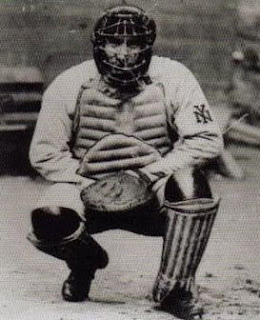
As catchers began to wear more equipment the was widespread disapproval.  In 1884 The New Haven News said:

“With his frontal liver-pad, his hands cased in thick gloves and the familiar wire helmet on his head, the average baseball catcher looks for all the world like an animated combination of a modern bed-bolster and a medieval knight.”

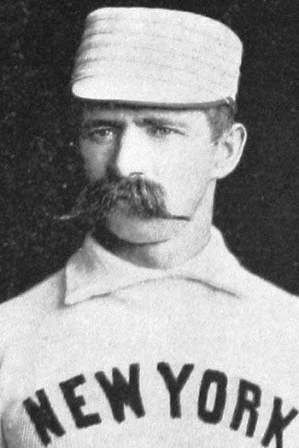
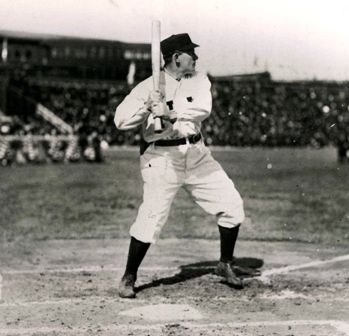
Roger Bresnahan, 1907, more than 20 years after catcher's began to look like "medieval knights."

Roger Bresnahan, 1907, more than 20 years after a catcher began to look like a “medieval knight.”

Cuban Giants Challenge

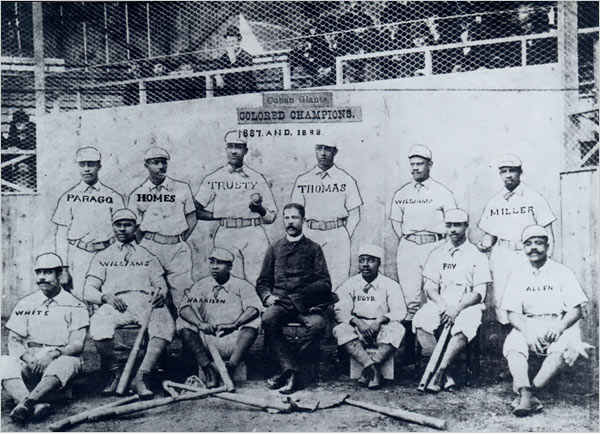
In August of 1888, The Freeman declared the Cuban Giants “virtually the champions of the world.”

The paper said that the first professional black baseball team, were willing to take on any ballclub, but:

“The St. Louis Browns, Detroits (Wolverines) and Chicagos (White Stockings) afflicted with Negrophobia and unable to bear the odium of being beaten by colored men, refused to accept their challenge.”

1887-88 Cuban Giants--"virtually the champions of the world."

1887-88 Cuban Giants–“virtually the champions of the world.”

The Elizabeth Resolutes

The Elizabeth (NJ) Resolutes were one of the worst professional teams of baseball’s infancy.  The 1873 National Association team only played 23 games, losing 21, and from the beginning of the season, the franchise was on the verge of demise.

The New York Herald summed up the general feeling about the team in an August article:

“The Resolute Club, whom everyone hoped had disbanded, as was reported, put in an appearance on the Union grounds yesterday afternoon and played the (Brooklyn) Atlantics, committing, as usual, about five hundred errors.”

It was the first, and last, game on the mound for pitcher Len Lovett.

The Herald concluded:

“The game was a most wretched affair.”

dougallison

Catcher Doug Allison who hit .300, and his brother Art, who hit .320, were rare bright spots for the resolutes.

“Phil Powers Seems to be Dead to the World”

15 Apr

Phillip J. Powers again left the National League umpire staff at the close of the 1888 season.  In 1889 he returned to London, Ontario to manage the Tecumseh’s, quit in May to become an umpire in the International Association, and then resigned from that job to return to the National League as an umpire in July.

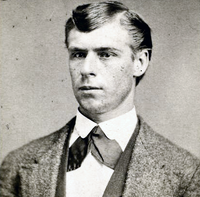
Phil Powers

Phil Powers

The Detroit Free Press said the former and current National League arbiter “would never be a success as an umpire.”

Within weeks he was again at the center of controversy.

After the Boston Beaneaters beat the Philadelphia Quakers on July 25, The Philadelphia Inquirer placed the blame for the home team’s loss squarely on the shoulders of one man:

“Anyone who saw Phil Powers umpire yesterday would set him down as incompetent or dishonest.  While he is neither of these he gave a combination of glaring decisions which robbed the Philadelphia club of the game…It was a hard game to lose and it was no wonder that nearly every one of the 6,7000 spectators joined in hooting at Powers.”

The Inquirer would continue to criticize Powers for the remainder of his career; a few sample quotes.

From 1890:

“Umpire Phil Powers seems to be dead to the world.”

From 1891:

“The rank work of umpire Powers.”

From 1892:

“Umpire Phil Powers has been unanimously elected a member of the Society for the Promotion of Riots.”

The Sporting Life joined the chorus and derided as a “decided detriment to the game,” his work in the Giants-White Stockings series in early August:

“Mr. Powers is not a competent umpire…He does not know the rules, and judging from his decisions on the bases his eyesight is certainly impaired.”

 The Chicago Daily News quoted “Cap” Anson saying Powers “ didn’t know his business.”

Powers did have one defender.  “Orator” Jim O’Rourke, of the New York Giants, wrote a long letter that was reprinted in The Sporting Life, and other papers, making the case for the “High opinion in which Mr. Powers is held by the majority of professionals”, and using the opportunity to heap scorn on Anson:

“No man ever filled the position to better advantage and with more honor and credit to himself.   Mr. Powers is conscientious, faithful and absolutely fearless in voicing his convictions; neither can there be any doubt of his intentions to discharge impartially the irksome duties which the office entail upon him.

“Anson’s hate of such a man is only limited by the capacity of his nature for hate. Now why is this so? Because this cross-grain brow-beater, with the swaggering air of a Mexican bandit, who is so susceptible to becoming red-headed In the presence of umpires and spectators, is forced by this honest referee to have the result of a game settled by the contesting clubs upon its merits and not by his disgusting methods, which have made him the laughing-stock of all players, not even excepting his own.”

Jim O'Rourke--Defender of Powers

Jim O’Rourke–Defender of Powers

Despite O’Rourke’s defense, the criticisms of Powers continued, but he managed to stay on the National League staff in 1890 and ’91.

The Sporting Life updated readers about the umpire through the 1891 season:

“(Powers) has been catching it along the Western line from spectators, players and reporters.”

“(The Pirates) ready to meet Anson’s team to the call of Umpire Phil Powers, who has never pleased Pittsburgh’s audiences”

“Western critics are unanimously of the opinion that Phil Powers argues too much with the players.”

“(Cleveland papers) roasted Phil Powers to their hearts’ content.”

In August of 1891 Powers was released as an umpire by the National League.  He died in New York City in 1914.

A postscript:

A story that has appeared in several books and articles (all citing previous secondary sources) claims Powers pulled a gun on enraged fans in either 1888 or ’89.  While similar stories have been attributed to other umpires (for example umpire Joe Ellick, in 1886, was escorted off the field in Philadelphia by police who drew their weapons to protect him from an angry mob) and there are numerous contemporaneous references to irate fans at games, some with Powers as umpire,  none mention the gun incident.

It is probably a conflation of stories such as Ellick’s and a wire service article that appeared in several newspapers in 1906, shortly after “Buck” Ewing’s death, and described another incident involving Powers and Ewing.

“It was in 1889 that one of the worst rows in the history of baseball was precipitated at Cleveland by “Buck” Ewing.  Phil Powers was umpiring and his weakness whenever a critical decision came up was so apparent that the crowd was on pins and needles as to which way the cat would jump.

“(Jimmy) McAleer hit for two bases.  After he had got (sic) to second, Ewing said something to Powers, and the umpire hesitated a moment and then declared McAleer out for not touching first base…(Powers) was not looking at first when McAleer passed, having turned his head as somebody yelled at him from the opposite side of the field.  This was plainly evident to the crowd, and the moment that the spectators understood why McAleer was out they bolted from the stands and made a rush for the umpire.

“(Powers) took one look at the approaching mob and fled to the players’ clubhouse.  The police cleared the field after a while and Powers was induced to come forth and finish the game, but with police protection on either side of him.”

According to the story (which makes no mention of a gun), Powers later admitted that he had no idea whether McAleer had touched first base and simply took “Ewing’s word for it.”

Jimmy McAleer, called out on Ewing's word

Jimmy McAleer, called out on Ewing’s word

Things I Learned on the Way to Looking Up Other Things #2

8 Apr

A few items from 1888 to 1890:

Largest bat 

Jonah William “Quiet Joe” Knight appeared in the National League as a pitcher for six games with the Philadelphia Quakers in 1884, posting a 2-4 record, and returned in 1890 as a left fielder with the Cincinnati Reds, hitting .312 in 127 games.  He also spent 16 seasons in the minor leagues and was one of the premier hitters in the Eastern League.

When Knight joined the Reds in 1890 The Cincinnati Post said he “uses a larger bat than any other professional.”  Reds shortstop Ollie Beard said:

“I can hardly swing the bat Knight uses let alone hit a ball with it.”

It was said Knight had his bats made to order in his home town St. Catherine’s Ontario, Canada.

joeknight

“Quiet Joe” Knight

Baseball in German

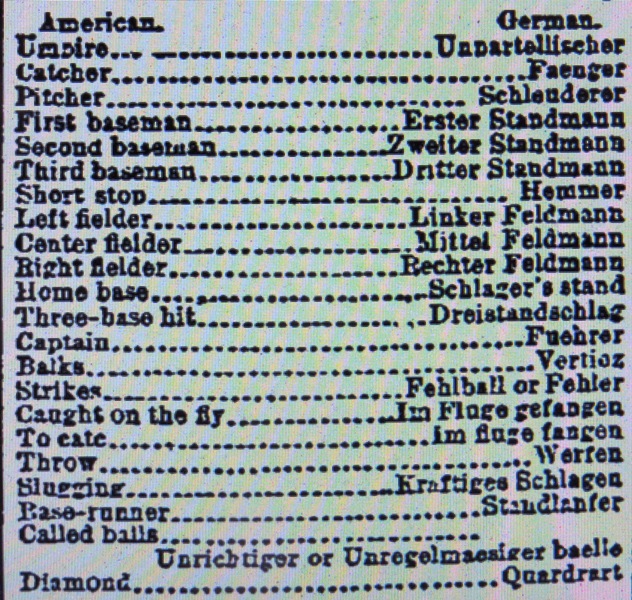
The Boston Herald reported in 1890 that New York’s German language paper Staats-Zeitung hired a baseball editor and would be recapping National League and American Association games:

“Naturally he has been obliged to invent words to describe the technical plays and points and how well he’s succeeded  will be seen from the following:”

???????????????????????????????

Harry Wright’s Team Unimpressive

After the 1887 season Hall of Famer and baseball pioneer Harry Wright took his Philadelphia Quakers on a tour of West Coast along with the Chicago White Stockings, New York Giants and St. Louis Browns; playing exhibition games against each other and with California League teams.

After seeing Philadelphia play The San Francisco Call was unimpressed with the National League’s second place team:

“The ‘Phillies’ will have to improve wonderfully to make their games at all interesting.  They may plead excuses, but they cannot disguise the fact that they played rank ball, and very rank at that.  Their initial effort stamps them as about fourth class, and it will require a brilliant rally to convince people in this section that they are ball-players.  There is not a team in the California League that will not give them a hard game and perchance defeat them.”

Unfortunately there is no record of  how Philadelphia fared on the rest of the tour.

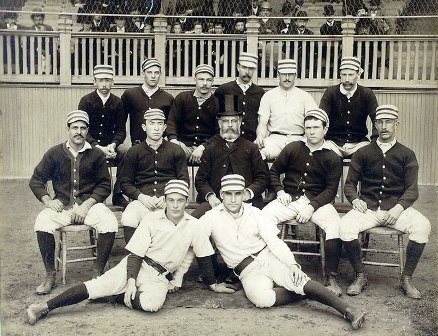
Harry Wright, center, with his 1887 Philadelphia Quakers

Harry Wright, center, with his 1887 Philadelphia Quakers

“Not Quite Such an Idiot”

5 Apr

The 1889 American Association season began and ended as a two-team race between the Brooklyn Bridegrooms and St. Louis Browns, who had won four straight championships—the third place Philadelphia Athletics finished 16 games back.  The battle between Brooklyn and St. Louis was bitter and culminated in September with a charge of umpire bribery.

St. Louis owner Chris von der Ahe made a charge of attempted bribery of an umpire.  He said Brooklyn Captain William “Darby” O’Brien had attempted to bribe umpire John Kerins “$100 and the chance for him to umpire in the World’s Series if Brooklyn got there.” (Some accounts claim the amount was $1000, but the overwhelming number of contemporaneous stories put the figure at $100).

Chris von der Ahe

Chris von der Ahe

The Browns owner claimed “I can prove,” the charges and said “Kerins himself told the story in my presence.  Captain (and manager Charles) Comiskey and another party were in the carriage at the time.”

The other “party” never materialized, and Comiskey, no stranger to dubious charges, never fully backed his boss with a statement confirming the accusation.

Kerins, who since 1884 had bounced back and forth between playing in the American Association with the Indianapolis Hoosiers, Louisville Colonels and Baltimore Orioles, and working as a minor league and Association umpire, called the claim “Simply absurd.”

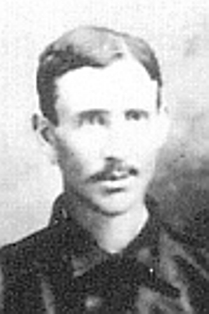
John Kerins

John Kerins


He said he never spoke to von der Ahe, and “I never told Comiskey that any attempt had been made to bribe me,” and that all the charges came from a misinterpreted conversation he had with Comiskey.

Kerins said he simply mentioned to the Browns manager that O’Brien had made “A casual remark,” that “I would give $100 out of my own pocket if Brooklyn could win the championship.”

Kerins said he told O’Brien he’d like to serve as an umpire in the World Series (against eventual National League champions the New York Giants), but it appears Kerins, like every other Association umpire, told many people he’d like to earn the additional money paid to post-season umpires.

Kerins told The Baltimore American that he was:

“Not quite such an idiot as to sell (myself) for the paltry sum of $100.”

O’Brien issued an indignant statement about the charges that appeared in The Chicago Times and other newspapers:

“I was completely nonplussed when I read that story, and, as it was the first intimation I had had of it, you can well imagine my surprise.  To think that that story should reach the eyes of my folks in Peoria and that they might believe me capable of stooping to a dishonest act is what galls me.”

Darby O'Brien

Darby O’Brien

Brooklyn went on to beat the Browns by two games for the American Association Pennant and lost the World Series to the Giants six games to three.

Nothing came of the charges, and it seems doubtful von der Ahe and Comiskey actually believed they were true.

A postscript:  After Comiskey jumped the Browns the following season to join the Chicago Pirates in Players League, von der Ahe signed Kerins (who had all but called him a liar six months earlier), and named him manager in May (one of five Browns managers that season) for 17 games; under Kerins the browns were 9-8.  In June Kerins, hitting .127, was replaced as manager and released by the Browns.

“A Heart-Breaking Play, Engineered by Wagner”

29 Mar

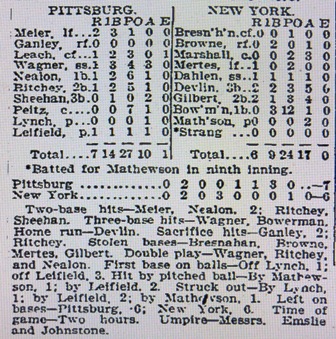
The defending World Series Champion New York Giants had gotten off to a fast start in 1906; on May 15 they were 19-7, the Chicago Cubs were 21-9, when they arrived in Pittsburgh for a four game series.

The Giants were shut out by the Pirates in the first two games.  In the third game of the series Christy Mathewson blew a three-run lead and the Giants trailed 7-5 heading into the top of the eighth inning..

Outfielder Sam Mertes walked, moved to second on Bill Dahlen’s single and scored on a two-out single by second baseman Billy Gilbert.  The Giants were behind 7-6 with runners on first and second; manager John McGraw was about to send Sammy Strang to pinch hit for Mathewson, when, according to The New York Times:

“A heart-breaking play, engineered by (Honus) Wagner in the last second of the eighth inning, beat the Champion New Yorks…It was a hard game to lose, and might not have been lost had Dahlen not fallen a victim to the wiles of Wagner.  The big Dutchman was guilty of the trick of hiding the ball, and when Bill stepped off second base, thinking (pitcher Albert “Lefty”) Leifield had the ball, Wagner, who had concealed it, touched Dahlen, which made the third out.”

Bill Dahlen

Bill Dahlen

The Pirates held on to win 7-6; The Times said of Dahlen:

“The New York shortstop felt so bad that he fairly wept.  McGraw, too, was angry, and it was said tonight he fined Dahlen heavily for his bit of carelessness.”

The Giants were unable to keep pace with the Cubs who finished 20 games ahead of New York for National League Pennant.

The Box Score

The Box Score

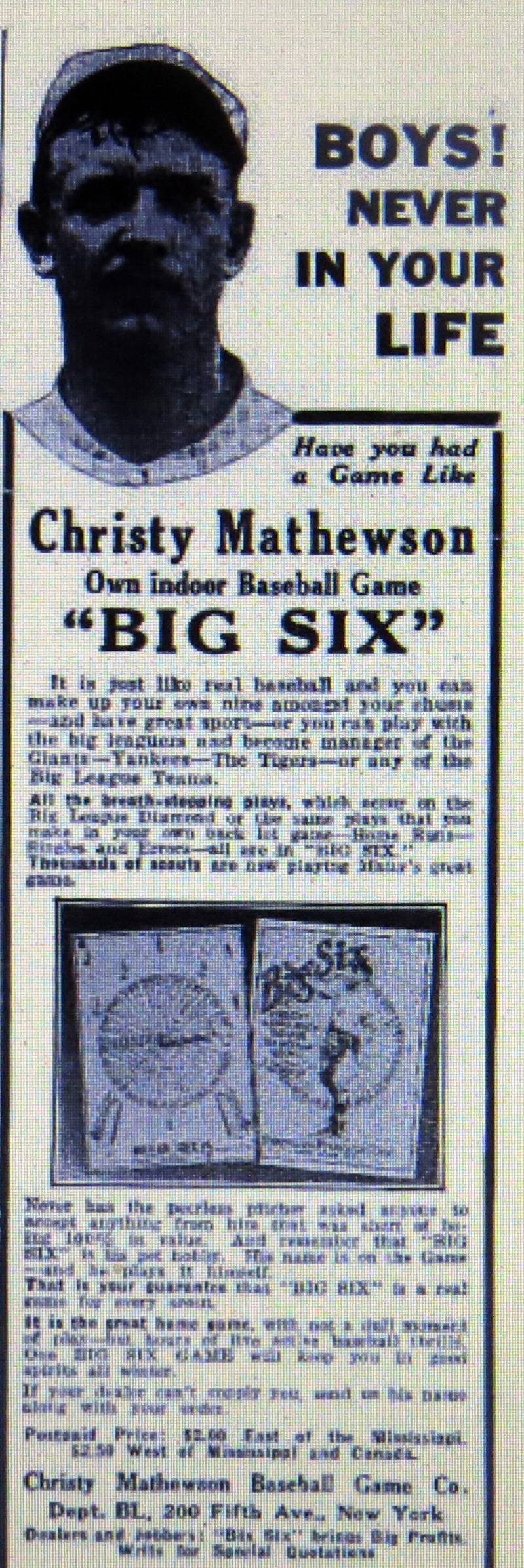
Lost Advertisements-Christy Mathewson “Big Six” Indoor Baseball Game

13 Mar

???????????????????????????????

From 1922–$2.00 East of the Mississippi, $2.50 West of the Mississippi and Canada.

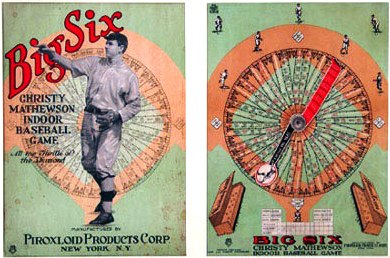
Boys! Never in your life have you had a game like Christy Mathewson Own Indoor Baseball Game “Big Six.”  it is just like real baseball and you can make your own nine amongst your chums–and have great sport–or you can play with the big leaguers and be manager of the Giants–Yankees–The Tigers or any of the Big League Teams.

Box cover and Game Board--Christy Mathewson "Big Six" Game

Box cover and game board–Christy Mathewson “Big Six” Game

Monte Irvin Turns 94 Today

25 Feb

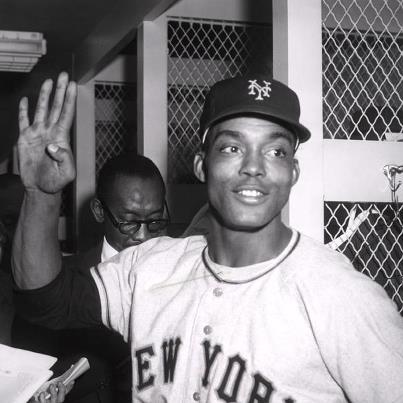
Montford Merrill “Monte” Irvin was born on this date in 1919.

monte

“If a person has good intentions in his heart and wants to do the right thing, then there are certain ways that any obstacle can be overcome. I was very fortunate to have the kind of parents that I had, who believed in doing the right thing, and always tried to be honest, trustworthy, and forthright.”–Monte Irvin, from “Nice Guys Finish First–The Autobiography of Monte Irvin (with James A. Riley)

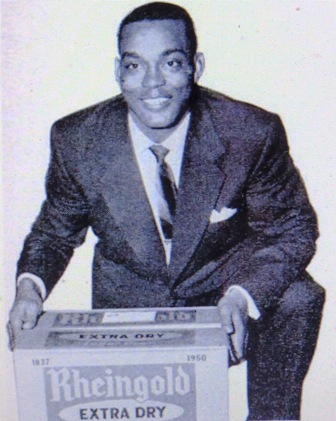
Irvin worked as a salesman for Rheingold Beer during the off season.

Irvin worked as a salesman for Rheingold Beer during the off season.

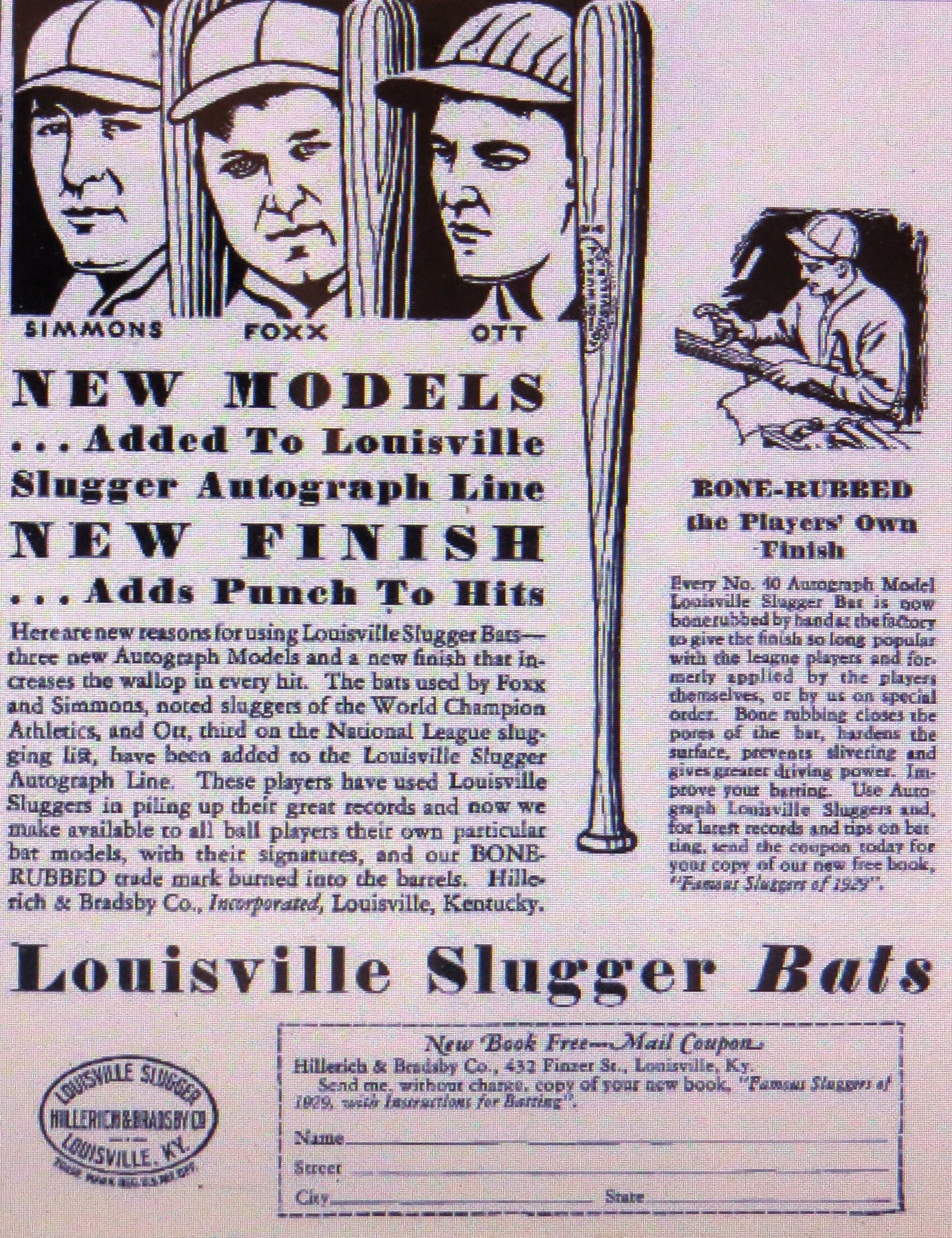
Lost Advertisements–Louisville Slugger, New Finish…Adds Punch to Hits

19 Feb

???????????????????????????????


April 1930 advertisement for Louisville Slugger, featuring Hall of Famers Al Simmons, Jimmy Foxx and Mel Ott.

“Here are new reasons for using Louisville Slugger Bats–three new Autograph Models and a new finish that increases the Wallop in every hit.  The bats used by Foxx and Simmons, noted sluggers of the World Champion Athletics, and Ott, third on the National League sluggers list, have been added to the Louisville Slugger Autograph Line.  These players have used Louisville Sluggers in piling up their great records and now we make available to all ballplayers their own particular bat models, with their signatures, and our BONE-RUBBED trademark burned into the barrels”


Kauff and Perritt

29 Jan

Benny Kauff and Pol Perritt were two of the reasons why the New York giants won the National League Pennant in 1917.  Kauff led the team with a .308 average and Perritt was 17-7 with a 1.88 ERA.  Both came to the Giants by way of the Federal League, and with the help of “Sinister Dick” Kinsella, John McGraw’s right-hand man.
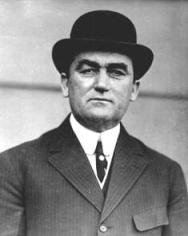
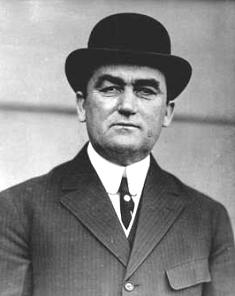
"Sinister Dick" Kinsella

“Sinister Dick” Kinsella

Kinsella was the former baseball magnate of Springfield, Illinois who went east to serve as McGraw’s chief scout.  He was a key player in the incident that led to Giants’ catcher Larry McLean’s banishment from organized baseball.

After the 1914 season, McGraw set his sights on the Indianapolis Hoosiers’ Kauff, who was being called the “Ty Cobb of the Federal League.”  Kauff led the league with a .370 average, 120 runs, 211 hits and 75 stolen bases.

When the debt-ridden Hoosiers were transferred to Newark for the 1915 season Kauff’s contract was sold to the Brooklyn Tip-Tops, and he joined the team in Browns Wells, Mississippi.

At the same time, Perritt coming off a 16-13 season was prepared to jump the St. Louis Cardinals and join the Pittsburgh Rebels in the Federal League.
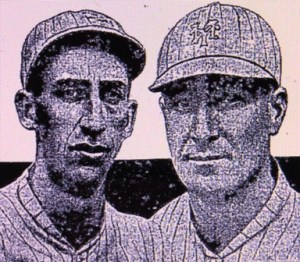
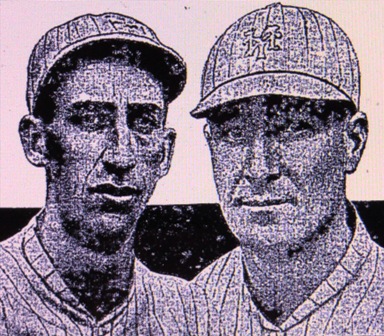
Pol Perritt and Benny Kauff, 1917

Pol Perritt and Benny Kauff, 1917

Sportswriter Frank G. Menke of Hearst’s International News Service picks up the story:

“Dick Kinsella, scout for the Giants, according to the story we get, hustled to Browns Wells and got a job on a plantation…Kinsella didn’t dare to put up at the same hotel because he was known by Manager Lee Magee, Business Manager Dick Carroll and others of the Brookfeds.”

Kinsella, according to Menke, was pretending to be a farm hand and also observing Kauff’s workouts and reporting back to McGraw who, along with Jack Hendricks of the Indianapolis Indians in the American Association (who held Kauff’s rights) was sending coded telegrams to Kauff signed “Father.”  Kauff received telegrams saying, “Mother wishes to see her boy,” and “All is forgiven.”

According to Menke, the telegrams were intended to inform Kauff that McGraw wanted him with the Giants and:

“The “everything forgiven” telegram was to tip Kauff off that if he jumped the National Commission probably would let him play.”

While Kauff was in Mississippi, Pol Perritt was in the process of  jumping to the Federal League.

According to Menke, Kinsella left Mississippi in the middle of the operation to secure Kauff in order to talk to Perritt.  What Kinsella said to Perritt is unknown, but Perritt’s meeting with Pittsburgh manager Rebel Oakes pretty much put an end to any chance of joining the Federal League.  The Associated Press said:

“Pitcher ‘Pol’ Perritt who jumped to the Pittsburgh Federal recently had a fist fight with Manager ‘Rebel’ Oakes…Those who saw the fight say that the pitcher delivered one blow that knocked Oakes over a chair…Friends and acquaintances interceded and hushed up the whole affair before police arrived on the scene.”

The story said Perritt was meeting with Cardinals’ management to “flop back to organized ball,” within weeks the Cardinals sold Perritt’s contract to the Giants, The AP said:

“Carefully guarded by “Sinister Dick” Kinsella…Perritt was delivered to John J. McGraw this noon…Kinsella brought his man in from Shreveport without struggle, and states that he did not even sight a Federal submarine during the entire journey.”

An alternate version of the story, published in The New York Times said it was McGraw who met with Perritt rather than Kinsella and highlighted the manager’s journey to meet the pitcher:

“McGraw had to travel forty miles on one railroad, nine miles on another, and then drive nine miles through the mud to get to Perritt’s home in Louisiana.”

Perritt was in the fold.  After a 12-18 season in 1915, he would win 18, 17 and 18 from 1916-18.

Kauff would be a bit more complicated.

While Kinsella was gone from Mississippi securing Perritt, Kauff signed a $6000 contract with Brooklyn, which he immediately regretted and contacted McGraw.
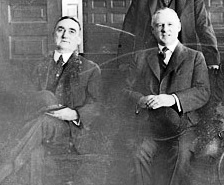
kinsellamcgraw

Dick Kinsella and John McGraw, 1920

According to Menke, Kauff:

“Related the difficulty he had with Robert B. Ward, president of the Brookfeds, over the contract.  The Giants people thought that owing to Kauff’s trouble—or alleged trouble—over the Brookfed contract that he was not legally under contract.”

Menke said the Giants signed Kauff for $7000 a year for three years with a $7000 bonus.

National League President John Tener voided the contract and Kauff was forced to return to the Tip Tops; he again led the league with a .342 average.

McGraw finally got his second man at the close of the 1915 season.  After the Federal League folded and Kauff was reinstated to organized baseball he signed a two-year contract for $6500 a season and a $5000 bonus with the Giants.

New York had finished in eighth place in 1915. They improved to fourth in 1916 and won the pennant by 10 games in 1917. McGraw’s Giants lost the to the Chicago White Sox four games to two in the World Series.  Perritt appeared in three games in relief, and Kauff hit a disappointing .160, despite two home runs in the Giants’ game four victory.

After the 1917 World Series Perritt and Kauff faded fast.

Perritt was 18-13 in 1918, but would only win four more games over the following three seasons with the Giants and Detroit Tigers; he was out of professional baseball before his 30th birthday.

Kauff’s demise is better known; his professional career came to an end at age thirty, the result of allegations of his involvement with gamblers, in general, and 1919 World series fixer Arthur Rothstein in particular.  Kauff, who owned an automobile accessory business with his half-brother and Giant teammate Jesse Barnes, was charged with stealing and reselling an automobile.  Although he was acquitted at trial, Kenesaw Mountain Landis banned Kauff for life.  Kauff’s oft-told story is told best in two excellent books by David Pietrusza:  Rothstein: The Life, Times, and Murder of the Criminal Genius Who Fixed the 1919 World Series and Judge and Jury: The Life and Times of Judge Kenesaw Mountain Landis.

Perritt died in Shreveport, Louisiana in 1947; Kauff died in Columbus, Ohio in 1961.

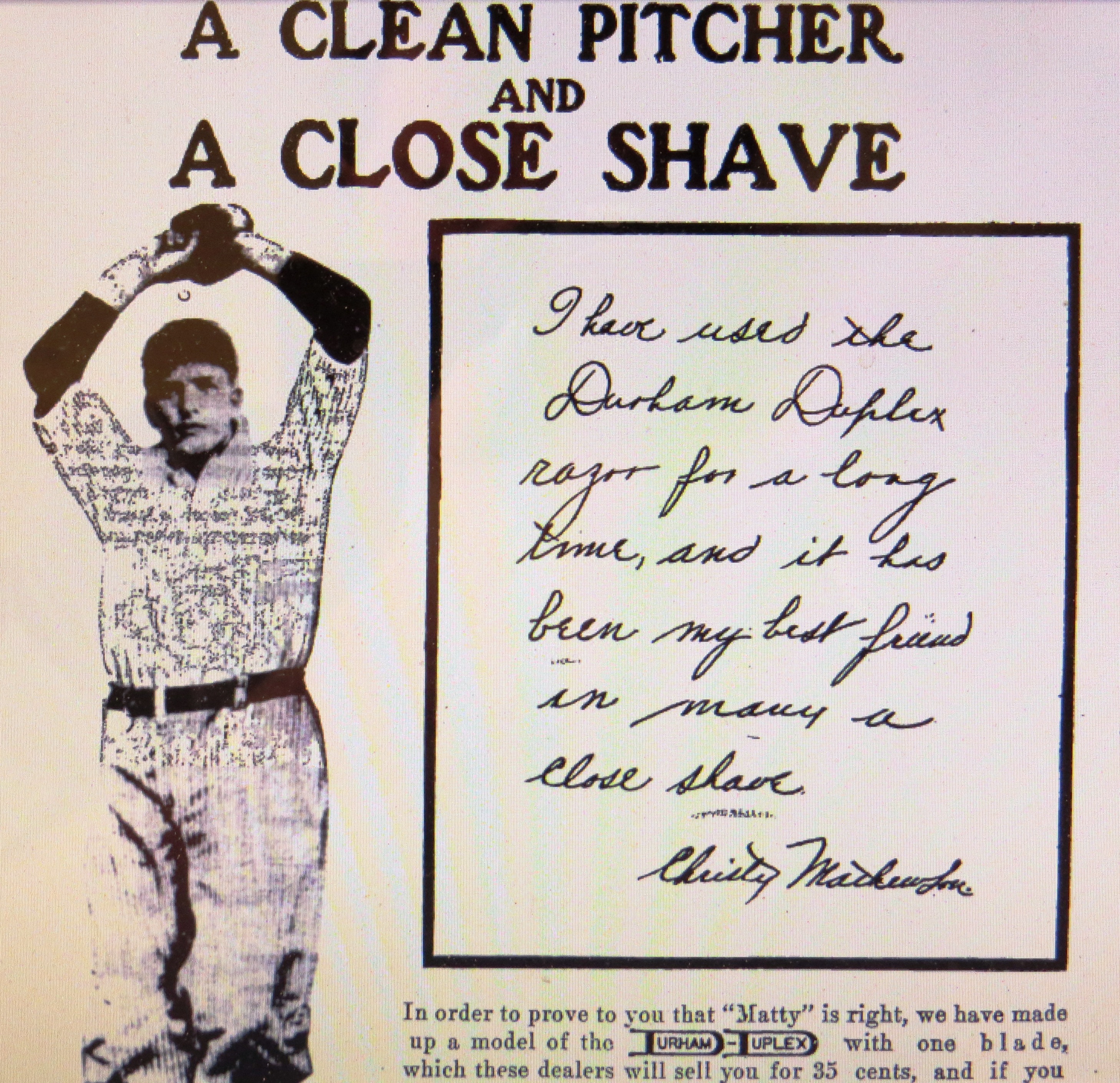
A Thousand Words–Lost Advertisements, Christy Mathewson

24 Jan

mattyad

“A Clean Pitcher and a Close Shave.”  Hall of Fame pitcher Christy Mathewson for the Durham Duplex razor.  “Big Six” says:

“I have used the Durham Duplex Razor for a long time, and it has been my best friend in many a close shave.”

Mathewson won 372 games for The New York Giants and one for the Cincinnati Reds from 1900-1916, including four 30-win seasons, and was a member of the first Hall of Fame induction class.

“Christy Mathewson brought something to baseball no one else had ever given the game. He handed the game a certain touch of class, an indefinable lift in culture, brains, and personality.’”
— Grantland Rice