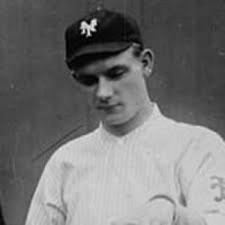
Tag Archives: New York Giants

Things I Learned on the Way to Looking Up Other Things, Bill Joyce Edition

2 May

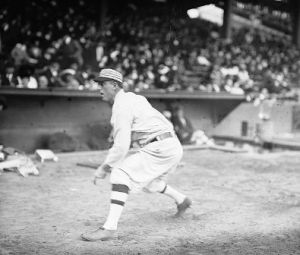
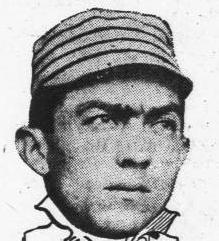
Scrappy” Bill Joyce’s managerial career ended badly.  In 1898, the player-manager was fired by New York Giants owner Andrew Freedman and replaced by Cap Anson—only to return as manager for the remainder of the season after Anson failed to turn the seventh place club around.  The turmoil took its toll on Joyce; after four straight .300 plus seasons, he hit just .258 in 1898.

Although just 32, and despite numerous reports of his imminent return to the Giants—or several other teams, including the St. Louis Browns, Washington Senators, and Cleveland Spiders— as a player or manager persisted for the next several years, he never played or managed another major league game.

He returned to his hometown, St. Louis, and opened a bar with Patsy Tebeau, and then later ran his own establishment after the two dissolved their partnership.  And, perhaps because of the way his career ended, and because of his inability to ever again secure an on-field job, he never stopped talking baseball, and became a popular source for sportswriters.
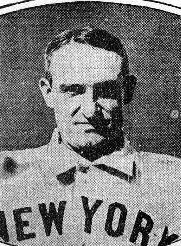
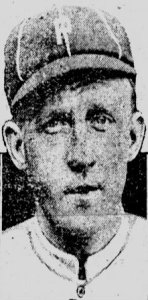
Scrappy Bill Joyce

Scrappy Bill Joyce

The Superstitious Jesse Burkett

Joyce told The Boston Globe in 1905 that “Ball Payers are a superstitious lot,” and that Jesse Burkett was among the most superstitious.

He said Burkett had one day received a tip at the racetrack on a horse that did not come in.

“After the race Jesse made one of his characteristic snaring, sarcastic remarks (to the tipster), who whirled around, and, knowing Jesse’s susceptibility to superstition said: ‘I’ll put the Spanish curse on you for a week.’

“The next day Burkett failed to get a hit and muffed a fly.  The next day he booted a grounder and struck out twice.  That night he sent for (the man).

“The racetrack man came down to the Lindell Hotel (in St. Louis), where Jesse was stopping.”

The man accompanied Burkett, who “was as serious as if he was making his will” to his room:

“(Burkett) unwrapped a package lying on a dresser and taking out a beautiful silk cravat said:

“’George, I’ll give you this ascot–it cost me $2—if you’ take off the Spanish curse.  I can’t make a hit while it is on.’”

The man snapped his fingers and said:

“’It’s off.’

“’Here is the tie,’ said Jess.”

According to Joyce:

“(T)he next day  Jesse made three hits.”

Joyce’s Tavern

In 1910, his tavern was located at 215 North Sixth Street in St. Louis.  But his love of taking baseball nearly cost him the business.

In August of 1910, The St. Louis Republic said:

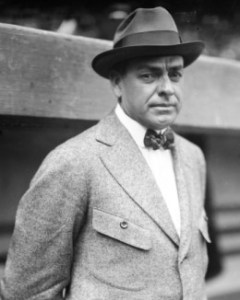
“’Scrappy’ Bill Joyce, former captain of the New York Giants, and Washington’s old third baseman, forfeited his saloon license today because he kept open until 1 AM, Sunday, July 24, while holding a ‘fanning bee’ with (New York Giants Manager) John McGraw and Sam Crane, a New York sporting writer.”

Joyce testified in front of the city’s excise commission that no drinks were served after midnight, “All he and the two guests did until the policeman arrived was talk baseball.”

Later that month, The St. Louis Post-Dispatch said, Crane, the former infielder, then writing for The New York Journal, and McGraw, both came back to St. Louis and met personally with the excise commissioner, Henry S. Caufield—who would later serve as governor of Missouri—and said the incident was “primarily their fault,” while both backing up Joyce’s assertion that no drinks were consumed after midnight.  As a result of their efforts, Joyce was allowed to keep his license.

“Told in a Man’s Way by a lot of Men”

While continuing to operate his tavern in St. Louis, Joyce finally got back into professional baseball.

In 1911, he became owner and manager of the Missoula (Montana) franchise in the newly formed Union Association.  But by August The Salt Lake City Tribune said he had been stripped of the franchise “for nonpayment of salaries.”  He later did  some scouting for the Federal League’s St. Louis Terriers.  While assessing current players, Joyce came to the conclusion shared by many of his 19th Century brethren. He told The St. Louis Globe-Democrat:
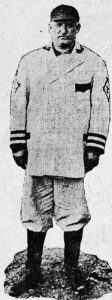
Bill Joyce, 1911

Bill Joyce, 1911

“Baseball today is not what it should be.  The players do not try to learn the fine points of the game as in the days of old, but simply try to get by.  They content themselves if they get a couple of hits every afternoon and pay an errorless game.  The first thing they do each morning is to get the papers and look at the hit and error columns.”

It was, of course, nothing like it was during his career—when the game was more scientific:

“When I was playing ball there was not a move made on the field that did not cause everyone on the opposing team to mention something about it.  All were trying to figure why it had been done and to watch and see what the result would be.  That move could never be pulled again without everyone on our bench knowing just what was going to happen.

“I feel sure that the same conditions do not prevail today.  The boys go out to the plate, take a slam at the ball, pray that they’ll get a hit and just et it go at that.  They are not fighting as in the days of old.”

And the way they behaved after a loss:

“Who ever heard of a gang of ballplayers, after losing a game, going into the clubhouse and singing at the top of their voices?  That’s what happens every day after the game at the present time.  Immediately after the last man is out the players make a dash for the clubhouse, the ‘quartet’ hits up a song and the whole squad joins in.

“In my days, the players went into the clubhouse after a losing game with murder in their hearts.  They would have thrown any guy out on his neck if they even suspected him of intentions of singing.  In my days the man who was responsible for having lost a game was told in a man’s way by a lot of men what a rotten ballplayer he really was.  Generally, he was told to go back to carrying the hod or to the police force.  It makes me weep to think of the men of the old days who played the game and the boys of today.  It is positively a shame and they are getting big money for it, too.”
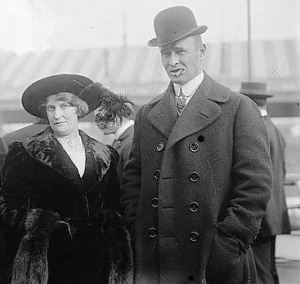
Baseball Wives, 1911

27 Apr

The Chicago Inter Ocean sent a reporter—a female reporter named Lois Willoughby—to get to know:

“The feminine element (that) is a silent factor in baseball of no mean importance.  It exerts a wonderful influence on the game…The women who preside over homes of West Side Players.”

The Chicago Cubs wives of 1911:

“The wives of members of the Chicago National League baseball team are always at the games.  They are thirty-third-degree fans—all but Mrs. (Nellie) Ed Reulbach…who is quite indifferent to the sport, and who wouldn’t know a base hit from a double play.”

As for the other wives of the defending National League Champions:

“They are comely, intelligent, charming women.  They know everything about the game.  They appreciate the value of every play.  They watch the contest with unflagging interest.  They cheer their husbands on to victory…Through ups and downs, they maintain unbounded enthusiasm and unfaltering faith in the Cubs.  They show it the only way they can by their daily presence in the grandstand.”

Manager Frank Chance’s wife, the former Edythe Pancake, attended every game:

“She may come at the last moment, accompanied by her Boston Bull pup, but she is generally comfortably settled for the afternoon before the game is called.  This beautiful woman, with golden hair and blue eyes, shares her husband’s enthusiasm in baseball.

Edyth and Frank Chance

Edyth and Frank Chance

“’Do I come every day?’ she asked as though she could not have heard the question right.  ‘Why, of course, I do.  I wouldn’t miss a game for anything.  I think baseball is the greatest sport there is.  It is a profession now and an honorable one, at that. Every year it is exacting men of higher standards…Baseball is such a clean, healthful sport that I should think it would appeal to everyone.”

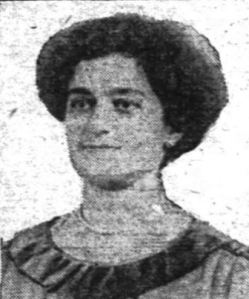
Jimmy Sheckard’s wife Sarah Jane said:

“I think Mr. Sheckard is the best left fielder in existence.  And he ought to be. Jimmy plays baseball, reads baseball, talks baseball and lives baseball…Baseball is the best profession and cleanest sport.  I don’t worry about the future.  With good health and good discipline, a man ought to get along all right anywhere.”

mrssheckard

Sarah Jane Sheckard

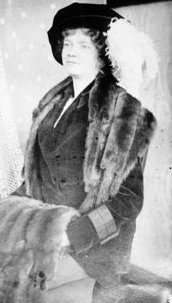
Ruby Tinker declared her husband the “greatest shortstop in the world,” and said:

“I never saw Joe on the diamond until after we were married.  I have watched him make many fine plays.  I think the best one was the day following his reinstatement this year (Chance suspended Tinker for “the remainder of the season” citing “gross indifference, on August 5—two days later he was back in the lineup) when he played against (Christy) Mathewson and got four hits.”

Ruby Tinker

Ruby Tinker

She said her life revolved around baseball “from morning until night,” and during the off-season as well:

“Joe goes into vaudeville in the winter and gives baseball talks with pictures.  I go with him as an ‘assisting artist,’ which means that I stand in the wings and prompt him…The winter spectators are just as enthusiastic as the summer ones.”

Of those who considered baseball a less than honorable profession, she said:

“They don’t know what they’re talking about.  Baseball is a good profession, a good sport, and good fun.”

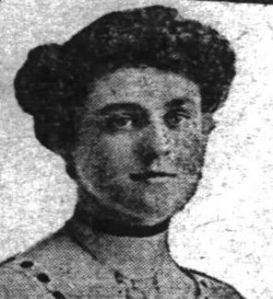
Helen Evers insisted that despite reports there were no bad feelings among the 1911 team:

“The Cubs are a fine lot of men.  There seems to be perfect harmony this year, and they do good team work.”

As for her husband’s well-known difficult personality, she said:

“He has the reputation for being ‘crabby’ at times.  Perhaps he is, but that’s what put him where he is.”

mrsevers

Helen Evers

Helen Evers noted one of Johnny’s other personality quirks:

“But when the jinx gets him!  If you don’t know about the jinx you can’t understand how serious it is.  I believe most of the players are superstitious, and they have enough to make them so. I always hope he won’t see a funeral on the way to the game.  That’s a sure sign of bad luck…there are scores of hoodoos and a baseball hoodoo seems hard to break.  One of the good signs is a wagon load of empty barrels.  I’m sure I would never know when they are empty.  These things probably count for nothing, but they seem to affect the nerves of the players.”

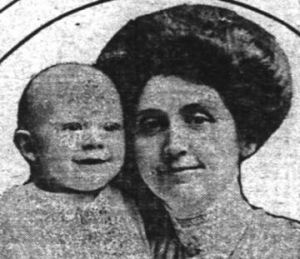
Back to Mrs. Reulbach who while not entirely against the sport, expressed her basic disdain for her husband’s chosen career:

“As a wholesome sport, I think baseball has no equal…But as a profession, it does not appeal to me. It is only for a few years at the most and the fascination of the game must make other professions  or lines of business seem dull and monotonous.”

And while conceding the Reulbach’s years in baseball had been “pleasant and profitable” she said:

“I trust Eddie Reulbach Jr. will not be a professional baseball player.”

Nelly Reulbach with Ed Jr.

Nelly Reulbach with Ed Jr.

Ed Reulbach Jr., then 2-years-old, suffered from a variety of illnesses throughout his short life and died in 1931.

Willoughby concluded that as the 1911 National League race wound down:

“Hoping against hope, these faithful women have seen the pennant slipping farther and farther away from them.”

The Cubs lost the pennant to the Giants by 7 ½ games.

“Even when he Wins he Loses”

18 Apr

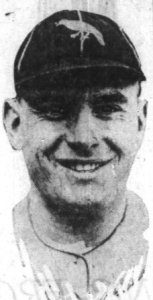
During his most successful season as a major leaguer, Bobby Byrne had some advice for the children who wished to follow in his footsteps:

“If they asked me I would tell them everything I could to keep them from starting.  Not that I knock the profession, but I think it is a poor one to choose, not because of the life itself, but because of its temptation and hardships, and worse than that, the small chances of being successful.”

Bobby Byrne

Bobby Byrne

That answer was given to syndicated journalist Joseph B. Bowles during the 1910 season when he asked Byrne questions about how he started in baseball “in order to help young and aspiring players.”

Despite being the starting third basemen for the defending World Champion Pittsburgh Pirates, and on his way to leading the National League in hits (tied with Honus Wagner) and doubles (178, 43), while hitting a personal-best .296 in 1910, he told Bowles:

“If I had it to do over again I do not think I ever would become a professional ballplayer, in spite of the fact that I love the game and love to play it.  I think a young fellow would do better to devote himself to some other line than to take the chances of success in the national game, for even when he wins he loses.”

He talked about how he started, and offered a theory about where the best players come from:

“I wanted to be a ballplayer and was educated at the game in a good school, on the lots around St. Louis.  I think that ballplayers develop faster when they are in the neighborhood of some major league team.  One or two of the players on a ‘prairie’ team are at every game the big league (team) plays.  They see how the game is played, and being at that age as imitative as monkeys, they work the same things on their own teams and teach all the other boys.  I have noticed when any city has a pennant winning club the quality of baseball played by the boys and the amateurs in that vicinity are much improved.”

Byrne

Byrne

Byrne said because of his time playing on the sandlots of St. Louis, he “picked up the game rapidly,” but said it wasn’t until he began to play professionally, first in Fort Scott, Arkansas, then in Springfield, MO, that he corrected the biggest flaw in his game:

“The hardest thing I had to learn was when to throw.   I think I must have thrown away half the games we played before I learned not to throw when there was no chance to get the runner. I think that is one of the first things a young player should learn; to look before he throws and only throw when he has a chance to make a play.  The next thing, it seems to me, is to learn to handle one’s feet and to keep in the game all the time, and be in position to move when the ball is hit.”

Even at the pinnacle of his career, the man who discouraged children from following in his path, was also somewhat cynical about his own experience:

“The biggest thing I had learned was that, no matter how far a fellow gets up in the business, there still is a lot he does not know, and by dint of watching and learning I held on, and still am learning and willing to learn.  When I know it all I’ll quit, or be released.”

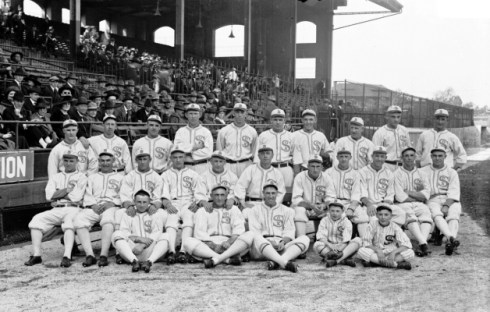
Byrne continued “learning” for seven more seasons, and the end of his career was fitting for someone who warned that a young man should steer clear of baseball because “even when he wins he loses.” After being acquired on waivers by the Chicago White Sox in September of 1917, he appeared in just one game, on September 4.  He was with the team when they clinched the pennant 20 days later; and was released the day after he appeared in the team photo commemorating their American League Championship.

Group portrait of American League's Chicago White Sox baseball team posing in front of a section of the grandstands on the field at Comiskey Park, Chicago, Illinois, 1917.

White Sox team photo after clinching 1917 pennant, Byrne is fourth from right in second row–he was released the following day.

While the Sox were beating the Giants in the World Series, Byrne was back in St. Louis operating a bowling alley.   After three years away from baseball, he managed minor league teams—the Miami (OK) Indians and Saginaw (MI) Aces—in 1921 and ’22 before returning again to the bowling business.

His admonition against professional baseball didn’t stop his two sons from having their own brief minor league careers; Bobby played for several clubs between 1939 and 1941, and Bernie (listed as “Byrnes” on Baseball Reference) played for the Paragould (AK) Browns in the Northeast Arkansas League in 1940.  Both had their careers interrupted by WWII, Bernie was an airforce fighter pilot in Asia, while Bobby was awarded the Distinguished Flying Cross, Air Medal and Purple Heart while flying for the airforce in the Mediterranean Theater.

“Many say he was so Modest he Hated to have his Picture Taken”

30 Mar

In the winter of 1918 Malcolm MacLean of The Chicago Evening Post wrote about the peculiar reactions of a few players to photographers:

“It may happen that a pitcher does a phenomenal streak of work and his photo should run.  It may be the only one of him in stock that has been used time and again—so often, in fact, that it is all but worn out.

“Hence it is necessary for a photographer to snap said fellow’s photo on the ball field.  Ninety-nine times out of a hundred this is a pipe. Yet there are exceptions.”

MacLean said he recalled a handful if examples of players refusing:

“In practically every case it was that uncanny thing known as ‘baseball superstition’ that made it difficult, almost impossible, to get them to pose.

(Urban) Red Faber, of the White Sox, on two occasions (during the 1917 season) lost ball games after he had been snapped.  So he announced his intention of refusing to pose again until the White Sox won the American League championship.  Another member of the Sox, Charles (Swede) Risberg, joined him in the declaration. And they stuck to it.

Red Faber

Red Faber

“The day after the title was clinched both Faber and Risberg were among the easiest fellows on the squad to photograph.  In their case it was ‘superstition’ and we don’t know they could be blamed.  If a player keeps winning, only to have the streak smashed the day his photo is taken, well we have an idea we’d do the same thing.”

MacLean said during Rube Marquard’s 19-game winning streak the Giants’ pitcher refused to allow a Chicago photographer to take his picture.  MacLean said he and a cameraman approached the pitcher on July 8, 1912:

 “’Nothing doing,’ he said.  ‘Come around any time you want after I’ve lost a game and you’re welcome to all you want.’  It so happened that Rube lost that day, Jimmy Lavender hanging the bee on him, and the following afternoon Rube posed and posed and posed.”

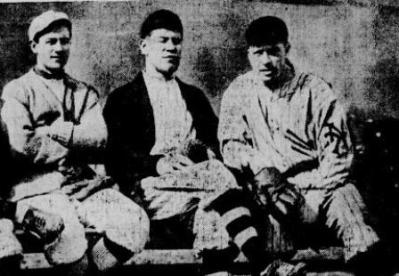
MacLean said Jim Thorpe was a particularly difficult subject to photograph when he began his major league career, but not due to superstition:

“When Thorpe first came to Chicago with the Giants, he was the most widely advertised athlete in the world.  He was fresh from his triumphs in Sweden on the track field and from the gridiron at Carlisle.

“Many say he was so modest he hated to have his picture taken.  At any rate, many a film and plate was wasted on him because he would turn his face away, throw up his arm in front of him, or do something also to ruin the exposure.”

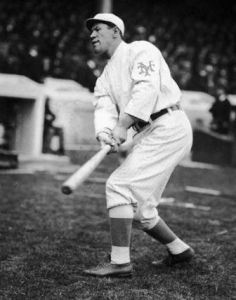
Jim Thorpe--Airedale fan

Jim Thorpe

Another difficult member of the Giants was catcher John “Chief” Meyers, who MacLean said would brush past photographers, saying:

“’Aw, you’ve got all of me you want,’ It was decidedly exasperating, especially when publicity is what helps keep major leaguers in the majors.”

Two other oft-photographed pitchers had their own particular quirks.

MacLean said:

“It will surprise many to learn that Ed Walsh, of the White Sox…refused to pose on the day he was expected to pitch…Few men were snapped so frequently as Ed when he was in his prime, yet we venture to say no man ever got a photo of him—when Ed knew it—on the day he was to work.

Eddie Plank, of the Athletics…was one of the easiest of all men to photograph, but it was exceedingly difficult to get a good one of him.  The reason was he kept tossing stones at the camera or twisting up his face in some farcical fashion.  And when other players were being taken Ed would throw peddles at them, trying to have them distort their faces.”

Eddie Plank

Eddie Plank

“Maryland is the Home Run State”

25 Mar

Jack Bentley, pitcher and first baseman for the Baltimore Orioles in the International League hit 20 home runs in 1920.  The feat earned Bentley, who was born in Sandy Spring, Maryland, the nickname “Home run” among local fans.   Dean Snyder of The Denver Express declared:

“Maryland is the home run state.

“Three swat kings hail from the oyster state.  Each has earned the “Home Run” prefix”

Snyder spoke to all three:  Bentley, Frank Baker, born in Trappe, Maryland, and Babe Ruth, born in Baltimore.

Bentley said:

“Homerunning depends on how you place your feet.  ’That gives a batter poise.  Keep your feet together.  You’re set to step up or back then.

“(During the 1920 season) I tried for a while to keep my feet apart.  I hit a batting slump.  (Orioles) Manager Jack Dunn told me to get my feet together.  I did.  Then I started bouncing ‘em over the walls.”

Jack Bentley

Jack Bentley

Baker said:

“It’s the way I grasp the bat.

“Grab it right down at the knob.  No long distance hitter holds the bat far up.  Use all the wood in the bat.

“That’s my secret.”

Frank Baker

Frank Baker

Ruth said:

“The eye and the swing is the thing.

“Coordinating the two…that makes the ball travel.  Swing a fraction of a second too early or too late and you don’t hit a homer.

“The old eye counts most.  Without a keen eye you flivver.

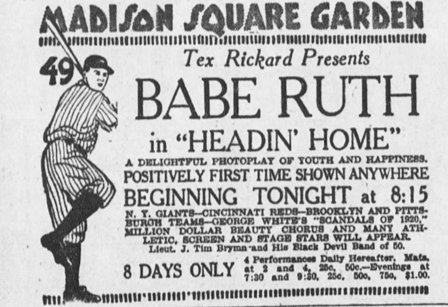
“I hit 54 last year because I timed my swing.  When I was making (the movie “Headin’ Home” during the 1920 season) my eyes went bad.  I didn’t bust one for three weeks.  No pictures for me this summer.

“I’m shootin’ at 75.”

Babe Ruth

Babe Ruth

Bentley hit 24 and 22 home runs the next two seasons with Baltimore (he was also 12-1 with 2.34 ERA in ’21 and 13-2 1.73 on the mound) and was purchased by the New York Giants for $72,000.

“Home run” Bentley appeared in 65 games in the field and hit just seven home runs in 539 National League at-bats from 1923-1927—as a pitcher, he was 40-22 with a 4.35 ERA.

Baker sat out the 1920 season after his wife died of Scarlet Fever in February.  Snyder predicted that when he returned to the Yankees he would “fight Bambino Babe a home run duel.”  He hit 16 home runs in 564 at-bats in 1921 and ’22 before retiring.

Ruth didn’t get “75 in 1921—he settled for 59.  “Headin’ Home,” presented by boxing promoter Tex Rickard, opened at Madison Square Garden on September 19, 1920, to what The Brooklyn Eagle called “a fair sized crowd.”  As for the quality of the film Ruth said caused his eyes to go bad for “three weeks,” the paper said:

“It is an astonishing thing that when people, prominent in other walks in life, enter the moving picture field, they generally appear in most absurd pieces.”

headinhome

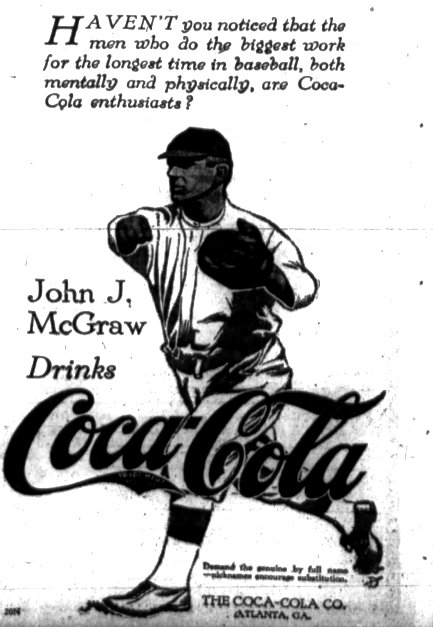
Lost Advertisements–John McGraw for Coca-Cola

18 Mar

mcgrawcoke

“Haven’t you noticed that the men who do the biggest work for the longest time in baseball, both mentally and physically, are Coca-Cola enthusiasts?

John J. McGraw drinks Coca-Cola.”

After winning three straight pennants with the Giants from 1911-1913, McGraw was confident his team was heading for a fourth straight National League championship after his club took over first place on May 30.  In September, the surging Boston Braves–who were in eighth place when New York took over first– split a doubleheader with the Giants to remain tied for first place (The Braves were tied with the Giants for one day on August 25 and were in sole possession of first for one day earlier in the month).

That day, under the headline “Prophecies and sich!” Ralph Davis of The Pittsburgh Press presented a series of quotes he attributed to McGraw which nicely summed up the season’s pennant race:

“John McGraw said on June 1: ‘The big disappointment of the year has been the Boston Nationals.  I thought (George) Stallings would get his team into the first division at the start and keep it there.’

George Stallings

George Stallings

“John McGraw said on July 1: ‘Those poor old Bostonians are still at the bottom of the pile, where they seem to be anchored.  The team is surely the surprise of the season.’

“John McGraw said on Aug 1: ‘The Boston Braves have made a great showing during the past two weeks, and are now in fourth place.  They will probably slump again, but should not drop back into last place.’

“John McGraw said on Aug. 15: ‘Boston is now in second place, but we are not worried about that.  Their present spurt is merely a flash, and they will soon be headed the other way.’

“John McGraw said on Sept. 1: ‘As I predicted, the Braves did not stay with us.  They have dropped back to second place and have probably shot their bolt.  They will decline from this out.  Mark my words.’

“John McGraw said on Sept. 7: “Those Braves blankety blank, blank, etc…, ad infinitum!’

McGraw

McGraw

“Which being interpreted means Boston once more tied with the Giants for the lead, and shows no sign of breaking badly, as the eminent Mr. McGraw predicted.”

Davis’ prophecy that the Braves showed “no sign of breaking badly” was correct.  Boston beat the Giants 8 to 3 the following day, recapturing sole possession of first place.  They never looked back.  The Braves went 25-6  (with three ties) the rest of the season and cruised to the pennant, beating McGraw’s Giants by 10 1/2 games.

“Spring Training is of More Importance in Winning than any one factor”

11 Mar

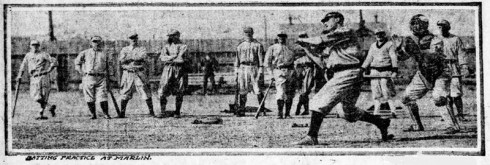
In 1912, two years before Hugh Fullerton of The Chicago Examiner called spring training Baseball’s “Annual Display of Foolishness,” Giants Manager John McGraw “wrote” an article for The New York Evening World explaining his training philosophy, from the team’s spring home in Marlin, Texas.

In stark contrast to Fullerton, McGraw said:

“In my opinion, the spring training of a ball club is of more importance in winning a pennant than any one factor.  Of course, players of exceptional ability are needed, but unless they are well prepared physically for their work they be laid up…In that event, the club would be just as badly off as if such players didn’t exist.”

McGraw

McGraw

McGraw said:

 “We often hear  of a club being in hard luck on account of having so many players laid up…in most of those cases, the fault can be traced back to the training work done in the spring.”

McGraw said he decided to train the Giants in Marlin because the climate was “mild and even” and “about the same as we find in the North,” during the late spring and early summer, and credited the location with for his club’s performance in 1911:

“I attribute out success in winning the pennant last year to the excellent weather conditions that we found in Marlin.  My club was about able to get up to top speed almost at the beginning of the regular season.”

He said “Everybody said we were lucky,” for the team’s lack of injuries during the pennant race, “But that did not cover it entirely.  The Giants were in excellent condition.”

Again, in stark contrast with Fullerton, who claimed, “A seasoned ballplayer will start with easy work, loosen up his muscles, take off eight or ten pounds and at the end of ten days or two weeks will be in nearly top condition to play baseball.”  McGraw said:

“I always take at least seven weeks for this work; for I don’t believe that a man can be trained in less time than that to last six months.”

In addition to the seven weeks of work, McGraw credited Marlin’s hot spring water with keeping his team healthy:

“I find that the hot water baths following hard workouts do more for sore muscles than all the liniments in the world.  It is not so much the medicinal qualities of the water as the fact that it is hot.”

He said a “mistaken idea of the public” was that spring training entailed:

“(G)iving the players certain kinds of food and putting them through certain athletic stunts.  I do nothing of the kind.  They are allowed to eat what they please.  If they suffer from it, it is their own fault and they quickly realize it.  I do not stop them from smoking or any other little habits that they may have taken up.  In other words, the idea is for them to live naturally and develop physically at the same time.”

An International Film Service photo of the Giants training in Marlin in 1916

An International Film Service photo of the Giants training in Marlin in 1916

After discovering that many players “tire of their work on the diamond” during the spring, McGraw said “I have introduced such pastimes as tennis, handball, pushball, etc…” to their daily routine.

As for the regular routine:

“I work the men two hours every morning and two hours in the afternoon. I work just as hard as they do.  It is pretty hard on me at first, but I know that I have got to show a willingness to do anything that I would ask the players to do.  I am not as young as some of these recruits and it comes hard at times, but I get results from it because the youngsters are ashamed not to stick as long as I do.”


Finally, McGraw said spring training provided another benefit for young players:

“Social polish is a big help in making a baseball club win, as it develops personal pride in the men and makes them want to be at the top.  For that reason, I always encourage the youngsters to take part in the dances that are given at Marlin every week. It also keeps their mind off the game.  I would like to have my players think of baseball all the time when they are on the field and forget it when they get to their homes or hotel.

“The businessman who worries over his business during his leisure hours soon becomes mentally unfit for his work and the same applies to ballplayers.”

The Giants continued to train at Marlin through 1918 and won four pennants (1911-1913, 1917) during that period.

Lost Advertisements–Heinie Groh for Sweet Caporal

4 Mar

grohsweetcaporal

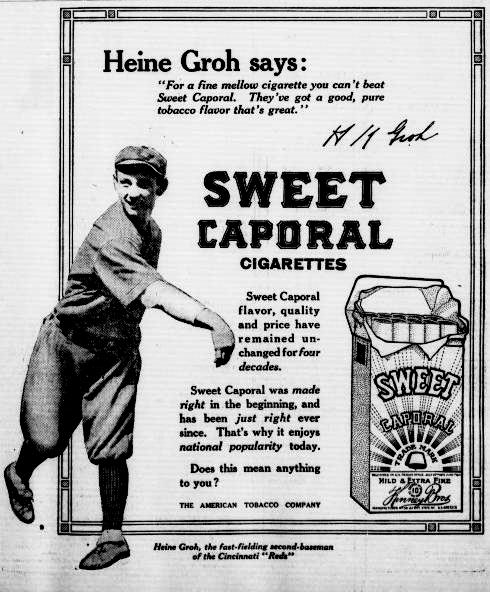
A 1914 Sweet Caporal advertisement featuring Heine [sic] Groh–the company didn’t spend a great deal of time checking the spelling of the names of their endorsers.

“For a fine, mellow cigarette you can’t beat Sweet Caporal.  They’ve got a good, pure tobacco flavor that’s great.”

The salary dispute that culminated with Groh’s trade from the Cincinnati Reds to the New York Giants after the 1921 season had been ongoing since at least 1917 and earned him the title “last of the holdout kings” from The Washington Herald.

His 1920 holdout was, according to Groh, inspired by his wife Marguerite, who also spoke to the press on her husband’s behalf as the dispute ground on into March.

The Cincinnati Times-Star said while speaking at a “local banquet,” Groh told the audience:

“We were sitting in a vaudeville show not long ago and were listening to the thunderous applause being accorded a couple of high salaried dancers.

“My wife touched my arm.  ‘Do you see how they are being praised now?’ she asked. ‘But what will happen to them in a few years when their legs start to go bad?  They’ll get asked to leave won’t they? That’s why they’re so high-priced now.  Let that be a lesson to you.’

“So right then and there Mrs. Groh made me promise that I would not sign a Reds contract until I got my figures…When my wife says sign, I’ll sign and not a minute before.”

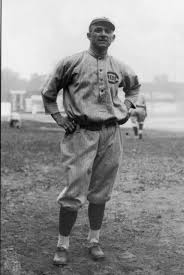
Groh

Groh

Marguerite Groh was more direct when she spoke to the paper:

“I don’t care if all the other players sign, and if Heinie can’t do anything better next summer than work in the garden I think he should continue holding out for what he wants.

“We both believe Heinie has been underpaid for several seasons.  This is the year in which we can afford to be independent, and I am urging Heinie to continue his fight to get what he believes he is entitled to.

“It is not a question of how much Heinie can make in some other business. We both know the Reds are willing to pay him more than he will make if he does not sign at the club’s terms.

“But we will be perfectly able to get through the year without any baseball income if the Reds don’t meet Heinie’s terms, and they’ll have to do it if he is to play for them.”

After the Reds left for Miami, Florida without Groh on March 5, The Associated Press said:

“Heinie Groh, or rather Mrs. Heinie Groh, is still among the holdouts in baseball.  There is lurking suspicion that Heinie would like to end the controversy and join his teammates in the South, but Mrs. Groh absolutely refuses to let him go unless (Reds owner August) Garry Herrmann offers her little Heinie more money.”

Four days later Groh agreed to terms, The Cincinnati Enquirer said the Reds “Would not state the amount” of the contract, but said Groh had asked for $12,500 and the team had originally offered $10,000.

During Groh’s long holdout the following year, Mrs. Groh’s opinion was never reported.


“A Good Ballplayer must be Temperamental”

15 Feb


Idah McGlone Gibson was the most famous female journalist of the early 20th Century; in addition to publishing several books, she wrote for the syndicated Newspaper Enterprise Association, The Chicago Tribune, The Los Angeles Evening Herald, and The Toledo Blade.

idahmgibson

Idah McGlone Gibson

She also interviewed New York Giants Manager John McGraw twice, five years apart.

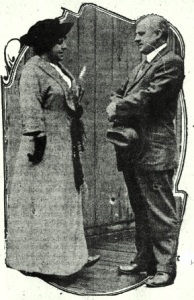
Their first meeting took place in New York shortly before the end of the Giants’ pennant-winning 1912 season.  McGlone told her readers:

“McGraw is surrounded by more ‘buffers’ to keep the public from him that Maude Adams (a notoriously press-shy actress), who is never interviewed, and that’s going some.

mcgrawgibson

Gibson and McGraw in 1912

“Neither his telephone number nor his home address is obtainable unless you reach one of his close friends, and at the Polo Grounds. he is never on view until you have passed all the police force and plain-clothes men.”

McGlone said former Giant turned New York attorney, John Montgomery Ward provided her with an introduction to McGraw.

“It was after the game that I saw the Giants’ manager, well-groomed, well-dressed, well-mannered. McGraw was evidently at peace with himself and the world…He is the most serious ballplayer I ever talked to.  He seldom smiles, and told me that he put one on to order when he had his picture taken with me.”

Gibson asked how McGraw thought the Giants would fare in the World Series against the Boston Red Sox:

“Of course, we are going into the game to win, not because of any glory attached to it, but because it is our business.  However, I feel that I shall be able to live through the winter if we lose the world’s championship.  I am not able to get up that high-water mark enthusiasm which exhilarates the fans to whom the game is a pleasure and not a business.”

She also asked McGraw about the biggest source of gossip surrounding his ballclub; the relationship between Rube Marquard, his 26-game winning pitcher and vaudeville star Shirley Kellogg—during August and September several newspapers published erroneous reports from Marquard’s mother that the couple had married:

“’Indeed, I don’t know whether he is married or not,’ he answered suavely, but his brown eyes narrowed and his lips came together firmly.  ‘You know I have nothing to do with the private lives of my men.’

“Marquard’s name and love affairs, however, did not bring a rosy glow to the manager’s face, and I imagine McGraw has helped make the course of true love run a little crooked, as ‘the Rube’ has lost the jump to his fast ball since his reported marriage.”

Rube Marquard

Rube Marquard


McGraw touted his other pitchers, telling Gibson that the greatest pitching performance “he had ever seen was in training camp last spring” when Jeff Tesreau and Al Demaree faced each other for 12 scoreless innings in an intersquad game in Texas.

Despite her fondness for McGraw, Gibson told her readers they “may trust a women’s intuition” and correctly predicted the Red Sox would win the World Series.

Gibson met McGraw five years later during a September series in Cincinnati, with the Giants on their way to another National League pennant. She said:

“I hope I have changed as little as he has in that time.

“His hair, the Irish hair that turns white early, has grown just a bit more optimistic—that is all.

“’Twenty-nine years is a long time to be in the game,’ he said as his eyes wandered over the field—‘longer than most of those boys can count their entire lives.’”

Gibson asked about temperamental players:

“In my nearly three decades of baseball I have learned one thing thoroughly—a good ballplayer must be temperamental, just as an artist, a musician, or a writer must have temperament.”

Gibson asked how he makes “a man’s temperament,” benefit the team:

“’By ignoring it,’ he answered.  ‘I must make every man think he has no temperament, even while making him use that most desirable quality in a ballplayer to its fullest capacity.’”

McGraw refused to say which player on the team was the most temperamental, but offered to tell who was the least.  Gibson said:

“’(Christy) Mathewson, I interrupted.’

“’Yes, Mathewson is always to be depended upon.  When he knows a thing is to be done he just does it.  Some men play best when a team is winning and some play best when spurred by defeat.  A baseball manager must not only be a good picker, but he must study each man individually and handle all differently.’

“’At the end of a season with a winning team you have to be more than ever on your guard.  Every man is a bundle of nerves, drawn taut.  At this time every little prejudice, every little idiosyncrasy, every little vein of superstition is laid bare and raw.  You get to know your men better then than at any other time during the season.’”

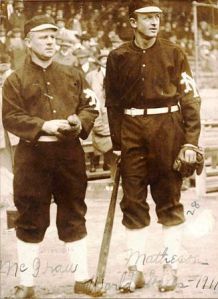
Christy Mathewson with John McGraw

McGraw and Mathewson

Gibson asked if the best ballplayers came from a particular nationality.  McGraw said:

“’I cannot answer that.  I think perhaps the Irish are the quickest thinkers and the readiest to take a fighting chance, but I would not like a team made up entirely of Irish.  You must have temperaments like the German to ballast the Irish.  Truly I think a winning ball team must be a melting pot of all nationalities.  This year there are more Germans among the Giants than any other nationality and they are just as temperamental as any other but they don’t show it in just the same way.’”

Gibson did not make a prediction about the World Series as she had done five years before; McGraw’s temperamental Giants were beaten four games to two by the Chicago White Sox.

Lost Advertisements–Frank Frisch, “Dr. Eliot’s Five-Foot Shelf”

12 Feb


frischad

In 1923, P.F. Collier & Son Co. used New York Giants second baseman Frank Frisch in advertisements for the 51-volumes of great world literature, now known as The Harvard Classics, then called “Dr. Eliot’s Five Foot Shelf.”

The collection first appeared in 1909.  Harvard University President Charles William Eliot claimed that anyone could receive a liberal education by spending 15 minutes a day reading from a collection of books that could fit on a five-foot shelf.

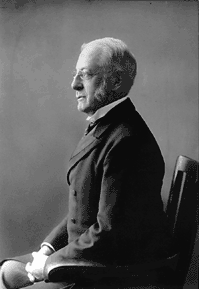
Charles William Eliot

Charles William Eliot

The anthology was borne out of that claim:

“When Frank Frisch first appeared at the Polo Grounds in 1920, he was hailed as the smartest young college player who ever broke into baseball.  He is still smart and still studying.  This column tells how.”


Brain’s are Frank Frisch’s main asset as a Champion ball-player

“When John J. McGraw started in 1920 to rebuild the Giants he looked about for young, smart, teachable players.

“From Fordham College, he took young Frank Frisch–and Frisch made good in the first game he played and is still making good.  His main asset is his brain; he thinks faster and further ahead than do most other players.

“But ballgames are short and so is a professional player’s active career.  What does Frisch do in the rest of his time? You will find him, not scattering his time and thought, but curled up somewhere with a good book in his hand.

“In his private library, for instance, is Dr. Eliot’s Five Foot Shelf of Books. He bought it with his earnings as a ballplayer, and now studies it to make his mind still faster and so to increase his earnings–both on the diamond and in later life.”

Frisch

Frisch

The use of a professional athlete, even one with a college education like Frisch, would likely have not pleased Eliot, who had a general contempt for sports.  He attempted, unsuccessfully, to abolish football at Harvard in 1905, and is often quoted having said about baseball:

  “Well, this year I’m told the team did well because one pitcher had a fine curve ball. I understand that a curve ball is thrown with a deliberate attempt to deceive. Surely this is not an ability we should want to foster at Harvard.”