Tag Archives: New York Yankees

“Probably the ‘Boniest’ Bonehead Play Ever”

22 Jun

While some of the details changed in subsequent tellings, this story stayed substantially the same from when it was first presented in a column by sports writer William A. in 1913, until the final published version in 1957 in The New Orleans Times-Picayune.  One version called it, “Probably the ‘boniest’ bonehead play ever”

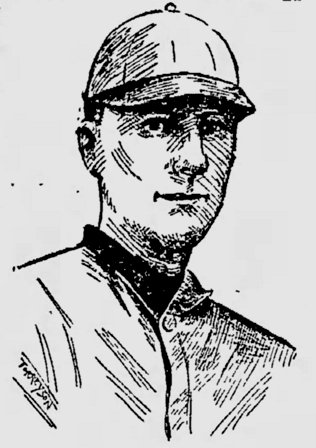
The story was told by and told about lefty Evan “Rube” Evans.  Born on April 28, 1890, in Sebring, Ohio, Evans was a career minor league pitcher who, when the story first appeared, seemed to be headed to the big leagues. 
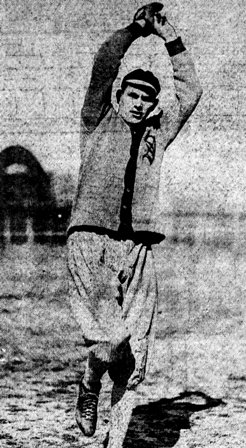
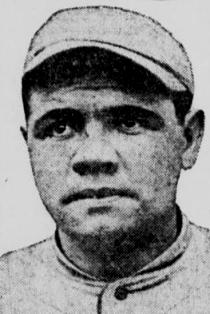
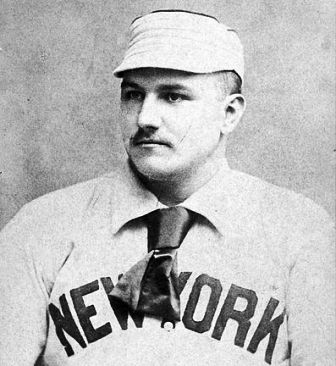
Rube Evans

Rube Evans

The tall–he was reported by various sources as anywhere from 6′ 2″ to 6′ 4″–began his professional career with the Dallas Giants in the Texas League in 1910; he was 15-12 for the pennant winners, but The Dallas Morning News said he didn’t “take baseball seriously” until the following year, when he was 18-16 for the Giants:

“Before that, it seemed, the big, husky flinger looked at playing baseball something in the light of a joke.  Last season, though he came back into the game with a different viewpoint. He seemed to realize that ball playing was a man-sized business.”

After his 1911 performance, Evans’ contract was purchased by the New York Giants, and he joined the team for spring training in Marlin, Texas in 1912.  The Morning News said if he maintained his new found focus “and works as hard as he knows how to work he ought to stick.”

Evans quickly impressed the Giants with a pitch “takes a most freakish break,” according to The Washington Times:

“Rube Evans, the Giants left-handed recruit pitcher from Dallas, surprised bot Manager (John) McGraw and Coach Robby (Wilbert Robinson) by showing them a curve that is entirely new to the big league…The ball is delivered in exactly the same manner as the spitball, but he does not moisten it.”

The paper did not elaborate on how Evans’ “dry spitter” was different from versions reported on during previous seasons–including the one thrown by Christy Mathewson of the Giants–but according to The New York World, “McGraw says he will try and teach it to Rube Marquard.”

Despite his “dry spitter,” Evans failed to make the team and was returned to Dallas where he posted a 22-12 record for the Giants.

In 1913, he joined the New Orleans Pelicans in the Southern Association but appeared to be headed to the Cleveland Naps before he threw a pitch in the regular season for the Pelicans.  In March, Evans shut down the Detroit Tigers 3 to 1 on five hits and followed that up with a four-hitter (and 3 to 1 victory) against the Naps.

The Cleveland Press said, “(Naps Manager Joe) Birmingham plans to cut down his squad considerably.  It is said recruits (Hugh) Peddy, (Pete) Shields and (Ward) McDowell will be left here in trade for one good pitcher, probably Southpaw Rube Evans.”

With Evans apparently on the verge of joining the Naps, the story of his “bonehead” play was told by Phelon, then repeated widely:

“(Evans) has one curious habit—a trait which has aroused much wonder on the part of every manager under whom the southpaw has been toiling.  When given an order by his manager or captain, Mr. Evans always stops, cocks his ears, and demands a repetition of the directions.  Naturally he is first taken for a simp, or bonehead, but when further acquaintance with him shows that he is a gentleman of intelligence and high mentality, the field leaders are muchly puzzled.

“’I always want my orders repeated,’ quoth Mr. Evans, ‘so that I will never again make such an error.”

(The 1913 version of the story, which quotes Evans,  places the incident in McKeesport, Pennsylvania, some later versions say it happened in 1913 with the Pelicans, still others say it was in Portland, Oregon; however, the original publication predates Evans’ time on the West Coast which did not begin until May of 1914).

Evans said he had pitched into the ninth inning when the opposing team put a runner on third with one out, when his manager told him if the other team attempted a squeeze play to “bean him.”  Evans said:

“’I knew no more what a squeeze play was than the man in the moon, but my orders rang in my ears as I started winding up.  Just as a swung up my arm, the fellow on third tore for the plate…I took careful aim at the oncoming runner, and pickled him with a fine shot to the back of the cranium.  Three seconds later the crowd was coming towards me with roars of fury, and I got over the back fence just in time.

“’Well how was I to know that I should have hit the batter and not the runner?  Ever since I have insisted on duplicate orders, so that I would know just what to do.’”

His acquisition by Cleveland never materialized and he had a disappointing 12-15 record in 1913, in a season split between New Orleans and the Birmingham Barons.

It is also in question whether Phelon’s characterization of Evans as a “gentleman of intelligence and high mentality,” was entirely accurate given his inability to stick with clubs who were impressed with physical abilities.  After his second chance to pitch in the majors didn’t materialize, the remainder his of career was marked by long stretches of mediocrity, charges of bad behavior and comparisons to another left-handed “Rube.”

In August of 1913, he was suspended for the remainder of the season by the Birmingham Barons for, according to The Birmingham Post-Herald, “Failure to keep in condition.”  The Sporting Life’s Chandler Richter called him “Erratic,” The Oakland Tribune said he was”Eccentric,” a wire service retelling of the “beanball” story from 1915 said he “earned a nationwide reputation as a ‘squirrel,” another called him “the real eccentric,” when compared to Rube Waddell.
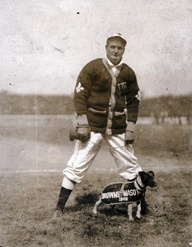
The other left-handed Rube

The other left-handed Rube

His two-year tenure with the Portland Beavers in the Pacific Coast League (PCL) began when he wore out his welcome in New Orleans in May of 1914 and was sold to the Beavers.  It was particularly rocky.  The Spokane Daily Chronicle said Evans and Beavers manager Walter “Judge” McCredie “got along like a pair of strange bulldogs.” He was suspended at least once, again for the euphemistic “failure to be in proper condition,” and gave up a game-winning home run to Jack Ness of the Oakland Oaks when he accidently threw a pitch over the plate while attempting to intentionally walk Ness.  At the close of the 1915 season, Portland let him go for what The Portland Oregonian called “His inability to take care of himself.” Of his 9-22 record the paper said:

“Rube ran into gobs of adversity.”

After leaving Portland, Evans played parts of three seasons for the Salt Lake City Bees in the PCL–in 1917 he was 21-9, but when McCredie was named manager of the Bees in 1918, Evans time with the team was nearly over.  Before the season, The Oregonian said, “Evans did not take kindly to the idea of having to take orders” from his former manager and was threatening to jump the club.  He finally did jump in June after appearing in 14 games and posting a 3-8 record.

Evans went to Portland and finished the 1918 season in the semi-pro Shipyards League, The Oregon Daily Journal said upon his arrival:

“Rube Evans was through at Salt Lake and McCredie was probably saved the trouble of wearying his hand by writing out Rube’s release, when Rube left.”

In 1919, he played for the Rupert franchise in the semi-pro Southern Idaho League; while successful, his reliance on the emery ball for his success didn’t make him friends.  The Twin Falls Times said:

“When Rube Evans lugged the emery ball into the S.I.L. he failed to do anything beneficial to the league.  Rube will win a few more games for the Rupert club, but he has lowered the standard of sport in the league.”

Evans had one more season in professional baseball, posting a 10-7 record with the Regina Senators in the Western Canada League in 1920.  In an August 15 doubleheader against the Edmonton Eskimos Evans was ejected for arguing with the umpire while facing the second batter of the first game; he came back to lead the Senators to 5 to 3 victory in the second game, giving up two runs in 7 2/3 innings, and hitting a three-run home run in the sixth.
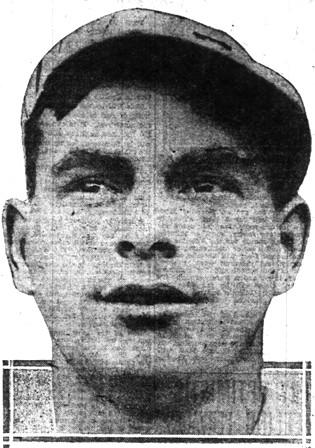
Rube Evans

Rube Evans

After the 1920 season, he returned to Ohio and spent the next decade playing semi-pro baseball there and in Western Pennsylvania.  His last headlines came in 1924 when he pitched six innings for the Sharon (PA) Elks team in an exhibition game against the New York Yankees.  The Elks lost 10-8, Babe Ruth went 2-4 with a double for the Yankees.

Evans’ playing days ended in Akron, Ohio.  He pitched for and managed the Goodyear Tire and Rubber Company team, and stayed on with the company as a rubber worker.  He died on January 30, 1950.

A clue to some of Evans’  erratic behavior is contained in his death certificate.  The pitcher spent the last three and a half years of his life in Ohio’s Cambridge State Hospital; his cause of death was listed as “General Paresis,’ brought on by syphilis.

A shorter version of this post appeared on June 3, 2013
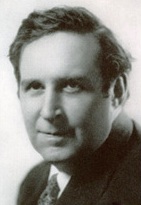
“If Baseball is really the National Game let the Club Owners go out and prove it”

4 May

Haywood Broun, columnist for The New York World-Telegram, shook up the annual Baseball Writers Association dinner in February of 1933.  The Pittsburgh Courier said Broun “struck out boldly in advocacy of admitting Negroes to the charmed circle of big leagues.”

Heywood Campbell Broun

Heywood Broun

Broun said (and later wrote in The World-Telegram):

“I can see no reason why Negroes should not come into the National and American Leagues.

“Why in the name of fair play and gate receipts should professional baseball be so exclusive?”

[…]

“The introduction of a few star Negro ball players would do a great deal to revivify interest in the big leagues.  It would attract a number of colored rooters. And it would be a fair and square thing.  If baseball is really the national game let the club owners go out and prove it.”

Jimmy Powers of The New York Daily News said he polled the dinner guests after Broun’s remarks:

“I made an informal tour around the tables asking club owners and players their reactions to Broun’s little talk.  I was amazed at the sentiment in favor of the idea.”

Powers claimed that Yankees owner Jacob Rupert, St. Louis Cardinals General Manager Branch Rickey, and Babe Ruth were all in support of Broun’s statement.   John McGraw the dinner’s guest of honor—he had resigned as manager of the New Giants the previous summer due to his failing health—was, according to Powers, “The only prominent man present vetoing” the idea.

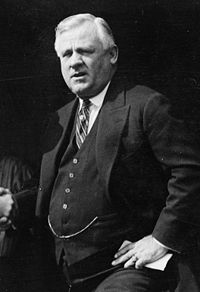
John McGraw

John McGraw vetoed the idea


Salem Tutt Whitney, a prominent star of the black vaudeville circuit, commented on McGraw in the pages of The Chicago Defender:

“John McGraw and his Giants have been the idols of the Colored baseball fans.  Whenever and wherever there had been talk about the color line in major league baseball, the Colored fans were a unit that declared that if John McGraw could have his way there would be no color line.  ‘Didn’t he play (Charlie) Grant at second base on the Giants!’  ‘Look how long he employed a Colored trainer (Ed Mackall)!’”

[…]

 “It is my opinion that if the Colored baseball fans of Harlem are not convinced that Mr. McGraw has nothing more to do with the Giants, there will be a lack of personal color in bleachers and stands at the Giants’ stadium this summer.”

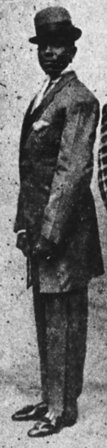
Salem Tutt Whitney

Salem Tutt Whitney

Not content to simply report on Broun’s pitch for integration, Powers made his own:

“I would like to make a case for the colored baseball player.  In football, Duke Slater, Fritz Pollard and Paul Robeson and stars of similar complexion played with and against the cream of Nordic colleges.  Eddie Tolan, Ralph Metcalfe and Phil Edwards have conducted themselves in a gentlemanly—not to mention championship—fashion.  Boxing has known Joe Gans, Sam Langford, Joe Walcott and Tiger Flowers.  There are only three popular sports in which the dark-skinned athletes are snubbed—tennis, golf and baseball.”

The New York Age approved:

“Here’s hoping all the other big white sportswriters have the courage of Jimmy Powers.”

Chester Washington, a sports writer at The Pittsburgh Courier announced that the paper was launching “A symposium of opinion, coming from outstanding figures in baseball circles,” designed to demonstrate a broad coalition of support for integration.

The Courier reported “The first of these statements,” in response to Washington’s outreach the following week—and it was a rather incredible one from John Heydler, president of the National League, who said:

“Beyond the fundamental requirement that a major league player must have unique ability and good character and habits, I do not recall one instance where baseball has allowed either race, creed or color enter into the selection of its players.”

Gerald Nugent “aggressive young owner of the Phillies,” was next to respond to The Courier:

“Nugent calls attention to the fact that no ‘color line’ is drawn on the dollars which are spent by colored and white fans for admissions in the various big-league parks…He further declares that the average colored semi-pro league player is better than his white brother in the same category.”

Support continued to come.  Chicago White Sox President J. Louis Comiskey:

“You can bet your last dime that I’ll never refuse to hire a great athlete simply because he isn’t the same color of some other player on my team if the alleged bar is lifted.”

While Commissioner Kennesaw Mountain Landis did not respond to The Courier, his right-hand man, Leslie O’Connor said “(T)here isn’t any rule which keeps colored players out.”  But, like Heydler, he made the incredible claim that “the subject of Negro ball players had never been brought up,” among the Major League Advisory Council.

Based on the initial responses, William Goldwyn Nunn, The Courier’s managing editor, expressed great, if premature, optimism:

“And the color will be black!

“As sure as the Ides of March are approaching, there’s going to be some added color in the Major Leagues.  AND, THAT COLOR WILL BE BLACK!”

Meanwhile Jimmy Powers quoted Lou Gehrig and Herb Pennock of the Yankees and Frankie Frisch of the Cardinals in The Daily News, all said they were “open-minded,” about the possibility integration.

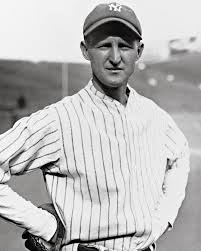
pennock

Pennock “Open-minded”


Two more prominent sportswriters came out in support:  Dan Parker of The New York Daily Mirror, and Gordon Mackay, who had been sports editor of three Philadelphia papers—The Enquirer, The Press and The Public Ledger.

And then, as abruptly as it began, the movement died.

Despite the brief groundswell of support, by the time the major league season opened Alvin J. Moses, another writer for The Courier admonished the papers readers:

“Aren’t you somewhat ashamed of yourselves that you haven’t seen fit to spare the time to flood (the paper) with letters that cry out against these NEGROPHOBES who for more than half a century have kept Negro ballplayers out of league competition?

“The cry of ‘Play Ball, Play Ball, Play Ball?’ is heard today in hundreds of parks the county over, and baseball statisticians have figured to show more than 40,000,000 fans walk past the turnstiles.  But what does that cry mean to you, and you, and you? Well, I’ll tell you—absolutely nothing.”


Things I Learned on the Way to Looking up other Things #14

29 Apr

Wishful Thinking in Boston–1921

Arthur Duffey was a former track athlete—he finished fourth in 100 yard dash in the 1900 Olympics—turned sports columnist for The Boston Post.

Arthur Duffey

Arthur Duffey

Like many in Boston, he hoped Babe Ruth would be unable again put up the type of numbers he did in 1920—54 home runs, 135 RBI, .376 average– after being sold by the Red Sox to the New York Yankees.

Ruth

Ruth

Duffey had received word in March of 1921 that his hopes would be realized:

“According to all reports from Hot Springs way where Babe Ruth is putting in his preliminary canters for the coming American League race, Babe evidently believes in that old slogan about ‘Living to eat instead of eating to live,’ for the Bambino is pounds overweight and not a few predict that he is going to have his troubles in getting down to anything like his baseball scale of last season…(Ruth) has no doubt been living the life of Reilly since he has proven himself the ‘King of Swat.’ But, is he going to eat himself out of another chance to beat that home run record?”

Ruth managed to “eat himself” into a season that included new career highs for games (152), at-bats (540), runs (177), home runs (59), RBI (168), and batting average (.378).  The Yankees won the American League pennant and the Red Sox finished their second straight fifth-place, Ruth-less season.

Wishful Thinking about honesty, 1901

George Erskine Stackhouse, sports editor of The New York Tribune, assured readers of “Leslie’s Weekly Illustrated” magazine, that there was no corruption in baseball:

“Baseball is honest.  Some peculiar things happen in baseball at times, but I have watched the game very closely for a great many years and believe that it is at least as close to perfect honesty as any professional sport in the world.”

George Erskine Stackhouse

George Erskine Stackhouse

Stackhouse also refused to believe that gamblers had any role in the game:

“Baseball has no side-show features, such as betting and the like, and soon as the average ‘fan’ thought the games dishonest he would lose all interest in the sport.”

But, Stackhouse assured his readers he was not naïve, but everyone involved in baseball had learned their lesson from the scandals of the 19th Century:

“I do not mean to say that there are not players and club owners who would not be tricky if they dared.  They simply don’t dare.

“The lesson dealt out to the early evil-doers who were charged with selling games in the interest of certain gamblers, has had a splendid effect.  The sentence hangs over those men yet, and the disgrace will remain with their children and their children’s children.  I believe that there have been hundreds of fake horse races, prize fights, wrestling matches, and professional running races to one really crooked baseball game.”

Stackhouse died in 1903 at the age of 42, content in the knowledge that baseball remained “close to perfect honesty.”

Miller Huggins

27 Mar

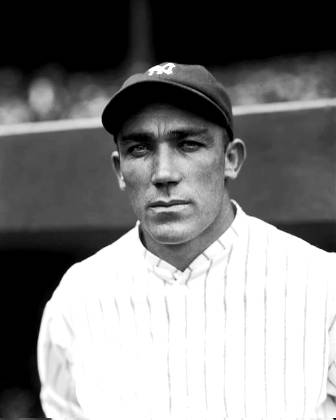
Miller James Huggins was born on this date in 1879.  The Hall of Fame Manager of the New York Yankees played 13 seasons as a second baseman for the Cincinnati Reds and St. Louis Cardinals.

Miller Huggins

Miller Huggins

In 1911, he told Hugh Fullerton of The Chicago Record-Herald about “The greatest play,” he had seen during his career.

Huggins said it was a play made the previous season—July 30, 1910–by his teammate, shortstop Arnold “Stub” Hauser during a game between the Cardinals and the Chicago Cubs, and was described by Charles Dryden of The Chicago Examiner as “the only quadruple play ever made.”

“The play was wonderful, not only because of the situation and the manner in which it was accomplished, but because of the fact that Hauser kept his head all the time and thought as quickly as he acted.

“The situation was this:  we had the game won, but (Frank) Chance and his Crabs were fighting hard and hitting harder.  It took a lot of fielding and desperate work to hold the lead we had gained as they had men on the bases in almost every inning and kept threatening to pile up a bunch of runs almost any minute and beat us out. “

In the fifth inning, with Solly Hofman on first and Jimmy Sheckard on second, Chance hit John “Red” Corriden’s first pitch:

“Chance hit it like a streak of lightning almost over second base, perhaps two or three feet to the third base side of the bag and on a low line.  The ball was hit so hard that I hadn’t a chance to get near it, although I took a running jump in that direction.  It didn’t seem that Hauser, who was playing short, could make it touch his hands.  He came with a run, and as he saw the ball going past he dived for it, and made it hit his left hand while it was extended at full length.  He just stabbed at the ball, and although it hit his hand he, of course, could not hold it.  He was staggering, almost falling, and the ball popped up in the air perhaps a couple of feet, and as it started to fall to the ground Hauser, still falling, grabbed it with his hand and clung to it.  I had covered second, hoping he would be able to get the ball to me when I saw him hit it with his hands.  (Instead of throwing to Huggins) He staggered over second base (to retire Sheckard) and shot the ball to first (to retire Hofman).  As he touched second he spiked me so severely that I had to quit the game.  That is why Dryden called it a quadruple play, as it retired three Crabs and myself at the same time.  I’m proud now that I got spiked, as it gave me a part in the greatest play I ever saw on a ball field.”

___

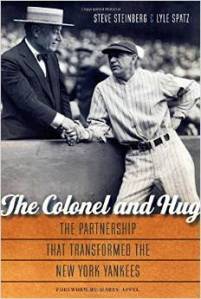
Speaking of Huggins.  I receive a fairly steady stream of advance copies of books, and while I read most of them, I don’t recommend many. Too many rely heavily on recycled information from secondary and tertiary sources, often repeating faulty information and perpetuating myths.  A soon to be released book about Huggins is a pleasant exception.

colonelandhugcover

The Colonel and Hug: The Partnership That Transformed the New York Yankees, by Steve Steinberg and Lyle Spatz, will be released on May 1. In addition to being a thoroughly researched, well-written, definitive, biography of both Huggins and Yankee owner Jacob Rupert, the book does an excellent job of weaving the story of the Yankees in the broader context of the 1920s.

Tragic Exits 3

23 Mar

Eddie Meade

Edward “Eddie” Meade appeared headed to the big leagues.  After beginning the 1926 season with the Kinston Eagles in the Virginia League, the 24-year-old left-hander was acquired at midseason by the St. Paul Saints of the American Association and posted a 12-7 record with a 3.40 ERA in 22 games.

Meade began the 1927 season with a 6-0 shutout of the Louisville Colonels on April 17.  The same week he recorded his first victory, The Associated Press said he was about to become a member of the defending American League champions:

“The Yankees talked of possible reinforcements in the shape of Eddie Meade, of St. Paul, called the best young pitcher in the American Association.”

Eddie Meade

Eddie Meade

During the same week, Meade became ill; although the nature of the illness was never disclosed.  Eight days later he started a game with the Columbus Senators but was pulled after giving up six runs in the fifth inning of 9 to 8 loss.  Five days later he pitched in relief against Louisville, but The Minneapolis Journal said he lasted less than an inning due to his “impaired physical condition.”

When the Saints left Minnesota for a series in Kansas City on May 16, Meade stayed behind.  The following evening Meade checked into St. Paul’s Boardman Hotel and shot himself to death.

The day after his suicide, The Journal said, “it was learned today that Meade was slated to go to the New York Yankees in the fall.”

St. Paul Manager Nick Allen told The Associated Press:

“He was one of the hardest working youngsters we ever had on the club and the outlook for his future was bright, as he had only two years in baseball.  The only motive he could have had for such action would be mental depression.  He was not married.  The nature of his illness was no cause for alarm, but he apparently believed it otherwise.”

Tommy Coates

Thomas A. “Tommy” Coates was born in Omro, Wisconsin on February 18, 1886 (Baseball Reference lists his middle initial as “O” but birth and death records  list it as “A”).

After starring, along with his older brother Hiram, on Omro High School’s undefeated baseball team in 1901—The Omro Herald called the team “possibly the best in the state”—Coates played industrial league and semi-pro ball in Central and Northern Wisconsin.

After playing in Rhinelander, Wisconsin in 1908, The Oshkosh Northwestern said:

“Coates had lots of confidence in himself, and during the winter months the Omro boy came to the city one day and sought out “Pink” Hawley. Hawley agreed to give him a trial.”

Emerson Pink Hawley, a Wisconsin native who pitched in the major leagues for a decade, was the manager of the Oshkosh Indians in the Wisconsin-Illinois League.

Tommy Coates

Tommy Coates

 “Coates came to this city from his home at Omro (for his tryout).  He donned baseball togs and he ‘made good’ from the start.”

Coates, who The Northwestern said  was “tall (and) built something like the great Ty Cobb,” became the Indians starting left fielder one week into the season and went on to lead  the team with a .299 batting average (he hit .002 better than his 19-year-old teammate Heinie Groh).

In September, The Sporting News reported that with just one season of professional experience, Coates “Looks good to Connie Mack,” and was drafted by the Philadelphia Athletics. He was the only member of the Indians drafted by a big league club in 1909.

At season’s end in September, Coates, with an invitation to train with Mack’s club in the spring, spent most of his time hunting.

On October 11 Coates was in a row-boat with a friend, hunting in a marsh near Omro.  The friend told The Omro Herald:

“Tom saw a mud hen rise up on the right hand side.  He turned about quickly and took hold of his gun which was at his left side and pulled it toward him…I turned about as soon as I heard the shot, and to my horror saw Tom lunge forward.”

Coates accidentally discharged his gun, shooting himself in the left eye.

Twelve days after the Oshkosh Indians received a $300 check from Connie Mack—his draft price—Coates was dead.

The Northwestern said:

“He was quiet and unassuming. After making a sensational play in the field or batting out the hit that won the game…the Oshkosh fans could not induce Coates to doff his hat.  He would return to the bench with face covered with blushes.”

[…]

“His more ardent admirers were confident he would make good in the American League, and one of their first thoughts upon hearing of the unfortunate accident, was the promising career he had before him.”

“The Next Babe Ruth”

18 Mar

After he hit 11 home runs in 1918, and for the next two decades, stories about the discovery of “The Next Babe Ruth” became commonplace in newspapers across the country.

One of the first was Joe Doyle, “The Babe Ruth of Great Lakes,” signed by the St. Louis Cardinals in November of 1918.  Doyle was the star of the team representing Camp Dewey at Great Lakes Navel Training Station where, The St. Louis Globe-Democrat said he made a name for himself, hitting “a dozen home runs and nine triples…(and) flogging a home run over the Camp Dewey Drill Hall, a smash that might be compared to a lift over the left fences of any major league park.”

Doyle began his professional career the following spring with the Houston Buffaloes in the Texas League and played his entire career in Texas.  “The Babe Ruth of Great Lakes” hit just eight home runs over five minor league seasons.

Ben Paschal had the distinction of being declared “The Next Babe Ruth” twice.  When the Boston Red Sox purchased Paschal from the South Atlantic League’s Charlotte Hornets in July of 1920, Manager Ed Barrow told The Boston Herald he had acquired “A second Babe Ruth.”

Paschal joined the Red Sox after Charlotte’s season ended in September.  He had 10 hit in 28 at-bats, but no extra base hits, and was returned to Charlotte after the season.

After four more excellent seasons in the South Atlantic League and Southern Association (he hit .335 with 68 home runs from 1921-1924) he was  purchased by the New York Yankees for $20,000 in August of 1924.

Ben Paschal

Ben Paschal

Paschal was again dubbed the “Second Babe Ruth” by newspapers.  His second stint as the second Ruth was longer and more successful than his first.  From 1924-1929 he hit .309 in with 24 home runs in 750 at-bats as an outfielder playing behind Ruth and Bob Meusel (Meusel was himself dubbed “Another Babe Ruth” by Manager Miller Huggins when he joined the Yankees in 1920).  On Opening Day in 1927 the Second Babe Ruth pinch-hit for Ruth (who was 0-3 and struck out twice) in the sixth inning; Paschal singled, and the Yankees went on to an 8 to 3 victory over the Philadelphia Athletics.

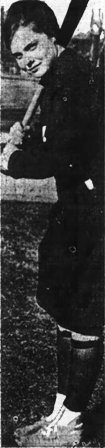
Then there was Dorothy Hodgens.  In 1921, Hodgens was a 20-year-old student at Wilson College in Chambersburg, Pennsylvania.  Hodgens briefly became a celebrity and was called the “feminine Babe Ruth” by many newspapers after The Associated Press (AP) reported that while growing up in Philadelphia Napoleon Lajoie said she was “the only girl he ever knew who could play ball.”

After her picture appeared in papers across the country, Hodgens, who played several sports at the school, was interviewed by The Harrisburg Evening News as she was “ready to enter a basketball game:”

“Yes, I’m terribly fond of baseball, and I’ve been playing it ever since I’ve been a bit of a youngster.”

She said Lajoie was a neighbor in Philadelphia when she was a child:

“Lajoie used to come out and pitch ball with the boys and girls in the neighborhood.  He told me I was the only girl he ever knew who could pitch and gave me a box of league balls that I have treasured ever since.”

Dorothy Hodgens "The Feminine Babe Ruth."

Dorothy Hodgens “The Feminine Babe Ruth.”

While she said her real ambition was to become an actress, Hodgens said, “I never expect to give up baseball entirely though, and I certainly think that every girl should learn to play the game.”

The “Feminine Babe Ruth” disappeared from the public eye shortly afterward.

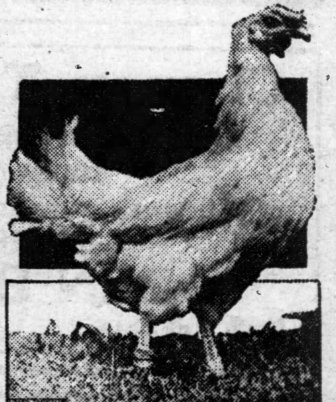
And finally, there was “Another Babe Ruth” who had a brief moment in the limelight in the fall of 1920.  This one was a three-and-a-half pound white Leghorn Chicken who was named “Babe Ruth,” and had just established a new record.

"Babe Ruth"

“Babe Ruth”

The AP said:

“(T)he home run king has a rival…She bats 326 eggs, and this beats the record of 314 (for a single year).  By experienced poultrymen, her record of 326 perfect eggs is considered the most remarkable in the history of the poultry industry.”

There was no report of how she performed the following season.

Lost Advertisements–Beer “The Proper Drink for Athletes in Training”

23 Jan

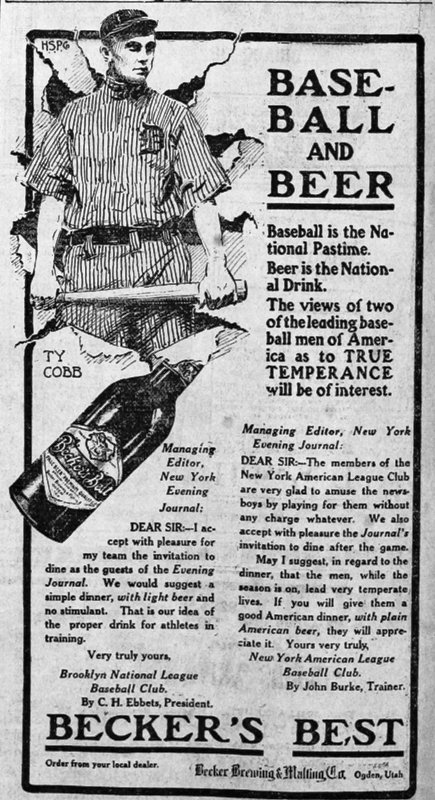
cobbbecker's

A 1918 advertisement for Becker’s Best Beer from Utah’s Becker Brewing & Malting Company, featuring Ty Cobb,  the ad said:

“Baseball is the National Pastime.  Beer is the National Drink”

It also included testimonials from “two of the leading baseball men of America as to True Temperance.”

As a result of the World War I “Food and Fuel Control Act,” malt beverages were mandated to contain less than 2.75% alcohol; brewers were trying to highlight the non intoxicating aspects of their current products as a wartime ban on the brewing of all beer was on the horizon (eventually that ban was adjusted to allow brewing of “non-alcoholic malt beverages).

The featured letters were from Brooklyn Robins President Charles Ebbets and New York Yankees Trainer John Burke to The New York Evening Journal regarding the paper’s invitation to a dinner honoring the ball clubs. Ebbet’s wrote:

“I accept with pleasure for my team the invitation to dine…We would suggest a simple dinner, with light beer and no stimulant.  That is out idea of the proper drink for athlete in training.”

Burke wrote:

“May I suggest in regard to the dinner , that men, while the season is on, lead very temperate lives.  If you will give them a good American dinner, with plain American Beer, they will appreciate it.”

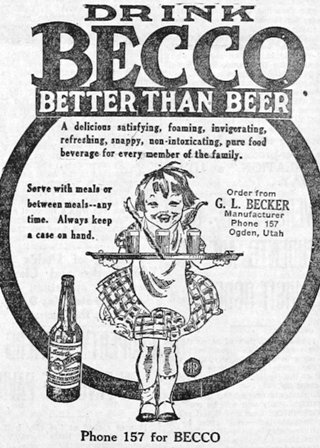
Becker Brewing & Malting, according to a  1919 issue of “Brewers Journal,” was among the company’s making “laudable efforts…to meet the adverse conditions which have been imposed under the veil of ‘war time’ prohibition” by bottling soft drinks and manufacturing “Becco, a cereal beverage.”

Ty Cobb no longer appeared in the ads.

becco

“Throw Strikes. Home Plate Don’t Move.”

19 Jan

Satchel Paige told Dave Condon of The Chicago Tribune that early in 1965, with the help of his wife Lahoma, and 17-year-old daughter Pamela he “wrote letters to everyone in baseball just looking for a steady job.  Anything.”

After not one professional team responded, the spring and early summer were like most during his 40-year career as a pitcher—Paige traveled wherever there was a chance for a paycheck.

He had made appearances with the Harlem Globetrotters in the winter and spring and then hit the road; pitching for the barnstorming Indianapolis Clowns and whoever else would call.  In May, The Chicago Defender said Abe Saperstein, who was managing Paige’s appearances, took out an ad in The Sporting News:

“(T)he man, who may have been the greatest pitcher of all time, is letting it be known that he has glove and is willing to travel.  All that is necessary to secure his services is to contact Saperstein.”

One night Paige would be at Chicago’s Comiskey Park, in a White Sox uniform, pitching for the Clowns in front of a large crowd, or across town in Wrigley Field where 30,000 fans came out; another night would find him in Hastings, Pennsylvania taking “the mound for the Hastings VFW club,” or Wheatfield, Indiana pitching “for the Band Boosters against the Wheatfield Young Farmers,” in front of a few hundred people.

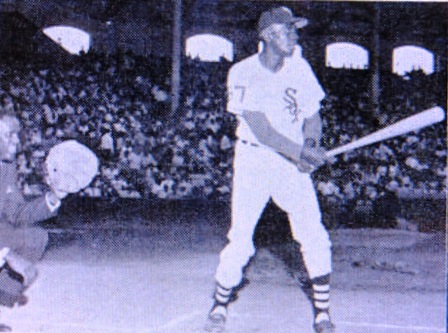
Paige at Comiskey Park in 1965--Chicago Cubs outfielder George Altman is the catcher.

Paige at Comiskey Park in 1965–Chicago Cubs outfielder George Altman is the catcher.

Things began to look up in late July when the Cleveland Indians inducted Paige into the team’s Hall of Fame between games of a Sunday doubleheader with the Yankees; in front of the team’s largest crowd of the season:  56,634.  According to United Press International:

“Satch tossed examples of his blooper, drooper and hesitation pitches to (former Indians teammate) Jim Hegan, now a Yankee coach and explained his philosophy of pitching thus: ‘Just take the ball and throw it where you want to.  Throw strikes.  Home plate don’t move.”

In August, he accepted an offer to pitch for and manage a team in Anchorage, Alaska called the Earthquakers.  In reality, Paige simply went to Alaska for a short series of exhibition games, and had no intention of staying there—he was already booked to appear at the old-timers game scheduled in September to mark the first season of the Houston Astrodome.  But he did his best to sell it as a possible long-term move.  He told a reporter for The Associated Press:

“Lately, I’ve wanted to leave barnstorming baseball to settle down somewhat to help the sport.  Anchorage seems to be the place to do it.”

In addition to his appearance in a handful of games in Alaska, his arrival in the state also resulted in a chance meeting that was reported in the press.

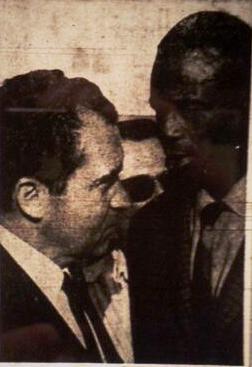
As a crowd of local residents gathered at the Anchorage airport to greet Paige, another plane arrived for refueling.  It carried former Vice President Richard M. Nixon on his way to Tokyo.  Nixon walked into the terminal while the plane was refueled, and when he asked about the crowd he was told they were waiting for Paige’s arrival.  Nixon joined the line to greet the pitcher.  The man who would be the leader of the free world in a little more than three years told a reporter from The Associated Press:

“I always like to meet celebrities.”

Nixon and Paige meet in Alaska

Nixon and Paige meet in Alaska

His commitment in Alaska over, Paige made it to the Astrodome on September 6.  The two-inning game, featuring a team of “immortals” versus “Texas All-Stars,” was an incredible collection of legends—more than 50 former players participated; twelve were already members of the Hall of Fame.  The Houston Post said of the player introductions:

Joe DiMaggio, the Yankee Clipper, got a deafening cheer.  So did Satchel Paige, peerless Negro hurler.”

The paper said the only others to receive a reception near that for Paige and DiMaggio were Dizzy Dean and native Texan Monty Stratton.

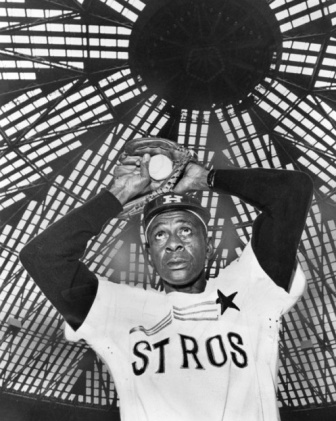
Paige in the Astrodome

Paige in the Astrodome

Perhaps it was the reception in Houston that caused one of the letters Paige, and his wife and daughter had written months earlier to finally be answered.

Charles Oscar Finley, who made his fortune in the insurance business and bought controlling interest of the Kansas City A’s before the 1961 season, was the one who finally responded.

That the signing of Paige appears to have been a spur of the moment decision for Finley after reading about the reception in Houston, is supported by the fact that it was announced by the marketing savvy Finley at what The Kansas City Times described as a “hastily called news conference,” which Finley, who was in Chicago, did not attend.

He appeared with General Manager Hank Peters and told reporters “I thought they were kidding” when Finley called and offered him a contract.

He said he was ready to pitch and brushed aside questions about his age:

“I think I can still pitch and help this club.  So what difference does it make what my age is if I can?”

Bill Veeck, who had signed Paige with the Cleveland Indians in 1948 and the St. Louis Browns in 1951, told The Times he hoped it wasn’t just a publicity stunt by Finley:

“I am hopeful he will be used as he should be—as a pitcher. Leroy should surprise a few people as he has for a long time.”

Veeck and Paige

Veeck and Paige

The controversial Veeck, more than a decade away from his return to the game, told The Kansas City Star he blamed himself for the pitcher’s  long absence:

“When I left Cleveland the first thing the new owners did was get rid of Satch.  When I sold the St. Louis Browns (and the team relocated to Baltimore), the same thing happened.  That’s nothing more than guilt by association.”

The signing of the 59-year-old Paige, who joined a team that included five 19 and 20-year-old pitchers who appeared in at least one game that year—Jim “Catfish” Hunter, John “Blue Moon” Odom, Ron Tompkins, Tom Harrison and Don Buschorn—inspired a short poem published in The Star:

“They’re either too

Young or too old,

When Charlie puts ‘em

In A’s Green and Gold.”

Papers across the country carried a photograph of Paige, seated on a chair, with one of Finley’s young pitchers, Catfish Hunter, on his knee.  While the photo was straight from Finley’s marketing plan, the impact of one future Hall of Famer on another, forty years his junior, seems to have been real.

Paige and Hunter

Paige and Hunter

The Star spoke to Paige about his pitching philosophy one afternoon as Hunter stood nearby.  The paper said:

“Hunter listened intently as Satchel expounded his pitching theories.”

Paige was equally impressed with the 19-year-old, telling The Star:

“This young man has shown me a lot of poise.  He has a great future in this game.”

The next two weeks were filled with pictures of, and stories about, Paige in a rocking chair, a nurse seated nearby, watching the A’s play, and while a “Satchel Paige Night” was scheduled, there appeared little chance the pitcher would be used as anything but a prop for publicity.  Then Finley announced that his new pitcher would start on his night, September 25 against the Boston Red Sox.

What took place on the mound on September 25 has been written about many times. With his six children and wife Lahoma—pregnant with number seven—sitting in the owner’s box with Finley, Paige pitched three shutout innings, allowing just one hit—a Carl Yastrzemski double.

The only disappointment was the anemic crowd—just 9,289 Kansas City fans turned out to see a legend, the second largest crowd during that six-game home stand was 2,874.

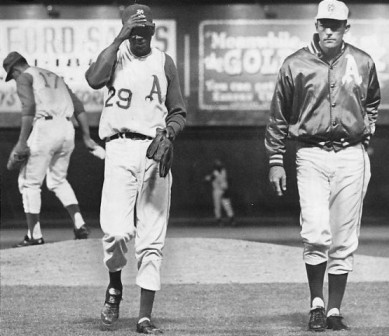
As Paige took the mound in the fourth inning, A’s Manager Haywood Sullivan, who was not consulted before Paige’s signing or before Finley announced he would pitch that night, came to the mound to remove Paige.  The pitcher walked off to a standing ovation.

Paige walks off the field with Manager Haywood Sullivan while Diego Segui warms up.

Paige walks off the field with Manager Haywood Sullivan while Diego Segui warms up.

Paige returned to the clubhouse.  The Star said:

“In the clubhouse he was down to his long underwear, and talking about helping the A‘s out of the basement when someone rushed in a and screamed, ‘Satch, they want you back on the field.’

“The lights were out.  More than 9,000 matches flickered in the darkness, and on ‘Salute to Satchel Paige Night,’ they sang ‘Rockin’ Chair,’ ‘Darling I am Growing Old,’ and “The Old Gray Mare.”

After returning to the clubhouse, Paige was greeted by Finley, who called him “a real credit to the game.”  Paige “shook the owner’s hand” and said “I want to thank you for bringing me here.”

Whether he truly believed it or not, Paige told reporters he planned to pitch again in 1965.

“Everybody doubted me on the ballclub.  They’ll have more confidence in me now.”

He did not appear in another game but stayed with the club for the remainder of the season.  Two days after his three-inning performance, he was with the team in Baltimore.

A discouraging word had not been uttered by Paige during his time with the A’s.  Perhaps being in Baltimore—where his big league career effectively ended after Veeck sold the Browns—or maybe just the realization that a man capable of throwing three shutout innings at age 59 was not given an opportunity by a major league club the previous 12 seasons, changed that.

Lou Hatter wrote in The Baltimore Sun:

“Satchel Paige, the slender pitching ancient signed 2 ½ weeks ago by Kansas City, bared a deep-rooted wound here last night for the first time.”

Paige said to Hatter:

“You can put it this way.  You can say I resent being overlooked by organized baseball all these years while I threw away most of my best years pitching for a barnstorming club…All they ask me, though, is how old am I.  But nobody asks me why I stayed out of the major leagues for 15 [sic 12] years.  That’s a long time isn’t it?  That’s a lifetime for most professional players.

“Let me ask another question. When Baltimore bought the St. Louis ballclub, why did they turn me loose?

“When I went to the Miami club (again pitching for Bill Veeck with the International League Marlins) and was a top pitcher for three years (11, 10 and 10 win seasons with ERAs of 1.86, 2.42 and 2.95), how come nobody picked me up?…I know the answer, but I won’t tell that neither—like I won’t tell my age.”

Despite Finley telling reporters throughout September that Paige would return to the A’s in 1966, if not as a player, then as a coach, he was released in September. The next time he appeared on the mound at Kansas City’s Municipal Stadium, it was again as a member of the barnstorming Indianapolis Clowns.

Paige back in Kansas City as a member of the Indianapolis Clowns in 1966.

Paige back in Kansas City as a member of the Indianapolis Clowns in 1966.

Big Six versus The Hoosier Thunderbolt

6 Aug

Christy Mathewson had only pitched five full seasons when Sam Crane of The New York Journal said in January of 1906 “there is a great diversity of opinion” regarding whether Mathewson or Amos Rusie was the better pitcher.

Crane said “Old-time lovers of the game” said Rusie, “The Hoosier Thunderbolt”, whose career ended in 1901 after being traded to Cincinnati for “Big Six” Mathewson,  was the best ever, “and refuse to acknowledge that the young college man who won the world’s championship so easily last fall…is his superior.”   While, “the younger generation of enthusiasts say there was never but one Mathewson and point to his wonderful record to prove their point.”

Amos Rusie

Amos Rusie

Crane said two famous New York baseball figures—and future Hall of Famers– disagreed on the point:

George Davis, the crack shortstop of the Chicago White Sox, and one of the best players who ever wore ‘New York’ across his shirt front, met Clark Griffith, manager of the Yankees (Crane was one of the earliest to call the then “Highlanders” the “Yankees”), yesterday at the headquarters of the New York American club, and argued over the much mooted questions of pitching superiority between the two crack box artists.  Both Davis and Griffith agreed that Mathewson and Rusie were two of the best, but differed as to which was entitles to the premier position.”

Davis thought Mathewson was better.

“Both have excelled all other Boxmen.  I have never batted against Matty in a game, but I have met his curves in practice and I want to say that he has just as good control of the ball as Rusie.  Matty’s most effective ball is a straight drop, but his speed is a great factor as well as a wonderfully controlled slow ball.  He uses his forearm and elbow and winds up in such a manner that a batsman is sure to be puzzled.  Rusie, on the other hand, depended on an out drop, which he controlled with remarkable skill, in addition to his fast ball; but he had very little preliminary motion and used his shoulder almost exclusively.  Rusie probably had the better physique, but in head work and vitality Mathewson outclasses the big Hoosier.”

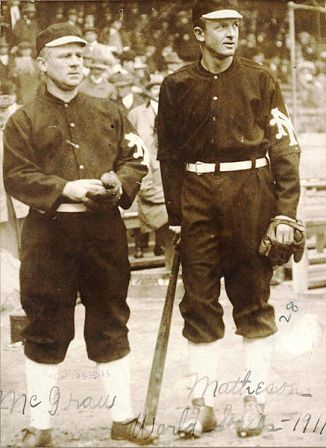
Christy Mathewson with John McGraw

Christy Mathewson with John McGraw

Griffith disagreed:

“Rusie in his prime was the best twirler that ever stepped into the box.  His curves, speed and control were the best assortment I ever looked at, and no pitcher has ever approached him in class since he made his departure from baseball.”

Crane cast the deciding vote, declaring:

“Rusie never had a peep in with Mathewson as a box artist.  Rusie relied mostly on brute strength until his arm began to show symptoms of crystallizing, then he accumulated a good slow ball; but for head work, pure good judgment, with a delivery or series of deliveries to back up his well-balanced brain, Mathewson is superior to any pitcher who ever wore shoe plates.”

Crane’s analysis was prescient.

Rusie’s greatness is undisputed—his speed was primary reason for moving the pitching distance from 50‘ to 60’ 6”—but his best days were behind him before he turned 24-years-old.  His season-long holdout in 1896 and the arm injury that effectively ended his career at 27 after the 1898 season (except for three games he pitched for the Cincinnati Reds in 1901) make him one of baseball’s great “what ifs?”  He still finished his career 246-174, and was elected to the Hall of Fame in 1977.

Mathewson won twenty games for nine straight seasons after Crane declared him “superior to any pitcher.   He finished 373-188 and was part of the Hall of Fame’s first induction class.

Tragic Exits

28 Apr

George Frazee

George Donald Frazee, listed on Baseball Reference as “G. Frazee” with the Shreveport Sports in the Texas League in 1928, was a three-sport star at Texas Christian University.

Born November 21, 1904 in Fort Worth, Texas, Frazee played outfield for the baseball team, halfback and fullback with the football team, and was a guard on the basketball team from 1923-1925.  After graduation he played basketball with a team representing the Fort Worth, Texas YMCA which played throughout the Southwest and Mexico.

It’s unclear where Frazee played baseball in 1926 and ’27, but in 1928 he started the season with the San Angelo Red Snappers in the West Texas League, there are no surviving statistics for his time there, but after being transferred to Shreveport he hit .301 in 32 games. Frazee signed with Shreveport for the following season.

On January 24, 1929 Frazee was flying from Ft. Worth with World War I flyer Willoughby Alvous “Al” Henley and another Fort Worth man, to attend the opening celebration for San Angelo’s new airport.  The United Press wire story said:

 “Tragedy marred the formal opening of the municipal airport today, claiming the life of Al Henley…one of the nation’s most skilled pilots.  Henley, Donald Frazee, professional baseball player, and W.E. Shytles…were killed when their cabin monoplane crashed in an attempted landing.”

The Brownsville Herald said:

 “He was an outfielder, fast, big and aggressive.  Shreveport lost an outfielder who was certain to make good this year.”


Chief Wano

William “Chief” Wano was born on Oklahoma’s Pottawatomie reservation on May 12, 1896.  He played semi-pro ball in Oklahoma City and in the army while serving with the 79th Infantry, 15th Division at Camp Logan, Texas.  After his discharge in early 1919 the twenty-three-year-old began his professional career with the Tulsa Oilers in the Western League.

Wano struggled during his first season, hitting just .195, but joined the Little Rock Travelers in the Southern Association the following season—and along with fellow Oklahoman, and former classmate and teammate at the Chilocco Indian School– Moses “Chief” Yellow Horse; he helped lead Little Rock to the pennant.

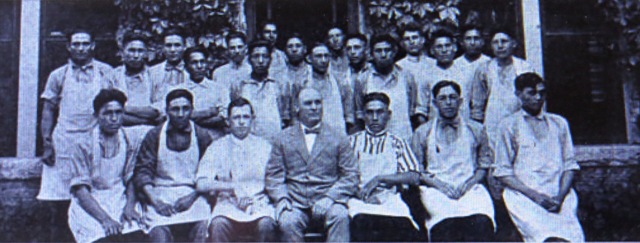
William Wano,

William Wano, back, fourth from right, at Chilocco Indian School

Wano was a consistent hitter throughout the 1920s (.317 in 11 seasons in class-A leagues), but was an erratic fielder and never made it to the major leagues.

After hitting .331 for the St. Joseph Saints in the Western League in 1930 Wano left organized baseball, first playing semi-pro then he accepted a position managing Ben Harjo’s All-Indian Baseball Club—Harjo was a millionaire and full-blooded Creek.   The team, based in Harjo’s hometown Holdenville, Oklahoma, barnstormed the Midwest and Southwest, and with Wano as player-manager won the Denver Post Tournament in July 1932.

Chief Wano

Chief Wano

Wano quit two months later after a dispute over two players Wano signed.  Harjo hired Jim Thorpe to manage the club the following season.

Wano moved to Dallas after his career.  According to The United Press he spent World War II working at the North American Aircraft plant in Dallas, and living at the home of Kal Hill Segrist Sr., his former Dallas Steers teammate (and father of Kal Segrist, who played with the New York Yankees in 1952 and the Baltimore Orioles in 1955).

On July 30, 1945 Wano was in the Dallas City Jail (reports varied on why he was there), when according to The Dallas Times-Herald another prisoner “slugged Wano on the chin, Wano fell, striking his head on the concrete floor.”  Other reports said Wano was trying to break up a fight when he was hit.

William “Chief” Wano died that night in Dallas’ Parkland Hospital.  A month later a grand jury chose not to indict the man who threw the punch.


Gene Gaffney

Eugene “Gene” Gaffney was one of the better hitters in the Florida State League during his brief career (1920-23), he was also a manager’s nightmare.

Gaffney hit .335 in 60 games for the league champion Orlando Tigers in 1921, but was suspended for several days in July by Manager Joe Tinker.

The following season he joined the Jacksonville Indians, managed by former major leaguer George Stovall.  The team struggled, and Gaffney, had his only sub .300 season, hitting just .277.  And, according to The St. Petersburg Evening Independent, a car caused a major riff between the outfielder and his manager:

“Has a baseball player a right to ride to and from the park in his own automobile?  George Stovall says no.  He suspended Gene Gaffney because Gaffney had bought an automobile and insisted on being his own bus.

“Stovall insisted he should parade to the park in the team bus.  Gaffney told Stovall to go jump; that if the team would win enough games so that he wouldn’t be ashamed to wear the uniform on parade it might be different.  At last accounts Gaffney was off the ballclub, but riding his automobile to his own intents and purposes, while Stovall still was trying to get the rest of the Jacksonville team somewhere on the field.”

Gaffney played just one more season; he hit .357 for the Daytona Beach Islanders in 1923.

After baseball, Gaffney tended bar in Orlando until August 12, 1937—The Associated Press said:

“Gene Gaffney, about 43, local bartender who once led the old Florida State League in batting, was believed today to have been the victim of foul play.

“His automobile, its windshield shattered and other windows broken, was found mired in mud on the shores of an almost inaccessible lake just across the Orange County line in Seminole County, with evidence of a struggle having taken place.

“His eye glasses were found in the mud about 20 feet from the car.”

Gaffney’s body was found the following day.  His death was ruled a homicide.