Tag Archives: New York Yankees

Brief Bios

7 Apr

Finley Yardley

Identified as “Findley” on Baseball Reference, Finley A. Yardley was born in Ben Arnold, Texas on March 21, 1895.

“Fin” Yardley was a good hitter, but his intelligence was questioned more than once during his career.

After a spring trial with the St. Louis Browns in 1917, he was released to the Little Rock Travelers in the Southern Association for 57 games, but according to The Arkansas Gazette, “Forgetting is what chased him out” and he was sent to the Spokane Indians in the Northwestern League.

Yardley hit well in Spokane (.339 in 115 at bats), but despite his success The Gazette noted that:

“His think tank still slips now and then.  Recently he hit a drive good for three bases but forgot to touch first.”

Fin Yardley was no rocket scientist—his son John Finley Yardley was.

John Yardley was an aeronautical engineer whose team from McDonnell Aircraft Corporation designed the Friendship 7 capsule in which John Glenn orbited the Earth in 1962—Glenn called him “one of the real pioneers of the space program.”  Yardley was also involved with the Gemini, Skylab and Space Shuttle Programs.

After his playing career, Finley Yardley settled in St. Louis where he worked as a sales manager at a car dealership.  He died in Tucson, Arizona on March 1, 1963.

Charles Gurtz

Charles Joseph Gurtz was born in DePauw, Indiana in 1890.  He served in the United States Army, where he was a member of the 22nd Infantry and played for the unit’s baseball team in the El Paso, Texas city league.  He then played in a number of leagues throughout the Southwest not recognized by the National Agreement, including stops with teams in the “copper circuit;” loosely connected teams and leagues in mining towns in New Mexico and Arizona

Gurtz was let out of his contract in Silver City, New Mexico in order to join the Bloomington Bloomers in the Three-I League in 1914.  He hit .333, finishing second to Howard Wakefield for the league batting title.

Shortly after the 1914 season ended, Gurtz broke his leg during a semi-pro game in Odell, Illinois and returned home to Indiana.

In February of 1915, The Associated Press reported that he was “suffering from mental trouble, due to excessive religious zeal (and) has been declared insane. “  He was committed to Indiana’s state hospital at Madison, where “Physician’s say that he should respond to treatment and become normal again if his mind can be kept off religion.”

A month later Gurtz was released from the state hospital, The Associated Press said the hospital’s “superintendent expressed the opinion that Gurtz would be able to play ball.”

Gurtz played, but not well.

He hit just .193 for Bloomington in 1915.  The following year he was released by Bloomington just before the season began, but was signed by the Oklahoma City Senators in the Western Association in May.  He split the 1916 season between the Senators and the Muskogee Mets in the same league, hitting just .210.  (Baseball Reference identifies the player with Oklahoma City and Muskogee in 1916 as “William Gurtz,” but contemporary references in The Oklahoma City Times confirm that it was Charles Gurtz)

Gurtz returned to his native Indiana after the 1916 season and died on November 9, 1989, three weeks short of his 100th birthday.

Jimmy Duchalsky

James Louis “Jimmy” “the Duke” Duchalsky was discovered in Hawaii between the 1922 and ’23 seasons when Herb Hunter’s touring big leaguers visited the island during their barnstorming trip which also included stops in Japan, Korea, China and the Philippines.

The International News Service, which called the 5’ 9” 150 lb. Duchalsky the “hardest hitting pitcher in Hawaiian baseball circles,” said he caught the eye of New York Yankee pitcher “Bullet” Joe Bush.  Bush “was so impressed with the youngster’s work in a game he pitched against the big leaguers that he recommended him highly to Duffy Lewis manager of the Salt Lake City Bees in the Pacific Coast League).”
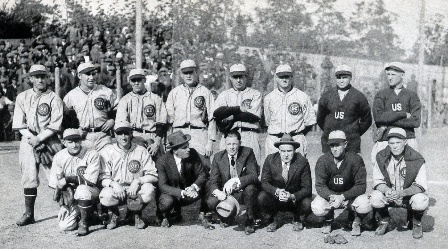
Joe Bush, front, second from right

Joe Bush, front, second from right  photographed during the tour.

Bush said the only thing he lacked was “a change of pace and that can be developed under the instruction of a good coach and manager.”

Duchalsky was 24-years-old (the Bees claimed he was just 21), but not as polished as Bush thought and struggled through 15 appearances, most in relief, for Salt Lake.  He posted a 1-3 record and 7.59 ERA in 51 innings—he did have 8 hits in 20 at bats, with one home run.   In May, he and teammate Tony Lazzeri were sent to the Peoria Tractors in the Three-I League; Duchalsky was 13-8 in 28 appearances.

The following season Duchalsky rejoined the Bees but pitched just one-third of an inning, allowing two runs and two hits in an 18-17 loss to the Oakland Oaks on April 10.  He was released later that week and returned to the Three-I League, this time as a member of the Decatur Commodores; he was 11-9 with a 4.13 ERA for the last-place (58-78) Commodores.
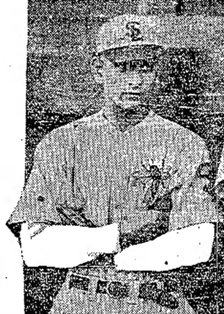
Jimmy Duchalsky 1923

Jimmy Duchalsky 1923

At the end of October he returned to Honolulu to play winter ball.

On December 7, 1924 Duchalsky was involved in an altercation with a cab driver. The Decatur Review said:

“Jim Duchalsky, known to all Three Eye League baseball fans as “The Duke,” has pitched his last game of ball… (he was) shot to death in his native city last evening after a street argument…It will be hard to convince Decatur baseball fans who have come in contact with Jim that he was the aggressor in any brawl that might have taken place for he was the most quiet player both on and off the field to ever appear here… Despite his quiet manners and the fact that he was not a mixer, many fans in both Decatur and Peoria will mourn his loss.  Duchalsky was admired by fans in every city where he played for his sportsmanlike conduct on the ball field and in all his games pitched at Staley Field was never seen disputing an umpire’s decision, even on balls and strikes.  He pitched his game and left the arguments out of his assortment.”

The Associated Press said, “The encounter was believed to have started in jealousy over a woman.”  The cab driver, John Emmeluth, claimed self-defense, but several witnesses said he approached and shot the pitcher with no warning.  He was sentenced to 20 to 25 years in prison.  Duchalsky was buried in Honolulu.
Irwin Howe

3 Feb

irwinhowebb


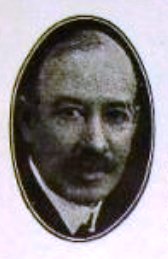
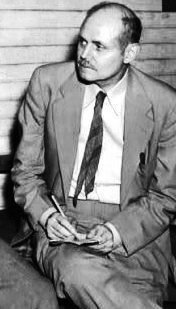
Irwin M. Howe founded Howe News Service in Chicago in 1910, published an annual record book and served as the primary statistician for several minor leagues, including the Western and the Three-I leagues.

After the 1911 season American League Secretary Robert McRoy, who was responsible for compiling statistics, left the league office to become an executive with the Boston Red Sox.  President Ban Johnson named Howe the league’s statistician; he served in that capacity until his death in 1934.

Irwin Howe

Irwin Howe

Howe leveraged his position with the American League.  He became the official statistician of several more leagues, including the American Association and the Federal League, wrote a nationally syndicated column called “Pennant Winning Plays,” became editor of the annual “Wilson Baseball Record and Rule Book,” and published an instructional pamphlet for kids.

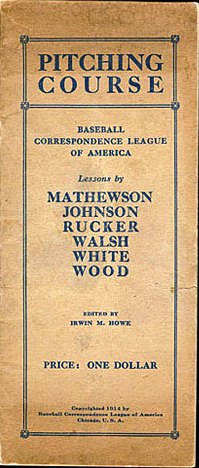
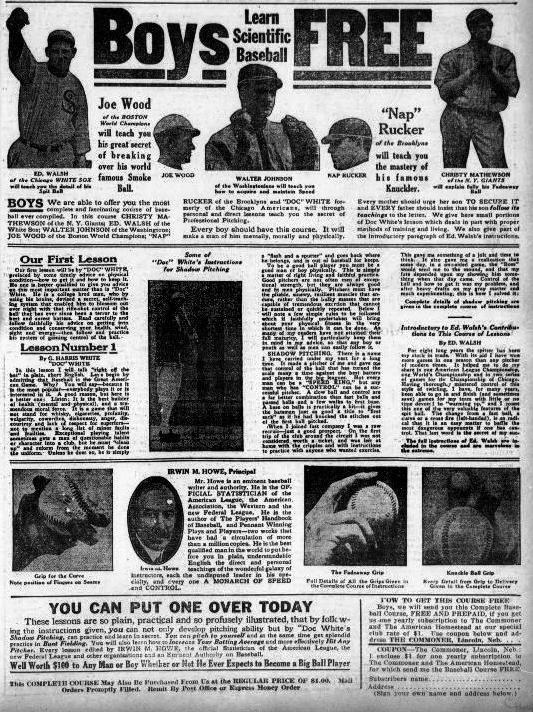
The ad from 1914 pictured above is for Howe’s 48-page “Pitching Course,” which he called “A correspondence school for baseball.” The pamphlets sold for one dollar, but were also offered by many small newspapers across the country for free to children who signed up subscribers (the pictured ad is from The Commoner, the Lincoln, Nebraska newspaper published by William Jennings Bryan).

Boys Learn Scientific Baseball Free

Ed Walsh of the Chicago White Sox will teach you the detail of his Spit Ball

Joe Wood of the Boston World Champions (1912) will teach you his great secret of breaking over his world famous Smoke Ball

Walter Johnson of the Washingtonians will teach you how to acquire and maintain speed

“Nap” Rucker of the Brooklyns will teach you the mastery of his famous knuckler

Christy Mathewson of the N.Y. Giants will explain fully his Fadeawy Ball

These lessons are so plain, practical and so profusely illustrated, that by following the instructions given, you can not only develop pitching ability…You will also learn to Increase Your Batting Average and more effectively Hit Any Pitcher.  Every lesson edited by Irwin M. Howe, the official statistician of the American League, the new Federal League and there organizations and an Eminent Authority on Baseball.

The pamphlet also included a lesson from Guy Harris “Doc” White of the Chicago White Sox “which deals in part with proper methods of training and living.”

Howe claimed his one dollar pamphlet was “Well worth $100 to any man or boy whether or not he ever expects to become a big ball player.”

Howe's pamphlet

Howe’s pamphlet

Perhaps Howe’s most famous contribution to baseball was certifying Ty Cobb as a .400 hitter in 1922.

On a rainy day in New York (years later in his book “Baseball as I Have Known It,” Fred Lieb said the game took place in August—contemporary newspaper accounts say it was May 15), Cobb beat out a ground ball hit to Yankee shortstop Everett Scott.  John Kieran of The New York Tribune (he was later a columnist with The New York Times) was the official scorer.  He charged Scott with an error.

Fred Lieb of The New York Telegram, who was compiling The Associated Press (AP) box score for the game, credited Cobb with a hit.  Lieb said “Considering the soggy field and Cobb’s speed, I gave it a hit.”

Fred Lieb

Fred Lieb

Howe’s habit was to rely upon The AP box score that appeared in the Chicago newspapers while awaiting the arrival of the “official” box score by mail.

When compiling the final averages at the end of the season Howe chose to accept Lieb’s scoring of the game rather than Kieran’s, and released a statement with the season’s final statistics:

 “I noted that the averages reached from my official scoring sheets had Cobb hitting .3995 (actually .3992).  With the unofficial averages giving him .401, I felt how can we deprive this great player of a third .400 average over a fractional point.”

Ban Johnson approved Howe’s decision.  Lieb, as president of the Baseball Writers Association of America’s (BBWAA) New York chapter was put in the uncomfortable position of attempting to repudiate his own scoring judgment.  He argued that the Kieran’s “official” score should be accepted, and said in a statement:

“Obviously, when there was a difference of opinion between the two scorers, the official and not the unofficial decision, should have been accepted.  There would be no further need for members of the Baseball Writers Association serving as official scorers if they were regulated to a secondary position.”

In a letter to Lieb, Ban Johnson said the “official” box score “was plainly in error in one other particular” besides the Cobb “hit” and “I requested a report of the official score of the game of May 15.  Mr. Howe had previously made a careful investigation of all facts surrounding the scoring.”  Johnson also chided Lieb asking “Are we to believe that you reversed your judgment at this late date?”

The 1923 “Wilson Record and Rule Book”–edited by Howe–contained an asterisk next to Cobb’s .401 average and noted that it was “not recognized” by the BBWAA—Howe was secretary of the association’s Chicago chapter.

The asterisk eventually disappeared, and Ty Cobb, thanks to Howe’s decision,  remains a .400 hitter for the 1922 season.

Lost Advertisements–Mike Martin’s Liniment

27 Dec

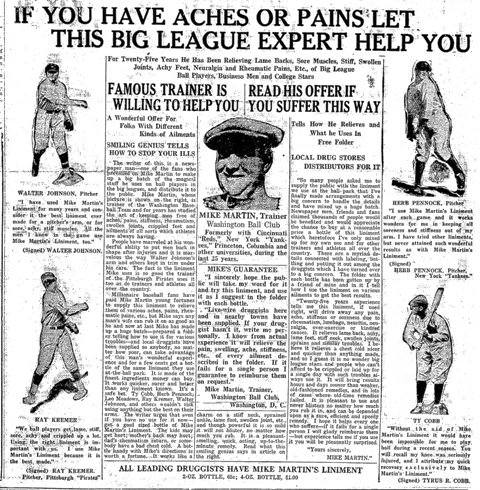
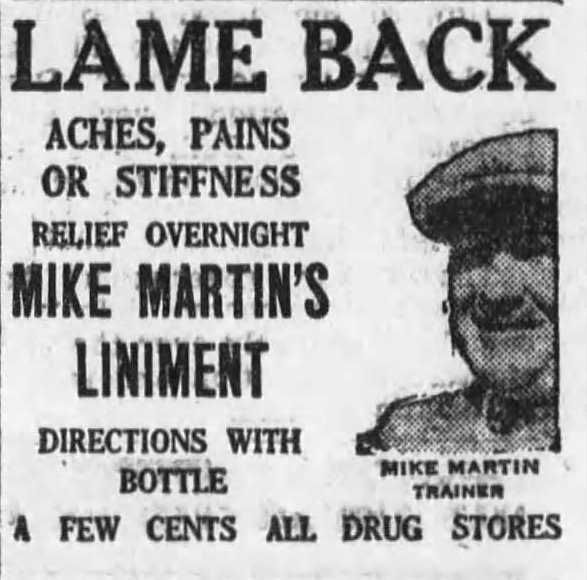
martinlinMike Martin spent 40 years with the Washington Senators as a trainer and scout; he was one of baseball’s first full-time trainers.  Martin was working as the athletic trainer at Columbia University when Clark Griffith hired him to work with the New York Highlanders, he followed Griffith to Cincinnati and then finally to Washington.

Martin began marketing the liniment he used on Walter Johnson and the rest of the Senators staff in the 1920s.  This 1925 ad featured testimonials from his good friend, Senator pitcher Walter Johnson, Herb Pennock of the Yankees, Ray Kremer of the Pirates and Ty Cobb (who rarely met a “cure” he couldn’t endorse):

“I have used mike Martin’s Liniment for many years and consider it the best liniment ever made for a pitcher’s arm, or for sore, achy, stiff muscles.  All the men i know in the game use Mike Martin’s Liniment too.”

(Signed) Walter Johnson

“I use Mike Martin’s Liniment after each game and it works wonders for me in keeping all soreness and stiffness out of my arm.  I have tried other liniments, but never attained such wonderful results as with Mike Martin’s Liniment.”

(Signed) Herb Pennock 

“We ball players get lame, stiff, sore, achy and crippled a lot.  Using the right liniment is important with us.  I use Mike Martin’s Liniment because it is the best made.”

(Signed) Ray Kremer

“Without the aid of Mike Martin’s Liniment it would have been impossible for me to play ball during the recent season.  You will recall my knee was seriously injured, and I attribute my quick recovery exclusively to Mike Martin’s Liniment.”

(Signed) Tyrus R. Cobb

mikemartin1930

1930 advertisement

Martin remained the Washington trainer until 1946 when Griffith made him a scout.  He was still working for the Senators, and his liniment was still a popular product, in June of 1952 when the 67-year-old Martin was killed in a traffic accident near his Maryland home while driving to Griffith Stadium.


“Anson, the Baseballist, would like to see some Changes”

26 Sep

Some of baseball’s pioneer’s had ideas for rule changes that would have if adopted, dramatically changed the game.  In 1896 Adrian Constantine “Cap” Anson proposed two such changes.

Anson’s Colts had not finished better than fourth place in the National League in the previous five seasons, and the manager apparently thought two radical changes would improve his team’s chances and simplify the game.

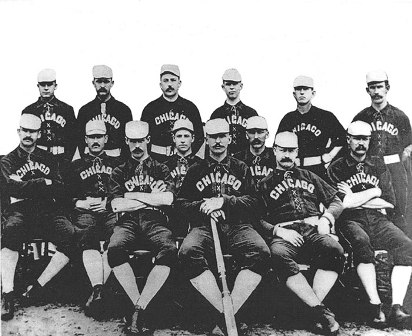
"Cap" Anson

“Cap” Anson

The Chicago Record said:

“Anson, the baseballist, would like to see some changes in the present system of playing ball.”

Anson said he wanted to make a change to the 1893 rule that established the distance from the pitcher’s mound to home plate and replaced the pitcher’s box with the rubber:

“He is in favor of putting the pitcher’s slab in front of the pitcher, instead of having it behind him.  He wants this done in order to stop the interminable bickering that is going on in almost every game as to whether the pitcher was in position.  It is much easier to see whether the rule is conformed to when the slab is in front of the pitcher, and he dare not stop over it.”

Anson’s other rule change would have led to complete chaos, and would have made it an adventure to fill out a scorecard:

“Another radical change that Anson is in favor of allowing the captain to put players back into the game after they have been taken out…(Anson)  wants all restrictions removed, the manager being allowed to play his men just as he sees fit, taking them out and putting them back just when he wants to.”

The issue of introducing free substitution into baseball has occasionally been raised in the years since Anson advocated for it.

Montreal Canadians coach Dick Irvin suggested it to Kennesaw Mountain Landis as a solution to player shortages when the baseball commissioner attended an NHL game during World War II.   Lew Fonseca made a pitch for the rule in the 1950s, and Walter “Red” Barber, long-time Dodger and Yankee broadcaster suggested in the 1960’s that the rule would help keep baseball from being “as exciting as watching paint dry.”

In 1967, Eddie Stanky of the Chicago White Sox was given permission from the American League to experiment with a crude form of what would become the designated hitter rule six years later.  The convoluted rule, according to The Milwaukee Sentinel, said:

“(T)he Sox and their spring opponents will be allowed to call on a pinch hitter twice provided that he is designated before the game is not used twice in the same inning.”

Eddie Stanky

Eddie Stanky


“Chief” Bender’s Catcher

3 Sep

Umpire Billy Evans, in one of his syndicated newspaper columns in the fall of 1910, said: “Most every ball player is more or less superstitious, but the pitchers, I believe, are more susceptible to beliefs uncanny than any of the other diamond athletes.”

Evans singled out Charles “Chief” Bender, who had just completed a 23-5 season with a 1.58 ERA for the World Champion Philadelphia Athletics, as one of the most “susceptible.”

Chief Bender

Chief Bender

According to Evans, Bender preferred throwing to catcher Ira Thomas over the team’s other two catchers Jack Lapp and Paddy Livingston:

“Bender has won lots of games with other catchers doing the receiving, but he never seems quite so steady as when Thomas is paired up with him.”

Evans said the preference extended to warming up as well:

“While there are scores and scores of pitchers who have their favorite catchers, still they are content to let one of the other receivers warm them up between innings, but not so with the Chief.  When Bender starts a game he absolutely refuses to throw to anyone other than Thomas.

“It is often the case that when the side is retired, the catcher happens to be a base runner.  Naturally much time is consumed by him in hurrying from the base he occupied to the bench to get his mask, glove and protector, and then back to the plate.  It is customary for most managers under such circumstances, to send one of the other catchers up to the plate to keep the pitcher warmed up.  I have seen Bender refuse at least a dozen times during the past summer to warm up with one of the Athletics other than Thomas.  He waits for Ira and takes a chance on getting cold in preference to putting the “jinx” on himself by tossing the ball to someone else.”

Bender's favorite catcher Ira Thomas

Bender’s favorite catcher Ira Thomas

The feeling was mutual.  In a 1911 article in The Pittsburgh Press, Thomas, who in addition to Bender also caught Jack Coombs (31-9, 1.30 ERA), Cy Morgan (18-12, 1.55 ERA), and Eddie Plank (16-10, 2.01 ERA) in 1910, said of Bender:

“I don’t take my hat off to…any other pitcher when Chief Bender is around.  He is a wonder of wonders.  No one can show me where there is a better pitcher in general.

“Bender has everything a pitcher needs and in a series of seven games he is almost invincible.”

Thomas remained with the Athletics organization for another 40 years as a coach, minor league manager and scout; he finished his scouting career with the Yankees, retiring in 1956.  He died in 1958.

Bender left Philadelphia in 1914 when he jump the Athletics for the Federal League; he returned to the Athletics organization in the 1930s.  He died in 1954.

Bender and Thomas shared a baseball card--the 1912 T202 Hassan Triple Folder

Bender and Thomas shared a baseball card–the 1912 T202 Hassan Triple Folder

The two remained close for the rest of their lives and often appeared together at baseball banquets.  One story Bender always told; the “greatest thrill” of his career, his May 12, 1910 no-hitter against the Cleveland Naps (this version was related in The Trenton Evening Times in 1936).  With two outs in the ninth Cleveland’s Elmer Flick hit a pop-up in front of home plate, the ball initially popped out of Thomas’ mitt before he secured it for the final out:

“Watching Ira juggle that ball and then hold it was my greatest thrill.”

Lost Advertisements–Germany Schaefer for Coca-Cola

30 Aug

schaefercoke


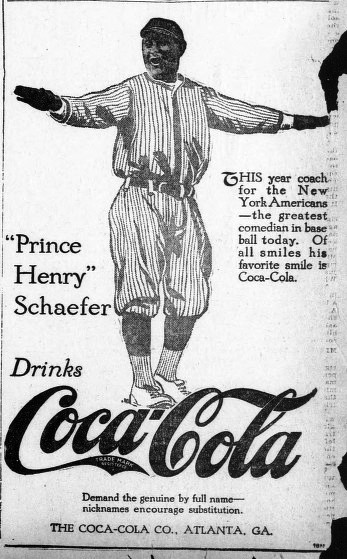
Another 1916 Coca-Cola advertisement featuring another new member of the New York Yankees, coach Herman “Germany,” “The Prince” Schaefer.

This year coach for the New York Americans–the greatest comedian in baseball today.  Of all smiles his favorite smile in Coca-Cola.

The 40-year-old Schaefer was purchased by the Yankees from the Newark Pepper of the Federal League when the Feds folded after the 1915 season.  Used almost entirely as a coach, he appeared in only one game and went 0 for 1 at the plate.  He was released by the Yankees in September.


Lost Advertisements–“Home Run” Baker for Coca-Cola

23 Aug

???????????????????????????????


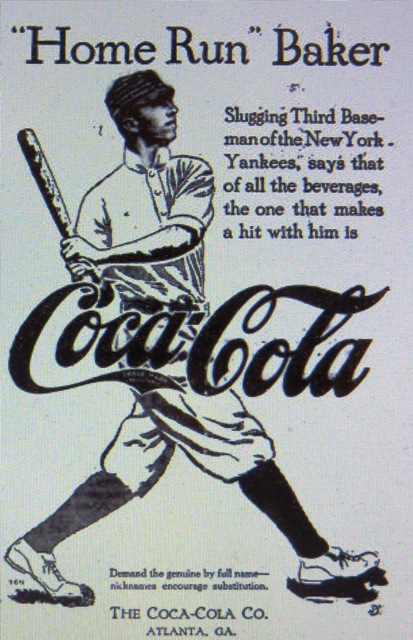
A 1916 advertisement featuring Frank “Home Run” Baker.

Slugging Third Baseman of the New York Yankees says that of all the beverages, the one that makes a hit with him Coca-Cola

Baker was sold to the Yankees for $37,500 in February of 1916 after the star of the Philadelphia Athletics had sat out the 1915 season over a salary dispute with Connie Mack.  The Hall of Famer remained a star while in New York, but never again put up the numbers he did before missing an entire season in the prime of his career.

“Baseball by Electricity”

11 Jul

In 1886, The Electrical Review told the story of the first attempts at “reproducing almost instantly a vivid view of the exact situations and plays in a game of baseball.”

The original plan was hatched by three telegraph operators in Nashville, Tennessee who “turned their enthusiasm for baseball to good account.”   J. U Rust, E.W. Morgan, and A.H Stewart made the first attempt to transmit a game between Chattanooga and Nashville in 1884:

“To do this they leased a wire from Nashville to Chattanooga, one end of which was on the ball field, with an expert operator, who was accurately informed in baseball playing, seated watching the game and immediately telegraphing each play as it progressed.  At the Nashville end of the wire were two other telegraphic and baseball experts.  As they received the record from their partner, one man reproduced it verbally to the audience, while the other man manipulated cards bearing the names of the players, around a painted view of the ball field which was placed in full view of the audience.”

The following season Southern League games were transmitted to opera houses in several of the league cities by Morgan & Co. “the ingenious firm” created by the three telegraph operators.

On July 9, 1886 Morgan & Co. transmitted the game between the Detroit Wolverines and the Chicago White Stockings from Chicago’s West Side Park to the Detroit Opera House. The “unique entertainment before a crowd of 600 persons,” was described by The Electrical Review:

“On the stage was a huge landscape—it would have done well as a drop curtain—having a well-painted perspective view of a baseball diamond and outfield.  At the points on the picture representing the positions of batsman, pitcher catcher and basemen, are openings into which may be shoved cards bearing the names of the players, and into which these names are placed as the telegraph operator seated at his instrument reads to the audience the progress of the game, even to the smallest details.”

The crowd at the Opera House “was wrought up to a very high pitch of enthusiasm.  For instance, when the operator read—with (Abner) Dalrymple’s name appearing as batsman—“foul fly to left,” the audience fairly held its breath, and when the next instant the operator called out, ‘and out to (James “Deacon”) White,’ there came a storm of applause, just such as heard on a veritable ball field…the excitement was intense.”

The Chicago White Stockings defeated the Detroit Wolverines 8-2 on July 9, on there way to the 1886 National League championship

The Chicago White Stockings defeated the Detroit Wolverines 8-2 on July 9, on their way to the 1886 National League championship

By the end of the 1886 season, games were presented in opera houses in Chicago, Boston, New York and Cincinnati.  By the end of the decade the practice would become commonplace in all big league cities.

By the mid 1890s the system for presenting games to the public had become much more advanced.

The Baltimore Morning Herald said in September of 1894:

“The ball game today between the Baltimore (Orioles) and Louisville (Colonels) clubs will be given as usual from the stage at Ford’s Grand Opera House at 4 o’clock by electricity.  The system utilized for the first game in the city is ‘The Compton Electric Baseball Game Impersonator.’   It has been used in New York and elsewhere with unbounded success.  It is a contrivance so ingenious that the slightest move of the players is visible, and the anxiety and interest of those present is just as great as though they had been occupying the grandstand.  Every strike is recorded and illustrated, and, whether at the bat, running the bases or in the field, all the players are known and watched…a visible reproduction of the game is given to the minutest detail.”

By the end of that season the Compton system was used to transmit games to fans in New York, Chicago, Philadelphia and Washington, and it, and numerous systems developed by competitors would become commonplace over the next four decades.

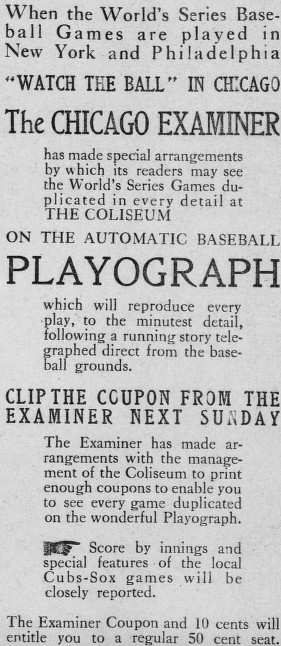
The Chicago Examiner sponsored the "automatic Baseball Playograph" exhibition of the 1913 World Series between the New York Giants and Philadelphia Athletics.

The Chicago Examiner sponsored the “automatic Baseball Playograph” exhibition of the 1913 World Series between the New York Giants and Philadelphia Athletics.

Usually sponsored by local newspapers, the exhibitions were an especially popular method for following the World Series in real-time.   It was not until 1938 (when the New York Yankees, New York Giants, and Brooklyn Dodgers became the last teams to have their games broadcast on radio) that the technological descendants of Morgan & Co. became completely obsolete.

“Said–Tinker to Evers to Chance”

5 Jul

???????????????????????????????

Franklin Pierce Adams’ famous poem “Baseball’s Sad Lexicon” appeared in The New York Evening Mail in 1910 and immortalized Chicago Cubs shortstop Joe Tinker, second baseman Johnny Evers and first baseman Frank Chance—within three years, the above cartoon appeared in newspapers along with a new, less well-known, poem written by Adams’ colleague at The Evening Mail, James P. Sinnott.

By 1913, baseball fans became aware that Tinker and Evers had barely spoken to each other since 1905, and the rivalry among the three exploded in public.  The former teammates, now all managers, Tinker with the Cincinnati Reds, Evers with the Cubs, and Chance, the recently deposed Cubs manager, with the New York Yankees.

In February Chance told reporters that Tinker was a better player than Evers; Evers responded and accused Tinker of trying to “tamper” with pitcher Larry Cheney and other members of the Cubs, as for Chance he said:

“I do not know whether Chance is jealous of my getting the position of leader, and I do not like to think so, but from the remarks he is making, I am forced to.”

By March, Hugh Fullerton said in The Chicago Examiner that Evers was unable to control his players; he said “Chance could whip any man on (the) team—Evers can’t,” and predicted a fourth place finish for the Cubs (they finished third).  Tinker’s Reds finished seventh in the National League; Chance’s Yankees were seventh in the American.

Sinnott’s poem appeared at the end of September:

“A Manager’s life is tough!

Said Tinker to Evers to Chance—

‘A manager’s road is rough!’

Said Tinker to Evers to Chance—

‘Here are we three, a lookin’ on

The big world’s series game,

In which we once were principals,

In which we gained our fame’

‘A manager’s life is no cinch!’

Said Tinker to Evers to Chance—

I’d almost as soon be Lynch!’

Said Tinker to Evers to Chance.”

“Lynch” was Thomas Lynch, who was about to be replaced as president of the National League.

It would not be until 1924, shortly before Chance’s death that the three reconciled.  Chance had been hired to manage the Chicago White Sox, but became too ill and returned home to California; he was replaced by Evers.

Chance summoned his former teammates to California that spring, where the three spent several days together.  Chance died in September.  Tinker, Evers and Chance, were inducted into the Hall of Fame together in 1946.

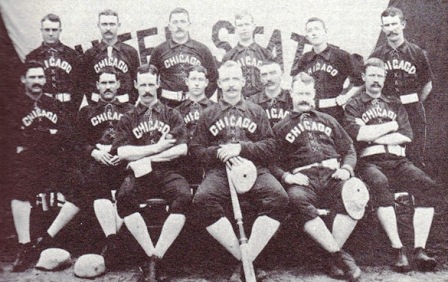
Tinker, Evers and Chance

Tinker, Evers and Chance

Lost Advertisements–A Message to Every Ballplayer from Babe Ruth

26 Feb

???????????????????????????????


“You’ve got to hand it to this Reach crowd.  When I told them what I figured was needed in major league mitts and gloves–I knew they’d do a good job of making them.  But I didn’t know how good till I saw the gloves they turned out.

“I stuck my hand in the different models. And they are great.  Big and roomy, like you need, yet fitting just right.  I bent and twisted my hand and fingers, and these gloves moved as natural and easy as an old shoe.  When a new glove does that–you can take it from me, it’s a real glove.

“And how these gloves snare the ball.  A specially formed pocket does the trick, Reach tells me.  Whatever it is, any ball that smacks into one of these gloves sure does stick.

“I’m ready to recommend them to any fellow who plays ball–in the field, on the bases, or back of the bat.  They got a pretty low price on them, too, for major league glove.”

Babe Ruth