Tag Archives: Philadelphia Athletics

Things I Learned on the Way to Looking Up Other Things #18

7 Mar

Tener on Anson

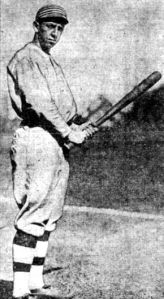
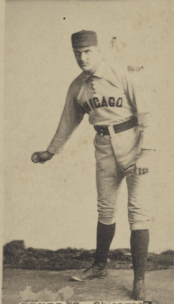
In 1917, John Tener wrote an article in “Baseball Magazine” about Cap Anson, his former manager with the Chicago White Stockings.
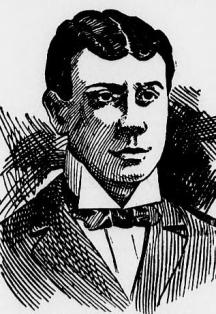
John Tener

John Tener

The former pitcher and outfielder, who went on to serve in the United States Congress and as Governor of Pennsylvania, and who in 1917 was president of the National League said:

“Pop Anson was the Greatest Batter who ever lived.  You may look up his record, compare it with others and draw your own conclusions.  When I say this I am well aware of the claims of Ed Delehanty, Hans Wagner and many other great hitters.  I give them all due credit, but in my opinion, Anson was the greatest of them all.

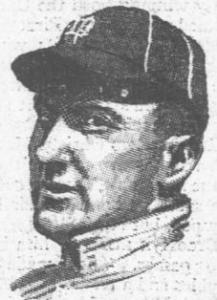
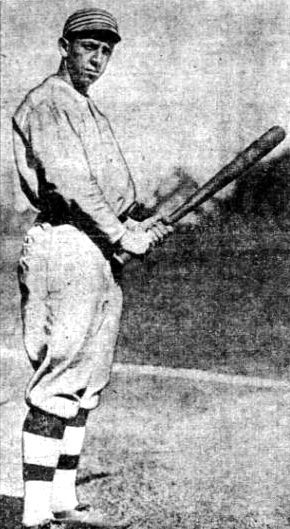
"Cap" Anson

Anson

“He was, first of all, a free hitter. He loved batting…He had that true eye which enabled him to hit the ball squarely on the nose.  His hits were line drives.  They were solid smashes with the full force of his muscular shoulders behind them.”

[…]

“He was an excellent judge of the precise fraction of a second that he needed to swing that heavy bat of his against the best the pitcher could offer.  He didn’t exactly place his hits, but he contrived to drive the ball behind the base runner about where he wanted to drive it…He was big and strong and heavy.  Some hitters of the present day fatten their averages by their nimbleness in reaching first.  Anson drove the ball solidly into the outfield and took his time in going to first.”

Conte on Mendez

Jose Pepe Conte was a well-known sportswriter in Havana, Cuba. Frank Menke of Heart Newspaper’s International News Service (INS) said of him:
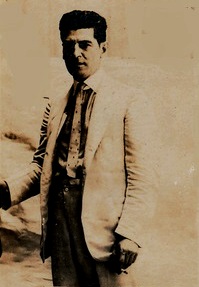
Jose Pepe Conte

Jose Pepe Conte

“Pepe is a fellow who knows heaps and heaps about ancient history, European customs, chemistry, baseball and prize fighting.”

The Pittsburgh Press called him:

“(A) Cuban newspaperman, political personage, and unearther of baseball talent.”

In 1912, the INS distributed an article Conte wrote about the pitcher he thought was the best ever:

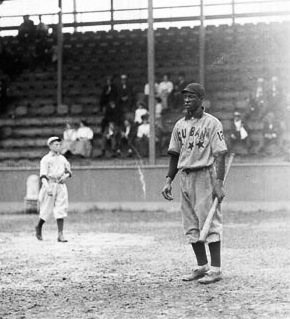
“American baseball fans can talk all they want about their (Chief) Benders, (Christy) Mathewsons, (Ed) Walshes and (Mordecai) Browns, but down in our country we have a pitcher that none of the best batters in the country can touch. This is the famous Black Tornado, (Jose) Mendez.  Talk about speed.  Why, when he cuts loose at his hardest clip the ball bounces out of the catcher’s mitt Talk about speed, Mendez has to pitch most of the time without curves because we haven’t a catcher who can hold him.  To make things better, Mendez can bat like (Ty) Cobb.  He has won his own games on various occasions with smashes over the fences for home runs.  He weighs about 154 pounds and is a little fellow.”

Jose Mendez

Jose Mendez

[…]

“No one has been found who can hold him when he really extends himself.  He has shown his skill in the past when he has faced the best batters of the Cubs and Detroit teams when those teams were champions, and when the Athletics went there last year.  Mendez has more curves than any pitcher in America, and if some inventive genius could produce a whitening process whereby we could get the fellow into the big leagues he could win a pennant for either tail-end team in either league.”
Sullivan on Comiskey

In his book, “The National Game,” Al Spink said Ted Sullivan was “the best judge of a ball player in America, the man of widest vision in the baseball world, who predicted much for the National game years ago, and whose predictions have all come true.”
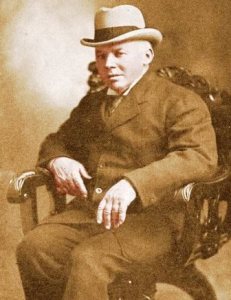
Ted Sullivan

Ted Sullivan

Sullivan was a player, manager, executive, and in 1921, he wrote a series of articles for The Washington Times called “The Best of my Sport Reminiscences.”  He said of Charles Comiskey, who he was crediting with “discovering” at St. Mary’s College in Kansas:
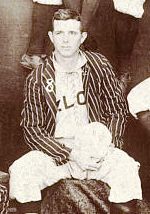
Charles Comiskey

Charles Comiskey

“As a player, Comiskey was easily the best first baseman of his time…His intuition in defining the thoughts of his opponents and making his play accordingly placed him head and shoulders over any man that played that position before or after.

“Comiskey was with John Ward and King Kelly one of the greatest of base runners.  I do not mean dress parade base running, either, merely to show the crowd he could run.  Comiskey’s base running was done at a place in the game when it meant victory for his side.  He was far from being the machine batter that Anson, Roger Connor and some others were; but as a run-getter, which means the combination of hitting, waiting, bunting and running, he outclassed all others.  Jack Doyle, when in his prime with Baltimore and New York, was the nearest approach to Comiskey in brainwork.  There are no others.”
“Cobb is Essentially an Individual Player”

29 Feb

In February of 1913, The Associated Press (AP) reported that Detroit Tigers second baseman Oscar “Ossie” Vitt had requested a raise from owner Frank Navin.  The AP said:

“Navin wrote Vitt that he was more than satisfied with his work last year, and would be ordinarily glad to increase his salary, but owing to the necessity of meeting the demands of (Ty) Cobb for $15,000.”

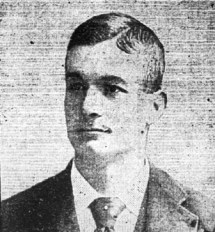
Ossie Vitt

Vitt

The Detroit Free Press disputed The AP’s, and Vitt’s account:

“Mr. Vitt did receive a letter from Mr. Navin, and this letter did pointedly refuse to add anything to the Vitt emoluments for 1913.  So far the story from the golden West is true.  But the reasons given  Oscar for not granting him an increase had nothing whatever to do with Mr. Cobb, nor was the star athlete’s name even mentioned.  Vitt was informed that he is mighty lucky to receive a contract for 1913 with as much money mentioned as the document recently sent him calls for.”

Whether Vitt believed Cobb was responsible for his lack of a raise is unknown, but he did take the opportunity 10 months later to take a swipe at Cobb in the pages of his hometown paper, The San Francisco Call.  Vitt wrote an article for the paper about the best player he had seen:

“I am picking the man who does most to win games for the club he represents.  That man is unquestionably Eddie Collins…Here is one player who is willing to sacrifice all personal gain to help his club.  When he is on the field it is the Athletics he is trying to help, and not Eddie Collins.”


Collins

Collins

Vitt said:

“Collins is great whether he is playing the defensive or offensive.

“In few departments of the game is he excelled.  He is a brilliant fielder, who thinks quickly, and he makes but few mistakes.  At the bat he has few superiors.  He has a wonderful eye, and when he hits the ball he meets it fairly, usually sending it away from the plate on a line for a clean drive.  He can lay down a bunt with equal skill, and it is hard to figure him when he faces a pitcher.

“The point that I admire in Collins is the fact that he never plays to the grandstand.  He adopts the play that will help his club and not the one that will win him applause from the spectators… I don’t think there is another player in the game today who wins as many games for his club than this fellow Collins.”

After lavishing praise on Philadelphia’s Collins, Vitt said of his teammate:

“Cobb is a remarkable ballplayer. I have been with him for two seasons, and while I consider him greater than Collins in many respects, I do not think he is as valuable to a club as Collin… His spectacular style of play is popular with the fans, and while the Tigers were rather lowly in the pennant race, they were good drawing cards, because the crowds would go out to see Cobb bat and steal bases.

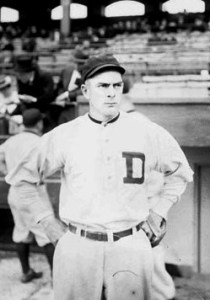
Cobb

Cobb

“If Cobb would play the game like Collins I think he would be the greatest of them all, but he does not.  Cobb is essentially an individual player.  He is unlike Collins in this respect.  However, the fans like to see Cobb, and they must be pleased.”

While Vitt equivocated, calling his teammate an “individual player,” while at the same time putting, at least, some of the blame for it on the fans who “must be pleased,” he took his biggest swipe at his teammate in another passage without ever naming him:

“You take a great player like Collins, who is so sincere in his work, and he naturally becomes a prime favorite with the other members of the club, because of his efforts to help them.  He gets them all in that stride, and I attribute (Connie) Mack’s success to that reason.”

Cobb’s only public reply came weeks later in The Detroit News:

“I think Vitt might help the team if he would accumulate a little better individual average and not attack his fellow players.”

Vitt hit .243 over seven seasons in Detroit.  He and Cobb remained teammates through the 1918 season.

“Pulling a Lave Cross,” Eddie Collins on the Life of a Ballplayer

24 Feb

In 1914, Eddie Collins contributed an article about the life of a major leaguer in The National Sunday Magazine, a syndicated insert that appeared in several papers across the country.

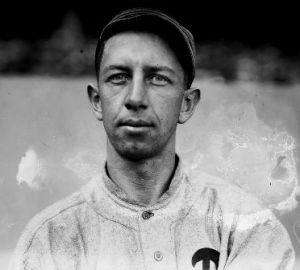
Eddie Collins

Eddie Collins

He described the beginning of his first road trip in the big leagues:

“It happened two days after I had joined the Philadelphia Athletics.  As ‘Mr. Sullivan,’ (Collins initially played under the name Edward T. Sullivan), still being an undergraduate at Columbia, I had watched two games from the grandstand at Shibe Park.

“The series over, Manager (Connie) Mack told me to report at the railroad station in time to catch a train that was leaving at six o’clock.  The Athletics were to make a quick September (1906) swing around the circuit.”

Collins said he was “about the first one at the depot,” and “eager as a boy” to begin his big league career.

Once on the train, he described the reaction of the players the first time the porter announced that dinner would be served:

“What transpired, immediately, might have led one to believe that the porter had insulted nearly everyone in the car.  There was a stampede.  Every one of the Athletics was up and rushing down the aisle, throwing aside magazines and newspapers, tumbling and pitching toward the door. The porter was knocked over and it is no exaggeration to state that one of our players—a very fleshy outfielder with elephantine tread (Topsy Hartsel)—walked over him in his haste.

“’What’s the matter with those fellows?’ I asked a veteran who had not joined the stampede.

“In justice to him, be it explained that he had a sprained ankle and couldn’t run.

“’They’re pulling a Lave Cross,’ he threw over his shoulder, as he hobbled after the others as fast as his lame ankle would permit.

“I came to know what ‘Pulling a Lave Cross’ meant.”

Lave Cross

Lave Cross

Collins explained the term, which referenced the former Athletics player:

“He was in the big leagues for years and during that period, he was never beaten into a dining car or eating room of any sort.  He always caught the first cab out of the station; he always was the first to plunge into the sleeper and select the best berth.  He never ran second where personal comforts or tastes were at stake.  During all his years, and the competition is keen, he was supreme.”

Collins said while Cross’ behavior might have been extreme, “haste” was “a habit inbred in all successful” ballplayers:

“I have noticed that after the game we all dress like firemen getting three alarms, race back the hotel, race into the dining room, race through our meal.  Then we saunter out into the lobby and kill two or three hours trying to see which foot we can stand on longer.  At first I marveled at this, then I found myself racing along with the rest of them.”

Calling himself, and his colleagues “rather peculiar individual(s)” Collins said of ballplayers:

“On the field, all his energies and thoughts are concentrated on one idea—the winning of the game.  His day’s work done, however, he throws that all off.  His first desire is to avoid the crowds and excitement.  Then he persistently refuses to talk baseball.  If you want to make yourself unpopular with big league ballplayers, drop into their hotel some night and try to talk baseball to them. “

Collins next provided readers with “some idea of ballplayers out of spangles,” to bring them into “closer touch.”

Honus Wagner, he said, was not a fan of fans:

“Down in Carnegie (PA) there are about twenty unfortunates…who are taken care of solely through Wagner’s generosity.  He has a heart as big as his clumsy looking body, but he hates the baseball ‘bug.’  Frequently wealthy fans have called at Wagner’s hotel on the road and tried to engage him in conversation.  Generally he will excuse himself and going over to the elevator boy will sit and chat with him for an hour at a time.  Wagner’s worst enemy will not tell you he is conceited, but he hates the fans prying into his affairs.”

Honus Wagner

Honus Wagner

Connie Mack, he said, “is the same kind of man” as Wagner:

“Connie is forever handing out touches to old time players.  He is always thinking of anybody connected with baseball from the bat boys up. I know he insisted out little hunchback mascot (Louis Van Zelst) getting a share of the World Series’ money—not that any players objected—but it was Connie’s thought first.

“’Little Van comes in on this,’ he said.”

Louis Van Zelst

Louis Van Zelst


Collins also talked about how his teammates occupied themselves on the road:

“You will never find Chief Bender, our Indian pitcher, hanging around the hotel.  Too many original fans are apt to salute him with a war-whoop.  Besides, he is golf mad and when not on the diamond, he is to be found on the links… (Carroll “Boardwalk”) Brown, the young pitcher who did so well for us last year, is a billiard expert… (Stuffy) McInnis and (Eddie) Murphy are the ‘movie fiends’ of our club and are the only ones (Collins said many players were scared to go to the movies because they thought it would damage their eyes).  They can call the name of every star as soon as they see the face on the screen. Jack Barry, our shortstop, is inordinately fond of Hebrew literature and Biblical history.  This, although he, as well as his name, is Irish.”

Collins also shared his manager’s rules for the Athletics when the team was traveling:

 “It is one of Mack’s rules that we are only allowed to play cards on the trains…Connie is against card playing, which only leads to-night after night sessions, ill feelings and finally, disruption. I could tell you of at least one American League team that was broken by card games…Everybody has to be in bed by half past eleven and report in Mack’s room at half past ten in the morning.  For an hour Mack talks baseball, planning our campaign for the day.”

After Mack’s meeting, it was time to eat, and Collins shared his insights on ballplayers and food:

He said a “young pitcher on our club” should be a star, but “he has a weakness for roast beef,” and “persists in stuffing himself at noon time.”  He didn’t name the pitcher.

 “Walter Johnson, the greatest pitcher in baseball, also has a noonday weakness.  It is ice cream, but he seems to thrive on it.  Jack Barry feels off-color if he does not get his slice of pie…On the day he is going to pitch, Eddie Plank, our veteran left-hander, always eats tomato soup.  He thinks he would lose if he did not observe this ritual.”

Collins concluded:

“There is great temptation for the young minor league player, being put up at first class hotels…to eat his head off.  I honestly believe that more good youngsters have been ruined for big league work simply from overeating than any other extraneous cause.”

Other than their general disdain for ‘bugs,’ Collins said, in the end, players of the current era were unrecognizable from their counterparts of a generation earlier:

“Ballplayers today are scrupulously careful never to offend anyone in any way.  Especially do they take pride in being Chesterfields when women are around.”

Lost Advertisements–Ty Cobb, Lewis 66 Rye

11 Dec

cobblewis66

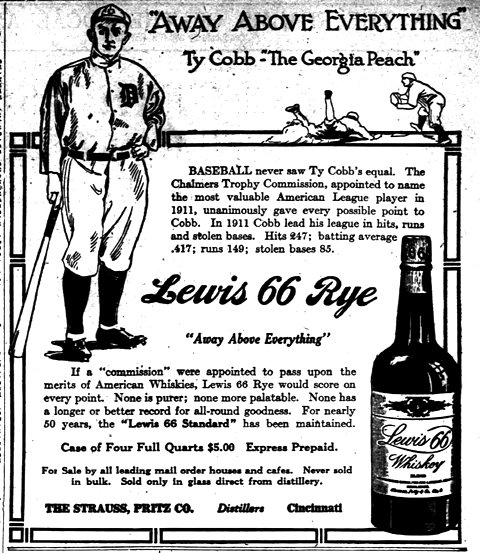
A 1912 advertisement for Lewis 66 Rye Whiskey from The Strauss, Pritz Company, a Cincinnati-based distiller:

“Away Above Everything”

Ty Cobb–‘The Georgia Peach’

“Baseball never saw Ty Cobb‘s equal.  The Chalmers Trophy Commission, appointed to name the most valuable American League player in 1911, unanimously gave every possible point to Cobb (he received all eight first-place votes–the commission consisted on one sportswriter from each league city).  In 1911, Cobb led his league in hits, runs, and stolen bases.  Hits 247; batting average .417; runs 149, stolen bases 85 [sic 248; .420; 147, 83].”

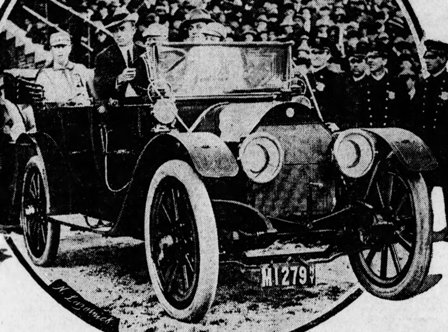
Cobb was presented with a Chalmers “36” at Shibe Park in Philadelphia on October 24, 1911, before game four of the World Series. Jack Ryder, covering the series for The Cincinnati Enquirer said of the presentation:

“President (John T.) Brush of the Giants declined to allow this ceremony at the Polo Grounds, so it was pulled off very quietly here this afternoon…The event took place 10 minutes before the game and was coldly ignored by the Giants though the Athletics took a keen interest in it and several of them had their pictures taken with Cobb. Ty now has three cars, but he says this one is much the best of the lot, and he expects to drive it to his home in Georgia as soon as the series is over.”

Cobb in his Chalmers at Shibe Park

Cobb in his Chalmers at Shibe Park

While Cobb was the unanimous choice of the eight-man commission, the second place finisher in the American League received a more valuable car.

The Chicago Inter Ocean said Chicago White Sox fans, unhappy that pitcher “Big Ed” Walsh finished second to Cobb, “Undertook to raise a fund to purchase an automobile,” for him.

But, said the paper, the fans:

“(F)ound themselves confronted with a dilemma–they had too much money in the fund to buy a duplicate of the Chalmers touring cars presented to Ty Cobb and (National League winner, Chicago Cubs outfielder) Frank Schulte.”

Two days before Cobb received his Chalmers in Philadelphia, Walsh was presented with his car before a charity game at Comiskey Park.

Ed Walsh

Ed Walsh

No Chicago newspaper reported the make and model.  The Daily News called it “A handsome automobile.”  The Inter Ocean said it was “A $4,000 automobile,” and The Tribune said simply that he had received an “(A)utomobile subscribed for by the fandom of the city.”  The Examiner also failed to mention the type of car Walsh received but said the Cubs’ Schulte “gave $25” to the fund.

According to The Tribune, Walsh promised to “‘(L)earn how to run it before spring,’ and the stands cheered loyally.”

Cuban X-Giants In Washington D.C., 1901

7 Dec

xgiants

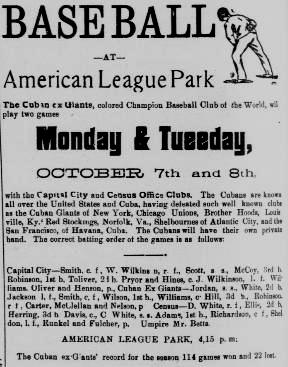
A 1901 advertisement for the Cuban X-Giants, managed by Soloman “Sol” White, in Washington D.C.  The team played the Capital City–described by The Washington Times as “a contingent of colored ball players of this city,” and the team representing the United States Census Bureau at American League Park.

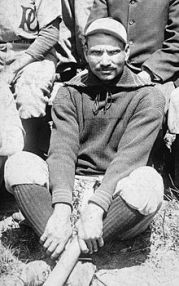
Sol White

Sol White


According to the ad:

“The Cubans are known all over the United States and Cuba, having defeated such well-known clubs as the Cuban Giants of New York, Chicago Unions, Brother Hoods, Louisville, KY. Red Stockings, Norfolk, VA., Shelbournes of Atlantic City, and the San Francisco, of Havana Cuba.  The Cubans will have their own private band.”

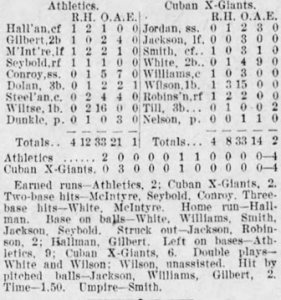
The previous week, the X-Giants played an 11-inning tie with the Philadelphia Athletics at Columbia Park–although the Athletics three biggest stars, Napoleon Lajoie, Harry Davis and Lave Cross did not participate, The Philadelphia Inquirer said, “Both teams put up a splendid article of ball and the game resulted in one of the best that has been played on the grounds this season.”

The Philadelphia Times was even more enthusiastic:

“The game itself was beyond all doubt one of the greatest ever witnessed upon the local diamond.”

The 11-inning tie against the Athletics

The 11-inning tie against the Athletics

The ad said the club had won 114 games and lost just 22 in 1901, and described them as the “Colored Champion Baseball Club of the World.”  In both 1900 and 1901 the X-Giants and the Cuban Giants each claimed to be “Colored Champion.”

In addition to Sol White, the roster included, Robert Jordan, Ray Wilson, Clarence Williams, John Nelson, Danny McClellan, Will Jackson, Johnny Hill, Robert “Ginney” Robinson, and Charles “Kid” Carter.

The X-Giants won both of the advertised games.  The victory over the Capital City club was of such little note that no newspaper mentioned the score.  The Washington Colored American simply said the X-Giants “Played stars and circles around the Capital Cities.”

They also beat the Census Department 8 to 0.  The Washington Times said:

“The visitors had things their own way throughout the game, and at no time were they in danger of being defeated.  They had a twirler (McClellan) in the box that knew the fine points of the game.  He struck out nine of the localities and allowed but two of them to get the slightest semblance of a safe hit off his cannon ball delivery.”

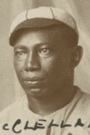
Danny McClellan

Danny McClellan

The X-Giants beat one more local team, the Eastern Athletic Club, on October 9, and left the nation’s capital 117-22.


Connie Mack vs Herman W. Souse

6 Nov

In his autobiography “My 66 Years in the Big leagues,Connie Mack said, “My first great disappointment came in 1912.”

Connie Mack

                          Connie Mack

After two straight World Series victories, Mack’s Athletics stumbled to a disappointing third-place finish.  With his team 15 ½ games out of first on September 6, Mack suspended pitcher Charles “Chief” Bender and Reuben “Rube” Oldring for, as The Philadelphia Inquirer  put it:

 “(T)heir failure to live up to the training requirements, as demanded by Mack and all common sense baseball managers.”

Chief Bender

                                Chief Bender

The Inquirer said “Mack refused to discuss this matter further,” but just days later in Detroit he gave what The New York World called “a sermon” on the reason for the suspensions:

“Booze and baseball don’t mix; never did, and never will. A pitcher who thinks he can fan Herman W. Souse is simply pitching to the greatest home run hitter he ever faced.

“Once in awhile you hear of some marvel who can stay out all night, drink all the breweries dry, wreck a few taxi cabs and otherwise enjoy himself, and then step in the box and pitch a wonderful game of ball.  Players who haven’t any more sense point to Rube Waddell, Bugs Raymond and that brand and say: ‘Ah, those were the good old days.  None of these high-priced managers and their red tape then.  And what wonderful players we produced in those days.’

“Well, look at Waddell—one of the most remarkable pitchers nature ever produced.  But Waddell, with all his talent, couldn’t stay in the major leagues.  Why?  Because he stood there and pitched himself to Old Man Barleycorn, and finally every one he threw was slammed over the fence.  And that’s the way all go.  Is it so wonderful, after all?

“No, sir, the day of the stewed ballplayer has gone and it won’t come back.  If the members of my team want to drink, all right.  But they can’t drink and play ball at the same time.  That’s settled.  They can do whatever they prefer, but they can’t do both.

“There are no exceptions to my rule, either.  Any manager will tell you the same.  A short life and a merry one—that’s it.  And the merrier it is the shorter it will be in the big leagues.”

In December of 1912, The Philadelphia Record said Bender had written a letter to Mack asking his manager “to please forgive him.”

According to The Inquirer, he was forgiven and set to return to the Athletics in 1913:

“This winter Bender has spent nearly all the daylight hours automobiling and hunting in the South.  He looks stronger than ever.”

The “stronger,” sober Bender appeared in 48 games, 21 as a starter, and posted a 21-10 record with a 2.21 ERA, and helped lead the Athletics to their third championship in four seasons.

In “My 66 Years in the Big leagues” Mack said of him:

“Let me say here that I consider Chief Bender the greatest one-game pitcher, the greatest money pitcher baseball ever has known.”

Collins’ “Ten Commandments”

5 Oct

The Philadelphia Inquirer said in February of 1916, Eddie Collins of the Chicago White Sox, had broken “into the ‘Gospel League,’ after  the second baseman gave a temperance speech in front of “500 persons” at the Epworth Methodist Church in Palmyra, New Jersey church.

collins2

Eddie Collins

Despite Collins telling his audience he wasn’t  “contemplating a pulpit career,” the paper said they “(A)pplauded like World Series fans when he handed ‘booze’ some wallops that would have done credit to Billy Sunday.”

Collins’ talk focused on the evils of alcohol:

“I come to bring a message to your young people, from a baseball player’s viewpoint, of the necessity of clean living and I will be glad if anything I say will help any of you fight the battle of life…Temperate living in necessary for success in any field of action.”

He also praised his former manager from the pulpit:

“Life is a whole lot like playing baseball under Connie Mack’s orders.  Mack is the greatest baseball general the world has ever known and any man who has ever played on the old Athletics honors respects and loves the boss.”

Sunday said he approved of Collins taking to pulpit and providing a “boost” for baseball:

“The way to make the great game respectable is for every player to be respectable himself.”

The Inquirer told readers the following day that the Columbia University graduate had little in common with the evangelist who often mangled the language:

“The statement that Eddie Collins is emulating Billy Sunday is entirely erroneous…Eddie had a perfect record at the bat and fielded cleanly with the King’s English.”

Billy Sunday, evangelist

Billy Sunday, evangelist

Within a week, The Philadelphia Press said:

“Eddie Collins’ dip into evangelism has had a home-run effect among church people throughout the country, and he now is swamped with invitations to address church congregations, bible classes, and Sunday school meeting.

“The requests have swept in upon him at his home in Lansdowne (Pennsylvania) in such a deluge that he said today he had reached the point where he would have to give up base ball if he were to meet all the engagements asked.”

Collins told a reporter:

“I am gratified to learn that my little talk of last Sunday and my rules of life amounted to something but I don’t rank as an evangelist and can’t follow that calling.”

Instead of leaving the diamond for the pulpit, Collins printed and had distributed to churches, several thousand copies of part of the talk, what he called “The Ten Rules of Life.”

Some reporters, including William Peet of The Washington Herald, referred to the list as “Collins’ Ten Commandments:”

First: Safeguard your honor

Second: Don’t overeat

Third: Be a good loser

Fourth: Smile

Fifth: Keep good hours

Sixth: Have courage to do right

Seventh: Don’t think you know it all

Eighth: Be prompt

Ninth: Don’t drink alcoholic drinks

Tenth: Think clean thoughts.

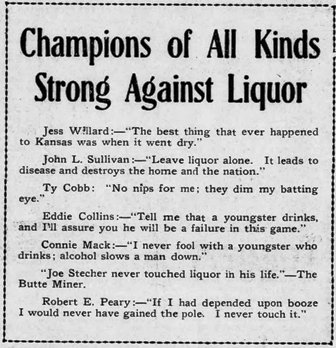
Collins’ statements about alcohol were used by various temperance organizations seeking prohibition.  Ads like the one below with quotes from Collins, Ty Cobb, and Connie Mack, and Admiral Robert Peary, as well as boxers Jess Willard, John L. Sullivan, and Joe Stecher appeared in newspapers and handbills distributed throughout the country.

temperance

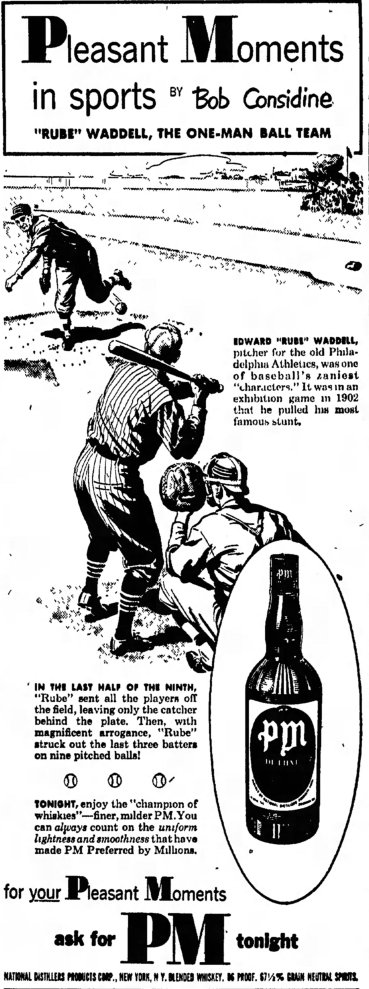
Lost Advertisements–PM Whiskey, “Rube Waddell, The One-Man Ball Team”

2 Oct

waddellad

A 1951 advertisement for PM De Luxe Blended Whiskey–part of a series of ads featuring “Pleasant Moments in Sports,” stories from Bob Considine, co-author with Babe Ruth of the “The Babe Ruth Story.”

This one features an oft-told Rube Waddell legend:

“Edward ‘Rube’ Waddell, pitcher for the old Philadelphia Athletics, was one of baseball’s zaniest ‘characters.’  It was in an exhibition game in 1902 that he pulled his most famous stunt.

“In the last half of the ninth, ‘Rube’ sent all his players off the field, leaving only the catcher behind the plate. Then with magnificent arrogance, ‘Rube’ struck out the last three batters on  nine pitched balls.”

As with all Waddell stories, there was some truth and a good deal of embellishment in Considine’s account.  While the contemporary coverage of the game differs on some aspects of the performance, they all agree that Waddell pitched to just one batter after members of the team left the field in the ninth inning.

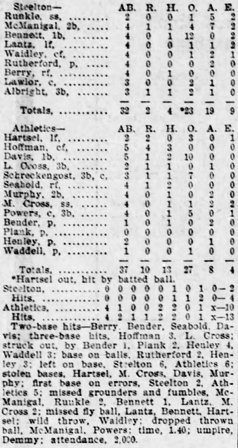
The game in question was played in 1903 at Steelton, Pennsylvania against that town’s YMCA team. The Athletics won easily, 10 to 2, and Waddell pitched the eighth and ninth innings for Philadelphia.

The Philadelphia Inquirer said:

“Waddell was the entertaining feature of the match, and in the last inning called in all the infielders after two men were out.”

The Harrisburg Daily Independent, which provided more in-depth coverage of the game, said:

“Rube Waddell was in all his glory at Steelton yesterday and his funny antics before and during the game were well worth the price of admission.”

The paper said before the game Waddell entertained the fans chasing “flies in the hills until he was perspiring,” and spent part of the early innings taking a “nap in his private carriage which carried him from (Harrisburg) to Steelton.”

rube

Waddell

As for his time on the mound, the paper said Waddell struck out the first two batters he faced in the eighth, then after getting two strikes on the third batter, named “Irish” McManigal:

“(W)hen he pitched the third ball (he) remarked, ‘Take your seat.’ ‘Irish,’ however, surprised the Rube and rapped out a pretty single to center field.”

Waddell gave up another hit in the eighth and the YMCA scored a run.

“The next inning Rutherford hit to Waddell and the Rube did a cake walk to first base to catch Rutherford.  Berry then hit to Monte Cross, but he threw wild to first and Berry reached third base.  Then the Reuben settled down and struck Lawlor out.”

The Daily Independent said Waddell did not call in the fielders, but instead, on their own:

“The Athletic players behind Waddell left the field and with a man on third base he and (Ossee) Schreck (Schrecongost) were left to put out the side.

“The Rube did not know his teammates had deserted him and when told to look around by Schreck he discovered the fact.  Then to make more complete the comedy Schreckengost [sic] sat down and the Rube struck out Albright while the crowd howled with merriment.”

The Harrisburg Telegraph provided a third set of contemporaneous “facts:”

“In the last inning when two men were out all the Athletics left the field except Waddell, Powers and L. Cross.”

The paper likely misidentified Schrecongost as Michael “Doc” Powers–Schrecongost had replaced him behind the plate in the eighth, and Lave Cross had already left the game–so the player who stayed on the field might have been shortstop Monte Cross.  The Telegraph also added another detail missing in the other reports:

“(Waddell) gave the batter three balls and the crowd was wild, but their last hope faded rapidly away as Rube put three fine ones over the plate and the striker was out.”

The Box Score

The Box Score

Considine likely cribbed his version from Harry Grayson, the sports editor of The Newspaper Enterprise Association syndicate.  Grayson told the three-batters-nine-pitches story several times throughout the forties, and that legend stuck.


“He was the Greatest Receiving Catcher”

23 Sep

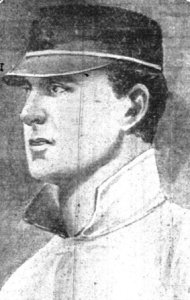
Freeman Ossee “Schreck” Schrecongost’s was most famous for being Rube Waddell’s catcher with the Philadelphia Athletics.

Ossee Schrecongost

                Ossee Schrecongost

Years later, Connie Mack told Harry Grayson of the Newspaper Enterprise Association that Schrecongost was “the fizz powder in the pinwheel that was Waddell.”  He also told the reporter that Waddell’s catcher “was the wilder of the two in many respects.”

Schrecongost lived at least as hard as Waddell and caused his manager as many headaches, but more than 30 years after his final game, Mack said he did “more with gloved hand than any other catcher who has come along.”

Allan Gould, the long-time sports editor for The Associated Press said of the catcher:

“Schreck had the eccentric habit of doing as much of his backstopping as possible with his gloved hand only. This worried Mack, who considered it careless workmanship until Schreck convinced his manager he could do a better job one-handed than with two.”

His teammates felt the same.

Three years after Schrecongost’s final major league game, Harry Davis told Gordon Mackay of The Philadelphia Times:

Walter Johnson is some grand pitcher with a barrel of speed.  But I’ll tell you one old boy who would sit on a chair and catch the big fellow.  That’s old Schreck.  He’d catch Walter with that big glove on his fin, and then after he had eaten up the old smoke to the limit he’d yell to the big chap to put something on the ball.

“I’ve seen Rube Waddell cross Ossee six or seven times, and Schreck wouldn’t pay the least bit of attention to it.  Suddenly Schreck would go out to the box and tell the Rube with a bunch of billingsgate trimmings that would make your hair curl that he stop crossing him.

Rube Waddell

                                 Rube Waddell

“There never was a backstop like old Ossee.  He could catch all the speed merchants in our league with one hand, and then only use the other one to throw with.  He was the greatest receiving catcher, receiving alone, I mean, who ever tripped down the pike.  He was a wonder, that old boy.”

Davis wasn’t Schreck’s only teammate who claimed he was a “wonder,” Tully “Topsy” Hartsell told The Philadelphia Press he saw the catcher perform “the greatest stunt” he had ever seen in 1904:

 “Schreck had a bad finger, and the other catcher (Michael) Doc Powers, was also laid up.  The third catcher, who was Pete Noonan, was doing all the backstopping.  He got hurt one day and Schreck had to go in in the first inning.  He couldn’t let the ball strike his wounded and uncovered hand, and Topsy says he caught the whole game only using his gloved hand.

“’Not only did he (only) use the glove to catch them,’ said Topsy, “’ but there wasn’t a stolen base or passed ball by him.  That’s the greatest catching feat I ever saw.”

Forever tied to Waddell, who died at age 37 on April 1, 1914, Schrecongost died just three months later, on July 9, at age 39.

The Associated Press said in his obituary:

“Grief over the death of the brilliant but eccentric Waddell…probably had much to do with hastening the end of the former great catcher.  Schreck told friends at the time that he ‘did not care to live now.  The Rube is gone and I am all in.  I might as well join him.’”

“That Short but Trite remark shaped my Career.”

24 Aug

In 1906, William George “Billy” Evans became the youngest umpire in major league history.  “The Boy Umpire” was just 22-years-old.

A decade later, in a syndicated newspaper article, he told the story of how he, by chance, he began his career as an umpire.  Somewhat altered versions of the story were told over the years, including a version in his obituary; however, this was his earliest, direct telling of the story:

Billy Evans

                                         Billy Evans

“It was one day in 1903 that I journeyed out to the ballpark to cover the game for the paper (The Youngstown Vindicator).  There was a delay when the time arrived to start to the contest.”

Evans said the umpire had become ill and while “a number of ex-players” were at the ballpark, the opposing managers could not agree.

“Finally, my name was suggested and proved acceptable to both managers.  I was informed of their decision but declined with thanks.

“The crowd was impatient.  It became noised about that I was the only man acceptable to both managers, and that since I refused to work the game would probably be called off.”

Evans was determined not to work the game, but said a voice from the stands changed his mind.

“Just when it seemed that I was to escape the ordeal a fan in the bleachers with a decidedly loud voice yelled: ‘What’s the matter—have you lost your nerve?’

“That short but trite remark shaped my career.”

Evans said one of the managers told him he’d earn $15 for the game—later versions said Youngstown Ohio Works Manager Marty Hogan told him what he’s be paid:

“Fifteen dollars for a couple of hours’ work—almost as much as I was getting for carrying the title of sporting editor for an entire week!  It made umpiring appeal to me.  Attired in the very best clothes I had, I took the field for my debut.”

Evans said that first game—a 1-0 victory in thirteen innings for the visiting team from Homestead, Pennsylvania—had “but few close decisions, and I got along famously.”

The regular umpire was still sick the following day.

“I gathered in $15 more.  My bankroll was so large that for the first time in my life I felt that a pocketbook was a necessity instead of a luxury.”

The following day, Evans accepted a permanent position “(A)lthough there were many times when I seriously doubted my wisdom in accepting the position.”

Three years later, Evans made his big league debut in New York.

“When I stepped on the field it seemed that wherever I looked I could see grinning faces.  I imagined that all of them were laughing at me when as a matter of fact I suppose there was scarcely a single person on the field who noticed me.”

Evans, who was harshly criticized early in his career, also wrote about his most dangerous incident on the field.

“I have dodged a million pop bottles…I have had them pass just above my head, between my legs, and, in fact, graze almost every part of my anatomy; but never have I been hit by a missile really intended for me.  I did stop a bottle that was intended for somebody else, and that stop almost resulted in the Great Umpire declaring me out.

“I was working a game at St. Louis, between the Detroit and the St. Louis clubs in the fall of 1907.”

The Tigers were locked in a three-team race  with the Philadelphia Athletics and Chicago White Sox—entering the series in second place, the Tigers fell to third after losing a doubleheader on September 14.

On September 15 the teams met for another doubleheader.  An overflow crowd filled an area of left field in front of a “swinging gate about six feet long out in the left field fence, about ten feet above the ground…used to facilitate the delivery of bottled goods into the park.”

With the game tied in the fifth inning, St. Louis pitcher Harry Howell was batting:

“(Howell) hit a ball into left field.  As I followed its course I was surprised to see the opening in the fence.  A few minutes before I had occasion to glance in that direction, and had observed nothing wrong.  I afterward learned that the gate had been opened only a few seconds before Howell hit the ball.

“It was my bad luck to have the ball pass squarely through the opening.  When Howell made the hit I had run toward third base in order to be able to follow the ball more closely.  When it passed through the opening I was about fifteen feet back of third base.  Howell paused at second base, and I motioned for him to continue home.”

[…]

“I was at once surrounded by a group of Tigers players all talking at the same time.  There is no fairer man in baseball that Hughey Jennings, the famous leader of the Detroit team, and I told that gentleman that the easiest way to settle the argument was to get rid of the players, and the two of us would thresh it out, which he proceeded to do.”

As Evans and Jennings wrapped up the argument, Evans suddenly slumped to the ground unconscious.

“The next thing I remember was when I came to in the hospital, and inquired what happened.”

What happened was a 17-year-old Browns fan named Hugo Dusenberg threw a pop bottle which struck Evans at the base of his skull.  As Evans lay unconscious on the field, fans attacked Dusenberg.

The St. Louis Post-Dispatch said:

“(Dusenberg) was saved from lynching by the quick action of the players who formed themselves into a guard and held back with bats a mob that swarmed.”

The St. Louis Republic said:

“Fifty policemen fought their way through the mob, rescued the assailant and with the greatest difficulty conducted him out of the grounds.”

Initial reports said Evans’ injury was serious—The Associated Press said his chance of recovery was “slim,” The Washington Post said he was “Probably fatally hurt.”  By the following day, it was reported that Evans would recover, but would likely miss the remainder of the season. Despite the grave predictions, Evans returned to work on October 5, the second to last day of the regular season; he worked the bases, with Jack Sheridan behind the plate, in a game between the Tigers and Brows in St. Louis.

Dusenberg, an American citizen who worked as a clerk at the German consulate in St. Louis, was charged with assault with the intent to kill Evans.  The Republic said in the days following the incident that “Sentiment is for the prosecution to the limit.”

Two months later Dusenberg was released after paying a $100 fine.