Tag Archives: Rube Waddell

“Here was the King of all the Tramps I’d ever seen”

7 Oct

In 1947, Grantland Rice of The New York Herald-Tribune told a story about how he came to know one of the most colorful pitchers of the first decade of the 20th Century:

“Baseball, above all other games, has known more than its share in the way of masterpieces of eccentricity.  Many of these I happen to know.”

Grantland Rice
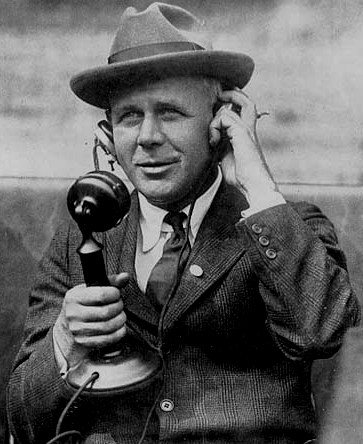
Grantland Rice

Rice went on to list some of his favorites—Rube Waddell, Crazy Schmit, Dizzy Dean—“Also, Flint Rhem, Babe Herman, Bobo Newsom, Germany Schaefer, Shoeless Joe Jackson, Arlie Latham—nits, wits, and half-wits—but all great ballplayers.”  But, said Rice, “one of the leaders in this colorful field” had been all but forgotten:

“His name was (Arthur) Bugs Raymond, the pitcher John McGraw always insisted had the finest pitching motion he ever saw, including Walter Johnson.”

[…]

“I remember Bugs because I happened to have a small part in his pitching career.  I was working in Atlanta (for The Journal) when I happened to read a story that came out of Shreveport (Louisiana), about a young pitcher named Raymond who had made and won the following bet:

“That he could eat a whole turkey, drink two bottles of scotch—and win a doubleheader.  He did it.  I didn’t believe it at the time, but I believed it later.  I recommended to either (Atlanta Crackers owner) Abner Powell or (manager) Billy Smith (44 years is a long time) that Raymond looked like a good buy.  Good copy is always scarce.  Raymond sounded like good copy.”

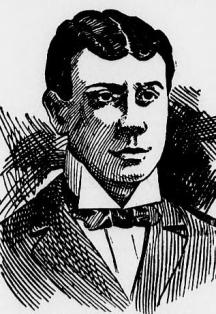
Bugs Raymond
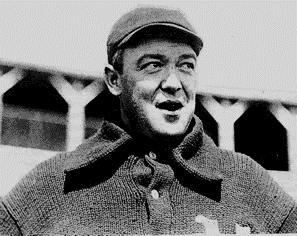
Bugs Raymond

Rice’s story about the bet is likely apocryphal, there is no mention of it in contemporary newspapers in Shreveport, or in Jackson, Mississippi where Raymond played in the Cotton States League before coming to Atlanta–he also names the wrong manager–Smith came to Atlanta the following season.  While Raymond probably didn’t make the bet Rice claimed, he did, on at least one occasion win both ends of a doubleheader, and he was wildly popular in Mississippi.  After he was sold to Atlanta in July of 1905, The Jackson News said:

“The regret over Raymond’s departure was not one-sided.  The big fellow was all broken up over the transaction.”

The paper said that although Raymond would make $200 a month in Atlanta and have a chance to return to the major leagues, leaving Jackson was difficult for him:

“During his engagement with the Jackson team he has made a host of friends and was undoubtedly the most popular player who ever donned a home uniform.  The plain fact is Raymond almost owned the town.  Nothing was too good for him and he always made a hatful of money on the big games, a shower of silver and greenbacks being the inevitable result of a victory in a doubleheader.”

Rice’s story about Raymond also took another real event and embellished it–either by design or through the fog of forty years.

After finishing the 1905 season with a 10-6 record for the Crackers, Raymond was picked by new Manager Billy Smith to start for Atlanta in an exhibition against the Boston Americans on March 26, 1906.

In Rice’s colorful version, he gave the incorrect date for the exhibition and wrongly claimed that he met Raymond face-to-face for the first time on the morning of the game:

“By some odd chance, before starting a mile-and-a-half walk to the ballpark, I happened to be taking a drink at some wayside bar in preparation for the trip.  A heavy hand fell on my shoulder and, as I looked around, there was an unkempt-looking fellow, around 200 pounds who wore no necktie and hadn’t shaved in at least two days.  Here was the king of all the tramps I’d ever seen.

“’How about buying me a drink, fellow?’ was his opening remark.  I bought him a drink.  Then I had to buy him another drink.

“’How do we get out to this ballpark?’ he asked.

“’We walk,’ I said, ‘if you are going with me.’ Then a sudden morbid thought hit me.  ‘Isn’t your name Raymond?’ I asked.

“’Yes,” he said ‘Bugs Raymond.’

“I figured then what my recommendation to the Atlanta team was worth.  Something less than two cents.

“’Do you happen to know,’ I suggested, ‘that you are pitching today against the Boston Americans?’

“’I never heard of ‘em,’ Bugs said.  ‘Where’s Boston?’

“On the walk to the ballpark that afternoon Bugs spent most of the trek throwing rocks at pigeons, telegraph poles and any target in sight.  People I had known in Atlanta gave me an odd look after taking a brief glance at my unshaven, rough and rowdy looking companion.”

Once at the ballpark, Rice said:

“Raymond started the game by insulting Jimmy Collins…and every star of the Boston team.  He would walk from the pitcher’s box up towards the plate and let them know, in forcible and smoking language, what he thought they were.”

In Rice’s version, the cocky, seemingly drunk Raymond shuts Boston out 3-0 on three hits.  He got those details wrong as well, and Raymond’s performance was just as incredible without the embellishments.
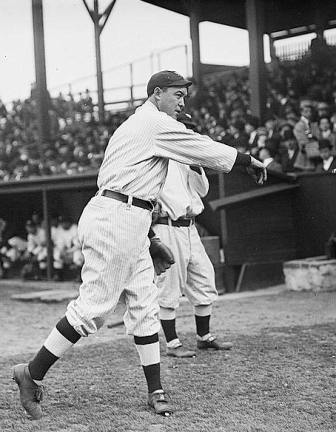
Bugs Raymond

Bugs Raymond

The Atlanta Constitution said on the day after the game:

“No better than bush leaguers looked the Boston Americans…yesterday afternoon at Piedmont Park, when ‘Bugs’ Raymond came near to scoring a no-hit game against the bean-eating crew, who escaped a shut-out through two errors made by (Morris “Mike”) Jacobs in the eighth inning.

“Score—Atlanta 4, Boston 2.

“’Bugs’ was there with the goods.  Boston hitter after hitter stepped up to the plate, pounded the pan, looked fierce for awhile, and then went the easy out route.

“’Bugs’ was in his glory.  It was in the eighth inning before a single hit or run was scored off his delivery

Both Boston hits were ground balls Atlanta shortstop Frank “Whitey” Morse beaten out by  Collins and Myron ”Moose” Grimshaw:

“As inning after inning went by, the Boston sporting writers along with the team began to think of the possibility of defeat, and, about the seventh inning, when it looked strangely like a shutout game, they pulled out their books of excuses and began to look for the proper one to use in Tuesday morning’s newspapers.

“The one finally agreed upon at a conference of all four writers read like this:

“’The eyes of the Boston players were dimmed by the flying moisture from the spit-ball delivery of one ‘Bugs’ Raymond, who let himself out at full steam, while our pitchers were waiting for the opening of the coming season.  It does a major league club good to be beaten every now and then, anyway.”

The Box Score
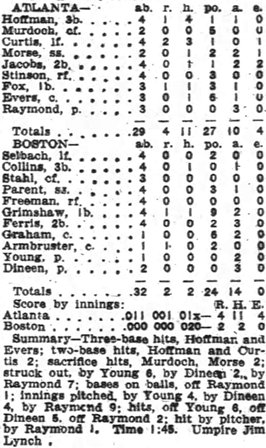
                 The Box Score

Given Raymond’s alcoholism, there might be some truth Rice’s embellishments although there is no evidence for most of his version.

The performance against Boston was quickly forgotten as Raymond just as quickly wore out his welcome with Manager Billy Smith.  On May 6 he was suspended indefinitely because, as The Constitution put it “(Raymond) looks with delight in wine when it is red.”  On May 31, Atlanta sold Raymond to the Savannah Indians in the South Atlantic leagues. An 18-8 mark there, followed by a 35-11 season with the Charleston Sea Gulls in the same league in 1907, earned Raymond his return to the big leagues with the St. Louis Cardinals.

By 1912, the pitcher, about whom Rice claimed John McGraw said “Even half sober Raymond would have been one of the greatest,” was dead.
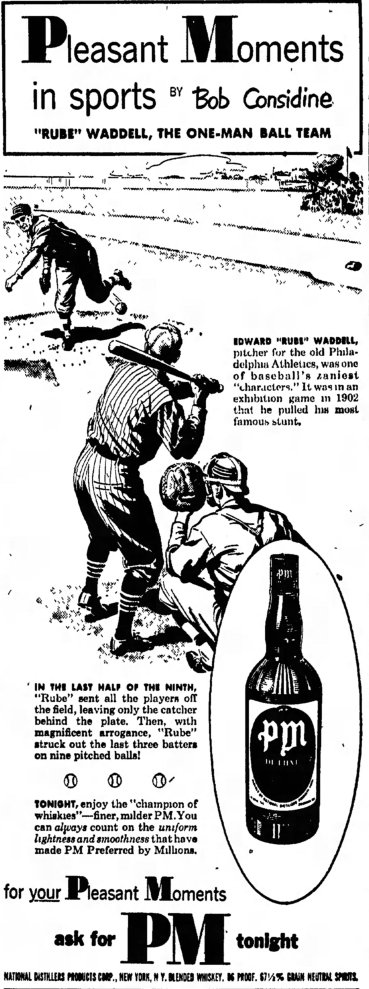
Lost Advertisements–PM Whiskey, “Rube Waddell, The One-Man Ball Team”

2 Oct

waddellad

A 1951 advertisement for PM De Luxe Blended Whiskey–part of a series of ads featuring “Pleasant Moments in Sports,” stories from Bob Considine, co-author with Babe Ruth of the “The Babe Ruth Story.”

This one features an oft-told Rube Waddell legend:

“Edward ‘Rube’ Waddell, pitcher for the old Philadelphia Athletics, was one of baseball’s zaniest ‘characters.’  It was in an exhibition game in 1902 that he pulled his most famous stunt.

“In the last half of the ninth, ‘Rube’ sent all his players off the field, leaving only the catcher behind the plate. Then with magnificent arrogance, ‘Rube’ struck out the last three batters on  nine pitched balls.”

As with all Waddell stories, there was some truth and a good deal of embellishment in Considine’s account.  While the contemporary coverage of the game differs on some aspects of the performance, they all agree that Waddell pitched to just one batter after members of the team left the field in the ninth inning.

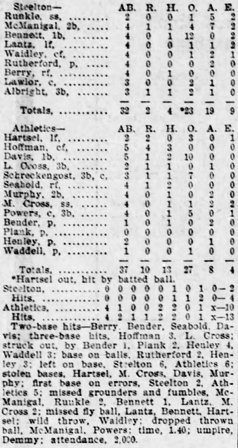
The game in question was played in 1903 at Steelton, Pennsylvania against that town’s YMCA team. The Athletics won easily, 10 to 2, and Waddell pitched the eighth and ninth innings for Philadelphia.

The Philadelphia Inquirer said:

“Waddell was the entertaining feature of the match, and in the last inning called in all the infielders after two men were out.”

The Harrisburg Daily Independent, which provided more in-depth coverage of the game, said:

“Rube Waddell was in all his glory at Steelton yesterday and his funny antics before and during the game were well worth the price of admission.”

The paper said before the game Waddell entertained the fans chasing “flies in the hills until he was perspiring,” and spent part of the early innings taking a “nap in his private carriage which carried him from (Harrisburg) to Steelton.”

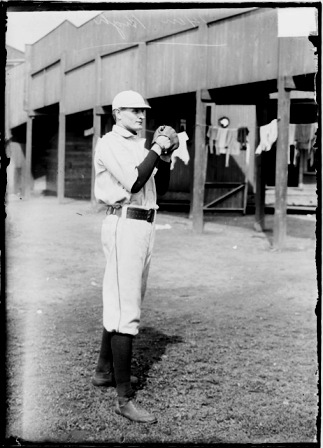
rube

Waddell

As for his time on the mound, the paper said Waddell struck out the first two batters he faced in the eighth, then after getting two strikes on the third batter, named “Irish” McManigal:

“(W)hen he pitched the third ball (he) remarked, ‘Take your seat.’ ‘Irish,’ however, surprised the Rube and rapped out a pretty single to center field.”

Waddell gave up another hit in the eighth and the YMCA scored a run.

“The next inning Rutherford hit to Waddell and the Rube did a cake walk to first base to catch Rutherford.  Berry then hit to Monte Cross, but he threw wild to first and Berry reached third base.  Then the Reuben settled down and struck Lawlor out.”

The Daily Independent said Waddell did not call in the fielders, but instead, on their own:

“The Athletic players behind Waddell left the field and with a man on third base he and (Ossee) Schreck (Schrecongost) were left to put out the side.

“The Rube did not know his teammates had deserted him and when told to look around by Schreck he discovered the fact.  Then to make more complete the comedy Schreckengost [sic] sat down and the Rube struck out Albright while the crowd howled with merriment.”

The Harrisburg Telegraph provided a third set of contemporaneous “facts:”

“In the last inning when two men were out all the Athletics left the field except Waddell, Powers and L. Cross.”

The paper likely misidentified Schrecongost as Michael “Doc” Powers–Schrecongost had replaced him behind the plate in the eighth, and Lave Cross had already left the game–so the player who stayed on the field might have been shortstop Monte Cross.  The Telegraph also added another detail missing in the other reports:

“(Waddell) gave the batter three balls and the crowd was wild, but their last hope faded rapidly away as Rube put three fine ones over the plate and the striker was out.”

The Box Score

The Box Score

Considine likely cribbed his version from Harry Grayson, the sports editor of The Newspaper Enterprise Association syndicate.  Grayson told the three-batters-nine-pitches story several times throughout the forties, and that legend stuck.


“Rube received the Princely Salary of but $4 a Week”

30 Sep

In 1903, The St. Louis Republic told the story about the arrangement that briefly made Rube Waddell a college man in 1897.  It involved Dr. Thomas H. George who was the manager of the baseball team at Volant College, a small state Normal School (Teacher’s College) in Volant, Pennsylvania.

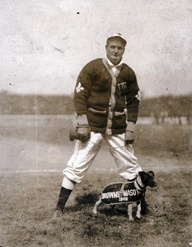
rube3

                            Rube Waddell

George said that he wrote to Waddell “asking his terms,” and upon hearing back that the pitcher had requested one dollar per game, George sent a telegram telling him to meet the team for a game in Waupun, Pennsylvania.

“Rube did not get the telegram until nearly noon on the day of the game, whereupon he hitched up a pair of his father’s horses…The game was nearly over when Waddell reached the field of action…he immediately broke into the game, giving the crowd a yell.”

George said the game was already lost, but Waddell did not allow a baserunner.

“That night Waddell signed a contract…doubling the amount which Waddell had agreed to pitch for, also giving him board and lodging.  As Volant only played two games a week, the Rube received the princely salary of but $4 a week.  There were many extras, however, as the rooters had a habit of taking up a purse for him after he won, which was, by the way, every game he pitched.”

The text of Waddell’s contract was included with the story, it read in part:

“The party of the second part (Waddell) agrees to pitch ball for the Volant College team during the season of 1897 for and in consideration of $2 for each game of ball played and pitched by said party of the second part. Said party of the first part (Volant) agrees to furnish…suitable room and boarding…This contract to hold good from May 18, 1897 to June 25, 1897.”

The story quoted George talking about one of Waddell’s “eccentricities” while pitching for Volant:

“Rube had a bad habit of throwing to bases without looking at the base to which he was throwing.  As a result the ball would go half a mile before it would be recovered, and every man who happened to be on the bases would score.  Consequently we had to instruct the basemen to play only for the batter, and not pay any attention to the base runner.  That used the Rube all up, for he delighted in throwing to the basemen with all his strength. When he found, however, that the guardians of the sacks were playing off from the bags, and not looking for throws, he stopped the practice.”

The story also claimed that even a contract covering just five weeks was too much for Waddell to honor:

“(Rube) deserted the Volant team upon the day they wanted him the most, commencement day, when a game had been scheduled with Mount Union College…The reason for (jumping) was that at the (nearby) town of Greenville there was fireman’s tournament in progress and a huge crowd would be on hand.  Now, Rube always liked to show off in front of a large crowd, and consequently he preferred going where the attendance would be larger.  He also took part in th firemen’s races which were held that day.”

There was no record of Waddell having attended a class during his brief college career.  He made his major league debut that same season, in September.

Volant College closed after a fire destroyed the school in 1911.

“Waddell got in his Deadly Work”

28 Sep

On July 12, 1902, Rube Waddell beat the Boston Americans 3-2, throwing a five-hitter.  The Philadelphia Times said:

“Waddell’s brilliant work enables Mack’s men to down Boston.”

The Philadelphia Inquirer said, “Waddell got in his deadly work at critical a stage…was by striking out the batsmen. He seduced nine on strikes.”

rube

Rube Waddell

The Inquirer also mentioned that before the game:

“Waddell and George (Candy) La Chance engaged in a friendly wrestling match, much to the amusement of the spectators.  It was finally won by Waddell, who came within an ace of putting both (of) LaChance’s ears to the ground.

Candy LaChance

Candy LaChance

In later years, LaChance’s teammates said the wrestling match was an attempt to keep Waddell out of the game.  In 1905, Albert “Hobe” Ferris told The Chicago Inter Ocean:

“Waddell was going to pitch and big George said to (Boston Manager Jimmy) Collins:  I’m going to fix Rube so we will hit him all over the field.

“Now, as you know, Rube is willing to wrestle anyone, and George challenged him to a friendly bout.  Right on the grass they sailed in.  LaChance was trying hard to get a hammerlock on Rube’s left arm, so that he could put it out of business for the afternoon.  But after six or seven minutes’ fooling Rube got a fall, and then, much to the disgust of La Chance and Collins, he shut Boston out with four hits and fanned twelve of us, getting George three times.

“’I suppose,’ said Collins after the game, to LaChance, ‘that if you had wrestled ten minutes longer Rube would have shut us out without a hit and struck out twenty men.”

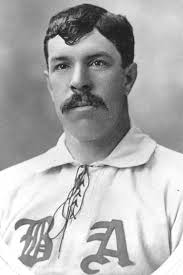
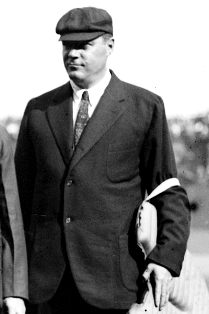
As with most stories about Waddell, later versions embellished some of the facts.  In 1918, Bill Dinneen, the losing pitcher in the game—and American League umpire from 1909-1937—told a version of the story to a reporter for The New York Sun.

Bill Dinneen

Bill Dinneen

In Dinneen’s version, “Waddell picked him off his feet as though he were a baby, held him high over his head and dashed him to the earth in a heap.”  Dinneen also claimed, “LaChance was barely able to play first base for us that day; he was so sore and bruised.”  His version also got the details of the game wrong:

“As for Rube, he shut us out with two hits.”

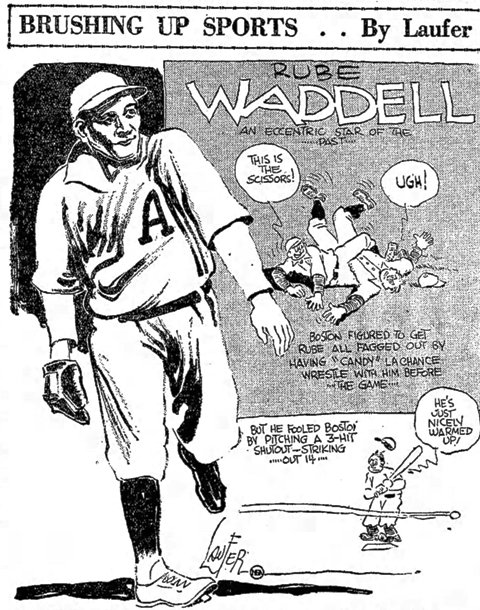
In 1922, Nick Altrock, who didn’t join Boston until September of 1902– two months after the game—retold the story one his syndicated articles for The Newspaper Enterprise Association (NEA).  Altrock got the date wrong (1903), claimed “the two wrestled for an hour,” and said Waddell “struck out 14 men and shut out Boston 1 to 0, allowing three hits.”

The version of the story with Altrock’s embellishments became the most often repeated and was still being told a decade later when Werner Laufer, The NEA’s sports cartoonist memorialized Waddell’s performance:

rubewernerlaufer1932

“He was the Greatest Receiving Catcher”

23 Sep

Freeman Ossee “Schreck” Schrecongost’s was most famous for being Rube Waddell’s catcher with the Philadelphia Athletics.

Ossee Schrecongost

                Ossee Schrecongost

Years later, Connie Mack told Harry Grayson of the Newspaper Enterprise Association that Schrecongost was “the fizz powder in the pinwheel that was Waddell.”  He also told the reporter that Waddell’s catcher “was the wilder of the two in many respects.”

Schrecongost lived at least as hard as Waddell and caused his manager as many headaches, but more than 30 years after his final game, Mack said he did “more with gloved hand than any other catcher who has come along.”

Allan Gould, the long-time sports editor for The Associated Press said of the catcher:

“Schreck had the eccentric habit of doing as much of his backstopping as possible with his gloved hand only. This worried Mack, who considered it careless workmanship until Schreck convinced his manager he could do a better job one-handed than with two.”

His teammates felt the same.

Three years after Schrecongost’s final major league game, Harry Davis told Gordon Mackay of The Philadelphia Times:

Walter Johnson is some grand pitcher with a barrel of speed.  But I’ll tell you one old boy who would sit on a chair and catch the big fellow.  That’s old Schreck.  He’d catch Walter with that big glove on his fin, and then after he had eaten up the old smoke to the limit he’d yell to the big chap to put something on the ball.

“I’ve seen Rube Waddell cross Ossee six or seven times, and Schreck wouldn’t pay the least bit of attention to it.  Suddenly Schreck would go out to the box and tell the Rube with a bunch of billingsgate trimmings that would make your hair curl that he stop crossing him.

Rube Waddell

                                 Rube Waddell

“There never was a backstop like old Ossee.  He could catch all the speed merchants in our league with one hand, and then only use the other one to throw with.  He was the greatest receiving catcher, receiving alone, I mean, who ever tripped down the pike.  He was a wonder, that old boy.”

Davis wasn’t Schreck’s only teammate who claimed he was a “wonder,” Tully “Topsy” Hartsell told The Philadelphia Press he saw the catcher perform “the greatest stunt” he had ever seen in 1904:

 “Schreck had a bad finger, and the other catcher (Michael) Doc Powers, was also laid up.  The third catcher, who was Pete Noonan, was doing all the backstopping.  He got hurt one day and Schreck had to go in in the first inning.  He couldn’t let the ball strike his wounded and uncovered hand, and Topsy says he caught the whole game only using his gloved hand.

“’Not only did he (only) use the glove to catch them,’ said Topsy, “’ but there wasn’t a stolen base or passed ball by him.  That’s the greatest catching feat I ever saw.”

Forever tied to Waddell, who died at age 37 on April 1, 1914, Schrecongost died just three months later, on July 9, at age 39.

The Associated Press said in his obituary:

“Grief over the death of the brilliant but eccentric Waddell…probably had much to do with hastening the end of the former great catcher.  Schreck told friends at the time that he ‘did not care to live now.  The Rube is gone and I am all in.  I might as well join him.’”

“And Mr. Waddell made good”

16 Sep

William A. Phelon, like Hugh Fullerton, told many stories over the years that may or may not have been 100% truthful.  One of his favorite subjects was Rube Waddell, who was the subject of as many apocryphal stories as any player of his era.

Rube Waddell

                    Rube Waddell

In 1912, Phelon, then writing for The Cincinnati Times-Star, told a story that he claimed happened while Waddell was pitching for Chicago and Phelon was writing for The Chicago Daily News:

“When Rube Waddell was much younger than he is today—to be exact, back in the golden days of 1901–he was with the Chicago club, and he was just as original and interesting as at the present time.  In just two respects the Rube was very different then—he was a heavy batter (not exactly heavy, but waddle hit .237 in 334 at bats through 1902, and .129 in 732 at bats thereafter), and he was a fiend for work.  You couldn’t put him on the slab too often to suit him, and you could throw him very few shoots  that he couldn’t hit.”

[…]

“One pleasant summer afternoon, during the Rube’s short stay with the Chicago club, he was feeling unusually hilarious, and worked his head off to show up the opposition.  Never did the Rube have finer curves or better speed.  Zim, zipp, the ball hurtled through the ether, and the batsmen were helpless before his terrific delivery.  He held the hostiles to perhaps three hits, struck out ten men, and made a three-bagger on his own accord.  It was a great day for Rube and the crowd went wild about him.

“Next morning, while Jim Hart, the boss of the Chicago club, was in his downtown office, a delegation of bankers called upon him.  ‘We are all coming out this afternoon, Mr. Hart,’ said the spokesman of the crowd, ‘and we have bought up a whole front row of boxes.  There’s only one thing we are sorry for, however—we had all hoped to see Waddell pitch, and we thought he would be due to work today.  If we had known that he was going in yesterday, we’d have been there instead of this afternoon.”

Waddell in Chicago, 1901

        Waddell in Chicago, 1901

According to Phelon, Waddell was made aware that the bankers were disappointed he would not be pitching and said he’d “go in again” the next day.

“And Mr. Waddell made good.  He went back on the slab that afternoon and pitched a gorgeous game, winning in easy style, while the rapturous bankers whooped and bellowed in the boxes.

“About ten days later, Mr. Waddell walked into the office of the banker who had been the spokesman for the delegation.  He was cordially received and invited to sit down in the inner sanctum.  Mr. Waddell, roosting his hat upon the rosewood desk, lit a cigar, crossed his knees, and said, smilingly:

“‘Are you a believer in reciprocity?’

“’Why of course,’ said the banker.  ‘What about it?’

“’Well, Mr. Banker,  I did you a favor the other day, didn’t I?’

“’You certainly did.  I was extremely grateful to you Mr. Waddell.’

“’Then Mr. Banker, suppose you reciprocate.  Lend me $50.’

“And Rube got the fifty.  Did the banker ever get it back?  Does a Hyena fly?  Why ask such foolish questions.”


“A Boy he Lived and a Boy he Died”

29 Jul

When Rube Waddell died on April 1, 1914, he was eulogized by sportswriters across the country.  Perhaps no one captured the essence of baseball’s most eccentric personality than William George “Billy” Murphy, sports editor of The St. Louis Star, who called the departed pitcher “The Peter Pan of the National Game.”

The other left-handed Rube

Waddell

Murphy said:

“A boy he lived and a boy he died.  He knew naught of the great problems of sociology or philosophy, but lived in the realm of love, adventure, romance, gallantry, and grace.

“The tales that are told of him, if written, would be classics in the folklore of childhood.  He was but a little child himself.

“A man of baseball genius, of an ardent temperament, reckless of physical laws and self-indulgent, he paid the penalty.”

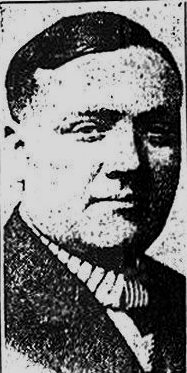
Murphy

Murphy

The story of Waddell’s catching pneumonia while helping to stack sandbags to save the town of Hickman, Kentucky, which contributed to his contracting tuberculosis, the cause of his death, has been told often.  But Murphy told another story about Waddell’s stay in Hickman—at the home of Joe Cantillon, his manager with the Minneapolis Millers.

 “Memory of Rube Waddell will live forever in the heart of Joe Cantillon…’Rube’s big heartedness has never been exaggerated,’ said Joe.  ‘In fact, his generosity never has been fully told.  Year before last down at Hickman the Rube was with me at Christmas time.  A storekeeper called me up Christmas Eve and told me the Rube was inviting everybody who passed the store to step in and get fitted for a pair of gloves.  The merchant thought the Rube had gone daffy and wanted to know if he should stop him.  I told him ‘no,’ to let Rube have his fun, and if he couldn’t pay for it I would.  He gave away forty pair.

“Rube was lonesome and the Christmas spirit was upon him and he couldn’t do anything else that would have brought him more pleasure.”

JoeCantillon

Cantillon

Murphy said Waddell, for “all his buffoonery, was brave and would go the limit to help a woman or child.”

 “Waddell was the greatest of all the southpaws and his name will live forever in the history of America’s national game.

“There was not a selfish bone in his body and he did much good.  He was indeed a little boy who never grew up.  He made many happy and lived his life as he saw it.

“May his rest be as sweet as was his life.”

“Wallace’s Head is Abnormally Developed”

29 Dec

When Bobby Wallace was named manager of the St. Louis Browns in 1911, the local press, desperate for any ray of hope for a club that finished in eighth place with a 47-107 record, enlisted a “noted phrenologist” named Squeers from Hot Springs, Arkansas to examine the new manager.

Booby Wallace

Booby Wallace

Phrenology was a popular pseudoscience in the in the 19th and early 20th Century that claimed the structure of the skull determined a person’s mental ability and character.

The result of Wallace’s examination was reported in several newspapers:

“The eminent brain specialist pronounced the manager of the Browns one of the most normal-minded men he had ever examined.  He did not know his man when he made his diagnosis.

“Wallace’s head is abnormally developed on the left side.  This is as it should be, Dr. Squeers declares.  The left lobe of the brain governs the right side of the body…It is natural, asserts Dr, Squeers, that a man should be right handed, right-footed, right-eyed, that the right side (of the body) should be larger and stronger than the left.”

It was not enough to declare Wallace “normal minded,’ the “doctor” also “diagnosed” roughly 10 percent of the general population.  He said because “It is natural” to be right-handed, left-handers therefore, were “in many cases a bit abnormal.”

The litany of “abnormal” left-handers–Rube Waddell, Crazy Schmit, Nick Altrock, Slim Sallee, Lady Baldwin, etc…–were trotted out to demonstrate the “proof” of the assertion.

 “For whatsoever the reason may be, the man whose throwing arm is governed by the right lobe of his brain seems bound to be erratic.  Thus is Dr, Squeers, knows little of baseball, justified in pronouncing Wallace an ‘abnormally normal’ man.  Wallace is the farthest thing from erratic that any man could be.  He could not do a left-handed or wrong thing—could not act abnormally to save his soul.”

[…]

“Wallace has been the quietest, most regular, most normal human being in the world.  He is the perfection of moderation, of balance in all things.  He takes life quietly and is never disturbed or out of temper.  He has never made an enemy.  He is the favorite of everyone…It remains to be seen if normality means success when it is applied to the management of a baseball team.”

In this case it didn’t.

The Browns, awful in 1910, were awful again under Wallace in 1911; another eighth place finish with a 45-107 record.  After a 12-27 start in 1912, George Stovall replaced him as Browns manager.

Wallace managed one more time—he replaced Chuck Dressen as manager of the Cincinnati Reds in September of 1937.  The “most normal human being in the world” was 5-20.


“You have to be Diplomatic Sir, you have to be Diplomatic”

29 Oct

“Wild Bill” Setley’s adventures did not all take place on US soil.  In 1911 Cincinnati Reds pitcher George McQuillan told William A. Phelon of The Cincinnati Times-Star a story about Setley’s attempt to organize a barnstorming tour in Cuba two years earlier.

Bill Setley 1895

Bill Setley 

“Setley went over to Cuba early in the winter, and conceived the idea that fortunes were to be made in the island.  He wired to a number of ballplayers, urging them to come over, an telling them Cuba was just full of money.  Quite a number of the boys went over on spec, all paying their own fares, and in the near future they all went broke.  The Cubans wouldn’t come across with any money for salaries, some of the boys, being Southern-born, refused to play when they found the Cuban clubs were mostly (black players), and in two weeks Havana was overrun with hungry ballplayers.    They hunted Setley up and chided him for his statement that the island was full of money.  ‘It is,’ said Setley, ‘and I gave you no misinformation.  But I didn’t say anything about your taking any of that money away with you.  The island is fuller of money than before , for you fellows have spent all you brought with you, thus adding to the total.’

“After starving a few days, the boys all got over their race prejudices and caught on with various clubs.  And, a few days later they had the sublime delight of seeing Setley get his.  He was umpiring a big Sunday game at Havana, with an enormous audience in the stands.  His decisions were either fearfully bad, or else he had got the Spanish terms for ball, strike, safe, and out badly twisted when he tried to learn them.  Suddenly, when he called a man out after he had stamped both feet upon the plate, the audience uprose and came flooding towards Mr. Setley.

“Bill had a gun.  Always toted one.  But here came 5,000 Cubans with long knives and machetes, and Setley didn’t stop to make any gun plays.  Far from such.  Out through the gate he galloped, and straight down the Cuban road.  On and on he went, the mob shaking machetes in full cry behind him, and presently he became a speck upon the far horizon.  He had won.  Nobody could catch him.

“Next day I met him, and asked why he didn’t draw his gun and stand at bay.  ‘My boy,’ said he, ‘our relations with Cuba are strained enough as it is.  What would have been the result had I shot down half a dozen of those fellows?  You have to be diplomatic sir, you have to be diplomatic.”

There was no shortage of Setley stories.  Albert Francis “Red” Nelson, who pitched in the major leagues between 1910 and 1913, and played in a number of the minor leagues Setley worked as an umpire, told a few to The Memphis News-Scimitar in 1911.

Red Nelson

Red Nelson

Nelson said when he was playing in the Three-I league:

“A player named (Jim) Novacek was at bat (with the count 3 and 1).  Ball came along, on the outside, way wide.  ‘Strike,’ said Setley.  Novacek roared and howled, quite naturally.  Next ball was also wide .  ‘Four balls, take your base,,’ quoth Setley.  As Novacek started for first he exclaimed sneeringly, ‘That ball was in exactly the same place as the one you called a strike, just before.’  ‘In that case,’ said Setley, ‘I will do anything to oblige you.  Three strikes—you’re out!”

Nelson claimed that Setley had been involved in an incident he said took place in Rock Island, Illinois that included a few elements of the Cuba story;

“Setley is, in my opinion,  a funnier card among umpires than (Rube) Waddell ever was among eccentric ball tossers…On one occasion he was umpiring in some town—I think it was Rock Island—and a couple of his decisions turned the tide in the favor of the Peoria club.  The Rock Island fans promptly stormed into the field and took after Setley, who fled through the gate and down the street with the mob in mad pursuit.  And as Setley ran he threw up one arm in commanding fashion and shouted: “I hereby forfeit this game to Peoria, 9 to 0, you sons of monkeys.”

Nelson also told yet another version of the “mirror story,” which appeared in print in many different versions over the years.  Nelson’s version located the story “at Peoria,” but unlike most versions, failed to name any of the other participants.

It was not unheard of for Setley to simply create a new rule—in force for one game only—when the mood struck.  In one case, while working a Western Association game between the Muskogee Redskins and the Coffeyville White Sox he instituted a one-game only rule that would make him a hero with today’s advocates for shorter games.  The Muskogee Times-Democrat approved as well:

“Umpire Bill Setley yesterday set in force the rule annulling the privilege of the pitcher to throw to a baseman to warm up between innings, and the practice of throwing the ball around the infield, which takes up so much time.  The rule worked well, as the game, with nineteen runs, was finished in a minute over an hour and a half.”

“Then the Harder I threw the Harder they hit them”

3 Oct

Walter Newton Justis–often misspelled “Justus” during his career– performed an incredible feat in 1908.  While posting a 25-17 record for the Lancaster Links in the Ohio State League, he pitched four no-hit games between July 19 and September 13.

Walter Justis

Walter Justis

The performance earned him his second shot to make the big leagues.  The first consisted of two relief appearances (8.10 ERA in 3.1 innings) with the Detroit Tigers in 1905 when he was 21.  He said later that he wasn’t ready:

“All I knew was to burn them over.  And the harder they hit them the harder I threw.  Then the Harder I threw the harder they hit them.  Most of the time in the three months that I was there I lugged the big bat bag, and I guess I earned my salary then about as much as at any time I know of.”

Justis’ bizarre behavior often made as big an impression as his pitching.  Roy Castleton was pitching for the Youngstown Ohio Works in 1906 when Justis joined Lancaster (the team was in the Ohio-Pennsylvania League in 1906 and ’07, and joined the Ohio State League in 1908).

Castleton, while playing for the Atlanta Crackers two years later told The Atlanta Constitution  he thought “Rube Waddell and Bugs Raymond, two players well-known for their eccentricities…will have to take off their top pieces,” to Justis.  Castleton was staying in the same hotel as the Lancaster team:

“Early one morning he heard someone raising a disturbance in the hotel hallway and taking a look to see what was doing, he observed pitcher Justis…running down the hallway.

“’At the end of the hall Justice placed a pillow against the wall.  He would get a good start down the hall and after the fashion of a man on the paths would take a running slide at the pillow.  When he arrived at his destination he would hold out his hand as umpires do and yell ‘safe!’  Justis would keep this up for hours at a time playing base runner and umpire out in the hall at daybreak.’

“’Sometimes he would stop the double existence of umps and runner and would (just) be the judge of the play.  Standing over the pillow he would hold out his hand and yell ‘safe’ so loudly that he could be heard a block off.’”

The Constitution also said that Justis was superstitious:

“He never goes into a game without wearing a pair of ladies’ silk hose supported in the usual manner.  Regular baseball stockings would never do for him, as he believes his career as a pitcher would be cut short if he were to wear them in a game.”

He was signed by the St. Louis Browns, and Manager Jimmy McAleer told The St. Louis Globe-Democrat the pitcher’s eccentricities were a positive:

“McAleer says that the reason he signed pitcher Justis of Lancaster was because Justis bears the reputation of being a baseball ‘bug.’  ‘Bugs,’ says McAleer, ‘make good in St. Louis.  We have Waddell, while the Cardinals have ‘Bugs’ Raymond.’”

Justis joined the Browns in Dallas in the spring of 1909.

The Globe-Democrat said after he had a poor outing in an exhibition against the Houston Buffaloes of the Texas League:

“Justis pitched two innings for the Browns Saturday and the Houston team got six runs.  Until this bombardment he was tagged for the regular club, and the label hasn’t been removed yet, though slightly loosened.”

And Justis appeared to have made the team when they broke camp in Texas and returned to St, Louis in early April, but The Associated Press reported on April 6:

“Walter Justus, a pitcher recruit of the St. Louis Browns, is confined to his room by a severe nervous collapse, and the nurse in charge says he may be able to leave for his home in Indiana in a few days.  Justis lost his power of speech at the end of a wrestling bout with Arthur Griggs in Sportsman’s Park today.  It is claimed Justus fell to the floor, striking his head, and reopened an old wound received when a boy.”

Justis suffered similar attacks at least four other times during his career; in June of 1907, twice in 1908, and August of 1909.  In July, 1908 after a double-header with the Lima Cigarmakers, The Marion (Ohio) Daily Mirror said “(Justis) suffered a sudden brain stroke akin to apoplexy.  He fell in a dead faint at the close of the second contest.  He was removed to his hotel in an unconscious condition.”   In September, after another attack left Justis hospitalized, The Sporting Life said prematurely “physicians say he will never twirl another game.”   It is likely that he suffered from epilepsy.

Within days of returning to Indiana from St. Louis Justis fully recovered.  The Associated Press said “His recovery is one of the most remarkable in the history of athletes.”  But, despite his recovery, Justis was returned to Lancaster by the Browns, and lost his opportunity to return to a major league team.

He threw another no-hitter for Lancaster in 1909, on May 18 against the Marion Diggers, and went 19-16 for the season.  Justis continued pitching until 1913, finishing with the Covington Blue Sox in the Federal League—where he played with the equally eccentric, enigmatic Fred “Humpy” Badel.

Justis shut out the St. Louis Terriers 4 to 0 on the opening day of the Federal League season, but no complete records remain for the season.  By late September of 1913 he was back home in Greendale, Indiana pitching for a local team.  He remained in Greendale until his death in 1941.