Tag Archives: St. Louis Cardinals

“Pitchers Should be Taught how to Sleep”

24 Sep

Edward Tilden Siever had a theory about one of the greatest dangers facing pitchers:  how they sleep.

Edward Siever

Edward Siever

The Kansas native did not begin playing professionally until he was 24-years-old in 1899, and was 18-14 as a rookie with the Detroit Tigers two years later.  He injured his arm that season, had a sub .500 record the next three seasons with the Tigers and St. Louis Browns, and went to the American Association with the Minneapolis Millers in 1905. 

Siever’s arm recovered sufficiently to post a 23-11 record with the Millers and was purchased by the Tigers the following spring; he was 14-11 in 1906.

He was having the best season of his career in 1907; finishing with an 18-11 record and a 2.16 ERA for the American League Champion Tigers.  It was during that season that he told The Detroit Times about his theory:

“Pitchers should be taught how to sleep.  Don’t laugh, I mean that More than one good pitcher has lost his arm because he did not know how to sleep correctly.”

Siever claimed that fellow Kansan, St. Louis Cardinal pitcher Charlie “Dusty” Rhodes, missed much of 1906 with a bad arm brought on by the manner in which he slept:

“(Rhodes) used to rest his head on it when he was sleeping.  It deadened the muscles…No ballplayer should ever rest his head on his arms when he is sleeping.  It’s more dangerous than the average young man imagines.  Many a ball player loses his whip and doesn’t know how to account for it.  I’ll bet that’s the real reason in many a case.”

Charlie "Dusty" Rhodes

Charlie “Dusty” Rhodes

The Chicago Cubs defeated Siever in his only World Series appearance in 1907, and after a 2-6 start in 1908 he was sold to the Indianapolis Indians in the American Association; he pitched three more seasons in the minor leagues. 

He remained a popular figure in Detroit and worked for the city’s public works department until he died of a heart attack in 1920.

Happy Labor Day

2 Sep
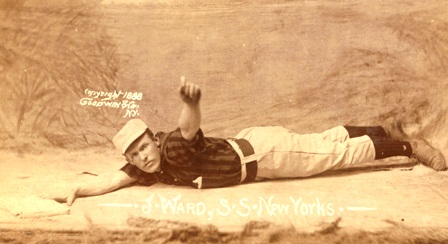
John Montgomery Ward

John Montgomery Ward

John Montgomery Ward spearheaded the movement to create baseball’s first union.  He invoked the recent memory of slavery in his article entitled “Is the Base Ball Player a Chattel?” in “Lippincott’s Monthly Magazine,” in August of 1887:

“Like a fugitive slave law, the reserve rule denies him a harbor or a livelihood, and carries him back, bound and shackled, to the club from which he attempted to escape.”

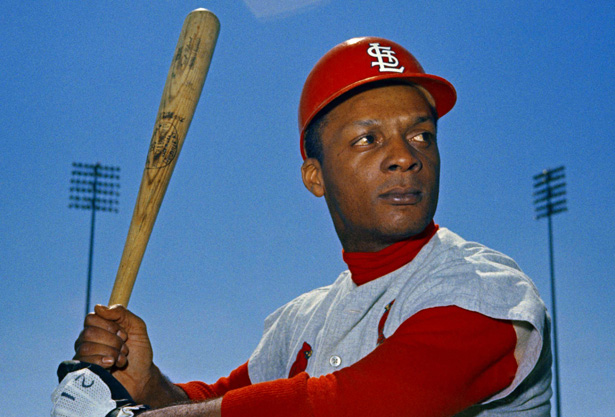
Curt Flood

Curt Flood sat out the 1970 season, refusing to report to the Philadelphia Phillies after being traded by the St. Louis Cardinals.  He challenged baseball’s reserve clause all the way to the United States Supreme Court.  Despite losing his challenge in 1972, Flood’s case was a major factor in the elimination of the reserve clause.

“I’m a human being I’m not a piece of property. I am not a consignment of goods.”

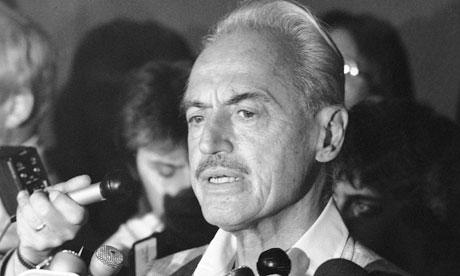
Marvin Miller

Marvin Miller

As Executive Director of the Major League Baseball Players Association from 1966 to 1982, Marvin Miller transformed the players union from a toothless entity to one of the nation’s strongest unions.  Jim Bouton, quoted by National Public Radio in 2009:

“If not for politics, so obvious to everyone, Marvin would have been voted in (to the Hall of Fame) years ago. Instead of pointing to the sky, today’s players should be pointing to Marvin Miller.”

“Figures of your kind are Pathetic”

13 Aug

John McGraw made news for an “innovation” in 1909.  The Associated Press said:

“McGraw has adopted an innovation in baseball which will appeal to fandom throughout the National league circuit and probably prevent (Fred) Merkle and others from running to the clubhouse before they ‘touch second.’ The innovation is the signing of the once famous player Arlie Latham as coach for the base runners.”

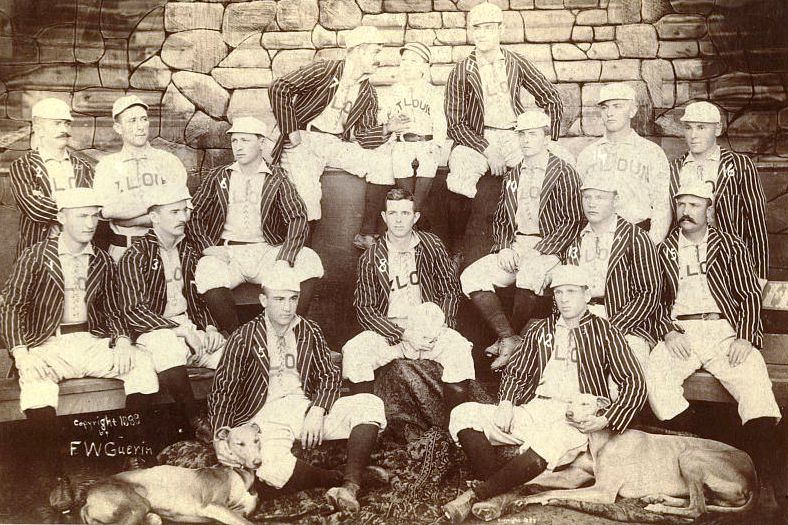
Arlie Latham, top center, facing team mascot, with 1888 American Association champion St. Louis Browns

Arlie Latham, top center, facing team mascot, with 1888 American Association champion St. Louis Browns

Walter Arlington “Arlie” Latham, was “particularly known for his humor” in the 1880s and 90s.  Primarily a third baseman with the St. Louis Browns in the American Association, the Chicago Pirates in the Players League and the Cincinnati Reds in the National League, Latham was nicknamed “The Freshest Man on Earth.”

The Associated Press said Latham:

“(B)rought much enjoyment to spectators of the Cincinnati club’s games and the Reds kept Latham a long while after he deteriorated as a player because of his drawing power as a comedian and humorist.

“Latham will don the uniform of the Giants and take his place in the coacher’s box while the Giants are at bat and between coaching the baserunner and batsmen and ‘getting the goat’ of the opposing pitchers will furnish an interesting sidelight to the New York games.”

Things did not go smoothly when Latham joined the team.  During spring training in Marlin, Texas Latham and McGraw were returning to their rooms at the Arlington Hotel when Giants outfielder James “Cy” Seymour, according to The St. Louis Post Dispatch, “knocked him down, and then bit him on the cheek.”  The article said McGraw and Latham did not know the “reason (Latham) was attacked,” but McGraw announced that Seymour was given his unconditional release.  McGraw said:

“Seymour is done with the New York club, and that goes.  It was the worst thing I ever saw pulled off.  Nothing like that can go on the New York club.”

Despite what he said McGraw did not release Seymour; the outfielder was suspended for the first week of the regular season, and The Dallas Morning News said McGraw made Seymour pay “his own expenses in Texas after the unpleasant episode.”

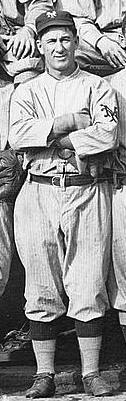
Arlie Latham, New York Giants coach

Arlie Latham, New York Giants coach

Latham was often criticized for his antics and even more often for the quality of his work as a coach, which became such a running joke that The New York Times said after the Giants had beaten the Cardinals in a September 1910 game:

“Arlie Latham’s team won it with their eyes shut, 11 to 3.  Latham’s coaching was invaluable yesterday.  He advised the players to touch every base and this tip won the game for them.”

The Sporting Life said:

“(Latham) undoubtedly lost a lot of games by bad coaching.  He got so unreliable that in a tight pinch McGraw would shift him from third to first and take the third line himself.”

The Sporting Life also said that Latham served as McGraw’s spy;  a position that would later be filled by another colorful McGraw coach, Dick Kinsella.

Giants outfielder Fred Snodgrass told Lawrence Ritter in “The Glory of their Times,” that Latham “was probably the worst third base coach who ever lived.”

It looked like the end of the line for baseball’s first full-time coach after the 1910 season.  The New York Herald said Latham “will not wear a Giant uniform next season,” and:

“He may amuse old timers, who remember him as a great ball player with (Charlie) Comiskey’s St. Louis Browns, but the new generation of fans seems to regard his efforts with disfavor.”

Despite the criticisms and predictions of his impending firing, Latham was back with Giants in 1911.  After the Giants pennant winning season Latham again joined the Giants for spring training in Texas in 1912, but in March, according to The Associated Press:

“(Latham) was carried as one of the twenty-five men permitted on the payroll.  McGraw did not want to let Latham go, but needed the place on the payroll for a real player.”

While McGraw didn’t want to lose his coach, most of baseball thought the end of Latham’s coaching career was a good thing; but even the New York press was not as harsh in their assessment of Latham as was Ed Remley, the baseball writer for The Fort Worth Star-Telegram:

“Arlie Latham has passed.

“May he rest in peace, for he is truly dead…Arlie has been called the fool of baseball and with much justice.  He was not the fool in any modern sense but more like the professional jesters who were kept in the courts of kings in the middle ages.

“Today, reading descriptions of the position of the court jesters, their crude horseplay jokes, we are not filled with laughter but with pity…The crude vassals of a former generation thought the brutal jokes of the court fool were funny; the bleacherites of today laugh at Arlie Latham pretending an engrossing interest in a game which he cannot even play himself…Vale, Latham—You have our sympathy, but we are not really sorry you are gone.  Figures of your kind are pathetic and pathos has nothing to do with baseball.”

Latham was next heard from when he accepted a coaching position with Patrick “Patsy” Flaherty’s Lynn Fighters in the New England League; that job only lasted until June.  Latham managed to run afoul of the entire Lynn team.  The Associated Press said he was forced to resign because “Players thought he was after manager Flaherty’s job and threatened to go on strike unless he was dismissed.”

Latham finished the 1914 season as an umpire in the Massachusetts and Rhode Island based Colonial League.  He did not return the following season, and in May of 1915 The Pittsburgh Press reported under the headline “Arlie Latham Has Quit The Diamond for All Time Now,” that he had found a new line of work; operating a deli in the Washington Heights neighborhood in Manhattan:

“He declares that as a delicatessener he is batting only .106 at present, but that when he gets properly warmed up and learns how to shave 15 ½ ounces of ham for a pound he will hit with the best of them in the delicatessen league.”

By 1917 Latham was in Europe, for the last act of his baseball career.  From 1917 to 1923 he lived in London and organized baseball leagues for military personnel.  The highlight of his stay was the July 4, 1918 game between the Army and Navy teams.  Latham served as umpire and greeted the most important dignitary at the game, King George V.  The Associated Press said:

“It had been planned to have the king throw out the first ball, but this was abandoned because of the netting in front of the royal box, so the king brought the ball out on the field and handed it to the umpire.  One of the balls used was autographed by the king with an American fountain pen and mailed tonight to President Wilson as a souvenir. “

Arlie Latham, front row center, with army team in London, 1918

Arlie Latham, front row center, with army team in London, 1918

After returning to the States, Latham first returned to the deli, then later was hired to work in the press box at the Polo Grounds, he remained a fixture at the New York ballpark until his death at age 92 in 1952.

As a result of outliving his critics and becoming one of the last surviving links to the 19th Century game by the time of his death, memories had faded about the “pathetic” figure of Latham, and only the image as  “baseball’s clown prince” remained.

“The Disappearing Oakland Infielder”

7 Aug

James Ernest “Jimmy” Frick began his career with the Iola Gasbags in the Missouri Valley League in 1904, hitting .331 in 106 games.  While Frick began the 1905 season with the Oklahoma City Mets in the Western Association, a “C” level league, press reports said he could have played at a higher level and The Sporting Life said St. Louis Cardinals, Hall of Famer pitcher Charles “Kid” Nichols “cannot understand why Jimmy Frick of Oklahoma City persists in hiding out it the bushes when he can make good in fast company.”

Frick was hitting above .300 in July when he was sold to the Seattle Siwashes in the Pacific Coast League; he hit .252 in 18 games until August 18 when The Associated Press said Frick “disappeared mysteriously.”

Four days later The Seattle Star said Frick who “was very popular” with local fans had jumped the Siwashes and rejoined Oklahoma City having been promised “$1000 and a chance to manage the team next year.”

Whether the reported deal was actually promised to Frick is unknown.  While he returned to Oklahoma City he never joined the Mets and finished the season with the Wichita Jobbers.

At the end of the 1905 season multiple teams laid claim to him.  The Associated Press said:

“The case of J. Frick who was claimed by Indianapolis, Wichita, Seattle and Oklahoma City was referred to Secretary (John) Farrell (of the National Association).”

In February of 1906 Frick was awarded to Wichita then immediately traded to the Toronto Maple Leafs in the Eastern League.  He spent the next five and a half years in the Eastern League with Toronto, the Baltimore Orioles and the Newark Indians.

On July 16, 1910, while with Baltimore, Frick was hit in the head with a pitch.  In August The Sporting Life said he had not yet returned to the lineup:

 “(Frick) is in a bad way in this city, as the result of being hit on the head by a pitched ball during the last home series of the Birds. Although the accident happened at least three weeks ago, Frick’s head is still in bad condition, his face is swollen and dizziness seizes him on the slightest provocation. It is doubtful if Frick will play again this season.”

He did return at the tail end of the season, but only appeared in a few games.  In 1911 he was sold to Newark, and after hitting just .200 in 28 games he was sold to the Troy Trojans in the New York State League.

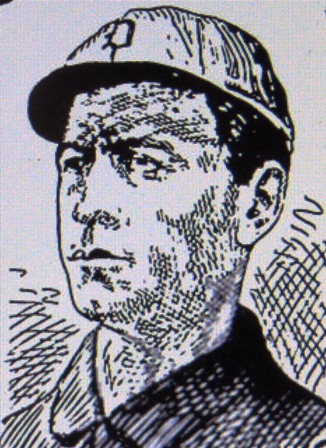
Jimmy Frick

Jimmy Frick

Before the 1912 season, Harry Wolverton, third baseman and manager of the Oakland Oaks in the Pacific Coast League, was named manager of the New York Highlanders in the American League.  Oakland hired Bayard “Bud” Sharpe to manage the team; one of his first moves was to purchase Frick from Troy to fill the void Wolverton left at third.

By March 7 The Associated Press said Sharpe was “somewhat exercised about infielder Frick.”  The new third baseman had arrived in Oakland by train several days earlier, but had not arrived at the Oaks training camp in Livermore, California and had not been heard from him.  Sharpe showed up the following day, but it was reported he had spent several days in an Oakland hospital—it was not reported why he was hospitalized.

Frick began the season as the Oaks starting third baseman, but after hurting his foot in April, August “Gus” Hetling filled in and Frick never returned to the regular lineup.

On September 17, with Oakland in a battle for the pennant with the Vernon Tigers, the team was in Los Angeles when Frick, according to The Associated Press left his room at the Hotel Rosslyn and “dropped from sight.”

The Los Angeles Examiner said the Oakland team and the Los Angeles Police Department had looked for Frick for more than a week and found no sign of the infielder.  The Associated Press said “all of Frick’s haunts have been searched,” and that the disappearance “may hurt Oakland in their fight for the pennant, as he is considered the best utility infielder on the team.”

Herb McFarlin, Secretary of the Oaks, said:

“Frick has always been a steady player, not inclined to drink or run around.  He always has been absolutely dependable.”

On October 4 The Associated Press said “the disappearing Oakland infielder” had been found by his wife:

“He had been ill in a Los Angeles Hospital, assuming an alias so that he would not be bothered.”

As with his spring disappearance there was no mention as to why Frick was in the hospital.

On October 5 he was with the Oaks in Portland for a game with the Beavers, he did not play, but was “out on the coaching line rooting for his team.”

Frick was with the team on October 27 when they took both games of a double-header in Los Angeles; Vernon won both games of a doubleheader from Portland, and Oakland took the pennant with a winning percentage of .591 to Vernon’s .587.

Frick saw little action in the final weeks of the season, his replacement Hetling hit .297 and was awarded a Chalmers Automobile as the league’s most valuable player.

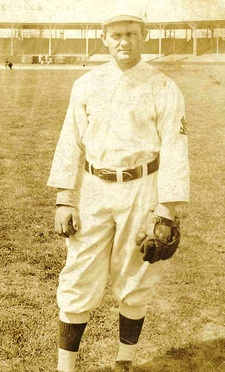
Gus Hetling, Frick's replacement at third

Gus Hetling, Frick’s replacement at third

Frick and his wife went to Portland at the end of the season, and in late November planned to leave for Oklahoma City where they owned a farm.  On November 20 Mrs. Frick went to pick up tickets for the trip, when she returned home, she found Jimmy Frick dead.  He committed suicide by drinking carbolic acid. (Baseball Reference incorrectly lists his date of death as November 18),

The Portland Oregonian said Frick had been “ill and despondent,” and said he was suffering from “brain fever.”  (Brain fever is an antiquated and vague term used for inflammation of the brain).

None of the stories about Frick’s suicide and “brain fever” mentioned the severe injury he had received when he was hit in the head in 1910, so  it’s impossible to determine whether it contributed to the erratic behavior that year, hospital stays, or death of the disappearing Oakland infielder.”

Lost Advertisements–Old Underoof Whiskey, Cubs and White Sox

2 Aug

OO62010


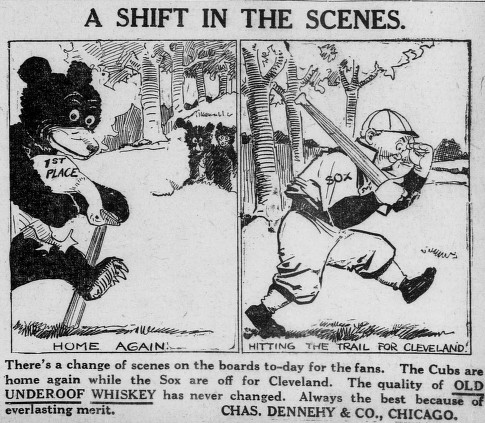
Two more 1910 advertisements for Old Underoof Whiskey featuring the Chicago Cubs and White Sox; these appeared in The Chicago Daily News and The Chicago Examiner.

The one above “A Shift in the Scenes” is from June 20, 1910.  The Cubs were returning home after a 10-4 road trip which put them 4 ½ games ahead of the second place New York Giants, while the struggling, seventh place White Sox were heading to Cleveland for a six game series.

The one below “It’s a Rocky Road to Pennantville” appeared just 10 days later.  The Cubs, who had won four straight games after the first ad appeared, just lost five of seven to the Pittsburgh Pirates, St. Louis Cardinals and Cincinnati Reds, cutting their lead over the Giants to a game and a half.

The White Sox would continue to struggle; they finished the season 68-85.  The Cubs would run away with the pennant, beating the Giants by 13 games.

OO63010

The National League versus Horace Fogel

8 Jul

In 1912 Horace Fogel, president and owner of the Philadelphia Phillies and umpire William Thomas “Bill” Brennan were at the center of baseball’s biggest controversy: Fogel  accused Brennan and others with favoring the pennant winning New York Giants.

Fogel first suggested that St. Louis manager Roger Bresnahan was “pulling for” New York after the Giants won two of three games from the sixth place Cardinals in August.

Less than a month later Fogel would turn his attention to the umpires, and National League President Thomas Lynch.  Fogel was not a fan of the league president to begin with; the previous December The New York Times said that Fogel had been coerced by Cincinnati Reds owner August Herrmann into supporting Lynch’s reelection at the league meeting in New York:

“It was reported about the Waldorf yesterday that… (Chicago Cubs President Charles) Murphy and Fogel would not vote against Mr. Lynch because President Herrmann had in his possession a letter which was sent to him by mistake from Fogel, when it should have been sent to Murphy.  Mr. Fogel, it seems, put Mr. Murphy’s letter in the envelope addressed to Mr. Herrmann.  It is said to contain something important about the relations of the Philadelphia and Chicago clubs.”
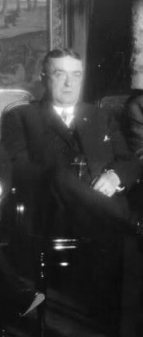
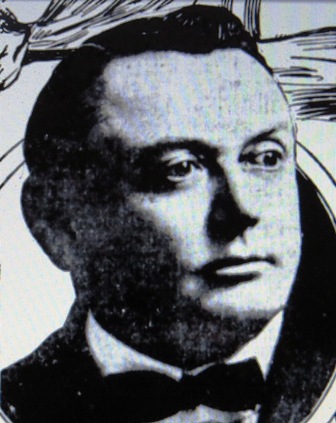
Horace Fogel

Horace Fogel

On September 7 Fogel wrote a letter to Lynch attacking the league’s umpires in general and Brennan specifically, and  according to The Philadelphia Inquirer “hinting that Lynch had some influence in their poor officiating.”

A week later an article, said to be authored by Fogel, appeared in The Chicago Evening Post that repeated the charges made in the letter to Lynch.  Fogel also sent Herrmann a telegram telling the Reds owner he felt the National League pennant race was “crooked.”

Brennan was the first umpire to respond.  He sent a letter to the National Baseball Commission on September 30 demanding an apology from Fogel for impugning “the impartiality of National League umpires.”

Fogel repeated his accusations again in letters sent the following week to the seven other National League team presidents, and promised to “make startling disclosures.”

On October 17 The Associated Press said his counterparts voted to “formally draw up charges against President Fogel of the Philadelphia club for his remarks reflecting on the integrity of National League umpires.”

Brennan told reporters that he would be filing a libel suit against the Phillies owner.
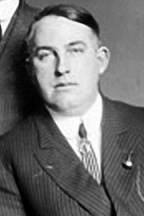
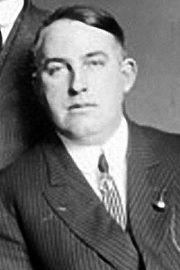
William "Bill" Brennan

William “Bill” Brennan

A hearing was scheduled for November 26.  President Lynch said:

“If the charges can be proved, then the umpires in question should be blacklisted and the president of the league should step down in disgrace.  If the charges are not true, some step should be taken to see that this man no longer represents a club in the National League.”

Fogel responded:

“I probably will begin an action for criminal libel against (Lynch) at an early date.  I have retained Hughey Jennings (the Tiger manager was also an attorney in Scranton, PA) as one of my lawyers, and I intend to have several of the best men in Philadelphia.”

As the members of the National League executive committee gathered at New York’s Waldorf Astoria Hotel to determine whether he should be expelled from the league, the Philadelphia magnate attempted and end run; he announced that he had relinquished day-to-day operations of the team VP Albert D. Wiler.  By doing so Fogel’s attorney (Jennings did not represent him at the hearing) claimed the league “had no right to try Fogel, as he was no longer an officer of the National League.”

The proceedings went forward with Fogel facing seven specific charges:

  1.  The accusation against Bresnahan

  2. An allegation that he told reporters on September 5 that the pennant race was fixed.

  3. The letter to Lynch attacking the umpires and hinting that Lynch was influencing their decisions.

  4. The article in The Chicago Evening Post repeating the charges made in the letter to Lynch.

  5. The telegram to Herrmann.

  6. The letters to the other seven club presidents.

  7. The allegations Fogel made both publicly and privately, about Brennan.

The Philadelphia Inquirer said:

“Fogel denied charges one and two and maintains that charge three was a privileged letter and not for publication.  While he did not actually deny writing the article that appeared in The Chicago Evening Post, he declared that the statement was not authorized and said it must have been misinterpreted.  He said he simply wanted to see reforms made and was not attacking anybody or anything in connection with baseball.  He denied outright the charges that he had said anything derogatory to umpire Brennan and claims privilege of the letters and telegrams.”

Besides Fogel,  three New York reporters testified that Fogel made the statements attributed to him in the press, while “Fogel had a flock of Philadelphia scribes who politely but forcibly insisted the New York men were romancing.”

After a six-hour hearing over two days the committee unanimously found Fogel guilty of five of the charges (the letter to Lynch and telegram to Herrmann were deemed privileged and those counts were dismissed).  The League ruled that Fogel was “forever excluded from participation,” in the National League.

The Inquirer said:

“Mr. Fogel had no sooner read the decision than he countered it with a defiant statement.  Before the meetings began he had expected such a decision, he declared.  ‘The jury was packed against us, ‘he asserted, and he practically told the magnates who had expelled him from their councils that he would pay no attention to their findings.”

Fogel did have his defenders, author, and Heart Newspaper correspondent,  Damon Runyon said:

“As we understand the matter, Horace Fogel has been found guilty of  conversation in the first degree.”
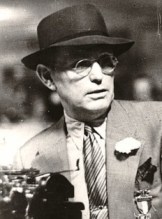
Damon Runyon, supported Fogel

Damon Runyon, supported Fogel

Fogel’s defiance and threats against Lynch, the league, and the magnates who had ousted him.  The Chicago Evening Post reported in February of 1913 that Fogel “has accepted an offer of $10,000 to write a series of articles in which he will later attempt to prove that baseball is a crooked game.”

Instead he launched a magazine, rumored to be funded by Charles Phelps Taft, brother of the President, who had bankrolled Fogel’s initial purchase of the Phillies. “Baseball Weekly” began publication in  March, 1913, and over the course of the next several months set out to discredit the game, focusing on two points, which had been and would continue to be the major criticisms of organized baseball.

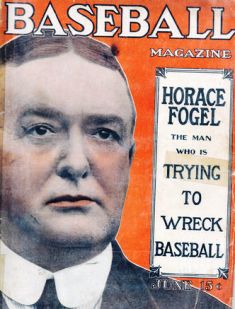
Fogel railed against the reserve clause, calling it “virtual baseball slavery,” and argued that organized baseball violated the Sherman Antitrust Act,  earning him the June 1913 cover of rival  “Baseball Magazine,” and the title, “The Man who is Trying to Wreck Baseball.”

Fogel would remain a baseball gadfly for the next decade.  Took ill in the early 20s and died in Philadelphia in 1928.
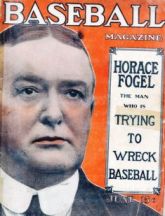
June 1913 edition of "Baseball Magazine"

June 1913 edition of “Baseball Magazine”

His interest in the team was purchased by a group led by William H. Locke, former secretary of the Pittsburgh Pirates.  When Locke died in October of 1913, his uncle, former New York Police Commissioner William Baker took control of the Phillies, leading the team until his death in 1930.

Brennan announced after Fogel was banned that he would drop his proposed $10,000 libel suit, telling The Associated Press:

“I am satisfied, I immediately demanded a hearing before the National League heads and Fogel’s trial was brought about as a result of my demands.”

Later this week; an allegation that Fogel was a patsy, and umpire Brennan’s other battle in the City of Brotherly Love.

“The Deterioration in the Morale of the Players”

10 Jun

The Chicago Tribune had had enough:

“The deterioration in the morale of the players has been followed by deterioration in that of the spectators.  The latter relish the obscene profanity and the slugging exploits of the hulking brutes of the baseball field.”

The Tribune provided an “account of the more disgraceful of the many rows witnessed by spectators of baseball games,” during the just-ended 1899 season:

“May 2—Row at Pittsburgh—St. Louis game.  (Frank) Bowerman was put out of the game.  (Jack) O’Connor was taken off the field by the police, and the crowd chased umpires (Tom) Burns and (William) Smith.

May 19—Umpire Burns put (Giants’ William “Kid”) Gleason out of the game at St. Louis.  Gleason’s protest was so strong Burns forfeited the game to St. Louis.

June 1—Row on the grounds at Washington.

June 16—After a long wrangle and continued rowing on the field at New York.  Umpire Burns forfeited the game to Brooklyn.

June 16—(Fred) Clarke and (Clarence “Cupid”) Childs fight on the field in Louisville.

June 27—Rowdy action of players caused the crowd at the Pittsburgh game to mob umpire (James “Chippy”) McGarr.

July 18—(Tommy) Corcoran slugged (John) McGraw at Baltimore after being first attacked, and his action started a riot.

July 26—(Emerson “Pink”) Hawley, (Fred) Tenney, and (Hugh) Duffy engaged in a game of fisticuffs at Cincinnati.

Aug 16—(Oliver “Patsy”) Tebeau, McGraw and (George “Candy”) LaChance fought at Baltimore

Aug 18—Riot at Baltimore game started by (Tim) Donahue throwing a handful of dirt at (Steve) Brodie’s face.

Sept 1—Childs and Aleck Smith fight on the field in Louisville.

Sept 7—Riots at St. Louis and Brooklyn.

Sept 15—Clarke taken off Philadelphia grounds by police.

Sept 16—Chicago players jerked (Ed) Swartwood around the diamond because he called the game in the eighth inning on account of darkness.

Oct 9—(George “Win”) Mercer assaulted (Al) Mannassau at Washington.

Oct 14—(Jimmy) Scheckard assaulted umpire (John) Hunt, refused to retire, and Hunt forfeited the game to Brooklyn.”

Cupid Childs, repeat offender

Cupid Childs, repeat offender

Al Mannassau, assaulted by Win Mercer in Washington

Al Mannassau, assaulted by Win Mercer in Washington

In addition to the fans, The Tribune blamed team owners:

 “For the multifarious minor acts of blackguardism and rowdyism of which the hired men of the club owners were guilty there is no room.  It is sufficient to say that they, like the graver offenses mentioned above, did not wound the feelings or jar on the nerves of the proprietors of these baseball roughs.  Those proprietors seem to have come to the conclusion that audiences like these ruffianly interludes.”

Like hundreds of predictions before and thousands more to come over the years, The Tribune saw dire consequences for baseball given the current state of the game:

“There was a time when Chicagoans went to see the games of the Chicago club because they had a feeling of proprietorship in that organization.  That day is over.  Men do not go to see games out of local pride, nor do they go to see fine playing.  They go to listen to the language of the slums and to witness the horseplay and brutalities of the players or performers.  When these have lost their attractions professional baseball will disappear. “

Lost Advertisements—Old Underoof Whiskey, 1910 Chicago Cubs

17 May

oldunderoof1910cubsgiants

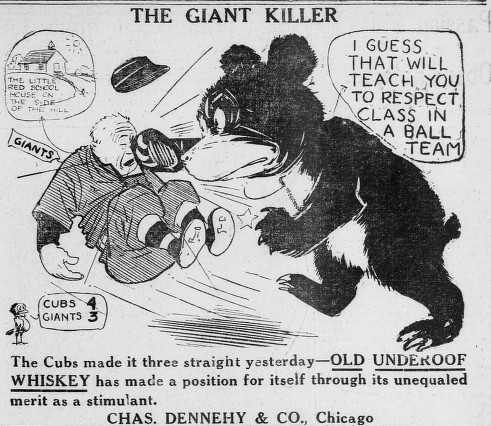
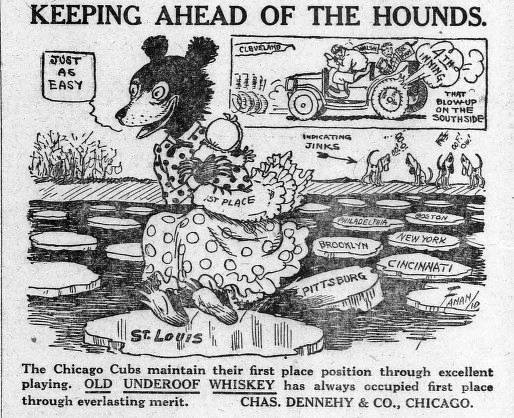
Two 1910 advertisements for Old Underoof Whiskey which appeared in The Chicago Daily News.

The ad above appeared in the paper on May 12.  The Cubs had just won their third straight game from the New York Giants, beating Rube Marquard,  4-3, to improve their record to 11-8.

 Hugh Fullerton wrote in The Chicago Examiner, that the Cubs, “chewed $10,999.98 of beauty out of the wry-necked, knock-kneed, cross-eyed and left-handed $11,000 beauty Marquard.”  The Giants pitcher had earned the nickname in 1908 when New York paid that amount to the Indianapolis Indians for the 21-year-old pitcher.  Through 1910, Marquard was a struggling pitcher with a 9-18 record who had all of baseball questioning the Giants purchase.  The next three seasons Marquard would win 24, 26 and 23 games, helping to lead the Giants to three straight National League Championships.

The one below is from June 27.  The Cubs had beaten the St. Louis Cardinals the previous day 3-2; scoring the winning run in the bottom of the sixth on a double steal, pulled off by catcher Johnny Kling and centerfielder “Circus” Solly Hofman.  It was the team’s twelfth victory in the last fifteen games and gave the Cubs a 4 1/2 game lead over the second place New York Giants.

The Cubs would run away with the pennant, 13 games ahead of New York.

oldunderoof19101stplacecubs

A Thousand Words–Satch and Diz

15 Mar

???????????????????????????????

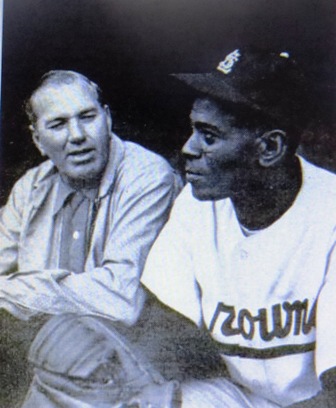
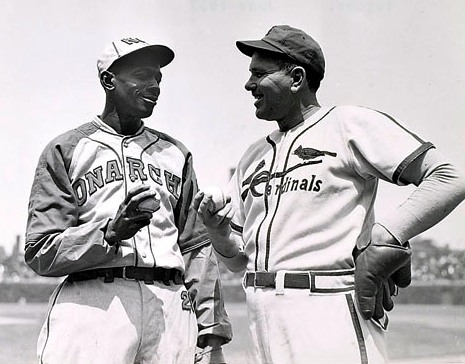
Ted Williams called for the recognition of Negro League players in his 1966 Hall of Fame induction speech:

“The other day Willie Mays hit his five hundred and twenty second home run. He has gone past me, and he’s pushing, and I say to him, “Go get ’em, Willie.” Baseball gives every American boy a chance to excel. Not just to be as good as someone else, but to be better  This is the nature of man and the name of the game. I hope that one day Satchel Paige and Josh Gibson will be voted into the Hall of Fame as symbols of the great Negro players who are not here only because they weren’t given the chance.”

After Williams’ speech, Jay Hanna “Dizzy” Dean became one of Paige’s most vocal supporters.In 1968 Dean said:

“I think that he was one of the most outstanding pitchers I ever saw throw a ball and too bad he couldn’t have broken in in his prime when he could really fire that ball.”

Dean encouraged fans to write letters to members of the Baseball Writers Association of America to tell then “The venerable Leroy Robert Paige has proved he belongs in Cooperstown.”

Dean said he had “played more baseball against Satchel Paige,” than any other Major League player:

“I certainly think that if anybody belongs in the Hall of Fame, Satchel Paige deserves it as much as anyone else.  I think he was one of the outstanding pitchers of all times, and a guy who has given his life to baseball.”

Paige was the first player inducted to the Hall of Fame by The Special Committee on the Negro Leagues in 1971.

satchndiz

McCloskey, Mays and Hair Color

12 Mar

Carl Mays is best known for being the pitcher who hit Cleveland Indians shortstop Ray Chapman with a pitch, resulting in the only hit by pitch death of a Major League player. In fifteen seasons he posted a 208-126 record with a 2.92 ERA.

Five years before he became infamous for Chapman’s death, Mays became embroiled in a strange feud with former National League manager John James McCloskey; the dispute was over hair color.

Carl Mays

Carl Mays

In December of 1914, McCloskey was a well-respected figure in baseball, credited with being the “father” of the original Texas League in 1888, he had spent five seasons as manager of the Louisville Colonels and St. Louis Cardinals in the National League, and another 23 as a minor league manager and owner.

Mays was coming off a 24-8 season for the Providence Grays in the international League, and while called up to the Red Sox in the closing weeks of the season had not yet appeared in a big league game.

The controversy originated when Charles “Toby” Fullerton, a pitcher for the Seattle Giants in the Northwestern League was quoted in an article that appeared in The Pittsburgh Press and several other papers about pitcher “Seattle Bill” James, who had just led the Boston Braves to a World Championship. Fullerton said when he and James were teammates in Seattle in 1912, manager Shad Barry had, “condemned the youngster for being a blond,” he then was quoted saying McCloskey also, “has no use in the world for blonde ball players.”

“Seattle Bill” James

The strange, silly, throwaway quote should have been the end of it, but it was apparently serious enough for McCloskey to issue a long denial from his home in Louisville, Kentucky. The full-page letter McCloskey wrote appeared in more newspapers than the original story, and read in part:

“Let me say, I have been accused of every crime in the calendar, but this is too much.”

McCloskey claimed the “rumor” originated when he was managing the Milwaukee Brewers in the American Association in 1910. Outfielder Rube DeGroff played for McCloskey (incidentally, Shad Barry was also a member of the team), and according to McCloskey:

“We were playing in Kansas City, we were behind…and made a big rally that came near giving us the game. The bases were full in the last inning, with two men out, when the big, blonde and good-natured Rube DeGroff, who was a splendid all-around player and life of the club, came to bat with the bases full and struck out. I was sore over losing the game and made the remark that I never saw a cotton-top who ever made good in a pinch.”

McCloskey said he also believed anything Barry might have said to or about James was certainly a joke, and closed with a final defense:

“In fact, in my humble opinion, I think the blonde has a shade over the brunette. But why the color of a man’s hair should have anything to do with his ability as a ball player is a mystery to me, and I hope this explanation will put an end to these silly rumors.”

It didn’t.

Within days Carl Mays weighed in, claiming that he had twice been rejected for an opportunity to pitch for McCloskey’s Ogden Canners in the Union Association because he was blond.

Mays said:

“McCloskey is a liar pure and simple…In 1912, when I was on my way to Boise to try out for the Boise team; I stopped off at Ogden, thinking possibly owner McCloskey might give me a trial. I met him downtown in a billiard parlor and went up and introduced myself.

“McCloskey looked me over carefully, like a horse-trader examining a piece of horseflesh, and then suddenly espied my blond hair. ‘No,’ said he coolly, ‘I don’t want you. In fact I wouldn’t have you around the ranch. I don’t want any blonds in my camp.’”

Mays also claimed that later in 1912 while compiling a 22-9 record for the Boise Irrigators in the Western Tri-State League; he was nearly sold to McCloskey’s pitching-strapped Ogden Canners until:

“One of the Ogden players happened to mention the fact that he was the same blond-haired fellow who had asked for a job earlier.”

According to Mays, McCloskey said:

“’Deal is off. Send that white-haired guy over here and I’ll kill him.’”

The story stuck with McCloskey for more than 20 years. A 1916 story in The Providence Tribune said:

“Scouts all over the country know McCloskey and never did one in his employ recommend a light-haired ballplayer…His peculiarity was well-known, and he knew that no one would have the temerity to recommend to him a blond or light-haired ballplayer. “

The black-haired John McCloskey

The black-haired John McCloskey

In 1934, The Milwaukee Journal called McCloskey, “one grizzled veteran who frowned on blond athletes.”

The article quoted E. Lee Keyser, a long-time minor league executive, who said when McCloskey managed Butte, “One of (McCloskey’s) players was an Indian outfielder whose hair was black,” the player struck out in a critical situation. According to Keyser, when the unnamed player returned to the clubhouse later, McCloskey grabbed his hair and said: “I just want to know if you’re wearing a wig. You hit like a blond.”

McCloskey managed in the minor leagues until he was 70-years-old, he died eight years later in 1940.