Tag Archives: Washington Senators

Clark Griffith, “How I Win”

14 Mar

In 1910, Cincinnati Reds Manager Clark Griffith spoke to journalist Joseph B. Bowles for one of  a series of syndicated articles in which baseball’s biggest stars described “How I Win.”

“If a fellow is going to cut any ice he needs ice picks and the first way for a manager to win is to get men who can deliver, and men intelligent enough to take care of themselves.

“My theories in regard to what constitutes a winner are the only ones, and I use them in instructing my players what to do.  I used them in pitching, and they worked out, and I believe any player will succeed if he follows them.”

Clark Griffith
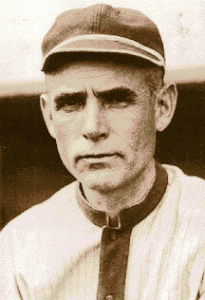
Clark Griffith

Griffith said baseball was “Ninety-nine and fifteen sixteenths” courage and nerve:

“It is more than that—it is what ballplayers call ‘guts’—which is courage with aggressive confidence behind it…The first thing to do to win baseball games is to go after anyone who does not wear a uniform that looks like yours, and go after him hard.  Hand every opposing player anything that will make him weaken or show the yellow.  Anytime I can convince my men that they are going to win and the other fellows that they are going to lose, I’ll win a pennant.”

He believed his confidence could successfully intimidate opponents:

“The best system of winning games is to tell the other fellow that you are going to beat him.  Tell it to him before the game starts and tell him in a way that will convince him.  You cannot convince him unless you believe it yourself.  I keep telling them all the time, and I believe it myself until the game is over and sometimes even then.”

Griffith said what he wanted most was for his players to:

“Take chances; any chance to gain an inch of ground or a base…Go after the game with intelligence and force every point as hard as possible…The player who takes chances of hurting himself seldom hurts either himself or his opponent and he will make a weak opponent run away.  More players get hurt stopping up on their feet and giving up before they are touched than are damaged in sliding to bases.”

He said that aggressiveness should also be directed at umpires:

“Then claim every point and claim it quick.  Holler.  ‘No, no’ real quick and beat the umpire to it on every close play a la (Johnny) Evers.  The umpire may be perfectly honest and square but on a close play the fellow who yells quickest is much more likely to get the decision.  I do not believe in fighting umpires or nagging at them.  I believe in yelling quickly.  Yelling quickly beats yelling loud all to pieces.  It is not cheating a bit, but simply protecting yourself on close plays not so much to get the decision yourself as to keep the other fellow from getting it.”

Griffith led the Chicago White Sox to the inaugural American League pennant during his first season as a manager in 1901.  And despite not winning one since, was very confident about his “theories” for success:

“These things, taken together with a little good pitching and perhaps one star pitcher, will win any pennant if carried out correctly and persistently, regardless almost of the mechanical ability of the players on the team.”

In the end, Griffith was unable “to win any pennant.”

His Reds teams in 1910 and 1911 were both sub .500 clubs and finished in fifth and sixth place.  He joined the Washington Senators in 1912, and finally with “one star pitcher’ he managed the team to two-second place finishes (1912-13), but did not win a pennant there either.  He stepped down as manager after the 1920 season to devote himself full time to his ownership duties.
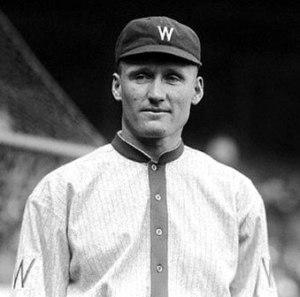
One Star Pitcher

One Star Pitcher

He ended his managerial career with a 1491-1367 record over 20 seasons.
Lost Advertisements–Anheuser-Busch, Washington Senators

5 Feb


ab1910sox

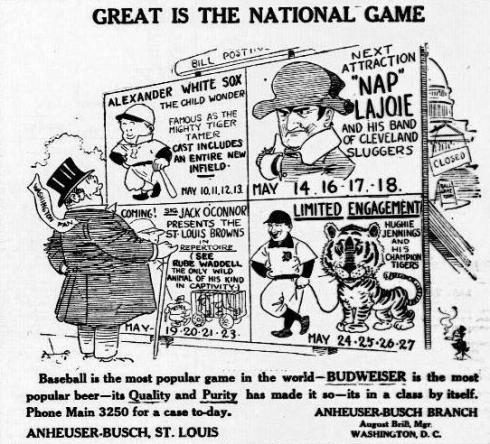
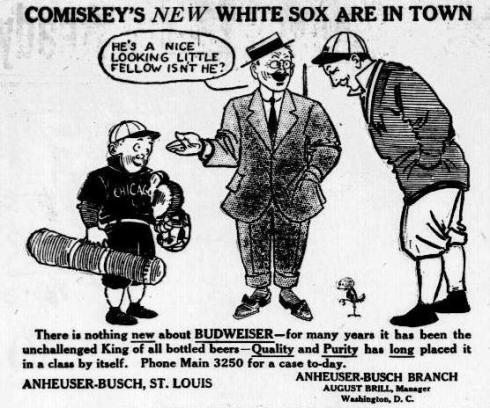
In 1910, a series of Anheuser-Busch ads  appeared in several Washington D.C. papers. The ad above appeared when the Chicago White Sox faced the Senators in early May:

Comiskey’s New White Sox are in Town

The headline referred to Charles Comiskey‘s shakeup of his team, which included the appointment of Hugh Duffy as manager, and a new starting infield; first baseman Chick Gandil, second baseman Rollie Zeider, and shortstop Lena Blackburne, and Billy Purtell at third.

An advertisement later that week featured caricatures of Napoleon Lajoie and Hughie Jennings, and described Rube Waddell as “The only wild animal of his kind in captivity:”

ab1910nap

The ads were similar in style and content to those for Old Underoof Whiskey that appeared in Chicago papers during the same period–all advertised upcoming games, commented on the behavior of fans and players, and chronicled the year’s pennant races–with one exception.

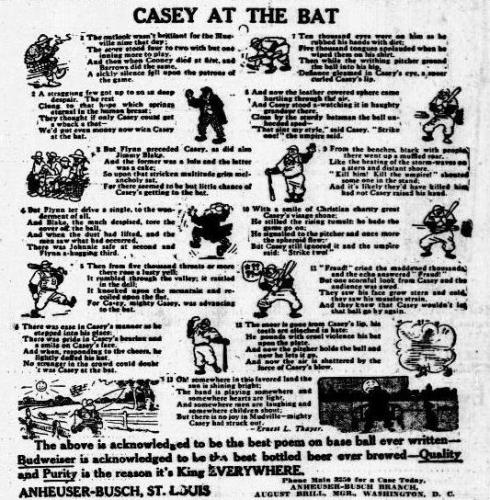
A July ad featured the full text, with illustrations, of Ernest Thayer’s “Casey at the Bat:”

ab1910casey

They only appeared for one season.


“Frysinger Hated in the Paper City”

28 Dec

It took less than two weeks for Jesse “Jess” M. Frysinger to go from being the most popular man in Holyoke, Massachusetts to becoming not just the most unpopular man in town, but a man reviled by the entire Connecticut State League.

His arrival in Holyoke in the winter of 1904 to take over the reins of the Holyoke Paperweights was met with great fanfare.

Frysinger

Frysinger

Born in 1873 in Chester, Pennsylvania, the son of a newspaper publisher, Frysinger was a well-known ballplayer around his hometown until his mid-20s when he became a manager.  He managed a local club in Chester from 1899 to 1901.  The 1901 team was a member of the Pennsylvania State League, and the following season Frysinger moved the team and most of the players to Wilmington, Delaware to join the “outlaw” Tri-State League.

When in 1903 Frysinger took over as manager of an independent team in Harrisburg, Pennsylvania, which would eventually join the Tri-State, he signed a young shortstop he knew in Chester named Joe Cassidy.  No statistics survive for the 1903 Harrisburg club, but Cassidy played well enough to be signed by the Washington Senators at the close of the season.  The 23-year-old was a promising prospect and rare bright spot with the horrible 1904 and ’05 Senator teams but passed away from either typhoid or malaria (depending on the report) in 1906 before he could realize his potential.

Cassidy

Cassidy

Frysinger managed the Tri-State League Wilmington Peaches in 1904, then left to manage Holyoke, making the bold prediction that he would bring a winning team to the paper producing capital of the world.  Frysinger brought with him several players from Pennsylvania who would make up the core of his ballclub, including Snake Deal, Chick Hartley and Butch Rementer.

The Paperweights quickly became the powerhouse of the Connecticut State League, in one stretch, beginning in late June the team won 20 of 23 games, and easily won the league championship.

Frysinger was given a $300 bonus on top of his $1200 salary and on September 12 signed a contract to manage the Paperweights in 1906 at a salary of $1400.  He was the town hero and was presented a diamond watch fob by the team’s directors.

Things changed quickly.

On September 29, while Frysinger and the Holyoke team were playing a series of exhibition games against local teams in Pennsylvania, he informed the Holyoke management that he had accepted an offer to manage the Lancaster Red Roses in the Tri-State League for $1800.  Holyoke refused to let Frysinger out of his contract so he simply jumped.  At the same time, Frysinger did exactly what he did when arriving in Holyoke; he took many Holyoke and Connecticut State League players with him.  In addition to Deal, Hartley and Rementer, Frysinger signed Fred Crolius, Pop Foster and Dave Altizer away from the league.

Holyoke was in an uproar.

“Frysinger Hated in the Paper City,” said the headline in The (New London, CT) Day, the story called Frysinger a”

“Traitor to Holyoke ideals and baseball ethics.”

The Bridgeport Herald said Frysinger “Is determined to take away from Holyoke all its best.”

No one in Holyoke or anywhere in the Connecticut State League seemed to care about the contract status of the players when they arrived with Frysinger, but their departure became the main focus of the league meeting in January of 1906.

There were demands to have Frysinger blacklisted, but the manager, recovering from appendicitis in Wilmington, Delaware told The Meriden Daily Journal “I brought them to Holyoke…why shouldn’t I try to bring them to Lancaster as well?”

Frysinger’s status would never be resolved.  The 33-year-old manager developed an infection from the surgery and died on February 5, 1906. The Philadelphia Inquirer said most of the Lancaster club and Philadelphia Athletics Manager Connie Mack were present at the funeral in Wilmington.

The Lancaster New Era reported that there was some concern in the city about whether the players signed by Frysinger would play for the team:

“(Q)uite a number of players affixed their signatures to local contacts for the only reason that they were to play under Frysinger, who had the reputation for being one of the squarest managers in the business….The deceased wife (Madge), who acted as the manager’s stenographer through his final illness is thoroughly conversant with the affairs concerning the local baseball situation, and she promises to retain the players already signed.”

She was true to her word; all of the players who were mentioned to have committed to Frysinger were members of the 1906 team which finished in third place in the Tri-State League

“Hard Luck” Harry Welchonce

23 Nov

In January of 1913, as Harry Monroe Welchonce was preparing for his fourth attempt to stick with a major league club, The Washington Herald said:

“Welchonce is one of the most unfortunate young men that ever tried to get a steady job in the majors.”

He did not make his professional debut until he was 25-years-old.  He worked as a telegraph operator for the Bessemer and Lake Erie Railroad while playing amateur ball in Pennsylvania until 1909 when he signed to play with the Steubenville Stubs in the Ohio-Pennsylvania League.

Harry Welchonce

Harry Welchonce

A .321 hitter over seven minor league seasons, Welchonce was purchased by three major league teams—The Phillies, Dodgers, and Senators—and went to spring training at least five times with big league teams, but earned just one 26-game trial with Phillies in 1911. He hit just .212 and made two errors in 17 games.

After failing to make the Senators in 1912, he hit a Southern Association leading .333 for the Nashville Volunteers, earning himself another spring trial with Washington.  The Washington Times said of him:

“(Welchonce) is said to have the abilities of a major leaguer without the inside adornment. In other words, he is easily disheartened. This is said to have caused his failure with the Phillies three years ago.”

While under the headline “Welchonce is Hard Luck Guy,” The Herald attempted to explain his big league failures:

“Welchonce is one of the most unfortunate young men that ever tried to get a steady job in the majors. He has always batted for more than .300 in the minor leagues, and he has the natural speed and ability to make good in the majors.

“Welchonce is a telegraph operator, and his hard luck really dates from several summers ago.  He was seated at his key at Indiana, PA, one afternoon, when a thunderstorm came up. A bolt of lightning shattered a tree outside his office and he was a long time recovering from the shock…He joined the Phillies (in 1910), and his dashy work made a big hit in the training camp at Southern Pines (North Carolina)

“The team had been there only about a week when lightning struck the hotel and a ball of fire ran down into a room in which Johnny Bates, Welchonce, (Lou) Schettler, and (Jim) Moroney were sleeping. The players were all badly scared, and the shock was such that Welchonce did not get over it.”

A contemporary account of the incident in The Philadelphia Inquirer said all four players were badly shaken and that “Welchonce was the first to recover his speech.”  The Associated Press said all four players “were covered with plaster and debris from the ceiling,” and that Schettler “could not talk for two hours.”

Adding to Welchonce’s woes in 1910 was an injured shoulder, or as The Philadelphia North American put it: “(He) still plays with a wrenched shoulder and it affects the fleet youngster’s batting. He can only get a very ladylike swing at the sphere.”

The Phillies sent Welchonce to the South Bend Bronchos in the Central League.  He hit .315, leading South Bend to the pennant.

The Times picked up the story:

“(In 1911) he took the training trip to Birmingham, Alabama (with the Phillies).Again it looked as if Harry would give (John) Titus a hard battle for right field honors.  Then came more hard luck. One of Earl Moore’s cross-fire slants struck Welchonce in the head, and Harry went to a hospital in Birmingham for several days. “

The contemporary account in The Inquirer said that he did not lose consciousness, but “was sick to his stomach,” and quoted a doctor saying he suffered from “nervous shock.”  When he was released from the hospital three days later, the paper said, “He looks weak and colorless.”

He failed to make the Senators again in 1913 and was released to the Atlanta Crackers in the Southern Association again and led the league with a .338.

Welchonce returned to Atlanta in 1914, and so did his “hard luck.”

He was hospitalized at the end of the April with pneumonia and was out for much of May.  By late June, The Atlanta Constitution said he was “Back in Stride,” and he was again hitting above .300.  But his season came to end in August when he was diagnosed with Tuberculosis.  The Atlanta Journal said he “Went to Ashville, North Carolina for the mountain air,” and treatment.

Atlanta held a benefit game and various other fundraisers and presented Welchonce with a check for $883.10.

Welchonce recovered, but not enough to rejoin the Crackers the following season.  He returned to his job with the Bessemer and Lake Erie Railroad and managed the company’s baseball team.

He returned to pro ball in 1915, accepting an offer from the  to be player-manager of the Texas League club.

welchoncedallas

Welchonce, 1915

He played fairly well, hitting .297, but the Giants were a last place club and Welchonce became ill again in August and retired from professional baseball.

He again returned to the railroad and management of the company baseball team until 1920, when poor health necessitated a move to the West.  He settled first in Denver where he was employed as an accountant, and later Arcadia, California where “Hard Luck” Harry lived to age 93.  He died in 1977.

Lost Advertisements–Walter Johnson Car Ads

9 Nov

johnsoncolecar

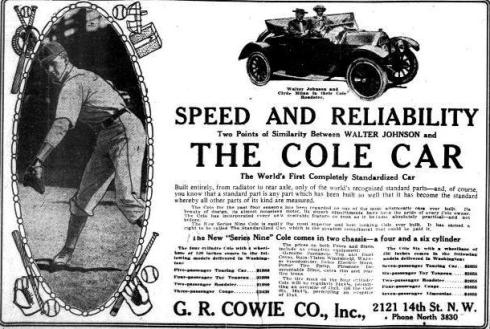
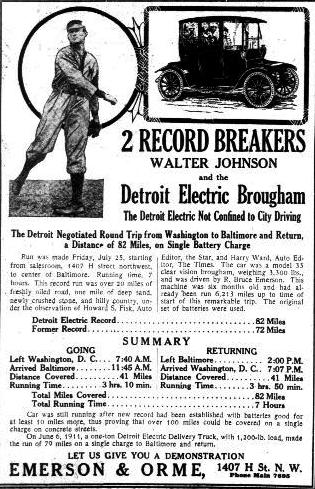
Two 1913 advertisements for automobiles featuring Walter Johnson.

Above, an ad for a Washington D.C. Cole dealership–the picture at the top is of Johnson and outfielder Clyde Milan “In their Cole Roadster”:

Speed and Reliability

Two points of similarity between Walter Johnson and 

The Cole Car

The world’s first completely standardized car

The second ad, below, is for the local Detroit Electric dealership:

2 Record Breakers

Walter Johnson 

and the

Detroit Electric Brougham

johnsondetroitelectric

Johnson remained on the mound longer than Cole stayed in business; the car maker closed in 1925.  Detroit Electric continued building cars until 1939 and the company was revived in 2008.

“There’s one thing you mustn’t do when you get to New York”

26 Oct

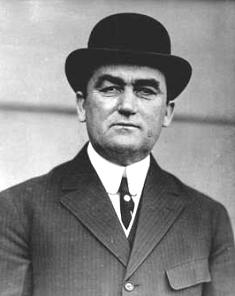
“Sinister Dick” Kinsella is primarily known as John McGraw’s equally pugnacious right-hand man and scout.  He was at McGraw’s side for one of the manager’s most famous brawls; a battle with Giants catcher Larry McLean in the lobby of the Buckingham Hotel in St. Louis, he also boasted an impressive list of “finds” including Carl Hubbell, Chief Meyers, Hack Wilson and Larry Doyle.

"Sinister Dick" Kinsella

              “Sinister Dick” Kinsella

Kinsella credited a career minor league player and manager for his discovery of Doyle, who he sold to the New York Giants in July of 1907.  After Doyle hit .310 in 1911, a syndicated Newspaper Enterprise Association told the story of how he acquired Doyle after the 1906 season from the Mattoon Canaries of the Kitty League, having never seen him play:

“Mattoon was in need of a pitcher and appealed to President Dick Kinsella of the Springfield Three-Eye League team for aid…Kinsella saw a chance to make a bargain when Mattoon hoisted the distress sign and struck one.  ‘I’ll let you have a pitcher for the pick of your team at the end of the season,’ Kinsella told the Mattoon people.  His offer was accepted and pitcher (John) Jokerst was sent  to the Kitty League team by Springfield.

“Doyle didn’t do well with Mattoon (.225 in 91 games) that season.  Kinsella had not even considered him in deciding what player to pick.  He had almost made up his mind to take a veteran pitcher.”

Fate intervened when Kinsella mentioned the Mattoon deal to Frank Belt, manager of the Kitty League’s Jacksonville Jacks.  Belt asked Kinsella if he had ever seen Doyle:

“’No,’ answered Kinsella.

‘”Well, don’t pick anyone until you do, and then pick him.  He’s the coming ballplayer of that club.  He hasn’t looked good in the box scores, but he’s ‘there’ any way you take him.  He’ll bring you more money inside of a year than you ever got for a player.”

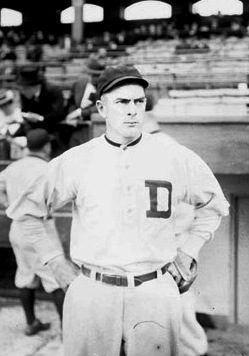
Larry Doyle

                  Larry Doyle

Sight unseen, Kinsella took Belt’s advice.  Doyle played third base and hit .290 in 66 games for Kinsella’s Springfield Senators.  He became the subject of a bidding war with the Giants winning out over the Detroit Tigers and Washington Senators for his services on July 16.

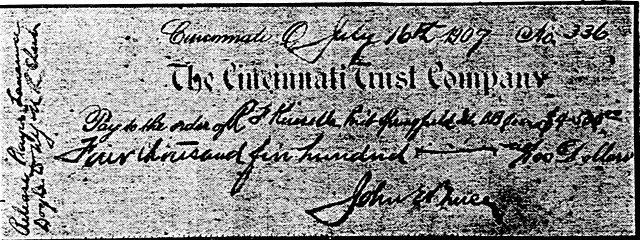
Kinsella was paid a then-record $4500 for Doyle—a record eclipsed the following year when Kinsella sold Rube Marquard to the Giants for $11,000.

The $4500 check to Kinsella for the sale of Doyle

                              The $4500 check to Kinsella for the sale of Doyle

According to The Springfield Journal Kinsella sent Doyle off to New York with just one piece of advice:

“There’s one thing you mustn’t do when you get to New York.  You must quit sliding to bases on your head.  If you don’t, they will think you’re from the brush.”

Doyle was moved to second base, hit .290 over a 14-year big league career, and presumably took Kinsella’s advice about sliding head first.

“Daily Chats with Famous Ballplayers”

18 Sep

In 1916, a series of two to three paragraph items called “Daily Chats with Famous Ballplayers” (some papers called the feature different names) appeared in several smaller West Coast and Midwest newspapers.

Some highlights:

Oscar “Ossie” Vitt, third baseman for the Detroit Tigers, who survived a beaning from Walter Johnson of the Washington Senators on August 10, 1915:

“The world stopped moving when the ball nicked my bean.  Johnson thought I was killed and I guess I thought so myself for awhile, so far as I was able to think at all.

Ossie Vitt

Ossie Vitt

“My head proved to be the goods alright and wasn’t worse for wear.  But it upset Johnson so much that he couldn’t locate the plate and we pounded him all over the lot (Vitt was hit leading off the first inning—Johnson gave up eight runs after that in six innings and lost 8 to 2 to Detroit).”

St. Louis Cardinals pitcher Henry “Hi” Jasper on the superstition of teammate Harry “Slim” Sallee:

“Sal’s pet superstition is that it’s bad luck for him to warm up with any catcher but the one who is to work in the game with him.

“If the playing backstop has batted last and has to put on his shin guards and armour before warming up, Sal will never throw a ball to the plate to any man who may come out of the dugout with a mitt.  He will throw either to the first or third baseman.”

Pittsburgh Pirates pitcher Al Mamaux on a lesson learned during a loss to the Chicago Cubs in September of 1914:

“Smart old timers can always make it tough for youngsters just breaking in.  I remember one day when I was the goat for a trick pulled by Roger Bresnahan.”

Mamaux

Al Mamaux

Mamaux said Chicago had two runners on base and Bresnahan was coaching third.

“(He was) talking real friendly like to me (then) hailed me suddenly as the ball was returned to me.  ‘Say Al, toss me that ball I want to look at it,’ said Roger.  I didn’t give it a second thought…tossed it towards him and I’ll be darned if he didn’t step to one side and yell to the runners to beat it home.  Each advanced a base and would have scored if Jimmy Viox hadn’t run his head off to recover the ball.  Believe me that one cured me.”

George Stallings, on suspensions and how badly the Boston Braves needed George Stallings:

“You don’t have to call an umpire all the names in the calendar to draw a suspension.  I got three days off for just remarking to (Charles “Cy”) Rigler that he ought to go to jail for umpiring a game like he did the other day.

George Stallings

George Stallings

“Nothing that I could say or do would make any difference.  What I can say though right now is that the action of (National League) President (John) Tener, coming as it does, with the race so close, appears peculiar to say the least (Tener said the suspension was for a series of altercations that Stallings and his players had with umpires during the two months before the August suspension was announced).

“Without any braggadocio I can say that my suspension will cripple my club considerably.  I know what my presence means to the club and so does President Tener.”

Boston won all three games during Stallings’ suspension and regained second place, but finished the season in third, five and half games behind the Brooklyn Robins.

Lost Advertisements–Danny Moeller Star of the Diamond

19 Aug

danny

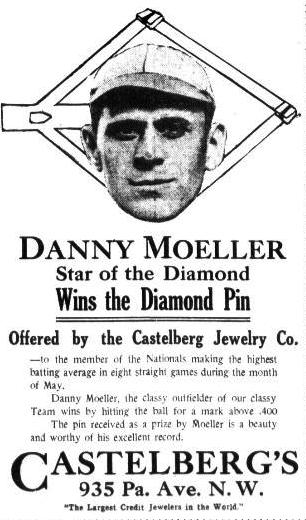
A 1912 advertisement for Castelberg’s Jewelry Company in Washington D.C., featuring Senators right fielder Danny Moeller:

Danny Moeller

Star of the Diamond

Wins the Diamond Pin

On May 1, the jewelry store announced a contest in The Washington Times:

“Beginning today the sluggers begin their battle for the handsome ruby-diamond stick pin offered by the Castelberg Jewelry Company to the batsman of the local outfit who leads with the willow for the month of May…to win the prize a player must participate in at least eight games.”

Throughout the month, the paper kept readers informed with updates of the standings.

Moeller and third baseman Eddie Foster led most of the way.  Moeller, who hit .276 for the season, his .414 during May to win the contest.  Foster was second at .380–he hit .285 for the year.  Clyde Milan (.320), Clarence “Tillie” Walker (.300), and Eddie Ainsmith (.282) followed.

“Danny Moeller, the classy outfielder of our classy team wins by batting the ball for a mark above .400

“The pin received as a prize by Moeller is a beauty and worthy of his excellent work.”

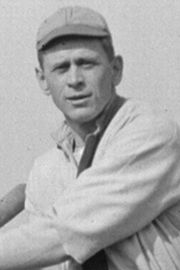
Moeller’s best season was in 1912.  He hit just .243 over seven big league seasons but was a fan favorite for his toughness.

Moeller

Moeller

The Times gave readers an example of his toughness during a game with the Philadelphia Athletics two years later in May of 1914:

“In sliding into second base in the fourth Moeller dislocated his left shoulder and it looked as though he might be out for some time.

“The player walked to the bench with the fin hanging limp and asked (trainer) Mike Martin to help him out.  Martin took one yank, the affected member popped back to its proper place, and Moeller sprinted back onto the field and onto second base.  It was an evidence of the gameness of which those who know Moeller realize.”

“Demmitt!!”

20 Jul

Arthur “Bugs” Baer was a humorist and sportswriter—widely credited with coining the nickname “Sultan of Swat” for Babe Ruth—who often included his own cartoons with his articles.

Baer worked for The Philadelphia Public Ledger, The Washington Times, and William Randolph Heart’s King Features Syndicate, before moving to Hollywood where he wrote several film scripts, including the titles for “Headin’ Home,” the first movie Babe Ruth appeared in.

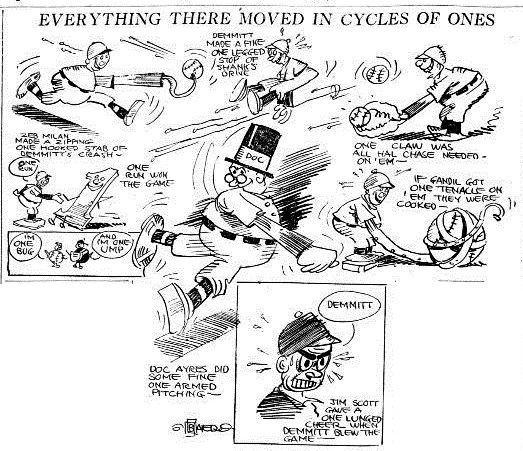
An example of Baer’s newspaper work; after a May 1914, 1-0 Washington Senators victory over the Chicago White Sox in 10 innings–Sox pitcher Jim Scott took a no-hitter into the 10th before allowing a single to Chick Gandil:

“Demmitt!!

“That’s the word.

“Oh! No!  We don’t mean what you mean.  (Ray) Demmitt is the right fielder on the Chicago White Sox, although we admit that it sounds as if he wasn’t.  He is the lad who made a brilliant one-legged stop of (Howie) Shanks’ drive in the tenth yesterday, allowing the ball to bruise our perfectly good right field wall and Jim Scott’s heart at the same time.  He came racing to snag the ball just like one of these pictures you see in the “Police Gazette.”  Just like a regular ball player, same as they have in big cities.  You’ve heard about those kind.

Demmitt!!

Demmitt!!

[…]

“The old pill went through him just like the Congressional Limited goes through Elkton, Maryland.  And Chick Gandil flat wheeled around the bases same as the Fourteenth Street car does around Thomas Circle…What we wanted to ask is did you notice how everything moved in cycles of one?

“One run won the game.  Demmitt’s one-legged stop allowed that one run to score and win one ballgame.  (Clyde) Zeb Milan (who made a bare handed stab of Demmitt’s sixth-inning single, and caught threw him out attempting to stretch it to a double) one-hooked stab saved the bacon, and Gandil’s one tentacled clutches chopped off many an error.

Hal Chase’s one-clawed catches of wide throws kept the Sox in the running and (Yancey) Doc Ayers’ great one-armed pitching put them out of it.  In fact, everybody acted as if they only had one arm.

Tommy Connolly did some fine one-cylindered umpiring.

“And Jim Scott gave a one-lunged cheer when Demmitt—there goes that word again—blew the game.”

Baer's cartoon that accompanied the article

The Baer cartoon that accompanied the article

“Honest John” Anderson’s Swing

29 Jun

While the New York Highlanders were training in Birmingham, Alabama before the 1905 season, outfielder “Honest John” Anderson told a reporter from The New York Herald-Tribune that he had developed a secret weapon:

“He claims to have discovered a way to swat the ball that will fool the fielders just as effectively as (Jack) Chesbro deceives the batters with his spitball.”

Anderson, a 10-year veteran, with a .297 career batting average entering 1905, even had a name for his swing:

“The ‘Tangent’ he calls it. Anderson declares he has developed a method of putting an ‘english’ on the ball when he hits it that will cause it to deflect from  its true course in a similar manner to a billiard ball…Just how he twists the bat to accomplish this Anderson refuses to divulge.”

Honest John Anderson

Honest John Anderson

The paper told readers that Anderson was working hard on his “new stunt,” and would “have it down to a fine art,” by the time the club broke camp:

“The advantages of the trick, if he gains control of it, are manifest.  It will turn many a fly or certain out into a safe hit.”

Anderson clearly had not made “a fine art” of the “Tangent” by the beginning of the season.  He hit just .232 in 32 games before being claimed on waivers by the Washington Senators.  He played through 1908; his career average dropped six points after he made his discovery.