Archive | December, 2013

“Baseballists of Note”

16 Dec

After rain prevented a June 1899 game between the Reading Coal Heavers and Wilkes-Barre Coal Barons of the Atlantic League, The Reading Times said “the handful of rooters that gathered,” had a good time in spite of the weather:

Baseballists of Note

The Wilkes-Barre boys are a jolly lot and, while the rain was falling (performed) a vocal concert by a quartet composed of (Billy) Goeckel, (Bill) Clymer, (Cy) Vorhees, and (Reading’s) Eddie Murphy.  The boys sand ragtime melodies, sentimental songs and selections from various operas in splendid shape.  Murphy, it was learned, is one of the sweetest tenors this old town has met for a long time.  Goeckel has an excellent bass voice, while Clymer sings a clear baritone.  Vorhees’ voice is a cross between a falsetto and a soprano, but at any rate he can make himself heard.”

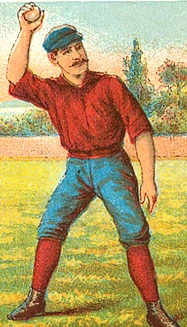
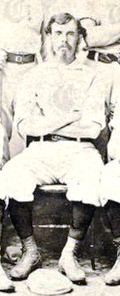
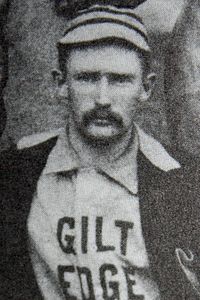
Baritone Bill Clymer

Baritone Bill Clymer

And there was more:

“Wilkes-Barre’s mascot pup, ‘George,’ also contributed to the amusement of the crowd by chasing balls thrown in the diamond.  Captain Goeckel claims ‘George’ can beat Clymer to a standstill hunting up grounders at short.”

George’s performance managed to improve his image in Reading;  a month earlier after Wilkes-Barre had defeated the Coal Heavers 5 to 4 with a run in the in the ninth, The Times quoted a fan who was convinced the mascot was to blame:

 “Hang these dog mascots; they’re always Reading’s hoodoo.”

Despite the “hoodoo” George was alleged to put on opponents, Wilkes-Barre was three games behind the league-leading Richmond Bluebirds on August 6 when the financially troubled league disbanded.

Lost Advertisements–“Now he is a Man with a Sound Body”

13 Dec

georgewrightcelery

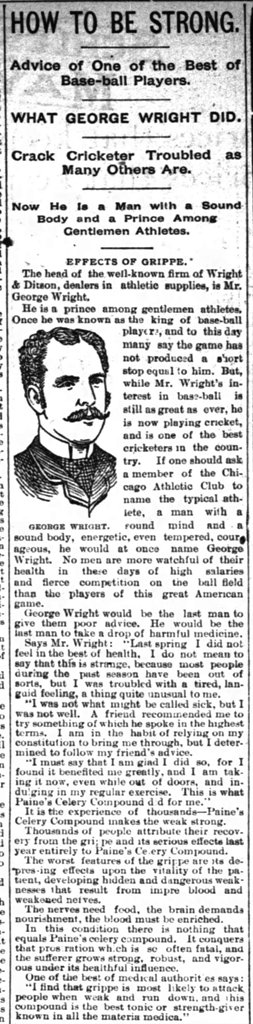
An 1890s advertisement featuring George Wright, which appeared in newspapers across the country, and presented as a regular news story, for Paine’s Celery Compound:

“He is a prince among gentlemen athletes. Once he was known as the king of base-ball players, and to this day many say the game has not produced a shortstop to equal him. But, while Mr. Wright’s interest in base-ball is still as great as ever, he is now playing cricket, and is one of the best cricketers in the country.”

Paine’s, like many patent medicines of the late nineteenth century, claimed to be a cure for the grippe (influenza):

“Says Mr. Wright: ‘Last spring I did not feel in the best of health. I do not mean to say that this is strange, because most people during the past season have been out of sorts, but I was troubled with a tired, languid feeling, a thing quite unusual to me.

“I was not what might be called sick, but I was not well. a friend recommended me to try something of which he spoke in the highest terms. I am in the habit of relying on my constitution to bring me through, but I determined to follow my friend’s advice.

“I must say that I am glad I did so, for I found it benefited me greatly, and I am taking it now, even while out-of-doors and indulging in my regular exercise. This is what Paine’s Celery Compound did for me.”

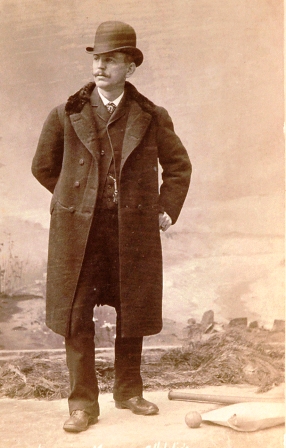
George Wright

George Wright

The ad said Paine’s “makes the weak strong,” and that “Thousands of people attribute their recovery from the grippe” to the compound.

According to The Journal of the American Medical Association, Paine’s contained fifteen different types of vegetables, but that “loses much of its impressiveness when it is seen that the total amount of vegetable extractives is less than 1.5 percent.” The Journal also noted that the compound contained 19.85 percent alcohol, which may account for Wright’s assertion that it “benefited me greatly.”

Al Reach

12 Dec

Alfred James “Al” Reach opened his first sporting goods store in Philadelphia in 1874 while playing for the Athletics in the National Association.  Within a decade he had built a hugely successfully business, began publishing “Reach’s Official Baseball Guide,” and established a National league franchise in Philadelphia.

In May of 1886 Reach talked to The Philadelphia Times about “one of the great industries of Philadelphia in the sporting line.”

“Men, women and children are employed in making base balls.  The cheaper ones are made by a press with leather shavings on the inside.  The body is wrapped with cotton and covered with leather.  The covering is done by hand.  The best balls—the ones in use by the American Base Ball Association—are a solid piece of Para rubber on the inside, covered with worsted yarn and then with an outside covering of horse-hide.  Men do this covering.  They are mostly harness-makers, yet they have to broken into the work, for even a good harness-maker may be a poor hand at covering and sewing a ball properly.”

Al Reach

Al Reach

Reach said the company had orders for “five hundred dozen, or six million, balls already for this season,” and the company was “two hundred thousand dozen behind” filling the orders:

“We have had the factory running until ten o’clock at night all winter.  Base balls sell from 5 cents to $1.25 apiece…Three-fifths of all the balls used in the country are made in Philadelphia.”

—–

“Base ball bats are made of willow, spruce and first and second-growth ash.  The latter wood makes the best bet.  They are sold at fifty, sixty and seventy-five cents each.  There are about sixty thousand bats used every season.  Our orders already indicate that we will dispose of at least fifteen thousand of the best quality.”

Reach said the company employed “upwards of five hundred persons.”

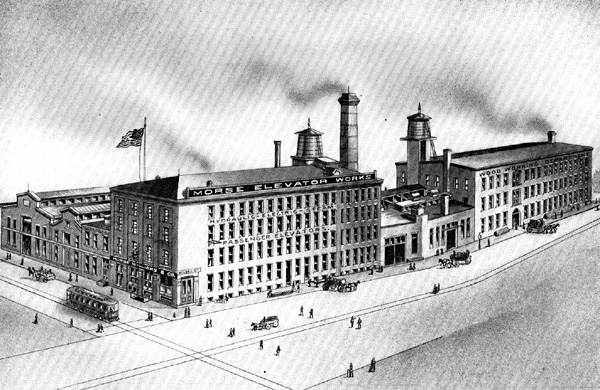
Reach's main factory in 1886 at Frankford Avenue and Wildey Street in Philadelphia---The Martin Landenberger Hosiery Mill Complex/Morse Elevator Works Building

Reach’s main factory in 1886 at Frankford Avenue and Wildey Street in Philadelphia–The Martin Landenberger Hosiery Mill Complex/Morse Elevator Works Building

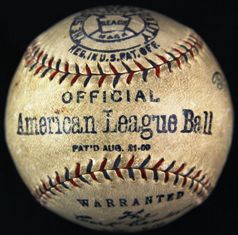
By the end of the decade Reach’s company was purchased by A.G. Spalding, with Reach staying on as an executive and the company continued to produce equipment with the Reach name, including the official American League baseball, which was used through the 1976 season.

Reach maintained controlling interest in the Phillies until 1899 and died in 1928.  He left an estate worth more than $1 million.

Reach Official American League ball 1920s

Reach Official American League ball 1920s

“Hilariously and Shockingly Drunk”

11 Dec

The Philadelphia Athletics were in second place, two games behind the St. Louis Browns in the American association pennant race in June of 1889; but The Philadelphia Times said the team was underachieving, and blamed it on drinking:

“Watch your men, Manager (Bill) Sharsig.

“It is a matter of notorious publicity that a portion of the best players on the Athletic Base Ball Club are not living up to their contracts.  They drink, carouse and make exhibitions of drunkenness that are disgusting the people who so liberally contribute to the support of the national game, and unless the management put an immediate stop to such proceedings the club will be certain to finish the season with a balance on the wrong side of the ledger.”

The paper said because it was “unjust to criticize the club as a whole” they would name the guilty parties:

“It is an open secret that (Denny) Lyons, (Curt) Welch, (Mike) Mattimore, (Henry) Larkin, (Harry) Stovey and sometimes (Frank) Fennelly and (Lou) Bierbauer are frequently in a beastly state of intoxication, and it is easy to prove when and where they have recently been seen so in public places.”

The Times singled out Welch, who was out of the lineup because Sharsig said he was ill:

“Sick he may be, and those who saw him in company with Lyons last Tuesday morning at the early hour of 3 O’clock wonder that he is not laid up.  That model pair were sitting on the curbstone on the South Penn Square side of the City Hall, hilariously and shockingly drunk.

“Saloon-keeper Irwin, who keeps on Juniper Street, told a friend that Welch and another ballplayer became so vulgarly and obscenely boisterous in his place on Monday night that he had to order them out.”

Curt Welch

Curt Welch

The Times said the Athletics loss on June 16—they were defeated 9 to 5 by the Browns—“was largely due to errors made by Welch, Stovey, Larkin and Lyons, all of whom showed traces of their Saturday night’s outing.”

The team’s activities were not limited to Philadelphia, from “every city on the circuit came stories of debauches and sprees,” involving the Athletics:

Chris von der Ahe, of the champion Browns, is responsible for the statement that on the last trip made by the Athletics to St. Louis six of the players became so drunk and noisy in the big Anheuser-Busch saloon that the proprietor had to have then ejected, and a ballplayer on another club that chanced to meet the Athletics in East St. Louis said yesterday that he never saw so many drunken men on one team and that their unseemly conduct was the subject of general talk around the depot.  From Baltimore and Brooklyn come well authenticated stories of boisterous sprees and hilarious conduct in public places.”

The Times said even the most famous umpire of the era, “Honest John” Gaffney, “whom a ballplayer has no truer friend,” commented on the state of the Athletics:

“He says that he has repeatedly seen some of them come up to bat so drunk that they could hardly stand.”

John Gaffney

John Gaffney

The paper said Sharsig, “an exceedingly clever gentleman,” had completely lost control of the team:

“The ballplayers all like him and avow their willingness to do for him whatever he asks, but he is apparently unable to keep them sober even at home and when away they are absolutely beyond his control.  He does not believe in imposing fines…Stovey, Welch and Larkin know that it would be hard to fill their places and laugh at threatened dismissal.”

The Athletics lost six straight games after the story appeared, and 16 of their next 22.  They ended the season in third place with a record of 75-58.

Manager Bill Sharsig

Manager Bill Sharsig

Mattimore was released in August.  Larkin, Bierbauer and Stovey jumped to the Players League after the season ended, and Fennelly was sold to the Brooklyn Gladiators.

Sharsig’s 1890 team led the American Association until July 17, then faded badly and finished in eighth place.  There was no mention in the Philadelphia press about whether drunkenness contributed to the 1890 collapse.

“Wilmington is in to the Finish”

10 Dec

When first-year manager Edgar Bear’s 1-9 Wilmington Sailors took the field on May 17, 1902 against the Durham Bulls, George Dudley Proud was, contrary to speculation in the press, assigned to work as umpire.

With the season just 10-games old Proud’s abilities as an umpire had been called into question by Bear, by Greensboro Farmers manager George “King” Kelly, and the press in Greensboro and Wilmington.

The game remained a scoreless tie into the bottom of the seventh inning.  The Wilmington Messenger said:

“Up to that stage it was a clean game, and there were many brilliant plays.  Neither side had scored.  Wilmington took her seventh inning and retired without any chance at the home plate.  Durham came up and (Otis) Stocksdale reached first on a clean hit and stole second. “

The next batter, John Curran, hit a ground ball to first baseman William “Germany” Dommel.  Proud ruled that Dommel did not touch first base and called Curran safe:

“This caused the trouble that resulted in Wilmington’s leaving the field.”

The team left the field and refused to return; Proud awarded the game to Durham by forfeit.  Bear’s role during the incident that led to the forfeit is unclear.   The Wilmington papers said he was present and in the stands, The Durham Herald said he was not at the ballpark when the incident took place.

What happened next is not in dispute.

The Durham Herald said:

“Umpire G. D. Proud, of the State Base Ball League, was assaulted last evening by Mr. E. J. Bear, manager of the Wilmington club.  The assault was the outcome of the kicks made by the Wilmington players in the game yesterday.”

According to the paper, Bear, accompanied by five Wilmington players, went to Durham’s Central Hotel and confronted the umpire.

“(Bear) knocked on the door of Proud’s room and being told to enter; he did so and started off by using insulting language.  This was followed by an attempt to strike the umpire.”

Bear was restrained by two hotel guests and arrested for assault.  Proud was fined $25 and released from jail the following morning.

The Messenger said:

“(Proud’s) conduct in Durham was such to make him many enemies, he told (a reporter) this morning that Durham had tried to ruin him and now he intended to break the state league if possible.  It is learned he telegraphed (North Carolina League) President (Perrin) Busbee this afternoon telling him either Durham or Wilmington had to get out of the league.”

On May 20 The Charlotte Observer published a letter from Bear, which read in part:

“I do most earnestly declare that in my opinion Mr. Proud is totally incompetent as an umpire, and the earlier he is relieved of his job the better it is for the league, and I desire to deny most emphatically that I ever made the statement that Wilmington was going to try to break up the league, or that either Durham or Wilmington had to get out of the league.”

Bear claimed he had not been in contact with the league president and said:

“I am manager of the Wilmington club at a great financial loss, but I have only the good of the league at heart, and intend that Wilmington shall remain a member of the league as long as any other club is in it, whether the Wilmington club wins another game or not.  And further that my best efforts will be given to make the league a success, financially and otherwise.  Wilmington is in to the finish.”

Wilmington was in to the finish—Bear was not.

The New Bern Daily Journal said:

“Manager Edgar Bear rather unceremoniously relinquished the management of the Wilmington baseball club (on May 25) by failing to provide transportation for the team to leave for the game at New Bern.”

Bear had disappeared.  His career as a professional baseball manager was over in less than a month.  He was replaced Harry Mace, who was an umpire in the league and a former professional player who had pitched in three games for the Washington Statesmen in the American Association in 1891.  Wilmington was 10-40 at the beginning of July when the team disbanded and the league was reconstituted with four teams.  Mace rejoined the league’s umpire staff.

Proud did not last much longer.  The day The New Bern Daily Journal reported on Bear’s exit, another article said:

“The New Bern team (the Truckers) arrived here (May 25), after its tempestuous three games at Raleigh…The team felt no discouragement from the loss of those games, which were under the complete control of Umpire Proud, who never gave new Bern a chance to win.”

Proud would resign before the end of May.  The Wilmington Messenger said he was “Honest, but not up to the requirements of the position.”

Proud became an umpire in the Tri-State League a month later.  He was also involved in automobile racing on East Coast, and created road maps.

Bear made the papers one last time.  On September 18 1905, Bear, going by the name of Eddie Merode and working as an acrobat in vaudeville performances in Utah.  The Charlotte Observer said police were called to “an opium joint” in Salt Lake City’s Chinatown were they found him “apparently dying of opium poisoning.”  He died later that day.

Edgar Bear

9 Dec

It was somewhat by accident that Edgar J. Bear came to be involved in organized baseball—as president and manager of the 1902 Wilmington Sailors.

Bear was born in Wilmington on January 12, 1877, and attended the Oak Ridge College Preparatory school, now Oak Ridge Military Academy, where according to The Charlotte Observer, he studied business then “wandered around the country for several years.”  The paper also said he inherited $30,000 from his father’s estate.

He first worked as a jockey, and then joined the circus.  He was with Walter L. Main and Carlo Brothers Circuses as a bareback rider and acrobat.  The Wilmington Messenger said he performed throughout the United States and South America, and “three trick mules” were part of his act.

In 1898 The Wilmington Morning Star said he took a break from the circus to travel to Alaska in search of gold.

Sometime early in 1902 he returned to Wilmington, and according to The Observer “became interested in baseball.”  In March The Morning Star said a Massachusetts man who was being counted on to bankroll a local team in the newly formed North Carolina League had dropped out and “Mr. Edgar J. Bear was found to be the man of the hour.”

The paper said Bear “made a proposition to assume the responsibility of managing and maintaining a team throughout the season, provided $500 will be raised by popular subscription and the Street Railway Company will hold good its proposition to furnish an enclosed park and donate $200 to the fund, making a total of $700.”

With that Bear became the president and manager of a professional baseball team.  He quickly raised the money to operate the club for the season; The Messenger said he “deserves credit for his zealous efforts and the faithful manner in which he has worked.”

That same month, the new league hired an umpire from Pennsylvania named George Dudley Proud.  It was Proud’s first professional job; he had worked in amateur leagues around Philadelphia for several years.

Wilmington got off to a slow start, losing six of their first eight games.

Proud, the league’s rookie umpire was having his own problems.  During the first week of the season Proud ejected George “King” Kelly, manager of the Greensboro Farmers, in the eighth inning of a game against the Raleigh Red Birds, after a close play at first base.  The Morning Star said:

“Kelly came on the field and insisted wildly that (the runner) was out and challenged the umpire to fight him.  Proud said he could not, in view of his position, have a fight.  Kelly refused to get off the field and was forcibly ejected amid great excitement…he later assaulted the umpire on Fayetteville street.”

The paper said Kelly landed several punches, but no one seriously hurt.

The Greensboro Daily Record accused the umpire of being crooked, and threatened further bodily harm:

The Record wants to say that the people of Greensboro are as fair as any people on earth.  Had the same thing occurred here and in our favor the public would not have stood it.  The umpire might have been allowed to have his way at the time, but the score would not have stood.  We want to say further that should Mr. Proud pursue his same tactics here we would advise him to get an accident policy.  He may not be killed while the game is going on, but someone will maul the life out of him afterwards.  Many spectators who have observed his work—they are not Greensboro people—say that his conduct is such as to lead to the belief that he is standing in with a lot of sports who are dividing their earnings with him.  That is to say, that there are men who make bets, tell Proud what they are and trust him to save them, then they divide with him.  If this or anything approaching it is true, the sooner his services are dispensed with, the better.”

The Morning Star said the day after the above story appeared in Greensboro, Proud “employed a Raleigh attorney to enter suit for libel against The Daily Record.”

On May 15 the first-time manager with a one and seven record, and the first-time umpire whose integrity was on the line came together in Durham, when the Wilmington Sailors arrived for three games with the Durham Bulls.

They lost the first game 5 to 3.  The Morning Star said “Manager Bear was put out of the grounds for interfering and he protested the game several times.  Several of the Wilmington players were fined.”

The following day Wilmington lost 3 to 0 and two more players were fined—The Messenger said the game was “marred by kicks against umpire Proud,” The Morning Star said “Proud doesn’t seem to be making a very enviable reputation,” and predicted that he “has umpired his last game.”

The prediction was wrong; the rest of the story tomorrow.

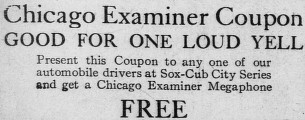
Lost Advertisements–“Yell For Your Team–And Help Them Win”

6 Dec

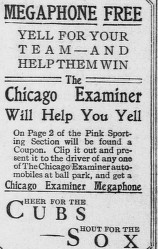
cubssoxmegaphoneA 1912 advertisement for a free megaphone available from “the driver of any one of The Chicago Examiner automobiles at ballpark.”

The Chicago Cubs and White Sox played 25 City Series’ between 1903 and 1942 (not including their World Series in 1906).  The first, in 1903 ended in a tie–both teams winning seven games before the series was forced to end because the player’s contracts had expired.  The Cubs won in 1905 and 1909, but the Sox won 18 of the next 22.

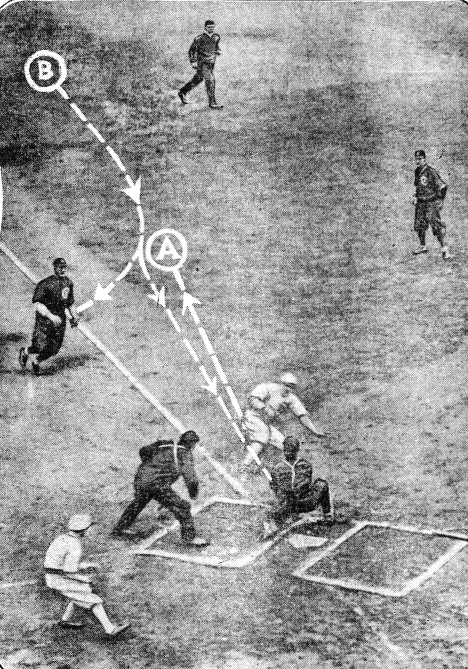
The 1912 series began with a 0-0 tie.  White Sox pitcher “Big Ed” Walsh held the Cubs to just one hit–a Joe Tinker double.   Cubs pitcher Jimmy Lavender held the Sox to six.

The highlight of the game came in the second inning.  With “Ping” Bodie on third and Rollie Zeider at bat.  The Chicago Tribune said:

“Zeider took a spitter for one ball, then hit the second for a high bounder to (Heinie) Zimmerman.  Bodie tried to score, but Zimmerman ran in stabbed the ball with his bare hand and got Bodie at the plate.”

The picture shows where Zimmerman was playing Zeider (B) and where he fielded the ball (A).

The picture shows where Zimmerman was playing Zeider (B) and where he fielded the ball (A).  Ping Bodie is tagged out by Cubs catcher Jimmy Archer.

The second game of the series also ended in a tie, 3 to 3.  The Cubs then won three straight, but the White Sox came back and won four in a row to take the series.

The 31-year-old Walsh, who was 27-17 in 62 games (41 starts, 32 complete games) and 393 innings pitched,  appeared in six games for the Sox, starting four.  He would only win 13 more games over parts of the next five seasons.

cubssoxmegaphone1912

1912 Cubs/Sox Megaphone coupon from The Chicago Examiner

” I had Lamed my Shoulder with Cricket Playing”

5 Dec

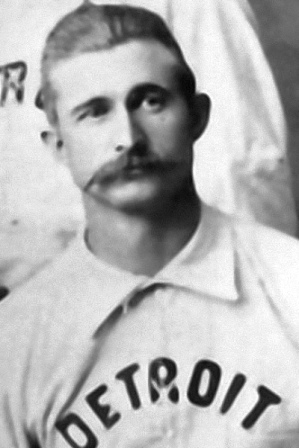
Hall of Fame outfielder Sam Thompson was known for his excellent arm.  After four seasons with the Detroit Wolverines, he was sold to the Philadelphia Quakers in October of 1888. Several months after the sale it was revealed that he had a bad shoulder.

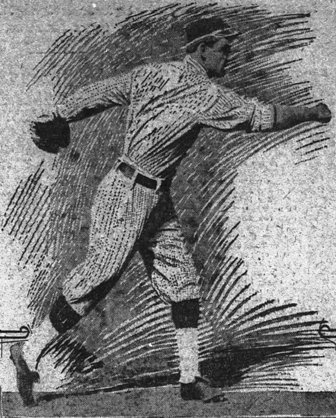
Sam Thompson

Sam Thompson

The speculation about how the injury might affect Thompson led The Cincinnati Enquirer to talk to “the old man of base-ball” Harry Wright about the art of throwing:

“Thompson’s trouble was entirely in the shoulder.  His arm muscles or elbow joint never bothered him.  He can, if he chooses, learn to throw without using his shoulder quite so severely as is natural for him.  The correct way to throw is to start the ball at the height of the ear, but after a man has had trouble with any of his throwing muscles he can often change his style of throwing with benefit.  Take Jack Rowe for an example.  He cannot throw naturally, and yet he plays a very good shortstop by snapping the ball with a peculiar wrist motion.  (John) Meister throws in a similar fashion.

Harry Wright

Harry Wright


“When I first tried to play baseball I could not throw twenty yards, and yet I could bowl very effectively.  I had lamed my shoulder with cricket playing.  I knew that I must learn to throw if I wanted to play baseball, so I put in a whole winter of practicing.  I was then living in Hoboken, and every day I would go down to the river and throw stones for an hour or so.  I had to snap my arm and wrist something as Rowe does, and at first, I could not tell where the stone was going to land.  I would throw an old bottle or piece of wood out into the stream and practice at that.  Before spring, I could hit the mark nearly every time, and could throw a ball seventy yards without difficulty.”

“A Yellower Effort at Baseball has not been Seen Here”

4 Dec

The doormat of the eight-team 1898 Pacific Coast League (also contemporaneously referred to as the Pacific State League)  was the Oakland Reliance.

Their 26-2 loss to the Sacramento Gilt Edges on April 17 resulted in this game recap which appeared in The Sacramento Record-Union:

They Called It Baseball

But If So, It Was The Oakland Quality

Sacramento’s Gilt Edge Players Up Against a Lot of Kindergartners

“A yellower effort at baseball has not been seen here since the Boston Bloomer Girl Aggregation waddled around the bags, than that offered by the Oaklands of the Pacific State League yesterday. A dozen pick-up teams in this city could give them cards and spades and win out easily.

“Probably 1,100 or 1,200 persons sat the essence of misery through several innings, and the many absconded, and the cranks who were not present played in luck.

“The Oaklanders did not know the game, and many disgusted enthusiasts present were willing to make affidavit that they could not distinguish between a baseball and a pumpkin.  In a game between that same aggregation of alleged Oakland players and the Young Cherub Teas of this city–all of the members of the latter club being under 12 years of age—the betting would be dollars to doughnuts with the Cherubs as favorites.

“The score was 26 to 2 and even the most inveterate gambler who saw the slaughter would have been unwilling to venture a white chip on what it would have been had the Gilt Edges let out a link and played the game to a finish.  But the locals tired of the fun before the end, and during the last three innings ran on everything and often on nothing, and, more’s the pity, they usually scored.

“The Oaklands have gone home.  There let them rest in peace, forever and a day, or until they are taught that there is a game called baseball, and that there are several thousand people in Sacramento who know the game, and are willing to render unto Caesar those things which are his, but who are willing to call sere, yellow, punk ball by its right name.

“None of the foregoing applies to the Gilt Edges, who were in the best of practice and ready to play the game of the season.  But the Gilts were handicapped, and to pile up runs against the Oakland infantiles reflected small honor upon them.  They had nothing to do but touch the ball.  Anything was good for a base, and even a cripple might have stolen any number of bases and come out without a scratch.”

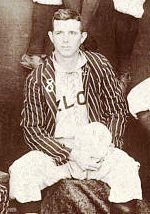
Ervin "Zaza" Harvey had four hits for Sacramento

Ervin “Zaza” Harvey had four hits for Sacramento

In May the Pacific Coast League consolidated with the California League and this incarnation of the PCL disappeared after 1898.  Five years later it was reborn, and remains in operation.

“The Great Baseball Question has been what will Capt. Comiskey do next Season”

3 Dec

In January of 1890 The St. Louis Globe-Democrat said what was on the minds of every baseball executive, writer, and fan:  “The great baseball question has been what will Capt. Comiskey do next Season”

For weeks there was speculation about whether Charles Comiskey, captain and manager of the St. Louis Browns, would remain in the American Association or join the Players’ National League of Professional Baseball Clubs (Players League), the league borne out of baseball’s first union the Brotherhood of Professional Base-Ball Players.

Charles Comiskey, against slang in baseball stories.

Charles Comiskey

On January 15, in a letter to The Sporting News, Comiskey announced his decision:

“During the past few weeks many interviews have appeared with me in different newspapers of the country relative to my having signed a contract with the St. Louis and Chicago Brotherhood clubs.  Up to this writing I am mind and fancy free.  But before Saturday night, January 18, I will have signed a contract to play at first base for the Chicago Brotherhood team.  I take this step for the reason that I am in sympathy with the Brotherhood.

“I believe its aims are for the best welfare and interest of the professional players.  I believe that if the players do not this time stand true to their colors and maintain their organization they will from this day forward be at the mercy of the corporations who have been running the game, who drafted the reserve rule and give birth to the obnoxious classification system.

“I have taken all the chances of success and failure into consideration, and I believe that if the players stand true to themselves they will score the grandest success ever achieved in the baseball world.

“But besides having the welfare of the players at heart I have other reasons for wanting to play in Chicago.  My parents and all my relatives reside there, and the all the property I own is located in the city.  I was raised there and have a natural liking for the place.  But, outside of all these reasons, my relations with the management of the St. Louis club have, during the past year been so unpleasant I do not care to renew them.  I have many friends in St. Louis, and for their sake I hate to leave here, but the other reasons out-balance this friendship, so I will cast my lines with the Chicago club.

“This is the first letter I have written on the subject which seems to have interested the baseball world throughout the whole of the present winter.

“Yours respectfully, Chas. Comiskey”

A week before the season began The Chicago Tribune said Comiskey’s new club “on paper, is the greatest team ever organized.”   Despite the hype, Comiskey’s Chicago Pirates finished in fourth place.  The Players League lasted only one season and dissolved in November of 1890.

Comiskey’s backing of the Brotherhood against “the corporations who have been running the game” would probably have come as a surprise to many of those who played for him when he owned the Chicago White Sox.  Arnold “Chick” Gandil, banned from baseball for his role in the 1919 Black Sox scandal said of Comiskey in a 1956 article in “Sports Illustrated:”

“ He was a sarcastic, belittling man who was the tightest owner in baseball. If a player objected to his miserly terms, Comiskey told him: “You can take it or leave it.” Under baseball’s slave laws, what could a fellow do but take it? I recall only one act of generosity on Comiskey’s part. After we won the World Series in 1917, he splurged with a case of champagne.”

Chick Gandil

Chick Gandil