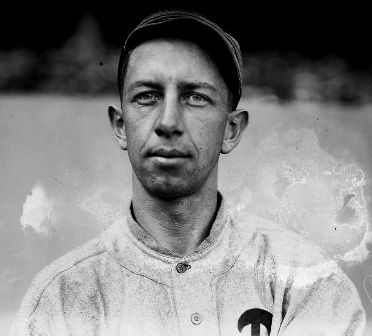
Archive | 2015

The Definitive Cobb Biography

11 May

Myths.  Baseball books are full of them.

Perhaps the most enduring myths are about Ty Cobb.  A prototype of a villain in spikes from central casting:  Dirty player– check, virulent racist—check, miserly and bitter in old age—check.

That is the Ty Cobb cemented into our consciousness.

So much so in fact, it is difficult to find a discussion on the internet regarding the merits of Pete Rose’s case for the Hall of Fame without a member of the pro-Rose faction, at some point, making the “Yeah, but Ty Cobb did (fill in the blank)” argument.

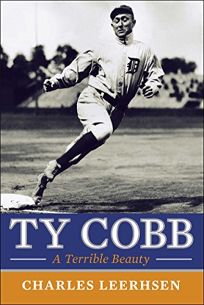
Or, as Charles Leerhsen puts it, in “Ty Cobb: A Terrible Beauty” (which will be released tomorrow), “This Cobb was someone (fans) could shake their heads at, denounce, and feel superior to.”

cobb


The clues were there that Cobb might just be more than the sum of the single-dimensional parts previous biographies claimed to reveal.

Not long ago, I wrote about Cobb’s embrace of fellow Royston, Georgia native, and former Negro League player and newspaperman Fred Downer at Wrigley Field in 1953—the same day Cobb spoke glowingly to reporters about Dodgers’ catcher Roy Campanella.

No less an authority than Wendell Smith—the legendary reporter from The Pittsburgh Courier who by then had joined The Chicago Herald-American as the first black sportswriter at a white-owned paper—said after that day at Wrigley that reports of Cobb’s racism were always “merely a matter of hearsay,” and “He gives no indication today of intolerance.”

Yet, the hearsay has always outpaced the reality; until now.

Through exhaustive research and a compelling narrative, Leerhsen demonstrates that the one-dimensional Cobb of lore is, at best, a caricature.   The stories that have been told and retold for years about racially motivated physical attacks were poorly sourced and greatly exaggerated.  Statements like the one about Campanella and several that Leerhsen has compiled were ignored.

The author even manages to add context to the often told stories of the death of Cobb’s father and Cobb’s relationship with mascot Ulysses Harrison (bonus points here because unlike many of the versions of this story elsewhere he gets Harrison’s name correct).

Leehrsen’s three-dimensional Cobb is more interesting than the one presented previously.  This Cobb was quick to anger, perhaps overly sensitive, certainly no less flawed than many of his contemporaries, but more complex, more introspective and much more difficult to shake our heads at.

An excellent read, well worth your time.

“The Game is Stricter and Better now”

8 May

Honus Wagner was an exception.  Unlike most of his contemporaries, he didn’t spend his later years complaining that the game was just not the same and that current players would not be able to compete with the stars of his era.

Financially strapped as a result of the Depression, Wagner was offered a job by the Pittsburgh Pirates to join Manager George Gibson’s staff.   While in California with the team for spring training he spoke to Russell Newland of The Associated Press.   Wagner said:

“We’ve got more good players than we ever had.  That’s because there are more strong leagues.  The game is stricter and better now.  You can’t bully the umpire any more.  The boys used to be a rough and ready lot.  Now the umpire is a real authority and it’s all for the best.”

Wagner

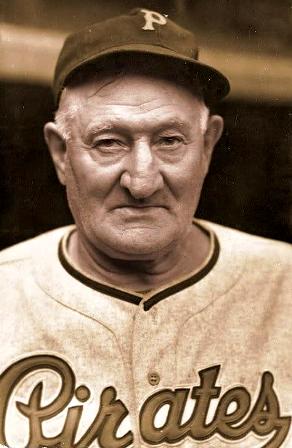
Pirates Coach Honus Wagner

Wagner also felt that pitchers had to work harder than they did when he played:

“Our pitchers had the advantage of a dead ball and used the spitter, the shine ball and the emery ball.  They worked the old bean ball overtime.  All that’s out now.  Nowadays a pitcher has to throw a lot more balls.  He has to work the corners because that lively ball sure sails when the boys get one in the groove.  Actually he pitches a couple of games in nine innings, compared to the chuckers of my day.”

Wagner had no complaints about the comparatively large money stars like Babe Ruth were paid either:

“That $50,000 they’re offering the Babe reads like a lot of money to me, but if he can get them to raise it, I say ‘more power to him.’”

Wagner was also optimistic about baseball’s future:

“’Baseball is O.K.,’ he said as he crossed the most famous pair of bow legs in the history of the pastimes.  ‘They’ll be playing it a long time from now.”

Fullerton on Drinking

6 May

At the beginning of the 1914 season, The Chicago Examiner’s Hugh Fullerton attempted to determine the impact of drinking on performance on the diamond.

“Boys, here is another temperance lecture in baseball averages.  It isn’t an argument or a statement of principles. Of course, we all know that a bottle of beer once in a while ‘ain’t never going to do no one no harm.’  I think during the last twenty years four or five hundred ballplayers have confided that information to me.  So it ought to be true.”

Hugh Fullerton

Hugh Fullerton

Fullerton said he had compiled a list of players who were drinkers.

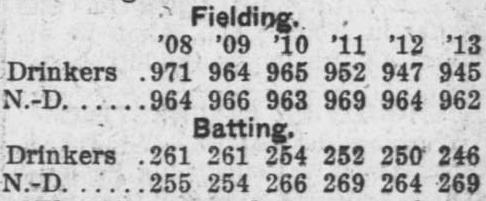
 “I took an even twenty of these fellows. Then I took 14 players who to my certain knowledge do not drink at all.  I jotted down the batting and fielding averages of these men using no pitchers or catchers, for six years (1907-1913), and made a composite average.  Here are the figures:
drinkersnondrinkers

“Then it occurred to me perhaps there may be some dope to show how drink acts upon pitchers.  Here are the composite averages of then men, their percentage of victories for five years:

drinkersnondrinkerspitchers

“Possibly I have picked some pitchers lucky enough to be with winning clubs; and some drinkers unlucky enough to be with losers.  As a matter of fact, one fellow on the drink side has been with a winning team and he boosts the averages of his fellows.”

A photo of baseball's premier teetotaler Eddie Collins appeared with Fullerton's story.

A photo of baseball’s premier teetotaler Eddie Collins appeared with Fullerton’s story.

His conclusion:

“Maybe these figures prove that a bottle of beer once in awhile ‘ain’t goin’ to hurt no one.” Anyhow, there are the figures.  Either the wets or the drys may use them.”

“If Baseball is really the National Game let the Club Owners go out and prove it”

4 May

Haywood Broun, columnist for The New York World-Telegram, shook up the annual Baseball Writers Association dinner in February of 1933.  The Pittsburgh Courier said Broun “struck out boldly in advocacy of admitting Negroes to the charmed circle of big leagues.”
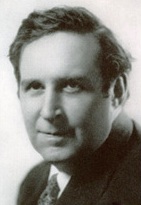
Heywood Campbell Broun

Heywood Broun

Broun said (and later wrote in The World-Telegram):

“I can see no reason why Negroes should not come into the National and American Leagues.

“Why in the name of fair play and gate receipts should professional baseball be so exclusive?”

[…]

“The introduction of a few star Negro ball players would do a great deal to revivify interest in the big leagues.  It would attract a number of colored rooters. And it would be a fair and square thing.  If baseball is really the national game let the club owners go out and prove it.”

Jimmy Powers of The New York Daily News said he polled the dinner guests after Broun’s remarks:

“I made an informal tour around the tables asking club owners and players their reactions to Broun’s little talk.  I was amazed at the sentiment in favor of the idea.”

Powers claimed that Yankees owner Jacob Rupert, St. Louis Cardinals General Manager Branch Rickey, and Babe Ruth were all in support of Broun’s statement.   John McGraw the dinner’s guest of honor—he had resigned as manager of the New Giants the previous summer due to his failing health—was, according to Powers, “The only prominent man present vetoing” the idea.
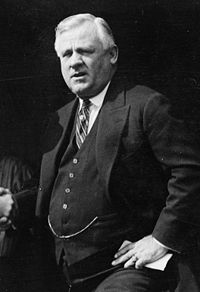
John McGraw

John McGraw vetoed the idea


Salem Tutt Whitney, a prominent star of the black vaudeville circuit, commented on McGraw in the pages of The Chicago Defender:

“John McGraw and his Giants have been the idols of the Colored baseball fans.  Whenever and wherever there had been talk about the color line in major league baseball, the Colored fans were a unit that declared that if John McGraw could have his way there would be no color line.  ‘Didn’t he play (Charlie) Grant at second base on the Giants!’  ‘Look how long he employed a Colored trainer (Ed Mackall)!’”

[…]

 “It is my opinion that if the Colored baseball fans of Harlem are not convinced that Mr. McGraw has nothing more to do with the Giants, there will be a lack of personal color in bleachers and stands at the Giants’ stadium this summer.”
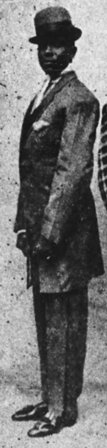
Salem Tutt Whitney

Salem Tutt Whitney

Not content to simply report on Broun’s pitch for integration, Powers made his own:

“I would like to make a case for the colored baseball player.  In football, Duke Slater, Fritz Pollard and Paul Robeson and stars of similar complexion played with and against the cream of Nordic colleges.  Eddie Tolan, Ralph Metcalfe and Phil Edwards have conducted themselves in a gentlemanly—not to mention championship—fashion.  Boxing has known Joe Gans, Sam Langford, Joe Walcott and Tiger Flowers.  There are only three popular sports in which the dark-skinned athletes are snubbed—tennis, golf and baseball.”

The New York Age approved:

“Here’s hoping all the other big white sportswriters have the courage of Jimmy Powers.”

Chester Washington, a sports writer at The Pittsburgh Courier announced that the paper was launching “A symposium of opinion, coming from outstanding figures in baseball circles,” designed to demonstrate a broad coalition of support for integration.

The Courier reported “The first of these statements,” in response to Washington’s outreach the following week—and it was a rather incredible one from John Heydler, president of the National League, who said:

“Beyond the fundamental requirement that a major league player must have unique ability and good character and habits, I do not recall one instance where baseball has allowed either race, creed or color enter into the selection of its players.”

Gerald Nugent “aggressive young owner of the Phillies,” was next to respond to The Courier:

“Nugent calls attention to the fact that no ‘color line’ is drawn on the dollars which are spent by colored and white fans for admissions in the various big-league parks…He further declares that the average colored semi-pro league player is better than his white brother in the same category.”

Support continued to come.  Chicago White Sox President J. Louis Comiskey:

“You can bet your last dime that I’ll never refuse to hire a great athlete simply because he isn’t the same color of some other player on my team if the alleged bar is lifted.”

While Commissioner Kennesaw Mountain Landis did not respond to The Courier, his right-hand man, Leslie O’Connor said “(T)here isn’t any rule which keeps colored players out.”  But, like Heydler, he made the incredible claim that “the subject of Negro ball players had never been brought up,” among the Major League Advisory Council.

Based on the initial responses, William Goldwyn Nunn, The Courier’s managing editor, expressed great, if premature, optimism:

“And the color will be black!

“As sure as the Ides of March are approaching, there’s going to be some added color in the Major Leagues.  AND, THAT COLOR WILL BE BLACK!”

Meanwhile Jimmy Powers quoted Lou Gehrig and Herb Pennock of the Yankees and Frankie Frisch of the Cardinals in The Daily News, all said they were “open-minded,” about the possibility integration.
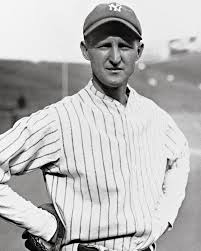
pennock

Pennock “Open-minded”


Two more prominent sportswriters came out in support:  Dan Parker of The New York Daily Mirror, and Gordon Mackay, who had been sports editor of three Philadelphia papers—The Enquirer, The Press and The Public Ledger.

And then, as abruptly as it began, the movement died.

Despite the brief groundswell of support, by the time the major league season opened Alvin J. Moses, another writer for The Courier admonished the papers readers:

“Aren’t you somewhat ashamed of yourselves that you haven’t seen fit to spare the time to flood (the paper) with letters that cry out against these NEGROPHOBES who for more than half a century have kept Negro ballplayers out of league competition?

“The cry of ‘Play Ball, Play Ball, Play Ball?’ is heard today in hundreds of parks the county over, and baseball statisticians have figured to show more than 40,000,000 fans walk past the turnstiles.  But what does that cry mean to you, and you, and you? Well, I’ll tell you—absolutely nothing.”


Lost Advertisements–Fit for a King

1 May

fitAn ad for Old Underoof Whiskey from April of 1910.  Chicago White Sox owner Charles Comiskey–and Chicago fans–had great expectations for the club.  After a disappointing 78-74 record and a fourth-place finish in 1909, Hugh Duffy was hired to replace Billy Sullivan as manager.

Comiskey also replaced his entire starting infield, purchasing the contracts of three minor leaguers: first baseman Chick Gandil, second baseman Rollie Zeider, and shortstop Lena Blackburne, and installing utility infielder Billy Purtell at third.

The new 1910 White Sox infield.

The new 1910 White Sox infield.

The Chicago Tribune said the Sox were now:

“Resplendent with brand new darns where were worn the biggest holes last year.”

Comiskey was confident enough to tell reporters the team “(W)ill lose their name of hitless wonders this year. I am confident we will be as strong as any club in the league in this department.”

He also maintained that Ed Walsh, Doc White, Jim Scott, and Frank Smith, who would start the opener on April 14, comprised “(T)he strongest staff of pitchers in any league.”

The Sox did not disappoint on opening day.  Behind Smith’s one-hitter, the Sox defeated the St. Louis Browns 3 to 0.

The Chicago Inter Ocean said the “New Sox lived up to every inch of the reputation they have gained this spring.” The Tribune dubbed the team “Commy’s Comets,” and said:

“When the dazzling display was over Comiskey’s face resembled the noonday sun wreathed in an aureole of smiles, which extended beyond the rings of Saturn and half the distance to the milky way.”

Old Underoof commemorated the victory with a new ad:

commy1910

The Sox quickly returned to earth and lost their next four games.  Things never got much better.  A month into the season they were 10 games out of first place; they finished 68-85, in sixth-place 35.5 games behind the Philadelphia Athletics.

With a league-worst .211 batting average, the they failed to ” lose their name of hitless wonders,” as Comiskey predicted.

As for “the strongest staff of pitchers in any league,” they could not overcome the horrible support they received all season.  Despite a 2.03 team ERA, second only to Philadelphia’s 1.79, only Doc White (15-13) had a winning record.

Walsh, who led the league with a 1.27 ERA,  was 18-20, and Scott was 8-18 with a 2.43 ERA.

Frank Smith, the 30-year-old hero of the opener, who had won 25 games with a 1.80 ERA in 1909, was 4-9, despite a 2.03 ERA and three shutouts, when he was traded with Billy Purtell to the Boston Red Sox in August.


Things I Learned on the Way to Looking up other Things #14

29 Apr

Wishful Thinking in Boston–1921

Arthur Duffey was a former track athlete—he finished fourth in 100 yard dash in the 1900 Olympics—turned sports columnist for The Boston Post.

Arthur Duffey

Arthur Duffey

Like many in Boston, he hoped Babe Ruth would be unable again put up the type of numbers he did in 1920—54 home runs, 135 RBI, .376 average– after being sold by the Red Sox to the New York Yankees.

Ruth

Ruth

Duffey had received word in March of 1921 that his hopes would be realized:

“According to all reports from Hot Springs way where Babe Ruth is putting in his preliminary canters for the coming American League race, Babe evidently believes in that old slogan about ‘Living to eat instead of eating to live,’ for the Bambino is pounds overweight and not a few predict that he is going to have his troubles in getting down to anything like his baseball scale of last season…(Ruth) has no doubt been living the life of Reilly since he has proven himself the ‘King of Swat.’ But, is he going to eat himself out of another chance to beat that home run record?”

Ruth managed to “eat himself” into a season that included new career highs for games (152), at-bats (540), runs (177), home runs (59), RBI (168), and batting average (.378).  The Yankees won the American League pennant and the Red Sox finished their second straight fifth-place, Ruth-less season.

Wishful Thinking about honesty, 1901

George Erskine Stackhouse, sports editor of The New York Tribune, assured readers of “Leslie’s Weekly Illustrated” magazine, that there was no corruption in baseball:

“Baseball is honest.  Some peculiar things happen in baseball at times, but I have watched the game very closely for a great many years and believe that it is at least as close to perfect honesty as any professional sport in the world.”

George Erskine Stackhouse

George Erskine Stackhouse

Stackhouse also refused to believe that gamblers had any role in the game:

“Baseball has no side-show features, such as betting and the like, and soon as the average ‘fan’ thought the games dishonest he would lose all interest in the sport.”

But, Stackhouse assured his readers he was not naïve, but everyone involved in baseball had learned their lesson from the scandals of the 19th Century:

“I do not mean to say that there are not players and club owners who would not be tricky if they dared.  They simply don’t dare.

“The lesson dealt out to the early evil-doers who were charged with selling games in the interest of certain gamblers, has had a splendid effect.  The sentence hangs over those men yet, and the disgrace will remain with their children and their children’s children.  I believe that there have been hundreds of fake horse races, prize fights, wrestling matches, and professional running races to one really crooked baseball game.”

Stackhouse died in 1903 at the age of 42, content in the knowledge that baseball remained “close to perfect honesty.”

Humpy Badel

27 Apr

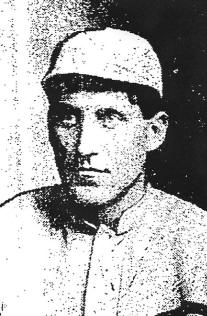
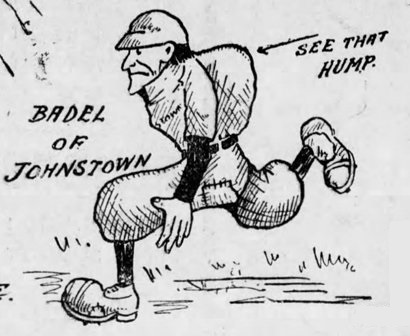
Fred Badel was the first player in professional baseball (and most likely the only one) who suffered from Kyphosis, the over-curvature of the upper back.  In less sensitive times, the first decade of the 20th Century, this led to his nickname: Humpy.

Badel was born in Carnegie, Pennsylvania, March 6, 1881, although contemporary newspaper accounts implied he was much older.  He never learned to read or write, and despite his medical condition developed into a solid ballplayer.

The Altoona Tribune said:

“He is a little left-handed hitter, fast on his feet, and an excellent baserunner.”

The Tribune also said he was “(A) protegé of (Honus) Wagner.”

The Pittsburgh Press said he was:

“[E]xtremely fast on his feet, can hit like a fiend, and fields his position in a most finished manner.”

That description of Badel’s abilities appeared in an article about “The assertion…there are three classes of men who do not succeed in fast company in baseball, namely Hebrews, hunchbacks and Negroes,” the article failed to mention the concerted effort of organized baseball to keep at least two of those “classes” out of the game.)

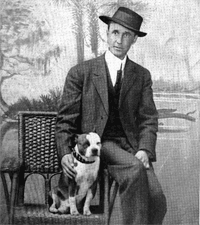
Fred “Humpy” Badel

His professional career began in 1905 with Johnstown in the independent “outlaw” Tri-State League, although earlier he appears to have played for the Youngstown team in the Ohio-Pennsylvania League, and independent teams in Pennsylvania.

No statistics survive, but Badel appears to have played well.  He was described variously by Pennsylvania papers as a “picturesque character” and “odd,” but there seemed to be general agreement that he was destined for the big leagues.  He also had a reputation for playing dirty, The Williamsport Sun-Gazette said he had “a nasty trick of trying to spike basemen.”

At the close of the 1905 season, Badel was signed by the Buffalo Bisons in the Eastern League, managed by George Stallings.  Stallings, who had managed the Bisons since 1902, took the team south for spring training for the first time.

George Stallings

The trip was so successful that Stallings said he’d never again hold spring training in a northern climate—a regular practice at that time.

When the Bisons stopped in Cincinnati for an exhibition game with the Reds on April 10, Badel made an impression.

The Cincinnati Enquirer said:

“Humpy Badel was the bright particular star of the game…Badel is humpback, but a great athlete, with great speed and a fine arm.  An outfielder who cuts into two double plays in one game is going some.  He also made a fine catch on (Jim) Delahanty‘s drive in the second, which would have gone on for three bags…Badel was the main Bison slugger, securing two of the four hits off (Orville) Overall and one of the three off (Leo) Hafford.  Toward the end of the game, the bleacherites were cheering him on with cries of ‘good work, Humpy,’ and applauding every move he made.”

The Enquirer reported that Stallings turned down a  $4000 offer from Cincinnati–it was later reported to be $5000– to purchase Badel’s contract; the paper said Reds Manager Ned Hanlon badly wanted Badel.

Within months everything changed.  He was with Buffalo until July, 6, when without notice he jumped the team and returned to Johnstown.

badel

A cartoon from The Harrisburg Telegraph featuring Badel.


The Buffalo Courier blasted Badel; under the headline “Humpy Badel is a Foolish Man” the newspaper detailed how well he had been treated in Buffalo.  While acknowledging that Badel “Has the makings of a great player in him,” the paper repeatedly mentioned his illiteracy, claimed he “Lacked common sense,” missed or ignored signs, refused Stallings’ attempts to help him,  and was the subject of ridicule from his teammates who considered him ignorant.

The Buffalo Times summed up their view in verse:

“There was an outfielder named Humpy.

Whose work was decidedly lumpy;

So one bright summer day

He asked George for his pay,

And went back to the farm rather grumpy.”

Badel’s hometown papers in Pittsburgh and Sporting Life were somewhat less harsh, but all said that Badel’s leaving Buffalo probably ended a sure chance at a major league career.  Rumors that he jumped because oil had been found on his Pennsylvania land and he no longer needed to play ball were quickly dismissed.

There is no record of Badel ever having been asked for an explanation for why he left Buffalo and effectively ended any chance he had to play in the major leagues.

Badel hit over .300 in Johnstown during the second half of 1906.  He did not play professional ball in 1907, some reports said he had been blacklisted, others claimed he was ill–The Washington Herald said he was “in the grip of consumption,” although that report was likely false.

He appeared briefly with Johnstown again in 1908, but it appears he was not the same player.  The Harrisburg Star-Independent said:

“‘Humpy’ Badel has degenerated.  The eccentric one is no longer the valuable player which he showed himself to be in 1906.”

Badel is listed on the rosters of several independent, C and D league teams between 1910 and 1914, including the “outlaw” United States League in 1912 and the Federal League in 1913.  As was the case throughout his career, there are few extant statistics for Badel during this period.

The last mention of Badel in the press was the report of  his release from Maysville in the Ohio State League in June of 1914.  According to census records and his World War I registration card, he lived in Cincinnati, then Akron and worked as a carpenter until 1919.

 After 1919, there are no records of Badel, a suitable, enigmatic end to the story of an enigmatic man.

A shorter version of this post was published on August 21, 2012

Lost Advertisements–Famous Ball Players–Farmers & Merchants

24 Apr

farmersandmerchantsad

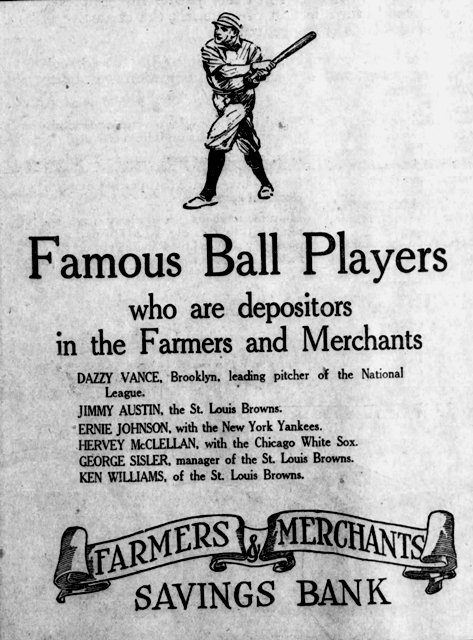
An October 1925 advertisement for California’s Farmers & Merchants Bank:

Famous Ball Players who are depositors in the Farmers and Merchants

Dazzy Vance, Brooklyn, Leading pitcher of the National League

Jimmy Austin, the St. Louis Browns

Ernie Johnson, with the New York Yankees

Hervey McClellan, with the Chicago White Sox

George Sisler, manager of the St. Louis Browns

Ken Williams, of the St. Louis Browns

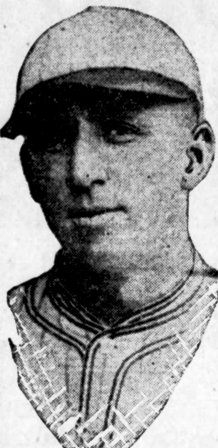
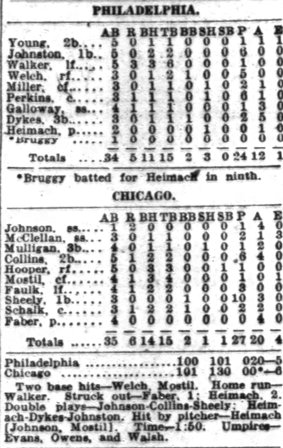
One of Farmer’s  Merchants depositors, Hervey McClellan, had an unusual distinction on June 14, 1922, while filling in at shortstop after his Chicago White Sox teammate, and fellow bank customer, Ernie Johnson was hit by a pitch and left a game against the Philadelphia Athletics.   The Sox, behind Urban “Red” Faber, took 6 to 3 lead into the eighth inning.

Hervey McClennan

Hervey McClellan

Then, according to The Chicago Tribune‘s Irving Vaughan, McClellan was responsible for “Possibly the most unusual feature of the afternoon,” when:

 “(He) started his high diving by muffing (Cy) Perkins‘ roller.  (Chick) Galloway then grounded to (first baseman Earl) Sheely who heaved to second, but McClellan neglected to cover.  This put runners on the two far corners and both counted when McClellan threw to the grandstand on (Jimmy) Dykes‘ grass cutter…What McClellan did was notch three errors on three consecutive batters…two runs scoring on the blunders and providing a close score.”

The Box Score

The Box Score

McClellan, who played six seasons with the White Sox, died a month after this advertisement appeared.  He had been ill for more than a year, suffering from  complications from two gall stone surgeries.

1911 Washington Senators Season Ticket Contest

22 Apr

hahnscontest1


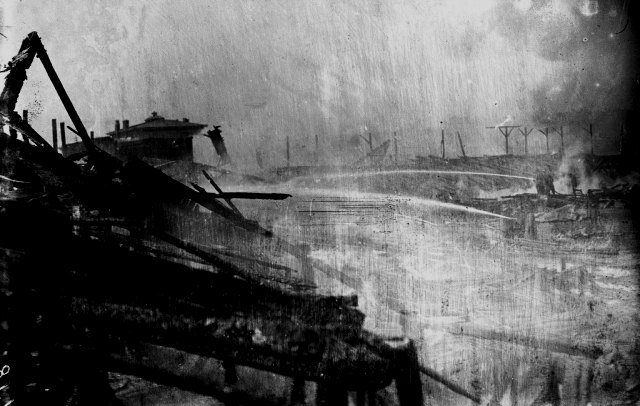
On March 17, 1911, a fire destroyed Washington D.C.’s Boundary Field, almost immediately construction began on a new ballpark on the site–what would become Griffith Stadium.

The Boundary Field fire.

The Boundary Field fire.

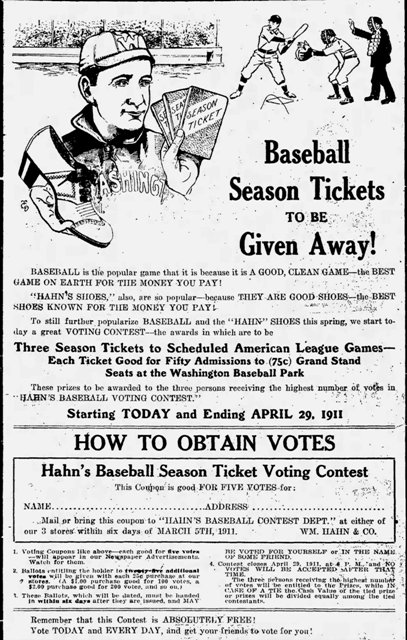
The Hahn Shoe Company took out advertisements in all of Washington’s daily newspapers announcing a promotion for the new ballpark:

Baseball Season Tickets To Be Given Away!

“Baseball is the popular game that it is because it is A GOOD, CLEAN GAME–the BEST GAME ON EARTH FOR THE MONEY YOU PAY!

“‘HAHN’S SHOES,’ also are so popular–because THEY ARE GOOD SHOES–the BEST SHOES KNOWN FOR THE MONEY YOU PAY!

“To still further popularize BASEBALL and the ‘HAHN’ SHOES this spring, we start today a great VOTING CONTEST–the awards in which are to be

“Three Season Tickets to Scheduled American League Games–Each Ticket Good for Fifty Admissions to (.75) Grand Stand Seats at the Washington Baseball Park.”

The contest called for fans to collect votes on their behalf–the three highest vote totals by April 29 would receive the tickets to 50 home games from May 4 through the end of the season.

The contest became very popular, and by April 9 The Washington Times said that a million votes had been cast,

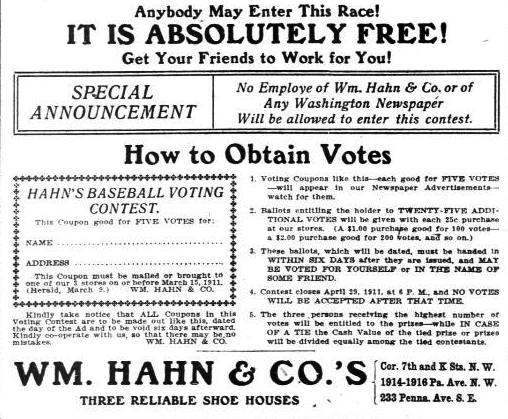
hahnscontestformBallots were printed regularly in the newspapers and additional votes could be received for submitting bonus coupons and purchasing items in Hahn stores.

Leader boards were displayed in the windows of each Hahn store, and The Washington Herald said “So close to the present leaders are many of the other contestants that constant changes are likely.”

When the contest came to an end, The Times claimed “a total of 7,000,000 votes was [sic] cast by friends of the contestants.”

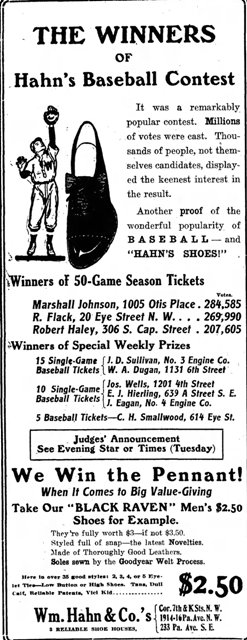
Hahn’s announced the winners in large ads in all of Washington’s newspapers:

hahnscontestwinners

The winning contestants each received more than 200,000 votes each.  Hahn’s said:

“That baseball and Hahn’s Reliable Shoes are both at the zenith of their popularity here in Washington was manifested by the phenomenal success of our Baseball Voting Contest, in which millions of votes were cast.”

Despite the claim that baseball was “at the zenith” of its popularity in the nation’s capital, or perhaps because construction of the new ballpark wasn’t completely finished until July 24, attendance dropped by nearly 10,000 from 1910 to 1911.

The Senators were no better either.  They followed their 66-85 record in 1910, with a slightly worse 64-90 mark in 1911.


“Let us try and meet his Qualifications as a Gentleman”

20 Apr

In April of 1947, with Jackie Robinson on the verge of making his debut with the Brooklyn Dodgers, the “Dean of Negro sportswriters,” Frank Albert “Fay” Young said in The Chicago Defender, Robinson would not be the only one under a microscope:

“It is hoped that the Negro fans, who want to see Robinson remain in big-time baseball will learn to treat him as another top-notch ball player.  He should not be made to carry the added burden of ‘the race problem’ on his shoulders.  He will have a hard enough job playing the brand of baseball expected of any other big leaguer.

“Two things are important.  The first is the conduct of the Negro fans.  Drinking is out in all National League parks.  Profane language, if you have to use it, reserve it for your home where your wife will ‘brain’ you.

Robinson will not be on trial as much as the Negro fan.  The Negro fan has been the ‘hot potato’ dodged by managers who would have taken a chance by signing a Negro player.”

Frank "Fay" Young, The Chicago Defender

Frank “Fay” Young, The Chicago Defender

Robinson was scheduled to make his first appearance in Chicago on May 18.  Young said:

“We hope that Sgt. Harness and ‘Two-gun Pete’ and some other brave Negro policemen will be assigned to the Cubs Park.  Harness and ‘Two-gun’ know the hoodlums.”

Harness and ‘Two-gun Pete’ were Robert Harness and Sylvester Washington, two well-known African-American police offers.  Harness rose to the rank of commander before he retired.  Washington, who The Defender called “Chicago’s toughest black cop,” and carried two pearl-handled revolvers, suffered a different fate.  The paper said in 1951, he was “(A)sked publicly to explain how he had been able to purchase a $40,000 building specifically, and maintain an expensive auto and flashy clothes on a $3,600 per year salary.  ‘A lot of people give me things…I am a great policeman,’ he is reported to have replied.”  Washington resigned from the force that year.

In addition to their behavior at the ballpark, Young also implored fans:

“Robinson is against being singled out before a game to be called to home plate and be presented with numerous gifts.  There will be eight other Dodger players in the game.  Jackie insists on being treated as a ballplayer trying to make good and not a Negro ballplayer seeking special privileges.

“The Negro fan can help Robinson.  The Negro fan can ruin him.  Robinson is an American citizen, an ex-army officer, a ballplayer and a gentleman.  Let us try and meet his qualifications as a gentleman.  If you Chicagoans have got to raise a lot of hell, do a lot of cussing, go somewhere else.”

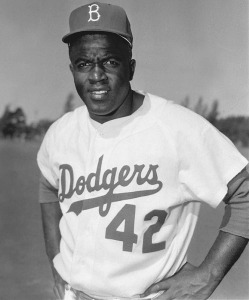
Jackie Robinson

Jackie Robinson

Robinson’s Chicago debut—a 4 to 2 Dodger victory–drew 46,572 fans, the then largest crowd to attend a game at Wrigley Field since field seating was discontinued in 1936.  The Defender reported that the fans were “Orderly,” focusing their only derision towards “one Dixie Walker who was the recipient of plenty of boos.”  The fans maintained order even when Robinson was called out on strikes with the bases loaded in the fifth inning “much to his disgust and to those who sat behind home plate and though the umpire should have called the pitch a ball.”