Archive | Uncategorized RSS feed for this section

“Daily Chats with Famous Ballplayers”

18 Sep

In 1916, a series of two to three paragraph items called “Daily Chats with Famous Ballplayers” (some papers called the feature different names) appeared in several smaller West Coast and Midwest newspapers.

Some highlights:

Oscar “Ossie” Vitt, third baseman for the Detroit Tigers, who survived a beaning from Walter Johnson of the Washington Senators on August 10, 1915:

“The world stopped moving when the ball nicked my bean.  Johnson thought I was killed and I guess I thought so myself for awhile, so far as I was able to think at all.

Ossie Vitt

Ossie Vitt

“My head proved to be the goods alright and wasn’t worse for wear.  But it upset Johnson so much that he couldn’t locate the plate and we pounded him all over the lot (Vitt was hit leading off the first inning—Johnson gave up eight runs after that in six innings and lost 8 to 2 to Detroit).”
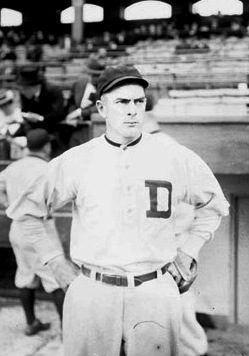
St. Louis Cardinals pitcher Henry “Hi” Jasper on the superstition of teammate Harry “Slim” Sallee:

“Sal’s pet superstition is that it’s bad luck for him to warm up with any catcher but the one who is to work in the game with him.

“If the playing backstop has batted last and has to put on his shin guards and armour before warming up, Sal will never throw a ball to the plate to any man who may come out of the dugout with a mitt.  He will throw either to the first or third baseman.”

Pittsburgh Pirates pitcher Al Mamaux on a lesson learned during a loss to the Chicago Cubs in September of 1914:

“Smart old timers can always make it tough for youngsters just breaking in.  I remember one day when I was the goat for a trick pulled by Roger Bresnahan.”
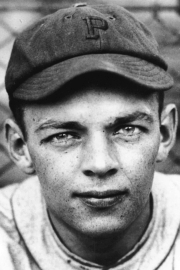
Mamaux

Al Mamaux

Mamaux said Chicago had two runners on base and Bresnahan was coaching third.

“(He was) talking real friendly like to me (then) hailed me suddenly as the ball was returned to me.  ‘Say Al, toss me that ball I want to look at it,’ said Roger.  I didn’t give it a second thought…tossed it towards him and I’ll be darned if he didn’t step to one side and yell to the runners to beat it home.  Each advanced a base and would have scored if Jimmy Viox hadn’t run his head off to recover the ball.  Believe me that one cured me.”

George Stallings, on suspensions and how badly the Boston Braves needed George Stallings:

“You don’t have to call an umpire all the names in the calendar to draw a suspension.  I got three days off for just remarking to (Charles “Cy”) Rigler that he ought to go to jail for umpiring a game like he did the other day.

George Stallings

George Stallings

“Nothing that I could say or do would make any difference.  What I can say though right now is that the action of (National League) President (John) Tener, coming as it does, with the race so close, appears peculiar to say the least (Tener said the suspension was for a series of altercations that Stallings and his players had with umpires during the two months before the August suspension was announced).

“Without any braggadocio I can say that my suspension will cripple my club considerably.  I know what my presence means to the club and so does President Tener.”

Boston won all three games during Stallings’ suspension and regained second place, but finished the season in third, five and half games behind the Brooklyn Robins.

“And Mr. Waddell made good”

16 Sep

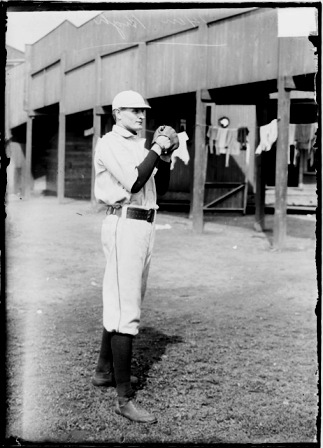
William A. Phelon, like Hugh Fullerton, told many stories over the years that may or may not have been 100% truthful.  One of his favorite subjects was Rube Waddell, who was the subject of as many apocryphal stories as any player of his era.

Rube Waddell

                    Rube Waddell

In 1912, Phelon, then writing for The Cincinnati Times-Star, told a story that he claimed happened while Waddell was pitching for Chicago and Phelon was writing for The Chicago Daily News:

“When Rube Waddell was much younger than he is today—to be exact, back in the golden days of 1901–he was with the Chicago club, and he was just as original and interesting as at the present time.  In just two respects the Rube was very different then—he was a heavy batter (not exactly heavy, but waddle hit .237 in 334 at bats through 1902, and .129 in 732 at bats thereafter), and he was a fiend for work.  You couldn’t put him on the slab too often to suit him, and you could throw him very few shoots  that he couldn’t hit.”

[…]

“One pleasant summer afternoon, during the Rube’s short stay with the Chicago club, he was feeling unusually hilarious, and worked his head off to show up the opposition.  Never did the Rube have finer curves or better speed.  Zim, zipp, the ball hurtled through the ether, and the batsmen were helpless before his terrific delivery.  He held the hostiles to perhaps three hits, struck out ten men, and made a three-bagger on his own accord.  It was a great day for Rube and the crowd went wild about him.

“Next morning, while Jim Hart, the boss of the Chicago club, was in his downtown office, a delegation of bankers called upon him.  ‘We are all coming out this afternoon, Mr. Hart,’ said the spokesman of the crowd, ‘and we have bought up a whole front row of boxes.  There’s only one thing we are sorry for, however—we had all hoped to see Waddell pitch, and we thought he would be due to work today.  If we had known that he was going in yesterday, we’d have been there instead of this afternoon.”

Waddell in Chicago, 1901

        Waddell in Chicago, 1901

According to Phelon, Waddell was made aware that the bankers were disappointed he would not be pitching and said he’d “go in again” the next day.

“And Mr. Waddell made good.  He went back on the slab that afternoon and pitched a gorgeous game, winning in easy style, while the rapturous bankers whooped and bellowed in the boxes.

“About ten days later, Mr. Waddell walked into the office of the banker who had been the spokesman for the delegation.  He was cordially received and invited to sit down in the inner sanctum.  Mr. Waddell, roosting his hat upon the rosewood desk, lit a cigar, crossed his knees, and said, smilingly:

“‘Are you a believer in reciprocity?’

“’Why of course,’ said the banker.  ‘What about it?’

“’Well, Mr. Banker,  I did you a favor the other day, didn’t I?’

“’You certainly did.  I was extremely grateful to you Mr. Waddell.’

“’Then Mr. Banker, suppose you reciprocate.  Lend me $50.’

“And Rube got the fifty.  Did the banker ever get it back?  Does a Hyena fly?  Why ask such foolish questions.”


“The Phillies were Somewhat Crippled by the absence of Roy Thomas”

14 Sep

Charles “Chief” Zimmer was acquired by the Philadelphia Phillies to play for and manage the team in 1903; it was assumed he couldn’t do worse than Bill Shettsline who led the team to a 56-81 record the previous season.  He did.

Unlike nearly every other “Chief” in 19th Century baseball, Zimmer had no Native American blood and various stories have circulated as to the origin of the nickname.  His 1949 obituary said:

“In 1886 he joined Poughkeepsie as captain and manager…”since we were fleet of foot we were called Indians.  As I was the head man of the Indians somebody began to call me “Chief.”  It stuck.”

The Pittsburgh Press said in 1904:

“Zimmer received his sobriquet as ‘Chief’ because of his facial resemblance to an Indian, although he is a German.”

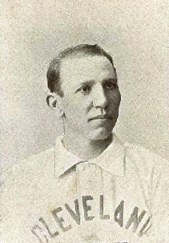
Zimmer was one of the best catchers in baseball for more than a decade.  He had brief trials in the National League with the Detroit Wolverines and American Association with the New York Metropolitans from 1884 and 1886, and was playing for the Rochester Maroons in the International Association in 1887 when his contract was purchased for $500 by the Cleveland Blues of the American Association.

zimmer

Chief Zimmer

Zimmer was the starting catcher for the Blues when the team moved to the National League and became the Cleveland Spiders in 1889, and remained in Cleveland until 1899.  In 1890, he caught 111 straight games; which was the Major League record for 19 years.

By January of 1903 the 43-year-old’s best days were behind when Philadelphia acquired him on waivers from the Pittsburgh Pirates and named Zimmer manager.

After a 2-2 start, the Phillies never saw .500 again and Zimmer quickly lost control of his team.

The team went into June with an 11-26 record.  Things got worse that month in Cincinnati when Zimmer put the team’s captain,  centerfielder and leadoff man Roy Thomas into the lineup–Thomas was  a devout Christian who did not want to play on Sundays.  The Philadelphia Record said:

“Manager Zimmer had some trouble getting Roy Thomas to play in the Sunday game, he claiming that he had not contracted to play on Sunday, and that he had no desire to break the Sabbath.  In the end, however, Zimmer prevailed and Thomas went into the game.”

The Philadelphia Times said Zimmer talked to the team’s new owner, James Potter, who was reported to have said:

“So he won’t play today, eh?  Well, then place him on the bench today, tomorrow and for the remainder of the season, without pay.”

Thomas relented, but told reporters before the game::

“I’m playing under protest.  There’s nothing in my contract that exempts me from playing on Sunday, but when I signed it I had no idea that the Philadelphia Club would change hands and abandon old precepts.”

The following Sunday, with the Phillies in Chicago, The Associated Press (AP) said:

“Thomas made his protest doubly strong and backed it up by staying out of uniform that day.”

After Philadelphia’s 4 to 2 loss, The Chicago Tribune said:

“The Phillies were somewhat crippled by the absence of Roy Thomas who does not like the new ownership of the club, because it believes in Sunday games. which Roy does not.”

As a result The AP said,  other players on the slumping team suddenly found religion.

“Now several other members of the team declare that they are as much opposed to playing baseball on Sunday as is Thomas and that their religious scruples are just as strong as his.”

The article quoted an unnamed member of the Phillies:

“(I)f the club insists on showing partiality to Thomas the others who also object to playing on Sunday, but who are willing to help out the club, will insist on the same privileges.”

Zimmer faced a full-blown revolt as they prepared to embark on a 19 game road trip:

“All of which portends a pleasant trip in the West for Zimmer when he starts out again.”

The Philadelphia papers did not continue to pursue the story during the Phillies’ 4-15  road trip, but it seems that for the remainder of 1903 Thomas backed off of his demand as he appears in box scores for several Sunday games in the final three months of the season.

Roy Thomas

Roy Thomas

The Phillies limped to a 49-86 seventh place finish, seven less victories than the previous season under Shettsline.  Zimmer was dismissed at the end of the season and was replaced by Hugh Duffy.

Thomas’ Sunday request was granted the following season, with manager Duffy making most of his appearances as a player in 1904 on Sundays when his centerfielder took the day off.  There is no record of teammates complaining about Thomas’ Sunday schedule under Duffy’s management.

Regardless of the team’s new-found harmony, the Phillies under Duffy finished 52-100.  Potter sold the team after the 1904 season to Bill Shettsline.

A shorter version of this story was posted 12-18-2012.


“A Knocking Umpire had Attempted to keep Speaker back”

11 Sep

Jesse Doak Roberts was a prominent figure in Texas baseball.  He was the two-time president of the Texas League (1904-’06 and 1920-’29), and had an ownership stake and managed clubs in the Texas and North Texas Leagues.

Jesse Doak Roberts

Jesse Doak Roberts, circa 1929

In 1911, the then owner of the Houston Buffaloes gave The Houston Chronicle his version of how Tris Speaker ended up in Boston:

“I want to tell you the story of the force that endeavored to act against the rise of Speaker—a force that did not succeed, but which cost me $700 in purchase money, and it was a knocking umpire.

“When Speaker was going at his best in his last year in this league (1906), I had made arrangements with Charlie Comiskey to purchase Tris for $1500…the deal was almost closed.”

Roberts said he was approached “by a (Texas) League umpire,” during a late-season game in Austin who, he claimed, demanded “a commission” for recommending Speaker:

“I told him that I had never asked an umpire to sell one of my players and would not—that I would prefer that they would not recommend any of them…I must have angered him, for he knocked the greatest Lone Star player to Comiskey (later) I got a draft from the Old Roman: ‘We can’t use Speaker.’

(George) Huff, then scouting for Boston, was in town.  He came around to see me and asked what I would take for Speaker.  I told him $1500.  He said that was too much for a class C player—that he would give me $500.”

Roberts said he then tried to sell Speaker to the St. Louis Browns (the biography “Tris Speaker: The Rough and Tumble Life of a Baseball Legend” said Roberts had attempted to sell Speaker to St. Louis earlier that season)

“I refused to accept (Huff’s) offer and wired (Jimmy) McAleer at St. Louis.  I told him I would sell him Speaker under a positive guarantee that he would make good.”

Tris Speaker "hardest hit"

                                 Tris Speaker 

Roberts said McAleer never responded and he “finally made an agreement to sell the boy for $800 cash,’ to Boston.

“A knocking umpire had attempted to keep Speaker back and had kept us from getting the difference between Comiskey’s price if $1500 and Boston’s of $800. And the White Sox lost a great player.”

Roberts never named the umpire who he said cost him $700.

The Pursuit of Elmer Foster

9 Sep

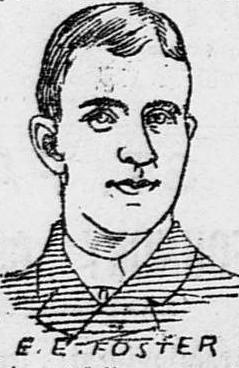
Elmer Ellsworth Foster was the talk of the Northwestern League in 1887.

His career as a pitcher had lasted just one season; in 1884, while pitching for the St. Paul Apostles, he snapped a bone in his arm while throwing a pitch.

Elmer Foster, 1887

            Elmer Foster, 1887

After he recovered, he returned the following year as an outfielder and second baseman with Haverhill in the Eastern New England League and hit .309.

The following spring, The Sporting Life’s Haverhill correspondent said the New York Metropolitans “have taken Elmer Foster from us.”

Hitting just .184 and, as The Sporting Life put it “reckless at the bat,” Foster went back to Haverhill in August.

In 1887, he returned to Minnesota, this time as centerfielder for the Minneapolis Millers.  The club was owned by his brother Robert Owen Foster, a successful dealer of musical instruments, who with his partner J. E. Whitcomb, had taken over operations of the Millers in January.

The Northwestern League of 1887 was a hitter’s paradise owing mostly to the single-season experiments with the four-strike rule and walks counted as hits—nineteen players with at least 350 at-bats hit better than .350—and Foster led with a .415 average and 17 home runs.   While his performance with the bat was noted, he received an equal amount of publicity for his great fielding.

Throughout the season, Minnesota newspapers reported that Foster’s contract would be sold to a major league team—the Indianapolis Hoosiers were the most frequently mentioned—but the deal never materialized.

When the season ended, The Philadelphia Times said Foster was in high demand:

“During the past week agents from nearly every League and Association (club) have been to Minneapolis to secure (Foster) for next season.  (Horace) Phillips of Pittsburgh; (Gus) Schmelz of Cincinnati; Ted Sullivan, agent for Washington; (Emery “Moxie”) Hengel agent for Detroit; (Charlie Hazen) Morton, agent for (A.G.) Spalding, and agents for the Brooklyn, Metropolitan, and Baltimore Clubs have tried to get him.

(John) Day, of New York, sent him this message:  ‘Multrie on the way to Minneapolis.  Make no promise until you see him.’  Boston also wired him for his terms.  (Horace) Fogel of Indianapolis arrived one night and had Foster in tow all the next day.  The bidding of all these clubs has been going on briskly, until now he is offered exorbitant figures by all the clubs.”

Foster called the fight for services a “circus;” it also turned into a controversy, with two teams claiming to have signed him.  The Saint Paul Globe said:

“The circus he speaks of is a curious one, but he is sublimely unmindful of the part he took in it.  The rules of the baseball covenant prohibit the signing of players until Oct. 20…Manager Fogel of Indianapolis approached Foster before that time and made a verbal contract with him, but Manager (Jim) Mutrie, of New York, took him out to Delano (Minnesota), and after midnight  (on the 20th) got his signature.”

Jim Mutrie

                       Jim Mutrie

Years later, Ted Sullivan, who was perusing Foster on behalf of his Washington Nationals, described Mutrie’s method to sign Foster as a kidnapping:

“Jim Mutrie of New York (Giants) grabbed the great fielder Foster on the streets of Minneapolis…bound and gagged him, threw him into a cab and brought him ten minutes out of the city, held him there and dined and wined him until midnight…then compelled him to take $1000 advance money and a contract of $4500 (various other sources put Foster’s salary at $2400, and $4000).”

Foster, it turned out, didn’t simply have a “verbal contract” with Fogel and Indianapolis when he disappeared with Mutrie, but had, as The Sporting News said, accepted “a draft for $100,” from Fogel at the time the two agreed to terms.  Fogel and Indianapolis owner John T. Brush told The Indianapolis News and The Indianapolis Times that there was “a written agreement” between Foster and the club.

Foster’s wife gave birth to a daughter during the height of the controversy.  He told The Globe:

“If she had been a boy I would have named him Mutrie Fogel, in memory of the baseball managers I have been having a circus with.”

In the end, Indianapolis acknowledged that the agreement with Foster, whether written or verbal, was entered into three days before the legal signing date of October 20 and National League President Nick Young awarded Foster to the Giants.

Foster never had success at the plate during his brief major league career; he hit just .187 in 386 at-bats over parts of five seasons.  But Mutrie called him “(O)ne of the best fielders in the country,” and Sullivan said of Foster’s time in the National League, “(H)e was a wonderful fielder in that league.”

Elmer Foster

      Elmer Foster

After he was released by the Giants, he played 31 games with the Chicago Colts in 1890 and ’91, but his brief stay with the club allowed his name to live on with fans long after his career ended.  One of the favorite subjects of Chicago sportswriter Hugh Fullerton, who called him “The rowdy of the rowdies,” Foster’s name was a staple of Fullerton’s stories for three decades after his career ended.

Lost Advertisements–“162,859 Excited Fans”

7 Sep

mecca

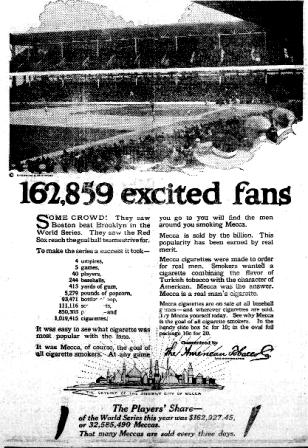
An advertisement for Mecca Cigarettes that appeared shortly after the 1916 World Series:

162,859 Excited Fans

“Some Crowd!  They saw Boston beat Brooklyn in the World Series.  They saw the Red Sox reach the goal ball teams strive for.”

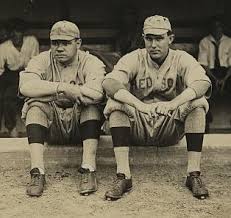
The Red Sox won the series 4 games to 1–Babe Ruth won one, a 14-inning complete game, and Ernie Shore won two, the first and fifth games.

Babe Ruth and Ernie Shore

          Babe Ruth and Ernie Shore

“To make the series a success it took–

4 umpires,

5 games,

40 players

244 baseball,

413 yards of gum,

5,279 pounds of popcorn,

93,471 bottles of pop,

111,116 score cards,

850,303 peanuts–and

1,019,415 cigarettes…

The Players’ Share–of the World Series this year was $162,927.45, or 32,585,490 Meccas.

That many Meccas are sold every three days.”

Winners shares for the Red Sox were $3,910.26, the Robins losing shares were $2,834.82.

Lost Advertisements–“Babe Ruth Home Runs”

4 Sep

ruthbbs

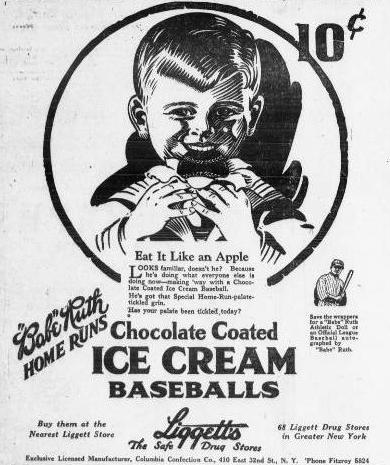
By 1922, Babe Ruth‘s name and image were used to sell dozens of products.  The above ad was for “Babe Ruth Home Runes Chocolate Covered Ice Baseballs.,” with the suggestion to “Eat it like an apple.”

“Save the wrappers for a ‘Babe’ Ruth Athletic Doll or an Official League Baseball autographed by ‘Babe’ Ruth.”

The ice cream was available at 68 New York area Liggett’s, “The Safe Drug Stores,” locations.

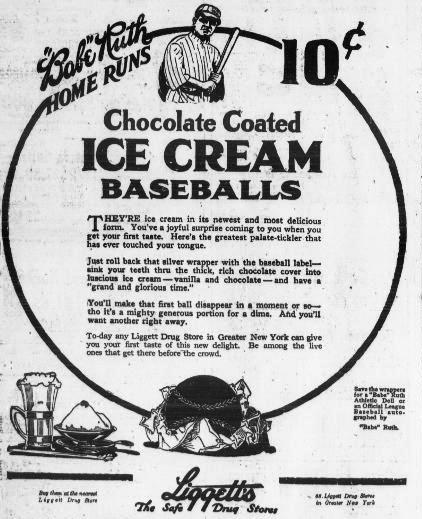
Below, is a second “Home Runs” ad featuring Ruth:

babeic


“The Sock on the jaw ended the game and their Friendship”

2 Sep

In June of 1922, Seventy-two-year-old Cal McVey was still working; more than 40 years after his final game with the Cincinnati Reds, he was a night watchman at a San Francisco lumber company.

A reporter from The San Francisco Call and Post called him to let him know the National League had just voted him a monthly pension.

“It was welcome news to the old-timer.  Jobs have been more and more infrequent and difficult to hold…Rheumatism and other ills of advancing age have meant weeks in the hospital…The idea of a benefit for the veteran had been suggested and abandoned, for the name ‘Cal McVey’ carried little significance to the bulk of 1922 fans.”

A benefit game on McVey’s behalf between two military teams held in 1919 at San Francisco’s Recreation Park had drawn a very small crowd.

The paper said

“(T)he league will only be doing what is partially due a man who was one of the real founders of organized baseball and one who did his full share toward keeping the game out of the clutches of the gamblers.”

McVey had been “approached” while playing for the Boston Red Stockings.

“This gambler was a friend of Cal and the two were playing billiards one day in Boston when the proposition was made…(McVey hit the gambler) so hard on the jaw that he forgot all about baseball and everything else for awhile…The sock on the jaw ended the game and their friendship.”

Cal McVey

                   Cal McVey

The Call and Post claimed McVey left major league baseball behind while still in his prime at the age of 30 partly as a result of his disdain for gamblers.  After the 1879 season, McVey, then manager of the Reds came to the West Coast with the team for a series of games with the Chicago White Stockings and local teams:

“Cal suspected two men on his team of being too friendly with gamblers.  But he could not prove anything on them, nor could he get the owner of the club to fire them (and) he was disgusted that fall because his team did not win the pennant when he thought it had the class to do so.”

After finishing in second place in 1878, the Reds added shortstop Ross Barnes and had high expectations for the 1879 season—McVey replaced Deacon White as manager in June—they finished the year 43-37 (34-28 under McVey) in fifth place.

McVey “took a flyer” on an investment in a mine while in California and The paper said he was “unlucky enough” to have quickly made a $3500 profit—he earned $2000 with the Reds that season.

“That settled it.  No more baseball for him (not entirely, McVey did play in the California and Pacific Leagues in 1880 and played with some independent teams in the mid-1880s). He was cut out for a mining broker.  He sold his stuff in Cincinnati and moved to San Francisco.”

McVey was successful in San Francisco until the 1906 earthquake and resulting fires:

“Cal was running a cigar store at Third and Folsom Streets…His wife (Abbey) was hurt in the disaster and, after a lingering illness of two tears, she died.  Cal says the light of his life went out when his wife died.”

After the loss of his wife and business, McVey worked a series of jobs.  In 1913, a wire service report said he had been “crippled” in a mine explosion in Nevada and friends in California asked many of his former teammates to help him financially.

It is unclear how incapacitated McVey was from the accident, in 1919 he was healthy enough to travel to Cincinnati for the World Series, but by 1922, when the National League granted his pension, McVey was nearly destitute and in poor health.  He told the reporter who called him with the news he “was proud today that the National League had ‘remembered an old fellow like me.’”

McVey 1922

                  McVey 1922

McVey died in San Francisco four years later.

The First Jackie Robinson All-Stars

31 Aug

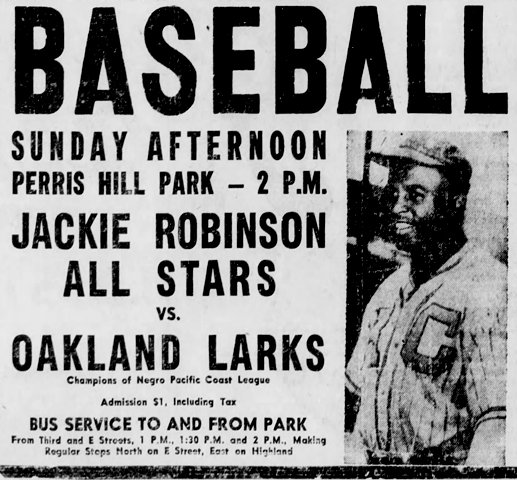
jackierobinsonas

The above advertisement is from the first, and least successful, of Jackie Robinson’s post season barnstorming tours.

In August of 1946, The Pittsburgh Courier said, “Jackie Robinson’s All-Stars” would play in several Eastern and Midwest cities after the Montreal Royals’ season ended.

The tour got off to bad start because the promoters—said to be from Pittsburgh, but never named in newspaper accounts—scheduled games to begin at the close of the International League season, failing to take into account that Robinson and Montreal would be playing in the Little World Series against the Louisville Colonels, the American Association champions.  East Coast games, including one at the Polo Grounds and one in Harrisburg, Pennsylvania were cancelled as a result.

After Robinson’s season ended, his “All-Stars” made up the game in Harrisburg and then played a handful of games in the Midwest before heading to California.

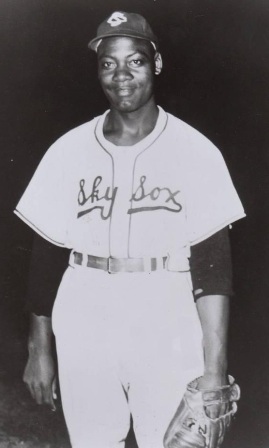
The All-Stars included Artie Wilson of the Birmingham Black Barons, John Scott of the Kansas City Monarchs. Ernie Smith, a one-time member of the Chicago American Giants, who played in 1946 with the Boston Blues in Branch Rickey’s U.S. Baseball League, and Bill “Wee Willie” Pope of the Pittsburgh Crawfords.

williepope

              Wee Willie Pope

Robinson’s All-Stars did not win a game in California.  They lost three games to Bob Feller‘s All-Stars—a team which included Bob Lemon, Stan Musial, Charlie Keller, Ken Keltner and Phil Rizzuto.  Feller’s club won 6 to 0 in San Francisco, 4 to 2 in San Diego, and 4 to 3 in Los Angeles.  Feller pitched five innings each in the San Diego and Los Angeles games—striking out 11 in the first game, and 10 in the second (he left that game having not allowed a hit through five innings).

One of those games was the impetus of the long-term animosity between Robinson and Feller that came to a head before the 1969 All-Star game.  At a press luncheon, Robinson noted the lack of black managers and front office personnel in major league baseball.  Feller criticized Robinson saying “The trouble with Jackie is that he thinks baseball owes him something.”  Feller told The Associated Press (AP) the bad feelings between the two started during the San Diego game on the 1946 tour:

“Jackie was getting a lot of publicity at the time since it was known he was being groomed to be the first Negro in big league baseball (and) threatened not to go on the field unless he got more money.”

Robinson told The AP Feller’s charge was “A damned lie.”

In 1975, Feller told The AP they “buried the hatchet,” before Robinson died in 1972:

“We discovered that out arguments were petty.  Both of us admitted our errors.  When Jackie died, we were good friends.”

Others claimed Feller never let the feud go.

The advertisement above is for the final game Robinson’s All-Stars played.  They faced the Oakland Larks, the champions of Abe Saperstein’s short-lived West Coast Negro Baseball Association (Negro Pacific Coast League) who posted a 14-3 record—the team barnstormed after the league folded and claimed a 56-12 record for all games played that season.

The teams played at San Bernardino’s Perris Hill Park; Robinson played center field.  The San Bernardino County Sun said he made “two stellar catches,” and was 3 for 4 with a double.  Despite Robinson’s efforts, the Larks won 8 to 5.

After Robinson’s final game with the All-Stars, he wasn’t quite finished for the year.  He joined the Los Angeles Red Devils, an integrated professional basketball team –three other well-known baseball players were members of the Red Devils: George Crowe, Irv Noren, and Everett “Ziggy” Marcel (the son of Oliver Marcelle).

Robinson’s brief professional basketball career ended in January of 1947.

“He fell off the Face of the Earth”

28 Aug

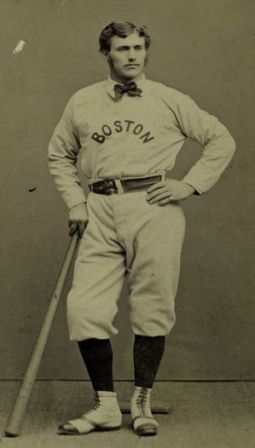
Charles Hazen Morton could run.  When he was playing shortstop and managing the Akron Independents in 1881 The Louisville Courier-Journal said:

“Morton, shortstop with the Akrons, can run like a deer.  It is probably that no one in the country can beat him for fifty yards.”

Morton’s major league career in the National League and American Association was unspectacular; he hit less than .200 with the Pittsburgh Alleghenys and St. Louis Brown Stockings in 1882, and the Toledo Blue Stockings and Detroit Wolverines in 1884 and ’85, he also managed Toledo and Detroit–Moses Fleetwood Walker and his brother Welday Wilberforce Walker played for Morton with the Blue Stockings.  He also managed the 1890 Toledo Maumees; Toledo’s only other season as a major league city.

Morton continued to manage minor league and independent teams through 1899.

After five years away from baseball he was the driving force in organizing several independent teams in Ohio and Pennsylvania into the eight-team Ohio-Pennsylvania League.  He was named president.

For two seasons, the league ran smoothly.  So smoothly that, according to The Akron Beacon Journal he was being aggressively pursued by owners in the Central League to assume the presidency of that league during the summer of 1906.  Morton chose to stay put.

As smoothly as things ran for two seasons, the tide turned badly in 1907.  Attendance was down all season and several franchises were on the verge of bankruptcy, and four teams wanted to leave the league entirely.  The Cleveland Plain Dealer said:

“Four O and P League clubs want a new league; four do not.  Four assert they will retire from baseball rather than be associated with the other four.  The league is deadlocked.  Neither side will give in.”

The Youngstown Vindicator said, “There seems to be no question that President Charles H. Morton will have strong opposition.”  Despite efforts to unseat Morton, he was narrowly reelected president of the league.

Ultimately, four teams did leave to form the Ohio State League.  But Morton told Sporting Life at the beginning of 1908 that he had managed to bring in four new clubs and was confident for the future of the O and P despite rumors that the league was in financial disarray:

“No, I do not think this is going to be a disastrous campaign.  The money stringency may hurt the crowds to a certain extent, yet people in this section of Ohio differ little from their brothers in other parts of the country. The germ of baseball Is not sporadic.”

He predicted that attendance would increase.

It didn’t, and things never got better for Morton.  After the 1908 season, it appeared all but certain he would be removed as president.

In December, two days before the league meeting was to begin in Pittsburgh, Morton abruptly canceled it.  A new meeting was scheduled for January in Cleveland and Morton’s fate seemed to be sealed.

On January 12 he traveled to Cleveland with representatives from the Canton Watchmakers and Akron Champs, likely his last two supporters.  But when the meeting was called to order Morton was nowhere to be found.  Samuel Wright, who had managed the Youngstown Champs the previous season, was elected president.

The Youngstown Vindicator said:

“He fell off the face of the earth so far as anybody knows.”

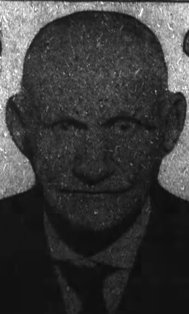
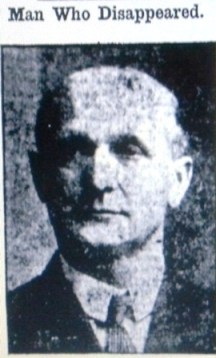
Charles Hazen Morton

Charles Hazen Morton

Some speculated he had run.

He disappeared with $2500 of the league’s money.  As days dragged into weeks there was no sign of Morton.

The Chicago Tribune said his friends were concerned that he had “done away with himself,” despondent over his pending removal as president.

The Marion Star said, “It is feared he has been thugged.”

The Pittsburgh Press advanced a conspiracy theory.  Under the headline “See Deep Plot in Morton’s Absence.”  The paper claimed  the Canton and Akron clubs realizing that he would be ousted had conspired with the president to have him disappear so, “Wright while really elected is far from president (of the league).”

But there was no conspiracy, Morton had really disappeared and remained missing for more than two months.

On March 16 he resurfaced.  Morton was found “wandering aimlessly” on Wabash Avenue in Chicago, near his brother’s home.  The Akron Beacon Journal said he was diagnosed with “Acute dementia (and) his mind is now a blank.”

The only clues where Morton had been for more than two months, were papers in his pockets which indicated he had been in Mexico and Texas and, The Beacon Journal said, “He mutters incoherently about Corpus Christi.”

He recovered enough to return to Akron by August of 1909.  His brother reimbursed the league $1500 that was not recovered after he was found.

Morton faded into obscurity after his return to Akron.  There was no follow-up to his story.  None of the many questions about his disappearance were ever answered.  And whatever happened in Corpus Christi died with him in 1921.