Archive | Uncategorized RSS feed for this section

“If we had a Veritable Ty Cobb among us, and no one Cared to See him, what would it Matter?”

7 Jan

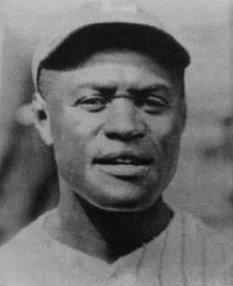
At the beginning of the 1914 baseball season, Andrew Bishop “Rube” Foster believed baseball’s color line was on the verge of being broken.
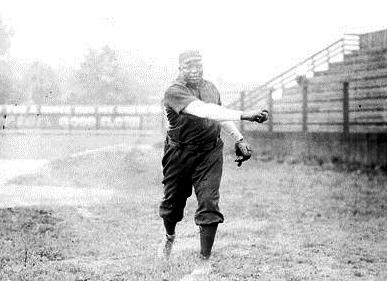
Rube Foster

Rube Foster

He talked about it with The Seattle Post-Intelligencer while touring the West Coast with the Chicago American Giants:

“Before another baseball season rolls around colored ball players, a score of whom are equal in ability to the brightest stars in the big league teams, will be holding down jobs in organized baseball…They’re taking in Cubans now, you notice and they’ll let us in soon.”

Billy Lewis, a writer for The Indianapolis Freeman did not share Foster’s optimism:

“It goes without saying it emphatically, that Foster’s opinion sounds mighty good to the ‘poor down-trodden’ colored players who have to do so much ‘tall’ figuring in order to make ends meet.  But the plain fact of the matter is that Rube has drawn on his imagination for the better part of his opinion.  For as much as I hope and as colored players and people hope for better days for the colored players there’s nothing to warrant what he had to say. Foster is having the time of his life, riding about in special cars out west, and naturally enough with the distinguished consideration paid him and his bunch of players, he feels to give out something worthwhile.

“Rube Foster nor the rest of us should expect to see any change in the baseball situation until there’s a general change…fact is, that our people are not breaking into the big leagues, and there’s no talk of them breaking into the big leagues, and there is not the slightest indication that they are needed.  This sounds rather severe, yet it is the truth, and that’s what we need even if we should not want it.  It may not make us free as it is so often insisted on.”

[…]

“As severe as the foregoing appears it has nothing to do with the playing ability of colored baseball men.  Expert sport writers long ago conceded that there were colored baseball players who played the game equal to the ‘high browed’ white players who drew their $3,000 plus per annum. It’s an old story why these competent men are not registered in the great leagues.  Really there is less opportunity for Negroes to play with the big leagues in the last few years than formerly. “

Lewis said Foster was wrong to claim that the acceptance of light-skinned Cuban players was positive sign:

“It is generally known that the Negroes stand last in the list of acceptability, hence it is rather poor diplomacy to speak of the preference shown for the Cubans.  It is right, all right.  Nevertheless, Cubans, Indians, Filipinos and Japanese have the right-of-way so to speak.  Of course they are not wholly persona grata, but they are not in the class with the colored players, who are absolutely without friends at court.”

Additionally, Lewis said fans were not ready for integration:

“If the management were inclined to take on the good ones among the colored players, they could not do so with impunity.  The box office is more often the dictator of terms than we think.  If we had a veritable Ty Cobb among us, and no one cared to see him, what would it matter?

“Foster is positive that he has the greatest player in the world in (John Henry) Lloyd.”

Foster had said of the shortstop:

“If you don’t believe it, wait until he gets into the big league—then watch the (Jack) Barrys, the (Honus) Wagners and the (Joe) Tinkers sweat to keep their jobs.”

Lewis said:

“It’s a fine boost for Lloyd, coming as it does from the famous Rube himself, yet we all know that if Lloyd was twice himself he would be no good unless it were the general sentiment that a man was a man.”

John Henry lloyd

John Henry Lloyd

Lewis felt Foster was deluded by the large percentage of white fans who watched him play when the American Giants barnstormed on the West Coast:

“The far west at this time seems ideal in the matter of patronizing games where colored and white teams are engaged.  But in spite of this there is no disposition in that seemingly fair country, to put colored men on the greater teams.  So it is not less than an iridescent dream.”

Lewis told his readers he did not disagree with what Foster desired, but said the great pitcher was basing his optimism on the of the wrong people:

“Much of the foregoing doubtless appears as an argument against mixed clubs.  It is not that way.  The object is to show up the true situation, the further object being to make the most of it. We will not be able to make the most of it as long as we fail to have the proper conception of things.  There are white managers who would gladly take on Negro players if it meant something by way of advancing their clubs.  But as said before it is the box office that dictates…the man on the bleachers and the man in the grand stand are together, and the manager must come by them…What have these to say about colored players entering the big league?  That’s the question.”

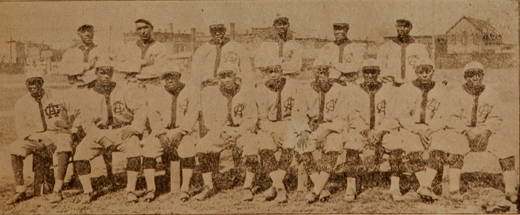
1915amgiants

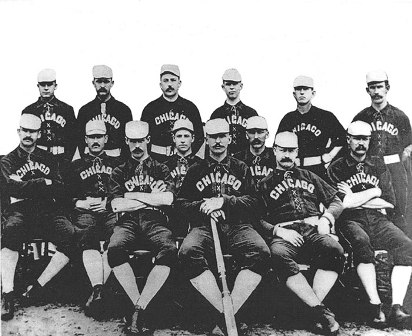
The 1915 Chicago American Giants–Rube Foster is standing third from left, John Henry Lloyd is standing fifth from left. A year after Foster’s prediction, white baseball wasn’t calling.
 

“Boys of ’76”

5 Jan

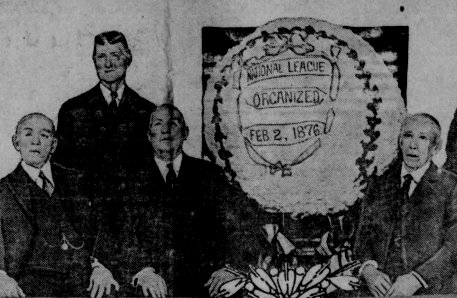
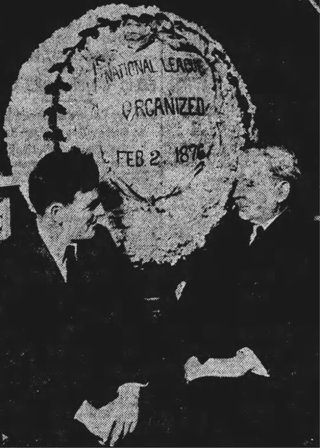
On February, 2, 1925, The National League magnates “paused in (their) schedule deliberations” to honor the league’s past, and kick-off the diamond Jubilee celebration.

Thomas Stevens Rice, of The Brooklyn Eagle said:

“In the very same rooms in which it was organized on Feb. 2, 1876, the National League of Professional Baseball Clubs met again yesterday.  These rooms are in what is now called the Broadway Central Hotel, then called the Grand Central Hotel.”

The Associated Press said:

“In the same room in which Morgan G. Bulkeley, of Hartford, Conn., was elected the first president of the National League, the baseball men, paid tribute to the character and courage of those pioneers a half century ago.”

Dozens of dignitaries were on hand, including, John McGraw, Christy Mathewson, John Montgomery Ward, and Governor John Tener

But, the stars that day were six of the surviving players who appeared during the league’s inaugural season:

George Washington Bradley, 72, who won 45 games for the St. Louis Brown Stockings; John “Jack” Manning, 71, who hit .264 and won 18 games as an outfielder and pitcher for the Boston Red Stockings; Alonzo “Lon” Knight, 71, an outfielder and pitcher for the Philadelphia Athletics in 1876 and hit .250 and won 10 games, and three members of the Hartford Dark Blues, Tommy Bond, 68, a 31-game winner; Tom York, 74, who played leftfield and hit .259, and John “Jack” Burdock, 72, an infielder who hit. 259. Also present was the only surviving umpire from the 1876 season–Calvin J. Stambaugh.

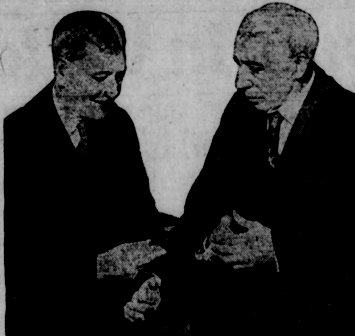
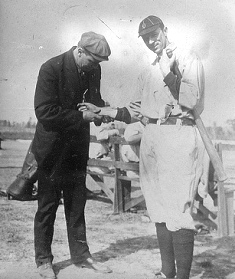
Calvin Stambaugh, right, the last surviving umpire from 1876 and Frank Wilson, a national League umpire from 1923 until his death in 1928.

Calvin Stambaugh, right, the last surviving umpire from 1876 and Frank Wilson, a national League umpire from 1923 until his death in 1928.

Other surviving 1876 players, including George Wright and and Al Reach cited “advancing age” for their inability to attend.

feb21925pix

Seated from left: York, Bradley, and Manning. Standing: Bond.

 Bozeman Bulger of The New York World said, in relating a conversation between too of the attendees, the event was notable for another reason as well:

“(S)everal of us younger men, moving over closer, discovered a contradiction of a tradition long cherished, that old-timers never could admit any improvement in the game or in the quality of the players.

“‘Have you seen this young fellow, Babe Ruth?’ Bradley asked of Manning.

“‘Yes, indeed,’ admitted Mr. Manning, ‘and don’t let anybody tell you that we ever had a man who could hit a ball as hard as that boy.  I doubt if there will ever be another one.'”

Bulger said the “Boys of ’76” also talked about how they “fought crookedness when a salary of $1,800 a year was considered big pay for a star.”  Bradley, who after baseball became a Philadelphia police officer, said:

“‘Oh, we had crooked fellows following us around back in ’76.  They pretended to make heroes out of us and would hang around the hotels.’

“‘One day Mr. (Chicago White Stockings President, William) Hulbert, a very learned man, advised me to keep away from these men.  He explained how they could ruin a boy and lead others into temptation . I was often approached, but thanks to that wise counsel, I kept myself straight, and I thank God for it today.  It’s worth a lot to me to look you younger men in the eye and feel that in turning the game over to you, we gave you something that was honorable.  It’s up to the players to keep it honorable.”

Tom York summed up his feelings about the game in 1876:

“‘Say, do you remember how proud we used to be after winning a game, when we walked home still wearing our uniform and carrying a bat–and the kids following us?  Ball players–all except Babe Ruth–miss that nowadays.”


bondmanning

Bond and Manning talk pitching at the Golden Jubilee kickoff event in 1925.


McGraw’s “Rubber”

2 Jan

In 1903 and ’04 the Boston Beaneaters finished sixth, and seventh, while the New York Giants followed a second place finish in 1903 by winning the pennant in ’04.

Jacob Charles “Jake” Morse of The Boston Herald said he it wasn’t just talent that made the Giants more successful:

“It is astonishing that so little attention is paid to the care of baseball players during the training season and the playing campaign, especially the former.  It is in the spring that arms need the most careful cultivation and a first-class expert is almost indispensable.

“A first-class ‘rubber’ ought to be taken by every club that goes South, and if this were done sore arms and muscles would be reduced to a minimum.

“Here in Boston neither club has what is called a trainer or a ‘rubber.’ The New York National League club has had the services of the well-known ‘rubber’ Gus Guerrero, for several seasons, and he has given satisfaction.”

Before coming to the Giants as the team “Rubber,” Guerrero had made a name for himself as a competitive walker and runner.  The San Francisco Call said of him:

“Back in the late (eighteen) seventies Guerrero was the one best bet when it came to a foot race, whether for one or for 500 miles, six-day match, or even if the proposition called for a jaunt from the Pacific to the Atlantic coast.  Anything went with Guerrero; he ran for 48 hours, making 300 miles flat in that time, and once in 1884 he trundled a wheelbarrow from San Francisco to New York City.”

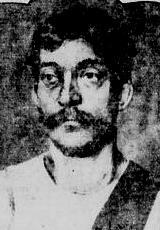
Gus Guerrero

Gus Guerrero

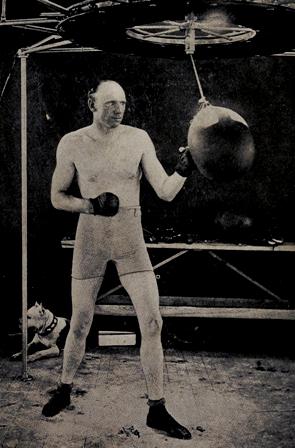
Guerrero, often billed as “The Mexican,” and “The best athlete Mexico ever produced,” was actually born in Northern California.  He became an athletic trainer in New York in the 1890s and began working for the Giants in 1900.

John McGraw inherited Guerrero when he came to New York in 1902, and swore by his “Rubber.”

The Associated Press said, in 1904 when McGraw, trying to rehabilitate his injured knee, took Guerrero on the spring training trip south:

“Last year (McGraw) depended on local massage men to rub and bandage the bad knee, but they did not understand the job.  Guerrero, a professional, has been spending several hours per day solely on McGraw’s weak muscles and has succeeded in hardening them so that the joint is fairly protected and does not spring at a critical moment.”

The New York Press said of Guerrero:

“(He) wears a baseball shirt labeled ‘New York’ all the time.  McGraw says he believes Gus sleeps in it. As the men come in he looks them over, particularly the pitchers.  If a box man complains of a stiff arm the trainer attends to it as carefully as a physician looks after the throat of an operatic prima donna.  He makes the player strip, steams him, puts him on a slab, massages him, and then rubs in a liniment of his own concoction which he declares would take the stiffness out of a telephone pole.  It is equal parts of witch hazel and alcohol to a quart; with half a teaspoon of oil of wintergreen and a dash of something else that Guerrero says is his secret.”

While McGraw seemed impressed with Guerrero, it appears some of his players were not.

When the team was training in Birmingham, Alabama during the spring of 1904, The New York Globe’s Allen Sangree, who was traveling with the Giants, wrote about an exchange between Guerrero and Christy Mathewson:

“Mathewson, in particular, was feeling grouchy yesterday.  ‘How’s your arm?’ asked Gus Guerrero, the rubber, as he put the finishing touches on him…’Arm alright,’ said Matty, ‘but I don’t feel good.’

“’Well, what’s the matter?’ pursued the rubber.

“’Nothing, didn’t I tell you!’ yelled the big fellow, in exasperated tones.  ‘Just nothing, only I don’t feel good; and don’t bother me either.’”

Just after Jake Morse wrote about the advantage McGraw’s “Rubber” had given the Giants, it was announced that he would no longer be the team’s trainer.

The New York Herald said:

“Gus and the players could not get along well, so he resigned.”

McGraw, who remained “a strong believer in massage treatment for pitcher’s arms before and after the game,” and replaced Guerrero with Harry Tuthill—Tuthill had trained several fighters, including William “Young Corbett II” Rothwell, and “Mysterious” Billy Smith.   Tuthill was with New York until 1908 when he joined the Detroit Tigers.

Harry Tuthill, with Tigers pitcher Del Gainer

Harry Tuthill, with Tigers pitcher Del Gainer

Guerrero never worked for another major league club. He continued to participate in races, and eventually returned to California where he died in 1914.

Pfeffer on Kelly

31 Dec

When Mike “King” Kelly died in 1894, Fred Pfeffer his teammate with the White Stockings from 1883-1886 eulogized him in The Chicago Times:

“He played by intuition, by instinct. Signs were not part of his equipment.  Most infielders use signals.  Kelly and I never had one.  We never tried them.  He was alive to every contingency which could come up in a ball game.  His wonderful powers of perception enabled him to protect every angle of the game and he would do so.  I studied Kel and got so close to him mentally that I knew just what he was liable to do and was always prepared to back him up.

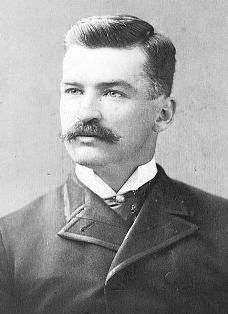
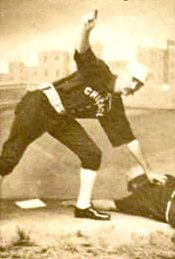
Mike "King" Kelly

Mike “King” Kelly

“He was the creator and the father of more original fine points than any man who ever stood behind a mask.  At the bat, on the base lines, in the coacher’s box, wherever you put Kelly, he was per se, a king.  His strongest playing point was that he was always ready.  He could take advantage of a misplay which others wouldn’t see until afterward.  He was a marvel at base running.  By that I do not mean that he had any extraordinary speed, but he out generaled, if I may use the term, the men who were chasing him.  He could cut the base and do it in such a manner that he would get away with it.

Fred Pfeffer

Fred Pfeffer

“He played the umpire as intelligently as he did the opposing nine.  He would make a friend of him, engage his confidence, and in various ways get the best of close decisions.

“He was never guilty of dirty ball playing.”

“Wallace’s Head is Abnormally Developed”

29 Dec

When Bobby Wallace was named manager of the St. Louis Browns in 1911, the local press, desperate for any ray of hope for a club that finished in eighth place with a 47-107 record, enlisted a “noted phrenologist” named Squeers from Hot Springs, Arkansas to examine the new manager.

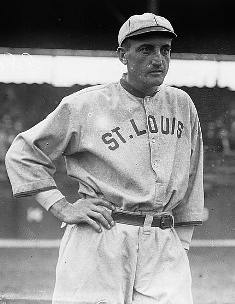
Booby Wallace

Booby Wallace

Phrenology was a popular pseudoscience in the in the 19th and early 20th Century that claimed the structure of the skull determined a person’s mental ability and character.

The result of Wallace’s examination was reported in several newspapers:

“The eminent brain specialist pronounced the manager of the Browns one of the most normal-minded men he had ever examined.  He did not know his man when he made his diagnosis.

“Wallace’s head is abnormally developed on the left side.  This is as it should be, Dr. Squeers declares.  The left lobe of the brain governs the right side of the body…It is natural, asserts Dr, Squeers, that a man should be right handed, right-footed, right-eyed, that the right side (of the body) should be larger and stronger than the left.”

It was not enough to declare Wallace “normal minded,’ the “doctor” also “diagnosed” roughly 10 percent of the general population.  He said because “It is natural” to be right-handed, left-handers therefore, were “in many cases a bit abnormal.”

The litany of “abnormal” left-handers–Rube Waddell, Crazy Schmit, Nick Altrock, Slim Sallee, Lady Baldwin, etc…–were trotted out to demonstrate the “proof” of the assertion.

 “For whatsoever the reason may be, the man whose throwing arm is governed by the right lobe of his brain seems bound to be erratic.  Thus is Dr, Squeers, knows little of baseball, justified in pronouncing Wallace an ‘abnormally normal’ man.  Wallace is the farthest thing from erratic that any man could be.  He could not do a left-handed or wrong thing—could not act abnormally to save his soul.”

[…]

“Wallace has been the quietest, most regular, most normal human being in the world.  He is the perfection of moderation, of balance in all things.  He takes life quietly and is never disturbed or out of temper.  He has never made an enemy.  He is the favorite of everyone…It remains to be seen if normality means success when it is applied to the management of a baseball team.”

In this case it didn’t.

The Browns, awful in 1910, were awful again under Wallace in 1911; another eighth place finish with a 45-107 record.  After a 12-27 start in 1912, George Stovall replaced him as Browns manager.

Wallace managed one more time—he replaced Chuck Dressen as manager of the Cincinnati Reds in September of 1937.  The “most normal human being in the world” was 5-20.


Lost Pictures–Sidney Smith’s Baseball Cartoons

26 Dec


sidneysmithapril221909

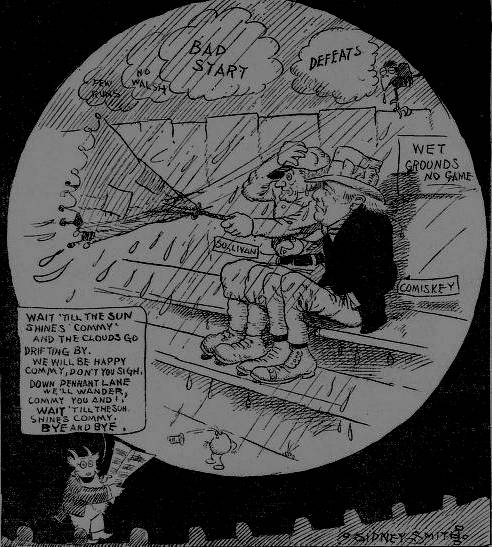
By the time of his 1935 death in a car accident, Robert Sidney Smith—known professionally as Sidney Smith—was one of America’s most popular cartoonists; The New York Times said his death “will be felt by literally millions of Americans.”  His comic strip, “The Gumps,” was syndicated by The Chicago Tribune, and ran in hundreds of newspapers; it also spawned dozens of animated film shorts, nearly fifty-two-reel comedy film, a radio program and merchandise.

But, before Smith joined The Tribune, he had started in Chicago drawing baseball cartoons for The Chicago Examiner.

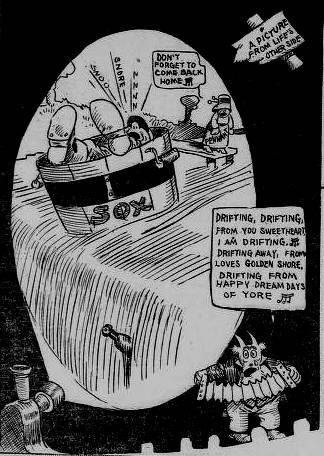
The cartoons featured a talking (sometimes singing) goat named Buck Nix.

These two examples chronicled the  fortunes of the 1909 Chicago White Sox.

The first, above, appeared just seven games into the season.  Chicago had high hopes for the Sox, 86-64, the previous season, but the club limped to a 3-4 start.

As the cartoon notes, in addition to bad weather and weak hitting causing a poor start for President Charles Comiskey and Manager Billy Sullivan, Sox ace “Big Ed” Walsh was not yet with the team.  Walsh, a forty game winner the previous season held out for $7,500 and did not sign until April 28.  Still hopeful, “Buck Nix” says “Wait ’til the sun shines Commy.”

The second, below, appeared on June 26.  The Sox were 24-28, in fifth place, and as Buck Nix sings were “Drifting away from loves golden shore.”  Walsh only started 28 games, the Sox hit just .221 as a team and were never in the race.  They finished 20 games out in fourth place.sidneysmithjune261909

“When Wagner Comes to Bat”

24 Dec

A poem composed by Grantland Rice in The Nashville Tennessean in 1909:

Grantland Rice

Grantland Rice


I know just how a fellow feels the cold gray ‘morning after;’ when all about the ceiling reels there’s little show for laughter;

I know just how it hits a guy when bills begin to grow, and bill collectors on the sly line up in motley row;

I know exactly how he feels when up and down they face him, and with a line of endless spiels they follow him and chase him;

But in the line of ticklish deals that send one to the mat, I wonder how the pitcher feels when Wagner comes to bat?

I know about how Roosevelt feels out in the jungled space, with boa constrictors at his heels and hippos at his face.

I know how it would strike me out in some wild western lair, if I should swiftly turn about, and face a grizzly bear, or walking down a street high-fenced, with no long stretch to run, should find my features pressed against an automatic gun;

But in the line of ticklish deals that leave one feeling flat, I wonder how a pitcher feels when Wagner comes to bat?

Honus Wagner

Honus Wagner

Things I Learned on the Way to Looking up other Things #13

22 Dec

Chief Meyers on the Plight of the Native American, 1913

John W. McConaughy, the former sports editor of The St. Louis Post-Dispatch, was no longer writing about baseball regularly as the New York Giants prepared to face the Philadelphia Athletics in the 1913 World Series.  McConaughy, who was the Washington correspondent for The New York Journal, was enlisted by the paper to write about some of the key figures of the series.

The result was, in the case of John “Chief” Meyers, a profile that went beyond a typical baseball story:

Chief Meyers

Chief Meyers

“Meyers is one of the coolest, shrewdest and quickest thinking catchers that ever came to the big leagues.  He has both gray matter and gumption, and the one is useless without the other in baseball as elsewhere.  He has a fund of general information that runs from national politics to the philosophy of Plato, and a delicately adjusted sense of humor, and these two combine to give him a good perspective of the national game.”

[…]

He is ready to fight any time for justice and fair play and he is so good-natured that he isn’t seriously annoyed when the fans perpetrate that bum war-whoop every time he comes to bat.

[…]

“One day in Cincinnati he asked the writer to go out to the art museum with him.  We came upon a bronze—an Indian turning to shoot an arrow at his pursuers.

“’There’s the idea.’ He said, pointing to the warrior.  ‘They never learned how to fight.  They had nothing but the willingness.  If Tecumseh had been as big a man as Napoleon he would have killed off the medicine men as his first official act, learned the white man’s style of warfare—and there would have been an Indian nation here today.

“’I don’t mean that the white man would not have been here, too.  But with a few leaders—real big men—our fathers would have come to see that the white man’s type of civilization was the highest, just as the (Japanese) have done.  We would have had great states and communities in the union, and we would have been useful, progressive citizens.

“’As it is the Indian is robbed by agents and shifted from reservation to reservation whenever anyone happens to want their land.  Tribe after tribe is scattered, and in another hundred years my people will have gone the way of the Aztecs.’

“Still, there will always probably be a few fans who will think it bright to pull the war-whoop when the Chief comes to bat.”

Tom Lynch Cracks Down, 1910

In June of 1910, The Associated Press said that after a 5 to 4 New York Giants victory over the St. Louis Cardinals, umpires Jim Johnstone and August Moran “stood in front of the press box and made remarks about the baseball writers.”

National League President Thomas Lynch, who had announced his intention to “break this habit of having players call the arbitrators bad names” said in response:

“I also will not stand for umpires talking back to spectators or taking it upon themselves to criticize newspaper men.”

National League President Thomas Lynch

National League President Thomas Lynch

He fined Johnstone and Moran $25 and $15 respectively for the incident.

In that era of newspapermen as frustrated poets, George E. Phair, then of The Milwaukee Sentinel, was one of the most prolific, often including a poem in his articles.  He dedicated the following verse to the National League President:

Old Thomas Lynch, who runs a league,

     Would propagate urbanity;

In fact, Sir Thomas would intrigue

     To curb the umps’ profanity.

He warns his umpires while within

     The baseball scribes vicinity

To speak no words that reek of sin,

     But emulate divinity.

He tells them not to harm the scribes,

     Nor flout at their ability;

Nor pester them with jokes or jibes;

     Nor laugh at their senility.

He plasters fines upon his umps

     For showing their ferocity

And calling scribblers ‘mutts’ and ‘chumps’

      With Teddy-like verbosity.

The veteran Sir Thomas is

     Most generous and affable,

But we’re inclined to think that his

     Solicitude is laughable.

The ump may blunder now and then

     And break into profanity;

The scribbler jabs him with his pen

     And drives him to urbanity.

Comiskey Tells a Tommy McCarthy Story, 1899

George Erskine Stackhouse, the baseball editor of the editor of The New York Tribune, spoke to Charles Comiskey in 1899 and found him in a “somewhat reminiscent mood.”  Comiskey told a story Tommy McCarthy when the two were with the St. Louis Browns:

Tommy McCarthy

Tommy McCarthy

“I heard in Chicago the other day that tom is in Boston, as fat as a Tammany alderman, and making money out of a big bowling alley.  (Hugh) Duffy owned an interest in it, but they say Tom bought him out.  I had Tom with me in St. Louis.  And say, St. Louis is the best town on earth for a winner.  They used to distribute among the players every season watches and rings and studs and pins enough to stock a jewelry store.  There was a diamond medal offered one year for the best base runner on the Browns.

“Tom McCarthy was quite a boy to steal bases, and after the medal was offered he wouldn’t run out his hits.  If he made a two-bagger, he would stop at first, and if he slammed the ball for a triple, he would manage to bring up at second, so as to get a chance to steal a base.  Of course, after a bit, I got on to him, and I had to warn him that if he didn’t stretch those hits I would have to lay him off altogether.  That helped some, but he was always hanging back when he thought he could get away with it.  I remember once that he had a chance to go down to second on a wild throw to first, and what does he do but toss his head and drop off his cap, so that he could stop and come back after it and stick at first.  He won that medal.”

“Take a Chance, any time, and Fight all the Time”

19 Dec

John W. McConaughy was just 19 when he became the sports editor of The St. Louis Post-Dispatch in 1903.  Over the next 30 years he worked as the Washington Correspondent for The New York Evening Journal, was the production manager for William Randolph Hearst’s film company, Cosmopolitan Productions, and was a member of the Creel Committee, created by President Woodrow Wilson to influence public opinion at home and abroad during World War I.  He also published several books on crime, politics and sports, including: “From Cain to Capone,” “Who rules America?: A Century of Invisible Government,” and “Big Jim Jeffries: His Twelve Greatest Battles.”

But, he continued to write about baseball long after he left St. Louis, including a profile of New York Giants Manager John McGraw on the eve of the 1913 World Series for The Evening Journal:

“The most distinctive and aggressive personality in baseball—this is John J. McGraw, the wonderful leader of the Giants.  He has been at one and the same time the most abused and most admired man in the national game.

John McGraw

John McGraw

“He has been called a rowdy and a Napoleon in equal parts.  He has been mixed up in more rows than any big league manager; but he has also been mixed up in more pennants… (Connie)Mack is his only rival for the title of greatest manager in the game and no two men in the world were ever more widely apart in character and methods than these two.  The old fox of Philadelphia has been dealt with elsewhere.  His system is carefully constructive work, leaving nothing to chance.

“McGraw’s motto is:

“’Take a chance, any time, and fight all the time.’

“He believes especially in fighting, but he is of the mind of Polonius in not advocating fighting as an end.  It is always a means with McGraw.  There is method in his mixing.  He has been represented as running amuck through baseball for the love of a rough-house.  Nothing is further from the truth.  When McGraw has a row on the ball field he figures that he is going to win something material at some time as a result.

“For instance, you never hear of any of the Giants being suspended or fined for battling with the umpires these days.  Why?  Because McGraw discovered that the magnates meant business in their manifestos against bully-ragging the arbiters and the chief of the Giants decided that a star on the field was worth six on the bench, recovering from the effects of ea sing their mind to an umpire.

“’I’ll do all the kicking from now on,’ he told his warriors.  ‘If any man is benched by an umpire I’ll fine him myself.  Let ‘em put me out of the game.  I’m not out there playing.’”

McConaughy said the two things McGraw looked for when evaluating players was “speed and brains,” but only the first one was non-negotiable:

“’It is possible to get good baseball out of a bonehead,’ he said once, ‘if you never expect him to think. Whenever there is any thinking to be done do it for him, and land on him with both feet if he tries to do any himself.

“By following this system he has actually made popular heroes out of notoriously slow-witted athletes.  He is out there on the coaching line thinking for them.”

McGraw, he said, was the “quickest and most daring thinker” in the game:

“It is characteristic of his aggressive mind that he is the only baseball leader who has no use for the sacrifice hit.  There is no doubt that he has lost many ball games by not using it, but there is also no doubt that he has won many a game by discarding it.  He follows offensive tactics of the dashing kind.  He is all for the hit-and-run and the double steal.  He believes in hitters and always has at least one a better than average hitting club, and his argument is that there is no sense in getting .300 hitters and ordering them to chuck away a one-in-three chance for a clean hit to advance a man a base at the cost of an out.”

McConaughy said McGraw was the ultimate player’s manager:

“He is the boss-he gives the orders and takes the blame.  He never breaks into print with anything like criticism of any man on his team no matter how much to blame any man may be for any disaster.

“He demands strict obedience and whole-hearted loyalty from his men, and he stands by them against all comers all the time and under all circumstances.  It doesn’t make any difference if every fan and sporting writer on the circuit has turned down his thumbs on a ballplayer.  This is usually a good reason, in McGraw’s system for moving him up a few places in the batting order and making him a regular player in a prominent position.

“There is scarcely a manager in the country who would have clung to (Fred) Merkle under the terrific panning that unfortunate man was let in for by his historic play at second base.  McGraw’s answer to the storm of abuse was to make him regular first baseman of the club, a place he has filled with credit.”

While McGraw did always defend Merkle for “his historic play, “he did not make him the “regular first baseman,” during “the storm of abuse” immediately following “Merkle’s Boner” in September of 1908, but  rather after the release of Fred Tenney following the 1909 season.

McConaughy summed up McGraw:

“His men are always looking for a chance to swear by him, and the fans around the circuit are equally keen for a chance to swear at him.”

Connie Mack, who McConaughy said was McGraw’s “only rival” for the title of baseball’s best manager, guided his Philadelphia Athletics to a four games to one victory over McGraw’s Giants in the 1913 world Series.

McGraw and Mack two years earlier at the 1911 World Series.

McGraw and Mack two years earlier at the 1911 World Series.

“People who saw the Sport are still Laughing”

17 Dec

High expectations came with George W. “Big Mike” Mahoney to his hometown Boston Beaneaters in 1897.

A baseball, track and football star at Georgetown University—he played football until the University disbanded the team after his backfield mate George “Shorty” Bahen—a foot shorter than Mahoney– died from injuries sustained during the team’s Thanksgiving Day game against Columbia in 1894.

George "Big Mike" Mahoney

George “Big Mike” Mahoney

In 1895, he gained notice for his pitching after striking out 13 batters in a game with Yale.

The following year, The Philadelphia Times said:

“He has won enviable renown as a pitcher, where his remarkable strength, speed and ability to curve have made him a very formidable player.  He has also played football, where his remarkable physique, weight and strength have stood him in good stead.  One would imagine that his weight—236 pounds—would prevent his running with any remarkable speed, but it is so distributed—he being probably the largest athlete in the college world, measuring six feet five—that it is little of an encumbrance to him.”

In the spring of 1897, it was rumored that Mahoney would not return to Georgetown and instead sign with Boston.  The Philadelphia Inquirer said:

“(I)t is understood that he will play professionally with the Boston league team.  Mahoney is considered a wonderful pitcher, as well as being a fine catcher and first baseman.”

Shortly after signing with the Beaneaters, The Washington Evening Times said Mahoney had been offered the opportunity to take up yet another sport:

“(Mahoney) has a chance to shine pugilistically.  En route to Pittsburgh Sunday the Bostons had Bob Fitzsimmons for a traveling companion.  Fitz was smitten with Mahoney’s size, and offered to take him in charge and coach him into a high-class heavyweight.”

Bob Fitzsimmons-wanted to train Mahoney for the ring.

Bob Fitzsimmons-wanted to train Mahoney for the ring.

Mahoney turned down the offer.

On May 18 Boston was in Chicago; trailing the Colts 9 to 5 in the eighth inning, Mahoney made his big league debut on the mound for the Beaneaters.

The Colts and The Chicago Daily News were not kind to the rookie:

“Mr. Mahoney, the largest man seen in the League for many moons, made his debut in professional ball at the west Side Grounds yesterday.  He now wishes he had tarried at his Georgetown school.  The reception given Mr. Mahoney was one of the warmest ever seen around these districts since the year 1, and the people who saw the sport are still laughing.

“Mr. Mahoney is 6 feet 5 or more, and one of the finest looking men imaginable.  Small girls, who admire big men, could be heard squeaking, ‘Isn’t he cute?’ all of the stand.  He has been loafing around the park during the present series, doing nothing but taking life easy, and the multitude were really getting inquisitive as to who he was and what right he had to live.

“He went into the fray at a rather inauspicious time.  The Colts had just demolished (Ted) Lewis and had biffed fat (Jack) Stivetts in the solar plexus.  When Mr. Mahoney’s giant frame loomed up there was a shout of laughter, then a pause of dread lest the monster should prove strong and speedy in proportion to his fearful size.

“He threw a ball:  (Bill) Dahlen hit it.  He threw another: (Bill) Lange hit it.  He threw one more: (Walter) Thornton hit it.  And the picnic might have gone on had not the long man climbed eleven feet higher and pulled down a bounding ball (Mahoney had jumped high to rob Colts catcher Tim Donahue of a hit up the middle)”

Mahoney faced seven batters, allowed two runs, three hits, walked one and struck out one.

Mahoney

Mahoney

The Daily News ended the ridicule by allowing that Mahoney might, someday, be a good pitcher:

“The fate of Mr. Mahoney is no new experience for a young pitcher.  Many a man who has afterward been a star has been a horrible fizzle on his first appearance, while many a man who has panned out no good on earth has made a glorious debut.  Thornton was a conspicuous success on his initial day, and has been nothing in the way of box work since.  (Clark) Griffith did not do very well the first tie he pitched for (Cap) Anson, and he is the best of all nowadays.  Mr. Mahoney, if given a fair show, may yet become a (Amos) Rusie.”

Mahoney never received “a fair show.”  He never pitched in another major league game.  He caught one game for Boston, and went 1 for 2 with an RBI, but was released in July of 1897.  Mahoney appeared in two games for the St. Louis Browns the following season—he was 1 for 7 and committed one error.  For his four-game big league career he hit .111 and posted an 18.00 ERA.

After one more season playing for several East Coast minor league teams, Mahoney returned to Boston where he became a police officer; he died there in 1940.