Archive | Uncategorized RSS feed for this section

“He Looked like an Animated Bean Pole”

21 Nov

Hall of Fame Pitcher Addie Joss was discovered, according to his first professional manager, by a man who made a living playing pool with his nose.

Addie Joss

Addie Joss


Bob Gilks was Joss’ first manager with the Toledo Mud Hens in the Interstate League.  In 1910 he told the story of the pitcher’s discovery to a reporter for The Wilkes-Barre Times-Leader:

“’About ten years ago,’ says Gilks.  ‘I was running the Toledo team in the Interstate League for Charlie Strobel.“

Gilks said he was approached by “Professor Lewis.”  Professor Henry Lewis was the stage name of a man named Herman Cohn, who preformed billiards exhibitions using his fingers, nose and other body parts; Cohn/Lewis also considered himself a good judge of baseball talent:

“(Lewis said) ‘Gilks, I’ve found a pitcher who is a wonder.  He’s playing…in the wilds of Wisconsin, and if you get him and he makes good all I want is $25.  His name is Joss.

“I went after Joss and signed him.  When he showed up at Toledo he looked like an animated bean pole.  He seemed about six and half feet tall and weighed more than 75 pounds, but not much more.

“Joss was a weakling then.  He would go into a game and pitch all kinds of curves and benders for three innings.  Then he’d get tired and I‘d have to take him out.  He complained of pains and I took him to a doctor who decided that Addie had growing pains.

Joss went along this way all year, and next season he showed up sick again.    The doctor gave him some pills and cured him, and Addie grew strong.  He filled out and began to pitch like a whirl wind.”

Wilks’ contention that he was often required to “take him out” is belied by the statistics—Joss had 33 complete games in 34 starts in 1900.

“Joss did so well the next year (25-18) I knew some big league club would grab him, so I told Strobel, and he decided to go to Addie’s home, invite him to spend a few weeks in Toledo and keep him under cover so no one would find him.

“This was just before Easter and Addie didn’t want to leave home until after that day.  He persuaded Strobel to return to Toledo, promising to follow later.  And a couple of days afterward Bill Armour slipped into Juneau (Wisconsin) with Charlie Somers’ bankroll and signed Joss.”

Joss was 17-13 for Cleveland in 1902.

According to The Times-Leader, Gilks and Strobel failed to pay the pool player his $25 despite the tip which led to Joss’ signing.

A Ripley's Believe it or Not Drawing about one of "Professor Lewis'" billiard feats.

A Ripley’s Believe it or Not Drawing about one of “Professor Lewis'” billiard feats.

“Either they think that Everybody is Gullible, or else they are Weak Mentally themselves”

19 Nov

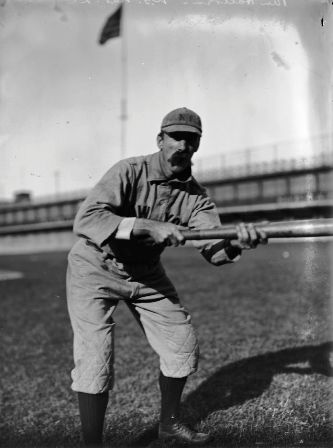
Until a broken ankle in 1902 slowed him, George Van Haltren was one of baseball’s best leadoff hitters; a .316 hitter with 2544 hits during his 17 seasons.   After a disappointing 1903–.257 in  84 games—his major league career was over, and he went home to the West Coast where he spent six seasons in the Pacific Coast League (PCL).

George Van Haltren

George Van Haltren

A member of the Seattle Siwashes during his first year in the PCL, Van Haltren was asked by The Oakland Tribune—the paper called him “an ultra-scientific batsman,” to share his expertise:

“Every ball player occasionally meets other players who call themselves ‘place hitters.’  The assertions of the majority of these players are such that either they think that everybody is gullible, or else they are weak mentally themselves.  They tell you they ‘can put the ball where they please,’ and that ‘it is easy when you know how.’

“Never take any stock in such twaddle.  These place-hitters would be just the men to have around when the ‘fans’ are calling on the home team to ‘hit ‘em where the fielders ain’t!’  But when it comes to delivering the goods, I have noticed, they are generally short.

“As a matter of fact, the batter often tries to hit to a certain field, and sometimes he is successful, but no man can give a guarantee when he goes up that the ball he hits will take any special direction.  If place-hitting could be carried out to the fine point that some players say they have it, they would be able to hit safely every time they came up.

“To the young player I would say: Don’t get in the habit of planting your feet on the ground and not moving them until you have swung at the ball.  Get a stride and advance a little toward the ball as you hit.  Do not step too far and accustom your eyes and hands to the change such a step makes.  Learn to hit squarely every ball that passes over any part of the plate between the knee and shoulder, and devote the most practice to what you are weakest on.

“Learn to think and act quickly and to keep your head at all times.  In a contest do not always do the same thing under the same circumstances.  Give your opponents a surprise whenever you possibly can.”

By the time he arrived on the West Coast, Van Haltren was no longer able to give his opponents “a surprise” as often as he could before the ankle injury; he hit .270 for Seattle in 1904, he played five seasons with the Oakland Oaks, hitting .255 before retiring in 1909.

Van Haltren died in 1945 without ever drawing serious Hall of Fame consideration.  A good argument for his enshrinement can be found here.

A “King” Kelly Story

17 Nov

In 1905, Elmer Ellsworth Bates of The Cleveland Press told a story about how the game had changed over the past two decades.

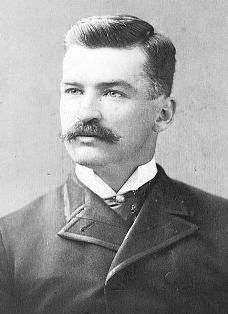
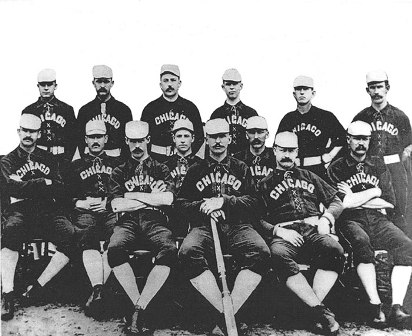
Ellsworth said that during the 1880s he witnessed an incident at the Café in Cleveland’s Weddell House Hotel involving Mike “King” Kelly.  Bates said he was with umpire “Honest John” Gaffney when Kelly came in:

Mike "King" Kelly

Mike “King” Kelly

“(T)he swing doors flew open and about half of the players of the Chicago team—Kelly in the lead—marched in.  The game between Cleveland and Chicago that day had been a stormy one, and Gaffney had assessed fines right and left.

“Kelly had been the chief offender.  Drawing at first a $5 penalty for disputing a decision, he had called Gaffney names at $5 or $10 a name until he owed the National League $50.  Kelly had left the ballpark vowing he would attend to Gaffney later.  I expected trouble when Kelly came in, for it wasn’t his first visit to that part of the hotel that night.

“’Hello, Gaf,’ Mike shouted, as he saw the umpire.  ‘Have a drink—you and your handsome friend.’

“’Much obliged Kel’ said Gaffney: ‘I’m not drinking today.’

“’Say Gaf,’ Kelly went on, ‘how much did you soak me today.’

“’An even $50,’ replied Gaffney, very quietly.

John Gaffney

John Gaffney

“’Reported it to the boss yet?’

“Not yet,’ was the reply.

“’Tell you what I’ll do,’ said Kelly, grabbing up the dice box.  I’ll shake you to see whether it’s $100 or nothing.’

“Gaffney started to walk away.

“’Come on, Gaf, be game,’ the other players called.

“So he came back.

“’Horses?’ asked Gaffney.

“Nope,’ said Kelly.  ‘One throw.’

“Gaffney spilled out aces and fours.  Kelly turned the box bottom side up, and, lifting it again, disclosed three fives.

“All right,’ said Gaffney, ‘the fine don’t go.’

“’Come on there, fellers,’ shouted Kel, starting for the door, ‘let’s go out and spend that $50.’”

“Is Napoleon Lajoie a Hoodoo?”

14 Nov

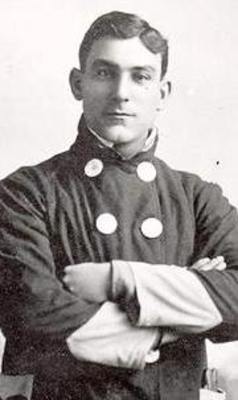
Napoleon Lajoie had his share of superstitions and sought to avoid “Hoodoo,” like most players of his era.  But, as Lajoie was winding down his long career, hitting un-Lajoie like .246 for a horrible Philadelphia Athletics team (36-117) in 1916, The Philadelphia Bulletin presented a case that Lajoie himself was the problem:

“Is Napoleon Lajoie a hoodoo?

Napoleon Lajoie

Napoleon Lajoie

“Several baseball managers and ‘Larry’ himself would like to know the answer.  And here is why:

“Lajoie, for many years recognized as the king of second basemen and dubbed ‘King Larry,’ now has visions of the waning of his baseball star of fame, and he has never played on a pennant-winning team…For years he hit well over the .300 mark—once over .400—was one of the most dangerous men to pitch to in a pinch, and fielded his position around second base in a finished, manner—so finished in fact, that he won the distinction of being the classiest second-sacker in baseball.  Every move of the big Frenchman was grace personified.

“Notwithstanding the fact that he was a star of the first magnitude, ranking with Hans Wagner of Pittsburgh—and they are the two real stars of baseball of former years—he never was able to help his team to the pennant.  So, when Lajoie was sold to Connie Mack dopesters and Larry himself thought he eventually would get into a World Series.  But alas!

“Larry joined the Athletics in the spring of 1915, and while his admirers were expecting him to get back his batting eye, which had apparently been dimmed while he was in Cleveland, Connie Mack decided to tear down his wonderful machine.  (Eddie) Collins, (Ed) Plank, (Charles “Chief”) Bender, (Jack) Coombs, and (Jack) Barry were sold (or released), while (Frank) Baker played bush league ball because Connie would not meet his salary demands, and the famous $100,000 infield of the Athletics was wrecked and the run making machine of the world champions was put out of commission.  And the hopes of Larry and his enthusiastic followers went glimmering.  He is on a tail-end team, just like he was at Cleveland.

“And worst of all from Lajoie’s point of view, the Cleveland team has been holding down first place in the American League for many weeks and is a contender for the pennant.

“The question, ‘Is Napoleon Lajoie a hoodoo?’ Again presents itself.”

While Cleveland was in first place as late as July 12, the Lajoie-hoodoo-free Indians still faltered and finished seventh in 1916.

After Philadelphia’s disastrous season—they finished 54 and a half games back—Lajoie accepted the position of player-manager with the Toronto Maple Leafs in the International League.  The 42-year-old second baseman hit a league-leading .380 and led the Maple Leafs to the championship in 1917—the first, and only of his career.

“I Never did trust an Umpire no how”

12 Nov

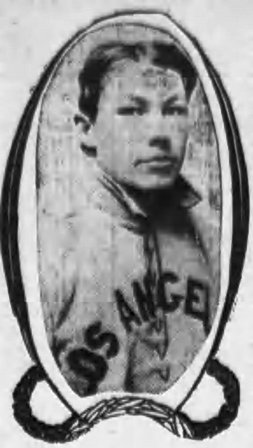
During an eight-year career spent in the California and Pacific Coast Leagues, Robert Joseph “Bobby” Eager was never a star but was very popular with West Coast baseball fans.  Years after he played his final game for the San Jose Prune Pickers in 1909 he began writing occasional columns about the game for The San Jose News.

Bobby Eager

Bobby Eager

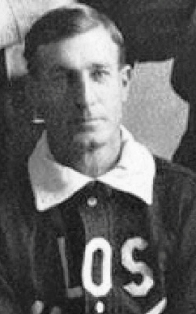
Eager backed up starting catcher Henry “Heine” Spies with the Los Angeles Angels:

“(O)ne of the best backstops the Coast has ever had.  Spies was known as the best foul ball chaser that ever put on a glove, barring none.  It seemed as though he really knew just where to go when a batter hit a long foul, he was right on the job.  I have played with him for five years and have never seen him misjudge a fly ball.  It got so that every time a foul ball went up, no matter where it went, the crowd would yell ‘Heine would have got it,’ even though the ball went out of the lot.  Well, to make a long story short, Los Angeles was playing and Heine was catching, Charlie Baum was pitching.  A foul ball went up and Heine chased the ball up against the grandstand and made a most wonderful catch, but it seemed as though the ball must have touched the stand in some way and Umpire (Jack) Huston ruled that it didn’t go.”

Henry "Heine" Spies

Henry “Heine” Spies

Eager said Spies argued Huston’s call, and as a result, the umpire—who had been a teammate of Spies in 1891 with the Sacramento Senators—fined the catcher $5.

“The next day was pay day and when Spies went to get his dough he was 5 short.  He immediately hunted up Huston at Morley’s pool rooms, where most of the ball players hung out (in addition to owning the billiard hall, Jim Morley managed the Los Angeles Angels for four seasons).  He immediately demanded that Huston either give him the $5 back or they go to the mat, which Huston refused to do, of course.  There was trouble, and poor Heine was fined $50 by the president of the league for beating up an umpire.  I never will forget how hard Spies took it to heart.  He and I were going down Market Street, San Francisco, and we were looking in the different windows and we came across a big furniture store with a swell bedroom set for $50.  Heine looked at it for a long time.  I looked up to see the tears rolling down his cheeks, and turning to me he said: ‘See—see, Bobby, there, see what Huston robbed me out of.  I could have had that swell bedroom set if he hadn’t gone and fined me that $5.  I never did trust an umpire no how.  They all seem to be a bunch of burglars.”

In addition to his occasional work for the newspaper, Eager coached several local baseball teams and worked for the Standard Oil company until his death on February 2, 1926.

“The Annual Spring Typhoon has Blown up Again”

10 Nov

In 1906, despite being, on paper, the best team in the American League, the Cleveland Naps finished in third place, five games behind the Chicago White Sox.  The club had three twenty game winners—Addie Joss, Bob Rhoads, and Otto Hess—and four regulars who  hit better than .300—Napoleon Lajoie, William “Bunk” Congalton, Elmer Flick and Claude Rossman,

As the 1907 season approached, Grantland Rice, of The Cleveland News said the team was now a victim of the success of individual players:

“The annual spring typhoon has blown up again—only a bit worse than ever.  In nearly every big league camp well-known athletes are breaking into loud roars over the pay question, and there promises to be quite a batch of trouble before the storm is cleared away.  In this respect Cleveland heads the list, although Napland owners have one of the highest salary lists in the game.  Up to date Joss, Rhoads, (Terry) Turner and Congalton have balked, while neither Flick nor Hess have returned a signed contract.”

Grantland Rice

Grantland Rice

Rice said the club’s negotiations with Joss and Rhoads were at an impasse, and “just how it will end is a matter of uncertainty.”  The news of the team’s trouble signing their stars led Rice to a discussion of “just how much a major leaguer is supposed to receive for his work each season.”

“When a youngster breaks in he is never given less, or at least rarely so, than he received in his minor league berth.  His pay is boosted the greater part of the time, so the average debutante’s pay roll ranges closely around $1,800 providing he is recognized as a first class man.

“If he delivers the goods his first year out he can figure on about $2,000 or $2,200 for his next season, and then if he becomes established as a regular, his income should be somewhere in the immediate vicinity of $2,500.

“From this point upward it all depends on their rankings as stars.  You hear considerable about $5,000 contracts and better, but as a matter of cold, clammy fact, but few athletes draw over $3,000 or $3,500 at best.

“In the epoch of war salaries $3,500 or $4,000 was a fairly common figure—but no more.

“A high grade slabman along the order of Joss, Rhoads (Nick) Altrock, etc…will rake in about $3,000 now.  In his weekly letter in a Toledo paper (The News-Bee), Joss stated that he was offered $3,000 for his season’s work, but that he demanded more—just how much he didn’t say.

“George Stone drew $3,000 or there abouts last season and now that he has fought his way to the premiership in the School of Slugs he demands $5,000, at which figure Mr. (Jimmy) McAleer balks strenuously.  (Johnny) Kling also asks for $5,000, which sum Charley Murphy says he will not receive.

“From this list we jump to the drawing cards of the game such as Lajoie, (Honus) Wagner, (Wee Willie) Keeler, (Christy) Mathewson, etc…

“Lajoie’s figures range somewhere above $8,000 and something shy of the $9,000 mark.

“Wagner is supposed to draw $5,000 for his work.

“If reports sent out from New York are true, Keeler’s yearly ante is close to $6,000, while Mathewson draws in about the same.

Hal Chase won’t miss $3,500 very far.

“But the high-priced teams are not pennant winners by a jug full.

(Charles) Comiskey and (Connie) Mack hew closer to the line than any others in Ban Johnson’s circle, and yet these two have won more pennants than all the rest put together.  In fact, they’ve gotten away with all but the two which Boston nailed.

“Mack had one of the cheapest, if not the cheapest team in the American League through 1905, the last year he copped the pennant.  Comiskey’s world champions of 1906 were far below Cleveland, New York or even Boston, from the salary standpoint.

“It looks funny to figure the cellar champions of a league paid more than the holders of the world’s title, but if all the figures were given out, the White Sox payroll would loom up under Boston’s to a certainty.

“The full salary cost of running a big league club varies from $40,000 to $50,000, or maybe $55,000 a year.

“A set of figures somewhere between $45,000 and $50,000 would probably hit at the higher average.

“There was a time when Boston’s payroll was close to $70,000 and (Clark) Griffith’s was only a notch below—but this golden era for the ballplayer has passed.”

According to The Washington Post, Joss had earned $3,2000 in 1906 ($2,700 and a $500 bonus), the biography, “Addie Joss:  King of Pitchers,” said he was paid $4,000 in 1907—Joss, who was 21-9 with a 1.72 ERA in 1906, followed that up with a league leading 27 wins (against 11 loses, with a 1.83 ERA) in 1907.

Addie Joss

Addie Joss

Fellow twenty game winners Rhoads and Hess both saw their production slip (15-14, 6-6), and only two regulars—Flick .302 and Lajoie .301—hit better than .300, and the team’s batting average slipped 28 points from the previous seasons.

The Naps finished fourth in 1907.

Lost Advertisements–Jimmy Austin for Farmers and Merchants Bank

7 Nov

austin


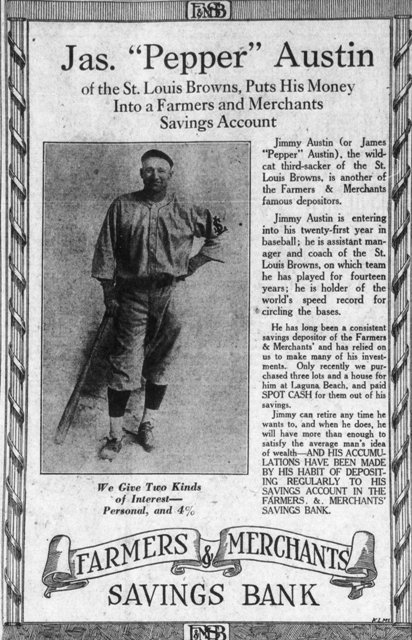
A 1924 advertisement for Southern California-based Farmers & Merchants Bank featuring Jimmy Austin:

Jimmy Austin (or James “Pepper” Austin), the wild-cat third-sacker of the St. Louis Browns, is another of Farmers & Merchants famous depositors.

Jimmy Austin is entering into his twenty-first year in baseball; he is assistant manager and coach of the St. Louis Browns, on which team he has played for fourteen years; he is holder of the world’s speed record for circling the bases.

He has long been a consistent savings depositor of the Farmers & Merchants’ and has relied on us to make many of his investments.  Only recently we purchased three lots and a house for him at Laguna Beach and paid Spot Cash for them out of his savings.

Jimmy can retire anytime he wants to, and when he does, he will have more than enough to satisfy the average man’s idea of wealth–And his accumulations have been made by his habit of depositing regularly to his savings account in the Farmers  Merchants Bank

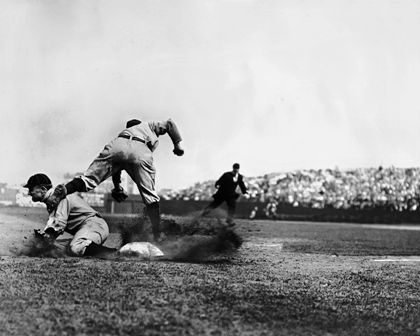
Austin is probably best known for being the third baseman in the famous 1909 Charles Conlon photograph of Ty Cobb sliding.

Conlon's 1909 photograph

Conlon’s 1909 photograph

In 1930 Conlon–then a proofreader for The New York Telegram–told  the story of how he came to capture what the paper called “the greatest baseball action picture ever taken.”

“Cobb was running wild on the bases that year, and the Tigers were fighting for a pennant.  I used to spend a lot of time down near third base chatting with Jimmy Austin who was a good friend of mine.

“Ty had worked his way down to second that day and the batter was trying to bunt.  As the pitcher’s arm went back to throw the ball Cobb sped for third.  Austin backed into the bag for the throw and Cobb hurled himself into the dirt, spikes flying.

“My first thought was that my friend Austin was going to be cut down by the Georgian.  I stood there motionless with my box in my hand.  I saw a blur of arms and legs through a screen of flying dirt It was a bright day and I could see Cobb’s lips grimly parted and the sun glinting off his clenched teeth.

“Austin never got his hands on the catcher’s throw.  He was knocked over.  He wasn’t hurt, however, and I was relieved because we were pretty good friends.

“Then I began to wonder if by any chance I had snapped the play.  I couldn’t remember, but I decided to change plates anyway.  It was lucky that I did, because when I printed up my stuff that night, there was the whole thing, as plain as day.”


Prince Hal’s Brush with Death

5 Nov

After nearly a decade as one of the California’s most popular players, Bobby Eager became an occasional columnist for The San Jose News.  Eager provided told stories about some of the biggest stars on the West Coast during the first decade of the 20th Century:

 “How close the greatest first baseman the game has ever produced came to losing his life in the infancy of his career is a story that has never been published though I guess everything else Hal Chase ever said, though or did has found its way into print.”

Eager said it happened in 1904 when he and Chase were teammates with the Los Angeles Angels in the Pacific Coast League.

“We were on our second trip to Seattle.  When the train reached Thrall, which was a water tank line and the last stop in California before we passed into Oregon, Chase and I saw some ripe apples hanging on a tree… Chase went up the tree like a squirrel and I stood on the ground.”

"Prince" Hal Chase

“Prince” Hal Chase

With Chase still in the tree, the train, which Eager re-boarded, prepared to pull out of the station.

“By the time Chase could get back the train got under headway, and the trainman had closed the doors of the Pullman.

“When we discovered the doors were shut we rushed out, and there was poor Hal hanging on the steps and his feet almost dragging in the ties.  He was hanging on for dear life.  First (Norman) Kitty Brashear and I tried to pull him up on the platform but that was impossible.  All the time the train was going faster and faster.  Then I yanked the bell rope but I yanked it so hard that broke and the engineer never got the signal.  In the meantime Tim Flood had rushed ahead to locate the conductor who refused to stop the train until the next station three miles ahead.  We wanted to kill the conductor, but that would have done no good.

“All the time Chase was getting weaker and weaker, but as it was a case of life or death with him he stuck to the train.  It was Brashear who hit on the scheme which saved Chase from having his legs cut off and the game losing its kingpin first sacker.  Brashear got down on the platform, yelled to him to let go when he pushed him with his foot.  Hal said he would do it.  Brashear, who was powerful as a bull, placed his big boot squarely in Chase’s breast and as he yelled ‘let go’ shoved Hal all the way over the embankment and when we saw him roll safely down the embankment we were happy.

“But Hal was not out of his peril.  As he told us afterwards he pulled himself together and hobbled back to Thrall half dead.  This was 3 o’clock in the afternoon.  The next train didn’t come along until 11 at night.  Soon after dark Hal said a flock of coyotes came down from the mountains.  They were hungry and looking for blood.  Hal said he found safety on top of the tank station house.  He said the Coyotes kept him treed until his train pulled in.”

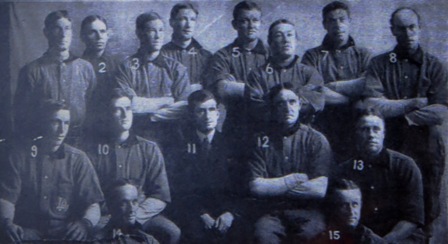
Hal Chase (3), Bobby Eager (6), Tim Flood (12), and Kitty Brashear (13)

Hal Chase (3), Bobby Eager (6), Tim Flood (12), and Kitty Brashear (13)

Despite the injuries, Chase appeared in 190 of the Angels 235 games.  At the close of the 1904 season, he was drafted by the New York Highlanders.

Things I Learned on the Way to Looking up other Things #12

3 Nov

The Cost of Superstitions, 1913

John Phalen “Stuffy” McInnis his .324 and drove in 90 runs for the 1913 Philadelphia Athletics, but the first baseman hit just .118—2 for 17—during the World Series.
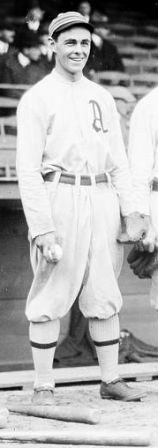
Stuffy McInnis

Stuffy McInnis

The Washington Post told how one superstition among the athletics players might have contributed to McInnis’ slump:

“Those boys believe that they can change the luck at a crucial moment by hurling their bats in the air and letting them fall where they will.  Probably you fans have often seen them do it.  They also believe that they can keep up their good luck by continuing this practice.

“During the first game, in which (Frank “Home Run”) Baker hit a home run, the Athletics started tossing their bats the minute the ball was hit.  As the bats came down Stuffy McGinnis couldn’t get out of the way in time and one of them struck him in the ankle, causing a painful bruise.  He limped to first base and for a while (Connie) Mack was afraid he couldn’t go on with the game.”

Despite McInnis’ slump, the Athletics beat the Giants four games to one.

The Case against the Spitball, 1905

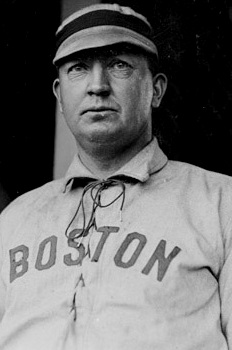
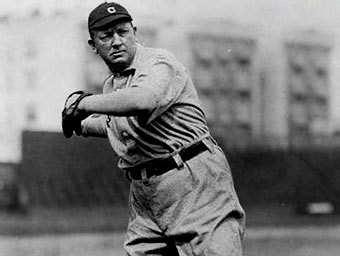
Baseball’s greatest pitcher hated the games most controversial pitch.  In 1905 Denton True “Cy” Young was quoted in The Sporting Life saying it wouldn’t be long before the pitch disappeared entirely:

“I don’t think the ‘spit ball’ is going to cut a much a figure as was thought early in the season.  Many of the pitchers that were using it at the start of the campaign have cut it now, and from now on the twirlers that use it will be dropping it one by one.  I used it against Philadelphia and Washington and had it working nicely, but it hurt my arm and I have cut it altogether.  An old pitcher like myself has no business using it at all.”
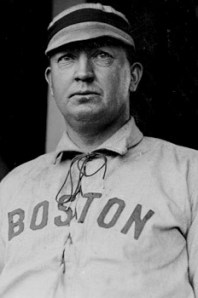
Cy Young

Cy Young

Young said the pitch injured his forearm and said he was not alone.  He claimed Jack Chesbro, George Mullin, (Guy) “Doc” White all received similar injuries.   And Washington’s Case Patten, who a year earlier so loved the pitch The St. Louis Republic said he was often “giving the ball a shower bath preparatory to flinging,” was now saying the pitch “lamed his arm.”

Young said even for those who weren’t injured, the spitter would ultimately lead to pitchers losing “control of his curve ball and his fast ones.”

While Chesbro disagreed with Young’s claim that his arm problems were the result of throwing spitballs, his effectiveness diminished greatly after the injury.

Young’s prediction of the demise of the pitch was premature.  At the time of his statement, Chicago White Sox pitcher “Big Ed” Walsh was perfecting the pitch, which he learned from teammate Elmer Stricklett—who had also been instrumental in Chesbro’s use of the spitter.   Walsh started throwing the spitball regularly in 1906.
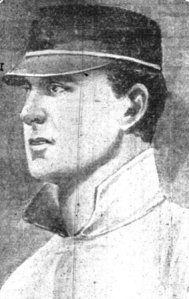
Ed Walsh circa

Ed Walsh circa

A month before his death, on his 78th birthday and bed-ridden, Walsh remained an advocate for the pitch Cy Young detested.  He told a reporter for The Associated Press:

“I admire the pitchers today who throw the pitch.  Some people call ‘em cheaters.  They’re not.  They’re just guys doing everything they can to win.”

Wahoo Sam’s Scouting Report, 1914

Coming off of the New York Giants off-season world tour with the Chicago White Sox, the consensus opinion seemed to be that Giants Manager John McGraw did not make a mistake in signing Jim Thorpe, the world’s greatest all-around athlete, to a three-year contract worth–depending on the source—from $5,000 to $6,500 per season.  Many doubted Thorpe’s prospects after he hit just .143 in 19 games for the Giants in 1913.
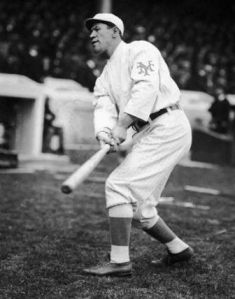
Jim Thorpe

Jim Thorpe

But, not to worry, said McGraw:

“All Thorpe needed was every day action, instead of idleness, although of course sitting on the bench all summer gave him a chance to learn lots of things that will stand him in good stead later on.”

The baseball world generally agreed with McGraw’s assessment.

Hugh Fullerton predicted Thorpe would be “the most sensational baseball player of 1914.”

Damon Runyon declared Thorpe was “now a star.”

Gustave (G.W.) Axelson, Sports Editor of The Chicago Record-Herald, who traveled with the teams, said of Thorpe’s development during the trip:

“The fans in the United States will see an entirely different kind of player when Thorpe Lines up for the season. “

White Sox pitcher Joe Benz, who played against Thorpe on the tour, agreed saying Thorpe “improved greatly” and would be of “great assistance to the Giants,” in 1914.

But, “Wahoo” Sam Crawford, the Detroit Tigers outfielder who traveled with the tour as a member of the White Sox disagreed with all the glowing accounts of Thorpe’s progress.  The Detroit Times said:

“Thorpe’s speed is all that commends him, according to Sam.  He is not a particularly good fielder, and he cannot hit.  He is not a natural hitter at all, but he gives the bat a little upward chop as he swings at the ball in a way that Crawford never saw any man do before.

“Furthermore Thorpe doesn’t seem to have that baseball instinct that is so necessary for a big league player, say Crawford.  He is a very chesty fellow for a man who has yet to prove that he is of big league caliber, is the assertion made by Wahoo Sam.”
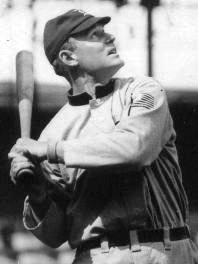
Sam Crawford

Sam Crawford

Crawford’s assessment was the most accurate.  Despite the fanfare that accompanied Thorpe’s return from the tour, Thorpe was never better than a mediocre outfielder (career .951 fielding percentage) and he hit just .252 over parts of nine major league seasons.

“The Fans there Like me. I Think so Anyway.”

31 Oct

In 1909 the Cleveland Naps traded pitchers Charlie Chech, Jack Ryan and $12,500 to the Boston Red Sox for Cy Young;  Young would turn 42-years-old before the beginning of the season.

Young was happy with the trade and told The Cleveland News:

“I’m glad to get back to the city where I started my career in 1890.  The fans there like me.  I think so anyway.  I believed they pulled for me there when I pitched against their own team.  I will give (Napoleon) Lajoie all I have and I think I’m good for several years.”

Cy Young

Cy Young

Addie Joss, the Naps ace, was also happy about the trade:

“Not only has Cleveland secured one of the best pitchers in the game today, but at the same time has added to the club a man who has done much for the good of baseball, and who is honored and respected everywhere he has ever played.  I have always contended, and always will, that Cy is the greatest pitcher the game has ever produced.”

Elmer Ellsworth Bates, the sports editor of The Cleveland Press, told some stories about the Indians new pitcher.

Ellsworth said a visitor to Young’s farm in Paoli, Pennsylvania asked the pitcher which of his then 478 victories did he “recall with the most satisfaction.”

“’The first game I ever pitched for Cleveland, back in 1890 (an 8 to 1 victory August 6),’ replied Old Cy, unhesitatingly.  ‘I doubt if a base ball crowd ever looked on a more typical rube than I appeared to be that day in a makeshift uniform six or seven sizes too small.  I didn’t have much money then, but I would not have lost that game to Chicago for the prettiest $1,000 bill ever printed.”

Bates said Young was “probably the most modest ‘big man’” in the game:

“At the Colonial (Hotel in Cleveland) one day last summer a young man took a chair next to the great pitcher and began paying him fulsome praise.

“’You are the swiftest pitcher I ever saw,’ he said.

“’Then,’ said Old Cy.  ‘I guess you never saw Amos Rusie.  My fastball looks like a slow freight trying to keep up with the Twentieth Century Limited Express compared to Rusie’s.’

“’But your slow ball is a peach.’

“’Young man,’ remarked Old Cy, gravely.  ‘If I could pitch the slow ball Eddie Beatin, the old Cleveland twirler, used to hand up to the batters I’d let them knock $1,000 a year off my salary.”

Bates also said it was “a matter of record” that Young was unaware he had pitched a perfect game against Connie Mack’s  Philadelphia Athletics on May 5, 1904:

“’I knew Connie’s boys hadn’t made a hit,’ said Old Cy the next day, but I couldn’t understand why the crowd was making such a demonstration.’

“’Well you’ve done it,’ said (manager and third baseman) Jimmy Collins, as we started for the dressing room after the crowd had let me go.’

“’Done what, Jimmy?’ I asked.  ‘Pitched a no-hit game?’

“’Better than that; not a man reached first.’

“’Then I knew what the racket was about.’”