McCloskey, Mays and Hair Color

12 Mar

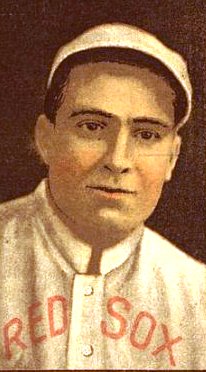
Carl Mays is best known for being the pitcher who hit Cleveland Indians shortstop Ray Chapman with a pitch, resulting in the only hit by pitch death of a Major League player. In fifteen seasons he posted a 208-126 record with a 2.92 ERA.

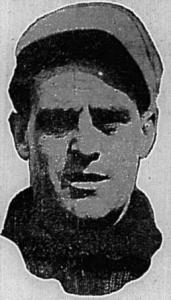
Five years before he became infamous for Chapman’s death, Mays became embroiled in a strange feud with former National League manager John James McCloskey; the dispute was over hair color.

Carl Mays

Carl Mays

In December of 1914, McCloskey was a well-respected figure in baseball, credited with being the “father” of the original Texas League in 1888, he had spent five seasons as manager of the Louisville Colonels and St. Louis Cardinals in the National League, and another 23 as a minor league manager and owner.

Mays was coming off a 24-8 season for the Providence Grays in the international League, and while called up to the Red Sox in the closing weeks of the season had not yet appeared in a big league game.

The controversy originated when Charles “Toby” Fullerton, a pitcher for the Seattle Giants in the Northwestern League was quoted in an article that appeared in The Pittsburgh Press and several other papers about pitcher “Seattle Bill” James, who had just led the Boston Braves to a World Championship. Fullerton said when he and James were teammates in Seattle in 1912, manager Shad Barry had, “condemned the youngster for being a blond,” he then was quoted saying McCloskey also, “has no use in the world for blonde ball players.”

“Seattle Bill” James

The strange, silly, throwaway quote should have been the end of it, but it was apparently serious enough for McCloskey to issue a long denial from his home in Louisville, Kentucky. The full-page letter McCloskey wrote appeared in more newspapers than the original story, and read in part:

“Let me say, I have been accused of every crime in the calendar, but this is too much.”

McCloskey claimed the “rumor” originated when he was managing the Milwaukee Brewers in the American Association in 1910. Outfielder Rube DeGroff played for McCloskey (incidentally, Shad Barry was also a member of the team), and according to McCloskey:

“We were playing in Kansas City, we were behind…and made a big rally that came near giving us the game. The bases were full in the last inning, with two men out, when the big, blonde and good-natured Rube DeGroff, who was a splendid all-around player and life of the club, came to bat with the bases full and struck out. I was sore over losing the game and made the remark that I never saw a cotton-top who ever made good in a pinch.”

McCloskey said he also believed anything Barry might have said to or about James was certainly a joke, and closed with a final defense:

“In fact, in my humble opinion, I think the blonde has a shade over the brunette. But why the color of a man’s hair should have anything to do with his ability as a ball player is a mystery to me, and I hope this explanation will put an end to these silly rumors.”

It didn’t.

Within days Carl Mays weighed in, claiming that he had twice been rejected for an opportunity to pitch for McCloskey’s Ogden Canners in the Union Association because he was blond.

Mays said:

“McCloskey is a liar pure and simple…In 1912, when I was on my way to Boise to try out for the Boise team; I stopped off at Ogden, thinking possibly owner McCloskey might give me a trial. I met him downtown in a billiard parlor and went up and introduced myself.

“McCloskey looked me over carefully, like a horse-trader examining a piece of horseflesh, and then suddenly espied my blond hair. ‘No,’ said he coolly, ‘I don’t want you. In fact I wouldn’t have you around the ranch. I don’t want any blonds in my camp.’”

Mays also claimed that later in 1912 while compiling a 22-9 record for the Boise Irrigators in the Western Tri-State League; he was nearly sold to McCloskey’s pitching-strapped Ogden Canners until:

“One of the Ogden players happened to mention the fact that he was the same blond-haired fellow who had asked for a job earlier.”

According to Mays, McCloskey said:

“’Deal is off. Send that white-haired guy over here and I’ll kill him.’”

The story stuck with McCloskey for more than 20 years. A 1916 story in The Providence Tribune said:

“Scouts all over the country know McCloskey and never did one in his employ recommend a light-haired ballplayer…His peculiarity was well-known, and he knew that no one would have the temerity to recommend to him a blond or light-haired ballplayer. “

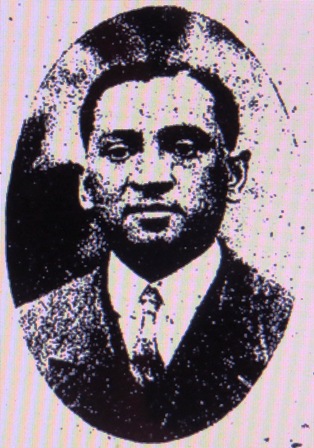
The black-haired John McCloskey
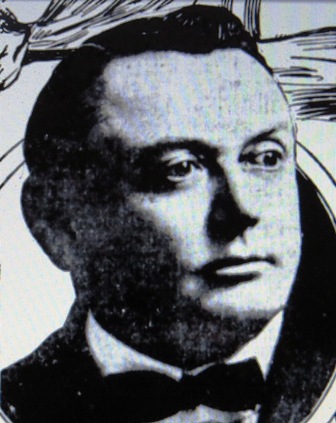
The black-haired John McCloskey

In 1934, The Milwaukee Journal called McCloskey, “one grizzled veteran who frowned on blond athletes.”

The article quoted E. Lee Keyser, a long-time minor league executive, who said when McCloskey managed Butte, “One of (McCloskey’s) players was an Indian outfielder whose hair was black,” the player struck out in a critical situation. According to Keyser, when the unnamed player returned to the clubhouse later, McCloskey grabbed his hair and said: “I just want to know if you’re wearing a wig. You hit like a blond.”

McCloskey managed in the minor leagues until he was 70-years-old, he died eight years later in 1940.
“An Umpire Nearly Lynched”

11 Mar

The above headline appeared on an Associated Press story in August of 1890.  Former Major Leaguer Jimmy Manning, then managing the Kansas City Blues in the Western Association had interceded to quell a riot at the end of a game with the Denver Grizzlies in Kansas City:

“Two questionable decisions by umpire Jovin (Sic) in the ninth inning, when Kansas City was about to tie the score, angered the crowd to such an extent that they swarmed into field, hooting and jeering the umpire.  Two young boys got hold of a rope, and in fun proposed to lynch him.  This added to the excitement, and it looked for a time as if the umpire would be mobbed.  Jimmy Manning climbed up to the top of the fence and addressed the mob.  He said the umpire had decided rightly and advised that no violence be attempted.  This quieted the mob to a degree.  In the meantime the players of both clubs formed a hollow square around the umpire and conducted him to the clubhouse.”

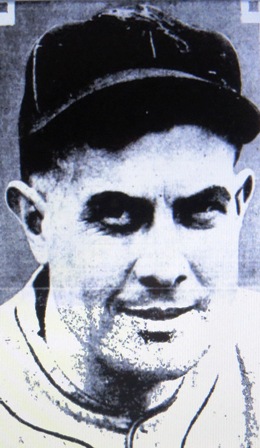
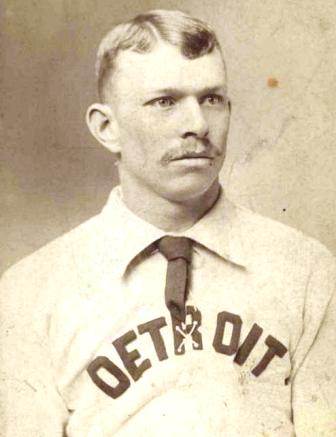
Jimmy Manning

Jimmy Manning

“Jovin” was actually Fred Jevne, a 26-year-old minor league veteran who had become an umpire just a month earlier.  After joining the Spokane franchise in the Pacific Northwest League in April, Jevne was suspended in May for punching an umpire.

In July The Spokane Falls Daily Chronicle said Jevne and teammate Tom Turner “quit the nine because they were excessively fined and ill-treated.”  According to the paper the two players showed up at the July, 1 game “in an intoxicated condition and acted like ruffians in the grand stand.” Turner was eventually reinstated and finished the season in Spokane, Jevne did not.

Since 1885 Jevne had played for a variety of teams in several leagues, including the Southern, International, and California.  When he was signed by Spokane to play center field and serve as captain, The Daily Chronicle said:

“Jevne is rather short.  He is a good batsman and a good player generally.  The San Francisco papers, when he played there, alternately praised him and berated him, but all agree that he was a good player.”

Jevne made one more attempt at playing, joining the Evansville Hoosiers in the Northwestern League in 1891.  He then returned to the Western Association as an umpire.

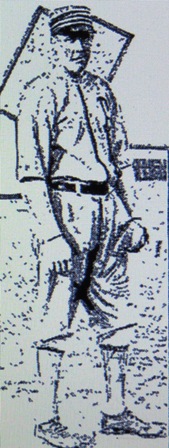
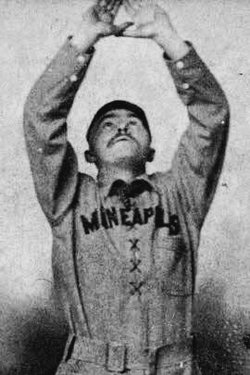
Fred Jevne

Fred Jevne with the Minneapolis Millers, 1889

In December of 1894 Jevne was named to the National League umpiring staff, where his work received mixed reviews.  In June The Baltimore Sun called him “As good an umpire as there is in the business.” In August, after a he worked a game between the Boston Beaneaters and Chicago Colts, The Boston Globe said “Umpire Jevne did poor work, both sides suffering from his yellow decisions.”  The Pittsburgh Press called Jevne’s performance in a September game between the Pittsburgh Pirates and Philadelphia Athletics “By far the worst exhibition of umpiring given this season.”

Jevne was not offered a position in the National League for 1896, and went to work in the Southern Association, where he seems to have a continued his fighting ways.  In July, The Birmingham Age-Herald said Jevne had missed the previous day’s game between the Montgomery Senators and Columbus River Snipes:

“Jevne, the regular umpire, arrived in town last night, but this morning loaded himself up with the spirit of hilarity, got into a fight with a citizen and when the hour for playing arrived was in the hands of the police, and failing to make bond was unavoidably absent from the field.”

Despite his troubles, or because of them, Jevne was asked to join the Interstate League at the end of the 1896 season because, according to The Sporting Life, umpires were losing control of games:

 “(Interstate League President Charles) Powers to-night wired for Fred Jevne the ex-National League umpire, who is so handy with his fists, to report for duty.”

Jevne was not popular with players or the press down south, and said his time in the Southern Association was difficult:

“It was no snap umpiring down South.  Fines didn’t go—were never paid—and so I used to remove men from the game.  Sometimes I would have to take out about half of a team before they would behave, and then the papers would roast me good and plenty the next morning…I had a scrap with a player named (Al) Gifford (Atlanta Crackers shortstop), and punched him in a car going from the grounds.  The local paper came out the next morning and urged the chartering of a special car for the umpire. So that he could be alone in his dignity, and another paragraph hinted that a cigar sign or dummy could be put in the special car for the umpire to punch”

Jevne appears to have returned to the Southern Association for parts of the 1897 and ’98 seasons.  He spent at least part of 1899 and 1900 in his hometown, Chicago, where he worked as an umpire in some college games.  In 1901 Jevne became a Western League umpire and that year met with a violent and mysterious end.

Initial newspaper reports said Jevne had fallen from a third story window in Denver’s Hotel Victor on August 2; he lingered for two days before dying. His body was returned to Chicago and he was buried at Graceland Cemetery.

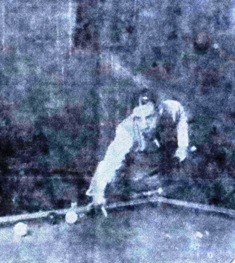
However, several months after his death, Jevne’s brother Lloyd, a well-known three cushion billiard champion, told The Associated Press he was certain he had been murdered, and that before dying Jevne had said he was pushed:

“I saw Fred’s body after it was shipped back to Chicago, where the burial took place, and the most prominent feature of his injuries was the bruise on his nose.  Doctors I saw believe that he was struck across the face with some blunt object… When he was about to die it is not probable he would have told a falsehood.  He would not have said at that time that he had been pushed out the window.”

Lloyd Jevne

Lloyd Jevne

Whether Fred Jevne fell or was pushed from that hotel window has never been positively determined.

A Valuable Groundball

8 Mar

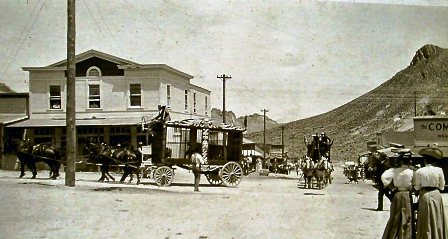
Rhyolite, Nevada was one of the great boom towns of the early 20th Century.  When gold was discovered in early 1905 people flocked to the town just east of Death Valley, and a thriving community rose around the Montgomery Shoshone Mine, the largest producer in the area.

Baseball was an important part of the mining communities.  Every town had at least one team, and while the region was only part of a league recognized by the National Commission for only one season (the 1907 Nevada State League composed of teams in Carson City, Reno, Tonopah and Goldfield) semi-professional and professional leagues were present throughout the decade.

In June of 1905 the Rhyolite team was playing a game against the team from the nearby town of Beatty, on the town baseball grounds, near the Montgomery Shoshone Mine.  A wire service report that appeared around the country tells the rest of the story:

“At a baseball game the other day between the towns of Rhyolite and Beatty, William Griffith, of Salt Lake City playing first base for the Rhyolite team, reached down to stop a fast grounder, with visions of an easy put-out for his team when the ball struck a small stone and bounded away.  While waiting for the ball to be returned by one of the spectators Griffith picked up the stone, which he found to be full of free gold.

“The game was played on the flat between Ladd and Montgomery Mountain.  Griffith put the stone in his pocket, and late at night, with the aid of a lantern, prospected the region where he made his find.”

A mine shaft was sunk on the spot of Griffith’s find and discovered to be part of a large deposit of gold “It is reported that the baseball player has been offered $25,000 for his interest.”

The find contributed to Rhyolite’s growth; Industrialist Charles M. Schwab purchased the Montgomery Shoshone Mine.

rhyolite

Rhyolite, Nevada 1907

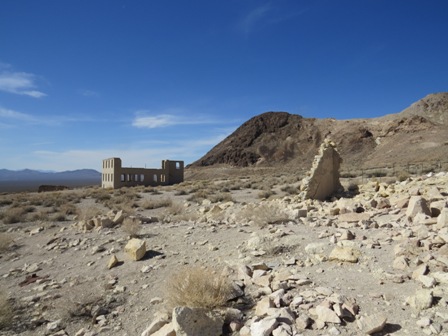
The town boomed quickly, and busted just as quickly.  Rhyolite’s population peaked somewhere in the neighborhood of 5,000 by 1907 (some sources have it as high as 8,000 and others as low as 3,500), and boasted three banks, a stock exchange, and opera house, electric lights, water mains, telephones, a daily newspaper, a hospital and a two-story school.  By 1908 the richest ore had been mined and the town started on a rapid decline.

By 1911 the town population had dropped to 1000, in another decade it would be nearly deserted. Just as quickly William Griffith and the ground ball that helped create a boom drifted into obscurity.

Rhyolite, Nevada--ghost town, 2013

Rhyolite, Nevada–ghost town, 2013

Things I Learned on the Way to Looking Up Other Things #1

7 Mar

There are many interesting, odd, great stories I stumble across when researching that are too short for a full post.

Sydney J. Harris, the late Chicago Daily News and Sun-Times Columnist had a regular feature by the same title as this post.  It seemed an appropriate name for this feature—so with a hat tip to Mr. Harris:

Arrested for Refusing to Fight Forest Fire

In December of 1911, Boston Red Sox pitcher Charley Hall and Pacific Coast League outfielder Harry Price were teammates on a winter league baseball team in Ventura, California, when a forest fire broke out in the area.  According to The Associated Press:

“When the fire was at its height Hall and Price…were sitting on the veranda of a hotel,  a deputy fire warden ordered them to fight the fire but they refused.”

Charley Hall, arrested for refusing to fight fire

Charley Hall, arrested for refusing to fight fire

Fire Warden John Kuhlman placed both players under arrest.  There is no record if they were ever convicted.

Baseball 1860

The New York Herald report on a July 5, 1860 game:

“The friendly game of ball between the Excelsior Club of Brooklyn and the Niagara Club of Buffalo resulted in an easy victory for the Excelsiors.

“The score was, Excelsior 50, Niagara 19.  In the fifth inning the Excelsiors made twenty-four runs.”

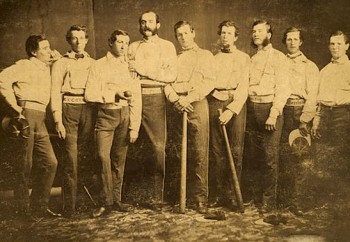
The Excelsiors, 1860

The Excelsiors, 1860

Carrier Pigeons

According to The Philadelphia Record in 1883 a zookeeper in Philadelphia used carrier pigeons dispatched between the zoo and Jefferson Street Grounds to provide updates on Athletic games.

Pigeons were also used by news organizations for the next several decades.  In 1900 The Milwaukee Journal bragged of their “carrier pigeon news service” which delivered updates from Milwaukee Park to the newspaper offices.  According to The Journal, sometimes the pigeons were more interesting to Brewers fans than the games.

The Journal’s carrier pigeon service attracted much attention on the field, and as each bird was released from the grand stand, the spectators of the game invariably lost interest for a moment in the diamond as they watched the bird dart upward and shape its course toward the city.

“Even the members of the contesting teams allowed their attention to be distracted at times by the unusual spectacle, and once, at the beginning of the sixth inning, when one of the liberated birds swooped down past big Perry Werden (Minneapolis Millers first baseman) as he stood guard over the initial bag…(Werden) raised an imaginary gun as though to take a shot at the pigeon, and of course the bleachers laughed.

“That The Journal’s service by means of the birds in not unknown to Milwaukeeans was well illustrated by the conversation of people seated around the spot from which the birds were set free.  They discussed the enterprise and those who did not understand the plan were quickly enlightened by the others, who knew all about how fast the birds flew, how they were kept and how they carried the news.”

The practice was continued at The Journal over the next decade.

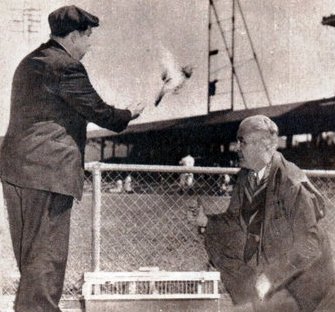
Cincinnati radio station WLW revived the practice for at least one game in 1939, when the station used pigeons to deliver information from a Reds game against the Pittsburgh Pirates to the studio.

Carrier Pigeons being released at Crosley Field,  Cincinnati, 1939

Carrier Pigeon being released at Crosley Field, Cincinnati, 1939

“War Against the Ballplayer”

6 Mar

As baseball continued to gain popularity in Chicago during the 1870s, the amount of pickup games being played in the city’s streets and alleys increased.

By June of 1877 the Chicago Police Department viewed baseball as a nuisance and issued an order to arrest anyone “Throwing balls…in, from, or to any street, sidewalk or alley.”

The Chicago Inter Ocean editorialized about the plan under the headline “War against the Ballplayer:”

 “Every now and again the Police Department of this city is seized with a sort of virtuous spasm, a desire to execute some coup d’état, some brilliant strategic movement which will cover the force with glory, and plant it still deeper in the confidence and affection of the noble taxpayer…Long and patiently have we waited, much have we suffered, loudly complained in vain.  But it has come at last.  War has been declared against the gamins, and the advance guard of the enemy has crossed the alley.”

After similar ridicule from all corners of the city, the order was rescinded by the end of the month and the streets of Chicago were again safe for baseball.

“A Historical Account of a Great Game of Ball”

5 Mar

The headline above appeared in 1907 above an article written by Frederick North Shorey in The Freeman regarding a series between Andrew “Rube” Foster’s Leland Giants and Mike Donlin’s All-Stars “an aggregation composed of such noted players as Mike Donlin, Jake Stahl, Jimmie Ryan and Jimmy Callahan, probably the best semi-professional team in the country.”

Shorey said the series at South Side Park “exceeded in interest to the people it attracted anything that took place between the White Sox and Cubs last fall (1906 World Series).”

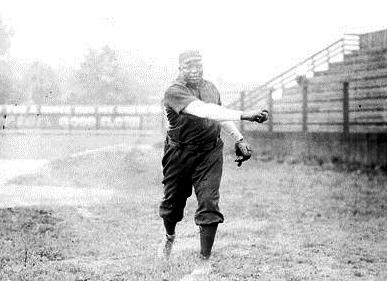
Rube Foster beat the Donlin All-Stars 3-1 in the first game, allowing only three hits:

“Rube Foster is the pitcher of the Leland Giants, and he has all the speed of (Amos) Rusie, the tricks of a Radbourne, and the heady coolness and deliberation of a Cy Young. What does that make him? Why, the greatest baseball pitcher in the country; that is what the best ballplayers of the white persuasion that have gone up against him say.”

Rube Foster

Rube Foster

Foster was so important to his fans, Shorey said:

“If it were in the power of the colored people to honor him politically or to raise him to the station to which they believe he is entitled, Booker T. Washington would have to be content with second place.”

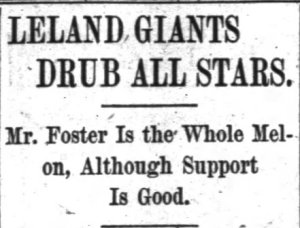
The Chicago Tribune said of Foster’s domination of the All-Stars:

lelandsvsdonlins

Back to the series, and back to Shorey:

“While the all-stars were confident in their ability to win, several of the old players, including Mr. Donlin himself, who have known of the prowess of Mr. Foster…knew that it was by no means a certainty…but they had hopes that the colored team behind him might do something to undo the efforts of the twirler.

Mike Donlin

Mike Donlin

Shorey said the all-stars were over matched:

“The colored men set a new pace for base running, while foster’s cool, deliberate pitching was too much for the old-time players on Donlin’s team. Both teams put up brilliant fielding games.”

Foster pitched in four games in the series; he won all four.

David Wyatt–who had been a teammate of Foster’s with the Chicago Union Giants in 1902, and who in 1920 was asked by Foster to help draft the constitution of the Negro National League—also wrote about the series in The Freeman:

“All the baseball critics in the city were out to look the Lelands over, many under the impression that they were overrated. The most interested of the number was Mr. Comiskey, owner of the white Sox…After witnessing the first game the white sox boss said if it were possible he would have annexed the signature of at least three of the boys to contracts, and he was so enthused over the fast, snappy work of the Lelands that he had his world’s champions to lay over one day in Chicago to watch the boys play.”

Wyatt had higher hopes for “Baseball as the common leveler” in general and the series specifically:

“There was no color line drawn anywhere; our white brethren outnumbered us by a few hundred, and all bumped elbows in the grand stand, the box seats and bleachers; women and men alike, all whetted freely with one another on the possible outcome of the series, the effect it would have upon the future of the negro in baseball, the merits of the different players etc…”

Foster’s heroics, Wyatt’s hopefulness, Comiskey’s words and Chicago’s enthusiasm were, of course, not enough to change the status quo; regardless of the “Great game of ball,” played at South Side Park in that 1907 series, the color line would remain intact for four more decades.

David Wyatt

David Wyatt

Another “Rube”

4 Mar

Hall of Famer “Lefty” Grove and Jack Ogden were the best known pitchers of the great Baltimore Orioles teams that won seven straight International League Pennants from 1919-1925, but in 1923 both were out-pitched by James Arthur “Rube” Parnham.

Parnham began his professional career in 1914 with the Huntington Blue Sox in the Ohio State League.  In 1915 he joined the Raleigh Capitals in the North Carolina State League, managed by Connie Mack’s son Earle.  The 21-year-old was an unspectacular 9-15 for Raleigh, but caught the eye of the elder Mack and spent the spring of 1916 with Jacksonville with the Philadelphia Athletics.

Rube Parnham, 1917

Rube Parnham, 1917

Parnham returned to the North Carolina State League for the 1916 season, splitting time between Raleigh and the Durham Bulls, posting a 17-19; his contract was purchased by the Athletics in late August.  Nearly a month later Parnham made his Major League debut; he appeared in four games for Mack’s last place (36-117) ballclub, he was 2-1 with a 4.01 ERA.

Parnham was with the Athletics in Jacksonville again in 1917, but was sent to Baltimore before the beginning of the season.  He won 16 games for the Orioles and earned one more shot with Mack in Philadelphia; Parnham was 0-1 with a 4.09 ERA in two September appearances.

As Parnham started winning games for Baltimore he developed a reputation as a work horse; in 1917 he won both ends of a double-header against the Rochester Hustlers, pitching a total of 24 innings in two 3-2 victories; in 1919 he won both games of a twin bill twice.   At the same time he began to earn a reputation as “eccentric’ and “erratic,” the inevitable comparisons to Rube Waddell and his small time roots earned Parnham the nickname “Rube,” he was also known as “Uncle.”

Baltimore sold Parnham to the Louisville Colonels in the American Association in March of 1918, but within two months was sold back to Baltimore, where he rejoined manager Jack Dunn, with who he had, and would continue to have, a contentious relationship.  He won 22 games in 1918 and followed with 28 in 1919, leading the Orioles to their first championship since 1908.

As the Orioles jumped out to a quick lead in 1920 (Parnham was 5-0, and was joined on the pitching staff by Ogden and Grove) the erratic Rube Parnham surfaced again. He was prone to disappearing for days at a time and also appears to have been hurt.  By mid-season he was gone.

More recent accounts have said Parnham jumped the Orioles to play semi-pro ball in Pennsylvania; just as likely, Parnham, who was suspended in June by Dunn for being out of shape, and who was clearly overshadowed by Grove (12-2) and Ogden (27-9); as well as Jack Bentley (16-3) and Harry Frank (25-12), was let go.

Lending credence to Parnham not having jumped is a January 1922 Associated Press item that said the pitcher “whose arm went on him” would rejoin “the Baltimores for the 1922 season.  Parnham wrote Dunn that he believed he could come back next season and pitch successfully.”  He won 16 games for the Orioles in 1922.

The following season would be Parnham’s best; the 29-year-old pitcher led the Orioles with a 33-7 record, Grove was 27-10, Ogden 17-12.   In addition to out-pitching his two teammates, Parnham set an international League record by winning 20 consecutive games.

Parnham’s old ways returned before the 1924 season when he failed to report to Florida for spring training.  The Associated Press said:

“Rube never reported at the Oriole training camp in the south and never even deigned to notify Jack Dunn whether he was going to play ball this year.”

Parnham eventually reported, but had another stormy, abbreviated season.  With a 6-5 record and a 4.84 ERA, Dunn suspended the pitcher in June, and he appears to have not pitched for the Orioles again that season.

The only reference to Parnham in 1925 was a May game he pitched for a semi-pro team in Duquesne, Pennsylvania and was beaten 8-0 by the Homestead Grays.

His career appeared to be over, but Dunn, it seems was willing to give his pitcher one more chance.

The Baltimore Sun said shortly before the 1926 season:

“Uncle Rube Parnham, the most colorful figure in the International League, will be back on the mound for the Orioles next season.”

Parnham was 13-9 with a 5.05 ERA, and spent the entire season feuding with Dunn; It was the end of the Orioles dynasty, the Toronto Maple Leafs won the championship in 1926 and Baltimore would not finish first again until 1944.

The Orioles were finally through with Parnham, The Baltimore Sun said:

“There was so much trouble between Parnham and Dunn last year that it was apparent Rube had spent his last season with the Orioles.” “

The 32-year-old was still considered valuable enough that the Milwaukee Brewers in the American Association purchased the pitcher from Baltimore.

The Brewers expected big things from their new pitcher, The Milwaukee Journal said:

“At times his playfulness leads him away from the straight and narrow, and he nearly drove Jack Dunn nutty last season…But Parnham is a great pitcher, despite his eccentricities, and if (Brewers owner) Otto Borchert can hire a good keeper for him is certain to be a winner with the Brewers.”

By March Parnham had worn out his welcome with another manager when he didn’t bother to report to Hot Springs, Arkansas for spring training.  The Journal said:

“Disgusted with the dilatory tactics of Rube Parnham, Jack Lelivelt, boss of the Brewers, hinted Saturday night that unless the eccentric righthander reports at once that he would probably be turned back to Baltimore.  Former International Leaguers …have told the Milwaukee leader about some of Reuben’s idiosyncrasies  and Lelivelt is beginning to feel that he will become a stepsister to Kid trouble if he had the former Oriole on his club.”

Parnham never played for the Brewers, and was returned to Baltimore, but Dunn was finished with him as well and he was shipped off to the Reading Keystones.  After a 2-8 season split between Reading and the Newark Bears, Parnham’s career was over.

rube

Rube Parnham, 1923

Parnham retired to McKeesport, Pennsylvania, where the troubles that followed him throughout his career seem to have continued.  James Bready, an editor for The Baltimore Sun went to Pennsylvania to interview the former Oriole hero in 1961:

“The story was that he had gone downhill. Falling asleep in the snow, recently, he had lost several toes. On the phone, the director of a home for indigents said he would notify Parnham of the interview project. He gave me the street address — and a caution: ‘Try to get here before noon.’

“Paper, pen — I knocked and Rube beckoned me inside what today would be called a shelter. He was wearing an overcoat (I understand that better, now) and had not shaved recently. We sat down, facing, on two of half a dozen cot beds.  I tried a question. ”Gbbmhdahlr,” he replied. I stared at him; slowly, the meaning penetrated. I reached in my pocket and handed him a dollar.”

Parnham died two years later in McKeesport.

Veeck and Paige–a third time?

27 Feb

In 1959, when Bill Veeck purchased the White Sox rumors swirled in Chicago that the Sox owner was planning on having Satchel Paige start on Opening Day. Later, as the Sox were making a run for their first American League Pennant in 40 years the rumors resurfaced that the ageless Paige would join the White Sox for the Pennant run.

???????????????????????????????

Bill Veeck and Satchel Paige, 1959

Paige, who had played for Veeck with the Cleveland Indians and St. Louis Browns, had spent 1956-59 with the Miami Marlins in the International League, winning 31 games. He had returned to barnstorming with the Cuban Giants and Indianapolis Clowns in 1959, but it was reported he was looking for another chance in the Major Leagues, and in June it began to be reported again that Paige would be joining the Sox.

A United Press International story in July said that Veeck had “sent Paige two new Chicago White Sox uniforms,” and quoted Paige:

 “If they want me they’d have to pay me big money.  I’m not going back for nothing.”

Whether it was ever a serious discussion, or simply two famous showmen milking rumors for the maximum publicity will never be known, but Veeck and Paige let the rumors swirl well into August before Veeck finally put them to rest, telling Jet Magazine:

“We’re not giving any thought to hiring him.  I’m very fond of LeRoy and I see him whenever he’s in town.  I gave him the uniforms because we’re old friend and for no other reason.”

And with that White Sox fans missed the chance to see the pitcher who Veeck called “The best righthander baseball has ever known,” pitch for the 1959 Pennant winners.

Lost Advertisements–A Message to Every Ballplayer from Babe Ruth

26 Feb

???????????????????????????????


“You’ve got to hand it to this Reach crowd.  When I told them what I figured was needed in major league mitts and gloves–I knew they’d do a good job of making them.  But I didn’t know how good till I saw the gloves they turned out.

“I stuck my hand in the different models. And they are great.  Big and roomy, like you need, yet fitting just right.  I bent and twisted my hand and fingers, and these gloves moved as natural and easy as an old shoe.  When a new glove does that–you can take it from me, it’s a real glove.

“And how these gloves snare the ball.  A specially formed pocket does the trick, Reach tells me.  Whatever it is, any ball that smacks into one of these gloves sure does stick.

“I’m ready to recommend them to any fellow who plays ball–in the field, on the bases, or back of the bat.  They got a pretty low price on them, too, for major league glove.”

Babe Ruth


Monte Irvin Turns 94 Today

25 Feb

Montford Merrill “Monte” Irvin was born on this date in 1919.

monte

“If a person has good intentions in his heart and wants to do the right thing, then there are certain ways that any obstacle can be overcome. I was very fortunate to have the kind of parents that I had, who believed in doing the right thing, and always tried to be honest, trustworthy, and forthright.”–Monte Irvin, from “Nice Guys Finish First–The Autobiography of Monte Irvin (with James A. Riley)

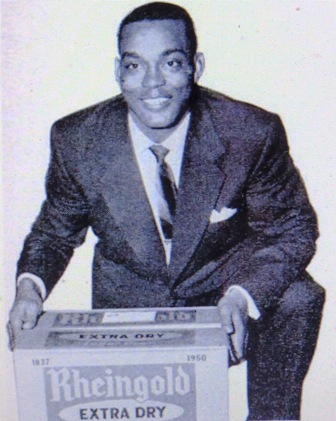
Irvin worked as a salesman for Rheingold Beer during the off season.

Irvin worked as a salesman for Rheingold Beer during the off season.