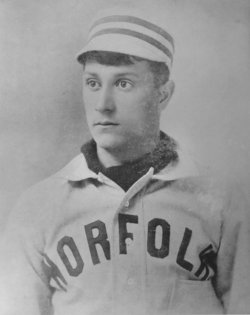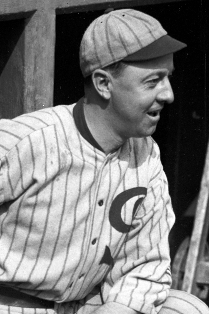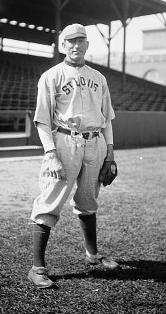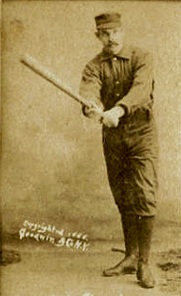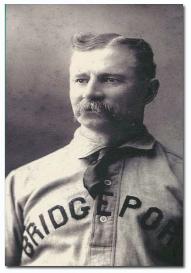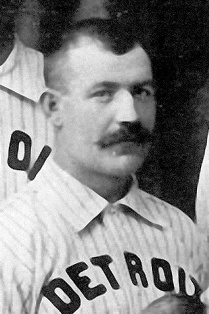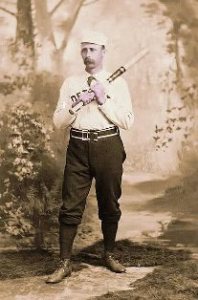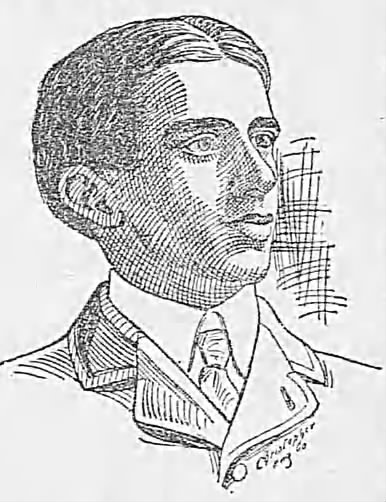
Bad Bill Eagan

6 Oct

William “Bad Bill” Eagan was just 35-years-old when he died from tuberculosis in 1905, but many people didn’t believe it when the news was first reported. The hard-living Eagan’s demise had been predicted and reported several times. In 1901, the year after his professional career ended, The Fort Wayne Sentinel said:

“’Bad Bill’ Eagan who died two or three times last year, is running a poker room in Detroit. Eagan dies on the average of three times a year and is about due for the first of this year’s series. Eagan captained and played first base for Youngstown before his second demise last season.”

Bad Bill
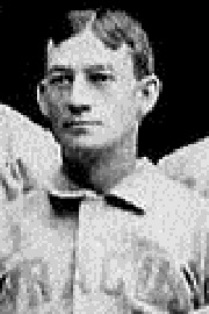
Bad Bill

In 1899 Connie Mack told The Philadelphia North American:

“Eagan would be one of the best second basemen in the business if he would keep in condition.”

He quickly wore out his welcome during all three of his brief stints in the big leagues. The first, with the St. Louis Browns in the American Association in 1891, ended, according to The Syracuse Standard after an incident with team owner Chris von der Ahe:

“(Eagan) was a jolly fellow and not afraid of discipline. The Browns got on a train at St. Louis to come East…von der Ahe’s nasal organ was rather large and red for its age and ‘Bad Bill’ determined to have some sport.

“Walking up to his employer, he caught the nose between his fingers, and said: ‘Say, Chris, how much did it cost to color that?’

“The owner of the cerise nose was furious with rage. He released Eagan at once. The train was ninety miles east of St. Louis, and at von der Ahe’s order the conductor put the nose twirler off the train.”

Two years later Eagan joined ‘Cap’ Anson’s Chicago Colts. Hugh Fullerton told the story of how he wore out his welcome there after just six games:

“Anson was a quick thinker on the ball field, but once he released the best second baseman that ever wore a suit for thinking a little quicker than anybody else on the nine.

“The second baseman in question was “Bad Bill’ Eagan. Everybody who remembers ‘Bad Bill’ will admit his supremacy on the second bag. When the play we celebrate came up there was a base runner on second. Chicago was one run to the good, and it was in the last half of the ninth inning.

(Bill) Dahlen was playing third base for Chicago. The man hit a sharp liner down to second. ‘Bad Bill’ started for it and at the same instant the man started for third base.

Bill Dahlen

Bill Dahlen

“The liner was a clipper and the ball struck ‘Bad Bill’s’ hands and bounded out. It struck the ground ten feet away, with ‘Bill’ right after it. Once he got his hands on it and without stopping to look where he was throwing. ‘Bill’ let the ball fly to third base.

“Most ball players after fumbling the ball would have tossed it to the pitcher or thrown it home if, after looking around, they saw that the base runner had started to try to score.

“In this case the base runner, after touching third, went on for twenty feet and then stopped for an instant to see what had become of the ball. He saw it coming straight as a die for third base, and went back there like a flash. But the ball beat him by ten feet. Unfortunately for the game, and also for “Bad Bill,’ Dahlen had taken it for granted that Eagan would throw the ball to the home plate, and was not looking for it to be thrown to him. Consequently the ball went by him, going within four inches of his nose, and striking the grand stand far behind.

“The result was that both base runners got safely home before Dahlen recovered himself and the ball, and the game was lost to Chicago.

“Anson was furious and immediately after the game gave ‘Bad Bill’ his release for making that throw. As a matter of fact, it was the best possible play under the circumstances, and Dahlen, rather than “Bad Bill’ was to blame for it not coming out as planned. If ‘Dal’ had thought as quickly as ‘Bill’ the game might have been settled right then and there.”
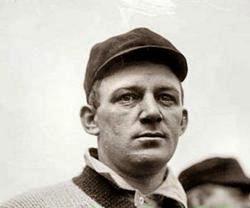
Eagan received one more trial with a major league team in 1898. He started the season on the bench for the Pittsburgh Pirates, but was given the opportunity to start when regular second baseman Dick Padden left the team over a dispute with Manager Bill Watkins in May.

Eagan hit .328, but committed 10 errors in 19 games. He was sold to Louisville Colonels on June 5. The Louisville Courier-Journal said:

“He is a clever fielder, a fair batsman, extremely aggressive and absolutely fearless (and will) certainly strengthen the team in one of its weakest spots.”

But he never appeared in a game for Colonels. The following day The Courier-Journal said the deal was off, and Manager Fred Clarke would only say, via telegram:

“Called deal for Eagan off for good reasons.”

The Colonels passed on Eagan despite being a team badly in need of a regular second baseman—Clarke tried nine different men there during the season, and his primary second baseman, Heine Smith hit .190 and committed 16 errors in 26 games.

Eagan finished the 1898 season with the Eastern League’s Syracuse Stars, where he had played from 1894 to 1897. He finished the year of 1898 in jail in his native Camden New Jersey.

That story Wednesday
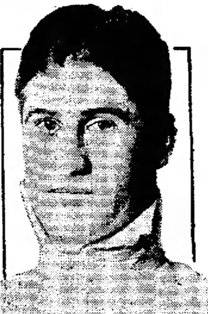
“Then the Harder I threw the Harder they hit them”

3 Oct

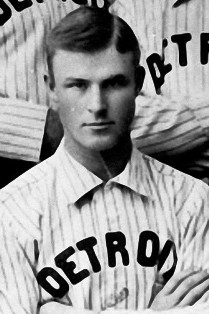
Walter Newton Justis–often misspelled “Justus” during his career– performed an incredible feat in 1908.  While posting a 25-17 record for the Lancaster Links in the Ohio State League, he pitched four no-hit games between July 19 and September 13.

Walter Justis

Walter Justis

The performance earned him his second shot to make the big leagues.  The first consisted of two relief appearances (8.10 ERA in 3.1 innings) with the Detroit Tigers in 1905 when he was 21.  He said later that he wasn’t ready:

“All I knew was to burn them over.  And the harder they hit them the harder I threw.  Then the Harder I threw the harder they hit them.  Most of the time in the three months that I was there I lugged the big bat bag, and I guess I earned my salary then about as much as at any time I know of.”

Justis’ bizarre behavior often made as big an impression as his pitching.  Roy Castleton was pitching for the Youngstown Ohio Works in 1906 when Justis joined Lancaster (the team was in the Ohio-Pennsylvania League in 1906 and ’07, and joined the Ohio State League in 1908).

Castleton, while playing for the Atlanta Crackers two years later told The Atlanta Constitution  he thought “Rube Waddell and Bugs Raymond, two players well-known for their eccentricities…will have to take off their top pieces,” to Justis.  Castleton was staying in the same hotel as the Lancaster team:

“Early one morning he heard someone raising a disturbance in the hotel hallway and taking a look to see what was doing, he observed pitcher Justis…running down the hallway.

“’At the end of the hall Justice placed a pillow against the wall.  He would get a good start down the hall and after the fashion of a man on the paths would take a running slide at the pillow.  When he arrived at his destination he would hold out his hand as umpires do and yell ‘safe!’  Justis would keep this up for hours at a time playing base runner and umpire out in the hall at daybreak.’

“’Sometimes he would stop the double existence of umps and runner and would (just) be the judge of the play.  Standing over the pillow he would hold out his hand and yell ‘safe’ so loudly that he could be heard a block off.’”

The Constitution also said that Justis was superstitious:

“He never goes into a game without wearing a pair of ladies’ silk hose supported in the usual manner.  Regular baseball stockings would never do for him, as he believes his career as a pitcher would be cut short if he were to wear them in a game.”

He was signed by the St. Louis Browns, and Manager Jimmy McAleer told The St. Louis Globe-Democrat the pitcher’s eccentricities were a positive:

“McAleer says that the reason he signed pitcher Justis of Lancaster was because Justis bears the reputation of being a baseball ‘bug.’  ‘Bugs,’ says McAleer, ‘make good in St. Louis.  We have Waddell, while the Cardinals have ‘Bugs’ Raymond.’”

Justis joined the Browns in Dallas in the spring of 1909.

The Globe-Democrat said after he had a poor outing in an exhibition against the Houston Buffaloes of the Texas League:

“Justis pitched two innings for the Browns Saturday and the Houston team got six runs.  Until this bombardment he was tagged for the regular club, and the label hasn’t been removed yet, though slightly loosened.”

And Justis appeared to have made the team when they broke camp in Texas and returned to St, Louis in early April, but The Associated Press reported on April 6:

“Walter Justus, a pitcher recruit of the St. Louis Browns, is confined to his room by a severe nervous collapse, and the nurse in charge says he may be able to leave for his home in Indiana in a few days.  Justis lost his power of speech at the end of a wrestling bout with Arthur Griggs in Sportsman’s Park today.  It is claimed Justus fell to the floor, striking his head, and reopened an old wound received when a boy.”

Justis suffered similar attacks at least four other times during his career; in June of 1907, twice in 1908, and August of 1909.  In July, 1908 after a double-header with the Lima Cigarmakers, The Marion (Ohio) Daily Mirror said “(Justis) suffered a sudden brain stroke akin to apoplexy.  He fell in a dead faint at the close of the second contest.  He was removed to his hotel in an unconscious condition.”   In September, after another attack left Justis hospitalized, The Sporting Life said prematurely “physicians say he will never twirl another game.”   It is likely that he suffered from epilepsy.

Within days of returning to Indiana from St. Louis Justis fully recovered.  The Associated Press said “His recovery is one of the most remarkable in the history of athletes.”  But, despite his recovery, Justis was returned to Lancaster by the Browns, and lost his opportunity to return to a major league team.

He threw another no-hitter for Lancaster in 1909, on May 18 against the Marion Diggers, and went 19-16 for the season.  Justis continued pitching until 1913, finishing with the Covington Blue Sox in the Federal League—where he played with the equally eccentric, enigmatic Fred “Humpy” Badel.

Justis shut out the St. Louis Terriers 4 to 0 on the opening day of the Federal League season, but no complete records remain for the season.  By late September of 1913 he was back home in Greendale, Indiana pitching for a local team.  He remained in Greendale until his death in 1941.

Bill Setley

1 Oct

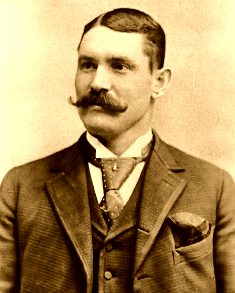
William Warren “Wild Bill” Setley was a career minor league player and umpire, and one of the most colorful figures in 19th and early 20th Century baseball.

He was born in New Jersey in 1871—Setley often claimed he was born in 1859; his grave marker and several sources still list this date, but there is a New Jersey birth certificate that confirms the 1871 date.

Bill Setley 1895

Bill Setley 1895

Setley spent the early part of his playing career in the Pennsylvania State League (PSL).  The Shenandoah Evening Herald said in 1893:

“(Setley) kept the home management on the anxious bench for many weeks last summer by his daring and acrobatic plays on the diamond and his eccentric whims between games.”

As a pitcher, Setley was credited with introducing the hidden potato play (made famous nearly a century later when Williamsport Bills Catcher Dave Bresnahan pulled a similar stunt), and he was known for turning routine plays in the outfield into spectacular circus catches.

William A. Phelon said Setley was “crazier than Rube Waddell ever thought of being,” and described an incident “when the pennant hung on the final game,”  with the winning runs on base in the ninth inning:

“Out came a fly to Setley.  Instead of catching it squarely in both hands he deliberately turned his back, reached out behind and made a dazzling circus catch—almost an impossibility.”

Years later, another Pennsylvania paper, The Mount Carmel Item described him as:

“(O)ne of the most erratic players in his day and while here a dozen years ago he was in his prime, but for a pack of cigarettes or a drink of whiskey he was liable to throw a game.”

George McQuillan who played in several leagues Setley worked as an umpire said:

“He is one of the real wonders of the game, and it’s too bad the big league fans have never had the chance to see him in action.”

There were many versions of the most often told story about Setley, and  Clarence “Pants” Rowland told the version that most often appeared in print:

Pants Rowland

Pants Rowland

“’I was managing Dubuque in the Three-I League at the time,’ says Rowland.  ‘The game was being handled by Wild Bill Setley, who was quite the character in those days.

“’I was coaching at third base and we got a runner to first during the early innings.  The next batter made a single and our runner started on the dead run from first, rounded second and bore down on third.  Right at his heels was Bill Setley.

“The ball was quickly recovered and beat the runner to third by a couple of steps.  Setley waved him out, and I had nothing to say.  But you should have heard me yell when, on turning, he also called my other man out at second, although he was standing on the base.  The third sacker had whipped the ball down to the second sacker, trying to complete a double play on our man who was trying for the base.

“’Where do you get that way? I demanded.  You had your back turned on the play how could you call him out?’

“’Setley grinned, came over to me, and showed me a small mirror he had concealed in his hand.  ‘I had my eye on the play all the time,’ he said, ‘and you know he was out.’  I was stopped all right, had nothing further to say.’”

Setley, on a few occasions, told a different version of the story.  This one placed the event in Pennsylvania and substituted Jack Tighe for Rowland.

In this rendition, Setley claimed that on the way to the ballpark he received “an advertising mirror” as a present for his daughter.  During the game, Tighe scored from second base on an infield hit, but Setley said:

“(I) knew he couldn’t have reached there if he had gone within 50 feet of the third bag.  The crowd kept yelling ‘Throw the ball to third,’ and when the first baseman did so I called Tighe out.  ‘What’s that?  Out! What do you mean?’ He yelled, chasing out on the diamond like a wild man.  ‘You are out for cutting third.’  ‘Well, if I did you didn’t see me’…’Be reasonable, Jack’ I replied, pulling out the mirror and holding it up in the palm of my hand before my face.  ‘When I was running over to first I had this glass up this way watching you.’  That wilted Tighe and he walked back to the bench as meek as a lamb.”

The Texas League was one of the many minor leagues Setley worked as an umpire.  On September 5, 1910, a triple-header (the first two games were five innings each) was scheduled between the Houston Buffaloes and the Galveston Sand Crabs on the season’s final day, with Setley working as the umpire in all three games.  After the teams split the first two games, The Houston Post said:

“The last game of the Texas League race progressed nicely here until the second inning when (with Galveston at bat) (Gus) Dundon singled to left and (Joe) Kipp had walked.  Then (Houston pitcher  Roy) Mitchell and umpire Setley, while (Bert) James was at the bat, had some words.  Suddenly Mitchell turned on the umpire and knocked him down.  Setley arose and ran towards short position, when Mitchell threw the ball at him, striking him in the back of the head rendering him unconscious.  Immediately the crowd surged into the field.”

The Associated Press added a few details, including that Mitchell “ran up and cuffed (Setley) several times,” after hitting him with the ball, and:

“(S)everal thousand fans had swarmed into the field, all of them apparently in sympathy with Mitchell.

“Setley remained motionless on the ground and the rumor spread like wild-fire over the field that his neck was broken.  Six men picked him up, shouldered him and carried him to the club house, where a physician examined him only to discover that his pulse was perfectly normal and that he was uninjured.  It suddenly dawned on the physician that someone was playing possum.

“’Come out of it Setley,’ said the physician, ‘no one is going to hurt you.’

“Setley ‘came back’ with a grin and said nothing but his feelings had been hurt.”

During the “riot” on the field, the Galveston club left the ballpark in a wagon “and returned to town.”  The game was awarded to Houston as a forfeit.

Mitchell was arrested but quickly released on bond.  Five days later he made his big league debut for the St. Louis Browns, beating the Chicago White Sox 7 to 2.

Roy Mitchell

Roy Mitchell

Somehow the Texas League and the National Commission failed to take any action against Mitchell for more than a month.  The Sporting News said:

“It was a matter of surprise that Mitchell was allowed to come direct to St. Louis and continue play, as if nothing had happened.”

He was fined $50, and while it was announced he was also suspended indefinitely, he was allowed to begin the 1911 season with the Browns.

Setley was let go by the Texas League in November.  The Fort Worth Star-Telegram said:

“(He) will always remember his short sojourn in this league as an umpire, as it probably was one of the most strenuous periods of his existence.  His first appearance was in Fort Worth, where he narrowly avoided a serious conflict with a spectator, and he precipitated wrangles at nearly every point he officiated, with the climax coming in the memorable last day’s game at Houston.”

More Setley stories later this month.

“Random Notes on the Leading Members of the Brotherhood.”

29 Sep

Ernest Justin Jarrold wrote for The New York Sun in the 1880s and 90s and was best known as the author of the “Mickey Finn” stories which were serialized in The Sun—Jarrold also wrote for the paper under the pseudonym “Mickey Finn,” about his travels through Ireland.

Ernest Jarrold

Ernest Jarrold

In 1889 Jarrold was at New York’s Fifth Avenue Hotel for “the meeting of the Ball Players Brotherhood for the purpose of forming the Players’ League.”  He provided readers with his “random notes on the leading members of the Brotherhood.”

Jarrold said:

“I met all the leaders.  The man who attracted the most attention was John Montgomery Ward, the celebrated shortstop.  This little man—for he is a pygmy compared with some of his associates—is generally admitted to have the largest business faculty of any baseball man in the country.  He originated the scheme of the new league while on the trip around the world last year, and, with the help of Fred Pfeffer, of Chicago, and Edward Hanlon, of Pittsburgh, formulated the plans while on the steamer going from Australia to Europe.  This conspiracy was carried out under the very nose of Al Spalding, and many secret conferences were interrupted by the entrance of Mr. Spalding.  Ward has a winning personality.  He dresses modestly but neatly.  He is the husband of the celebrated actress Helen  Dauvray, and has saved money from his earnings as a ballplayer.  This he has invested mostly in western real estate.  He is variously estimated to be worth from $50,000 to $75,000.

“Perhaps the next man in popular interest seen in the corridors was Michael Kelly.  In addition to being one of the handsomest men in the new league, Kelly is probably the wittiest.  He has created more original coaching expressions than any of his contemporaries.  He dresses well and wears diamonds.  Kelly is credited with executive ability on the ball field of a high order.  Most of the tricks in ball playing are the tricks of his prolific Irish brain. “

Jarrold said “one of the most striking figures” present at the meeting was the six-foot-four 200 pound Jay Faatz:

Jay Faatz

Jay Faatz

Faatz is the most expert poker player in the United States.  He has a passionate love for diamonds and always carries in his shirt bosom and cuffs $1,500 worth of these gems…He also has a snug sum in the bank.  Faatz always takes in the prize fights and the dog disputes which occur in his vicinity.  He is a level-headed, clear thinker, and the orator o the Brotherhood.

Fred Pfeffer, of Chicago, is one of the few players who has put money into the new league.  He has invested $3,000.  He is said to be the best fielder in the West.  Pfeffer is remarkable for his neat appearance when playing ball.  He is quiet and reserved.  He wears a brown mustache, a silk hat and a pleasant smile.  The New York reporters couldn’t elicit any information from him even when they used a corkscrew.

William Ewing, the greatest ball player in the world, is a bachelor. He is a very ordinary looking citizen in street attire.  He earned $6,500 last season (The New York Times said he earned $5,500, the “Spalding Guide” said $5,000).  Ewing was the first man to sign the agreement which bound the players to the new scheme.  He said he had no grievance, as the league had always used him well, but he wanted to cast his lot with ‘the boys.’  For a long time he was distrusted by the players on account o his intimacy with Mr. Day (Giants owner John B. Day).  Ewing will be captain of the New York team.

Lawrence G. Twitchell, five years ago, was a carpenter, working for $2 per day.  Today he is a capable left fielder, and earns $2,500 for working about six months in the year.  Tony, as he is familiarly known, is remarkable for his fine physique.  No more perfect man physically ever set foot on a diamond.  The trip east from his house in Ohio to attend the convention cost him $500.  He married a wealthy young woman, who became enamored of him while playing ball at Zanesville, Ohio…Tony says he is not obliged to play ball for a livelihood.  He does it for love of the game.  He is young, beardless and handsome;  also enthusiastic as to the ultimate success of the new league.

Larry Twitchell

Larry Twitchell

Edward Hanlon, who will fill the onerous position of captain of the new Pittsburgh club, will also act as manager and centerfielder of the team.  He has been frugal and has saved money during his long and illustrious baseball career.  Hanlon is one of the progenitors of the new league.”

Hanlon had been responsible for making the initial contact with street car magnate Albert Loftin Johnson, who would become one of the league’s principal financial backers, and according to Jarrold “the missionary of the new baseball venture.”  Jarrold said:

“(Johnson is) an ardent admirer of the game…All preliminary meetings in the formation of the Players’ League were held in his rooms in Cleveland.  A policeman was stationed at the door to keep out reporters.  It was mainly through his efforts that the seal of secrecy was kept over the organization for so long a time.  He can talk longer and state less facts for reportorial use than any man connected with the baseball fraternity.  It can be stated truthfully that no organization of such interest to the public as the Players’ League was ever handled so secretly as has this one.  This was mainly due to Johnson’s perspicuity.  He is a heavy backer of the new enterprise, and is known as the Moses of the new baseball dispensation.  Johnson doesn’t pay much attention to clothes or diamonds.”

Among those present at the meeting, Jarrold seemed to think most highly of outfielder George Gore “One of the most dashing, devil-may-care men in the new league.”  Jarrold said:

George Gore

George Gore

“Gore has the happy faculty of laying aside his profession when off the diamond, which faculty is shared by but few ball players.  As a rule these men are very sensitive, and when a game is lost it is not uncommon for them to be so depressed in spirits that they cannot eat or sleep.  Gore, however is not that kind.  As John Ward says:  ‘Gore lets care get behind the wood pile when his work is over.’  He used to run a paper machine in Saccarappa, Maine in 1878.  Gore lives up to his income and has saved no money.”

Within a year, the Players League was finished and “Mickey Finn” had moved on to writing about his travels in Ireland.

“Go Back to Old Kentucky”

26 Sep

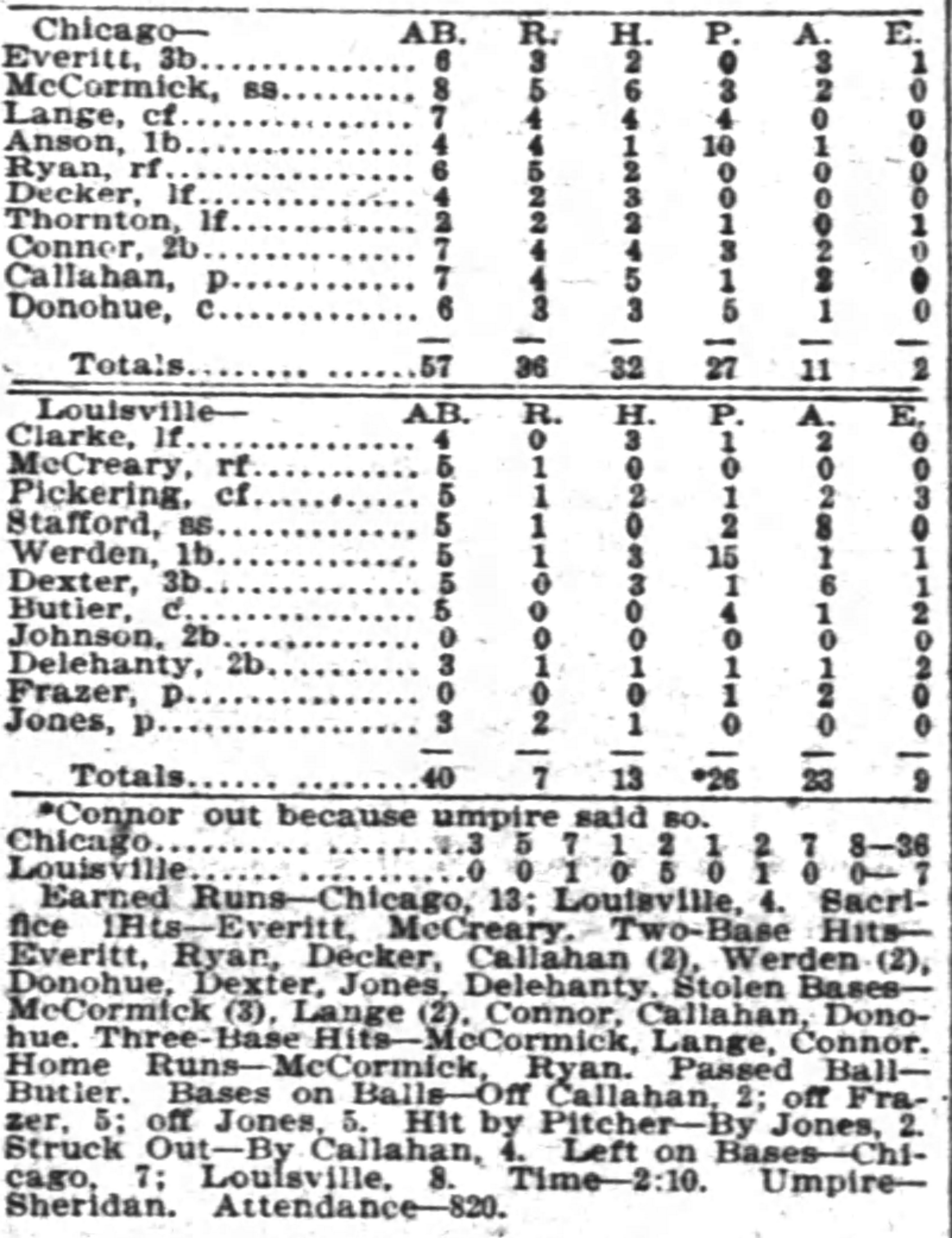
On June 29, 1897 “Cap” Anson’s Chicago Colts defeated Fred Clarke’s Louisville Colonels by scoring more runs than any team has ever scored in a single game.  The Chicago Tribune said:

“Game is a farce and everybody has a good time except the Colonels.”

The Chicago Inter Ocean said:

“Chicago exterminates Bourbons to the tune of 36 to 7.”

The Louisville Courier-Journal headline put it simply:

“Awful work.”

The Colts scored at least one run in each inning, collected 30 hits, and Louisville committed nine errors.

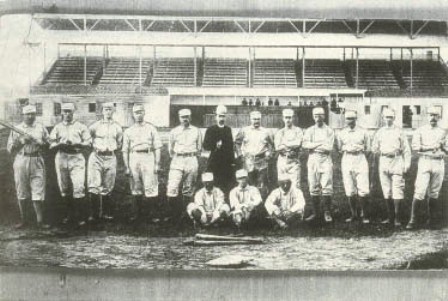
The Colonels finished in 11th place with a 52-78 record in 1897

The Colonels finished in 11th place with a 52-78 record in 1897

One Chicago fan memorialized the contest with a song, which The Courier-Journal shared with their readers.  The song, said the paper, was “a parody on the song ‘She Was Bred in Old Kentucky;”

Go Back to Old Kentucky

While talking one summer’s day,

With a friend not far away,

About a baseball game

That was coming off that day,

The Colonels and the Colts

Were going to take the holts

On the Diamond Field

And battle for the game.

A man, Fred Clarke, by name,

Young, but who had won great fame,

Had come out to play

With the Kentucky boys.

He had reason to be sad,

For Louisville was bad,

When a hobo in the crowd

Rose up and said:

Chorus

Go back to old Kentucky,

Here the meadow grass is green;

You’re a lot of dub ball-players,

You’re the worst I ever seen,

Go back to old Kentucky

And consider yourself lucky

You got off as light as you did.

Oh! His heeding of advice,

He would not listen to him twice,

And the grounds that day he did go;

There was Clarke and (Charlie) Dexter too,

The game began at half-past two,

And their places in the field they took;

Ritchie was at second base,

With the ball he tried to race.

The ball bounded

And caught him in the eye;

And Clarke fancied he could trace

A little swelling on his face.

As he sat down a lobster in the crowd cried:

(Repeat Chorus)

“Richie” was Ebenezer “Abbie” Johnson, who was occasionally called “Richie” in the press; Johnson was playing second base during the third inning when a ball hit by Anson—The Tribune called it “a viciously driven ball”– took a bad hop and “smashed Johnson in the eye, almost knocking it out.”

Abbie Johnson

Abbie Johnson

The game also included, in the fifth inning, an incident The Tribune called “probably the most ludicrous situation ever seen on a league diamond.”

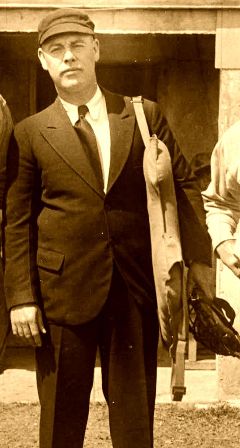
The Colts led 16 to 1 at the beginning of the inning.  After loading the bases and scoring two runs, catcher Tim Donahue fouled out, and third baseman Bill Everitt grounded out; Jim Connor, the Colts second baseman appeared to score from third on the play, but, The Tribune said:

“When the players all came off the field the fact only two were out became known.  After much searching through his brain pan for and excuse (Umpire Jack) Sheridan took the tally away from Connor and called him out for ‘Cutting third base.’”

Perhaps the first, and only, time a player was called out for “cutting” the base he left from; Sheridan’s call also made for one of the most interesting notations included within a box score.

The Tribune box score included the note: “Connor called out.  No reason assigned.”  The Inter Ocean went with the more sarcastic:  “Connor out because umpire said so.”

The Tribune Box Sore


The Inter Ocean Box Score

The Inter Ocean Box Score


30 runs or more have only been scored by one team in a single game nine times—eight of them were before 1900—and Chicago is responsible for four; the other three games were in 1876, 1883 and 1883.

Tom Lynch’s Broom

24 Sep

In 1905 Chicago White Sox outfielder Jimmy “Nixey” Callahan talked about his first season in Chicago in 1897 in an article distributed by “Newspaper Enterprise Association” to several newspapers across the country:

“’Bill’ Lange, who is now a prosperous real estate dealer in Frisco, and former Umpire Tom Lynch, who is a theatrical magnate in New Britain, Conn., were sworn enemies of the diamond.  On the ball field Lynch insisted on being addressed as ‘Mr. Lynch’ and was probably the strictest disciplinarian that ever wore a mask.

“We were playing in Boston with the old Chicago club, under (Cap) Anson, and noticed that the broom used to brush the plate was always kept or thrown over to our side, due to some superstition of other on the part of the Boston players to have it on the visitors’ side.  Lange was leading off about the fifth inning and as he walked to the plate he picked the broom up and threw it over on the Boston side.  (Hugh) Duffy, who was then captain of the Boston nine, threw it back.  One of our players ran from the bench and hurled the broom over to the Boston side.  The large crowd began to see the humor of the situation and began cheering the players as the broom passed back and forth.  Lynch stopped the game and as a truce umpired the rest of the game with the broom in his possession.  The next day the broom was missing and Mr. Lynch carried a small whisk broom in his pocket.”

National League President Thomas Lynch

National League President Thomas Lynch

During the same series, Callahan said:

“Lange’s method of annoying Lynch was artistic.  When at bat or passing Lynch he would say” ‘Don’t you think Boston will win today Mr. Lynch? Or ‘Don’t you think Boston will win the pennant Mr. Lynch? Would you as a disinterested party like to see Boston win, Mr. Lynch?’  Never giving Lynch a chance to fine him by being vulgar or noisy, Lange would not stop walking when addressing him, ever.

“He would have Lynch furious, but as he kept within the bounds Lynch was forced to take his medicine.”

Five years later, after Lynch had been named president of the National League; Lange retold the broom story to a reporter and said:

“After the damage had been done I suggested that we compromise by allowing one half the handle to lie on one side of the plate and the other half on the other.”

Years later, another National League umpire, George Barr, told a reporter for The Associated Press that the umpire’s whisk broom was “The most important thing, he possessed on the field:

“That little whisk-broom which most of the fans and players, too, believe is carried around to keep the plate free from dust is actually the symbol of authority the umpire has over the game.

“So when you are working behind the plate, stride up to the old pan and give her a vigorous dusting, even if the thing’s as clean as a whistle.  That’s to let the fans and players know you’re in charge of the game—that you’re the official representative of the league which, in fact, you are.”

George Barr

George Barr

Things I Learned on the Way to Looking up other Things #11

22 Sep

Floto on Baseball’s Most Powerful Men

Otto Clement Floto was one of the more colorful sportswriters of the late nineteenth and early twentieth century’s.  The Denver Post’s Woody Paige said of the man who was once worked for that paper:

“In the early 1900s Floto was The Denver Post’s sports editor and a drunk, barely literate, loud-mouthed columnist–sounds like a description of that guy in my mirror–who didn’t believe in punctuation marks, wrote about fights he secretly promoted on the side, got into shouting matches with legendary Wild West gunman–turned Denver sportswriter–Bat Masterson.”

Otto Floto

Otto Floto

Floto, in 1910, provided readers of The Post with his unvarnished opinion of baseball’s most powerful figures:

John T. Brush—The smartest man in baseball, but vindictive.

Garry Herrmann—Smart, but no backbone; the last man to him has him.

Ban Johnson—Bluffs a great deal and makes it stick.  Likes to talk.

Charles Comiskey—Shrewd as can be.

Connie Mack—Shrewd and clever; knows the game better than anyone.

Charles Murphy—A hard fighter, but backs up at times.

George Tebeau—More nerve than any other man in baseball, very shrewd.

Barney Dreyfus—Smart, but always following, never leading.

As for John McGraw, Floto allowed that the Giants’ manager was “Pretty wise,” but attributed his success to the fact that he “has lots of money to work worth.”

Too Much Money for Players, 1884

The Cleveland Herald was not happy when pitcher Jim McCormick jumped his contract with the Cleveland Blues in the National League to the Union Association’s Cincinnati franchise.  Although teammates Jack Glasscock and Charles “Fatty” Briody also jumped to Cincinnati, the paper saved most their anger for the first big leaguer to have been born in Scotland.

Jim McCormick

Jim McCormick

The paper noted that McCormick, who was paid $2500 by the Blues, had received a $1,000 bonus to jump:

“(A) total of $3,500 for joining the Cincinnati Unions to play the remainder of the season.  This is equal to $1750 a month, which again divided makes $437.50 a week.  Now McCormick will not play oftener than three times a week which makes his wages $145.83 per day for working days.  The game will average about two hours each, so that he receives for his actual work no less than $72.91 an hour, or over $1.21 a minute for work done.  If he was not playing ball he would probably be tending bar in some saloon at $12 a week.”

McCormick was 21-3 with a 1.54 ERA in 24 games and helped pitch the “Outlaw Reds” to a second place finish in the struggling Union Association.  After the Association collapsed was assigned to the Providence Grays, then was sold to the Chicago White Stockings.  From July of 1885 through the 1886 season McCormick was teamed with his boyhood friend Mike “King” Kelly—the two grew up together in Paterson, New Jersey and were dubbed “the Jersey Battery” by the Chicago press—and posted a 51-15 record during the season and a half in Chicago, including a run of 16 straight wins in ‘86.

He ended his career with a 265-214 record and returned home to run his bar.  In 1912 John McGraw was quoted in The Sporting Life calling McCormick “the greatest pitcher of his day.”

The pitcher who The Herald said would otherwise be a $12 a week bartender also used some of the money he made jumping from Cleveland in 1884 the following year to purchase a tavern in Paterson.

Not Enough Money for Owners, 1885

In 1885 J. Edward “Ned” Allen was president of the defending National League Champions –and winners of baseball’s first World Series—the Providence Grays.  He told The New York Sun that baseball was no longer a profitable proposition:

“The time was when a man who put his money into a club was quite sure of coming out more or less ahead, but that is past.  When the National League had control of all the best players in the country a few years ago, and had no opposition, salaries were low, and a player who received $1,500 for his season’s work did well.  In 1881, when the American Association was organized in opposition to the league, the players’ salaries at once began to go up, as each side tried to outbid the other.  When the two organizations formed what is known as the National Agreement the clubs retained their players at the same salaries.

“Several other associations were then organized in different parts of the country and were admitted under the protection of the National Agreement.   This served to make good ball-players, especially pitchers, scarce, and forced salaries up still higher, until at the present time a first-class pitcher will not look at a manager for less than $3,500 for a season.  (“Old Hoss”) Radbourn of last year’s Providence Club received the largest amount of money that has ever been paid to a ball-player.  His wonderful pitching, which won the championship for the club, cost about $5,000 (Baseball Reference says Radbourn earned between $2,800 and $3,000 in 1884), as did the work of two pitchers and received the pay of two.

The Providence Grays--Champions and unprofitable

The Providence Grays–Champions and unprofitable

“Some of the salaries which base-ball players will get next season are; (Jim) O’Rourke, (Joe) Gerhardt, (Buck) Ewing and (John Montgomery) Ward of the New York Club, $3,000 each.  (Tony) Mullane was to have played for the Cincinnati Club for $4,000 (Mullane was suspended for signing with Cincinnati after first agreeing to a contract with the St. Louis Browns).  (Fred) Dunlap has a contract with the new League club in St. Louis for $3,400.  These are only a few of the higher prices paid, while the number of men who get from $2,000 to $3,000 is large.  At these prices a club with a team costing only from $15,000 to $20,000 is lucky, but it has not much chance of winning a championship.  To this expense must be added the ground rent, the salaries of gate-keepers, and the traveling expenses, which will be as much more.

“As a high-priced club the New York Gothams leads, while the (New York) Metropolitans are nearly as expensive.  The income of these two clubs last year was nearly $130,000, yet the Metropolitans lost money and the New York Club (Gothams) was only a little ahead.  The first year the Metropolitans were in the field(1883) their salary list was light, as were their traveling expenses, and at the end of the season they were $50,000 ahead.”

The Grays disbanded after the 1885 season.

The Wealthiest Ballplayers, 1894

19 Sep

In 1894, major leaguer turned sportswriter, Sam Crane wrote about the wealthiest players in baseball in The New York Press:

(Cap) Anson is probably the wealthiest ball-player on the diamond today.  His wealth has been estimated anywhere from $50,000 to $100,000.  It is, without doubt, nearer the latter sum than the former.”

"Cap" Anson

“Cap” Anson

Anson’s fortune would be long gone, due to a series of poor investments and other financial setbacks, by the time he died in 1922.

“From the time he joined the Chicago club he has enjoyed a big salary.  In his nearly 20 years’ connection with the club he has acted as manager and captain since the retirement as a player of A.G. Spalding in 1877.  Anson, of course received extra salary as manager, and has also been a stockholder in the club…He has been fortunate, too, in real estate transactions in the “Windy City,” under the tutelage of Mr. Spalding, and could retire from active participation in the game without worrying as to where his next meal was coming from.”

The men who Crane said were the second and third wealthiest players managed to keep their fortunes.

Jim O’Rourke is thought to come next to Anson in point of wealth.  Jim came out as a professional player about the same time as Anson.  He did not get a large salary at first with the Bostons, which club he joined in 1873.  He remained with the team until 1878, when he went to Providence.  Jim was young and giddy when he came from Bridgeport to Boston, in 1873, and did not settle down into the staid, saving player he now is…He was a ‘sporty’ boy then, and liked to associate with lovers of the manly art.  Patsy Sheppard was his particular friend in the ‘Hub,’ and James made the boxer’s hotel his home for some time.  When he went to Providence in 1879 Jim began to think of saving his money, and from that time on his ‘roll’ began to increase.

Jim O'Rourke

Jim O’Rourke

Dan Brouthers has received big salaries only since 1886, when he, as one of the famous ‘big four,’ was bought by Detroit from Buffalo.  But since then he has pulled the magnates’ legs and socked away the ‘stuff.’  He has been situated so that he has been able to make the magnates ‘pony up’ to the limit, and Dan had no mercy.  He said he was out for the ‘long green,’ and he got it.  When the Boston club bought Brouthers, (Abram “Hardy”) Richardson, (Charlie) Bennett, (Charles “Pretzels”) Getzein and (Charlie) Ganzell, Dan grasped the opportunity and got a big bonus and also a big salary.  He made the Detroit club give up a big slice of the purchase money before he would agree to be sold.

Dan Brouthers

Dan Brouthers

“The Brotherhood war, when Dan jumped to the Boston Players league was another favorable opportunity for him, and he grasped it and the boodle with his accustomed avidity.  Dan has planted his wealth in brick houses in Wappingers Falls (NY), and can lie back at his ease with his 30,000 ‘plunks’ and laugh at the magnates.  It is this feeling of contentment that has made Dan almost too independent and has affected his playing lately (Brouthers appeared in just 77 games in 1893, but hit .337, and hit .347 in 123 games in 1894).  Dan is what ballplayers call ‘hard paper,’ which was a most distinguishing characteristic of every one of the ‘big four.’”

Detroit’s “Big Four” consisted of Brouthers, “Hardy” Richardson, James “Deacon” White and Jack Rowe.

“Hardy Richardson was not so awful bad, but Jim White and Jack Rowe took the whole bake shop for being ‘hard papes.’  They have both been known to start on a three weeks’ trip with 80 cents each, and on their return Jim would ask Jack, ‘How much have you spent?’  Jack would reply:  “I haven’t kept run of every little thing, but I’ve got 67 cents left.’   Jim would remark gleefully: ‘Why, I’m three cents ahead of you; I’ve got 70 cents.’  And Pullman car porters are blamed for kicking when a ball club boards their car!  Jack and Jim would sleep in their shoes for fear they would have to pay for a shine.  The only money they spent was for stamps in sending home papers, which they borrowed from the other players.  They are both well off now, however, and can afford to laugh at the players who used to guy them.”

Deacon White

Deacon White

(Charles) Comiskey has been fortunate in getting big money since 1883.  (Chris) Von der Ahe appreciated the great Captain’s worth and paid him more and more every year.  The Brotherhood business enabled him to make a most advantageous contract, and as manager and Captain of the Chicagos he received $7,000 salary besides a big bonus.  His contract with Mr. (John T.) Brush to play and manage in Cincinnati called for $23,000 for three years and $3,000 in cash.  This was made in 1891 and runs this year (1894).  Comiskey has his money invested in Chicago real estate, which is paying him a good income at the present time.

(John “Bid”) McPhee, (William “Buck”) Ewing, (Harry) Stovey, (Paul) Radford, (Ned) Hanlon, (Jack) Glasscock, (Tim)Keefe, (Charles “Chief”) Zimmer, (Charlie) Buffington, (Charlie) Bennett, and (Fred) Pfeffer are players who are worth from $10,000 to $15,000, which has all been made by playing ball.  There are only a few more players who have much in the ‘stocking.’”

“The Poet-Pitcher”

17 Sep

Edward Benninghaus Kenna came from a prominent West Virginia Family; his father, John Edward Kenna was a United States Senator.  Another West Virginia Senator, William Edwin Chilton was often referred to as Kenna’s uncle—he was his father’s former law partner and best friend, but they were not related.

Edward B. Kenna, circa 1900

Edward B. Kenna,1900

He was, according to The Kansas City Star:

“(A)n unusually well-educated young man,.  He spent four years at Mount St. Mary’s College and was graduated there in 1898.  His post graduate course of one year was taken at Georgetown University, and the following three years he spent at West Virginia University, studying law.”

Kenna played football and baseball at all three schools—and coached both sports at Richmond College in 1900, the same season he made his professional debut with the Toledo Mud Hens in the Interstate League.

He was also a poet who had two anthologies of his poems published and was later the editor of The Charleston Gazette.  While most current sources say his nickname was “The Pitching Poet,” during his lifetime he was nearly always referred to by the slightly less lyrical “The Poet-Pitcher.”

Despite his education, and pedigree, The Star said:

“Seeing Kenna on the ball field one would not think that he was the possessor of so many distinctions.  He does not attempt to hold himself aloof from his teammates, but on the contrary is one of the most energetic (players) in the pursuit of victory and when not in the pitcher’s box is on the coacher’s line haranguing the opposing players and urging the members of his own team to their best efforts.  Coaching is one of his hobbies and he is particularly successful at this line of work.  He finds special enjoyment in ‘kidding’ the bleacher element…He says that base ball is not an uplifting pursuit either morally or intellectually, but is an enjoyable one.”

He pitched two games in the major leagues—with the Philadelphia Athletics in 1902–but said the two most interesting games of his career were back-to-back starts in 1904 while he was a member of the Denver Grizzlies in the Western League.

When Kenna joined the Louisville Colonels in the following season, The Louisville Times told the story of the games—both against the Des Moines Prohibitionists:

“(He) was touched up for nineteen safe hits, and yet his opponents failed to get a runner over the pan.  In one inning he was hit for a triple, a double and three singles, and still his opponents failed to get a man home.

“The first batter up hit for a triple, but was nailed trying to stretch it into a homer.  The next man doubled down the left field line, but was afterward caught off second by the poet.  The next three batters hit safely, and then Kenna got down to work and fanned the next batter with the bases full.

“Two days later Kenna was sent in against the same team.  For eight innings he did great work (allowing no hits) and his teammates made but one error.  He had perfect control and during this period gave only one base on balls.  The Denver team managed to get one runner across the pan, which looked as good as a hundred when the ninth inning was about to close.  The bard fanned the first two batter, but the third reached first on a fluke (a second error).  Then (Bob) Ganley, who is now with Pittsburgh, stepped to the plate and drove out a home run, which won the game.  Only one hit was made off his delivery, and yet Kenna lost the contest by one score.”

He was 16-13 for the Colonels in 1905 when, on September 1, he and seven other members of the team were injured in Kansas City when an electric trolley car crashed into the wagon they were riding  to the ballpark.  Kenna was the most seriously injured, and  reportedly suffered broken bones in his right (pitching) hand, a fractured left arm, a concussion, broken nose and an eye injury.  The Kansas City Star said he was listed in serious condition at a local hospital.  Despite the extent of his injuries—which ended his season– Kenna sent a telegram to family members in Washington D.C., saying simply

“Nothing serious; strained arm.  Don’t worry.  Ed.”

He never fully recovered.  He returned to Louisville in 1906, and struggled, finishing the season 12-21, but he hit .325 in 166 at bats.  Given his new found success as a hitter—his best previously recorded average was .225—Kenna decided he was through as a pitcher:

The Louisville Times said:

“Kenna announces that from now on he will be an outfielder, and he hopes (team President George) Tebeau will play him in right field on the Louisville team next season.  Kenna is simply tired of pitching.”

The Colonels accommodated him, but he struggled at the plate and was released in July after hitting just .143.

Edward Kenna, circa 1910

Edward Kenna, circa 1910

Kenna returned to West Virginia, newspapers, and poetry.  About the time his book “Songs of the Open Air, and Other Poems” was published in early 1912, he left his job at the paper, and went to Florida to attempt to recover from what was described simply as “a heart condition.”  He died in Florida on March 22.

Sporting Life said of the thirty four-year-old’s funeral in Charleston:

“(It) was one of the largest ever seen here.  All races and creeds showed their deep grief for this beloved man.”

Kenna’s younger brother John Edward Kenna Jr. was also a right-handed pitcher; he was 15-6 for the Chattanooga Lookouts in the South Atlantic League in 1909 and 7-7 with the Worcester Busters in the New England League in 1910—also born in Charleston on January 6, 1883, he died there on May 5, 1956.

Comiskey’s “Sandusky Terror”

15 Sep

In February of 1899 The Chicago Inter Ocean said of Charles Comiskey, then owner of the Western League’s St. Paul Saints:

“It is also proper to state that C. Comiskey is, all things considered, the greatest story teller in this profession.”

Charles Comiskey

Charles Comiskey

The paper then related one of Comiskey’s favorite stories, told during that winter’s Western League meeting:

“’Speaking of ballplayers and their ways,’ he began, ‘did I ever tell you about my efforts to make a pitcher of the ‘Sandusky Terror?’  It happened while I was managing the old St. Louis Browns… It was in the early spring and I was in St. Louis waiting for my men to report for preliminary training.  (Browns owner Chris) von der Ahe had trouble in signing his star pitcher (Dave Foutz) that year, and when I looked over the list I found that I needed twirlers and needed them badly.  I told my troubles to Chris and he did his best to cheer me up.  He told me, among other things, that he had sent a railroad ticket to a young farmer who lived near Sandusky, and from all accounts was a wonder.  I didn’t enthuse, for I had had previous experience with these rustic phenomenons , but Chris said that a friend of his in Sandusky had bet him a case of champagne that the boy would prove a grand find.’

Chris von der Ahe

Chris von der Ahe

“’Next morning the boy from Sandusky showed up at the ballpark.  He was one of the biggest and strongest chaps I ever met in or out of baseball.  What is more, he had a pitching arm of tremendous powers, and after he passed the ball to me five minutes I saw that he had a world of speed and for a raw amateur, very fair control of the ball.’

“’Well, we started on a little training trip down South, and as a matter of course I took the boy with us.  His terrific speed and his willingness to learn made him popular with the members of the team, and they spent hours in catching him.  A week passed and I really began to think I had discovered the pitching star of the year.  Things went well until we struck Mobile..  When we drove up the hotel a fairly good looking woman of 30 or thereabouts walked up the bus and caught my Sandusky wonder by the arm.’

“’William,’ she said, ‘I want to have a serious talk with you.’

“’They strolled down the street arm in arm while the other players lounged around the hotel wondering what it all meant.  Half an hour later the couple returned.  The girl went into the parlor, but the young fellow called me to one side.’

“’Captain,’ he said, ‘I have gone and done it.’

“’Done what?’ I asked.’

“’Married Louisa,’ he answered.  ‘You see, she came all the way from Sandusky to teach school down in this part of the country, an’ she says she’s lonesome like an’ that playin’ ball for wages don’t suit her views.  Me an’ she kinder liked each other when she lived up in Sandusky an’ we’ve been writin’ letters to each other ever since she left home.  That’s how she knew I was with your club.  Captain, I guess that’s all, exceptin’ here’s the 60 cents I borrowed from you yesterday.  Louisa says I musn’t quit you owin’ a cent, and she gave me the money to hand to you.’

“’You don’t mean to say you’re going to quit the team,’ I gasped.  ‘Why, we will make a pitcher of you and pay you good wages while you are developing.’

“’That’s just it,’ he answered.  Louisa says I musn’t play for money.  Says her uncle, who is a preacher in the village, insists that it is wrong to do it.  Come in and ask Louis if I am not tellin’ you the truth.’

“’Well, I spent an even half hour in trying to induce that woman to change her mind, but she wouldn’t.  She said she had decided to make a lawyer out of her husband and that they would live on the money she earned teaching school until he was admitted to the bar.  Then she took her youthful husband away from the hotel and that was the last we ever laid eyes on the pair.  Later in the day I made a little investigation on my own account and found that the woman, who by the way, was at least ten years older than her new husband, had taken the boy straight to the parsonage and married him before he had been in the town twenty minutes.  I don’t know whatever became of the pair, but I believe to this very day that if the ‘Sandusky Terror,’ as the players nicknamed him, had gone back to St. Louis with the team he would have developed into another (Amos) Rusie.  I have never forgiven that pretty school teacher for making him jump our club, and, what’s more, I never will.’”