Tag Archives: Brooklyn Dodgers

“I mentioned Satchel and Josh and Cool Papa, I told Him he was Missing the boat”

18 May

After Heywood Broun’s remarks at the 1933 Baseball Writers Association dinner about integrating the game, The Pittsburgh Courier initiated a campaign to push the issue.  Despite some support inside baseball and from well-known newspapermen, the effort fell flat by opening day.

That summer, after the first East-West Game—won by the West All-Stars 11 to 7—at Comiskey Park, Henry L. Farrell of The Chicago Daily News suggested several “(M)ajor league club owners who are now on their knees might have their prayers answered,” by signing some the Negro League stars.

In the fall, The Chicago Defender briefly picked up the mantle from The Courier.  The paper asked their readers:

“How would you like to see the great baseball players of the Race performing in the major leagues? Wouldn’t you like to see Willie Foster, Satchel Paige and (Sam) Streeter pitch to Babe Ruth?”

If so:

“Sit down and write K.M. Landis commissioner of baseball, 333 N. Michigan Ave., Chicago.”

The following week, the paper reported that Landis’ office had refused to comment.  When baseball’s winter meetings commenced in Chicago in December, The Defender promised readers that the letters they had sent:

“(A)re not being passed on lightly as many suggested would be the case.  On the contrary, the club owners are downright concerned and from the inside word leaked out that some action would be taken.”

The optimism was tempered later that week when their reporter was barred from covering a meeting where he was told “vital points were discussed.”  The Defender reporter was told no newspapermen would be admitted, but:

“That sinister moves were being made against your author’s admission became a certainty when a well-known writer from one of the downtown papers came along, gave the high sign and was admitted.”

When 1933 came to a close, integration was no closer to being a reality than it was 11 months earlier as Broun stood to deliver his remarks to the baseball writers.

Four years later, Sam Lacy from The Baltimore Afro-American met with Washington Senators owner Clark Griffith in an attempt to revive the subject:

“I mentioned Satchel and Josh and Cool Papa, I told him he was missing the boat.”

Sam Lacy
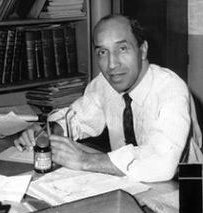
Sam Lacy

Griffith, he said, told him the timing was wrong, and that Southern-born players would not accept integration.

The next major effort came in 1939.

Political support had generally been limited to socialist and communist organizations—the Young Communist League spent the summer of ’39 gathering signatures to present to Commissioner Landis.  But, in July of that year, the Illinois House of Representatives adopted a resolution which read in part:

“Resolved, by the House of Representatives of the Sixty-first General Assembly.  That the owners of all professional baseball teams in the United States, both in the major and minor leagues be strongly urged to give baseball players of the colored race the same opportunity of becoming players on their respective teams as is accorded to such players of the white race.”

Another push came from Pittsburgh as well.

Wendell Smith, who was playing baseball at West Virginia State College when Broun made his speech in 1933, was now a reporter for The Courier. In July, he promised readers:

“The most exclusive, startling and revealing expose, of the attitude of the major league players and managers themselves, ever written.”

Wendell Smith
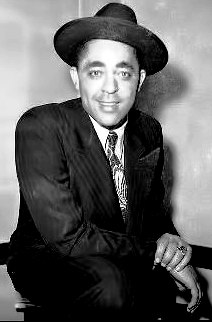
Wendell Smith

Over the course of several weeks Smith asked 40 players and eight managers as they passed through Pittsburgh, “Are Negro ballplayers good enough to ‘crash’ the majors?”

The Courier’s Chester Washington said in a column to introduce the series of articles:

“One of the major reasons why Mr. Smith’s discovery is so revolutionary is that the club owners, in trying to pass the buck, have blamed the ban on the players themselves.  They claimed that the injection of colored stars into the clubs would bring about friction and dissention… (Smith) practically disproves this contention.

“Fearlessly buttonholing the managers and outstanding players of all the National League clubs, Mr. Smith received scores of testimonials which should be a revelation to the owners.”

A sampling of the statements collected by Smith:

Ernie Lombardi, Cincinnati Reds:  “(Satchel) Paige is as good as (Dizzy) Dean.”

Johnny Vander Meer, Cincinnati Reds:  “I wouldn’t object.”

James “Doc” Prothro, Philadelphia Phillies: “If given permission I would jump at the opportunity to sign up a good Negro ballplayer.”

Leo Durocher, Brooklyn Dodgers:  “(Satchel) Paige, (Bill “Cy”) Perkins, (Mule) Suttles and (Josh) Gibson are good enough to be in the majors right now…I certainly would use a Negro ballplayer if the bosses said it was all right.”

Gabby Hartnett, Chicago Cubs:  “I am sure that if we were given permission to use them, there would be a mad scramble between managers to sign them.”

Gabby Hartnett

Gabby Hartnett

Dizzy Dean, Chicago Cubs: “If some of the colored players I’ve played against were given a chance to play in the majors they’d be stars as soon as they joined up.”

Pepper Martin, St. Louis Cardinals: “Some of the big league players would object, but on the whole I think they would be accepted.”

Pie Traynor, Pittsburgh Pirates: “believe me when I say I have seen countless numbers of Negro ball players who could have made the grade in the majors.  Only their color kept them out.  If given permission, I would certainly use a Negro player who had the ability.”

Honus Wagner, Pittsburgh Pirates:  “Yes, down through the years I have seen any number of Negro players who should have been in big league baseball.”

Over the next five years, Smith would interview more than 150 additional major leaguers, who would echo the sentiments of his original 40, keeping the pressure on professional baseball to desegregate.
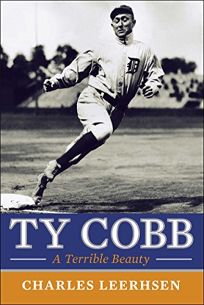
The Definitive Cobb Biography

11 May

Myths.  Baseball books are full of them.

Perhaps the most enduring myths are about Ty Cobb.  A prototype of a villain in spikes from central casting:  Dirty player– check, virulent racist—check, miserly and bitter in old age—check.

That is the Ty Cobb cemented into our consciousness.

So much so in fact, it is difficult to find a discussion on the internet regarding the merits of Pete Rose’s case for the Hall of Fame without a member of the pro-Rose faction, at some point, making the “Yeah, but Ty Cobb did (fill in the blank)” argument.

Or, as Charles Leerhsen puts it, in “Ty Cobb: A Terrible Beauty” (which will be released tomorrow), “This Cobb was someone (fans) could shake their heads at, denounce, and feel superior to.”

cobb


The clues were there that Cobb might just be more than the sum of the single-dimensional parts previous biographies claimed to reveal.

Not long ago, I wrote about Cobb’s embrace of fellow Royston, Georgia native, and former Negro League player and newspaperman Fred Downer at Wrigley Field in 1953—the same day Cobb spoke glowingly to reporters about Dodgers’ catcher Roy Campanella.

No less an authority than Wendell Smith—the legendary reporter from The Pittsburgh Courier who by then had joined The Chicago Herald-American as the first black sportswriter at a white-owned paper—said after that day at Wrigley that reports of Cobb’s racism were always “merely a matter of hearsay,” and “He gives no indication today of intolerance.”

Yet, the hearsay has always outpaced the reality; until now.

Through exhaustive research and a compelling narrative, Leerhsen demonstrates that the one-dimensional Cobb of lore is, at best, a caricature.   The stories that have been told and retold for years about racially motivated physical attacks were poorly sourced and greatly exaggerated.  Statements like the one about Campanella and several that Leerhsen has compiled were ignored.

The author even manages to add context to the often told stories of the death of Cobb’s father and Cobb’s relationship with mascot Ulysses Harrison (bonus points here because unlike many of the versions of this story elsewhere he gets Harrison’s name correct).

Leehrsen’s three-dimensional Cobb is more interesting than the one presented previously.  This Cobb was quick to anger, perhaps overly sensitive, certainly no less flawed than many of his contemporaries, but more complex, more introspective and much more difficult to shake our heads at.

An excellent read, well worth your time.

“Let us try and meet his Qualifications as a Gentleman”

20 Apr

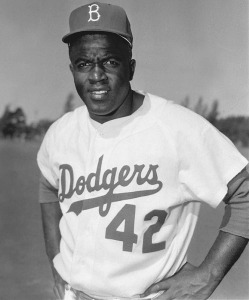
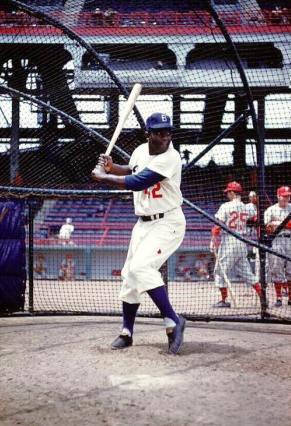
In April of 1947, with Jackie Robinson on the verge of making his debut with the Brooklyn Dodgers, the “Dean of Negro sportswriters,” Frank Albert “Fay” Young said in The Chicago Defender, Robinson would not be the only one under a microscope:

“It is hoped that the Negro fans, who want to see Robinson remain in big-time baseball will learn to treat him as another top-notch ball player.  He should not be made to carry the added burden of ‘the race problem’ on his shoulders.  He will have a hard enough job playing the brand of baseball expected of any other big leaguer.

“Two things are important.  The first is the conduct of the Negro fans.  Drinking is out in all National League parks.  Profane language, if you have to use it, reserve it for your home where your wife will ‘brain’ you.

Robinson will not be on trial as much as the Negro fan.  The Negro fan has been the ‘hot potato’ dodged by managers who would have taken a chance by signing a Negro player.”

Frank "Fay" Young, The Chicago Defender

Frank “Fay” Young, The Chicago Defender

Robinson was scheduled to make his first appearance in Chicago on May 18.  Young said:

“We hope that Sgt. Harness and ‘Two-gun Pete’ and some other brave Negro policemen will be assigned to the Cubs Park.  Harness and ‘Two-gun’ know the hoodlums.”

Harness and ‘Two-gun Pete’ were Robert Harness and Sylvester Washington, two well-known African-American police offers.  Harness rose to the rank of commander before he retired.  Washington, who The Defender called “Chicago’s toughest black cop,” and carried two pearl-handled revolvers, suffered a different fate.  The paper said in 1951, he was “(A)sked publicly to explain how he had been able to purchase a $40,000 building specifically, and maintain an expensive auto and flashy clothes on a $3,600 per year salary.  ‘A lot of people give me things…I am a great policeman,’ he is reported to have replied.”  Washington resigned from the force that year.

In addition to their behavior at the ballpark, Young also implored fans:

“Robinson is against being singled out before a game to be called to home plate and be presented with numerous gifts.  There will be eight other Dodger players in the game.  Jackie insists on being treated as a ballplayer trying to make good and not a Negro ballplayer seeking special privileges.

“The Negro fan can help Robinson.  The Negro fan can ruin him.  Robinson is an American citizen, an ex-army officer, a ballplayer and a gentleman.  Let us try and meet his qualifications as a gentleman.  If you Chicagoans have got to raise a lot of hell, do a lot of cussing, go somewhere else.”

Jackie Robinson

Jackie Robinson

Robinson’s Chicago debut—a 4 to 2 Dodger victory–drew 46,572 fans, the then largest crowd to attend a game at Wrigley Field since field seating was discontinued in 1936.  The Defender reported that the fans were “Orderly,” focusing their only derision towards “one Dixie Walker who was the recipient of plenty of boos.”  The fans maintained order even when Robinson was called out on strikes with the bases loaded in the fifth inning “much to his disgust and to those who sat behind home plate and though the umpire should have called the pitch a ball.”

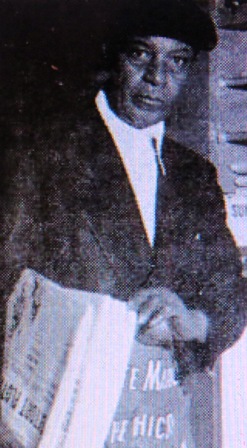
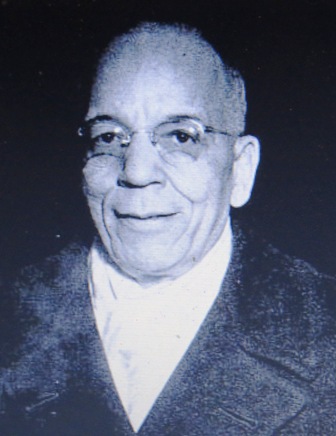
Fred Downer

30 Mar

In August of 1953, “Jet Magazine” said people were talking about:

 “That affectionate hug baseball immortal Ty Cobb gave Chicago news dealer Fred Downer.”

By then, Frederick Douglas Downer was largely forgotten.

Before playing as a professional, he was, according to The Pittsburgh Courier, the “star” of the Morehouse College baseball team in Atlanta.

Fred Downer

Fred Downer

His first professional experience was with the Atlanta Cubs in 1919—the team was colloquially called the Atlanta Black Crackers for years, and newspapers referred to them by both names until 1922 when the “Cubs” name was permanently dropped.  Years later, Downer told The Chicago Defender he also played with the Knoxville Giants during this period.

In 1921, Downer and Gerard Williams, his teammate at Morehouse and with the Atlanta Cubs, went north to join the Pittsburgh Keystones.   Downer is listed by several sources as the club’s manager, but in the 1970s he told The Defender said he “played under the management of (William) Dizzy Dismukes.”  Dismukes was also the Keystones’ manager the following year when the team entered the Negro National League.

Downer appears to have played independent and semi-pro ball during 1922.

While not listed on any extant rosters, Downer spent some time with the Cleveland Tate Stars in 1923—in an interview given in 1972 Elander “Vic” Harris, who debuted with the Tate Stars as an 18-year-old that season, said Downer, who he had gotten to know in Pittsburgh was with the club. Harris told The Van Nuys (CA) News he tried out as a first baseman but was installed in the outfield, leading to Downer being let go.

Downer returned to Pittsburgh and assumed management of the Keystones in 1924. After a single season in the Negro National League, the Keystones had dropped out, and the team continued operations as a semi-pro club.

Downer, and another Georgian who also played with the 1923 Cleveland Tate Stars, Mathis Williams, managed and played for the semi-pro version in 1924 and ’25.  The Keystones barely treaded water financially.

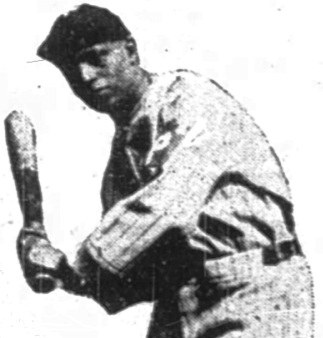
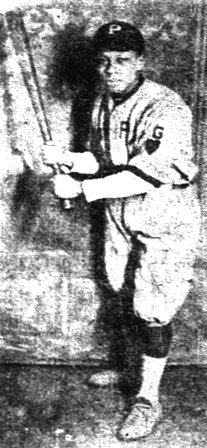
Mathis Williams

Mathis Williams

In June of 1925 The Pittsburgh Courier said:

“Of the colored clubs in action, none but the Homestead Grays are making any money…Fred Downer and his Pittsburgh Keystones are practically a thing of the past.”

Within a month the team disbanded and Downer was through as a player.

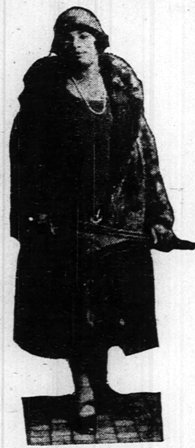
The following year, he and his wife Marian Foster Downer, a reporter for The Pittsburgh Courier—and later The Chicago Defender— relocated to Chicago.  She continued to write for The Courier’s society page while Fred began covering baseball and boxing for the paper and acted as The Courier’s Midwest circulation manager.

In addition to covering most major Midwest-based events–including the annual Negro League East-West All-Star Game and several championship fights—Downer started the Atlas News and Photo Service which distributed content to Black newspapers.


Marian Foster Downer also wrote about sports for The Defender.  Her article on the 1935 East-West All-Star Game—won by the West 11-8 on George “Mule” Suttles’ three-run home run after Webster McDonald walked Josh Gibson to face him—was headlined:

Mule Suttles

Mule Suttles

Our Girl Scribe Sees Mule’s Hit

Marian Foster Downer--The Defender's "Girl Scribe"

Marian Foster Downer–The Defender’s “Girl Scribe”

In 1945, Fred Downer proposed a new path for Negro League baseball, writing in a Chicago-based magazine called “New Vistas:”

“If the white majors won’t hire good colored players, then the Negroes should build their own parks and hire the best players regardless of race.  This will build up competition, and competition will break down many barriers.”

Downer was covering the World Series at Wrigley Field in 1932 and was on-hand for Babe Ruth’s “called shot.”  The Courier’s Sports Editor Wendell Smith said Downer was “One of Babe’s most staunch and loyal supporters,” and was determined to find the ball.

 “His decision to find the ball Ruth hit resulted in a search that has been a detailed and intensive as any by a ‘G-man.’  Fred scoured every baseball haunt in the Chicago area.”

According to Smith, Downer expanded his search throughout the Midwest, with no luck.

Downer later told The Chicago Defender he found the ball and bought it from a former Chicagoan who had moved to Michigan.  He called the ball “one of his prized possessions.”

The actual provenance of the ball and its current whereabouts are unknown.

Twenty-one years after he witnessed Ruth’s “called shot,” Downer—by then he had left  The Courier and owned three newsstands on Chicago’s South Side– was again at Wrigley Field where he had an encounter that raised questions in the Black press about a long-held opinion of another baseball legend.

Ty Cobb stopped in Chicago on his way back to his California home from Cooperstown, to attend a game between the Cubs and the Brooklyn Dodgers.

Downer was born in Cobb’s hometown of Royston, Georgia in 1896.  The Defender said of the relationship between the two:

“(Downer) got his start in baseball chasing fly balls for Ty Cobb as a kid.”

The California Eagle said:

“Downer was raised around the Cobb’s household in Royston, Georgia.”

Wendell Smith, then with The Chicago Herald-American, said of Cobb’s day at Wrigley:

“(T)here were two things said about (Cobb) that were, apparently, the gospel truth:

  • He could hit any living pitcher.

  • He would hit any living Negro.”

Smith said the second “truth” was “merely a matter of hearsay.”

And, he said:

“(H)e gives no indication today of intolerance.”

In addition to his embrace of Downer, Cobb was asked which players on the field most impressed him:

“’Why that catcher there, he said, pointing to Roy Campanella.  ‘He’s the best ball player I’ve seen in many a year…That fella’s a great catcher,’ he volunteered.  ‘The very best in the game.  He reminds me a little of Roger Bresnahan.  If he can stick around for five or six more years they’ll have to put him alongside the game’s all-time catchers.’”

Downer continued to operate his newsstands well into his 70s.  At the corner of 53rd Street and Lake Park Avenue, The Defender said, he would:

“(S)ell morning newspapers (and) answer hundreds of questions pertaining to his long career.”

Fred Downer

Fred Downer

Frederick Douglas Downer died in Chicago on March 10, 1986.

Jackie Robinson’s “Proudest Moment”

31 Jan

Profiles in Courage: Jackie Robinson faced nearly as much prejudice when he was named vice president of the Chock Full O’ Nuts coffee and restaurant company in 1958 as he had when he broke baseball’s color barrier.  In a 1959 syndicated newspaper column Robinson said:  “My proudest moment of all,” was a statement issued by company president  William Black:

“I cannot speak for all the stockholders of Chock Full O’ Nuts, because I now own only one-third of the company.  Speaking for my third, if anyone wants to boycott ‘Chock’ because I hired Jackie Robinson, I recommend Martinson’s Coffee, it’s just as good. As for our restaurants, there are Nedick’s, Bickford’s, and Horn and Hardart in our price range.  Try them, you may even like them better than ours.”

jackie

“I Believe that a Pitcher of a Slow Ball could make Monkeys out of Opposing Batsmen”

21 May

After the success of William Arthur “Candy” Cummings’ decades-long campaign to be recognized as the inventor of the curveball—his claim was supported by influential voices like A.G. Spalding, Cap Anson,  and Tim Murnane—culminated with his 1908 “Baseball Magazine” article “How I Pitched the First Curve,” Cummings was often sought out by the press for his opinions on pitching.

Candy Cummings

Candy Cummings

In 1910, an article “By Arthur Cummings, Discoverer of the Curve,” appeared in several newspapers, including The Boston Post.  Cummings took current pitchers to task for throwing too hard:

“Speed, speed, speed seems to be the cry of the pitcher today.  The more steam a fellow has, the more valuable he appears in the eyes of the managers.  It’s only once or twice in a game that a twirler will let loose his slow ball, and then he doesn’t put a whole lot of faith in it.  Of course there are some exceptions, like Mathewson, but I am talking about the general run.  To my mind, the speed craze is an obsession and many a pitcher would meet with greater success if he’d only revert to the old style of pitching and try slow ones oftener.  Players and managers of today think that the only way to win a ballgame is to have a pitcher who can throw a ball with such force that it will go through a six-inch plank, and if the fellow hasn’t got that amount of speed he is no good.

“If some managers would go back to the old-time style of pitching and send men in the box who would serve up slow balls there wouldn’t be as much base running as there is now, but the ball would be batted more and there would be better exhibitions of fielding.  Players of today can’t hit a slow ball with any degree of safety, they having become used to the swift article.  That’s why I believe that a pitcher of a slow ball could make monkeys out of opposing batsmen.

“Of course, there is a difference in the national sport, as now exemplified, when you compare it with the game when I was in it some thirty years ago.  The pitcher’s box now is further away from the home plate than it was when I used to pitch.  At that time it was forty-five feet from the home plate; now it is more than sixty, and it takes some speed to get over the plate.  I don’t know as I could go in a pitcher’s box, such as it is used today, and get a ball over the home plate, but if they moved it up to forty-five feet I could get my slow overshoots over the pan and I’ll bet a cigar the batsman wouldn’t hit it; he’d hit at it, though, and swing for all he’s worth.

“But even though the plate is further back, the pitchers have the curve worked down to such a science that they can make their ‘floaters’ break more sharply than we old timers could, and consequently they would much more easily fool the hitters.  Once in a while a genuine slow ball pitcher pops up and gets along but little confidence is placed in him; his victories are attributed to luck, and he is not used very regularly.

“Fans laugh these days when a pitcher takes it into his head to serve up a slow ball, which scorers call a change of pace, and see a heavy hitter almost break his back trying to kill the ball.  When he misses, it pleases the bugs immensely, but let me tell you, that the slower a ball is the harder it is for the batsman to connect with.  The hitting column wouldn’t have as big averages as it does now, and a man who could bat for .300 would be a wonder indeed, if slow balls were used by pitchers.

“But it seems as if the day of the slow ball has gone by.  A scout will not sign a pitcher unless he has got something good in the way of speed or a peculiarly curving swift ball, like Harry Howell’s or Eddie Cicotte’s knuckle ball.  It seems as if when we old timers dropped out of the game and the present generations took it up where we left off, they thought they would introduce new features to the game, and selected speed as the proper thing.  Of course, the invention of the mask, protector and heavy mitts had something to do with slow pitching passing out of existence, but it was the ideas of the young pitchers more than anything else that developed the desire of captains and managers for pitchers with great speed.

Ed Cicotte's knuckleball grip

Eddie  Cicotte’s knuckleball grip

“Perhaps you notice that these pitchers of today who have such great speed and assortment of curves do not work very regularly.  Well, when I played ball I was in the box one day and in the field the next and in that way I kept my arm in good shape and my batting eye keen, just because I was at the game all the time.  I never used much speed; therefore my arm was in condition to work.  Perhaps some manager will come along yet and decide that there was better pitching in the old days and give a slabbist with a slow curve ball a chance to work in the box.

“When that day arrives the fans will see some fun, for the long-distance hitters will find it hard to connect with the ball very often.”

In 1921 Cummings, then 72-years-old was sitting in the press box of Ebbetts Field, a guest of The Brooklyn Eagle, for a game between the Dodgers and Philadelphia Phillies.  Cummings told The Eagle’s Sports Editor Abe Yager:

“I think I could out-guess   Babe Ruth if I were pitching right now.  I had to pitch against Dan Brouthers, Cap Anson and other sluggers of bygone fame and believe me it was some feat to fool them.  We did it often, but of course, they hit ‘em out just as often.  Ruth can be fooled by an outcurve, a high one in close or a drop the same as the sluggers of old, but of course, he will connect once in every three times by the law of averages.”

Irwin Howe

3 Feb

irwinhowebb


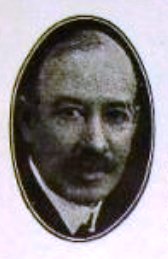
Irwin M. Howe founded Howe News Service in Chicago in 1910, published an annual record book and served as the primary statistician for several minor leagues, including the Western and the Three-I leagues.

After the 1911 season American League Secretary Robert McRoy, who was responsible for compiling statistics, left the league office to become an executive with the Boston Red Sox.  President Ban Johnson named Howe the league’s statistician; he served in that capacity until his death in 1934.

Irwin Howe

Irwin Howe

Howe leveraged his position with the American League.  He became the official statistician of several more leagues, including the American Association and the Federal League, wrote a nationally syndicated column called “Pennant Winning Plays,” became editor of the annual “Wilson Baseball Record and Rule Book,” and published an instructional pamphlet for kids.

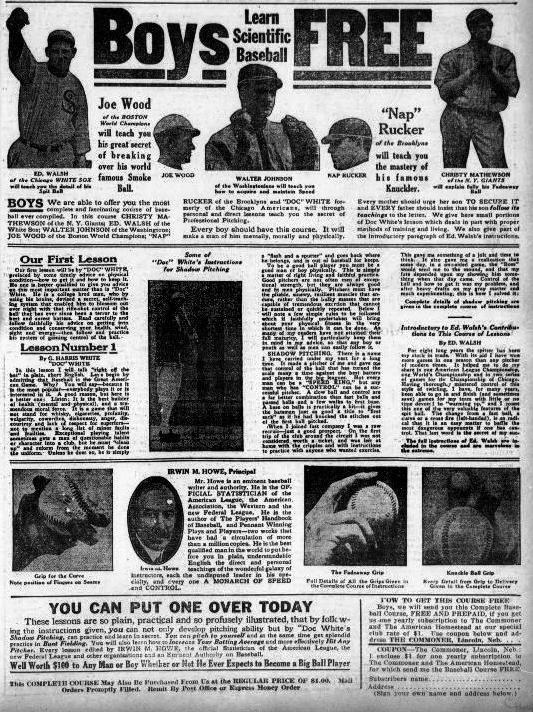
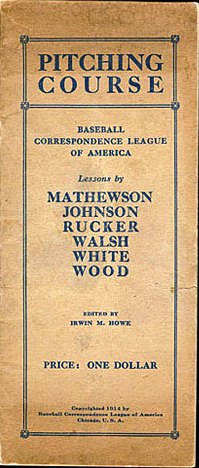
The ad from 1914 pictured above is for Howe’s 48-page “Pitching Course,” which he called “A correspondence school for baseball.” The pamphlets sold for one dollar, but were also offered by many small newspapers across the country for free to children who signed up subscribers (the pictured ad is from The Commoner, the Lincoln, Nebraska newspaper published by William Jennings Bryan).

Boys Learn Scientific Baseball Free

Ed Walsh of the Chicago White Sox will teach you the detail of his Spit Ball

Joe Wood of the Boston World Champions (1912) will teach you his great secret of breaking over his world famous Smoke Ball

Walter Johnson of the Washingtonians will teach you how to acquire and maintain speed

“Nap” Rucker of the Brooklyns will teach you the mastery of his famous knuckler

Christy Mathewson of the N.Y. Giants will explain fully his Fadeawy Ball

These lessons are so plain, practical and so profusely illustrated, that by following the instructions given, you can not only develop pitching ability…You will also learn to Increase Your Batting Average and more effectively Hit Any Pitcher.  Every lesson edited by Irwin M. Howe, the official statistician of the American League, the new Federal League and there organizations and an Eminent Authority on Baseball.

The pamphlet also included a lesson from Guy Harris “Doc” White of the Chicago White Sox “which deals in part with proper methods of training and living.”

Howe claimed his one dollar pamphlet was “Well worth $100 to any man or boy whether or not he ever expects to become a big ball player.”

Howe's pamphlet

Howe’s pamphlet

Perhaps Howe’s most famous contribution to baseball was certifying Ty Cobb as a .400 hitter in 1922.

On a rainy day in New York (years later in his book “Baseball as I Have Known It,” Fred Lieb said the game took place in August—contemporary newspaper accounts say it was May 15), Cobb beat out a ground ball hit to Yankee shortstop Everett Scott.  John Kieran of The New York Tribune (he was later a columnist with The New York Times) was the official scorer.  He charged Scott with an error.

Fred Lieb of The New York Telegram, who was compiling The Associated Press (AP) box score for the game, credited Cobb with a hit.  Lieb said “Considering the soggy field and Cobb’s speed, I gave it a hit.”

Fred Lieb

Fred Lieb

Howe’s habit was to rely upon The AP box score that appeared in the Chicago newspapers while awaiting the arrival of the “official” box score by mail.

When compiling the final averages at the end of the season Howe chose to accept Lieb’s scoring of the game rather than Kieran’s, and released a statement with the season’s final statistics:

 “I noted that the averages reached from my official scoring sheets had Cobb hitting .3995 (actually .3992).  With the unofficial averages giving him .401, I felt how can we deprive this great player of a third .400 average over a fractional point.”

Ban Johnson approved Howe’s decision.  Lieb, as president of the Baseball Writers Association of America’s (BBWAA) New York chapter was put in the uncomfortable position of attempting to repudiate his own scoring judgment.  He argued that the Kieran’s “official” score should be accepted, and said in a statement:

“Obviously, when there was a difference of opinion between the two scorers, the official and not the unofficial decision, should have been accepted.  There would be no further need for members of the Baseball Writers Association serving as official scorers if they were regulated to a secondary position.”

In a letter to Lieb, Ban Johnson said the “official” box score “was plainly in error in one other particular” besides the Cobb “hit” and “I requested a report of the official score of the game of May 15.  Mr. Howe had previously made a careful investigation of all facts surrounding the scoring.”  Johnson also chided Lieb asking “Are we to believe that you reversed your judgment at this late date?”

The 1923 “Wilson Record and Rule Book”–edited by Howe–contained an asterisk next to Cobb’s .401 average and noted that it was “not recognized” by the BBWAA—Howe was secretary of the association’s Chicago chapter.

The asterisk eventually disappeared, and Ty Cobb, thanks to Howe’s decision,  remains a .400 hitter for the 1922 season.

“Anson, the Baseballist, would like to see some Changes”

26 Sep

Some of baseball’s pioneer’s had ideas for rule changes that would have if adopted, dramatically changed the game.  In 1896 Adrian Constantine “Cap” Anson proposed two such changes.

Anson’s Colts had not finished better than fourth place in the National League in the previous five seasons, and the manager apparently thought two radical changes would improve his team’s chances and simplify the game.

"Cap" Anson

“Cap” Anson

The Chicago Record said:

“Anson, the baseballist, would like to see some changes in the present system of playing ball.”

Anson said he wanted to make a change to the 1893 rule that established the distance from the pitcher’s mound to home plate and replaced the pitcher’s box with the rubber:

“He is in favor of putting the pitcher’s slab in front of the pitcher, instead of having it behind him.  He wants this done in order to stop the interminable bickering that is going on in almost every game as to whether the pitcher was in position.  It is much easier to see whether the rule is conformed to when the slab is in front of the pitcher, and he dare not stop over it.”

Anson’s other rule change would have led to complete chaos, and would have made it an adventure to fill out a scorecard:

“Another radical change that Anson is in favor of allowing the captain to put players back into the game after they have been taken out…(Anson)  wants all restrictions removed, the manager being allowed to play his men just as he sees fit, taking them out and putting them back just when he wants to.”

The issue of introducing free substitution into baseball has occasionally been raised in the years since Anson advocated for it.

Montreal Canadians coach Dick Irvin suggested it to Kennesaw Mountain Landis as a solution to player shortages when the baseball commissioner attended an NHL game during World War II.   Lew Fonseca made a pitch for the rule in the 1950s, and Walter “Red” Barber, long-time Dodger and Yankee broadcaster suggested in the 1960’s that the rule would help keep baseball from being “as exciting as watching paint dry.”

In 1967, Eddie Stanky of the Chicago White Sox was given permission from the American League to experiment with a crude form of what would become the designated hitter rule six years later.  The convoluted rule, according to The Milwaukee Sentinel, said:

“(T)he Sox and their spring opponents will be allowed to call on a pinch hitter twice provided that he is designated before the game is not used twice in the same inning.”

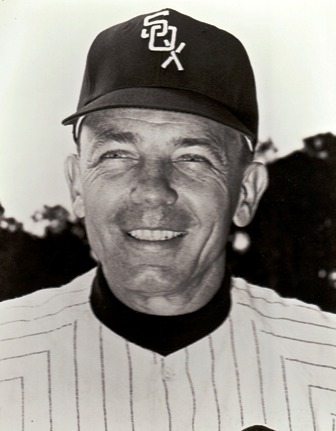
Eddie Stanky

Eddie Stanky


“Baseball by Electricity”

11 Jul

In 1886, The Electrical Review told the story of the first attempts at “reproducing almost instantly a vivid view of the exact situations and plays in a game of baseball.”

The original plan was hatched by three telegraph operators in Nashville, Tennessee who “turned their enthusiasm for baseball to good account.”   J. U Rust, E.W. Morgan, and A.H Stewart made the first attempt to transmit a game between Chattanooga and Nashville in 1884:

“To do this they leased a wire from Nashville to Chattanooga, one end of which was on the ball field, with an expert operator, who was accurately informed in baseball playing, seated watching the game and immediately telegraphing each play as it progressed.  At the Nashville end of the wire were two other telegraphic and baseball experts.  As they received the record from their partner, one man reproduced it verbally to the audience, while the other man manipulated cards bearing the names of the players, around a painted view of the ball field which was placed in full view of the audience.”

The following season Southern League games were transmitted to opera houses in several of the league cities by Morgan & Co. “the ingenious firm” created by the three telegraph operators.

On July 9, 1886 Morgan & Co. transmitted the game between the Detroit Wolverines and the Chicago White Stockings from Chicago’s West Side Park to the Detroit Opera House. The “unique entertainment before a crowd of 600 persons,” was described by The Electrical Review:

“On the stage was a huge landscape—it would have done well as a drop curtain—having a well-painted perspective view of a baseball diamond and outfield.  At the points on the picture representing the positions of batsman, pitcher catcher and basemen, are openings into which may be shoved cards bearing the names of the players, and into which these names are placed as the telegraph operator seated at his instrument reads to the audience the progress of the game, even to the smallest details.”

The crowd at the Opera House “was wrought up to a very high pitch of enthusiasm.  For instance, when the operator read—with (Abner) Dalrymple’s name appearing as batsman—“foul fly to left,” the audience fairly held its breath, and when the next instant the operator called out, ‘and out to (James “Deacon”) White,’ there came a storm of applause, just such as heard on a veritable ball field…the excitement was intense.”

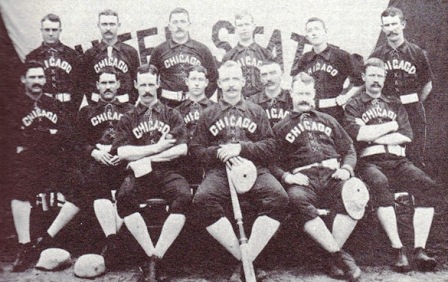
The Chicago White Stockings defeated the Detroit Wolverines 8-2 on July 9, on there way to the 1886 National League championship

The Chicago White Stockings defeated the Detroit Wolverines 8-2 on July 9, on their way to the 1886 National League championship

By the end of the 1886 season, games were presented in opera houses in Chicago, Boston, New York and Cincinnati.  By the end of the decade the practice would become commonplace in all big league cities.

By the mid 1890s the system for presenting games to the public had become much more advanced.

The Baltimore Morning Herald said in September of 1894:

“The ball game today between the Baltimore (Orioles) and Louisville (Colonels) clubs will be given as usual from the stage at Ford’s Grand Opera House at 4 o’clock by electricity.  The system utilized for the first game in the city is ‘The Compton Electric Baseball Game Impersonator.’   It has been used in New York and elsewhere with unbounded success.  It is a contrivance so ingenious that the slightest move of the players is visible, and the anxiety and interest of those present is just as great as though they had been occupying the grandstand.  Every strike is recorded and illustrated, and, whether at the bat, running the bases or in the field, all the players are known and watched…a visible reproduction of the game is given to the minutest detail.”

By the end of that season the Compton system was used to transmit games to fans in New York, Chicago, Philadelphia and Washington, and it, and numerous systems developed by competitors would become commonplace over the next four decades.

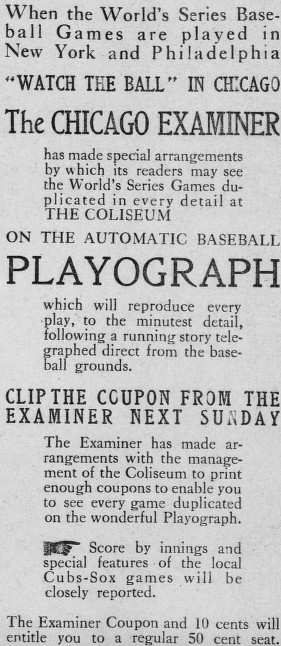
The Chicago Examiner sponsored the "automatic Baseball Playograph" exhibition of the 1913 World Series between the New York Giants and Philadelphia Athletics.

The Chicago Examiner sponsored the “automatic Baseball Playograph” exhibition of the 1913 World Series between the New York Giants and Philadelphia Athletics.

Usually sponsored by local newspapers, the exhibitions were an especially popular method for following the World Series in real-time.   It was not until 1938 (when the New York Yankees, New York Giants, and Brooklyn Dodgers became the last teams to have their games broadcast on radio) that the technological descendants of Morgan & Co. became completely obsolete.

The Quarter Million Dollar Wrist Injury

10 Aug

Ken Strong was a Hall of Fame running back and kicker for 12 seasons in the NFL, and the hero of the 1934 Championship game when he scored 17 points in the New York Giants 30-13 win over the Chicago Bears.  The aftermath of a wrist injury prevented him from starring in the major leagues as well.

Elmer Kenneth Strong Jr. was born March 21, 1906 (Baseball Reference incorrectly lists his birth as August 6, and his name as Kenneth Elmer).  A football and baseball star at New York University, Strong played the 1929 season at New Haven in the Eastern League before joining the NFL’s Staten Island Stapleton’s in September.

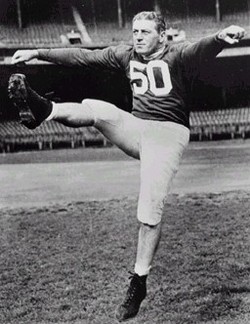
Ken Strong

In 104 games at New Haven Strong hit .283 with 21 home runs. After hitting .272 in 27 games at New Haven in 1930, he was sent to Hazleton in the New York Penn League.  Strong hit .373 with 41 home runs in 117 games at Hazelton.  Headlines that referred to Strong as the “New Babe” were greatly exaggerated given that 39 of his 41 home runs were hit at Hazleton’s Buhler Stadium, the smallest ballpark in organized ball in 1930.  Regardless, he was considered a top prospect and his contract was purchased by the Detroit Tigers who sent him to Toronto in the International League in 1931.

At Toronto he was batting .340 through 118 games when he broke his wrist.  Strong underwent a surgical procedure in Detroit which included the removal of part of his wrist bone and was limited to kicking during the 1931 NFL season.

Strong was given a good shot at making the Tigers opening day roster, but was slow to recover from the surgery.  When the Tigers sent Strong to New York for a second surgery it was discovered that the wrong bone had been removed during the first procedure, permanently damaging Strong’s wrist.

In 1933 Strong sued the doctor for $250,000, the equivalent of more than $4.4 million today.  Strong claimed the surgery robbed him of the opportunity to play major league ball and limited his ability in the NFL.

The trial featured former Tigers star Bobby Veach demonstrating to Federal Judge Ernest O’Brien “that good wrist action was essential in baseball.

Bobby Veach

Strong was awarded $75,000 and the verdict was upheld on a later appeal.

While Strong continued to play in the NFL through 1935, and again in 1939 and 1944-47, his baseball career was over. He attempted to come back in 1935, signing with the Brooklyn Dodgers, but was released before the season began.

Elected to the Pro Football Hall of Fame in 1967, Strong died in New York City on October 5, 1979.