Tag Archives: Chicago White Sox

Lost Advertisements–The Leland Giants’ New Ballpark

3 Apr

lelands


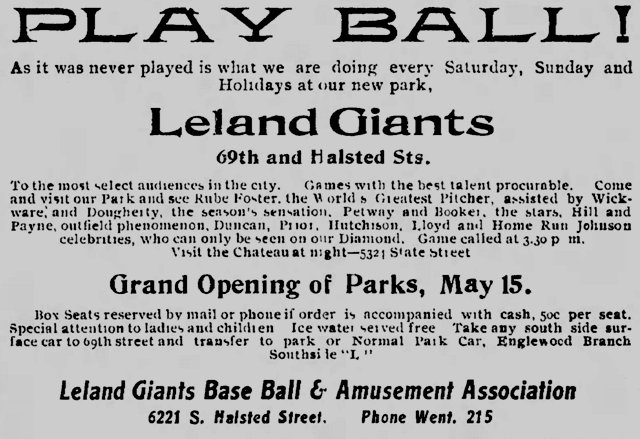
An advertisement for the opening of the Leland Giants’ newly refurbished ballpark, Normal Park, at 69th and Halsted Streets in Chicago, on May 15, 1910.  Just three weeks earlier, Cook County Judge Jesse Baldwin had given the team, managed by Andrew “Rube” Foster, the right to use the name Leland Giants.
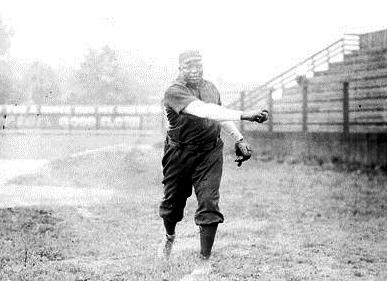
Rube Foster

Rube Foster

May 15 would be the first regular season game for the Leland Giants after the split between Frank Leland and Foster over finances, which resulted in the formation of two separate teams–Leland’s team would be called the Chicago Giants.

Beauregard Fitzhugh Moseley, who had been one of Leland’s primary financial backers but sided with Foster in the split, became the business manager of the new club and represented the team in court.  Under Moseley and Foster’s leadership, the club retained many of the club’s stars and added John Henry Lloyd and Grant “Home Run” Johnson to the roster:

“To the most select audiences in the city.  Games with the best talent procurable.  Come and visit our park and see Rube Foster, the World’s Greatest Pitcher, assisted by (Frank) Wickware and (Charles) Dougherty, the season’s sensation, (Bruce) Petway and (Pete) Booker, the stars (Pete) Hill and (Andrew) Payne, outfield phenomenon, (Frank) Duncan, (Wesley) Pryor, (Fred) Hutchinson, Lloyd and Home Run Johnson, celebrities, who can only be seen on our diamond.”

1910 Leland Giants--Seated, left to right, Johnson, Booker, Payne, Strouthers, Duncan, Pryor; standing, left to right, Petway, Lloyd, Hill, Dougherty, Bill Lindsay, Wickware, and Foster.
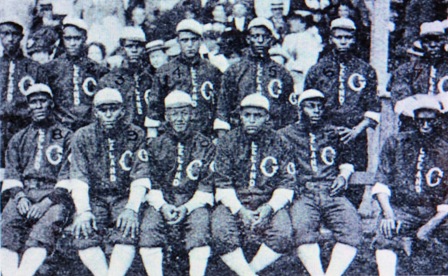
1910 Leland Giants–Seated, left to right, Johnson, Booker, Payne, Strouthers, Duncan, Pryor; standing, left to right, Petway, Lloyd, Hill, Dougherty, Bill Lindsay, Wickware, and Foster.

While Foster and Moseley’s club consisted of several of the core players from the 1909 Leland Giants, who had won the championship of Chicago’s City League, the league’s members rejected their request for league membership in 1910;  Frank Leland’s Chicago Giants were accepted into the league and The Chicago Tribune said it would be the Chicago Giants who would “hoist the pennant” signifying the 1909 championship at their ballpark, Auburn Park, at 79th and Wentworth,  on May 15.

When the Chicago Giants played their first City League game on May 1, the Leland Giants were on what The Chicago Inter Ocean called “Moseley’s 9,000-mile trip;” a spring training tour that covered 9,073 miles and included games in 10 states.
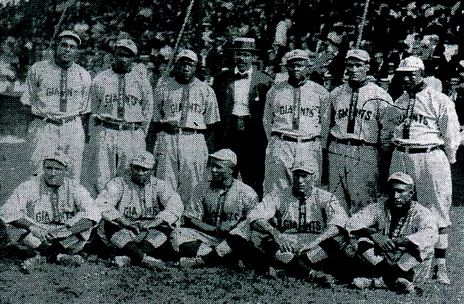
While they were not members of the City League, the Leland Giants played games against league teams throughout the season; including the May 15 opener.

The Chicago Defender said:

“Those in doubt about the popularity and ability of the 1910 line-up of the Leland Giants, had that doubt dispelled last Sunday if they were at the giants’ new park…B.F. Moseley presented the entire line-up, together with Manager (William C. “Billy”) Niesen‘s team, the Gunthers (a member of the City League) to 4,000 enthusiastic fans, comprising some of the best citizens of Chicago.”

The Defender described Normal Park as “one of the swellest and best-equipped ballparks in the city…it is clean and accessible to the (street) car lines and a credit to the race.”

As part of the festivities, at Normal Park–and at roughly the same time Frank Leland was about to”hoist the pennant” at Auburn Park, Niesen, on behalf of the City League gave the Leland Giants their own championship banner:

“(Niesen) presented the pennant to Rube Foster, as the champions of the city, a march was then formed, headed by the First Regiment K of P (Knights of Pythius) Band to the rear of the grounds, where the pennant, a beautiful flag in maroon, properly lettered ‘Leland Giants, City Champions’ was hoisted and unfurled to the breeze amidst great applause and music.”

The Lelands beat the Gunthers 5 to 1 behind the pitching of Frank Wickware.

Frank Leland’s Chicago Giants, lacked some of the star power of 1909 and  finished in second place in the City League.

Foster and Moseley’s Leland Giants fared better.  The “best talent procurable” won 35 straight games until June 11; The Chicago Tribune said, “Lelands Defeated at Last–Gunthers break winning streak of colored players,” when, with Foster on the mound, they lost 3 to 1 to Niesen’s Gunthers.  It was a rare loss, the Leland giants won 106 games in 1910, with just seven losses.
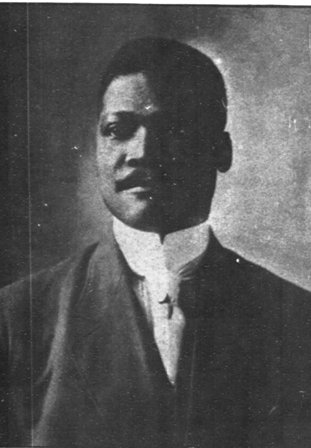
Beauregard Fitzhugh Moseley

Beauregard Fitzhugh Moseley

The next season, with an infusion of cash from a new business partner, a white Chicago tavern owner, John Schorling–another former partner of Frank Leland, who was sometimes identified as Charles Comiskey‘s son-in-law–the Leland Giants became the Chicago American Giants and moved from Normal Park to “Schorling’s Park” at 39th and Wentworth, the former home of the Chicago White Sox.
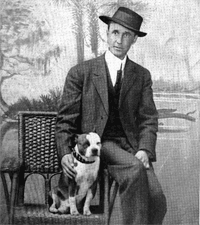


“Walsh? Ed Walsh? Who’s he?”

16 Mar

On May 1, 1912, as a result of a contract dispute, press operators walked off or were locked-out, of their jobs at 10 Chicago newspapers.  The following day, drivers and newsboys walked out in sympathy, and ultimately three more unions joined.

The dispute, which at times became violent, lasted until November.

The New York Times said at one point during the strike’s first week, less than 50,000 copies of the city’s four morning newspapers—limited to just four pages each– were distributed to a metropolitan area with a population of nearly four million.

Every Chicago paper, with the exception of The Day Book, Edward Willis Scripps’ advertisement free, pro-labor publication, suffered decreases in circulation and were forced to publish smaller editions for the first weeks of the strike.

The strike also had a negative impact on two other Chicago institutions.

The New York Tribune noted that during the first two weeks of May, while most of Chicago’s papers provided a minimum amount of baseball coverage, attendance at White Sox Park (renamed Comiskey Park the following season) and West Side Grounds “dropped off 30 percent.”

Writing in The Chicago Herald-Record after that paper had again begun publishing full-sizes editions in mid-May, sportswriter Hugh Fullerton was not surprised that less baseball news resulted in smaller crowds at the ballparks:

“Various major league club owners have, during their recent years of great prosperity, declared that baseball was independent of the newspapers.  Indeed such intellectual giants as C. Webb Murphy and Charles Ebbets have practically stated that the newspapers depended upon baseball for their circulation.  Of course, printing baseball news makes circulation for newspapers; else the newspapers would not print it.

“But during the last ten days Chicago has given the club owners and object lesson in the relative values.  There has been a strike of several trades allied with the newspaper printing business which resulted in crippling ten big dailies, restricting their circulation, besides cutting down the amount of baseball news and gossip printed.  The instantaneous result must have been a shock to the baseball magnates, who thought that the game was independent of the advertising.”

Hugh Fullerton

Hugh Fullerton

Fullerton, like the New York paper, said the attendance decline was “at least” 30 percent.

“I scouted around the city and discovered, rather to my amazement, that the lack of baseball news was received rather as a welcome relief from a necessary evil than as a bereavement.  A score of men told me they were glad they couldn’t get the news, that their employees could attend to business and that there was less waste of time…The town, which has been wild over the sensational race of the White Sox, cooled off in an instant.  I met fans who had been rooting wildly, who inquired whether or not the team was in town.”

Fullerton’s observations led him to the “startling proof that interest in baseball largely is manufactured by the papers.”

And, if the strike were to result in a further decrease in baseball news:

“I really believe that if the newspapers were to be suppressed for a couple of months, and one was to mention Walsh, people would say, ‘Walsh?  Ed Walsh?  Who’s he?’”

Ed Walsh

Ed Walsh

While the strike continued through the entire season, circulation and baseball coverage increased in June, giving no one the opportunity to forget Chicago’s best pitcher.

Attendance at Chicago’s ballparks rebounded as well.  By season’s end, Walsh’s White Sox drew more than 600,000 fans, despite a 20-34 swoon in June and July and a fourth place finish; while 514,000 fans  came out for the third place Cubs.

“A Ballplayer can’t chase ‘Chickens’ and Chase Flies”

25 Feb

With money borrowed from his brother Clarence, an oil speculator, Henry “Hen” Berry stepped in to take over ownership of the Los Angeles Angels in 1906.

"Hen" Berry

“Hen” Berry

Berry’s Angels won the Pacific Coast League championship in 1907 and ’08, and that success, along with his own profits in the oil business, made Berry a wealthy man in his own right.

He also managed, during his tenure with the Angels, to sell a player to a big league club for the highest amount ever received by a Coast League Club to that point, when he was paid $5,000 by Charles Comiskey of the Chicago White Sox for 18-year-old Lee “Flame” Delhi in 1911; Delhi appeared in just one game for the Sox the following season and was out of organized ball well before his 25th birthday.

Berry was also the driving force in getting the league to finally adopt a two-umpire system in 1912.

He also had a theory about what the type of lifestyle that best suited his players.  In 1914, he talked about it with a reporter from The Los Angeles Examiner:

“’A ballplayer can’t chase ‘chickens’ and chase flies at the same time with any degree of certainty that he’ll land the flies.’

“That is ‘Hen’ Berry’s way of saying that a player whose head is turned by the hero-worship of the fair patrons on the diamond stands a mighty slim chance at high fielding averages or of shining in the .300 batting class…Wedding bells for all players, he believes, would result in the highest possible efficiency.”

Eighteen of the 21 members of the Angels were married, and it was that way by design:

“’It is his susceptibility to the attentions of pretty hero worshippers that keep many a promising athlete from reaching the high place that otherwise would be his in the world of sport,’ asserts Berry.

“’The ballplayer is perhaps more constantly beset by these fair idolizers than any other professional athlete because women frequent the diamond more generally by far than any other sport.’

“’So we have the very thing which keeps baseball keyed up to concert pitch—the element of personal admiration for the players—becoming the most dangerous possibility in pulling a good man down or keeping him mediocre.’”

"Hen" Berry caricature

“Hen” Berry caricature

While Berry conceded that marriage didn’t guarantee that a player would be “immune from lionizing” by women, it would at least reduce the “social diversions which frazzle a man’s nerves.”

Marriage, said Berry, resulted in “Emotional calm” and provides “stability which goes far towards winning pennants.”

Berry’s theory had not resulted in any recent success; after his two pennants in 1907 and ’08, the Angels had experienced a drought that would continue in 1914 when his predominately married club finished second to the Portland Beavers.

Berry sold the Angels after the 1914 season and moved north, purchasing the San Francisco Seals.

He picked up two more championships with the Seals—it is unclear how many of the players on each pennant-winning club were married– and sold the team to group headed by former Coast League catcher Charlie Graham before the 1918 season.

San Francisco Seals owner Charlie Graham

Charlie Graham

After leaving baseball, Berry managed the family’s oil holdings in California.  On March 13, 1929 the steering broke on Berry’s car as he rounded a curve while driving near his home in Maricopa.  The car plunged 100 feet into a ravine, and the former West Coast baseball magnate was dead at age 59.

“Why not bring one of the Big League Teams to Phoenix for Spring Training?”

18 Feb

Grover Cleveland Land was a visionary.

In 1921 The Arizona Republican asked the question the former catcher had put to several major league clubs:

“Why not bring one of the big league teams to Phoenix for spring training?”

Land, a Kentucky native who spent the last 40 years of his life as a Phoenix resident,  was encouraged by a report that Connie Mack had announced that his Philadelphia Athletics would no longer train in Lake Charles, Louisiana;  according to The Associated Press Mack said “certain things happened at the Louisiana resort last March that handicapped” the team.

Grover Land

Grover Land

Land, the former catcher for the Cleveland Naps and the Brooklyn Tip-Tops, said:

“I have played ball in every section of the country, and I have yet to find a climate more suited for baseball training than I find right here in Phoenix…Major league managers have been sending their players to Texas and other southern states for many years and I can safely state that there is not one manager entirely satisfied with the present training camp sites.  Fully one-third of the training period is hampered by rain and storms and by the time the training season is ended the players are just beginning to round into shape.”

He said he understood that “local boosters” had made some effort to bring teams to Arizona in the past—the Chicago White Sox, Cubs, and Pittsburgh Pirates had played spring exhibition games in the state several times since 1909—but Land said he would “make an effort to induce one of my manager friends to come down here…I am certain that if one of the managers could be induced to come here for a few weeks Phoenix would have no difficulty getting on the sport pages.”

He said the local chamber of commerce was getting behind the push, and that he had “already written to one of the major league managers and I have been corresponding with several sports writers in the east,’ to make the case for Phoenix.

“If the local fans get behind the move and convince Connie Mack that they want his team here next spring I have every confidence that the Philadelphia Athletics will do their 1922 training in Phoenix.”

Land was a bit overconfident in regard to Philadelphia; Mack chose to take the Athletics to Eagle Pass, Texas in the spring of 1922.

No team would train in Arizona until 1929—the Detroit Tigers came to the state for one season—but chose California the following year.

The Detroit Tigers in Arizona, 1929

The Detroit Tigers in Arizona, 1929

But Land, who died in 1958, lived long enough to see his adopted home become the spring training location for four clubs.

Lost Pictures–Sidney Smith’s Baseball Cartoons

26 Dec


sidneysmithapril221909

By the time of his 1935 death in a car accident, Robert Sidney Smith—known professionally as Sidney Smith—was one of America’s most popular cartoonists; The New York Times said his death “will be felt by literally millions of Americans.”  His comic strip, “The Gumps,” was syndicated by The Chicago Tribune, and ran in hundreds of newspapers; it also spawned dozens of animated film shorts, nearly fifty-two-reel comedy film, a radio program and merchandise.

But, before Smith joined The Tribune, he had started in Chicago drawing baseball cartoons for The Chicago Examiner.

The cartoons featured a talking (sometimes singing) goat named Buck Nix.

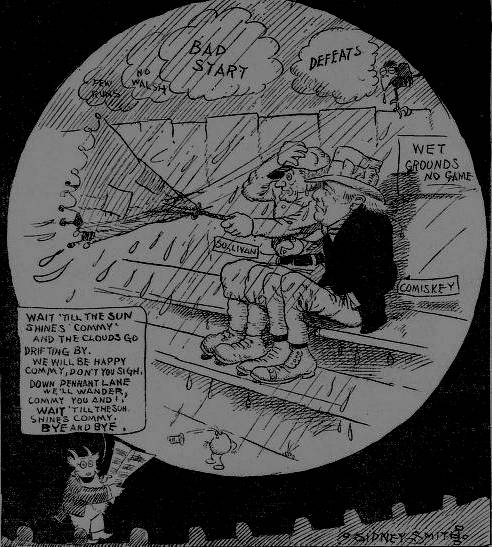
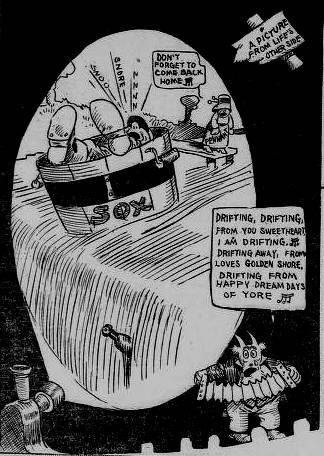
These two examples chronicled the  fortunes of the 1909 Chicago White Sox.

The first, above, appeared just seven games into the season.  Chicago had high hopes for the Sox, 86-64, the previous season, but the club limped to a 3-4 start.

As the cartoon notes, in addition to bad weather and weak hitting causing a poor start for President Charles Comiskey and Manager Billy Sullivan, Sox ace “Big Ed” Walsh was not yet with the team.  Walsh, a forty game winner the previous season held out for $7,500 and did not sign until April 28.  Still hopeful, “Buck Nix” says “Wait ’til the sun shines Commy.”

The second, below, appeared on June 26.  The Sox were 24-28, in fifth place, and as Buck Nix sings were “Drifting away from loves golden shore.”  Walsh only started 28 games, the Sox hit just .221 as a team and were never in the race.  They finished 20 games out in fourth place.sidneysmithjune261909

“The Annual Spring Typhoon has Blown up Again”

10 Nov

In 1906, despite being, on paper, the best team in the American League, the Cleveland Naps finished in third place, five games behind the Chicago White Sox.  The club had three twenty game winners—Addie Joss, Bob Rhoads, and Otto Hess—and four regulars who  hit better than .300—Napoleon Lajoie, William “Bunk” Congalton, Elmer Flick and Claude Rossman,
As the 1907 season approached, Grantland Rice, of The Cleveland News said the team was now a victim of the success of individual players:

“The annual spring typhoon has blown up again—only a bit worse than ever.  In nearly every big league camp well-known athletes are breaking into loud roars over the pay question, and there promises to be quite a batch of trouble before the storm is cleared away.  In this respect Cleveland heads the list, although Napland owners have one of the highest salary lists in the game.  Up to date Joss, Rhoads, (Terry) Turner and Congalton have balked, while neither Flick nor Hess have returned a signed contract.”

Grantland Rice

Grantland Rice

Rice said the club’s negotiations with Joss and Rhoads were at an impasse, and “just how it will end is a matter of uncertainty.”  The news of the team’s trouble signing their stars led Rice to a discussion of “just how much a major leaguer is supposed to receive for his work each season.”

“When a youngster breaks in he is never given less, or at least rarely so, than he received in his minor league berth.  His pay is boosted the greater part of the time, so the average debutante’s pay roll ranges closely around $1,800 providing he is recognized as a first class man.

“If he delivers the goods his first year out he can figure on about $2,000 or $2,200 for his next season, and then if he becomes established as a regular, his income should be somewhere in the immediate vicinity of $2,500.

“From this point upward it all depends on their rankings as stars.  You hear considerable about $5,000 contracts and better, but as a matter of cold, clammy fact, but few athletes draw over $3,000 or $3,500 at best.

“In the epoch of war salaries $3,500 or $4,000 was a fairly common figure—but no more.

“A high grade slabman along the order of Joss, Rhoads (Nick) Altrock, etc…will rake in about $3,000 now.  In his weekly letter in a Toledo paper (The News-Bee), Joss stated that he was offered $3,000 for his season’s work, but that he demanded more—just how much he didn’t say.

“George Stone drew $3,000 or there abouts last season and now that he has fought his way to the premiership in the School of Slugs he demands $5,000, at which figure Mr. (Jimmy) McAleer balks strenuously.  (Johnny) Kling also asks for $5,000, which sum Charley Murphy says he will not receive.

“From this list we jump to the drawing cards of the game such as Lajoie, (Honus) Wagner, (Wee Willie) Keeler, (Christy) Mathewson, etc…

“Lajoie’s figures range somewhere above $8,000 and something shy of the $9,000 mark.

“Wagner is supposed to draw $5,000 for his work.

“If reports sent out from New York are true, Keeler’s yearly ante is close to $6,000, while Mathewson draws in about the same.

Hal Chase won’t miss $3,500 very far.

“But the high-priced teams are not pennant winners by a jug full.

(Charles) Comiskey and (Connie) Mack hew closer to the line than any others in Ban Johnson’s circle, and yet these two have won more pennants than all the rest put together.  In fact, they’ve gotten away with all but the two which Boston nailed.

“Mack had one of the cheapest, if not the cheapest team in the American League through 1905, the last year he copped the pennant.  Comiskey’s world champions of 1906 were far below Cleveland, New York or even Boston, from the salary standpoint.

“It looks funny to figure the cellar champions of a league paid more than the holders of the world’s title, but if all the figures were given out, the White Sox payroll would loom up under Boston’s to a certainty.

“The full salary cost of running a big league club varies from $40,000 to $50,000, or maybe $55,000 a year.

“A set of figures somewhere between $45,000 and $50,000 would probably hit at the higher average.

“There was a time when Boston’s payroll was close to $70,000 and (Clark) Griffith’s was only a notch below—but this golden era for the ballplayer has passed.”

According to The Washington Post, Joss had earned $3,2000 in 1906 ($2,700 and a $500 bonus), the biography, “Addie Joss:  King of Pitchers,” said he was paid $4,000 in 1907—Joss, who was 21-9 with a 1.72 ERA in 1906, followed that up with a league leading 27 wins (against 11 loses, with a 1.83 ERA) in 1907.

Addie Joss

Addie Joss

Fellow twenty game winners Rhoads and Hess both saw their production slip (15-14, 6-6), and only two regulars—Flick .302 and Lajoie .301—hit better than .300, and the team’s batting average slipped 28 points from the previous seasons.

The Naps finished fourth in 1907.

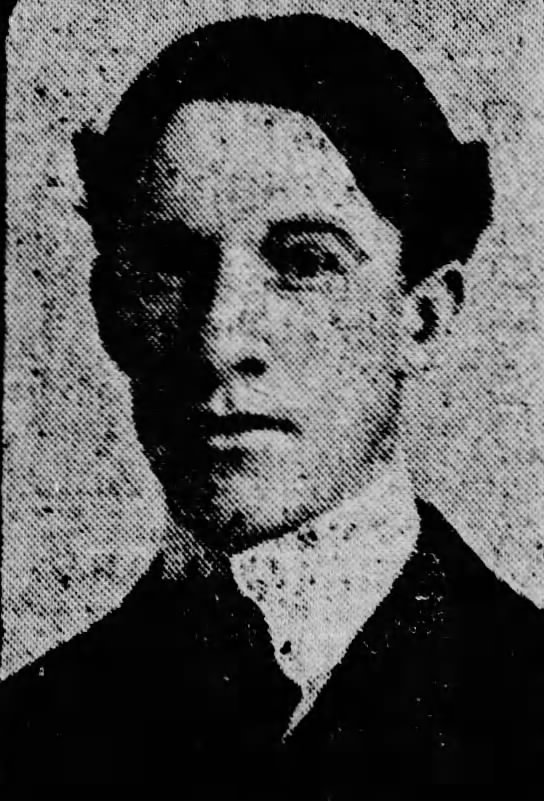
Harley Parker

20 Oct

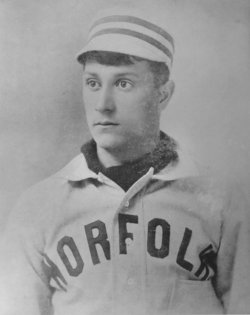
Harley Park Parker was a renaissance man; a physician, an ambidextrous golfer, a billiard player who trained champions, in addition to being a major league pitcher—he was 5-8 with a 5.90 ERA in parts of four seasons with the Chicago Colts and Cincinnati Reds.

He is also responsible for what might be the worst single game pitching performance in professional baseball history.

The 22-year-old Parker was pitching for the Grand Rapids Rippers (several newspapers in other in the other Western League cities called the team the Rustlers) against the Kansas City Blues (newspapers were split between referring to the club as the Blues or the Cowboys) on July 25, 1894.

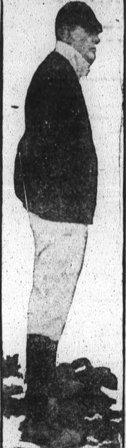
Harley Parker circa 1895

Harley Parker circa 1895

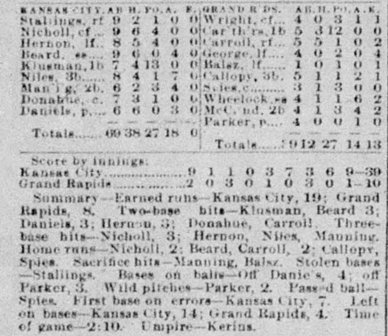
The Kansas City Gazette said:

“The ball bats of the Kansas City Blues in the game against Grand Rapids collided with Pitcher Parker’s curves thirty-nine times yesterday, and yielded as many runs.”

The Blues actually had thirty-eight hits, to go along with 13 Grand Rapids errors.

The Kansas City Star said:

“(The Blues) hit him at will yesterday, for singles, doubles, triples and home runs.  It was a slugging match, the like of which had never before been seen in a professional game at Exposition Park, and while the Rustlers did some very sloppy fielding, there was world of free, sharp and hard hitting.”

Every member of the Kansas City line up had at least two hits, and three players, Sam Nicholl, Ollie Beard, and pitcher Pete Daniels, collected six each.

The final score was 39 to 10.

The Box Score Grand Rapids vs Kansas City

The Box Score Grand Rapids vs Kansas City

The game was indicative of Parker’s season; he finished with a 15-18 record with a 6.23 ERA—in addition to the 193 earned runs he gave up in 278.2 innings, his team gave him horrible support, and he allowed 194 unearned runs.

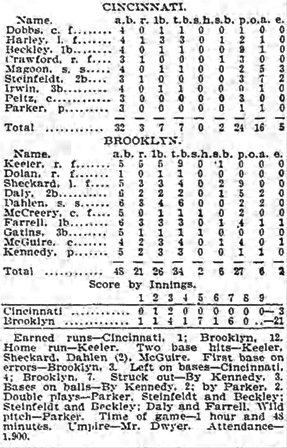
Parker had a similarly disastrous day as a major leaguer seven years later.  While pitching for the Reds against the Brooklyn Superbas on June 21, 1901 Parker allowed 21 runs on 26 hits in a complete game loss—“Wee Willie” Keeler was 5 for 5 with a rare home run (he hit just 33 during his 19-year career).

The Box Score Cincinnati vs Brooklyn

The Box Score Cincinnati vs Brooklyn

During his five minor league seasons Parker was only above.500 once; 5-4 in 1898 with the Minneapolis Millers; he was 5-8 as a major leaguer.

Parker briefly owned a Central League franchise in 1911, the club moved from Grand Rapids, Michigan to South Bend, Indiana, but even with the move he was forced to sell the team at mid-season because of financial difficulties.

That same year he also had a short stint as an umpire that ended with a trip to the United States Capitol.

In August, after one of Umpire Jack Sheridan’s frequent resignations—he returned to his position days later—American League President Ban Johnson hired Parker to the league staff.

Less than a month into his tenure Parker was on the field for one of William Herman “Germany” Schaefer’s stunts.  On August 4, Schaefer’s Washington Senators were playing the Chicago White Sox.  With the score tied in the ninth inning Schaefer stole second, hoping to draw a throw to allow Clyde Milan to score from third base; Sox catcher Fred Payne did not throw to second.  Schaefer then led off second base on the first-base side and returned to first on the next pitch.
The Washington Herald said:

“Umpire Harley Parker, who was officiating on the bases, was near first at the time.  When he saw Schaefer coming back to first Parker accosted the comedian ball player with the query: ‘What are you doing here?’

“’I have stolen second.  Now I am stealing first,’ said the Nationals’ troublemaker.

“’Well, if you stay down here I’ll call you out,’ said Parker.

“(White Sox) Manager (Hugh) Duffy in the meantime had ordered Doc White to throw the ball to John “Shano” Collins at first.  Germany thought discretion the better part of valor, and made a dive back toward second.  In the meantime Milan was tearing down toward home.  Collins wheeled and threw home, Milan being tagged out at the plate.”

Germany Schaefer

Germany Schaefer

Duffy was standing in the middle of the diamond arguing with Parker and home plate umpire Tommy Connolly as Milan was thrown out at home—Washington protested that “the play shouldn’t go because Chicago had ten men on the field.  Manager Duffy having stayed out to the middle of the diamond.”

Connolly and Parker finally ruled that Milan was out.  Washington went on to win the game 1 to 0 in 11 innings.

Harley Parker, 1910

Harley Parker, 1910

The following month Parker was again in Washington working a series between the Senators and the White Sox when, while sitting in the lobby of Washington’s Driscoll Hotel, according to The Washington Star he was approached by an “officer from the United States Senate,” who told Parker “I have a warrant for you.”

Parker was taken to the United States Capitol.

“The officer of Uncle Sam marched the arbitrator up to the desk of Vice President (James Schoolcraft) Sherman in the senate, the most august assemblage in the United States.

“’I guess I’ve got your man at last,’ said the officer as he introduced Parker to the vice president.

“’I sent for you to inquire about that play when Germany Schaefer went back to first after stealing second,’” said Sherman and Parker drew a sigh of relief.

“It was just like eating pie for Parker to explain the play and he did so to the satisfaction of all concerned.  Sherman admitted the play bothered him more than any problem that had come up in the extra session of congress and that was going some.”

Parker did not work as an umpire again after the 1911.  He returned to Chicago to practice medicine and teach billiard; contemporary newspaper accounts said he trained two champions—Calvin Demarest and Welker Cochran.

He died in Chicago in 1941.

Bill Setley

1 Oct

William Warren “Wild Bill” Setley was a career minor league player and umpire, and one of the most colorful figures in 19th and early 20th Century baseball.

He was born in New Jersey in 1871—Setley often claimed he was born in 1859; his grave marker and several sources still list this date, but there is a New Jersey birth certificate that confirms the 1871 date.

Bill Setley 1895

Bill Setley 1895

Setley spent the early part of his playing career in the Pennsylvania State League (PSL).  The Shenandoah Evening Herald said in 1893:

“(Setley) kept the home management on the anxious bench for many weeks last summer by his daring and acrobatic plays on the diamond and his eccentric whims between games.”

As a pitcher, Setley was credited with introducing the hidden potato play (made famous nearly a century later when Williamsport Bills Catcher Dave Bresnahan pulled a similar stunt), and he was known for turning routine plays in the outfield into spectacular circus catches.

William A. Phelon said Setley was “crazier than Rube Waddell ever thought of being,” and described an incident “when the pennant hung on the final game,”  with the winning runs on base in the ninth inning:

“Out came a fly to Setley.  Instead of catching it squarely in both hands he deliberately turned his back, reached out behind and made a dazzling circus catch—almost an impossibility.”

Years later, another Pennsylvania paper, The Mount Carmel Item described him as:

“(O)ne of the most erratic players in his day and while here a dozen years ago he was in his prime, but for a pack of cigarettes or a drink of whiskey he was liable to throw a game.”

George McQuillan who played in several leagues Setley worked as an umpire said:

“He is one of the real wonders of the game, and it’s too bad the big league fans have never had the chance to see him in action.”

There were many versions of the most often told story about Setley, and  Clarence “Pants” Rowland told the version that most often appeared in print:

Pants Rowland

Pants Rowland

“’I was managing Dubuque in the Three-I League at the time,’ says Rowland.  ‘The game was being handled by Wild Bill Setley, who was quite the character in those days.

“’I was coaching at third base and we got a runner to first during the early innings.  The next batter made a single and our runner started on the dead run from first, rounded second and bore down on third.  Right at his heels was Bill Setley.

“The ball was quickly recovered and beat the runner to third by a couple of steps.  Setley waved him out, and I had nothing to say.  But you should have heard me yell when, on turning, he also called my other man out at second, although he was standing on the base.  The third sacker had whipped the ball down to the second sacker, trying to complete a double play on our man who was trying for the base.

“’Where do you get that way? I demanded.  You had your back turned on the play how could you call him out?’

“’Setley grinned, came over to me, and showed me a small mirror he had concealed in his hand.  ‘I had my eye on the play all the time,’ he said, ‘and you know he was out.’  I was stopped all right, had nothing further to say.’”

Setley, on a few occasions, told a different version of the story.  This one placed the event in Pennsylvania and substituted Jack Tighe for Rowland.

In this rendition, Setley claimed that on the way to the ballpark he received “an advertising mirror” as a present for his daughter.  During the game, Tighe scored from second base on an infield hit, but Setley said:

“(I) knew he couldn’t have reached there if he had gone within 50 feet of the third bag.  The crowd kept yelling ‘Throw the ball to third,’ and when the first baseman did so I called Tighe out.  ‘What’s that?  Out! What do you mean?’ He yelled, chasing out on the diamond like a wild man.  ‘You are out for cutting third.’  ‘Well, if I did you didn’t see me’…’Be reasonable, Jack’ I replied, pulling out the mirror and holding it up in the palm of my hand before my face.  ‘When I was running over to first I had this glass up this way watching you.’  That wilted Tighe and he walked back to the bench as meek as a lamb.”

The Texas League was one of the many minor leagues Setley worked as an umpire.  On September 5, 1910, a triple-header (the first two games were five innings each) was scheduled between the Houston Buffaloes and the Galveston Sand Crabs on the season’s final day, with Setley working as the umpire in all three games.  After the teams split the first two games, The Houston Post said:

“The last game of the Texas League race progressed nicely here until the second inning when (with Galveston at bat) (Gus) Dundon singled to left and (Joe) Kipp had walked.  Then (Houston pitcher  Roy) Mitchell and umpire Setley, while (Bert) James was at the bat, had some words.  Suddenly Mitchell turned on the umpire and knocked him down.  Setley arose and ran towards short position, when Mitchell threw the ball at him, striking him in the back of the head rendering him unconscious.  Immediately the crowd surged into the field.”

The Associated Press added a few details, including that Mitchell “ran up and cuffed (Setley) several times,” after hitting him with the ball, and:

“(S)everal thousand fans had swarmed into the field, all of them apparently in sympathy with Mitchell.

“Setley remained motionless on the ground and the rumor spread like wild-fire over the field that his neck was broken.  Six men picked him up, shouldered him and carried him to the club house, where a physician examined him only to discover that his pulse was perfectly normal and that he was uninjured.  It suddenly dawned on the physician that someone was playing possum.

“’Come out of it Setley,’ said the physician, ‘no one is going to hurt you.’

“Setley ‘came back’ with a grin and said nothing but his feelings had been hurt.”

During the “riot” on the field, the Galveston club left the ballpark in a wagon “and returned to town.”  The game was awarded to Houston as a forfeit.

Mitchell was arrested but quickly released on bond.  Five days later he made his big league debut for the St. Louis Browns, beating the Chicago White Sox 7 to 2.

Roy Mitchell

Roy Mitchell

Somehow the Texas League and the National Commission failed to take any action against Mitchell for more than a month.  The Sporting News said:

“It was a matter of surprise that Mitchell was allowed to come direct to St. Louis and continue play, as if nothing had happened.”

He was fined $50, and while it was announced he was also suspended indefinitely, he was allowed to begin the 1911 season with the Browns.

Setley was let go by the Texas League in November.  The Fort Worth Star-Telegram said:

“(He) will always remember his short sojourn in this league as an umpire, as it probably was one of the most strenuous periods of his existence.  His first appearance was in Fort Worth, where he narrowly avoided a serious conflict with a spectator, and he precipitated wrangles at nearly every point he officiated, with the climax coming in the memorable last day’s game at Houston.”

More Setley stories later this month.

Polchow and Starnagle

13 Aug

At the close of the 1902 Three-I League season two unlikely candidates for the big leagues were signed by Cleveland Bronchos Manager Bill Armour.

Pitcher Louis William “Polly” Polchow and catcher George Henry Starnagle (born Steurnagel) did not put up impressive numbers.   Neither the Reach or Spalding Guides included Polchow’s won-loss record, but both said the 22-year-old’s winning percentage was just .414 in 32 games for the Evansville River Rats.  Starnagle hit just .180 with 13 passed balls and eight errors in 93 games for the Terre Haute Hottentots.

Louis Polchow

Louis Polchow

The two joined the fifth place Bronchos in St. Louis on September 13.  The following day both made their major league debuts in the second game of a doubleheader against the second place Browns.

The St. Louis Republic said:

“Captain (Napoleon) Lajoie decided to try his new Three-Eye League battery, which reported to him yesterday.  Starnagle, the former Terre Haute catcher, was as steady as a veteran, but Polchow wobbled at the drop of the hat, and before he steadied himself the damage was done.

“Five runs in the first two innings gave the Browns a good lead, and it was well they made hay while the sun shone, for Polchow handed them six ciphers for dessert.”

Starnagle made an error in the seventh when he overthrew Lajoie on an attempted steal of second by Bobby Wallace—Wallace advanced to third on the error, but Polchow retired the side without a run.

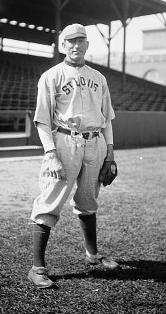
George Starnagle

George Starnagle

In Cleveland’s half of the seventh Starnagle and Polchow had the opportunity to get them back in the game.  With two runs in, and a runner on first and one out Starnagle came to the plate.  The Republic said:

 “Starnagle tried to put on a Three-Eye League slugging scene.  He dislocated two ribs going after (Bill) Reidy’s slow ones and finally fanned.  Polchow forced (Jack) McCarthy.”

Starnagle was lifted in the ninth for a pinch hitter.  Cleveland lost 5-3.  Polchow gave up nine hits and walked four, striking out two, and was 0 for 4 at the plate.  Starnagle was 0 for 3, with one error behind the plate.  Neither would ever appear in another big league game.

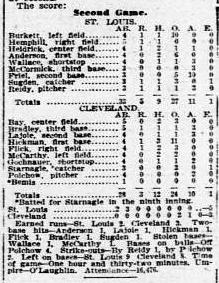
The Box Score

The Box Score

Starnagle was 28-years-old, and had only played two seasons of pro ball before his game with Cleveland—he was semi-pro player with teams in Danville and Sterling, Illinois for nearly a decade before he joined Terre Haute in 1901.  He was considered a solid defensive catcher, but during 10 minor league seasons he only hit better than .230 three times.  When he played with the Toronto Maple Leafs and Montreal Royals in 1909 The Montreal Gazette said:

“Starnagle has been drafted every year by big league clubs, all of whom have been pretty well supplied with seasoned catchers; hence his failure to be kept.”

Polchow was just 22 when he pitched his only big league game.  Plagued by wildness, he spent three mediocre seasons with teams in the Southern Association and South Atlantic League (he was 36-45 for the Montgomery Senators, Macon Highlanders and Augusta Tourists), then pitched five seasons in the New York State League.

In 1906 he helped lead the Scranton Miners to the New York State League championship (the team’s leading hitter was Archibald “Moonlight” Graham), although The Scranton Republican said his first start with the team was nearly his last.  Polchow lost 12 to 2 to the Utica Pent-Ups, walking 10 and giving up 10 hits.  After the game Polchow accused catcher “Wilkie Clark of throwing the game.  A fight followed and Clark and Polchow never worked together after that.   Andy Roth was Polchow’s battery partner during the remainder of the season.”

Starnagle retired after the 1910 season.  He returned to Danville, Illinois where he died in 1946; he was 72.

Polchow played through the 1911 season, and then became ill.  He died of Bright’s Disease at 32-years-old in August of 1912

In addition to Polchow and Starnagle, the Bronchos signed two other Three-I League players in September of 1902—both had somewhat more success.

Rock Island Islanders catcher George “Peaches” Graham made his debut the same day as Polchow and Starnagle, during the first game of the doubleheader; he struck out as a pinch hitter in the ninth inning of a 3 to 1 loss. He spent parts of seven seasons in the major leagues, and hit .265.  Decatur Commodores pitcher Augustus “Gus” Dorner made his debut three days later beating the Chicago White Sox 7 to 6.  He pitched for parts of six big league seasons, compiling a 35-69 record.


Big Six versus The Hoosier Thunderbolt

6 Aug

Christy Mathewson had only pitched five full seasons when Sam Crane of The New York Journal said in January of 1906 “there is a great diversity of opinion” regarding whether Mathewson or Amos Rusie was the better pitcher.

Crane said “Old-time lovers of the game” said Rusie, “The Hoosier Thunderbolt”, whose career ended in 1901 after being traded to Cincinnati for “Big Six” Mathewson,  was the best ever, “and refuse to acknowledge that the young college man who won the world’s championship so easily last fall…is his superior.”   While, “the younger generation of enthusiasts say there was never but one Mathewson and point to his wonderful record to prove their point.”

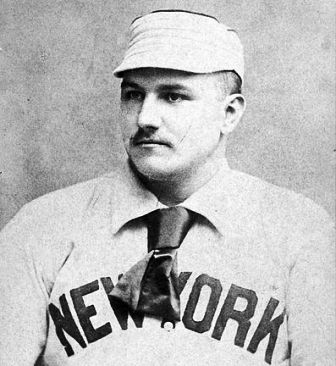
Amos Rusie

Amos Rusie

Crane said two famous New York baseball figures—and future Hall of Famers– disagreed on the point:

George Davis, the crack shortstop of the Chicago White Sox, and one of the best players who ever wore ‘New York’ across his shirt front, met Clark Griffith, manager of the Yankees (Crane was one of the earliest to call the then “Highlanders” the “Yankees”), yesterday at the headquarters of the New York American club, and argued over the much mooted questions of pitching superiority between the two crack box artists.  Both Davis and Griffith agreed that Mathewson and Rusie were two of the best, but differed as to which was entitles to the premier position.”

Davis thought Mathewson was better.

“Both have excelled all other Boxmen.  I have never batted against Matty in a game, but I have met his curves in practice and I want to say that he has just as good control of the ball as Rusie.  Matty’s most effective ball is a straight drop, but his speed is a great factor as well as a wonderfully controlled slow ball.  He uses his forearm and elbow and winds up in such a manner that a batsman is sure to be puzzled.  Rusie, on the other hand, depended on an out drop, which he controlled with remarkable skill, in addition to his fast ball; but he had very little preliminary motion and used his shoulder almost exclusively.  Rusie probably had the better physique, but in head work and vitality Mathewson outclasses the big Hoosier.”

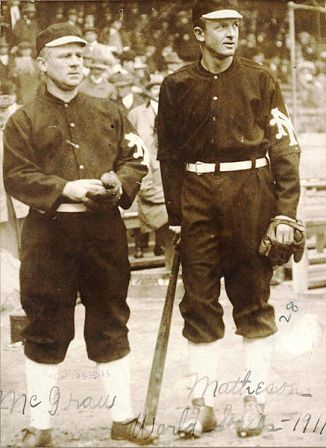
Christy Mathewson with John McGraw

Christy Mathewson with John McGraw

Griffith disagreed:

“Rusie in his prime was the best twirler that ever stepped into the box.  His curves, speed and control were the best assortment I ever looked at, and no pitcher has ever approached him in class since he made his departure from baseball.”

Crane cast the deciding vote, declaring:

“Rusie never had a peep in with Mathewson as a box artist.  Rusie relied mostly on brute strength until his arm began to show symptoms of crystallizing, then he accumulated a good slow ball; but for head work, pure good judgment, with a delivery or series of deliveries to back up his well-balanced brain, Mathewson is superior to any pitcher who ever wore shoe plates.”

Crane’s analysis was prescient.

Rusie’s greatness is undisputed—his speed was primary reason for moving the pitching distance from 50‘ to 60’ 6”—but his best days were behind him before he turned 24-years-old.  His season-long holdout in 1896 and the arm injury that effectively ended his career at 27 after the 1898 season (except for three games he pitched for the Cincinnati Reds in 1901) make him one of baseball’s great “what ifs?”  He still finished his career 246-174, and was elected to the Hall of Fame in 1977.

Mathewson won twenty games for nine straight seasons after Crane declared him “superior to any pitcher.   He finished 373-188 and was part of the Hall of Fame’s first induction class.