Tag Archives: Cleveland Indians

Murphy’s “Billion Dollar Team”

17 Aug

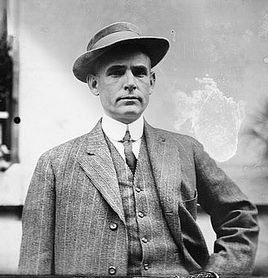
“Money will not buy a pennant winner;” so said William George “Billy” Murphy, the sports editor of The St. Louis Star.  In 1914, he set out to select a team that not even “John D. Rockefeller… (With) all his wealth could buy a club that would win a World’s championship from the one we have picked…The Billion Dollar Team.”

Murphy said:

“You fans of towns that have never won a flag, how would you feel to wake up some morning and find that Dame Fortune had so arranged matters that this club had suddenly been picked to represent your fair city.”

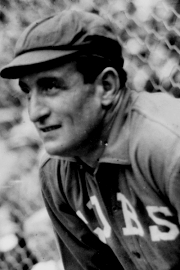
Jimmy Archer, catcher

Behind the plate he acknowledged “There are many who would doubtless pick (John) Chief Meyers…but considering the Indian’s slowness of foot and propensity for clogging up the bases and stealing when the bags are full, we must remark we cannot see the “Chief” for a minute with Jimmy Archer, who, although not so good a hitter, is faster, a quicker thinker, greater fielder and better pegger.”

Jimmy Archer

Jimmy Archer

Murphy was in the minority questioning the baseball intelligence of Meyers, who was widely considered one of the most intelligent and articulate players of his era.  He also rated Ray Schalk and Wally Schang as superior, saying:

“In the writer’s humble opinion they are much more valuable men to their team than Meyers.”

Walter Johnson, pitcher

“There will hardly be a dissenting vote cast against Walter Johnson.  Unquestionably he is the greatest of all the pitchers.

(Charles Chief) Bender and (Christy) Mathewson are also great—great when they should show class—in championship games.  Every nerve, every fiber of their brains, every muscle necessary to their craft, is at its best when big games are being fought.

“Wonderful as they are, we must pick Johnson, who also has class and is game to the core.”

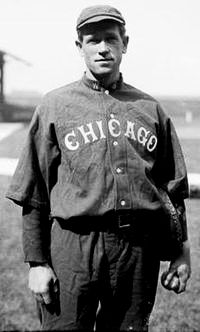
Hal Chase, first base

“For first base, there is only Hal Chase.  He is a great hitter, marvelous fielder, can run the sacks, and is a brilliant tactician.

(John) ‘Stuffy’ McInnis, Jake Daubert, Eddie Konetchy, Fred Merkle, and Jack (Dots) Miller are all stars, but they are ‘also rans’ in the class with Prince Hal of the White Sox.”

Prince Hal of the White Sox

Prince Hal of the White Sox

Eddie Collins, second base

“At second base, Eddie Collins in the potentate.  Johnny Evers, Larry Doyle, and Larry Lajoie occupy seats in the second sackers’ hall of fame, but Collins rules over the roost.”

Honus Wagner, shortstop

“At short, notwithstanding his age, the palm goes to Hans Wagner.  Taken all in all he is still the greatest man at the position in the game.  He can do everything and does it better than any of his contemporaries.  When will we look upon his like again?”

Frank Baker, third base

“At third base, there is that wonderful silent son of swat, Frank Baker, the conqueror of the wonderful Mathewson and Richard (Rube) Marquard.”

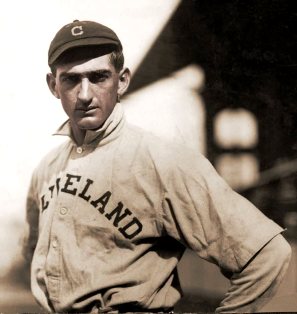
Joe Jackson, right field

“In right field we have Joe Jackson, the young Southerner with the Cleveland club.  He is one of the greatest batsmen in the game today and is a fielder and base runner of unusual ability.”

Joe Jackson

Joe Jackson

Ty Cobb, center field

“In center, there is Tyrus Raymond Cobb, the Royston, Georgia marvel, who is the greatest player baseball has ever known.”

Tris Speaker, left field

“And in left field, there is Tris Speaker of the Boston Red Sox—second only to Cobb.”

Griff’s Invention

5 Aug

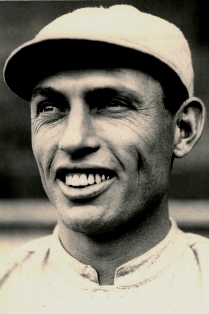
Bob “Buster” Bescher arrived in Cincinnati a right-handed hitter.  In 1909, he led the National League with 54 stolen bases but hit just .240.

Bescher

Bescher

Bescher’s manager, Clark Griffith would compare him to Ty Cobb in an interview with Harry Salsinger of The Detroit News:

“If Bescher could hit he would probably set a pace for base-stealing that would never be equaled…Bescher gets away like Cobb, and his success lies mostly in getting away.  He is running in his first few steps.  He has a great pair of limbs and is in stride at the jump.  He is lightning fast.”

The Cincinnati Enquirer said:

“Bescher is a big, strong fellow, naturally left-handed, who was, unfortunately, coached to bat right-handed when he was a kid.”

Griffith set out to change that before the 1910 season.  In January, The Enquirer said:

“A device for batting practice was shipped to Bob Bescher at his home in London (Ohio) by Manager Griffith yesterday.  The arrangement was constructed according to Griff’s order, and it was designed to give Buster practice in batting left-handed before he goes South with the club six weeks or so hence.”

Clark Griffith

Clark Griffith

The paper described Griffith’s invention:

“The device consists of a ball of regulation size, but fitted with an extra cover, to which stout rubber cords are attached, one on each side.  One of the cords is to be fastened to the floor and the other to the ceiling, allowing the ball to swing loosely at about the height of the batter’s waist.  When the ball is struck with a bat, the flexible cord allows it to swing several yards and it returns with great force, coming back at about the speed of a pitched ball.  Then it is time for Buster to get busy with the club and soak it out again.”

A diagram of Griffith's invention.

A diagram of Griffith’s invention.

The Enquirer said Griffith hoped Bescher would add “30 or 40 points” to his average batting left-handed.

“He is the best base runner in the National League…Griff has sent him instructions to hit only left-handed with the new machine, and he hopes that Bob will be a regular Ty Cobb when he reports in March.”

Bescher batted almost exclusively left-handed during spring training in Hot Springs, Arkansas and became a switch-hitter that season, and seems to have benefitted from Griffith’s invention—but never became a “regular Ty Cobb.”

He improved his average to .250 in 1910 and again led the league with 70 stolen bases.  The next two seasons he hit .275 and a career-high .281, leading the league with 81 and 67 steals.

Bescher

Bescher

In 1913, Bescher slowed, hitting just .258 and stealing 38 bases.  He bounced from the New York Giants to the St. Louis Cardinals and Cleveland Indians over the next five seasons, never hitting better than .270 or stealing more than 39 bases.  He played minor league ball through the 1925 season.

“A Lajoie Bunt”

22 Jul

Francis “Red” Donahue was a teammate of Napoleon Lajoie in Philadelphia and Cleveland.  During a road trip in New York with the Indians in 1904 he told a story to Elmer Ellsworth Bates of The Cleveland News:

“I never come to New York without recalling the first time (Fred) Dutch Hartman of the old New York team ever saw Lajoie in a game.  Hartman had just began playing third base for the Giants and he had to be coached all the time by his teammates.

Fred "Dutch" Hartman

Fred “Dutch” Hartman

“The Phillies came over here and when Larry came to bat Hartman appealed to his fellow players for instructions.

“‘Play in for this fellow,’ was the tip.  ‘He’s liable to bunt.’

“Hartman went in about 30 feet and pushing his cap back on his head waited for the bunt.  The pitcher swung up a nice one and Larry smashed it.  The ball went away at awful speed.  It brushed the top of Hartman’s head, struck squarely in the middle of his cap and carried that piece of headgear with it clear out against the left field fence.  The other 17 players roared, but Hartman couldn’t see the joke.

Napoleon Lajoie

Napoleon Lajoie

“‘I thought you said he would bunt,’ said he.

”That was a Lajoie bunt’ said (Giants center fielder George) Van Haltren.  Wait and see him hit one with no cap to interfere with the ball.”


Lost Pictures–Tris Speaker and Laddie Boy’s Brother

10 Apr

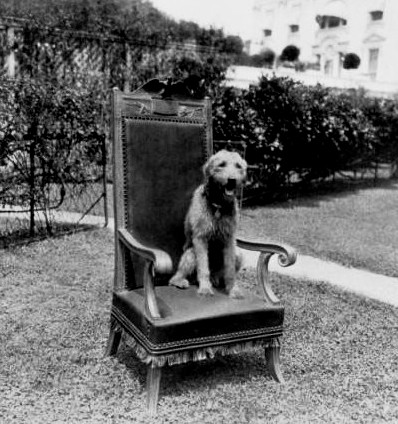
trisIn 1921, the most famous dog in the world was Laddie Boy; the Airedale Terrier was the first celebrated Presidential Dog.  Laddie Boy was presented to President Warren G. Harding on March 5, 1921–the day after his inauguration–by a Toledo, Ohio breeder–his father  was an international champion Airedale named Tintern Tip-Top.

Laddie Boy had his own chair at Harding’s cabinet meetings, “wrote” articles about his life at the White House, and after Harding’s death a statue of Laddie Boy–paid for with donations collected by newsboys across the country–was commissioned and displayed at the Smithsonian Institution.

laddieboy

Laddie Boy poses on the White House lawn in his chair.

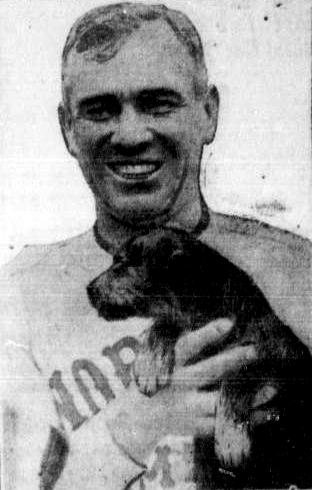
Nearly two months after Laddie Boy went to the White House, one of his lesser-known brothers was presented to Player-Manager Tris Speaker of the defending World Series Champion Cleveland Indians on opening day of the 1921 season.

Speaker became a fan of the breed and later bought Airedales from another Ohio breeder, Walter Lingo.  Lingo, to promote his breeding business–Oorang Kennel Company–hired another one of his customers, Jim Thorpe, and together they organized the Oorang Indians National Football League franchise.

Jim Thorpe--Airedale fan

Jim Thorpe–Airedale fan

Lost Pictures: Dode Paskert Plays Ice Baseball

20 Feb

dode

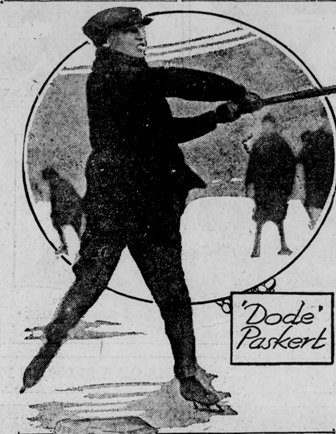
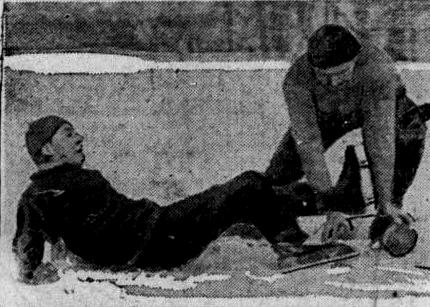
Ice Baseball made its first appearance in the winter of 1866 when the Athletic Baseball Club of Philadelphia played a game on ice against a “picked nine’ comprised of other local baseball teams.  Games were played occasionally over the next 50 years, but the game never caught on.

That changed briefly the winter following the 1919 season when the game, along with Ice Boxing, became a sensation in Cleveland.  The Cleveland Press said the biggest star among the “many ice baseball clubs” was Chicago Cubs centerfielder, and Cleveland native,  George “Dode” Paskert “an expert skater (who) says the exercise he is getting is going to put him about a month ahead” of his teammates.

Unidentified Ice Baseball players in 1920 photo.

Unidentified Ice Baseball players in 1920 photo.

The paper said Cleveland Indians players Bill Wambsganss and Jack Graney played, and that Ray Chapman, the Indians second baseman,  and William “Pickles” Dillhoefer, catcher for St. Louis Cardinals would be joining teams.

Indians Manager Tris Speaker umpired at least one game.

Like every other short-term Ice Baseball craze, the game quickly faded in Cleveland.

Dode Paskert

Dode Paskert

As for Paskert, after a horrible 1919 season–.196 in 88 games–the 38-year-old seems to have benefitted from his “extra exercise.”  He hit .279 in 139 games in his final full season in the major leagues.


“The Longest Three-bagger on Record”

11 Feb

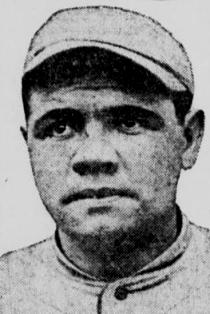
Babe Ruth was the reason American League Umpire Billy Evans called for a rule change after the 1918 season.

Billy Evans

Billy Evans

Ruth tied Philadelphia Athletics outfielder Clarence “Tillie” Walker for the league lead with 11 home runs, but Ruth was not given credit for what would have been number 12 on July 8.

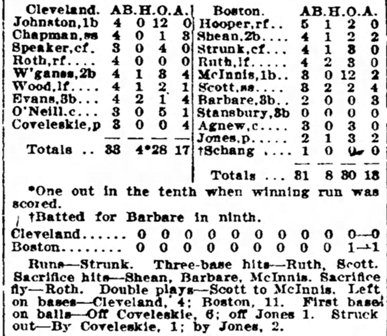
Ruth’s Red Sox were in a scoreless tie with the Cleveland Indians in the tenth innings of the first game of a doubleheader.  Stan Coveleski gave up a single to Amos Strunk with one out, and Ruth came to the plate.

The Boston Post said:

“Coveleski will probably hear the crash of Ruth’s bat for many a day.  The ball sped like a bullet far into the right field bleachers almost to the top.”

The Boston Globe said:

“It is getting so now that Ruth is the man of the hour every day.  His mighty crash into the right field bleachers in the 10th inning drove Strunk home.”

Ruth’s blast landed more than half way up into the right field bleachers, and The Boston Herald said a ball had never been hit further at Fenway Park, but noted, because Strunk had crossed the plate with the winning run “The best the scorers could give Ruth was a triple;” or, as The Post called it “The longest three-bagger on record.”

The box score

The box score

That winter, in his nationally syndicated column, Evans called Ruth’s “triple:”

“(O)ne of the longest drives I have ever seen.

“If there was a real, genuine, sure-enough home run, that wallop was the last word.  It was the longest drive Ruth made for the season, yet in the records he is credited with only a three-base hit.”

Ruth hit

Ruth hit “The longest three-bagger on record.”

To Evans, the solution was simple:

“I believe a more just scoring would have had the final result 2 to 0 in favor of Boston.  I believe a rule should be made which said that when a ball was knocked over the fence, or into the bleachers in an extra-inning game, all runners on the bases, as well as the batsman, should be entitles to score.”

For any present day fan, Evans’ suggestion sounds like common sense.  But, in 1918 it was criticized in many quarters.  One of the biggest critics of the potential rule change was William Blythe Hanna of The New York Herald.  Hanna said the rule change would go against everything the game stood for:

“Nothing could smack more of sophism than such advocacy.  Ball games end when the winning run crosses the plate, and any juggling with the rules to give a man a home run under the circumstances noted would be making the game subordinate to individual feats, which, of course, would be contrary to all the well-founded tenets of sport, discipline and organization.  It is surprising that a man of Evans’ intelligence could take so specious, so fallacious a view.”

Evans suggested his proposed rule change again in a column the following year, and sportswriter Fred Lieb of The New York Sun—a non-voting member of the rules committee—introduced the proposal.  The final roadblock was committee member and National League umpire Hank O‘Day, who according to Lieb insisted “I’m telling you, it is illegal.  You can’t score runs after the game is over!”

Despite O’Day’s objection the rule change was officially enacted by the Rules Committee on February 9, 1920 in Chicago.  Hanna had his final word on the rule the following day in The Herald:

 “This is a radical departure, and it is by no means a sure thing that is was based on sound reasoning.”

“Throw Strikes. Home Plate Don’t Move.”

19 Jan

Satchel Paige told Dave Condon of The Chicago Tribune that early in 1965, with the help of his wife Lahoma, and 17-year-old daughter Pamela he “wrote letters to everyone in baseball just looking for a steady job.  Anything.”

After not one professional team responded, the spring and early summer were like most during his 40-year career as a pitcher—Paige traveled wherever there was a chance for a paycheck.

He had made appearances with the Harlem Globetrotters in the winter and spring and then hit the road; pitching for the barnstorming Indianapolis Clowns and whoever else would call.  In May, The Chicago Defender said Abe Saperstein, who was managing Paige’s appearances, took out an ad in The Sporting News:

“(T)he man, who may have been the greatest pitcher of all time, is letting it be known that he has glove and is willing to travel.  All that is necessary to secure his services is to contact Saperstein.”

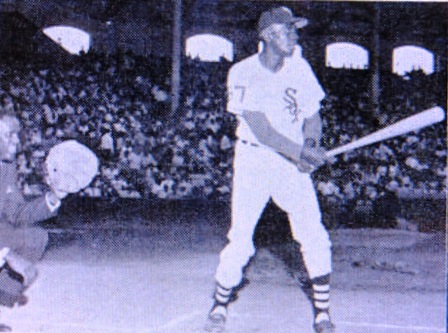
One night Paige would be at Chicago’s Comiskey Park, in a White Sox uniform, pitching for the Clowns in front of a large crowd, or across town in Wrigley Field where 30,000 fans came out; another night would find him in Hastings, Pennsylvania taking “the mound for the Hastings VFW club,” or Wheatfield, Indiana pitching “for the Band Boosters against the Wheatfield Young Farmers,” in front of a few hundred people.
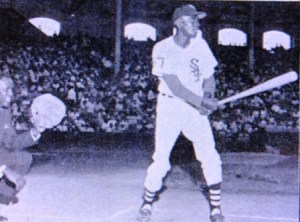
Paige at Comiskey Park in 1965--Chicago Cubs outfielder George Altman is the catcher.

Paige at Comiskey Park in 1965–Chicago Cubs outfielder George Altman is the catcher.

Things began to look up in late July when the Cleveland Indians inducted Paige into the team’s Hall of Fame between games of a Sunday doubleheader with the Yankees; in front of the team’s largest crowd of the season:  56,634.  According to United Press International:

“Satch tossed examples of his blooper, drooper and hesitation pitches to (former Indians teammate) Jim Hegan, now a Yankee coach and explained his philosophy of pitching thus: ‘Just take the ball and throw it where you want to.  Throw strikes.  Home plate don’t move.”

In August, he accepted an offer to pitch for and manage a team in Anchorage, Alaska called the Earthquakers.  In reality, Paige simply went to Alaska for a short series of exhibition games, and had no intention of staying there—he was already booked to appear at the old-timers game scheduled in September to mark the first season of the Houston Astrodome.  But he did his best to sell it as a possible long-term move.  He told a reporter for The Associated Press:

“Lately, I’ve wanted to leave barnstorming baseball to settle down somewhat to help the sport.  Anchorage seems to be the place to do it.”

In addition to his appearance in a handful of games in Alaska, his arrival in the state also resulted in a chance meeting that was reported in the press.

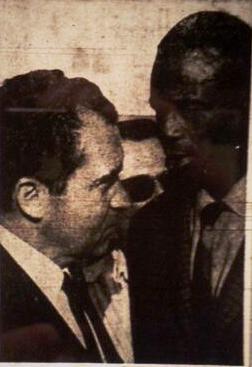
As a crowd of local residents gathered at the Anchorage airport to greet Paige, another plane arrived for refueling.  It carried former Vice President Richard M. Nixon on his way to Tokyo.  Nixon walked into the terminal while the plane was refueled, and when he asked about the crowd he was told they were waiting for Paige’s arrival.  Nixon joined the line to greet the pitcher.  The man who would be the leader of the free world in a little more than three years told a reporter from The Associated Press:

“I always like to meet celebrities.”
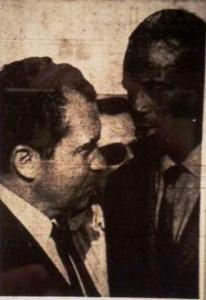
Nixon and Paige meet in Alaska

Nixon and Paige meet in Alaska

His commitment in Alaska over, Paige made it to the Astrodome on September 6.  The two-inning game, featuring a team of “immortals” versus “Texas All-Stars,” was an incredible collection of legends—more than 50 former players participated; twelve were already members of the Hall of Fame.  The Houston Post said of the player introductions:

Joe DiMaggio, the Yankee Clipper, got a deafening cheer.  So did Satchel Paige, peerless Negro hurler.”

The paper said the only others to receive a reception near that for Paige and DiMaggio were Dizzy Dean and native Texan Monty Stratton.
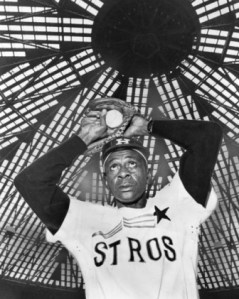
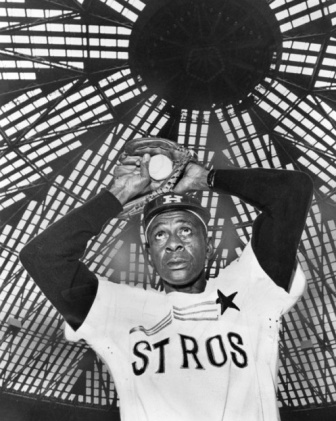
Paige in the Astrodome

Paige in the Astrodome

Perhaps it was the reception in Houston that caused one of the letters Paige, and his wife and daughter had written months earlier to finally be answered.

Charles Oscar Finley, who made his fortune in the insurance business and bought controlling interest of the Kansas City A’s before the 1961 season, was the one who finally responded.

That the signing of Paige appears to have been a spur of the moment decision for Finley after reading about the reception in Houston, is supported by the fact that it was announced by the marketing savvy Finley at what The Kansas City Times described as a “hastily called news conference,” which Finley, who was in Chicago, did not attend.

He appeared with General Manager Hank Peters and told reporters “I thought they were kidding” when Finley called and offered him a contract.

He said he was ready to pitch and brushed aside questions about his age:

“I think I can still pitch and help this club.  So what difference does it make what my age is if I can?”

Bill Veeck, who had signed Paige with the Cleveland Indians in 1948 and the St. Louis Browns in 1951, told The Times he hoped it wasn’t just a publicity stunt by Finley:

“I am hopeful he will be used as he should be—as a pitcher. Leroy should surprise a few people as he has for a long time.”
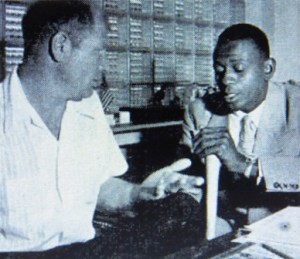
Veeck and Paige

Veeck and Paige

The controversial Veeck, more than a decade away from his return to the game, told The Kansas City Star he blamed himself for the pitcher’s  long absence:

“When I left Cleveland the first thing the new owners did was get rid of Satch.  When I sold the St. Louis Browns (and the team relocated to Baltimore), the same thing happened.  That’s nothing more than guilt by association.”

The signing of the 59-year-old Paige, who joined a team that included five 19 and 20-year-old pitchers who appeared in at least one game that year—Jim “Catfish” Hunter, John “Blue Moon” Odom, Ron Tompkins, Tom Harrison and Don Buschorn—inspired a short poem published in The Star:

“They’re either too

Young or too old,

When Charlie puts ‘em

In A’s Green and Gold.”

Papers across the country carried a photograph of Paige, seated on a chair, with one of Finley’s young pitchers, Catfish Hunter, on his knee.  While the photo was straight from Finley’s marketing plan, the impact of one future Hall of Famer on another, forty years his junior, seems to have been real.
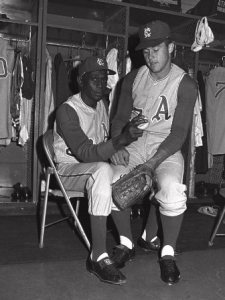
Paige and Hunter

Paige and Hunter

The Star spoke to Paige about his pitching philosophy one afternoon as Hunter stood nearby.  The paper said:

“Hunter listened intently as Satchel expounded his pitching theories.”

Paige was equally impressed with the 19-year-old, telling The Star:

“This young man has shown me a lot of poise.  He has a great future in this game.”

The next two weeks were filled with pictures of, and stories about, Paige in a rocking chair, a nurse seated nearby, watching the A’s play, and while a “Satchel Paige Night” was scheduled, there appeared little chance the pitcher would be used as anything but a prop for publicity.  Then Finley announced that his new pitcher would start on his night, September 25 against the Boston Red Sox.

What took place on the mound on September 25 has been written about many times. With his six children and wife Lahoma—pregnant with number seven—sitting in the owner’s box with Finley, Paige pitched three shutout innings, allowing just one hit—a Carl Yastrzemski double.

The only disappointment was the anemic crowd—just 9,289 Kansas City fans turned out to see a legend, the second largest crowd during that six-game home stand was 2,874.

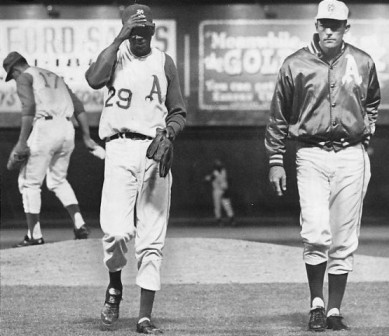
As Paige took the mound in the fourth inning, A’s Manager Haywood Sullivan, who was not consulted before Paige’s signing or before Finley announced he would pitch that night, came to the mound to remove Paige.  The pitcher walked off to a standing ovation.
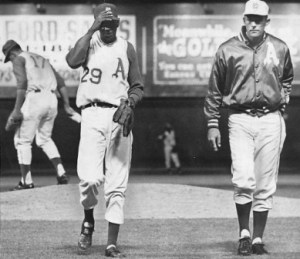
Paige walks off the field with Manager Haywood Sullivan while Diego Segui warms up.

Paige walks off the field with Manager Haywood Sullivan while Diego Segui warms up.

Paige returned to the clubhouse.  The Star said:

“In the clubhouse he was down to his long underwear, and talking about helping the A‘s out of the basement when someone rushed in a and screamed, ‘Satch, they want you back on the field.’

“The lights were out.  More than 9,000 matches flickered in the darkness, and on ‘Salute to Satchel Paige Night,’ they sang ‘Rockin’ Chair,’ ‘Darling I am Growing Old,’ and “The Old Gray Mare.”

After returning to the clubhouse, Paige was greeted by Finley, who called him “a real credit to the game.”  Paige “shook the owner’s hand” and said “I want to thank you for bringing me here.”

Whether he truly believed it or not, Paige told reporters he planned to pitch again in 1965.

“Everybody doubted me on the ballclub.  They’ll have more confidence in me now.”

He did not appear in another game but stayed with the club for the remainder of the season.  Two days after his three-inning performance, he was with the team in Baltimore.

A discouraging word had not been uttered by Paige during his time with the A’s.  Perhaps being in Baltimore—where his big league career effectively ended after Veeck sold the Browns—or maybe just the realization that a man capable of throwing three shutout innings at age 59 was not given an opportunity by a major league club the previous 12 seasons, changed that.

Lou Hatter wrote in The Baltimore Sun:

“Satchel Paige, the slender pitching ancient signed 2 ½ weeks ago by Kansas City, bared a deep-rooted wound here last night for the first time.”

Paige said to Hatter:

“You can put it this way.  You can say I resent being overlooked by organized baseball all these years while I threw away most of my best years pitching for a barnstorming club…All they ask me, though, is how old am I.  But nobody asks me why I stayed out of the major leagues for 15 [sic 12] years.  That’s a long time isn’t it?  That’s a lifetime for most professional players.

“Let me ask another question. When Baltimore bought the St. Louis ballclub, why did they turn me loose?

“When I went to the Miami club (again pitching for Bill Veeck with the International League Marlins) and was a top pitcher for three years (11, 10 and 10 win seasons with ERAs of 1.86, 2.42 and 2.95), how come nobody picked me up?…I know the answer, but I won’t tell that neither—like I won’t tell my age.”

Despite Finley telling reporters throughout September that Paige would return to the A’s in 1966, if not as a player, then as a coach, he was released in September. The next time he appeared on the mound at Kansas City’s Municipal Stadium, it was again as a member of the barnstorming Indianapolis Clowns.
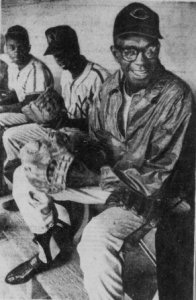
Paige back in Kansas City as a member of the Indianapolis Clowns in 1966.

Paige back in Kansas City as a member of the Indianapolis Clowns in 1966.

“The Fans there Like me. I Think so Anyway.”

31 Oct

In 1909 the Cleveland Naps traded pitchers Charlie Chech, Jack Ryan and $12,500 to the Boston Red Sox for Cy Young;  Young would turn 42-years-old before the beginning of the season.

Young was happy with the trade and told The Cleveland News:

“I’m glad to get back to the city where I started my career in 1890.  The fans there like me.  I think so anyway.  I believed they pulled for me there when I pitched against their own team.  I will give (Napoleon) Lajoie all I have and I think I’m good for several years.”

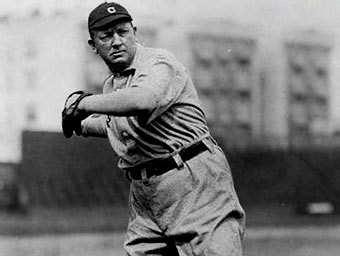
Cy Young

Cy Young

Addie Joss, the Naps ace, was also happy about the trade:

“Not only has Cleveland secured one of the best pitchers in the game today, but at the same time has added to the club a man who has done much for the good of baseball, and who is honored and respected everywhere he has ever played.  I have always contended, and always will, that Cy is the greatest pitcher the game has ever produced.”

Elmer Ellsworth Bates, the sports editor of The Cleveland Press, told some stories about the Indians new pitcher.

Ellsworth said a visitor to Young’s farm in Paoli, Pennsylvania asked the pitcher which of his then 478 victories did he “recall with the most satisfaction.”

“’The first game I ever pitched for Cleveland, back in 1890 (an 8 to 1 victory August 6),’ replied Old Cy, unhesitatingly.  ‘I doubt if a base ball crowd ever looked on a more typical rube than I appeared to be that day in a makeshift uniform six or seven sizes too small.  I didn’t have much money then, but I would not have lost that game to Chicago for the prettiest $1,000 bill ever printed.”

Bates said Young was “probably the most modest ‘big man’” in the game:

“At the Colonial (Hotel in Cleveland) one day last summer a young man took a chair next to the great pitcher and began paying him fulsome praise.

“’You are the swiftest pitcher I ever saw,’ he said.

“’Then,’ said Old Cy.  ‘I guess you never saw Amos Rusie.  My fastball looks like a slow freight trying to keep up with the Twentieth Century Limited Express compared to Rusie’s.’

“’But your slow ball is a peach.’

“’Young man,’ remarked Old Cy, gravely.  ‘If I could pitch the slow ball Eddie Beatin, the old Cleveland twirler, used to hand up to the batters I’d let them knock $1,000 a year off my salary.”

Bates also said it was “a matter of record” that Young was unaware he had pitched a perfect game against Connie Mack’s  Philadelphia Athletics on May 5, 1904:

“’I knew Connie’s boys hadn’t made a hit,’ said Old Cy the next day, but I couldn’t understand why the crowd was making such a demonstration.’

“’Well you’ve done it,’ said (manager and third baseman) Jimmy Collins, as we started for the dressing room after the crowd had let me go.’

“’Done what, Jimmy?’ I asked.  ‘Pitched a no-hit game?’

“’Better than that; not a man reached first.’

“’Then I knew what the racket was about.’”

“Evans, who, at the Least, is Incompetent”

2 Dec

William George “Billy” Evans was nicknamed “The Boy Umpire” when he was hired by the American League at the age of 22.  After 21 seasons  he became a front office executive, working for the Cleveland Indians, Boston Red Sox and Detroit Tigers; he was also president of the Southern Association, authored two baseball books and in 1973, 17 years after his death, was elected to the Baseball Hall of Fame.

Billy Evans

Billy Evans

But during his first season as an umpire, 1906, he was not held in high esteem in Chicago.

On September 10 the White Sox were in second place, a game behind the New York Highlanders.  The Sox trailed the Tigers 2 to 1 in the 9th inning.  Chicago shortstop George Davis laid down a bunt and was called out at first by Evans.  Every Chicago paper said Evans beat the throw by “at least a step.”

The call precipitated a near riot.  The Chicago Tribune said:

“Instantly a shower of bottles from the first base bleachers drove the umpire, coacher, and players away from the vicinity of the base.”

After the next two batters were retired:

“Evans walked off the field amid another volley of bottle from the third base stand.”

The Tribune and The Chicago Inter Ocean said Evans and fellow umpire Tommy Connolly were mobbed by fans as they attempted to leave the ballpark with a police escort.  Both papers said “one or two blows” from fans connected with the umpire during his retreat.

The Inter Ocean said, “Evans has been the most heartily reviled arbiter that ever worked in any league.”

The Tribune said two weeks earlier Evans cost the Sox a game in Philadelphia.  After Chicago scored two runs in the top of the sixth inning to take a 5 to 4 lead, Evans “let the Athletics take advantage of his inexperience,” and stopped the game on account of rain with two men out in the bottom of the inning.  The Inter Ocean said, “(Sox Manager Fielder) Jones and (second baseman Frank) Isbell nearly came to blows with the umpire and members of the Athletic team.”

After a half hour, the game was called and the score reverted back to the end of the 5th inning, giving Philadelphia a 4 to 3 victory.

The next day, September 11, the Sox played the St. Louis Browns at South Side Park.  Evans worked the game along with Jack Sheridan.  The newspapers said Sox owner Charles Comiskey had discontinued the sale of “bottled goods” at the park that day.

The Browns won 7 to 3, and the Chicago press put much of the blame for the loss on the rookie umpire.

The Tribune said:

President (Ban) Johnson’s persistence in sending Evans, who, at the least, is incompetent, is giving baseball a black eye in Chicago.  Half the crowd believes the charges that Evans is working under instructions from Johnson to beat Chicago.  These charges undoubtedly are founded on mere prejudice, yet, had Evans been under instructions and trying to beat Chicago, he could not have done better than he did yesterday.”

The Inter Ocean said the Browns “were aided and abetted by Umpire Evans, the boy wonder…Why Ban Johnson insists upon sending the joke to officiate at important games is more than any sane man can see.”

But the Evans’ most ardent critic was William A. Phelon, sports editor of The Chicago Journal:

“Umpire Evans is the worst that ever yet came down this or any other pike in the history of the modern universe…And Ban says he is the best in the game.  We are not selfish and we are willing to let some other city endure him.  We can get over the shock of his removal.  If he doesn’t move he may have a statue down on the lake front, a statue 200 feet high made of bottles.  Give us liberty, give us death, give us any old thing, but, by the snakes of old Ireland, give us an umpire!”

Phelon also said Evans “seems to be a gentlemanly individual, whose place in life is evidently a long ways from the profession of umpiring.”

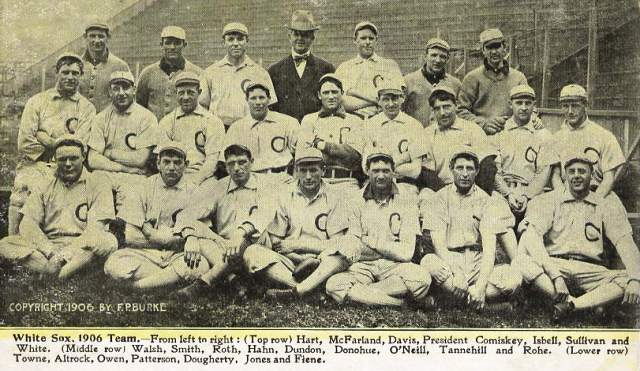
1906 White Sox

Despite the blame heaped on the young umpire in the press, the White Sox went 17-7 the rest of the season and won the pennant by three games.  They went on to beat the Chicago Cubs 4 games to 2 in the World Series.

Things got better for Evans as well.  He worked his first World Series in 1909—the youngest umpire to do so– and participated in five more from 1912 to 1923.  He was the third umpire to be elected to the Hall of Fame; Connolly and Bill Klem were the first two.

Lost Advertisements–Ready! Lajoie Baseball Guide

25 Oct

lajoieguide

Above is a 1906 advertisement for an Atlanta hardware store offering the inaugural edition of “Napoleon Lajoie‘s Baseball Guide.”  The Lajoie Guide was intended to compete with the well established Spalding and Reach Guides, and sold for 10 cents, but despite Lajoie’s popularity the guide failed to catch on and was only published for three years.

In addition to the standard recap of professional baseball leagues across the country, and many photos, the Lajoie guide included a significant amount of information specific to its name sake.  An advertisement for the Cincinnati-based Queen City Tobacco Company said:

Lajoie Chews Red Devil Tobacco

Ask him if he don’t

reddevil

Grantland Rice wrote for the guide, and the first edition included a Rice-penned poem called “For Lajoie’s in Town:”

We’ve gazed on Mr. Roosevelt,

Who rules this whole wide land.

We’ve looked at Carrie Nation, 

And shook Jim Corbett’s hand

We’ve eaten bread with Robert Fitz

And chummed with George Tebeau.

We’ve drank out beer with Mr. Schlitz.

Great notable we know.

We’ve interviewed Friend Morgan,

Thrown talk at old John D.

We’ve opened wine with Sullivan

And seen Prince Hennery.

King Edward is a bosom pal,

Langtry our school-day girl.

Dick Croker smiles in our face,

We’ll give Boss Fame a whirl

*     *     *     *     *     *     *     *

Around the shrine of heroes

There’s little we’ve not seen.

We’ve talked to all, both great and small,

Of high and lowly mien.

But this group pales beneath the looks

Of one of far renown.

Hats off!The greatest comes today,

For Lajoie’s in town.

T. Roosevelt’s backed off the boards,

A plater is king Ed.

Langtry a chorus lady now,

The others are all dead.

For Lajoie, pride of several leagues!

Lajoie, the mighty man!

Lajoie, his bat and fielding glove

Knocks out the wholes blamed clan.

The 1906 Lajoie Guide

The 1906 Lajoie Guide