Tag Archives: Cy Young

Things I Learned on the Way to Looking Up Other Things #16

21 Oct

Pirates Slump, 1921

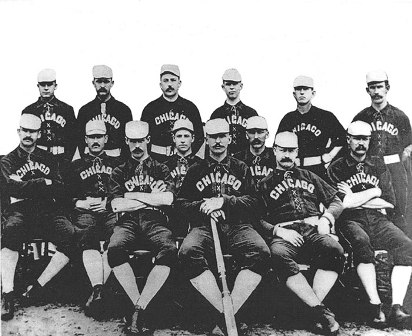
The first place Pittsburgh Pirates were preparing for a doubleheader with the New York Giants on August 24, 1921, when the team took time out to pose for a photo.  The Pittsburgh Leader said:

“Someone happened to mention, as the photographer moved away, that for a whole team to watch the little birdie at once was a jinx.”

The team promptly went out and dropped the doubleheader, then lost three more to the Giants.  The paper said of the five straight losses:

“It doesn’t prove the jinx exists.  But it does prove that to imbue a man or a team of men, with the idea that they can’t win a ballgame generally means that they won’t win.  For their pep and enthusiasm has been stolen.”

The Pirates finished second, four games behind the Giants.

Anson’s All-Time Team, 1918

While visiting St. Paul, Minnesota in the summer of 1918, Cap Anson was asked by a reporter for The Associated Press to name his all-time all-star team.  The reporter said the team was most “notable for including in its makeup not one” current player:

"Cap" Anson

                        “Cap” Anson

“According to Captain Anson, at  least four outfielders of old times are better than (Ty) Cobb or (Tris) Speaker and (John) Clarkson, (Amos) Rusie, and (Jim) McCormick, he thinks were better pitchers than (Grover Cleveland)  Alexander  or (Walter) Johnson.  His line-up would be:

Catchers—William “Buck” Ewing and Mike “King” Kelly

Pitchers—Amos Rusie, John Clarkson, and Jim McCormick

First Base—Captain Anson, himself

Second Base—Fred Pfeffer

Third Base—Ned Williamson

Shortstop—Ross Barnes

Outfielders—Bill Lange, George Gore, Jimmy Ryan and Hugh Duffy

Cy Young’s Five Rules, 1907

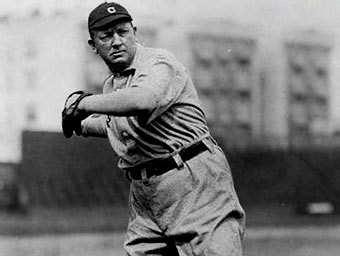
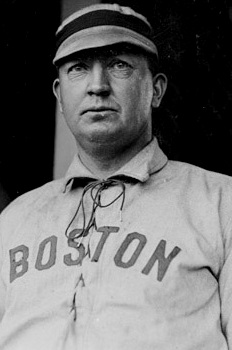
Forty-year-old Cy Young won 21 games for the Boston Americans in 1907 and his longevity became a popular topic of newspaper copy until he pitched his final major league game four years later.

Cy Young

                                             Cy Young

During that 1907 season he gave a reporter for The Boston Post his advice for young players:

“(T)o the young player who seeks his advice about getting in condition and being able to stay in the game as long as the veteran himself, Cy lays down a few simple rules, which are as follows:

  1.  Live a temperate life
  2. Don’t abuse yourself if you want to attain success
  3. Don’t try to bait the umpires; abusing the arbitrators does a player no good and harms him in the eyes of the umpires, players and public in general
  4. Play the game for all you are worth at all times
  5. Render faithful service to your employers

Regarding his “rule” about umpires, Young said:

“What’s the use in kicking?  The umpire won’t change his decision, and kicking will give him another chance to get back at you for your silly abuse.”

Grantland Rice’s “All-Time All-Star Round up”

10 Aug

In December of 1917, thirty-eight-year-old sportswriter Grantland Rice of The New York Tribune enlisted in the army–he spent fourteen months in Europe.  Before he left he laid out the case, over two weeks, for an all-time all-star team in the pages of the paper:

“As we expect to be held to a restricted output very shortly, due to the exigencies and demands of the artillery game, this seemed to be a fairly fitting period to unfold the results.”
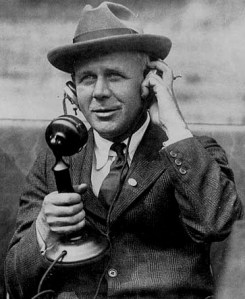
Grantland Rice

Grantland Rice

Rice said the selections were “not solely from our own limited observation, extending over a period of some eighteen or twenty years,” but included input from players, managers and sportswriters, including  “such veterans” as Frank Bancroft and Clark Griffith, and baseball writers Joe Vila of The New York Sun, Bill Hanna of The New York Herald and Sam Crane, the former major league infielder turned sportswriter of The New York Journal.

Rice said only one of the nine selections “(S)eems to rest in doubt.  The others were almost unanimously backed.”

The selections:

Pitcher:  Christy Mathewson

A. G. Spalding, John (Montgomery) Ward, Larry Corcoran, Charley Radbourn, John Clarkson, (Thomas) Toad Ramsey, Tim Keefe, Bill Hoffer, Amos Rusie, (Mordecai) Miner Brown, Addie Joss, Ed Walsh–the array is almost endless.

“In the matter of physical stamina, Cy Young has outclassed the field.  Cy won more games than almost any others ever pitched.

“(But) For all the pitching mixtures and ingredients, stamina, steadiness, brilliancy, brains, control, speed, curves, coolness, courage, is generally agreed that no man has ever yet surpassed Christy Mathewson…there has never been another who had more brains or as fine control.”


[…]

“It might be argued that Radbourn or (Walter) Johnson or (Grover Cleveland) Alexander was a greater pitcher than Mathewson.

But we’ll string with Matty against the field.”

Radbourn was the second choice.  Bancroft said:

“Radbourn was more like Mathewson than any pitcher I ever saw.  I mean by that, that like Matty, he depended largely upon brains and courage and control, like Matty he had fine speed and the rest of it.  Radbourn was a great pitcher, the best of the old school beyond any doubt.”

Catcher:  William “Buck” Ewing

“Here we come to a long array—Frank (Silver) Flint, Charley Bennett, (Charles “Chief”) Zimmer, (James “Deacon”) McGuire, (Wilbert) Robinson, (Marty) Bergen(Johnny) Kling, (Roger) Bresnahan and various others.

“But the bulk of the votes went to Buck Ewing.”
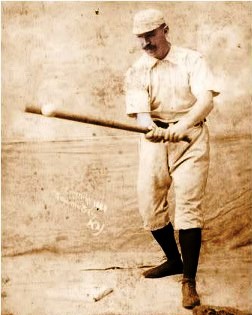
Buck Ewing

Buck Ewing

[…]

“Wherein did Ewing excel?

“He was a great mechanical catcher.  He had a wonderful arm and no man was surer of the bat…he had a keen brain, uncanny judgment, and those who worked with him say that he had no rival at diagnosing the  weakness of opposing batsman, or at handling his pitchers with rare skill.”

Kling was the second choice:

“Kling was fairly close…a fine thrower, hard hitter, and brilliant strategist…But as brilliant as Kling was over a span of years, we found no one who placed him over the immortal Buck.”

1B Fred Tenney

First Base was the one position with “the greatest difference of opinion,” among Rice and the others:

“From Charlie Comiskey to George Sisler is a long gap—and in that gap it seems that no one man has ever risen to undisputed heights… There are logical arguments to be offered that Hal Chase or Frank Chance should displace Fred Tenney at first.

But in the way of batting and fielding records Tenney wins….Of the present array, George Sisler is the one who has the best chance of replacing Tenney.”

2B Eddie Collins

 “There was no great argument about second base.

“The vote was almost unanimous.

“From the days of Ross Barnes, a great hitter and a good second baseman on through 1917, the game has known many stars.  But for all-around ability the game has known but one Eddie Collins.”

Rice said the competition was between Collins, Napoleon Lajoie and Johnny Evers:

“Of these Lajoie was the greatest hitter and most graceful workman.

“Of these Evers was the greatest fighter and the more eternally mentally alert.

“But for batting and base running, fielding skill, speed and the entire combination, Collins was voted on top.”

 SS Honus Wagner

“Here, with possibly one exception, is the easiest pick of the lot.  The game has been replete with star shortstops with George Wright in 1875 to (Walter “Rabbit”) Maranville, (George “Buck”) Weaver…There were (Jack) Glasscock and (John Montgomery) Ward, (Hardy) Richards0n, (Hugh) Jennings, (Herman)Long, (Joe) Tinker and (Jack) Barry.

“But there has been only one Hans Wagner.”
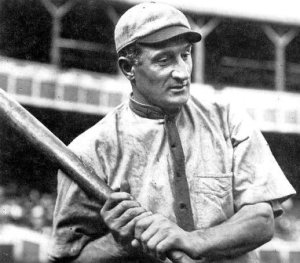
Honus Wagner

Honus Wagner

Jennings and Long were rated second and third,  “But, with the entire list  considered there is no question but that Wagner stands at the top.”

3B Jimmy Collins

Rice said:

“From the days of (Ned) Williamson(Jerry) Denny, and (Ezra) Sutton, over thirty years ago, great third basemen have only appeared at widely separated intervals.

“There have been fewer great third basemen in baseball than at any other position, for there have been periods when five or six years would pass without an undoubted star.”

The final decision came down to “John McGraw vs. Jimmy Collins.”  McGraw was “a great hitter, a fine bunter and a star base runner,” while “Collins was a marvel and a marvel over a long stretch…he was good enough to carve out a .330 or a .340 clip (and) when it came to infield play at third he certainly had no superior…So taking his combined fielding and batting ability against that of McGraw and Collins wins the place.  McGraw was a trifle his superior on the attack. But as a fielder there was no great comparison, Collins leading by a number of strides.”


OF Ty Cobb

“The supply here is overwhelming…Yet the remarkable part is that when we offered our selection to a jury of old players, managers and veteran scribes there was hardly a dissenting vote.”

[…]

“Number one answers itself.  A man who can lead the league nine years in succession at bat.

“A man who can lead his league at bat in ten out of eleven seasons.

“A man who can run up the record for base hits and runs scored in a year—also runs driven in.

“Well, the name Ty Cobb answers the rest of it.”

OF Tris Speaker

 “The man who gives Cobb the hardest battle is Tris Speaker.  Veteran observers like Clark Griffith all say that Speaker is the greatest defensive outfielder baseball has ever exploited…Speaker can cover more ground before a ball is pitched than any man.  And if he guesses incorrectly, which he seldom does, he can go a mile to retrieve his error in judgment…And to this impressive defensive strength must be added the fact he is a powerful hitter, not only a normal .350 man, but one who can tear the hide off the ball for extra bases.”
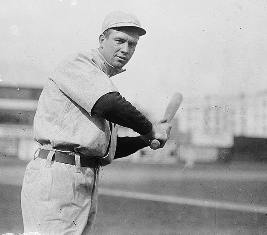
Tris Speaker "hardest hit"

Tris Speaker 

OF “Wee Willie” Keeler

Mike Kelly and Joe KelleyJimmy Sheckard and Fred Clarke—the slugging (Ed) Delehanty—the rare Bill LangeBilly Hamilton.

“The remaining list is a great one, but how can Wee Willie Keeler be put aside?

“Ask Joe Kelley, or John McGraw, or others who played with Keeler and who remember his work.

“Keeler was one of the most scientific batsmen that ever chopped a timely single over third or first…And Keeler was also a great defensive outfielder, a fine ground coverer—a great thrower—a star in every department of play.

“Mike Kelly was a marvel, more of an all-around sensation, but those who watched the work of both figure Keeler on top.”

Rice said of the nine selections:

“The above is the verdict arrived at after discussions with managers, players and writers who have seen a big section of the long parade, and who are therefore able to compare the stars of today with the best men of forgotten years.

“Out of the thousands of fine players who have made up the roll call of the game since 1870 it would seem impossible to pick nine men and award them the olive wreath.  In several instances the margin among three or four is slight.

“But as far a s deductions, observations, records and opinions go, the cast named isn’t very far away from an all-time all-star round up, picked for ability, stamina, brains, aggressiveness and team value.

“If it doesn’t stick, just what name from above could you drop?”

“He Drinks one Glass of Whiskey a day while Training”

8 Apr

The Associated Press (AP) said in 1912 that 45-year-old Denton True “Cy” Young, “(B)aseball’s most interesting veteran has gone to Augusta, Georgia, to join his teammates of the Boston Nationals at their training camp.”

Young had gone to Augusta from Hot Springs, Arkansas, where T he had spent several weeks performing his annual ritual for getting into shape, “He started going there years ago.”

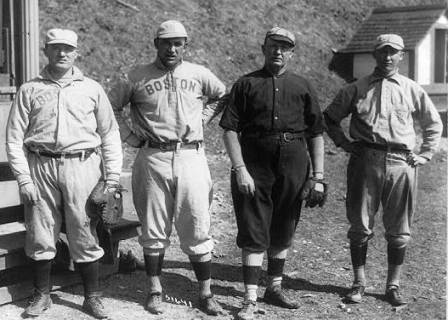
Cy Young, third from left, with Bill Carrigan, Jake Stahl and Fred Anderson at Hot Springs in 1912

Cy Young, third from left, with Bill Carrigan, Jake Stahl, and Fred Anderson at Hot Springs in 1912

Among his secrets: “He drinks one glass of whiskey a day while training.”

Young shared his training regimen with the wire service:

“First week: The regular daily baths at Hot Springs.

“Second week: Baths and road work. He dresses in flannels and sweater and does 10 to 15 miles on the road. He tramps, sprints and climbs hills. He does not touch a baseball.

“Third week: He continues baths and road work. He fields and tosses the ball. He handles bunts to reduce his stomach. At the end of the third week, he pitches his first ball.”

Cy Young

Cy Young

Young said after he began throwing pitches, he had no set rule for when to begin throwing hard:

“Young doesn’t attempt a fastball until he is just right and no one but himself can tell when this will be. He says he doesn’t know how he knows when the moment arrives, but he just naturally begins to speed them across and perhaps to put ‘something on the ball’ at the correct time. The result is you never hear of Cy Young complaining of a sore arm, or wrenched back, as many youngsters do.”

Young, by all accounts, pitched fairly well in games in Georgia and went north with Boston.

But, he never appeared in a game. An April story that said he was retiring to take a baseball writing job at The Boston American proved untrue.

Finally, on May 23, Young was scheduled to pitch against the Pittsburgh Pirates. The AP said:

“The veteran was sent out to warm up to pitch for Boston against the Pirates…but his salary wing refused to behave.”

Young vowed to return to his farm, “and get into shape,” in order to return before the end of the season.

His training regimen finally wasn’t enough. His career was over.

Hearing that Young was returning to his farm, his Boston teammates took up a collection, “to defray Cy’s expenses and $44.39 was raised.” The AP said some of the young players didn’t realize the collection “(W)as a joke…He is worth $75,000 and owns 160 acres of land in Ohio…Cy smiled and spent a good hour hunting up the younger players and returning their money.”

Things I Learned on the Way to Looking up other Things #12

3 Nov

The Cost of Superstitions, 1913

John Phalen “Stuffy” McInnis his .324 and drove in 90 runs for the 1913 Philadelphia Athletics, but the first baseman hit just .118—2 for 17—during the World Series.

Stuffy McInnis

Stuffy McInnis

The Washington Post told how one superstition among the athletics players might have contributed to McInnis’ slump:

“Those boys believe that they can change the luck at a crucial moment by hurling their bats in the air and letting them fall where they will.  Probably you fans have often seen them do it.  They also believe that they can keep up their good luck by continuing this practice.

“During the first game, in which (Frank “Home Run”) Baker hit a home run, the Athletics started tossing their bats the minute the ball was hit.  As the bats came down Stuffy McGinnis couldn’t get out of the way in time and one of them struck him in the ankle, causing a painful bruise.  He limped to first base and for a while (Connie) Mack was afraid he couldn’t go on with the game.”

Despite McInnis’ slump, the Athletics beat the Giants four games to one.

The Case against the Spitball, 1905

Baseball’s greatest pitcher hated the games most controversial pitch.  In 1905 Denton True “Cy” Young was quoted in The Sporting Life saying it wouldn’t be long before the pitch disappeared entirely:

“I don’t think the ‘spit ball’ is going to cut a much a figure as was thought early in the season.  Many of the pitchers that were using it at the start of the campaign have cut it now, and from now on the twirlers that use it will be dropping it one by one.  I used it against Philadelphia and Washington and had it working nicely, but it hurt my arm and I have cut it altogether.  An old pitcher like myself has no business using it at all.”

Cy Young

Cy Young

Young said the pitch injured his forearm and said he was not alone.  He claimed Jack Chesbro, George Mullin, (Guy) “Doc” White all received similar injuries.   And Washington’s Case Patten, who a year earlier so loved the pitch The St. Louis Republic said he was often “giving the ball a shower bath preparatory to flinging,” was now saying the pitch “lamed his arm.”

Young said even for those who weren’t injured, the spitter would ultimately lead to pitchers losing “control of his curve ball and his fast ones.”

While Chesbro disagreed with Young’s claim that his arm problems were the result of throwing spitballs, his effectiveness diminished greatly after the injury.

Young’s prediction of the demise of the pitch was premature.  At the time of his statement, Chicago White Sox pitcher “Big Ed” Walsh was perfecting the pitch, which he learned from teammate Elmer Stricklett—who had also been instrumental in Chesbro’s use of the spitter.   Walsh started throwing the spitball regularly in 1906.

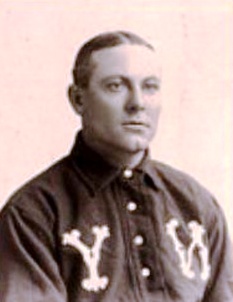
Ed Walsh circa

Ed Walsh circa

A month before his death, on his 78th birthday and bed-ridden, Walsh remained an advocate for the pitch Cy Young detested.  He told a reporter for The Associated Press:

“I admire the pitchers today who throw the pitch.  Some people call ‘em cheaters.  They’re not.  They’re just guys doing everything they can to win.”

Wahoo Sam’s Scouting Report, 1914

Coming off of the New York Giants off-season world tour with the Chicago White Sox, the consensus opinion seemed to be that Giants Manager John McGraw did not make a mistake in signing Jim Thorpe, the world’s greatest all-around athlete, to a three-year contract worth–depending on the source—from $5,000 to $6,500 per season.  Many doubted Thorpe’s prospects after he hit just .143 in 19 games for the Giants in 1913.

Jim Thorpe

Jim Thorpe

But, not to worry, said McGraw:

“All Thorpe needed was every day action, instead of idleness, although of course sitting on the bench all summer gave him a chance to learn lots of things that will stand him in good stead later on.”

The baseball world generally agreed with McGraw’s assessment.

Hugh Fullerton predicted Thorpe would be “the most sensational baseball player of 1914.”

Damon Runyon declared Thorpe was “now a star.”

Gustave (G.W.) Axelson, Sports Editor of The Chicago Record-Herald, who traveled with the teams, said of Thorpe’s development during the trip:

“The fans in the United States will see an entirely different kind of player when Thorpe Lines up for the season. “

White Sox pitcher Joe Benz, who played against Thorpe on the tour, agreed saying Thorpe “improved greatly” and would be of “great assistance to the Giants,” in 1914.

But, “Wahoo” Sam Crawford, the Detroit Tigers outfielder who traveled with the tour as a member of the White Sox disagreed with all the glowing accounts of Thorpe’s progress.  The Detroit Times said:

“Thorpe’s speed is all that commends him, according to Sam.  He is not a particularly good fielder, and he cannot hit.  He is not a natural hitter at all, but he gives the bat a little upward chop as he swings at the ball in a way that Crawford never saw any man do before.

“Furthermore Thorpe doesn’t seem to have that baseball instinct that is so necessary for a big league player, say Crawford.  He is a very chesty fellow for a man who has yet to prove that he is of big league caliber, is the assertion made by Wahoo Sam.”

Sam Crawford

Sam Crawford

Crawford’s assessment was the most accurate.  Despite the fanfare that accompanied Thorpe’s return from the tour, Thorpe was never better than a mediocre outfielder (career .951 fielding percentage) and he hit just .252 over parts of nine major league seasons.

“The Fans there Like me. I Think so Anyway.”

31 Oct

In 1909 the Cleveland Naps traded pitchers Charlie Chech, Jack Ryan and $12,500 to the Boston Red Sox for Cy Young;  Young would turn 42-years-old before the beginning of the season.

Young was happy with the trade and told The Cleveland News:

“I’m glad to get back to the city where I started my career in 1890.  The fans there like me.  I think so anyway.  I believed they pulled for me there when I pitched against their own team.  I will give (Napoleon) Lajoie all I have and I think I’m good for several years.”

Cy Young

Cy Young

Addie Joss, the Naps ace, was also happy about the trade:

“Not only has Cleveland secured one of the best pitchers in the game today, but at the same time has added to the club a man who has done much for the good of baseball, and who is honored and respected everywhere he has ever played.  I have always contended, and always will, that Cy is the greatest pitcher the game has ever produced.”

Elmer Ellsworth Bates, the sports editor of The Cleveland Press, told some stories about the Indians new pitcher.

Ellsworth said a visitor to Young’s farm in Paoli, Pennsylvania asked the pitcher which of his then 478 victories did he “recall with the most satisfaction.”

“’The first game I ever pitched for Cleveland, back in 1890 (an 8 to 1 victory August 6),’ replied Old Cy, unhesitatingly.  ‘I doubt if a base ball crowd ever looked on a more typical rube than I appeared to be that day in a makeshift uniform six or seven sizes too small.  I didn’t have much money then, but I would not have lost that game to Chicago for the prettiest $1,000 bill ever printed.”

Bates said Young was “probably the most modest ‘big man’” in the game:

“At the Colonial (Hotel in Cleveland) one day last summer a young man took a chair next to the great pitcher and began paying him fulsome praise.

“’You are the swiftest pitcher I ever saw,’ he said.

“’Then,’ said Old Cy.  ‘I guess you never saw Amos Rusie.  My fastball looks like a slow freight trying to keep up with the Twentieth Century Limited Express compared to Rusie’s.’

“’But your slow ball is a peach.’

“’Young man,’ remarked Old Cy, gravely.  ‘If I could pitch the slow ball Eddie Beatin, the old Cleveland twirler, used to hand up to the batters I’d let them knock $1,000 a year off my salary.”

Bates also said it was “a matter of record” that Young was unaware he had pitched a perfect game against Connie Mack’s  Philadelphia Athletics on May 5, 1904:

“’I knew Connie’s boys hadn’t made a hit,’ said Old Cy the next day, but I couldn’t understand why the crowd was making such a demonstration.’

“’Well you’ve done it,’ said (manager and third baseman) Jimmy Collins, as we started for the dressing room after the crowd had let me go.’

“’Done what, Jimmy?’ I asked.  ‘Pitched a no-hit game?’

“’Better than that; not a man reached first.’

“’Then I knew what the racket was about.’”

“It’s Strange how these Stars of Balldom have such Beliefs”

27 Aug

Throughout his career as an American League umpire, Billy Evans, who had covered baseball for The Youngstown Vindicator continued to write syndicated newspaper articles.  He was fascinated by the superstitions that controlled the actions of so many players.

Billy Evans

Billy Evans

He followed a 1907 article about the subject, with more stories the following year:

“Of all professions, that of baseball player is the most superstitious…Of course, there are many superstitions in common, yet most of the players have pet ideas of their own on which they place much reliance.  The data of origin of many of the superstitions is a deep, dark mystery.”

Evans said:

“There is certainly nothing out of the ordinary to be seen in a load of hay, yet most players welcome the sight of one during the playing season.  In the dictionary of baseball a load of hay signifies two hits that afternoon for the discoverer, and history tells us there is nothing dearer to a player’s heart than base hits…While its supposed strange magic often fails, still the players retain faith in it.  On the other hand, the sight of a load of empty barrels is always dreaded, for some it means a shutout, to others merely defeat.”

Of one popular superstition of the time, Evans said there was “no greater believer in shaking up the bats when a rally is on” than Cleveland Naps pitcher Charles “Heinie” Berger:

“Ordinarily a team keeps its bats lined up in front of the bench in a fairly tidy manner.  According to Heinie’s code that is all well and good when everything is moving along smoothly, but when a rally appears to be in the air, the proper way to encourage it, according to Berger, is to scatter the bats in every direction.”

Heinie Berger

Heinie Berger

Evans told the story of the Naps’ August 21, 1908, game, although some of the details regarding the scoring wrong, he got most of the facts correct:

“One day last summer during an important game at Philadelphia, the Athletics got away with a seven-run lead in the first two innings.  When they added another in the third, it certainly looked as if things were all off so far as Cleveland was concerned.  Until the seventh inning the Naps bench was not unlike a funeral.  Two runs in the seventh stirred up a little hope, and caused Heinie to heave a few big sticks in different directions.  His actions caused Umpire Jack Sheridan (Sheridan and Evans both worked the game, Sheridan was behind the plate) was to offer a mild rebuke and incidentally warn Heinie that he wanted nothing but silence during the rest of the afternoon.”

Cleveland scored two runs the following inning, and had the tying run on base:

“Heinie proceeded to scatter the two dozen or more bats in all directions.  That was too much for the veteran Sheridan, and after he had made Berger replace all the bats back in a straight line, he tied a can on the Teuton and chased him from the lot.

“Berger viewed the remainder of the game from the bleachers, failing to carry out completely the edict of the umpire.  When the Naps scored the two men on the sacks and tied up the game he was happy.  Heinie was confident that the bat superstition had aided in the victory that he was sure would result, now that the score was tied.  When the Athletics scored a run in the eighth that proved to be the winner his confidence in the theory was not shaken in the least. He blamed the defeat on Sheridan, claiming that as soon as the umpire ejected him from the game the spell was broken.”

Evans also wrote about his favorite superstitious player, “Wild Bill” Donovan, pitcher for the Detroit Tigers.  Evans had previously mentioned Donovan’s fear of throwing a shutout during his first start of each season, and his actions in one game in particular, but now gave a more detailed account:

“It all seems rather foolish, yet I have worked back of Donovan on two such occasions and have every reason to believe that Bill makes it possible for his opponents to score.  In one of the games Detroit had the affair clinched 8 to 0 in the eighth.  With one down and a man on second Charley Hickman stepped to the plate.  A straight fast one is the most delicious kind of dessert for Charley, although he likes almost any old thing in the shape of curves and slants.

“There is no more strategic pitcher in the league than Donovan, yet he started off the reel to hand them up to Hick’s liking.  After fouling off three, Hick met a fast one on the nose and was blowing hard at third by the time the ball was relayed back to the infield.  He scored a moment later, but Detroit too the game easily, 8 to 2.  Bill had escaped the much despised shutout.  By the way that year was the most successful of Donovan’s career, and, of course, merely served to strengthen his belief.”

Bill Donovan

Bill Donovan

Again, Evans got nearly all the details correct—except the final score was 9 to 2.  The May 24, 1907, game was Donovan’s first start of his best season in baseball (25-4, 2.19 ERA for the American League Pennant winners), and he did lose a shutout to Washington in the eighth inning on a Hickman triple.

Evans said a superstition often attributed to Cy Young, was not a superstition at all:

“The veteran Cy Young, the grand old man of them all, is one of the few players who doesn’t take much stock in omens of good or bad luck.  Cy, however, has one big hobby.  He always prefers to pitch on dark days…The dark day idea is no superstition with Cy.  No one except the batters perhaps realizes how hard it is to hit his fast ball when the light is dim.  It is really a pleasure for him to work out of turn on such days, for he knows what a big handicap he has over his opponents.”

Evans said another Hall of Fame pitcher had a bizarre habit, that while perhaps not a superstition, bears mentioning:

Jack Chesbro, the famous spitter, is always of the opinion that someone is slipping a doctored ball over on him, and quite often asks for a new one when the cover doesn’t taste just right.”

The umpire concluded:

“It’s strange how these stars of balldom have such beliefs and stick to them, but they do.  The ball player lives in a world of his own, more than any other profession with the possible exception of the actors.”

Kid Nichols

25 Jun

Add Hall of Famer Charles “Kid” Nichols to the list of those who were convinced that players from an earlier era were of better quality than those “of today,” even if the earlier era was less than a decade before.

Kid Nichols

Kid Nichols

While pitching for the Kansas City Blue Stockings in the Western League in 1903, the 33-year-old pitcher told a group which included a reporter for The Associated Press:

“I am not so sure that the ball players of today are much superior to those of ten years ago in general utility.  It seems to me there was more life and spirit in the games of a decade ago than in those of the present regime.  They weren’t so mercenary in those days and there was much more sportsmanlike spirit.  Nowadays the paramount question with the average player is salary.  He doesn’t care so much about the record of the team he plays with makes as opportunities offered him to make himself individually famous and thus increase the value of his services.  In many clubs teamwork is lacking on account of the intense desire of some of the men to make an impressive showing by individual work.  In the old days one didn’t hear so much of the individual as the playing of the team as a whole an in my opinion baseball would stand on much firmer foundation if the same spirit prevailed nowadays.”

Among the best:

“Take old (Tommy) McCarthy for instance.  As an outfielder none of them had him beaten, and in my opinion there is not an outfielder his equal now.  It was McCarthy who originated the trap ball which he worked so effectively.

“He was absolutely the headiest man in the outfield I ever saw.  You have seen outfielders throw men out at first on line drives, but you haven’t seen it done often.  I’ve seen McCarthy spoil many a legitimate one-base hit by that same play.  Another favorite play of his was this:  A man would be on first and second.  The man at bat would drive to left.  McCarthy would snap it up on a short bound and flip it to second as quick as a flash in time to catch the man who had run off first.  In turn the second baseman would throw the ball to third in time to head off the man who had started from second.  Thus a really legitimate one-base hit was turned into a double play.

“But, speaking of outfielders, Willie Keeler was about as good as any of them for all around ability.  He was like lightning on his feet and was no slouch at hitting.  He certainly did things to me one day in Baltimore.  He faced me four times and this is what he did:  Made four hits to four different parts of the field off of four different kinds of curves.  Keeler was the hardest man to fool I ever pitched to.”

Nichols said Herman “Germany” Long, his teammate for 12 years was:

“(O)ne of the greatest shortstops in the business.  He played with Boston while I was a Beaneater, and of course I had good opportunities to watch him work.  He could cover a world of territory and was a sure and accurate fielder.  You hear many people say that Hughie Jennings in his palmy days was the best infielder ever developed.  In my opinion Long could cover a foot more territory than Jennings.

“When it comes to catchers my preference is, and always has been, Charlie Bennett, whose legs were cut off in a railroad accident at Wellsville, Kansas.  Charlie was always consistent and knew what his brain was given to him for.  He was also an accurate, quick thrower…Martin Bergen was another good catcher.  He was the one who went crazy, you know, and murdered his wife and children.  Bergen always was ‘a little bit off of the top,’ but when he took a notion to do his best, his playing was beyond criticism.  Ed McFarland and (Billy) Sullivan are two right good men, and then there was reliable old Jim McGuire and Charles Zimmer, both of whom were cracker jack.”

bergen

Martin “Marty” Bergen–” always was ‘a little bit off of the top,’

Nichols said as a pitcher “I can hardly be considered a competent judge” of fellow “slabsters,” but continued:

“Personally, I admire the old war-horse, Cy Young, more than any of the others.  He is certainly a remarkable man.  Of the left-handers there a few better than (Frank “Noodles”) Hahn, of Cincinnati; (Christy) Mathewson and (Joe) McGinnity are undoubtedly valuable men.  Clark Griffith is, I think, the headiest pitcher that ever stepped on a rubber.  Among the other great ones are Jack Taylor, Joe Corbett, (Bill) Bernhard, of Cleveland and our own Jake Weimer.

Nichols was largely forgotten as one of baseball’s great pitchers by the time the Baseball Hall of Fame’s inaugural class was selected in 1936.  In the late 1940s, a push for his inclusion was led by sportswriter Grantland Rice.  Rice frequently mentioned the pitcher in his columns and in the summer of 1948 quoted two Hall of Famers regarding Nichols’ prowess:

“A few decades ago I asked Christy Mathewson to name the best pitcher he ever faced.  ‘That’s easy,’ Matty answered.  ‘His name is Charles Kid Nichols of Boston.  Nichols isn’t a good pitcher.  He is a great one.’

“I recalled this talk when the mail brought a letter from Ty Cobb at Menlo Park, California.

“‘I think everyone has overlooked one of the greatest pitchers of all time,’ Cobb Writes.  ‘His name is Kid Nichols.  Here are just a few of his records from 1890 to 1906:

“1.  Won three consecutive games on three consecutive days, all pitched in different cities.

“2.  Won 20 or more games for 10 consecutive years.  He won 360 and lost 202. (Nichols’ record was 361-208)

“3.  Won 28 or more games for eight consecutive seasons.  (Nichols won more than 28 games seven times, and not consecutively).”

Despite the inaccuracies in the letter, Cobb and Rice continued to campaign for Nichols and the push to honor him worked.  He was elected to the Hall of Fame in 1949.

Nichols, right, with Pie Traynor, left, and Branch Rickey at the Hall of Fame in 1949. Traynor was elected in 1948, but his plaque was not presented until 1949

Nichols, right, with Pie Traynor, left, and Branch Rickey at the Hall of Fame in 1949. Traynor was elected in 1948, but his plaque was not presented until 1949

“The Contest is going to be the Hottest in the History of Baseball”

6 Jun

Just weeks into the 1892 season, National League president Nick Young declared the newly expanded league, which absorbed four franchises from the defunct American Association and included the only scheduled split-season in major league history, an unqualified success.

Nick Young

Nick Young

The schedule, which called for the first half to end on July 15, and the second in later October, necessitated starting league play two weeks earlier than 1891 resulting in a large number of early season games being played in inclement weather.

Young spoke to a reporter named Max Ihmsen, who usually covered politics for The Pittsburgh Dispatch, about the state of game

“(T)here is no doubt of the overwhelming success of the new deal.  Considering the wretched weather that prevailed everywhere during April the showing, both financially and as to skill displayed, has been remarkable.  Everyone is making money, and I look for the most successful season ever known in the history of the game.  The reconciliation of the clashing interests, a reconciliation effected during the past winter, has been the salvation of the sport…This year there is every prospect of each club quitting a big winner.  Never before have such games, as are now being put up, been seen.”

Young said an April 19 doubleheader in Chicago, which brought in $4,000 accounted for the league’s highest single-day gate receipts of the season so far.

As for the pennant race Young said:

“The contest is going to be the hottest in the history of baseball.  Everybody is ‘out for blood,’ and at the close of the season I anticipate seeing a tie for every place up to fourth or fifth.  A difference of 10 or 15 games between the highest and lowest clubs will reflect no discredit on the lowest club…All the clubs are in good shape and I expect quite a number of absolutely errorless games will be recorded before the season closes.”

Young got nearly everything wrong.

At the close of the season, Ernest J. “Ernie” Lanigan said in The Philadelphia Record that only two teams (Cleveland and Pittsburgh) operated in the black.  He said their profits were less than $20,000 combined while “ten clubs have lost in the neighborhood of $150,000.”

O.P. Caylor said in The New York Herald the league’s financial state was a “disaster more astonishing than any which have preceded it and knocks the hot air out of President Nick Young’s prosperity balloon, which went sailing up so grandly.”

At a June meeting in New York team owners agreed to cut rosters from 15 to 13, and the salaries for the remaining thirteen players were cut (as much as 40 percent).  At the same time, they increased to 12 ½ percent the 10 percent of gate receipts each club was assessed to pay off the debt incurred to buy out the American association franchises that were not absorbed into the league.

Caylor said salaries would continue to fall and “This is the year when the owners of huge blocks of baseball stock are not classed with the Vanderbilts, Goulds, Astors, and Rockefellers.  Every one of the holders has been ‘touched’ heavily, more or less, by the financial disappointments of the year.”

The Baltimore Sun put it more succinctly:

“The season has been a failure financially.”

The Boston Beaneaters won the first half (52-22) over the Brooklyn Grooms (51-26), after the June roster and salary reductions, the Cleveland Spiders (fifth place with a 40-33 record in the first half) won the second half (53-23) over the Beaneaters (50-26).

Initially, Boston owner Arthur Soden said his team would not meet Cleveland in a post-season series as a result of charges in Boston that his team tanked the second half.  He told Caylor:

“You cannot make a large number of our patrons believe that the Boston club has not purposely lost the last championship for the sake of making money out of a series of finals.  That belief has hurt us to the extent of thousands of dollars during the last half of the season, and unless it be removed will hurt us equally as much next season.  The only way we can remove the wrong impression is by refusing to play.”

Caylor said at the October owners meeting “the rest of the league took up the case and literally forced the Boston club to play…Boston’s refusal to play would do more harm to the interests of the League at large than the Bostons could possibly suffer by the playing of the games.”

The nine-game championship series began with an 11-inning pitching duel between Boston’s Jack Stivetts and Cleveland’s Cy Young that ended in a 0-0 tie.  Boston swept the next five games.

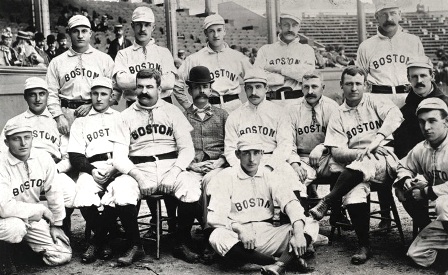
The Boston Beaneaters

The Boston Beaneaters

The split schedule and the resulting longer season were dropped for 1893.

Max Ihmsen, the reporter Nick Young spoke with, became city editor of The New York Journal, a William Randolph Hearst paper, in 1895.  Ihmsen went on to manage Hearst’s unsuccessful campaigns for mayor of New York City and governor of New York; he was also the Hearst-backed candidate for Sheriff  of New York County in 1907, a race he lost to the Tammany Hall-backed candidate.

Ihmsen later became the managing editor of another Hearst paper, The Los Angeles Examiner.  He died in 1921.

Baseball’s “Fountain of Youth”

16 Apr

John Brinsley “J.B.” Sheridan wrote for several St. Louis newspapers and The Sporting News from 1888-1929.

In 1917 he asked in The St. Louis Globe-Democrat:

“How is it that two young chaps come up together, one lasts a year or two, the other keeps on playing until he meets his sons and the sons of his pals coming up?”

Sheridan noted that Bobby Wallace was 43-year-old and in his twenty-fourth season–albeit as a reserve who appeared in just eight games for the Cardinals–while contemporaries like Jimmy Collins were out of the game for nearly a decade.  (Sheridan failed to mention or notice that Wallace was three years younger and started his professional career at age 20 while Collins began his at 23):

“Wallace has had a great career in baseball.  Only one man, A. C. (Cap) Anson has played longer than Wallace in the major leagues (Sheridan didn’t mention Deacon McGuire who also had Wallace beaten in years of service with 26—but he only played a total of 20 games in his final eight “seasons”) Anson did twenty-seven seasons, but had he not been his own manager he would not have done so many.  The old man could hit to the end, but for the last ten years of his major league career Anson was so slow and stiff that it is doubtful if any manager, other than himself would have employed him.”

Booby Wallace

Booby Wallace

Sheridan neglected to mention that “slow and stiff” Cap Anson managed to play in more than 1100 games in those last ten seasons when no manager “other than himself would have employed him,” and hit better than .330 in five of them–and would contradict himself on the “slow and stiff” part later in the same article.

He said, “Jack O’Connor did twenty-two years in the majors and was useful to the end.” (O’Connor only hit better .250 twice in his last ten seasons, never appearing in more than 84 games during that period)”

Despite the many misstatements, Sheridan’s article included interesting character sketches of several 19th and early 20th Century players (the veracity of those sketches can be judged with the above misstatements in mind).

“O’Connor was a really wonderful man.  He always retrained his diet during the playing season, but gave it full rein during the off season.  O’Connor had some appetite, too.  Usually he put on 20 pounds of extra weight every winter and regularly took it off every spring.  O’Connor must have taken off 500 pounds of flesh in the twenty-two years of his baseball playing.  He ate and drank like Gargantua during the winter, but denied himself like a monk in the spring, summer and fall.

(Napoleon) Lajoie, who did his 20 years [sic 21] in the majors, was like Wallace and (Jake) Beckley, an iron man.  (Lajoie) came from Breton peasant stock…The Bretons lived off the rocks and fishing grounds of Brittany, beaten by Atlantic spray long before the dawn of history.  No wonder then, that Lajoie is a hardy man (who) needed no conditioning in his youth.  He threw a couple, hit a couple and was ready for the fray.”

Sheridan said O’Connor’s former battery-mate Cy Young was “another physical wonder” despite being “rather soft and inclined to obesity later in life.”

“Cy never cared much for beer, the beverage of the old-time ballplayer, but he did not mind a little ‘red eye’ now and then In fact, the old boys say the farmer could pack more whiskey about him than any man they had ever known.”

As an example of Young’s prowess Sheridan said O’Connor told him a story about a night out in Boston:

“I drank beer while Cy drank whiskey. Drink for drink with me, but the last thing I remembered that night was that Cy put me to bed.

“I got up the next morning looking for sedlitz powder and something cooling.  I got the powder and I went into the breakfast room to get a grapefruit.  Then I saw Young behind a big plate of beefsteak with onions.  I turned and ran for the fresh air…Cy ate the entire steak, all the onions, a lot of bread and butter, stuck a strong cigar in his mouth and joined me on the sidewalk.

“What made you quit so early last night, Jack?  I was just getting’ goin’ good, when you said ‘Let’s go home I’m sleepy.’”

Jack O'Connor

Jack O’Connor

Sheridan compared Young’s career to that of Bill Dinneen:

“Dinneen came into the game seven [sic–nine] years after Young, was Cy’s teammate for four years [sic–five and part of a sixth] then dropped out (Dinneen played three more seasons with the St. Louis Browns, but his career was over after 12 seasons at age 33)

“Dinneen ate too well, and what ballplayers call the ‘old uric acid’ got him in the arm.  Yet Dinneen was one of the finest physical specimens that ever played ball.

“Some big fellows look strong but prove to be soft and unenduring.  Jack Chesbro was one of these.  Chesbro had three great years as a pitcher, and then broke down.  Jack was a soft-boned boy, with bad ankles and could not stick the route.

“Some men hold out in arm, legs and bone, but lose the keenness of vision essential to good batting, Willie Keeler, was one of these.  Keeler’s legs were good to the end and his arm worked all right, but his eyes went back on him and he had to quit…(Art) Devlin was one of the three great third basemen of his time.  He was a star, but endured only a few years.  Bad Digestion stopped him when he was at the height of his fame, and when he should have been good for many more years.”

Sheridan claimed to know the secret of a ballplayer’s longevity: the waters of Hot Springs, Arkansas.

“Each January 1 for twenty-two years saw (Young) at Hot Springs…O’Connor and (Jake) Beckley were always at Hot Springs, too.  These three men never missed a season at the Arkansas resort, while they were playing ball…Fred Clarke, too, was a great advocate of Hot Springs as a training resort, and the Pirates always fitted in there when Clarke was manager.  That took (Honus) Wagner, another long liver, there too.

“Anson always took a season at Hot Springs.  It is pretty well established that the Arkansas resort is the location of Ponce de Leon’s famous “Fountain of Youth.”  It may or may not be a coincidence, but the fact remains that Young, O’Connor, Beckley, Anson, Clarke, Wallace and Wagner, men who played from seventeen to twenty-two years of major league baseball, have all been frequenters of or habitues of Hot Springs.”

Cy Young, third from left, with Bill Carrigan, Jake Stahl and Fred Anderson at Hot Springs in 1912

 Cy Young, third from left, with Bill Carrigan, Jake Stahl and Fred Anderson at Hot Springs in 1912

The St. Louis sportswriter was certain the springs were a magic “Fountain of Youth, “and said he was only aware of one exception to his rule:

“Every iron man of baseball, except Lajoie, has been a yearly visitant.”

Lost Advertisements–“Big Ed” Walsh No-Hitter, Old Underoof Whiskey

7 Mar

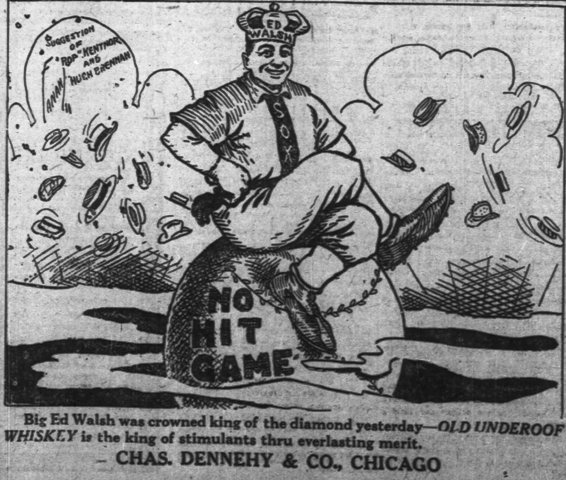
walshnohitter

A 1911 advertisement for Old Underoof Whiskey which appeared in Chicago News papers the day after Edward Augustine “Big Ed” Walsh threw his first nine-inning no-hitter (Walsh gave up no hits in a 5-inning 8 to 1 victory over the New York Highlanders on May 26, 1907).  Walsh had also thrown five one-hitters, including one two weeks earlier against the Detroit Tigers.

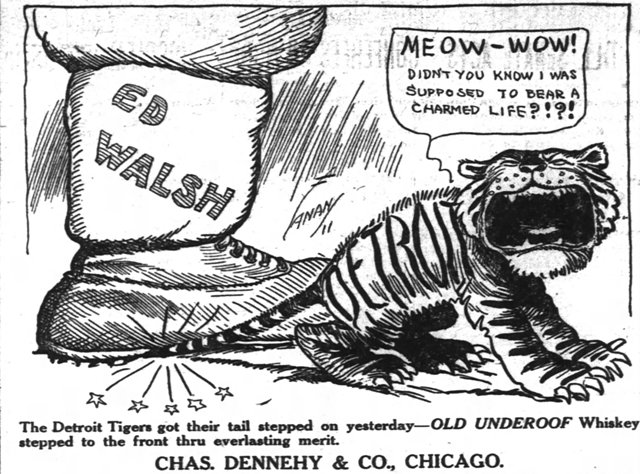
Old Underoof commemorated that effort as well:

walshonehitter

The Chicago Inter Ocean said of the no-hitter:

“Never in His long and brilliant career in the box has Big Ed shone as he did on the hill in yesterday’s game.”

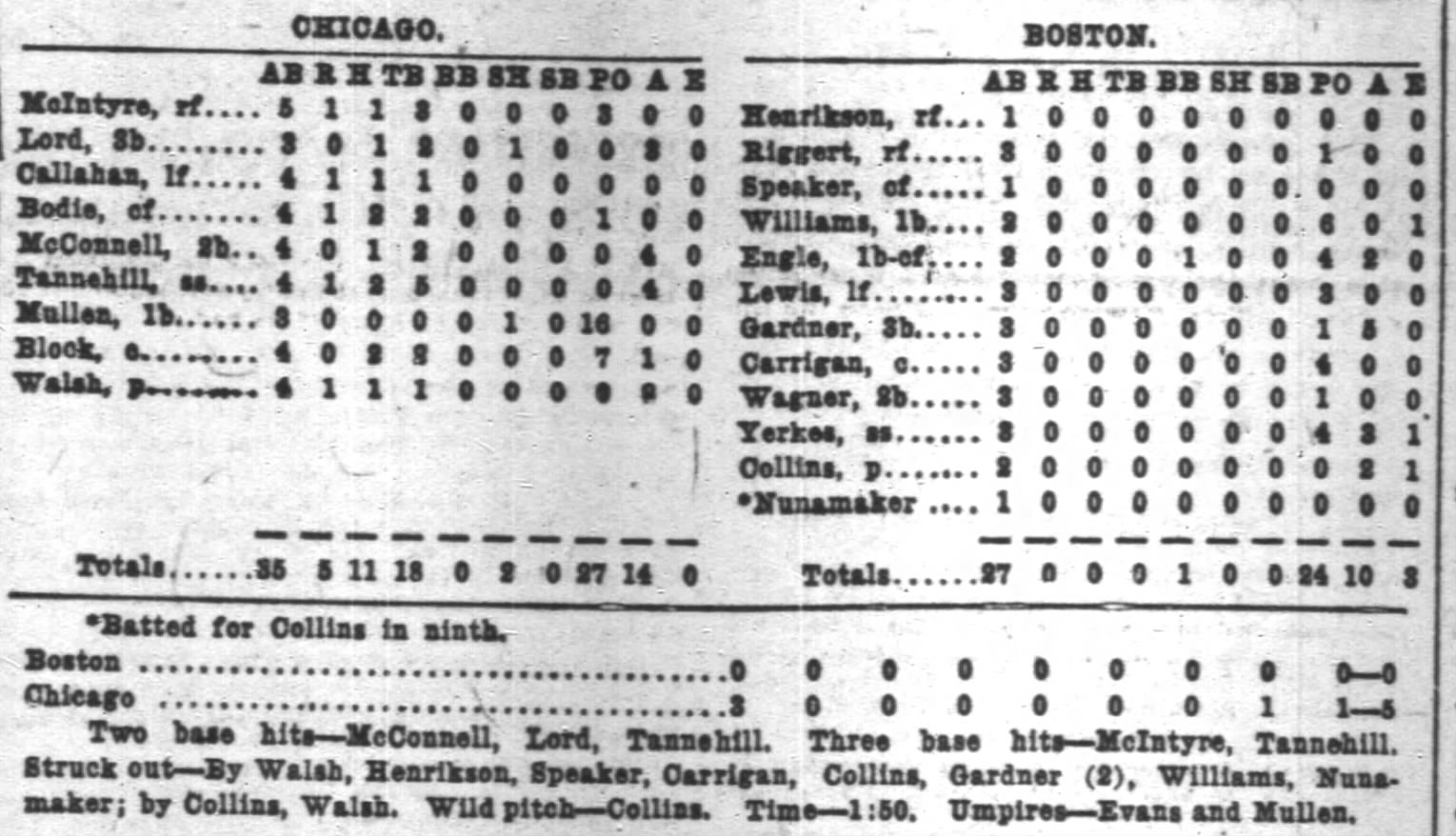
Walsh faced only 27 Boston Red Sox batters, but gave up a fourth inning walk to Clyde Engle.  The Inter Ocean said umpire Billy Evans’ call that led to the walk was “questionable.”  And that two plays helped preserve the  spitballer’s no-hitter:

“(T)here were two times when the monarch of all he expectorated nearly lost his charm.  Once the ball was driven out right over the second sack.  Lee Tannehill rushed back, scooped it up and threw out the runner easily.  Lee must have had a margin of at least three-eighths of an inch in his favor.  Another time Ping Bodie saved Ed’s dinner dishes by rushing in with the greatest burst of speed at his command and licking up the ball a little above his ankles.”

The other incident of note in the game took place in the third inning when Tannehill hit a line drive to right center field in the third inning, The Chicago Tribune said Red Sox center fielder Tris Speaker and right fielder Olaf  Henriksen came together “in a terrific collision” which knocked both unconscious and out of the game.  Henriksen got the worst of it, and was briefly hospitalized with a broken rib and injured ankle.  Speaker “was first to recover and emerged from the accident with a severe shaking up and a lame shoulder.”

The box score

The box score

Walsh came one batter away from joining Cy Young and Addie Joss as the only two modern era pitchers to that point to throw a perfect game–Joss’ perfect game was against the White Sox in 1908, Walsh was pitching for Chicago and only gave up one hit and struck out 15 in the loss.

Ed Walsh circa 1904

Ed Walsh,  circa 1904

Walsh was 27-18 with a 2.22 ERA in 1911, leading the league with 255 strikeouts, in a league-leading  368 and two-thirds innings.  The Hall of Famer pitched until 1917 compiling a 195-126 record and 1.82 ERA.

He supported making the spitball legal again after the pitch was banned after the 1920 season.  The Associated Press quoted him in his 1959 obituary:

“Everything else favors the hitters.  Ball Parks are smaller and baseballs are livelier.  They’ve practically got the pitchers working in straitjackets.  Bah!  They still allow the knuckle ball and that is three times as hard to control.”