Tag Archives: Detroit Tigers

Lost Advertisements–Ty Cobb ‘The American Boy”

29 Apr

cobbamericanboy1921

A 1921 advertisement for “The American Boy.”  “The Biggest, Brightest, Best Magazine for boys in all the world.”

The magazine was published from 1899-1941, and at one point had a circulation of nearly 300,000.

The May issue, on sale for .25 at newsstands, featured Ty Cobb:

How Ty Cobb put new thrills in baseball!

“The, bulliest, most inspiring story of the year; the kind that will set your blood tingling and boost your enthusiasm!  Complete with splendid action photographs of Cobb.”

[…]

“Read Cobb’s experiences: how he has blazed a path to greater baseball; how his new standard is being felt in every department of the game.

“Read about the batters Cobb had t beat; how he used his brains at the plate and conquered his fear of southpaws; how he used his brains in base running;  the story of his greatest play; his lightning thinking and running;  how he fooled the fielders;  his nine ways to side; ‘picking up a fly,’ one of Cobb’s great tricks.

“Every line will delight you!”

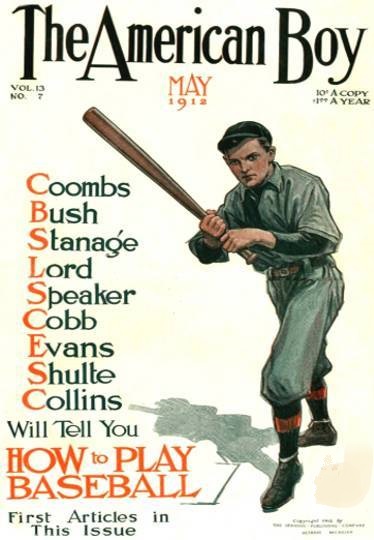
It appears that no copies of the May 1921 edition are still available.  Below is anther example of a baseball cover from “The American Boy” in 1912:

amboy1912

Things I Learned on the Way to Looking Up Other Things #18

7 Mar

Tener on Anson

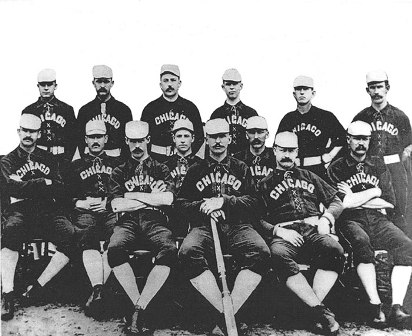
In 1917, John Tener wrote an article in “Baseball Magazine” about Cap Anson, his former manager with the Chicago White Stockings.

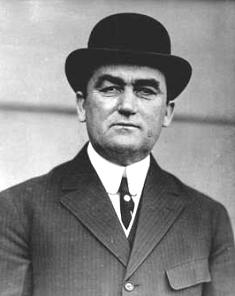
John Tener

John Tener

The former pitcher and outfielder, who went on to serve in the United States Congress and as Governor of Pennsylvania, and who in 1917 was president of the National League said:

“Pop Anson was the Greatest Batter who ever lived.  You may look up his record, compare it with others and draw your own conclusions.  When I say this I am well aware of the claims of Ed Delehanty, Hans Wagner and many other great hitters.  I give them all due credit, but in my opinion, Anson was the greatest of them all.

"Cap" Anson

Anson

“He was, first of all, a free hitter. He loved batting…He had that true eye which enabled him to hit the ball squarely on the nose.  His hits were line drives.  They were solid smashes with the full force of his muscular shoulders behind them.”

[…]

“He was an excellent judge of the precise fraction of a second that he needed to swing that heavy bat of his against the best the pitcher could offer.  He didn’t exactly place his hits, but he contrived to drive the ball behind the base runner about where he wanted to drive it…He was big and strong and heavy.  Some hitters of the present day fatten their averages by their nimbleness in reaching first.  Anson drove the ball solidly into the outfield and took his time in going to first.”

Conte on Mendez

Jose Pepe Conte was a well-known sportswriter in Havana, Cuba. Frank Menke of Heart Newspaper’s International News Service (INS) said of him:

Jose Pepe Conte

Jose Pepe Conte

“Pepe is a fellow who knows heaps and heaps about ancient history, European customs, chemistry, baseball and prize fighting.”

The Pittsburgh Press called him:

“(A) Cuban newspaperman, political personage, and unearther of baseball talent.”

In 1912, the INS distributed an article Conte wrote about the pitcher he thought was the best ever:

“American baseball fans can talk all they want about their (Chief) Benders, (Christy) Mathewsons, (Ed) Walshes and (Mordecai) Browns, but down in our country we have a pitcher that none of the best batters in the country can touch. This is the famous Black Tornado, (Jose) Mendez.  Talk about speed.  Why, when he cuts loose at his hardest clip the ball bounces out of the catcher’s mitt Talk about speed, Mendez has to pitch most of the time without curves because we haven’t a catcher who can hold him.  To make things better, Mendez can bat like (Ty) Cobb.  He has won his own games on various occasions with smashes over the fences for home runs.  He weighs about 154 pounds and is a little fellow.”

Jose Mendez

Jose Mendez

[…]

“No one has been found who can hold him when he really extends himself.  He has shown his skill in the past when he has faced the best batters of the Cubs and Detroit teams when those teams were champions, and when the Athletics went there last year.  Mendez has more curves than any pitcher in America, and if some inventive genius could produce a whitening process whereby we could get the fellow into the big leagues he could win a pennant for either tail-end team in either league.”

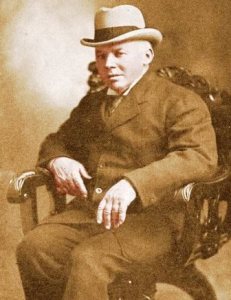
Sullivan on Comiskey

In his book, “The National Game,” Al Spink said Ted Sullivan was “the best judge of a ball player in America, the man of widest vision in the baseball world, who predicted much for the National game years ago, and whose predictions have all come true.”

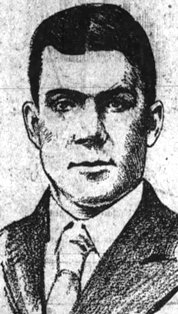
Ted Sullivan

Ted Sullivan

Sullivan was a player, manager, executive, and in 1921, he wrote a series of articles for The Washington Times called “The Best of my Sport Reminiscences.”  He said of Charles Comiskey, who he was crediting with “discovering” at St. Mary’s College in Kansas:

Charles Comiskey

Charles Comiskey

“As a player, Comiskey was easily the best first baseman of his time…His intuition in defining the thoughts of his opponents and making his play accordingly placed him head and shoulders over any man that played that position before or after.

“Comiskey was with John Ward and King Kelly one of the greatest of base runners.  I do not mean dress parade base running, either, merely to show the crowd he could run.  Comiskey’s base running was done at a place in the game when it meant victory for his side.  He was far from being the machine batter that Anson, Roger Connor and some others were; but as a run-getter, which means the combination of hitting, waiting, bunting and running, he outclassed all others.  Jack Doyle, when in his prime with Baltimore and New York, was the nearest approach to Comiskey in brainwork.  There are no others.”

“Cobb is Essentially an Individual Player”

29 Feb

In February of 1913, The Associated Press (AP) reported that Detroit Tigers second baseman Oscar “Ossie” Vitt had requested a raise from owner Frank Navin.  The AP said:

“Navin wrote Vitt that he was more than satisfied with his work last year, and would be ordinarily glad to increase his salary, but owing to the necessity of meeting the demands of (Ty) Cobb for $15,000.”

Ossie Vitt

Vitt

The Detroit Free Press disputed The AP’s, and Vitt’s account:

“Mr. Vitt did receive a letter from Mr. Navin, and this letter did pointedly refuse to add anything to the Vitt emoluments for 1913.  So far the story from the golden West is true.  But the reasons given  Oscar for not granting him an increase had nothing whatever to do with Mr. Cobb, nor was the star athlete’s name even mentioned.  Vitt was informed that he is mighty lucky to receive a contract for 1913 with as much money mentioned as the document recently sent him calls for.”

Whether Vitt believed Cobb was responsible for his lack of a raise is unknown, but he did take the opportunity 10 months later to take a swipe at Cobb in the pages of his hometown paper, The San Francisco Call.  Vitt wrote an article for the paper about the best player he had seen:

“I am picking the man who does most to win games for the club he represents.  That man is unquestionably Eddie Collins…Here is one player who is willing to sacrifice all personal gain to help his club.  When he is on the field it is the Athletics he is trying to help, and not Eddie Collins.”


Collins

Collins

Vitt said:

“Collins is great whether he is playing the defensive or offensive.

“In few departments of the game is he excelled.  He is a brilliant fielder, who thinks quickly, and he makes but few mistakes.  At the bat he has few superiors.  He has a wonderful eye, and when he hits the ball he meets it fairly, usually sending it away from the plate on a line for a clean drive.  He can lay down a bunt with equal skill, and it is hard to figure him when he faces a pitcher.

“The point that I admire in Collins is the fact that he never plays to the grandstand.  He adopts the play that will help his club and not the one that will win him applause from the spectators… I don’t think there is another player in the game today who wins as many games for his club than this fellow Collins.”

After lavishing praise on Philadelphia’s Collins, Vitt said of his teammate:

“Cobb is a remarkable ballplayer. I have been with him for two seasons, and while I consider him greater than Collins in many respects, I do not think he is as valuable to a club as Collin… His spectacular style of play is popular with the fans, and while the Tigers were rather lowly in the pennant race, they were good drawing cards, because the crowds would go out to see Cobb bat and steal bases.

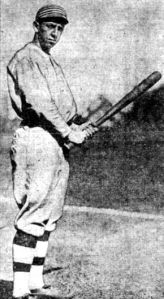
Cobb

Cobb

“If Cobb would play the game like Collins I think he would be the greatest of them all, but he does not.  Cobb is essentially an individual player.  He is unlike Collins in this respect.  However, the fans like to see Cobb, and they must be pleased.”

While Vitt equivocated, calling his teammate an “individual player,” while at the same time putting, at least, some of the blame for it on the fans who “must be pleased,” he took his biggest swipe at his teammate in another passage without ever naming him:

“You take a great player like Collins, who is so sincere in his work, and he naturally becomes a prime favorite with the other members of the club, because of his efforts to help them.  He gets them all in that stride, and I attribute (Connie) Mack’s success to that reason.”

Cobb’s only public reply came weeks later in The Detroit News:

“I think Vitt might help the team if he would accumulate a little better individual average and not attack his fellow players.”

Vitt hit .243 over seven seasons in Detroit.  He and Cobb remained teammates through the 1918 season.

“There’s one thing you mustn’t do when you get to New York”

26 Oct

“Sinister Dick” Kinsella is primarily known as John McGraw’s equally pugnacious right-hand man and scout.  He was at McGraw’s side for one of the manager’s most famous brawls; a battle with Giants catcher Larry McLean in the lobby of the Buckingham Hotel in St. Louis, he also boasted an impressive list of “finds” including Carl Hubbell, Chief Meyers, Hack Wilson and Larry Doyle.

"Sinister Dick" Kinsella

              “Sinister Dick” Kinsella

Kinsella credited a career minor league player and manager for his discovery of Doyle, who he sold to the New York Giants in July of 1907.  After Doyle hit .310 in 1911, a syndicated Newspaper Enterprise Association told the story of how he acquired Doyle after the 1906 season from the Mattoon Canaries of the Kitty League, having never seen him play:

“Mattoon was in need of a pitcher and appealed to President Dick Kinsella of the Springfield Three-Eye League team for aid…Kinsella saw a chance to make a bargain when Mattoon hoisted the distress sign and struck one.  ‘I’ll let you have a pitcher for the pick of your team at the end of the season,’ Kinsella told the Mattoon people.  His offer was accepted and pitcher (John) Jokerst was sent  to the Kitty League team by Springfield.

“Doyle didn’t do well with Mattoon (.225 in 91 games) that season.  Kinsella had not even considered him in deciding what player to pick.  He had almost made up his mind to take a veteran pitcher.”

Fate intervened when Kinsella mentioned the Mattoon deal to Frank Belt, manager of the Kitty League’s Jacksonville Jacks.  Belt asked Kinsella if he had ever seen Doyle:

“’No,’ answered Kinsella.

‘”Well, don’t pick anyone until you do, and then pick him.  He’s the coming ballplayer of that club.  He hasn’t looked good in the box scores, but he’s ‘there’ any way you take him.  He’ll bring you more money inside of a year than you ever got for a player.”

Larry Doyle

                  Larry Doyle

Sight unseen, Kinsella took Belt’s advice.  Doyle played third base and hit .290 in 66 games for Kinsella’s Springfield Senators.  He became the subject of a bidding war with the Giants winning out over the Detroit Tigers and Washington Senators for his services on July 16.

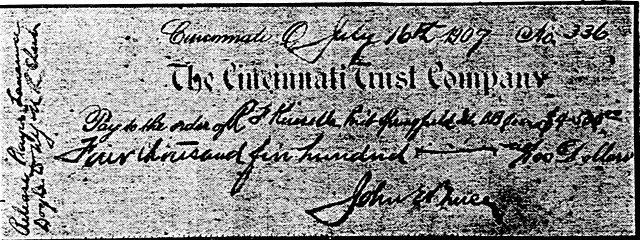
Kinsella was paid a then-record $4500 for Doyle—a record eclipsed the following year when Kinsella sold Rube Marquard to the Giants for $11,000.

The $4500 check to Kinsella for the sale of Doyle

                              The $4500 check to Kinsella for the sale of Doyle

According to The Springfield Journal Kinsella sent Doyle off to New York with just one piece of advice:

“There’s one thing you mustn’t do when you get to New York.  You must quit sliding to bases on your head.  If you don’t, they will think you’re from the brush.”

Doyle was moved to second base, hit .290 over a 14-year big league career, and presumably took Kinsella’s advice about sliding head first.

Lost Advertisements–American Giants in Nashville

16 Oct

1913amgiants

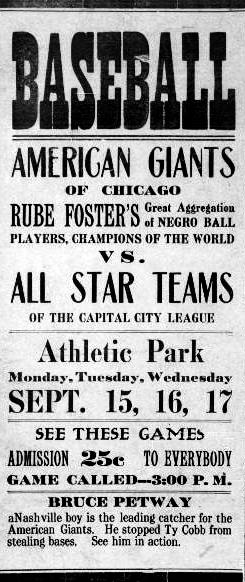
A 1913 advertisement for a three-game series in Nashville between the Chicago American Giants and “all-star teams” comprised of players from the city’s semi-pro league:

Rube Foster‘s Great Aggregation of Negro Ball Players, Champions of the World vs.  All Star Teams of the Capital City League

The games were scheduled for Nashville’s Athletic Park (Sulphur Dell), on September 15, 16, and 17.

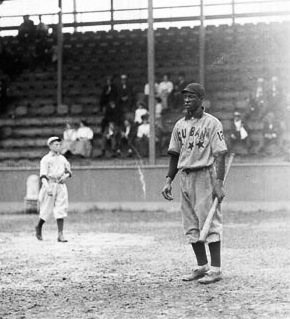
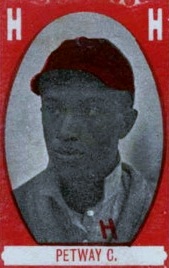
In addition to Foster, the primary drawing card was Bruce Petway:

“A Nashville boy is the leading catcher for the American Giants.  He stopped Ty Cobb from stealing bases.  See him in action.”

The Cobb reference is from the 1910 tour of Cuba by the Detroit Tigers–depending on the source, Petway playing for the Havana Reds threw Cobb out attempting to steal between one and three times.

petway

The American Giants with “Big Bill” Gatewood on the mound won the first game of the series 12 to 1.

The next two games were rained out and were rescheduled as a September 19 doubleheader.  Bill Lindsey beat the locals 6 to 5 in the first game and Foster shut them out 4 to 0 in the second.


“Daily Chats with Famous Ballplayers”

18 Sep

In 1916, a series of two to three paragraph items called “Daily Chats with Famous Ballplayers” (some papers called the feature different names) appeared in several smaller West Coast and Midwest newspapers.

Some highlights:

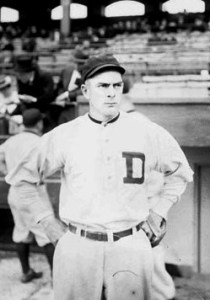
Oscar “Ossie” Vitt, third baseman for the Detroit Tigers, who survived a beaning from Walter Johnson of the Washington Senators on August 10, 1915:

“The world stopped moving when the ball nicked my bean.  Johnson thought I was killed and I guess I thought so myself for awhile, so far as I was able to think at all.

Ossie Vitt

Ossie Vitt

“My head proved to be the goods alright and wasn’t worse for wear.  But it upset Johnson so much that he couldn’t locate the plate and we pounded him all over the lot (Vitt was hit leading off the first inning—Johnson gave up eight runs after that in six innings and lost 8 to 2 to Detroit).”

St. Louis Cardinals pitcher Henry “Hi” Jasper on the superstition of teammate Harry “Slim” Sallee:

“Sal’s pet superstition is that it’s bad luck for him to warm up with any catcher but the one who is to work in the game with him.

“If the playing backstop has batted last and has to put on his shin guards and armour before warming up, Sal will never throw a ball to the plate to any man who may come out of the dugout with a mitt.  He will throw either to the first or third baseman.”

Pittsburgh Pirates pitcher Al Mamaux on a lesson learned during a loss to the Chicago Cubs in September of 1914:

“Smart old timers can always make it tough for youngsters just breaking in.  I remember one day when I was the goat for a trick pulled by Roger Bresnahan.”

Mamaux

Al Mamaux

Mamaux said Chicago had two runners on base and Bresnahan was coaching third.

“(He was) talking real friendly like to me (then) hailed me suddenly as the ball was returned to me.  ‘Say Al, toss me that ball I want to look at it,’ said Roger.  I didn’t give it a second thought…tossed it towards him and I’ll be darned if he didn’t step to one side and yell to the runners to beat it home.  Each advanced a base and would have scored if Jimmy Viox hadn’t run his head off to recover the ball.  Believe me that one cured me.”

George Stallings, on suspensions and how badly the Boston Braves needed George Stallings:

“You don’t have to call an umpire all the names in the calendar to draw a suspension.  I got three days off for just remarking to (Charles “Cy”) Rigler that he ought to go to jail for umpiring a game like he did the other day.

George Stallings

George Stallings

“Nothing that I could say or do would make any difference.  What I can say though right now is that the action of (National League) President (John) Tener, coming as it does, with the race so close, appears peculiar to say the least (Tener said the suspension was for a series of altercations that Stallings and his players had with umpires during the two months before the August suspension was announced).

“Without any braggadocio I can say that my suspension will cripple my club considerably.  I know what my presence means to the club and so does President Tener.”

Boston won all three games during Stallings’ suspension and regained second place, but finished the season in third, five and half games behind the Brooklyn Robins.

“That Short but Trite remark shaped my Career.”

24 Aug

In 1906, William George “Billy” Evans became the youngest umpire in major league history.  “The Boy Umpire” was just 22-years-old.

A decade later, in a syndicated newspaper article, he told the story of how he, by chance, he began his career as an umpire.  Somewhat altered versions of the story were told over the years, including a version in his obituary; however, this was his earliest, direct telling of the story:

Billy Evans

                                         Billy Evans

“It was one day in 1903 that I journeyed out to the ballpark to cover the game for the paper (The Youngstown Vindicator).  There was a delay when the time arrived to start to the contest.”

Evans said the umpire had become ill and while “a number of ex-players” were at the ballpark, the opposing managers could not agree.

“Finally, my name was suggested and proved acceptable to both managers.  I was informed of their decision but declined with thanks.

“The crowd was impatient.  It became noised about that I was the only man acceptable to both managers, and that since I refused to work the game would probably be called off.”

Evans was determined not to work the game, but said a voice from the stands changed his mind.

“Just when it seemed that I was to escape the ordeal a fan in the bleachers with a decidedly loud voice yelled: ‘What’s the matter—have you lost your nerve?’

“That short but trite remark shaped my career.”

Evans said one of the managers told him he’d earn $15 for the game—later versions said Youngstown Ohio Works Manager Marty Hogan told him what he’s be paid:

“Fifteen dollars for a couple of hours’ work—almost as much as I was getting for carrying the title of sporting editor for an entire week!  It made umpiring appeal to me.  Attired in the very best clothes I had, I took the field for my debut.”

Evans said that first game—a 1-0 victory in thirteen innings for the visiting team from Homestead, Pennsylvania—had “but few close decisions, and I got along famously.”

The regular umpire was still sick the following day.

“I gathered in $15 more.  My bankroll was so large that for the first time in my life I felt that a pocketbook was a necessity instead of a luxury.”

The following day, Evans accepted a permanent position “(A)lthough there were many times when I seriously doubted my wisdom in accepting the position.”

Three years later, Evans made his big league debut in New York.

“When I stepped on the field it seemed that wherever I looked I could see grinning faces.  I imagined that all of them were laughing at me when as a matter of fact I suppose there was scarcely a single person on the field who noticed me.”

Evans, who was harshly criticized early in his career, also wrote about his most dangerous incident on the field.

“I have dodged a million pop bottles…I have had them pass just above my head, between my legs, and, in fact, graze almost every part of my anatomy; but never have I been hit by a missile really intended for me.  I did stop a bottle that was intended for somebody else, and that stop almost resulted in the Great Umpire declaring me out.

“I was working a game at St. Louis, between the Detroit and the St. Louis clubs in the fall of 1907.”

The Tigers were locked in a three-team race  with the Philadelphia Athletics and Chicago White Sox—entering the series in second place, the Tigers fell to third after losing a doubleheader on September 14.

On September 15 the teams met for another doubleheader.  An overflow crowd filled an area of left field in front of a “swinging gate about six feet long out in the left field fence, about ten feet above the ground…used to facilitate the delivery of bottled goods into the park.”

With the game tied in the fifth inning, St. Louis pitcher Harry Howell was batting:

“(Howell) hit a ball into left field.  As I followed its course I was surprised to see the opening in the fence.  A few minutes before I had occasion to glance in that direction, and had observed nothing wrong.  I afterward learned that the gate had been opened only a few seconds before Howell hit the ball.

“It was my bad luck to have the ball pass squarely through the opening.  When Howell made the hit I had run toward third base in order to be able to follow the ball more closely.  When it passed through the opening I was about fifteen feet back of third base.  Howell paused at second base, and I motioned for him to continue home.”

[…]

“I was at once surrounded by a group of Tigers players all talking at the same time.  There is no fairer man in baseball that Hughey Jennings, the famous leader of the Detroit team, and I told that gentleman that the easiest way to settle the argument was to get rid of the players, and the two of us would thresh it out, which he proceeded to do.”

As Evans and Jennings wrapped up the argument, Evans suddenly slumped to the ground unconscious.

“The next thing I remember was when I came to in the hospital, and inquired what happened.”

What happened was a 17-year-old Browns fan named Hugo Dusenberg threw a pop bottle which struck Evans at the base of his skull.  As Evans lay unconscious on the field, fans attacked Dusenberg.

The St. Louis Post-Dispatch said:

“(Dusenberg) was saved from lynching by the quick action of the players who formed themselves into a guard and held back with bats a mob that swarmed.”

The St. Louis Republic said:

“Fifty policemen fought their way through the mob, rescued the assailant and with the greatest difficulty conducted him out of the grounds.”

Initial reports said Evans’ injury was serious—The Associated Press said his chance of recovery was “slim,” The Washington Post said he was “Probably fatally hurt.”  By the following day, it was reported that Evans would recover, but would likely miss the remainder of the season. Despite the grave predictions, Evans returned to work on October 5, the second to last day of the regular season; he worked the bases, with Jack Sheridan behind the plate, in a game between the Tigers and Brows in St. Louis.

Dusenberg, an American citizen who worked as a clerk at the German consulate in St. Louis, was charged with assault with the intent to kill Evans.  The Republic said in the days following the incident that “Sentiment is for the prosecution to the limit.”

Two months later Dusenberg was released after paying a $100 fine.

“He is a Model for the Young Ballplayer to Emulate”

21 Aug

March of 1916 was a bad month for “Prince Hal” Chase.

According to The International News Service, Chase, who spent the winter in San Jose, California playing for the Maxwells—a team sponsored by the automobile company–was “the last of the stars” of the defunct Federal League who had still not signed with a professional team.
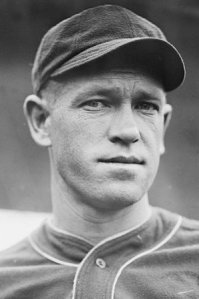
Hal Chase

                          Hal Chase

It got worse when he was arrested for failure to pay alimony and support to his ex-wife Nellie and their son Hal Jr.

He was released on $2000 bond, and it is unclear whether the case was ever fully adjudicated. After his release, Chase continued playing with the Maxwells and working out with Harry Wolverton‘s San Francisco Seals while rumors of who he would play for during the regular season were advanced on a daily basis.

The strongest rumors were that Chase would go to the New York Giants in a deal which would include Fred Merkle, who would be displaced at first base, going to the Chicago White Sox, the team Chase jumped to join the Federal League.

The Pittsburgh Post-Gazette said the deal was eventually foiled by Pirates Manager Jimmy “Nixey” Callahan, who “refuse(d) to waive.”

At the same time the papers in Cincinnati said Chase would be joining the Reds while West Coast papers said he might stay in California and join the Seals.

The Cincinnati Enquirer said Reds’ Manager Charles “Buck” Herzog “vigorously denied,” that Chase would join his club and said he would stick with Frederick “Fritz” Mollwitz at first base.
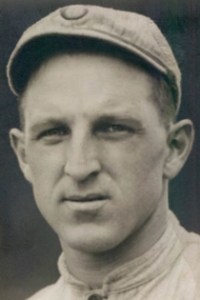
Buck Herzog

                     Buck Herzog

Herzog was even more forceful in his denial in The Cincinnati Times-Star:

“I wouldn’t have Chase at the camp.  Mollwitz is a very much better player, and he won’t jump when he is most needed.”

An even stronger indictment of Chase came from Detroit Tigers Manager Hugh Jennings, who told The Detroit News:

“As a player, there is nobody who can touch Chase for holding down first base.”

Jennings went on to note Chase’s intelligence, speed, and “superb” fielding:

“Yet for all his ability I would not have him on my club, and I do not believe any other major league manager will take a chance on him.  He will not heed training rules and has a demoralizing influence on the younger players.”
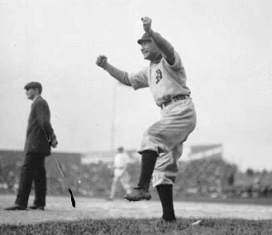
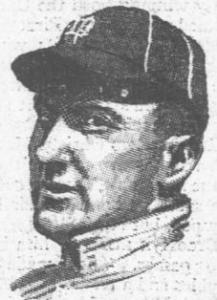
Tiger Manager Hugh Jennings

Tiger Manager Hugh Jennings

Jennings said while Chase managed the New York Highlanders in 1910 and ’11, led his team “astray,” instead of “trying to keep his players straight.”

Perhaps most damaging, Jennings said Chase was a source of dissent on the clubs he played for:

“One of his favorite stunts is to go around telling on man what another is supposed to have said about him, with the result that in a very short time he has the fellows pulling in all directions  instead of working together.  He is apt to take a dislike to the manager and work against him with the players until the whole squad is sore and will not give the sort of work that it is paid for.”

Jennings, whose team finished second in 1915 with George Burns at first base, said:

“The Tigers would win the pennant beyond question with a player of Hal’s ability on first this season, but I wouldn’t risk introducing a man who had such a bad disposition.  I believe that we can accomplish better results by having harmony on the squad, even if we have to get along with a first baseman with less talent.”

Despite the negative press, and over the objection of Herzog, the Reds purchased Chase’s contract from the defunct Buffalo Blues on April 6.

The New York Times lauded the move and defended Chase against his detractors.  The paper said “His failure with the New York Americans was due to petty controversies and rebellion against the club’s discipline,” and “(W)hen he is at his best there is not a player in the major leagues who is more spectacular than ‘Prince Hal.’”

Chase initially balked at reporting to Cincinnati, telling The San Francisco Chronicle “I haven’t made up my mind…it is possible that I would prefer to remain in California, even if there is no chance to play ball.”

Six days later, while his new team opened the season, Chase was on a train to Cincinnati.  The Associated Press said he agreed to join the Reds after receiving “word from Cincinnati that his entire contract with the Federal League, which calls for a salary of $8,000 a year, has been taken over,” by the Reds.

When Chase arrived in Cincinnati on April 15, the Reds had won three straight after losing their opener, and Mollwitz had played well at first base with five hits in 13 at-bats and just one error.

According to Frederick Bushnell “Jack” Ryder–college football star and Ohio State football coach turned sportswriter–of The Enquirer, Herzog had no intention of putting Chase in the game April 16:

“Herzog had little thought of playing him, as Fritz Mollwitz was putting up a bang-up game and hitting better than any member of the club,” until “Mollwitz made a bad mental mistake in the third inning.”

After Umpire Hank O’Day called a strike on Mollwitz, “the youngster allowed his tongue to slip,” and was ejected.
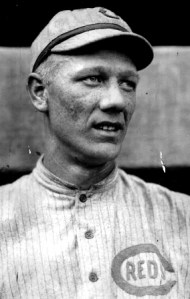
Fritz Mollwitz

                 Fritz Mollwitz

Chase came to bat with an 0-2 count and doubled off of Pirates pitcher Frank Miller, stole third, and after catcher Tommy Clark walked “(Chase) caused an upheaval in the stands by scoring on (a) double steal with Clark.”

Chase also wowed the crowd in the ninth.  After making “a nice stop” on Max Carey’s hard ground ball over first base and with pitcher Fred Toney unable to cover first in time, Chase dove “headforemost to first base to make a putout on the fleet Carey.”

In all, he played 98 games at first base, 25 in the outfield, and 16 at second base, he also hit a league-leading and career-high .329.

While the Reds struggled, Chase was wildly popular in Cincinnati.  The Enquirer’s Ryder was possibly his biggest fan—the writer raved about Chase’s performance in the outfield, his adjustment to playing second base, and his consistent bat.

While Chase thrived, Herzog, who had a contentious relationship with Reds’ owner August Herrmann, exacerbated by the signing of Chase against his wishes, began to unravel as the season progressed.  On May 30, he was hit in the head and knocked unconscious, by a throw from catcher Ivey Wingo during pregame warm-ups.  While he recovered physically, he became increasingly frustrated by the club’s performance.  On July 5—with a 29-40 record– he announced that he would retire at the end of the season when his contract expired.  He told The Times-Star:

“It would be a great blow to my pride to continue as a player, after being a manager for three years.”

The following day it was reported that the Chicago Cubs and New York Giants were interested in acquiring Herzog.  Within a week, it was reported that Herzog was heading to New York in a trade that would bring Christy Mathewson to Cincinnati to manage.  The negotiations continued over several days but floundered.  The Cubs reentered the picture—Owner Charles Weeghman told The Chicago Daily News “I brought the bankroll along…and I’ll get Herzog so quick I’ll make (the Reds) eyes pop.”  He later told the paper he offered “$25,000 and an outfielder” for Herzog.

At the same time The Brooklyn Daily Eagle said the Dodgers were after Herzog, and The Pittsburgh Post said the Pirates were in pursuit as well.

The pressure got to Herzog who held himself out of the lineup of July 17, The Enquirer said:

“The managerial situation is worrying Herzie, who had expected by this time to be cavorting at the third corner for the giddy Giants.  With the deal held off for various reasons, the Red leader is naturally a bit anxious.”

Herzog’s destination was unclear, but it was clear he would be gone.  With Mathewson seeming to be out of the picture, rumors persisted—fueled by Ryder of The Enquirer and William A. Phelon in The Times-Star—that Chase would be the new manager.

On July 20, Ivey Wingo managed the team to a doubleheader split with the Philadelphia Phillies, and the papers reported on Herzog’s successor:

The Enquirer ran Chase’s picture under the headline “Reds’ New Manager,” although they hedged in another headline which said he would “probably” be named.

The Times-Star said “Hermann has decided to allow Hal Chase to manage the team for the remainder of the season, and for this reason he does not want Mathewson.”

They were both wrong.

Within hours of the papers hitting the streets, a trade involving three future Hall of Famers was agreed to.  Herzog, along with catcher Wade “Red” Killefer went to New York for Mathewson, Edd Roush, and Bill McKechnie.  Mathewson was immediately named manager.
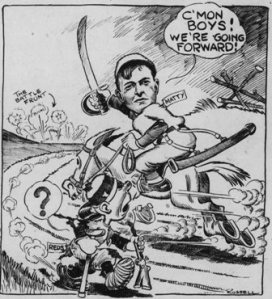
Cartoon accompanying the announcement of Mathewson's appointment.

          Cartoon which accompanied the announcement of Mathewson’s appointment.

Ryder said in The Enquirer that “Chase was greeted with a great round of applause” when he stepped to the plate for the first time on July 20:

“The fans at that time did not know of President Herrmann’s change of mind with regard to Matty, and they thought Chase was the new leader of the team.  The universal and hearty applause showed how popular the star third-sacker has become in this town.”

The Chase story is well-known; two years later Mathewson would suspend him, charge him with “indifferent playing.”  With Mathewson in Europe when the charges were heard by National League President John Heydler that winter, three Reds teammates, and Giants Manager Pol Perritt testified Chase had thrown games.

But in October of 1916 Chase appeared to have repaired his reputation, and his difficult March appeared to be far behind him.  In a season wrap-up, The Enquirer–there was no byline on the article, but it was likely the work of Ryder–published a glowing profile of the National League’s leading hitter and the man who nearly became the Reds’ manager:

“What has become of all the talk about Chase being a bad actor, a disorganizer, a former of cliques and a knocker of managers?  All gone to the discard.  Chase has not only played brilliant ball for the reds all season, but he has been loyal to the club and the managers.  He worked hard for Herzog and equally hard for Matty.  He has been a wonderful fellow on the club.  Chase is modest and does not seek notoriety or approbation…He played game after game in midseason when he was so badly crippled with a Charley horse that he could scarcely walk.  When Manager Herzog wanted to make an outfielder out of him he went to the garden and played sensational ball…Later in the season he filled in for several games at second base, a difficult position for a left-hand thrower, but he put up great ball there.  He is a natural ballplayer of the highest class, and with it all a perfect gentleman, both on and off the field.”

The profile concluded with this assessment of the man who would become synonymous with the baseball’s greatest sins:

“Chase has been a great man for the Reds, and there is many a manager of today who wishes that he had got in ahead of the Cincinnati club in signing him.  He is the smartest ballplayer and the quickest thinker in the National League today.  He is a model for the young ballplayer to emulate, because he is a real artist in his profession.”

Lost Advertisements–“The World’s Best Pitchers Recommend…”

8 Jul

adreach

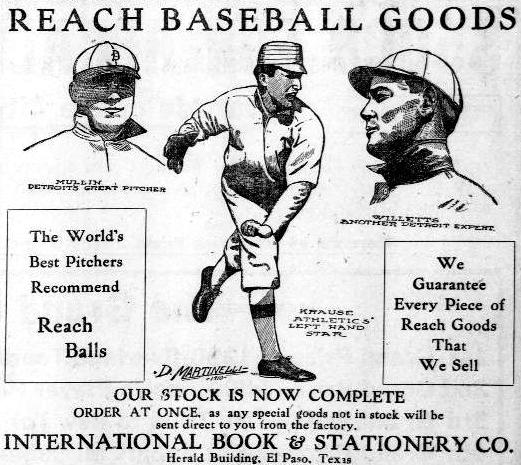
A 1910 advertisement for Reach Baseball Goods  “The World’s Best Pitchers Recommend Reach Balls”–from International Book & Stationary Co. in El Paso, Texas.  The ad features “Detroit’s Great Pitcher,” George Mullin, “Another Detroit Expert,” Ed Willett (Misspelled Willetts in the ad), and “Athletics’ Left Hand Star,” Harry Krause.

In 1909, the 20-year-old Krause, who had been 1-1 in four appearances with the Athletics in 1908, became the talk of baseball when he opened the season with 10 straight victories–including six shutouts.  A San Francisco native who played under Hal Chase and was a teammate of Hall of Famer Harry Hooper at St. Mary’s College, Krause was asked by The Oakland Tribune what led to success:

“That’s easy.  A capable manager in Connie Mack, one of the best pitching tutors in the world in Ed Plank, fairly good control on my part and lots of luck.”

The Tribune‘s scouting report on Krause:

“He has a good curve, but many pitchers in the league have a better one.  He has speed, but any number of American League twirlers have more smoke than he.  However, there are very few twirlers, whether right or left-handers, who can equal him in control of the ball.

“He doesn’t appear to have much to the opposing batters when they first face him, but when the game is over they wonder how it came to pass that he let them down with three or four hits and no runs.”

Harry Krause

Harry Krause

On July 18 his luck ran out, Krause dropped his first game of the season, an 11-inning, 5 to 4 loss to the St. Louis Browns.

He went just 8-7 (with one shutout) the rest of the season, but led the league with a 1.39 ERA.

He appeared in only 55 more games over three seasons, winning 17 and losing 20, before a sore arm ended his major league career at age 23.

He finished the 1912 season in the American Association with the Toledo Mud Hens, then returned to California and pitched for 15 seasons in the Pacific Coast League (with a one-season detour to the western League), where he won 230 games.

“Probably the ‘Boniest’ Bonehead Play Ever”

22 Jun

While some of the details changed in subsequent tellings, this story stayed substantially the same from when it was first presented in a column by sports writer William A. in 1913, until the final published version in 1957 in The New Orleans Times-Picayune.  One version called it, “Probably the ‘boniest’ bonehead play ever”

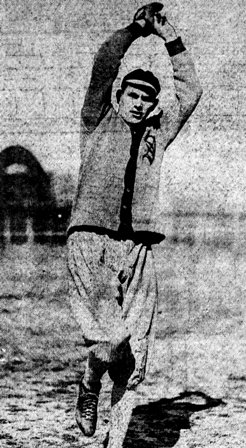
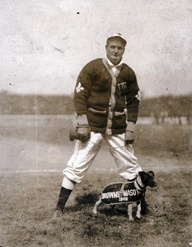
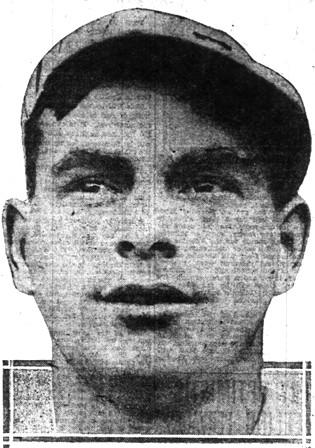
The story was told by and told about lefty Evan “Rube” Evans.  Born on April 28, 1890, in Sebring, Ohio, Evans was a career minor league pitcher who, when the story first appeared, seemed to be headed to the big leagues. 

Rube Evans

Rube Evans

The tall–he was reported by various sources as anywhere from 6′ 2″ to 6′ 4″–began his professional career with the Dallas Giants in the Texas League in 1910; he was 15-12 for the pennant winners, but The Dallas Morning News said he didn’t “take baseball seriously” until the following year, when he was 18-16 for the Giants:

“Before that, it seemed, the big, husky flinger looked at playing baseball something in the light of a joke.  Last season, though he came back into the game with a different viewpoint. He seemed to realize that ball playing was a man-sized business.”

After his 1911 performance, Evans’ contract was purchased by the New York Giants, and he joined the team for spring training in Marlin, Texas in 1912.  The Morning News said if he maintained his new found focus “and works as hard as he knows how to work he ought to stick.”

Evans quickly impressed the Giants with a pitch “takes a most freakish break,” according to The Washington Times:

“Rube Evans, the Giants left-handed recruit pitcher from Dallas, surprised bot Manager (John) McGraw and Coach Robby (Wilbert Robinson) by showing them a curve that is entirely new to the big league…The ball is delivered in exactly the same manner as the spitball, but he does not moisten it.”

The paper did not elaborate on how Evans’ “dry spitter” was different from versions reported on during previous seasons–including the one thrown by Christy Mathewson of the Giants–but according to The New York World, “McGraw says he will try and teach it to Rube Marquard.”

Despite his “dry spitter,” Evans failed to make the team and was returned to Dallas where he posted a 22-12 record for the Giants.

In 1913, he joined the New Orleans Pelicans in the Southern Association but appeared to be headed to the Cleveland Naps before he threw a pitch in the regular season for the Pelicans.  In March, Evans shut down the Detroit Tigers 3 to 1 on five hits and followed that up with a four-hitter (and 3 to 1 victory) against the Naps.

The Cleveland Press said, “(Naps Manager Joe) Birmingham plans to cut down his squad considerably.  It is said recruits (Hugh) Peddy, (Pete) Shields and (Ward) McDowell will be left here in trade for one good pitcher, probably Southpaw Rube Evans.”

With Evans apparently on the verge of joining the Naps, the story of his “bonehead” play was told by Phelon, then repeated widely:

“(Evans) has one curious habit—a trait which has aroused much wonder on the part of every manager under whom the southpaw has been toiling.  When given an order by his manager or captain, Mr. Evans always stops, cocks his ears, and demands a repetition of the directions.  Naturally he is first taken for a simp, or bonehead, but when further acquaintance with him shows that he is a gentleman of intelligence and high mentality, the field leaders are muchly puzzled.

“’I always want my orders repeated,’ quoth Mr. Evans, ‘so that I will never again make such an error.”

(The 1913 version of the story, which quotes Evans,  places the incident in McKeesport, Pennsylvania, some later versions say it happened in 1913 with the Pelicans, still others say it was in Portland, Oregon; however, the original publication predates Evans’ time on the West Coast which did not begin until May of 1914).

Evans said he had pitched into the ninth inning when the opposing team put a runner on third with one out, when his manager told him if the other team attempted a squeeze play to “bean him.”  Evans said:

“’I knew no more what a squeeze play was than the man in the moon, but my orders rang in my ears as I started winding up.  Just as a swung up my arm, the fellow on third tore for the plate…I took careful aim at the oncoming runner, and pickled him with a fine shot to the back of the cranium.  Three seconds later the crowd was coming towards me with roars of fury, and I got over the back fence just in time.

“’Well how was I to know that I should have hit the batter and not the runner?  Ever since I have insisted on duplicate orders, so that I would know just what to do.’”

His acquisition by Cleveland never materialized and he had a disappointing 12-15 record in 1913, in a season split between New Orleans and the Birmingham Barons.

It is also in question whether Phelon’s characterization of Evans as a “gentleman of intelligence and high mentality,” was entirely accurate given his inability to stick with clubs who were impressed with physical abilities.  After his second chance to pitch in the majors didn’t materialize, the remainder his of career was marked by long stretches of mediocrity, charges of bad behavior and comparisons to another left-handed “Rube.”

In August of 1913, he was suspended for the remainder of the season by the Birmingham Barons for, according to The Birmingham Post-Herald, “Failure to keep in condition.”  The Sporting Life’s Chandler Richter called him “Erratic,” The Oakland Tribune said he was”Eccentric,” a wire service retelling of the “beanball” story from 1915 said he “earned a nationwide reputation as a ‘squirrel,” another called him “the real eccentric,” when compared to Rube Waddell.

The other left-handed Rube

The other left-handed Rube

His two-year tenure with the Portland Beavers in the Pacific Coast League (PCL) began when he wore out his welcome in New Orleans in May of 1914 and was sold to the Beavers.  It was particularly rocky.  The Spokane Daily Chronicle said Evans and Beavers manager Walter “Judge” McCredie “got along like a pair of strange bulldogs.” He was suspended at least once, again for the euphemistic “failure to be in proper condition,” and gave up a game-winning home run to Jack Ness of the Oakland Oaks when he accidently threw a pitch over the plate while attempting to intentionally walk Ness.  At the close of the 1915 season, Portland let him go for what The Portland Oregonian called “His inability to take care of himself.” Of his 9-22 record the paper said:

“Rube ran into gobs of adversity.”

After leaving Portland, Evans played parts of three seasons for the Salt Lake City Bees in the PCL–in 1917 he was 21-9, but when McCredie was named manager of the Bees in 1918, Evans time with the team was nearly over.  Before the season, The Oregonian said, “Evans did not take kindly to the idea of having to take orders” from his former manager and was threatening to jump the club.  He finally did jump in June after appearing in 14 games and posting a 3-8 record.

Evans went to Portland and finished the 1918 season in the semi-pro Shipyards League, The Oregon Daily Journal said upon his arrival:

“Rube Evans was through at Salt Lake and McCredie was probably saved the trouble of wearying his hand by writing out Rube’s release, when Rube left.”

In 1919, he played for the Rupert franchise in the semi-pro Southern Idaho League; while successful, his reliance on the emery ball for his success didn’t make him friends.  The Twin Falls Times said:

“When Rube Evans lugged the emery ball into the S.I.L. he failed to do anything beneficial to the league.  Rube will win a few more games for the Rupert club, but he has lowered the standard of sport in the league.”

Evans had one more season in professional baseball, posting a 10-7 record with the Regina Senators in the Western Canada League in 1920.  In an August 15 doubleheader against the Edmonton Eskimos Evans was ejected for arguing with the umpire while facing the second batter of the first game; he came back to lead the Senators to 5 to 3 victory in the second game, giving up two runs in 7 2/3 innings, and hitting a three-run home run in the sixth.

Rube Evans

Rube Evans

After the 1920 season, he returned to Ohio and spent the next decade playing semi-pro baseball there and in Western Pennsylvania.  His last headlines came in 1924 when he pitched six innings for the Sharon (PA) Elks team in an exhibition game against the New York Yankees.  The Elks lost 10-8, Babe Ruth went 2-4 with a double for the Yankees.

Evans’ playing days ended in Akron, Ohio.  He pitched for and managed the Goodyear Tire and Rubber Company team, and stayed on with the company as a rubber worker.  He died on January 30, 1950.

A clue to some of Evans’  erratic behavior is contained in his death certificate.  The pitcher spent the last three and a half years of his life in Ohio’s Cambridge State Hospital; his cause of death was listed as “General Paresis,’ brought on by syphilis.

A shorter version of this post appeared on June 3, 2013