Tag Archives: Hal Chase

Grantland Rice’s “All-Time All-Star Round up”

10 Aug

In December of 1917, thirty-eight-year-old sportswriter Grantland Rice of The New York Tribune enlisted in the army–he spent fourteen months in Europe.  Before he left he laid out the case, over two weeks, for an all-time all-star team in the pages of the paper:

“As we expect to be held to a restricted output very shortly, due to the exigencies and demands of the artillery game, this seemed to be a fairly fitting period to unfold the results.”

Grantland Rice
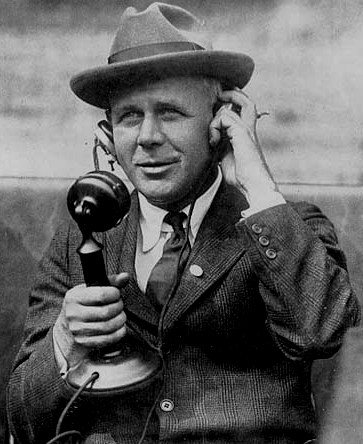
Grantland Rice

Rice said the selections were “not solely from our own limited observation, extending over a period of some eighteen or twenty years,” but included input from players, managers and sportswriters, including  “such veterans” as Frank Bancroft and Clark Griffith, and baseball writers Joe Vila of The New York Sun, Bill Hanna of The New York Herald and Sam Crane, the former major league infielder turned sportswriter of The New York Journal.

Rice said only one of the nine selections “(S)eems to rest in doubt.  The others were almost unanimously backed.”

The selections:

Pitcher:  Christy Mathewson

A. G. Spalding, John (Montgomery) Ward, Larry Corcoran, Charley Radbourn, John Clarkson, (Thomas) Toad Ramsey, Tim Keefe, Bill Hoffer, Amos Rusie, (Mordecai) Miner Brown, Addie Joss, Ed Walsh–the array is almost endless.

“In the matter of physical stamina, Cy Young has outclassed the field.  Cy won more games than almost any others ever pitched.

“(But) For all the pitching mixtures and ingredients, stamina, steadiness, brilliancy, brains, control, speed, curves, coolness, courage, is generally agreed that no man has ever yet surpassed Christy Mathewson…there has never been another who had more brains or as fine control.”


[…]

“It might be argued that Radbourn or (Walter) Johnson or (Grover Cleveland) Alexander was a greater pitcher than Mathewson.

But we’ll string with Matty against the field.”

Radbourn was the second choice.  Bancroft said:

“Radbourn was more like Mathewson than any pitcher I ever saw.  I mean by that, that like Matty, he depended largely upon brains and courage and control, like Matty he had fine speed and the rest of it.  Radbourn was a great pitcher, the best of the old school beyond any doubt.”

Catcher:  William “Buck” Ewing

“Here we come to a long array—Frank (Silver) Flint, Charley Bennett, (Charles “Chief”) Zimmer, (James “Deacon”) McGuire, (Wilbert) Robinson, (Marty) Bergen(Johnny) Kling, (Roger) Bresnahan and various others.

“But the bulk of the votes went to Buck Ewing.”

Buck Ewing
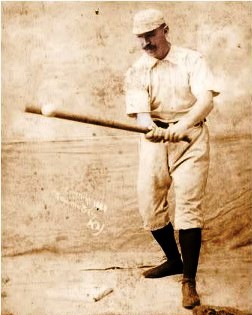
Buck Ewing

[…]

“Wherein did Ewing excel?

“He was a great mechanical catcher.  He had a wonderful arm and no man was surer of the bat…he had a keen brain, uncanny judgment, and those who worked with him say that he had no rival at diagnosing the  weakness of opposing batsman, or at handling his pitchers with rare skill.”

Kling was the second choice:

“Kling was fairly close…a fine thrower, hard hitter, and brilliant strategist…But as brilliant as Kling was over a span of years, we found no one who placed him over the immortal Buck.”

1B Fred Tenney

First Base was the one position with “the greatest difference of opinion,” among Rice and the others:

“From Charlie Comiskey to George Sisler is a long gap—and in that gap it seems that no one man has ever risen to undisputed heights… There are logical arguments to be offered that Hal Chase or Frank Chance should displace Fred Tenney at first.

But in the way of batting and fielding records Tenney wins….Of the present array, George Sisler is the one who has the best chance of replacing Tenney.”

2B Eddie Collins

 “There was no great argument about second base.

“The vote was almost unanimous.

“From the days of Ross Barnes, a great hitter and a good second baseman on through 1917, the game has known many stars.  But for all-around ability the game has known but one Eddie Collins.”

Rice said the competition was between Collins, Napoleon Lajoie and Johnny Evers:

“Of these Lajoie was the greatest hitter and most graceful workman.

“Of these Evers was the greatest fighter and the more eternally mentally alert.

“But for batting and base running, fielding skill, speed and the entire combination, Collins was voted on top.”

 SS Honus Wagner

“Here, with possibly one exception, is the easiest pick of the lot.  The game has been replete with star shortstops with George Wright in 1875 to (Walter “Rabbit”) Maranville, (George “Buck”) Weaver…There were (Jack) Glasscock and (John Montgomery) Ward, (Hardy) Richards0n, (Hugh) Jennings, (Herman)Long, (Joe) Tinker and (Jack) Barry.

“But there has been only one Hans Wagner.”

Honus Wagner

Honus Wagner

Jennings and Long were rated second and third,  “But, with the entire list  considered there is no question but that Wagner stands at the top.”

3B Jimmy Collins

Rice said:

“From the days of (Ned) Williamson(Jerry) Denny, and (Ezra) Sutton, over thirty years ago, great third basemen have only appeared at widely separated intervals.

“There have been fewer great third basemen in baseball than at any other position, for there have been periods when five or six years would pass without an undoubted star.”

The final decision came down to “John McGraw vs. Jimmy Collins.”  McGraw was “a great hitter, a fine bunter and a star base runner,” while “Collins was a marvel and a marvel over a long stretch…he was good enough to carve out a .330 or a .340 clip (and) when it came to infield play at third he certainly had no superior…So taking his combined fielding and batting ability against that of McGraw and Collins wins the place.  McGraw was a trifle his superior on the attack. But as a fielder there was no great comparison, Collins leading by a number of strides.”


OF Ty Cobb

“The supply here is overwhelming…Yet the remarkable part is that when we offered our selection to a jury of old players, managers and veteran scribes there was hardly a dissenting vote.”

[…]

“Number one answers itself.  A man who can lead the league nine years in succession at bat.

“A man who can lead his league at bat in ten out of eleven seasons.

“A man who can run up the record for base hits and runs scored in a year—also runs driven in.

“Well, the name Ty Cobb answers the rest of it.”

OF Tris Speaker

 “The man who gives Cobb the hardest battle is Tris Speaker.  Veteran observers like Clark Griffith all say that Speaker is the greatest defensive outfielder baseball has ever exploited…Speaker can cover more ground before a ball is pitched than any man.  And if he guesses incorrectly, which he seldom does, he can go a mile to retrieve his error in judgment…And to this impressive defensive strength must be added the fact he is a powerful hitter, not only a normal .350 man, but one who can tear the hide off the ball for extra bases.”

Tris Speaker "hardest hit"
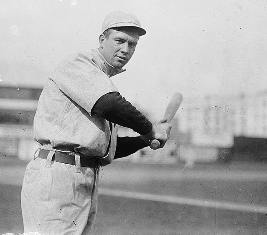
Tris Speaker 

OF “Wee Willie” Keeler

Mike Kelly and Joe KelleyJimmy Sheckard and Fred Clarke—the slugging (Ed) Delehanty—the rare Bill LangeBilly Hamilton.

“The remaining list is a great one, but how can Wee Willie Keeler be put aside?

“Ask Joe Kelley, or John McGraw, or others who played with Keeler and who remember his work.

“Keeler was one of the most scientific batsmen that ever chopped a timely single over third or first…And Keeler was also a great defensive outfielder, a fine ground coverer—a great thrower—a star in every department of play.

“Mike Kelly was a marvel, more of an all-around sensation, but those who watched the work of both figure Keeler on top.”

Rice said of the nine selections:

“The above is the verdict arrived at after discussions with managers, players and writers who have seen a big section of the long parade, and who are therefore able to compare the stars of today with the best men of forgotten years.

“Out of the thousands of fine players who have made up the roll call of the game since 1870 it would seem impossible to pick nine men and award them the olive wreath.  In several instances the margin among three or four is slight.

“But as far a s deductions, observations, records and opinions go, the cast named isn’t very far away from an all-time all-star round up, picked for ability, stamina, brains, aggressiveness and team value.

“If it doesn’t stick, just what name from above could you drop?”

“Demmitt!!”

20 Jul

Arthur “Bugs” Baer was a humorist and sportswriter—widely credited with coining the nickname “Sultan of Swat” for Babe Ruth—who often included his own cartoons with his articles.

Baer worked for The Philadelphia Public Ledger, The Washington Times, and William Randolph Heart’s King Features Syndicate, before moving to Hollywood where he wrote several film scripts, including the titles for “Headin’ Home,” the first movie Babe Ruth appeared in.

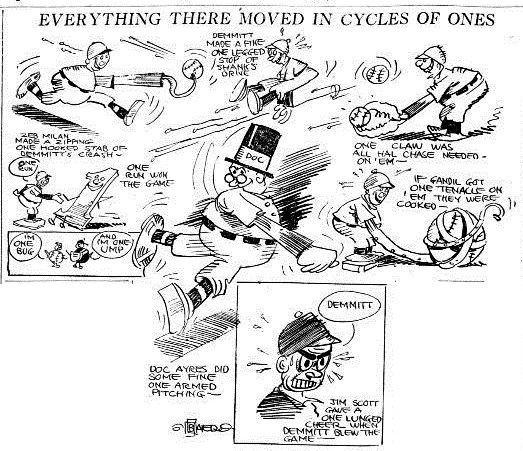
An example of Baer’s newspaper work; after a May 1914, 1-0 Washington Senators victory over the Chicago White Sox in 10 innings–Sox pitcher Jim Scott took a no-hitter into the 10th before allowing a single to Chick Gandil:

“Demmitt!!

“That’s the word.

“Oh! No!  We don’t mean what you mean.  (Ray) Demmitt is the right fielder on the Chicago White Sox, although we admit that it sounds as if he wasn’t.  He is the lad who made a brilliant one-legged stop of (Howie) Shanks’ drive in the tenth yesterday, allowing the ball to bruise our perfectly good right field wall and Jim Scott’s heart at the same time.  He came racing to snag the ball just like one of these pictures you see in the “Police Gazette.”  Just like a regular ball player, same as they have in big cities.  You’ve heard about those kind.

Demmitt!!

Demmitt!!

[…]

“The old pill went through him just like the Congressional Limited goes through Elkton, Maryland.  And Chick Gandil flat wheeled around the bases same as the Fourteenth Street car does around Thomas Circle…What we wanted to ask is did you notice how everything moved in cycles of one?

“One run won the game.  Demmitt’s one-legged stop allowed that one run to score and win one ballgame.  (Clyde) Zeb Milan (who made a bare handed stab of Demmitt’s sixth-inning single, and caught threw him out attempting to stretch it to a double) one-hooked stab saved the bacon, and Gandil’s one tentacled clutches chopped off many an error.

Hal Chase’s one-clawed catches of wide throws kept the Sox in the running and (Yancey) Doc Ayers’ great one-armed pitching put them out of it.  In fact, everybody acted as if they only had one arm.

Tommy Connolly did some fine one-cylindered umpiring.

“And Jim Scott gave a one-lunged cheer when Demmitt—there goes that word again—blew the game.”

Baer's cartoon that accompanied the article

The Baer cartoon that accompanied the article

Lost Advertisements–“The World’s Best Pitchers Recommend…”

8 Jul

adreach

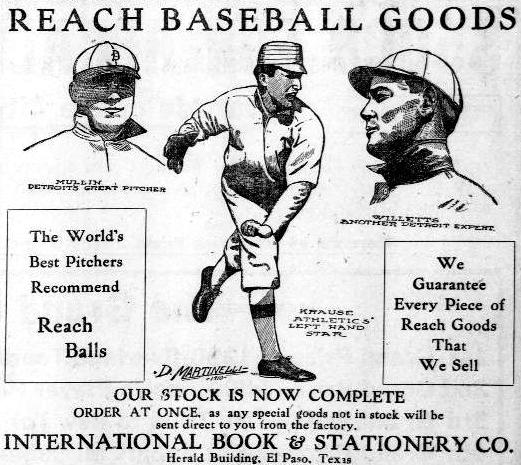
A 1910 advertisement for Reach Baseball Goods  “The World’s Best Pitchers Recommend Reach Balls”–from International Book & Stationary Co. in El Paso, Texas.  The ad features “Detroit’s Great Pitcher,” George Mullin, “Another Detroit Expert,” Ed Willett (Misspelled Willetts in the ad), and “Athletics’ Left Hand Star,” Harry Krause.

In 1909, the 20-year-old Krause, who had been 1-1 in four appearances with the Athletics in 1908, became the talk of baseball when he opened the season with 10 straight victories–including six shutouts.  A San Francisco native who played under Hal Chase and was a teammate of Hall of Famer Harry Hooper at St. Mary’s College, Krause was asked by The Oakland Tribune what led to success:

“That’s easy.  A capable manager in Connie Mack, one of the best pitching tutors in the world in Ed Plank, fairly good control on my part and lots of luck.”

The Tribune‘s scouting report on Krause:

“He has a good curve, but many pitchers in the league have a better one.  He has speed, but any number of American League twirlers have more smoke than he.  However, there are very few twirlers, whether right or left-handers, who can equal him in control of the ball.

“He doesn’t appear to have much to the opposing batters when they first face him, but when the game is over they wonder how it came to pass that he let them down with three or four hits and no runs.”

Harry Krause

Harry Krause

On July 18 his luck ran out, Krause dropped his first game of the season, an 11-inning, 5 to 4 loss to the St. Louis Browns.

He went just 8-7 (with one shutout) the rest of the season, but led the league with a 1.39 ERA.

He appeared in only 55 more games over three seasons, winning 17 and losing 20, before a sore arm ended his major league career at age 23.

He finished the 1912 season in the American Association with the Toledo Mud Hens, then returned to California and pitched for 15 seasons in the Pacific Coast League (with a one-season detour to the western League), where he won 230 games.

Lost Advertisements–Bull Durham’s Fan for a Fan

29 May

1913fan

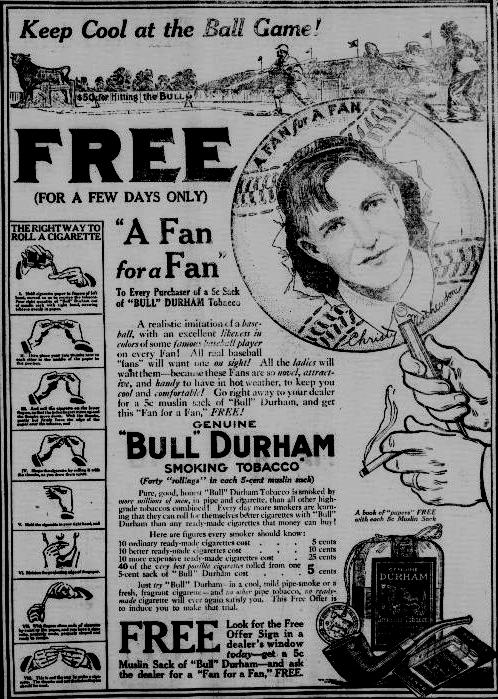
A 1913 advertisement for the “A Fan for A Fan” offer from Bull Durham Tobacco:

Keep Cool at the Ballgame

 Free (for a few days only)

A Fan for a Fan

 To Every Purchaser of a 5 cent sack of “Bull” Durham Tobacco

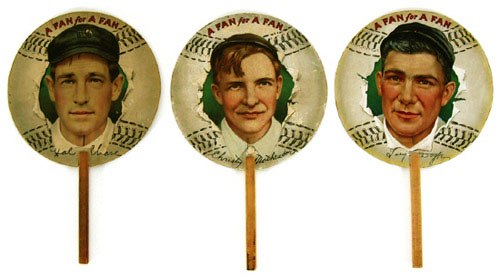
A realistic imitation of a baseball, with an excellent likeness in colors of some famous baseball player in every fan!  All real baseball “fans” will want this on site!  All the ladies will want them–because these fans are so novel, attractive, and handy to have in hot weather to keep you cool and comfortable!  Go right away to your dealer for a 5 cent muslin sack of “Bull” Durham, and get this “Fam for a Fan,” Free!

In addition to the Christy Mathewson fan featured in the ad,  Ty Cobb, Hal Chase, Frank Baker, and Larry Doyle were also available; the fans themselves included a facsimile signature of the player and no mention of Bull Durham.  Apparently they are rare enough that auctions date them only to “Circa 1910,” and make no mention of them being distributed by the tobacco company.

fan

Chase, Mathewson and Doyle fans from a 2005 auction; the three sold for $3,480.


“The Annual Spring Typhoon has Blown up Again”

10 Nov

In 1906, despite being, on paper, the best team in the American League, the Cleveland Naps finished in third place, five games behind the Chicago White Sox.  The club had three twenty game winners—Addie Joss, Bob Rhoads, and Otto Hess—and four regulars who  hit better than .300—Napoleon Lajoie, William “Bunk” Congalton, Elmer Flick and Claude Rossman,

As the 1907 season approached, Grantland Rice, of The Cleveland News said the team was now a victim of the success of individual players:

“The annual spring typhoon has blown up again—only a bit worse than ever.  In nearly every big league camp well-known athletes are breaking into loud roars over the pay question, and there promises to be quite a batch of trouble before the storm is cleared away.  In this respect Cleveland heads the list, although Napland owners have one of the highest salary lists in the game.  Up to date Joss, Rhoads, (Terry) Turner and Congalton have balked, while neither Flick nor Hess have returned a signed contract.”

Grantland Rice

Grantland Rice

Rice said the club’s negotiations with Joss and Rhoads were at an impasse, and “just how it will end is a matter of uncertainty.”  The news of the team’s trouble signing their stars led Rice to a discussion of “just how much a major leaguer is supposed to receive for his work each season.”

“When a youngster breaks in he is never given less, or at least rarely so, than he received in his minor league berth.  His pay is boosted the greater part of the time, so the average debutante’s pay roll ranges closely around $1,800 providing he is recognized as a first class man.

“If he delivers the goods his first year out he can figure on about $2,000 or $2,200 for his next season, and then if he becomes established as a regular, his income should be somewhere in the immediate vicinity of $2,500.

“From this point upward it all depends on their rankings as stars.  You hear considerable about $5,000 contracts and better, but as a matter of cold, clammy fact, but few athletes draw over $3,000 or $3,500 at best.

“In the epoch of war salaries $3,500 or $4,000 was a fairly common figure—but no more.

“A high grade slabman along the order of Joss, Rhoads (Nick) Altrock, etc…will rake in about $3,000 now.  In his weekly letter in a Toledo paper (The News-Bee), Joss stated that he was offered $3,000 for his season’s work, but that he demanded more—just how much he didn’t say.

“George Stone drew $3,000 or there abouts last season and now that he has fought his way to the premiership in the School of Slugs he demands $5,000, at which figure Mr. (Jimmy) McAleer balks strenuously.  (Johnny) Kling also asks for $5,000, which sum Charley Murphy says he will not receive.

“From this list we jump to the drawing cards of the game such as Lajoie, (Honus) Wagner, (Wee Willie) Keeler, (Christy) Mathewson, etc…

“Lajoie’s figures range somewhere above $8,000 and something shy of the $9,000 mark.

“Wagner is supposed to draw $5,000 for his work.

“If reports sent out from New York are true, Keeler’s yearly ante is close to $6,000, while Mathewson draws in about the same.

Hal Chase won’t miss $3,500 very far.

“But the high-priced teams are not pennant winners by a jug full.

(Charles) Comiskey and (Connie) Mack hew closer to the line than any others in Ban Johnson’s circle, and yet these two have won more pennants than all the rest put together.  In fact, they’ve gotten away with all but the two which Boston nailed.

“Mack had one of the cheapest, if not the cheapest team in the American League through 1905, the last year he copped the pennant.  Comiskey’s world champions of 1906 were far below Cleveland, New York or even Boston, from the salary standpoint.

“It looks funny to figure the cellar champions of a league paid more than the holders of the world’s title, but if all the figures were given out, the White Sox payroll would loom up under Boston’s to a certainty.

“The full salary cost of running a big league club varies from $40,000 to $50,000, or maybe $55,000 a year.

“A set of figures somewhere between $45,000 and $50,000 would probably hit at the higher average.

“There was a time when Boston’s payroll was close to $70,000 and (Clark) Griffith’s was only a notch below—but this golden era for the ballplayer has passed.”

According to The Washington Post, Joss had earned $3,2000 in 1906 ($2,700 and a $500 bonus), the biography, “Addie Joss:  King of Pitchers,” said he was paid $4,000 in 1907—Joss, who was 21-9 with a 1.72 ERA in 1906, followed that up with a league leading 27 wins (against 11 loses, with a 1.83 ERA) in 1907.

Addie Joss

Addie Joss

Fellow twenty game winners Rhoads and Hess both saw their production slip (15-14, 6-6), and only two regulars—Flick .302 and Lajoie .301—hit better than .300, and the team’s batting average slipped 28 points from the previous seasons.

The Naps finished fourth in 1907.

Prince Hal’s Brush with Death

5 Nov

After nearly a decade as one of the California’s most popular players, Bobby Eager became an occasional columnist for The San Jose News.  Eager provided told stories about some of the biggest stars on the West Coast during the first decade of the 20th Century:

 “How close the greatest first baseman the game has ever produced came to losing his life in the infancy of his career is a story that has never been published though I guess everything else Hal Chase ever said, though or did has found its way into print.”

Eager said it happened in 1904 when he and Chase were teammates with the Los Angeles Angels in the Pacific Coast League.

“We were on our second trip to Seattle.  When the train reached Thrall, which was a water tank line and the last stop in California before we passed into Oregon, Chase and I saw some ripe apples hanging on a tree… Chase went up the tree like a squirrel and I stood on the ground.”

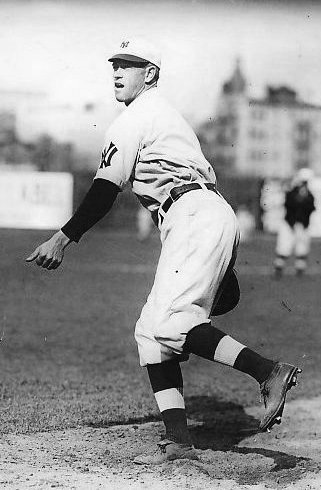
"Prince" Hal Chase

“Prince” Hal Chase

With Chase still in the tree, the train, which Eager re-boarded, prepared to pull out of the station.

“By the time Chase could get back the train got under headway, and the trainman had closed the doors of the Pullman.

“When we discovered the doors were shut we rushed out, and there was poor Hal hanging on the steps and his feet almost dragging in the ties.  He was hanging on for dear life.  First (Norman) Kitty Brashear and I tried to pull him up on the platform but that was impossible.  All the time the train was going faster and faster.  Then I yanked the bell rope but I yanked it so hard that broke and the engineer never got the signal.  In the meantime Tim Flood had rushed ahead to locate the conductor who refused to stop the train until the next station three miles ahead.  We wanted to kill the conductor, but that would have done no good.

“All the time Chase was getting weaker and weaker, but as it was a case of life or death with him he stuck to the train.  It was Brashear who hit on the scheme which saved Chase from having his legs cut off and the game losing its kingpin first sacker.  Brashear got down on the platform, yelled to him to let go when he pushed him with his foot.  Hal said he would do it.  Brashear, who was powerful as a bull, placed his big boot squarely in Chase’s breast and as he yelled ‘let go’ shoved Hal all the way over the embankment and when we saw him roll safely down the embankment we were happy.

“But Hal was not out of his peril.  As he told us afterwards he pulled himself together and hobbled back to Thrall half dead.  This was 3 o’clock in the afternoon.  The next train didn’t come along until 11 at night.  Soon after dark Hal said a flock of coyotes came down from the mountains.  They were hungry and looking for blood.  Hal said he found safety on top of the tank station house.  He said the Coyotes kept him treed until his train pulled in.”

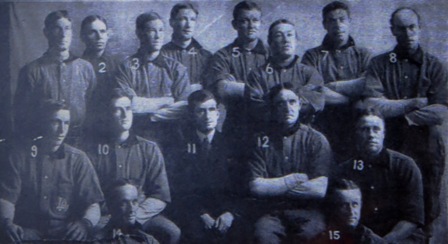
Hal Chase (3), Bobby Eager (6), Tim Flood (12), and Kitty Brashear (13)

Hal Chase (3), Bobby Eager (6), Tim Flood (12), and Kitty Brashear (13)

Despite the injuries, Chase appeared in 190 of the Angels 235 games.  At the close of the 1904 season, he was drafted by the New York Highlanders.

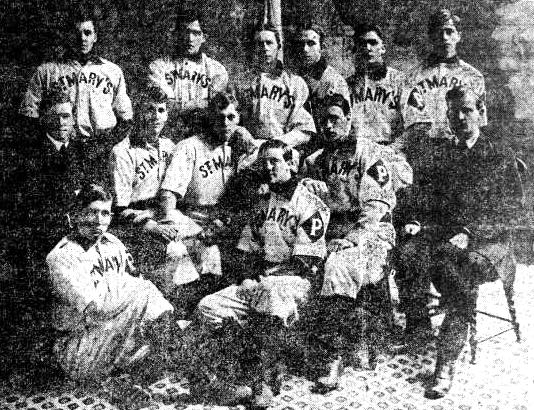
Lost Team Photos–Harry Hooper’s 1907 St. Mary’s College Team

13 Jun

1907stmarypix

Harry Hooper, Hall of Fame outfielder for the Boston Red Sox and Chicago White Sox (standing, far right), with the 1907 St. Mary’s College team.  The team, often called the best  pre-World War I college ballclub, also included pitcher Harry Krause (center, second from left), and catchers Charlie Enwright (center, second from right), and Ed Burns center, middle)–The San Francisco Chronicle referred to the 5′ 10′ Krause and the 5′ 6″ burns as “the midget battery.”

Coach Hal Chase is in the middle row, far left.

After the team’s final game The San Francisco Call said:

“The Phoenix baseball team of St. Mary’s, satisfied that it has conquered the world, has closed its schedule for the season.”

How good were they?

“Perhaps no California team has ever had a more brilliant career than has the 1907 phoenix.  Pitted 27 times against only first class teams, professional and amateurs, it has escaped from the fray without once having to bow to a foe.  Moreover, but 39 runs have been scored against the Phoenix all season, while the Phoenix players have scored 137.  No team made more than four runs on them, and this occurred but three times.  They have had eight shutouts, eight one run games, seven two run victories (and) one three run contest.”


Hooper, left, with Red Sox teammate George "Duffy" Lewis after the 1915 World Series

Hooper, left, with Red Sox teammate George “Duffy” Lewis after the 1915 World Series–the two were also teammates at St. Mary’s in 1906.

“Johnson can Hit the Ball as far as Anybody”

14 Oct

After Hal Chase replaced George Stallings as manager of the New York Highlanders, Otis “Ote” Johnson was given another opportunity to play for the team.

Highlanders’ second baseman Frank LaPorte and third baseman Jimmy Austin were traded to the St. Louis Browns for third baseman Roy Hartzell.  Chase said he’d move shortstop John Knight to second and playing Johnson at shortstop.

The Sporting Life quoted Chase saying he planned to play Johnson at short “for his batting,” but noted that Johnson “only batted .223 in the fast Eastern League last season.”

Otis "Ote" Johnson

Otis “Ote” Johnson

New York scout Arthur Irwin agreed with Chase that the team needed Johnson’s bat in the lineup, and told The New York Globe:

“Johnson can hit the ball as far as anybody, and what is more he can hit often.”

The New York Herald said:

“Johnson is a beautiful fielder as well as a good hitter, and it is Chase’s intention to have him take the shortstop job.”

That’s where Johnson was on Opening Day, a 2 to 1 victory over the defending World Champion Philadelphia Athletics; Johnson batted seventh, went 0 for two with a walk and a sacrifice, and scored a run.

After sweeping Philadelphia in three games, New York split a four game series with the Washington Senators.

The Washington Herald said New York’s new shortstop “sure looked good, he fielded his position in fine shape,” and “keeps the infield alive with his funny remarks.”

A month after the season began The Indianapolis News said Johnson was “called home (to Muncie, Indiana) by the serious illness of his mother.”  Three days later the paper said he returned to New York “his mother’s condition having considerably improved.”  Within a week of his return the New York papers reported that Johnson had filed for divorce from his wife.

Less than two weeks later Johnson lost his starting job; Knight moved to short and Earle Gardner played second base.

Ote Johnson

Ote Johnson 1911

The San Francisco Chronicle said of the former Pacific Coast League star:

“Ote Johnson has been benched for his weak hitting.  He put up a star game in the field…but Ote did not respond with the hitting which featured his work when he was with Portland.”

Three days after he was benched Johnson left the team again to finalize his divorce.  After returning Johnson became New York’s primary utility infielder until he fell out of favor with Hal Chase.  The manager had been criticised as the team slumped for, as The Globe said “utterly lacking in the qualities for successful management.”

By August the team was fourteen games out of first place and The Herald said:

“Hal Chase, who has been very lenient with his players, is drawing the string tighter.”

The paper said Johnson “has been suspended without pay for violating the club’s rule of discipline.”  It was never revealed what rule was violated, but Johnson was suspended for about a week.  Johnson also hurt his throwing arm in August, further limiting his playing time.

Many in the New York press questioned Chase’s ability as a manager; Wilton Simpson Farnsworth of The New York Evening Journal was the exception.  Farnsworth said of Chase, when the team was 13 games back in August:

“Hal Chase, the game’s greatest first baseman, has made good as manager of the new York Yankees…Knockers claim that poor management is keeping the Yanks down, but forget it! A bad break in luck plus innumerable injuries is the cause.”

Hal Chase

Hal Chase

Regardless of the reasons, 1910’s second place team was limping to a sixth place finish. Chase resigned as manager in November.  Johnson hit just .234 and committed 31 errors in just 65 games.  He was released to the Rochester Hustlers in the International league in December.

Johnson spent just one season in Rochester; he hit .268 and got married; after the season his contract was sold to the Binghamton Bingoes in the New York State League (NYSL).  Johnson protested the pay cut his Binghamton contract called for, and initially threatened to jump to the PCL, he eventually signed a contract and became popular with fans.  He hit the Bingoes first home run of the 1913 season and was awarded with a free daily shave from a local barber and fan named Billy McCann.

He played most of the next three seasons in the NYSL—with the exception of 45-games with the St. Paul Apostles in the American Association at the beginning of the 1914 season.

After playing for the Elmira Colonels in 1915 Johnson recommended two players to his friend Walter “Judge” McCredie on the Portland Beavers—his teammate, pitcher Frank Caporal, and Syracuse Stars first baseman Owen Quinn—and it appeared the 31-year-old Johnson might be heading back to Portland where he remained very popular.

On November 9 Johnson went hunting with friend in Binghamton.  The (Portland) Oregonian said:

“Ote Johnson, famous ‘Home Run’ Ote of the Portland Pacific Coast team of 1907, 1908 and 1909, is dead…It seems Johnson, in company with a party of friends, went forth in search of game and while chasing a wounded fox stumbled and fell, both barrels of the shotgun he was carrying discharged into his abdomen.

“To the older generation of Portland fans Johnson will be remembered for his prowess in poling out long bingles.  He was one of the longest hitters that ever wore the livery of a Coast League club.  Some are prone to argue that he eclipsed the performances of (Frank) Ping Bodie and Harry Heilman, who are now the long-swat stars of the circuit.  Johnson also had a peculiar throw from third that will be remembered–He had a perfect underhand throw and was a wonder at handling bunts.”

He was buried in Johnson City, New York–his pallbearers included several players: Mike Roach, Charles Hartman, Mike Konnick, and William Fischer,

“The Longest Hit in the World”

10 Oct

Walter “Judge” McCredie, longtime Portland Beavers player, manager and president said the longest home run he ever saw was hit by Otis L. “Ote” Johnson when Johnson played for him:

“The drive of Ote Johnson’s at Los Angeles (in 1909) was the longest clout I have ever witnessed.  Out in center field they had a pavilion 150 feet long.  Hits at Chutes Park in Los Angeles had never come within fifty feet of the pavilion…Johnson put the ball clean over the pavilion and the ball bounced into the bandstand for what I call the longest hit in the world.”

By the time he hit that ball in Portland he had already been called “Home run” Johnson for at least five years, a name earned in the Texas League when he hit 22 home runs in two seasons for the Dallas Giants—he finished third with 12 in 1903 and led the league with 10 in 1904.

Otis "Ote" Johnson

Otis “Ote” Johnson

Johnson was born in Fowler, Indiana in 1882, and grew up in Muncie.  The Dallas Morning News said fellow Indianan Claude Berry recommended Johnson to Dallas.  Primarily a shortstop, Johnson also played first, third and outfield, and appeared in more than 30 games as a pitcher during his professional career.

Johnson was sold to the Little Rock Travelers near the end of the 1904 season; he remained with Little Rock through 1906 but hit just .210 against “A” class Southern Association pitching.  He was sold to the Charleston Sea Gulls in the class “C” South Atlantic League before the 1907 season and hit .263, leading the team in doubles (27), triples (13) and home runs (10).

His performance in Charleston earned him another shot in the Pacific Coast League (PCL) when his contract was sold to Portland.  After a slow start at the tail-end of the 1907 season, Johnson regained his form, hitting .280 with 10 home runs in 1908 and .293 with 13 home runs (including his “longest hit in the world”) in 1909.

McCredie said the day Johnson hit his home run against Los Angeles scouts from the New York Highlanders was in the stands:

“(A)fter the battle they asked me to put a price on Ote.  I did, and a few days later the deal was consummated.”

The price was $4,000.

As Johnson prepared to join the Highlanders and manager George Stallings for spring training in Georgia, the New York press was excited about the team’s new prospect who was spending the winter in Muncie working and playing goalie Muncie’s professional roller polo team.  The New York Globe said:

“There is a ‘terrible Swede’ coming to New York next season.  He is a glass blower and makes from $6 to $7 a day in a factory at Muncie, Ind., and in the summertime he makes his living at swinging a large club and gathering bad and good bounders on the baseball field…The boy we’re harping about is Ote Johnson, who will be a member of the New York Americans. (In the PCL) he is known as ‘Home Run’ Johnson.  They say he has driven many a pitcher to the bench.”

George Stallings

George Stallings

Phil Cooney, a New Yorker, who played with Johnson in Portland, told The Globe:

“They seem to think that this boy Johnson can’t hit a curve ball, but Stallings will find out that he can hit any kind.”

On March 23 Stallings told The New York American that Johnson, who was playing third base and shortstop, “couldn’t hit.” Two days later The American said:

“Ote Johnson this afternoon gave an apt illustration of a home run and for the first time since he reported to Stallings the Portland demon found his batting eye.  But for the most daring burglaries on the part of (William) Birdie Cree, the big third sacker would have hit for 1.000 during the afternoon.  As it was he had a single and a homer in three times at bat.  His single might have been a homer had not (2nd baseman) Earle Gardner sprang into the air and retarded its progress by a blind stab.  But the four-base smash was beyond reach.

“Johnson got to one of (Dick) Carroll’s choicest curves and knocked the ball further than any had ever before traveled in Georgia.  Birdie Cree was playing deep for the big fellow.  The ball went so far that Cree had not gotten to it by the time Johnson crossed the home plate, and he only jogged from second.  The ball rolled to the fence, which is fully 300 yards from the plate.”

As late as April 1 it looked like Johnson might stick with New York.  The Trenton Evening Times said:

“The latest ‘phenom’ to be discovered is Otis Johnson, the New York Americans’ third sacker.  This recruit has been playing sensational games around the last station since he joined the club…Johnson is also quite a slugologist.  In the last few games the youngster has been batting like a Tyrus Cobb.  In a recent game at Athens, Ga., he made four hits in as many times at bat.  Among them was a home run.  Manager Stallings says he thinks Johnson will make a great name for himself this season.”

Despite the build up, and the reports of his prowess at the plate, Johnson did make Stallings’ club.  His contract was sold to the Jersey City Skeeters in the Eastern League.

The (Portland) Oregonian said New York “farmed out” the former Beaver star despite the fact that:

“New York critics credit Ote, nevertheless, with having more promise than some of the players retained by Stallings.”

Johnson hit just .223 with 9 home runs (second in the league) with Jersey City, but would benefit from unrest in the New York clubhouse.  Manager George Stallings accused his star first baseman, Hal Chase, of trying to throw a game in St. Louis (the first of what would become many accusations against Chase). Stallings said he would resign if Chase wasn’t let go; Highlander owner Frank Farrell sided with Chase and forced Stallings out in September; Chase was named manager.

Hal Chase

Hal Chase

After the season ended the New York papers said Johnson would on Chase’s club the following season, either at third base in place of Jimmy Austin (who was rumored to be on the market, and eventually traded to the St. Louis Browns), or to play shortstop in place of John Knight  who would be moved to second base to replace Frank LaPorte (also on the market, and also eventually traded to St. Louis with Austin).

More Otis Johnson on Monday.

“Mique” Fisher 2

7 May

On October 12, 1906, with the World Series between the Chicago White Sox and Chicago Cubs deadlocked at two games apiece, August “Garry” Herrmann, President of the National Commission, received a telegram from Fresno, California:

“Fresno will give $25,000 guarantee; guarantee 40,000 fans and sunshine for deciding game of World Series.

–Mike Fisher”

Fisher said the offer to bring the series and Fresno native Frank Chance to town was backed by “the businessmen here.”

It is doubtful Herrmann took the offer seriously, and it’s probably just as doubtful that Fisher took it seriously, but it was picked up by newspapers across the country, and Fisher enjoyed the publicity.

It was a last bit of publicity before his career in organized baseball ended.  Later in the month he was dismissed as manager of the Fresno Raisin Eaters, and the team was dropped from the Pacific Coast League (PCL) the following spring.

Within weeks Fisher had moved on to a new project; he announced that he was in the process of forming a team to travel to Hawaii.  The San Francisco Call said “It will be the first American ball team to make the trip across the Pacific in a little over nineteen years,” since Spalding’s world tour.

In conjunction with Jesse Woods, a Honolulu promoter, Fisher organized a tour of the Hawaiian Islands with a team of PCL stars.

Mike Fisher

Mike Fisher

Upon his return, Fisher got more ink on the West Coast, when he headed to Nevada with Charlie Irwin of the San Francisco Seals; the two met with businessmen in the mining towns of Goldfield and Tonopah to discuss forming a professional league—Fisher told The San Jose Mercury News that he was now “against organized baseball,” and if he got involved in the league “it will be an outlaw organization.”

Fisher chose not to get involved in the new league, but immediately went to work on an even more ambitious tour than the 1907 Honolulu trip.

With the sponsorship of the Reach Sporting Goods Company, Fisher would accompany a group of stars to China, Japan and the Philippines.  Early publicity promised the travelers would include Ty Cobb, Hal Chase, and Frank Chance.

When the ship set sail in November of 1908 those three stars were not on board, but “several hundred fans and friends” were present when the steamer China left the port in San Francisco to see the group off.  The team was substantially the same as the one that toured Hawaii the previous year—an aggregation of PCL stars and a few National and American League players– and consisted of: Jim Delahanty, George Hildebrand, Bill Burns, Pat Flaherty, Jack Bliss, Babe Danzig, Harry McArdle, Nick Williams, Joe Curtis, Heine Heitmuller, Jack Graney and Bill “Brick” Devereaux.

Despite the failure to land Cobb, Chase or Chance for the tour, the West Coast press applauded Fisher for even attempting the trip, The Call said:

“The undertaking which he has fathered and which is so successfully underway at the present time is a big proposition.  With the single exception of the around-the-world trip of the A.G. Spaldings years ago, nothing on as big a scale as this has ever been attempted.  To take a team of American baseball players over a journey that will total 10,000 miles before they return, to play games in China, Japan, Manila and Honolulu is something that two or three years ago would have been laughed at as an impossibility.”

The tour lasted more than three months, with the team barnstorming through Japan, China, the Philippines and Hawaii, playing local and US Service member teams.  Though reports varied, the team played between twenty and thirty games, and lost no more than four.

While they drew large crowds throughout the trip, the newspapers back home reported that the tour was a financial disaster; when the players arrived back in San Francisco on February 15, 1909 aboard the Tenyo Maru, Fisher responded to the reports:

“I hear that it has been said that the trip was a financial frost.  Well, anybody who says that is a liar.  We broke even in Japan and made money in Manila and Honolulu.  I am satisfied with the trip.”

Fisher didn’t mention the financial results in China; likely because that leg of the tour was a disaster financially.  Years later he would tell a story about the team’s experience there, complete with his usual exaggerations:

“In one game we played in Canton we had 150,000 people inside, and as the gatemen had been instructed to accept Chinese money it required the combined efforts of the entire team to tote the money up to the hotel.  A special staff of accountants was busy all night totaling it up and in the morning we discovered we had $46.15.”

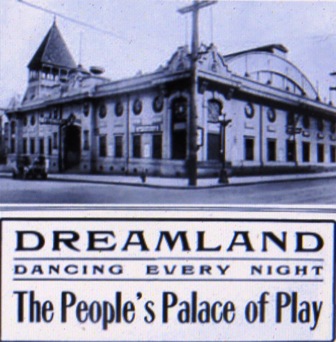
Fisher promised to take a team to Australia the following year.  The trip never took place; instead Fisher purchased a Seattle dance hall called the Dreamland, and quickly became the target of the pious women of the city.  Early in 1910 Fisher was indicted by “The King County grand jury, as a direct result of the activity of the Women’s Clubs,” for violating liquor laws, allowing “unescorted women” into his dance hall, and other assorted charges.  A special prosecutor, Justice William Henry White, one of the most respected jurists in Washington State, was appointed to prosecute Fisher and other club owners targeted by the women.

Ever the promoter, Fisher used the indictment to promote his dance hall and rally public support.  After the indictment was handed down Fisher sponsored a “Sermon in the Dreamland rink.”  According to The Seattle Times, Fisher engaged Reverend Frank Herthum, who “has liberal ideas about amusements.”

Mike Fisher's Dreamland Dancehall, Seattle

Mike Fisher’s Dreamland Dance Hall, Seattle

Herthum preached, and Fisher presented a free vaudeville show.  The paper said Fisher had stirred up a “protest against the effort to close the dance hall without having provided a substitute where clerks, servant girls and employees in the shops may pass an evening to their liking.”  At the same time The Times noted that the prosecutor was becoming impatient with the women who brought the charges because they continually promised to provide evidence that “has not yet come to light.”  The charges were quietly dismissed within weeks.

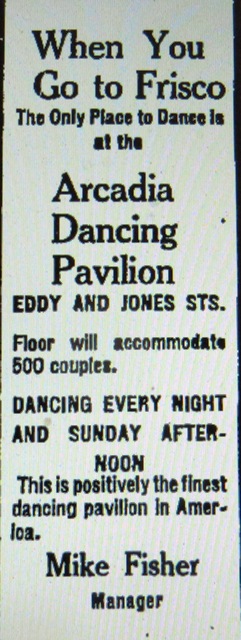
Fisher left Seattle sometime in 1911 and began operating the Arcadia Dance Hall in San Francisco.

Advertisement for Fisher's Arcadia Dancing Pavilion.

Advertisement for Fisher’s Arcadia Dancing Pavilion.

In January of 1917 Fisher made headlines in California when he announced that he was directing an effort to restart the California State League, which had folded after the 1915 season.  He said he would have clubs in Sacramento, Fresno, Stockton and San Jose.  Within two weeks Fisher abandoned the plan.  The San Jose Mercury News was not surprised:

“Mr. Fisher, the wonderful getter of publicity, has his publicity and is through.  Probably he has done wonders for his dance emporium or whatever it is he runs.”

The following year the San Francisco Seals of the Pacific Coast League came on the market; the first name reported as a potential buyer was Mike Fisher.  Fisher again got his headlines, but it was his old friend Charlie Graham who got the team.  Graham, and a group of investors purchased the Seals and the former catcher was installed as manager.

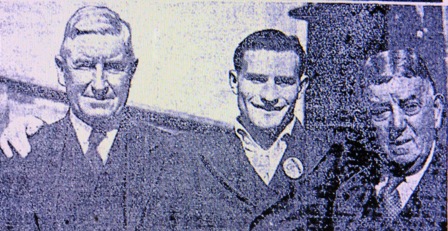
Charlie Graham, left, Mique Fisher, right, with World Middleweight Champion and actor Freddie Steele.

Charlie Graham, left, Mique Fisher, right, with World Middleweight Champion and actor Freddie Steele.

With his friend in charge The Mercury News said Fisher became a fixture “around the San Francisco ballpark ever since Graham bought in on the Seals in 1918,” he would remain a fixture at Recreation Park, and later at Seals Stadium for more than 20 years , and continued to provide copy for West Coast s sports writer

As a result of his friendship with Graham, who recommended he get the honor, 77-year-old Fisher was selected to travel to Cooperstown to represent the PCL at baseball’s centennial celebration in 1939.  The man who so loved seeing his name in the paper  received headlines one more time, when he died in San Francisco on June 6, 1943.