Tag Archives: Philadelphia Athletics

“Hilariously and Shockingly Drunk”

11 Dec

The Philadelphia Athletics were in second place, two games behind the St. Louis Browns in the American association pennant race in June of 1889; but The Philadelphia Times said the team was underachieving, and blamed it on drinking:

“Watch your men, Manager (Bill) Sharsig.

“It is a matter of notorious publicity that a portion of the best players on the Athletic Base Ball Club are not living up to their contracts.  They drink, carouse and make exhibitions of drunkenness that are disgusting the people who so liberally contribute to the support of the national game, and unless the management put an immediate stop to such proceedings the club will be certain to finish the season with a balance on the wrong side of the ledger.”

The paper said because it was “unjust to criticize the club as a whole” they would name the guilty parties:

“It is an open secret that (Denny) Lyons, (Curt) Welch, (Mike) Mattimore, (Henry) Larkin, (Harry) Stovey and sometimes (Frank) Fennelly and (Lou) Bierbauer are frequently in a beastly state of intoxication, and it is easy to prove when and where they have recently been seen so in public places.”

The Times singled out Welch, who was out of the lineup because Sharsig said he was ill:

“Sick he may be, and those who saw him in company with Lyons last Tuesday morning at the early hour of 3 O’clock wonder that he is not laid up.  That model pair were sitting on the curbstone on the South Penn Square side of the City Hall, hilariously and shockingly drunk.

“Saloon-keeper Irwin, who keeps on Juniper Street, told a friend that Welch and another ballplayer became so vulgarly and obscenely boisterous in his place on Monday night that he had to order them out.”

Curt Welch

Curt Welch

The Times said the Athletics loss on June 16—they were defeated 9 to 5 by the Browns—“was largely due to errors made by Welch, Stovey, Larkin and Lyons, all of whom showed traces of their Saturday night’s outing.”

The team’s activities were not limited to Philadelphia, from “every city on the circuit came stories of debauches and sprees,” involving the Athletics:

Chris von der Ahe, of the champion Browns, is responsible for the statement that on the last trip made by the Athletics to St. Louis six of the players became so drunk and noisy in the big Anheuser-Busch saloon that the proprietor had to have then ejected, and a ballplayer on another club that chanced to meet the Athletics in East St. Louis said yesterday that he never saw so many drunken men on one team and that their unseemly conduct was the subject of general talk around the depot.  From Baltimore and Brooklyn come well authenticated stories of boisterous sprees and hilarious conduct in public places.”

The Times said even the most famous umpire of the era, “Honest John” Gaffney, “whom a ballplayer has no truer friend,” commented on the state of the Athletics:

“He says that he has repeatedly seen some of them come up to bat so drunk that they could hardly stand.”

John Gaffney

John Gaffney

The paper said Sharsig, “an exceedingly clever gentleman,” had completely lost control of the team:

“The ballplayers all like him and avow their willingness to do for him whatever he asks, but he is apparently unable to keep them sober even at home and when away they are absolutely beyond his control.  He does not believe in imposing fines…Stovey, Welch and Larkin know that it would be hard to fill their places and laugh at threatened dismissal.”

The Athletics lost six straight games after the story appeared, and 16 of their next 22.  They ended the season in third place with a record of 75-58.

Manager Bill Sharsig

Manager Bill Sharsig

Mattimore was released in August.  Larkin, Bierbauer and Stovey jumped to the Players League after the season ended, and Fennelly was sold to the Brooklyn Gladiators.

Sharsig’s 1890 team led the American Association until July 17, then faded badly and finished in eighth place.  There was no mention in the Philadelphia press about whether drunkenness contributed to the 1890 collapse.

” I had Lamed my Shoulder with Cricket Playing”

5 Dec

Hall of Fame outfielder Sam Thompson was known for his excellent arm.  After four seasons with the Detroit Wolverines, he was sold to the Philadelphia Quakers in October of 1888. Several months after the sale it was revealed that he had a bad shoulder.

Sam Thompson

Sam Thompson

The speculation about how the injury might affect Thompson led The Cincinnati Enquirer to talk to “the old man of base-ball” Harry Wright about the art of throwing:

“Thompson’s trouble was entirely in the shoulder.  His arm muscles or elbow joint never bothered him.  He can, if he chooses, learn to throw without using his shoulder quite so severely as is natural for him.  The correct way to throw is to start the ball at the height of the ear, but after a man has had trouble with any of his throwing muscles he can often change his style of throwing with benefit.  Take Jack Rowe for an example.  He cannot throw naturally, and yet he plays a very good shortstop by snapping the ball with a peculiar wrist motion.  (John) Meister throws in a similar fashion.

Harry Wright

Harry Wright


“When I first tried to play baseball I could not throw twenty yards, and yet I could bowl very effectively.  I had lamed my shoulder with cricket playing.  I knew that I must learn to throw if I wanted to play baseball, so I put in a whole winter of practicing.  I was then living in Hoboken, and every day I would go down to the river and throw stones for an hour or so.  I had to snap my arm and wrist something as Rowe does, and at first, I could not tell where the stone was going to land.  I would throw an old bottle or piece of wood out into the stream and practice at that.  Before spring, I could hit the mark nearly every time, and could throw a ball seventy yards without difficulty.”

“Evans, who, at the Least, is Incompetent”

2 Dec

William George “Billy” Evans was nicknamed “The Boy Umpire” when he was hired by the American League at the age of 22.  After 21 seasons  he became a front office executive, working for the Cleveland Indians, Boston Red Sox and Detroit Tigers; he was also president of the Southern Association, authored two baseball books and in 1973, 17 years after his death, was elected to the Baseball Hall of Fame.

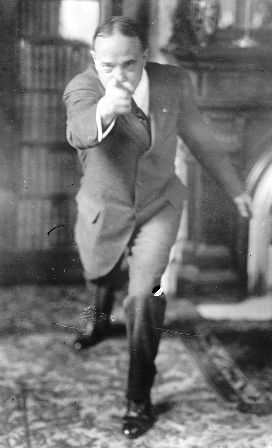
Billy Evans

Billy Evans

But during his first season as an umpire, 1906, he was not held in high esteem in Chicago.

On September 10 the White Sox were in second place, a game behind the New York Highlanders.  The Sox trailed the Tigers 2 to 1 in the 9th inning.  Chicago shortstop George Davis laid down a bunt and was called out at first by Evans.  Every Chicago paper said Evans beat the throw by “at least a step.”

The call precipitated a near riot.  The Chicago Tribune said:

“Instantly a shower of bottles from the first base bleachers drove the umpire, coacher, and players away from the vicinity of the base.”

After the next two batters were retired:

“Evans walked off the field amid another volley of bottle from the third base stand.”

The Tribune and The Chicago Inter Ocean said Evans and fellow umpire Tommy Connolly were mobbed by fans as they attempted to leave the ballpark with a police escort.  Both papers said “one or two blows” from fans connected with the umpire during his retreat.

The Inter Ocean said, “Evans has been the most heartily reviled arbiter that ever worked in any league.”

The Tribune said two weeks earlier Evans cost the Sox a game in Philadelphia.  After Chicago scored two runs in the top of the sixth inning to take a 5 to 4 lead, Evans “let the Athletics take advantage of his inexperience,” and stopped the game on account of rain with two men out in the bottom of the inning.  The Inter Ocean said, “(Sox Manager Fielder) Jones and (second baseman Frank) Isbell nearly came to blows with the umpire and members of the Athletic team.”

After a half hour, the game was called and the score reverted back to the end of the 5th inning, giving Philadelphia a 4 to 3 victory.

The next day, September 11, the Sox played the St. Louis Browns at South Side Park.  Evans worked the game along with Jack Sheridan.  The newspapers said Sox owner Charles Comiskey had discontinued the sale of “bottled goods” at the park that day.

The Browns won 7 to 3, and the Chicago press put much of the blame for the loss on the rookie umpire.

The Tribune said:

President (Ban) Johnson’s persistence in sending Evans, who, at the least, is incompetent, is giving baseball a black eye in Chicago.  Half the crowd believes the charges that Evans is working under instructions from Johnson to beat Chicago.  These charges undoubtedly are founded on mere prejudice, yet, had Evans been under instructions and trying to beat Chicago, he could not have done better than he did yesterday.”

The Inter Ocean said the Browns “were aided and abetted by Umpire Evans, the boy wonder…Why Ban Johnson insists upon sending the joke to officiate at important games is more than any sane man can see.”

But the Evans’ most ardent critic was William A. Phelon, sports editor of The Chicago Journal:

“Umpire Evans is the worst that ever yet came down this or any other pike in the history of the modern universe…And Ban says he is the best in the game.  We are not selfish and we are willing to let some other city endure him.  We can get over the shock of his removal.  If he doesn’t move he may have a statue down on the lake front, a statue 200 feet high made of bottles.  Give us liberty, give us death, give us any old thing, but, by the snakes of old Ireland, give us an umpire!”

Phelon also said Evans “seems to be a gentlemanly individual, whose place in life is evidently a long ways from the profession of umpiring.”

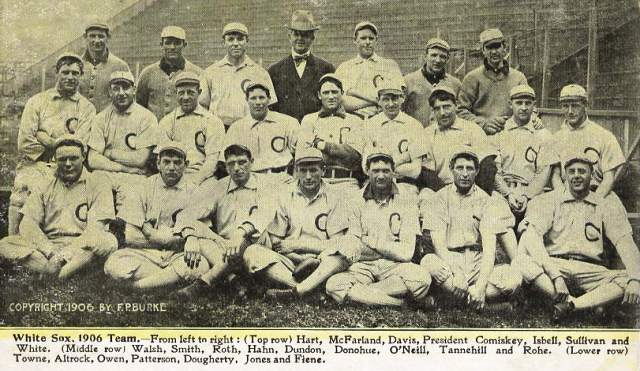
1906 White Sox

Despite the blame heaped on the young umpire in the press, the White Sox went 17-7 the rest of the season and won the pennant by three games.  They went on to beat the Chicago Cubs 4 games to 2 in the World Series.

Things got better for Evans as well.  He worked his first World Series in 1909—the youngest umpire to do so– and participated in five more from 1912 to 1923.  He was the third umpire to be elected to the Hall of Fame; Connolly and Bill Klem were the first two.

Sam Barkley and the Mobster

29 Oct

Samuel W. Barkley’s brief career on the diamond was highlighted by two legal disputes over his services; his life off the field was more complicated and interesting.

Barkley rose from amateur and semi-pro teams around Wheeling, West Virginia, to a solid season (.306, league-leading 39 doubles) as a 26-year-old rookie with the Toledo Blue Stockings in the American Association in 1884. Among his teammates in Toledo were Fleetwood and Welday Walker.

Toledo was only a major league franchise in 1884—The Toledo Blade said the team had lost “nearly $10,000–and disbanded,” selling five players, including Barkley, to the St. Louis Browns—the sale included pitcher Tony Mullane, who attempted to sign with Cincinnati after agreeing to sign with St. Louis, leading to his year-long suspension. By the time all the legal wrangling was done, only Barkley and Curt Welch reported to the Browns.

After a .268 season in St. Louis, owner Chris Von der Ahe sold him to the Pittsburgh Alleghenys, but Barkley had already signed a contract with the Baltimore Orioles. The American Association suspended and fined Barkley; Barkley sued. The dispute was settled with Barkley being reinstated and Pittsburgh paying the fine on his behalf.
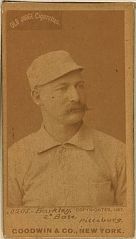
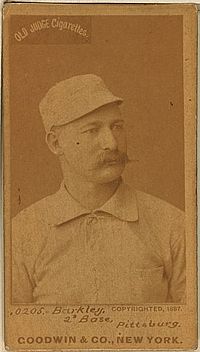
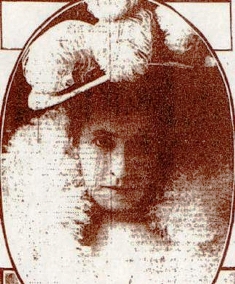
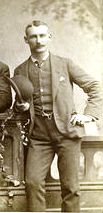
Sam Barkley

Sam Barkley

After two years in Pittsburgh, he was purchased by the Kansas City Cowboys, and that’s when his life got more interesting.

In Chicago, he met an 18-year-old woman named Dora Feldman, who followed him to Kansas City, where as The Toledo News-Bee said, “most of his money was thrown at the feet of the young woman.”

The Chicago Inter Ocean said Barkley claimed, that the day before he married Dora, “she went to her room in a Kansas City hotel and took poison, fearing he would not marry her.”

Despite the suicide attempt, the two married.

He hit just .216 in 1888 but was hitting .284 the following year when he was sold to the Toledo Black Pirates in the International League. After just 50 games there his career was over. At some point during the 1888 season he suffered a knee injury he said ended his career:

“I knocked a safe one to left field, and was dancing around between first and second bags when (Mike) Mattimore, the Philadelphia (Athletics) pitcher attempted to catch me napping. He ran to the base line, and as I attempted to slide back to the first bag he unintentionally gave me the ‘knee’ and it injured severely the knee cap on my left leg.”

With his playing days behind him, Barkley, who was reported to have made as much as $1,800 a season with the Alleghenys, returned to Pittsburgh with a young wife who had aspirations to be an actress and opened a cigar store.

It didn’t end well.

After just more than a year in business, The Pittsburgh Press said Barkley’s store on Smithfield Street closed by order of the sheriff, due to “claims aggregating $3,600.”

The couple moved to Chicago.

Initially, things went better there.

Barkley opened a tavern at 292 West Madison Street, and he and Dora had a son who was born around 1895.

Shortly after they returned to Chicago Dora met Chicago’s first crime boss Michael Cassius “Mike” McDonald.

Richard Henry Little of The Chicago Tribune said McDonald, “never held office but ruled the city with an iron hand.”

McDonald built a gambling and protection syndicate, controlled the Garfield Park racetrack, and solidified his control of the city as leader of the local Democratic Party. He was also heavily involved in legitimate businesses—he owned The Chicago Globe newspaper and financed the building of Chicago’s first elevated rail line.
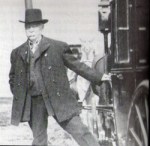
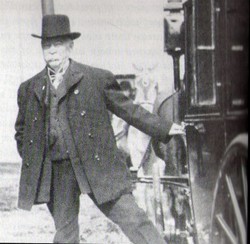
Mike McDonald

Mike McDonald

Years later Barkley told The Inter Ocean about his wife’s first meeting with McDonald:

“She was introduced to him at a box party in McVicker’s Theater shortly after the close of the big fair (World’s Columbia Exposition), in 1893…I remember the night distinctly. Dora came home to our place at 319 Washington Boulevard and told me that she had met a very fascinating old man (McDonald was 44), who was reputed to have a lot of money.

“’Watch me get a piece of that money,’ Dora said to me, jestingly, and fool that I was I laughed at the supposed joke.”

Dora Feldman Barkley McDonald

Dora Feldman Barkley McDonald

There are several versions of what happened next. One involves an elaborate (seemingly too elaborate) story that suggested Barkley was lured by a friend of McDonald into a compromising position involving women and drugs—only to be “caught” by his wife. The more likely version was that he was simply paid off—The Inter Ocean said he received $30,000 to divorce Dora.

Barkley never acknowledged receiving the money and only said:

“(Dora and McDonald) had planned between them to oust me, and no matter what I might have done, it would have been all the same in the long run. With his money and his influence, McDonald could put it over me any time he wanted.”

Dora eventually became McDonald’s second wife in 1898, (his first wife, who once shot a police officer—she was acquitted—had eloped to Europe with a soon to be former priest).

By 1897, Barkley had opened a new tavern at 15 North Clark Street, which was frequently in the news.

Sam Barkley

Sam Barkley

The Chicago Tribune called it a “notorious saloon,” and The Chicago Daily News reported on several occasions that the bar had its license revoked temporarily for various criminal activities and violations; in 1900 The Inter Ocean said a grand jury report was “almost an indictment of the city administration for its toleration of the dives, all-night saloons, and resorts for thieves and the depraved.” Of Barkley’s location the grand jury said:

“Men and women drinking, swearing and carousing, with music; open after midnight in the past. Several murders have been committed in front of this door.”

As with all such “clean-up” drives during that era in Chicago, nothing came of the grand jury report.

Dora again made headlines in 1907—and as a result so did her ex-husband.

The Inter Ocean said:

‘Mike ‘ M’Donald’s Wife Kills Artist in His Studio

“Dora McDonald, wife of Michael C. McDonald, millionaire, politician, traction man, and ex-gambler, shot and killed Webster S. Guerin, an artist, behind the locked doors of his studio in the Omaha Building, LaSalle and Van Buren Streets yesterday.”

Barkley was quickly contacted by reporters and told his sad story of how Dora had left him. The paper said:

“The story that Sam Barkley slowly grieved his life away over the loss of his pretty wife is disproved by the discovery of Sam Barkley alive and prosperous in Chicago today.”

Dora McDonald was eventually acquitted, but Mike McDonald did not live to see it, he died during her trial.

Barkley fell on hard times in Chicago soon after the killing. In August of 1908 a six-inning benefit baseball game was played at Comiskey Park between two Chicago City League teams–“Nixey” Callahan‘s Logan Squares and the Rogers Parks–“to raise enough money to start him in the cigar business.”

The Chicago Examiner said, “A fair-sized crowd turned out.”

Fred Pfeffer played first base for the Rogers Parks and “was the hero of the game with two hits besides fielding in grand style,” another former big leaguer, Emil Gross, served as umpire.

Shortly after that Barkley was operating a cigar store in his hometown, Wheeling, West Virginia.

There was one last chapter in the Barkley story. Soon after he returned to West Virginia he was living in poverty and became ill, and died on April 20, 1912. The Chicago Daily News said several days before his death a former baseball acquaintance was summoned to his side:

Billy Sunday called on him. He talked baseball for a while and then religion. At the end Sam liked both equally well.”
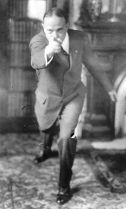
Billy Sunday

Billy Sunday

Dora McDonald was contacted for a comment:

“It is a closed incident—it’s so long ago that I knew him. But I’m sorry.”

She eventually married a doctor, moved to California and died in 1930.

“Johnson can Hit the Ball as far as Anybody”

14 Oct

After Hal Chase replaced George Stallings as manager of the New York Highlanders, Otis “Ote” Johnson was given another opportunity to play for the team.

Highlanders’ second baseman Frank LaPorte and third baseman Jimmy Austin were traded to the St. Louis Browns for third baseman Roy Hartzell.  Chase said he’d move shortstop John Knight to second and playing Johnson at shortstop.

The Sporting Life quoted Chase saying he planned to play Johnson at short “for his batting,” but noted that Johnson “only batted .223 in the fast Eastern League last season.”

Otis "Ote" Johnson

Otis “Ote” Johnson

New York scout Arthur Irwin agreed with Chase that the team needed Johnson’s bat in the lineup, and told The New York Globe:

“Johnson can hit the ball as far as anybody, and what is more he can hit often.”

The New York Herald said:

“Johnson is a beautiful fielder as well as a good hitter, and it is Chase’s intention to have him take the shortstop job.”

That’s where Johnson was on Opening Day, a 2 to 1 victory over the defending World Champion Philadelphia Athletics; Johnson batted seventh, went 0 for two with a walk and a sacrifice, and scored a run.

After sweeping Philadelphia in three games, New York split a four game series with the Washington Senators.

The Washington Herald said New York’s new shortstop “sure looked good, he fielded his position in fine shape,” and “keeps the infield alive with his funny remarks.”

A month after the season began The Indianapolis News said Johnson was “called home (to Muncie, Indiana) by the serious illness of his mother.”  Three days later the paper said he returned to New York “his mother’s condition having considerably improved.”  Within a week of his return the New York papers reported that Johnson had filed for divorce from his wife.

Less than two weeks later Johnson lost his starting job; Knight moved to short and Earle Gardner played second base.

Ote Johnson

Ote Johnson 1911

The San Francisco Chronicle said of the former Pacific Coast League star:

“Ote Johnson has been benched for his weak hitting.  He put up a star game in the field…but Ote did not respond with the hitting which featured his work when he was with Portland.”

Three days after he was benched Johnson left the team again to finalize his divorce.  After returning Johnson became New York’s primary utility infielder until he fell out of favor with Hal Chase.  The manager had been criticised as the team slumped for, as The Globe said “utterly lacking in the qualities for successful management.”

By August the team was fourteen games out of first place and The Herald said:

“Hal Chase, who has been very lenient with his players, is drawing the string tighter.”

The paper said Johnson “has been suspended without pay for violating the club’s rule of discipline.”  It was never revealed what rule was violated, but Johnson was suspended for about a week.  Johnson also hurt his throwing arm in August, further limiting his playing time.

Many in the New York press questioned Chase’s ability as a manager; Wilton Simpson Farnsworth of The New York Evening Journal was the exception.  Farnsworth said of Chase, when the team was 13 games back in August:

“Hal Chase, the game’s greatest first baseman, has made good as manager of the new York Yankees…Knockers claim that poor management is keeping the Yanks down, but forget it! A bad break in luck plus innumerable injuries is the cause.”

Hal Chase

Hal Chase

Regardless of the reasons, 1910’s second place team was limping to a sixth place finish. Chase resigned as manager in November.  Johnson hit just .234 and committed 31 errors in just 65 games.  He was released to the Rochester Hustlers in the International league in December.

Johnson spent just one season in Rochester; he hit .268 and got married; after the season his contract was sold to the Binghamton Bingoes in the New York State League (NYSL).  Johnson protested the pay cut his Binghamton contract called for, and initially threatened to jump to the PCL, he eventually signed a contract and became popular with fans.  He hit the Bingoes first home run of the 1913 season and was awarded with a free daily shave from a local barber and fan named Billy McCann.

He played most of the next three seasons in the NYSL—with the exception of 45-games with the St. Paul Apostles in the American Association at the beginning of the 1914 season.

After playing for the Elmira Colonels in 1915 Johnson recommended two players to his friend Walter “Judge” McCredie on the Portland Beavers—his teammate, pitcher Frank Caporal, and Syracuse Stars first baseman Owen Quinn—and it appeared the 31-year-old Johnson might be heading back to Portland where he remained very popular.

On November 9 Johnson went hunting with friend in Binghamton.  The (Portland) Oregonian said:

“Ote Johnson, famous ‘Home Run’ Ote of the Portland Pacific Coast team of 1907, 1908 and 1909, is dead…It seems Johnson, in company with a party of friends, went forth in search of game and while chasing a wounded fox stumbled and fell, both barrels of the shotgun he was carrying discharged into his abdomen.

“To the older generation of Portland fans Johnson will be remembered for his prowess in poling out long bingles.  He was one of the longest hitters that ever wore the livery of a Coast League club.  Some are prone to argue that he eclipsed the performances of (Frank) Ping Bodie and Harry Heilman, who are now the long-swat stars of the circuit.  Johnson also had a peculiar throw from third that will be remembered–He had a perfect underhand throw and was a wonder at handling bunts.”

He was buried in Johnson City, New York–his pallbearers included several players: Mike Roach, Charles Hartman, Mike Konnick, and William Fischer,

Lost Advertisements–His Big Bat Brings the Bingles

20 Sep

dannymurphyad

A 1910 ad for Kellogg’s Toasted Corn Flakes featuring Philadelphia Athletics outfielder Danny Murphy.

“Speaking of bingles, here’s one of the longest hitting swatters in the game.”

Kellogg’s boxes featured a “new baseball game found printed on every package:”

“For Danny has tried it, and fell down–and this is what he said: ‘The only thing I miss in the home runs.’  But he still sticks at it, for it’s the wildest, newest, biggest fun creator of the age.”

Murphy hit .400 and drove in nine runs during the Athletics four games to one victory over the Chicago Cubs in the 1910 World Series.


Lost Advertisements–Athletics/Cubs 1910 World Series

13 Sep

1910ws2

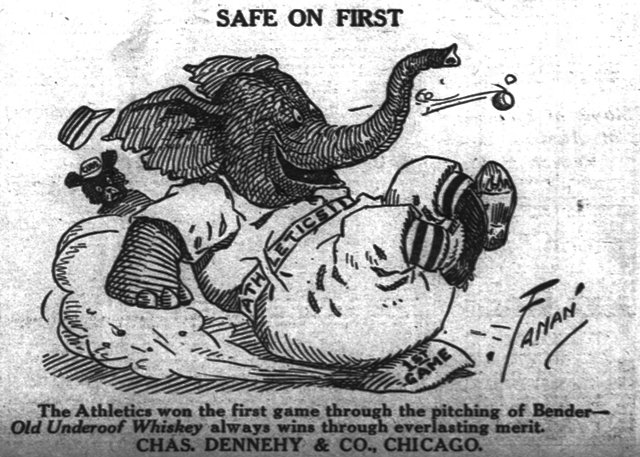
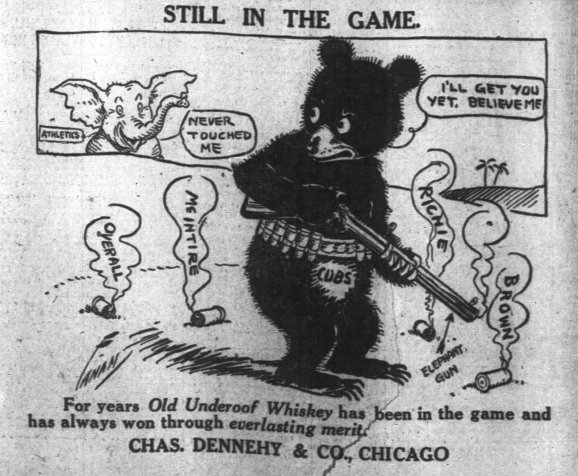
Three advertisements for Old Underoof Whiskey that appeared in Chicago during the 1910 World Series between the Cubs and the Philadelphia Athletics.  The first “Safe On First,”  above, appeared after Charles “Chief” Bender beat the Cubs 4 to 1, giving up only three hits in game one.  The second “Still In The Game,” below, appeared before game three.  The bear is holding as “elephant gun” with four spent shells on the ground–(Orval) Overall, (Harry) McIntire, (Lew) Richie, and (Mordecai) Brown–the four pitchers who gave up 13 runs to the Athletics and the first two games.


The final one, bottom, “No They are Not Dead” appeared before game four.  The Cubs, down 3 games to 0 beat the Athletics 4 to 3 in 10 innings, Brown relieved Leonard “King” Cole in the ninth and got the decision over Bender.  The following day Jack Coombs beat the Cubs and Brown 7 to 2 to take the series four games to one.


1910ws3


1910wscubs

Lost Advertisements–Connie Mack Day in Cleveland

6 Sep

???????????????????????????????

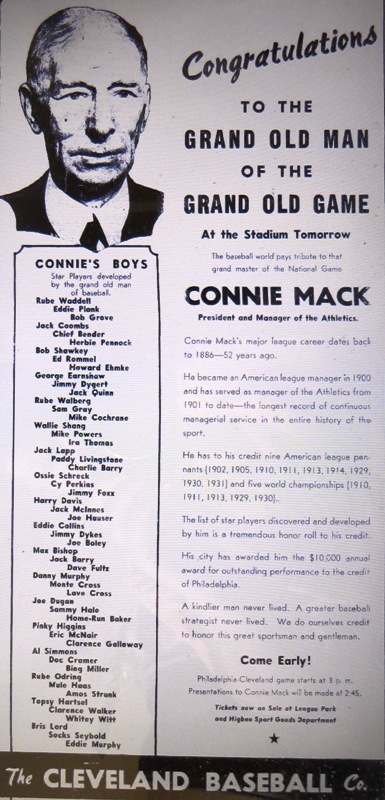
A 1938 Advertisement printed in Cleveland newspapers for Connie Mack Day.

The Philadelphia Athletics manager was honored on June 19 in front of 20,000 fans at Cleveland Stadium.  The ad listed every “star player developed by the grand old man of baseball.”

The baseball world pays tribute to that grand master of the National Game

Connie Mack

President and Manager of the Athletics

Connie Mack’s major league career dates back to 1886–52 years ago.

He became an American League manager in 1900 and had served as manager of the Athletics from 1901 to date–the longest record of continuous managerial service in the entire history of the sport.

He has to his credit nine American League pennants (1902, 1905, 1910, 1911, 1913, 1914, 1929, 1930, 1931) and five world championships (1910, 1911, 1913, 1929, 1930).

The list of star players discovered and developed by him is a tremendous honor roll to his credit.

His city has awarded him the $10,000 annual award for outstanding performance to the credit of Philadelphia.

A kindlier man never lived.  A greater baseball strategist never lived.  We do ourselves credit to honor this great sportsman and gentleman.

The Cleveland Plain Dealer said Mack was presented with “a handsomely bound leather book in which were the signatures of every person in organized baseball from Judge Kenesaw Mountain Landis down to the greenest rookie in the West Texas-New Mexico League.”  Cleveland’s baseball writers also presented Mack with an engraved gold pencil.

The Plain Dealer and The Cleveland News both noted that when Mack addressed the crowd he added an “n” to Indians president Alva Bradley’s first name; The Plain Dealer said:

“Mr. Mack always had a tough time with names of his friends and players.  For years he has called ‘Lefty’ Grove ‘Groves’ and Lou Gehrig “Garridge.’ In fact he never has attempted to call his second baseman, (Dario) Lodigiani, anything but ‘Lodi’ for this season.”

The league-leading Indians beat Mack’s Athletics 5 to 4.

“A Great deal of foolish Sympathy was wasted on Rusie”

5 Sep

Hank O’Day, pitcher and Hall of Fame umpire, said Amos Rusie was the greatest pitcher ever:

“Amos is the greatest pitcher the country ever saw. Why, Rusie had more speed in his curve ball than any pitcher I ever saw before, or have ever since seen, has in his straight fast ones.  Rusie was a wonder—that’s all there is to it.  I was behind the plate one day when one of Rusie’s  fast incurves hit Hughey Jennings…the ball hit Jennings squarely in the temple, and he fell as though shot by a ball from a Winchester rifle.  I caught him in my arms as he toppled backwards—and he was out of his head for three days.” (Contemporary reports of the incident said Jennings actually finished the game, but later lost consciousness for four days)

O’Day was also on the field when Rusie blew out his arm in 1898; Rusie threw to first to pick-off Chicago Orphans outfielder Bill Lange and “his arm cracked like a pistol’s shot.”  In 1940 Lange told his version of the story to The Portland Oregonian:

“Amos Rusie, I don’t know of any better one and I never played against any other one as good.  He had great control, as well as everything else a pitcher should have.  But my base stealing got him.  He worried over it.  I guess he lost sleep over it.  Anyway, one day he showed up on the field and said he had developed a new way to catch me off of first without turning his body.  I was anxious to see what he had, and he caught me off of first.  But—and it was a mighty large but—in doing so Rusie threw his arm out.  And never could pitch in his old form again.”

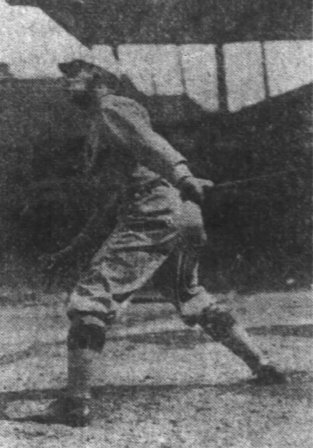
Amos Rusie

Amos Rusie

Rusie, with a dead arm, became a benchmark, an oddity, and a cautionary tale.

He posted a 246-173 record before the injury; after sitting out all of 1899 and 1900 he was traded to the Cincinnati Reds for Christy Mathewson, appeared in three games, was 0-1 with an 8.59 ERA, and his career was over.

In the decade between 1898 and 1908 The Sporting Life christened “the next Rusie,” or “another Rusie” no less than 20 times; scores more were given the same title by newspapers across the country.  Most like Cecil Ferguson (career 29-46), Davey Dunkle (17-30), Cowboy Jones (25-34), and Whitey Guese (1-4) were busts.  The three best were Orval Overall (108-71), who was called the “next Rusie” more than anyone else; Ed Reulbach (182-106), and Hall of Famer Ed Walsh (195-126).

During that same decade there were regular, small items in newspapers about Rusie’s post National League life.  Shortly after his release from the Reds in June of 1901 papers reported that Rusie, “who commanded a salary of many thousands of dollars, is now working as day laborer at $1.50 a day.”   The pitcher told a reporter “This shows I am not afraid to work, but it’s an awful comedown in salary.”

The Dallas Morning News pulled no punches in their assessment of his plight:

“The dismal afterclap to the brilliant career of a once-famous ballplayer whose name was a household word in balldom…reckless wastefulness in financial matters and a total disregard for physical care brought Rusie to his present deplorable condition when he should have been in his prime, for the big fellow is barely 30 now.”

In 1903 it was reported that Rusie had joined the Vincennes (IN) Alices in the Kitty League.  While no statistics survive, he appears to have stayed with the team for most of the summer.  The Detroit Free Press said he was “playing for a salary of $75 per month.”

After the 1903 season he went to work in a lumber yard, and the regular reports on his activities as a “low-wage laborer” appeared regularly in newspapers.  The items became such a regular feature that The Associated Press, in a short story about the Philadelphia Athletics’ eccentric and troubled Rube Waddell in 1904 said:

“Rube has run the gamut of foolishness.  He is in his prime but a few more years of such lack of sense as he displayed last season will send him to the wood pile or coal heap and he will, like Amos Rusie, be occupying two inches in the has-been columns every spring.”

There were multiple reports that Rusie was coming back as a pitcher for the 1906 season.  The rumors started in September of 1905 when Rusie attended an exhibition game in Vincennes between the Alices and the Chicago Cubs.  The Philadelphia Inquirer said of the news:

“If you don’t know the tremendous importance of this announcement you are no baseball fan.”

Not everyone agreed that Rusie returning to baseball would be a good thing.  A report from The News Special Service, which appeared in many Midwest papers said:

“His habits were none of the best, and he rapidly deteriorated in efficiency as an athlete.  He refused to pitch one whole season because he had been fined by the New York (Giants) management for being intoxicated and abusing his wife.  A great deal of foolish sympathy was wasted about that time on Rusie, but he was entitled to nothing except what he received, and some who knew the circumstances thought stricter disciplinary methods would not have been amiss.”

Rusie didn’t sign a contract that spring; and two other rumors that John McGraw had sent him a letter inviting him to spring training with the Giants and that he would return to the Kitty League didn’t materialize either.

But Rusie did make the news again in June.  A man named Gabe Watson was collecting mussels in the Wabash River when his boat when his boat overturned.  The Evansville Courier said Rusie pulled the drowning man from the river.

The nearly annual reports of “Rusie’s return” ended after 1906, but Rusie’s many career, and life changes continued as newspaper copy for the next twenty years.

When pearls were discovered in the Wabash River’s mussels, Rusie became a pearl diver.  Two years later he was in Weiser, Idaho, serving a 10-day sentence for public drunkenness.  In 1910 he was in Olney, Illinois working in a glass factory.  The following year he moved to Seattle, Washington.  For the next decade served as an umpire for a couple of Northwestern League games, worked as a ticket taker and groundskeeper at Yesler Way Park and Dugdale Field, home of the Seattle Giants, and also worked as a steam fitter.  Rusie went to jail at least once while in Seattle, and remained a big enough name that when he was injured by a falling pipe in 1913, it made newspapers throughout the country.

In 1921 Rusie became another in the long line of former players hired by the New York Giants at the behest of John McGraw.  According to newspaper reports McGraw offered the former pitcher a “job for life” as a “deputy superintendent” at the Polo Grounds.  Interest in Rusie’s career was renewed, and the pitcher was regularly interviewed for the next couple of years, reminiscing about his career and about how he’d like to have had the opportunity to pitch to Babe Ruth.

Unlike most of the former players who McGraw found work for at the Polo Grounds, Rusie did not stay for the rest of his life; he returned to Auburn, Washington in 1929 and bought a farm, where he remained for the rest of his life.  He was badly injured in a car accident in July of 1934—The Seattle Daily Times said Rusie’s vehicle overturned and he sustained a concussion and broken ribs.

While he received less attention after being incapacitated after the car accident, Rusie was still mentioned frequently in the press until his death in 1942; contrary to oft-repeated fiction that he died in obscurity.  And his obituary appeared in hundreds of papers across the country in December of 1942.  It wasn’t until the post WWII area that Rusie stopped being a household name, which led to his final comeback in the 1970s; Rusie was inducted into the Hall of Fame 34 years after his death.

“Chief” Bender’s Catcher

3 Sep

Umpire Billy Evans, in one of his syndicated newspaper columns in the fall of 1910, said: “Most every ball player is more or less superstitious, but the pitchers, I believe, are more susceptible to beliefs uncanny than any of the other diamond athletes.”

Evans singled out Charles “Chief” Bender, who had just completed a 23-5 season with a 1.58 ERA for the World Champion Philadelphia Athletics, as one of the most “susceptible.”

Chief Bender

Chief Bender

According to Evans, Bender preferred throwing to catcher Ira Thomas over the team’s other two catchers Jack Lapp and Paddy Livingston:

“Bender has won lots of games with other catchers doing the receiving, but he never seems quite so steady as when Thomas is paired up with him.”

Evans said the preference extended to warming up as well:

“While there are scores and scores of pitchers who have their favorite catchers, still they are content to let one of the other receivers warm them up between innings, but not so with the Chief.  When Bender starts a game he absolutely refuses to throw to anyone other than Thomas.

“It is often the case that when the side is retired, the catcher happens to be a base runner.  Naturally much time is consumed by him in hurrying from the base he occupied to the bench to get his mask, glove and protector, and then back to the plate.  It is customary for most managers under such circumstances, to send one of the other catchers up to the plate to keep the pitcher warmed up.  I have seen Bender refuse at least a dozen times during the past summer to warm up with one of the Athletics other than Thomas.  He waits for Ira and takes a chance on getting cold in preference to putting the “jinx” on himself by tossing the ball to someone else.”

Bender's favorite catcher Ira Thomas

Bender’s favorite catcher Ira Thomas

The feeling was mutual.  In a 1911 article in The Pittsburgh Press, Thomas, who in addition to Bender also caught Jack Coombs (31-9, 1.30 ERA), Cy Morgan (18-12, 1.55 ERA), and Eddie Plank (16-10, 2.01 ERA) in 1910, said of Bender:

“I don’t take my hat off to…any other pitcher when Chief Bender is around.  He is a wonder of wonders.  No one can show me where there is a better pitcher in general.

“Bender has everything a pitcher needs and in a series of seven games he is almost invincible.”

Thomas remained with the Athletics organization for another 40 years as a coach, minor league manager and scout; he finished his scouting career with the Yankees, retiring in 1956.  He died in 1958.

Bender left Philadelphia in 1914 when he jump the Athletics for the Federal League; he returned to the Athletics organization in the 1930s.  He died in 1954.

Bender and Thomas shared a baseball card--the 1912 T202 Hassan Triple Folder

Bender and Thomas shared a baseball card–the 1912 T202 Hassan Triple Folder

The two remained close for the rest of their lives and often appeared together at baseball banquets.  One story Bender always told; the “greatest thrill” of his career, his May 12, 1910 no-hitter against the Cleveland Naps (this version was related in The Trenton Evening Times in 1936).  With two outs in the ninth Cleveland’s Elmer Flick hit a pop-up in front of home plate, the ball initially popped out of Thomas’ mitt before he secured it for the final out:

“Watching Ira juggle that ball and then hold it was my greatest thrill.”