Tag Archives: Philadelphia Athletics

Lost Advertisements–Danny Moeller Star of the Diamond

19 Aug

danny

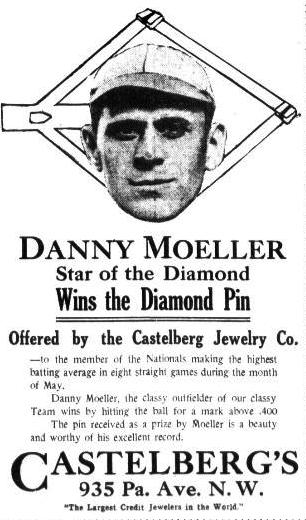
A 1912 advertisement for Castelberg’s Jewelry Company in Washington D.C., featuring Senators right fielder Danny Moeller:

Danny Moeller

Star of the Diamond

Wins the Diamond Pin

On May 1, the jewelry store announced a contest in The Washington Times:

“Beginning today the sluggers begin their battle for the handsome ruby-diamond stick pin offered by the Castelberg Jewelry Company to the batsman of the local outfit who leads with the willow for the month of May…to win the prize a player must participate in at least eight games.”

Throughout the month, the paper kept readers informed with updates of the standings.

Moeller and third baseman Eddie Foster led most of the way.  Moeller, who hit .276 for the season, his .414 during May to win the contest.  Foster was second at .380–he hit .285 for the year.  Clyde Milan (.320), Clarence “Tillie” Walker (.300), and Eddie Ainsmith (.282) followed.

“Danny Moeller, the classy outfielder of our classy team wins by batting the ball for a mark above .400

“The pin received as a prize by Moeller is a beauty and worthy of his excellent work.”

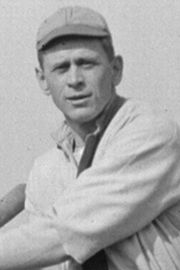
Moeller’s best season was in 1912.  He hit just .243 over seven big league seasons but was a fan favorite for his toughness.

Moeller

Moeller

The Times gave readers an example of his toughness during a game with the Philadelphia Athletics two years later in May of 1914:

“In sliding into second base in the fourth Moeller dislocated his left shoulder and it looked as though he might be out for some time.

“The player walked to the bench with the fin hanging limp and asked (trainer) Mike Martin to help him out.  Martin took one yank, the affected member popped back to its proper place, and Moeller sprinted back onto the field and onto second base.  It was an evidence of the gameness of which those who know Moeller realize.”

Lost Advertisements–Harry Davis for Sweet Caporal

17 Jul

harrydavis

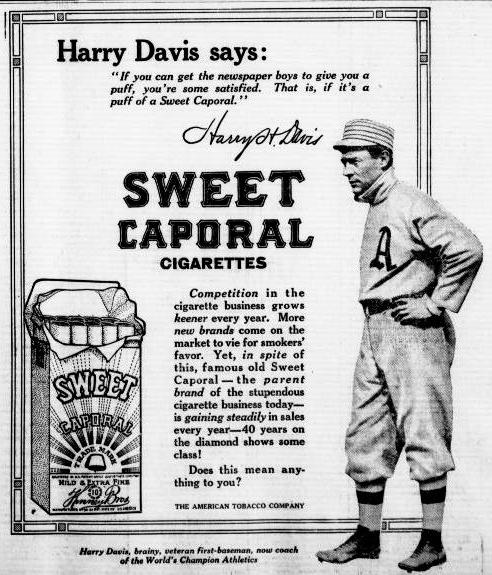
A 1914 advertisement for Sweet Caporal Cigarettes featuring Philadelphia Athletics Coach–sometimes referred to as the team’s “Assistant Manager” after their 1913 World Championship– Harry Davis:

Harry Davis says:

“If you can get the newspaper boys to give you a puff, you’re some satisfied.  That is if it’s a puff of Sweet Caporal.”


“Stars for A’s, Pep for Phils—In Negro Ranks”

13 Jul

The push to integrate baseball in the late 1930s and early 1940s came most frequently from the black press and American Socialists, but occasionally a white voice would call for the color line to be broken.

In May of 1940, with both Philadelphia teams struggling and headed towards last place finishes (Phillies 50-103, and Athletics 54-100), The Philadelphia Record made the case under the headline:

Stars for A’s, Pep for Phils—In Negro Ranks

“Experienced players are available who could strengthen the A’s shaky pitching staff and give the Phils the batting punch they need.  These players could make potential champions out of any of the other also-rans in either major league.”

[…]

“But they are Negroes, and organized baseball says they can’t come in.”

The previous season, Phillies Manager James Thompson “Doc” Prothro, a Memphis native, told The Pittsburgh Courier he would welcome players from the Negro Leagues on his club:

“I certainly would, if given the opportunity to sign up a good Negro ball player.  I need good players, and if I ran across a colored boy who could make the grade I wouldn’t hesitate signing him.”

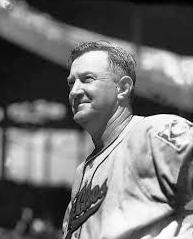
Doc Prothro

Doc Prothro

The Courier’s Wendell Smith said that when the Phillies manager made the statement:

“Prothro draped his right arm across our shoulders and we walked along, as though to assure us he realized the unfairness of the major league color line.  It seemed he wanted to convince us that he was against it as much as we were.”

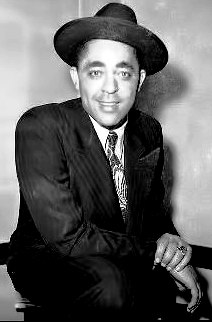
Wendell Smith

Wendell Smith

Now as Prothro and the Phillies headed towards their second straight 100 loss season, one of Philadelphia’s daily papers agreed that it was time:

“In all baseball law there is not a single line barring colored players from the game.  Several major league managers have said they would jump at the chance to sign the best of them.  Some owners have declared they would vote to admit them.

“But no vote ever is taken on the subject.  No manager or owner dares defy the Jim Crow tradition which in the past has been the most inflexible unwritten law in the game.”

Most importantly, the paper said, the “unwritten law” had left a key group out of the decision:

“No one seems to have consulted the fans…There is an even chance—and a whole lot more—that a few thousand fans who have been staying away from the A’s and the Phils might turn out to see what (Satchel) Paige and (Josh) Gibson and a few more like them, might do in the major leagues.”

The Record never followed up on their call to integrate.  The issue was forgotten in Philadelphia.  As both teams limped to their last place finishes the fans that were never consulted on the issue stayed away in droves. The Athletics drew 432,135—sixth out of eight American League teams.  The Phillies had the worst attendance in the major leagues, just 207,177.

Lost Advertisements–“The World’s Best Pitchers Recommend…”

8 Jul

adreach

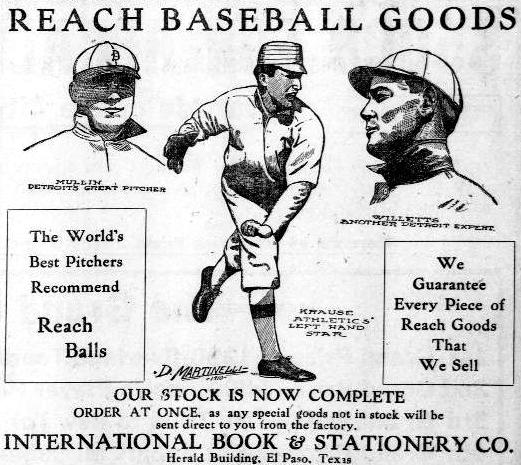
A 1910 advertisement for Reach Baseball Goods  “The World’s Best Pitchers Recommend Reach Balls”–from International Book & Stationary Co. in El Paso, Texas.  The ad features “Detroit’s Great Pitcher,” George Mullin, “Another Detroit Expert,” Ed Willett (Misspelled Willetts in the ad), and “Athletics’ Left Hand Star,” Harry Krause.

In 1909, the 20-year-old Krause, who had been 1-1 in four appearances with the Athletics in 1908, became the talk of baseball when he opened the season with 10 straight victories–including six shutouts.  A San Francisco native who played under Hal Chase and was a teammate of Hall of Famer Harry Hooper at St. Mary’s College, Krause was asked by The Oakland Tribune what led to success:

“That’s easy.  A capable manager in Connie Mack, one of the best pitching tutors in the world in Ed Plank, fairly good control on my part and lots of luck.”

The Tribune‘s scouting report on Krause:

“He has a good curve, but many pitchers in the league have a better one.  He has speed, but any number of American League twirlers have more smoke than he.  However, there are very few twirlers, whether right or left-handers, who can equal him in control of the ball.

“He doesn’t appear to have much to the opposing batters when they first face him, but when the game is over they wonder how it came to pass that he let them down with three or four hits and no runs.”

Harry Krause

Harry Krause

On July 18 his luck ran out, Krause dropped his first game of the season, an 11-inning, 5 to 4 loss to the St. Louis Browns.

He went just 8-7 (with one shutout) the rest of the season, but led the league with a 1.39 ERA.

He appeared in only 55 more games over three seasons, winning 17 and losing 20, before a sore arm ended his major league career at age 23.

He finished the 1912 season in the American Association with the Toledo Mud Hens, then returned to California and pitched for 15 seasons in the Pacific Coast League (with a one-season detour to the western League), where he won 230 games.

“He is a $900 Man”

6 Jul

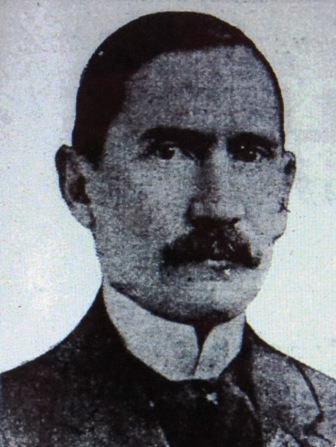
Frank Leonardo Hough had a major conflict of interest. While sports editor for The Philadelphia Inquirer, he also held a 12.5% interest in the Philadelphia Athletics from the club’s inaugural season until 1912—he also served as the team secretary for several seasons while working at the paper. Another Philadelphia sports writer, Sam Jones of The Associated Press also held a 12.5% interest in the team.
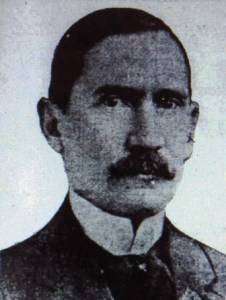
Frank L. Hough

Frank L. Hough

Perhaps it was Hough’s close association with an American League team that made him one of the most vocal advocates for the rights of current and former National League players while the leagues battled for stars.

In 1902, he told his readers the story of how William “Bill” Duggleby, who jumped from the Phillies to the Athletics after the 1901 season, was treated—Hough said he was, “Human Chattel”–while a member of the Phillies:

“These are the facts:

“William Duggleby, pitcher played with the Auburn Club, of the New York State League, during the season of 1897. In the fall of that year, he was drafted by the Philadelphia Ball Club.”

According to Hough, Duggleby was offered $900 for the season, a $25 raise from his salary in Auburn.

Hough pitched just nine games for the Phillies in 1898 and, “was farmed or rented,” to minor league clubs for the remainder of 1898 and in 1899 and 1900.

“Thus it will be seen that although he was under the absolute control of the Philadelphia Club from 1897, he played only a few games in the season of 1898 with that organization. He had no control over his own services. He could not even say where he would play, or where he would not play. That matter was determined by the treasurer of the Philadelphia Ball Club.”
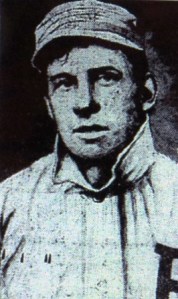
William Duggleby
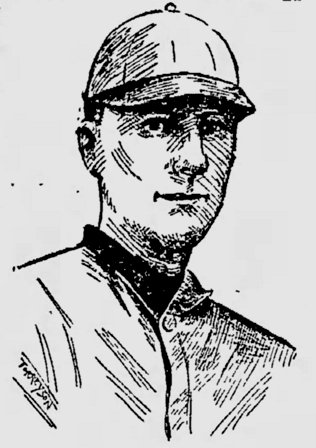
William Duggleby
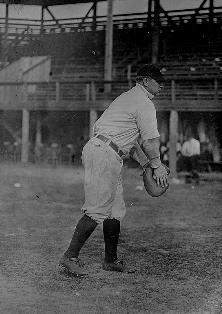
Hough noted that while Duggleby, “developed considerable skill,” and had three good seasons in the Eastern League (12-11, 22-16, 17-10) drawing considerable interest from a “half dozen” major league teams, he only received $900 from the Phillies each season:

“The clubs that rented Duggleby did not know him in the financial end of the transaction at all.

“Had Duggleby the right to sign wherever he could have made the best bargain he would have undoubtedly received at least $1800 a season for his services—just twice as much as received under the White Slave system of the National League.”

Hough said Duggleby likely only had six to 10 years total earning power and “lost three years in which he should have received a salary somewhere commensurate to his ability.”

That, however, said Hough, was not the worst of it. In 1900, Duggleby was with the Toronto Canucks, who paid the Phillies, “$225 per month for his services,” while Duggleby was paid just $150 a month.

“No convict from a Texas or Georgia penitentiary was ever rented or leased to break stone on a quarry or repair roadways in colder blood than was Duggleby to the Toronto Club.

“If Duggleby was not a white slave in a free country, what in the name of all that is fair was he?…Of course, Duggleby did not have to wear ball and chain—that might have interfered with his playing ability. But he had no more control over his actions than would the most hardened criminal consigned to the quarries.”

Just days after Hough made the case for Duggleby’s victimhood—and after he appeared in just two games for the Athletics— the pitcher returned to the Phillies. Said to have been paid $3250 by the Athletics, Duggleby accepted a $2400 contract with the Phillies. He told Sporting Life:

“There was no great reason for my going with the American League in the first place, but after I had given my word to go with Connie Mack’s team I did not feel like breaking it. Then came the decision in the (Napoleon) Lajoie case, and a notice from Manager (Bill) Shettsline to report to him or meet with the same fate as Lajoie. I went to see Shetts at once and asked him if the club really intended to proceed against all players that were under reserve. He assured me that they would. Well, under the circumstances I saw nothing for me to do but go back to the National.”

Hough’s tone changed considerably after Duggleby left the Athletics; in addition to his paper referring to the pitcher in a headline as a “Vertebraeless Youth,” he said:

“Without awaiting the outcome of the efforts to be made today to secure an appeal (in the Lajoie case)… (Duggleby) runs to cover like a frightened hound…Evidently the treasurer of the Philadelphia Ball Club sized up Duggleby right in the first place. He is a $900 man.”

Duggleby, who posted a 20-12 record for the Phillies in 1901, only had one winning season after (18-17 in 1905). He pitched in the major leagues until 1907.

Duggleby had one other distinction: During his initial trial with the Phillies in 1898, he hit a grand slam in his first major league at-bat on April 21–for 70 years he remained the only player to hit a grand slam in his first game until Bobby Bonds hit one during his debut (his third at-bat) on June 25, 1968; Jeremy Hermida equaled the feat in his first major league at-bat in 2005.

Hough remained a stockholder and officer with the Athletics while simultaneously reporting on baseball for The Inquirer, until he sold his interest to Connie Mack in 1912. He was the paper’s sports editor until his death the following year. (While Hough’s middle name was said to be Leonardo throughout his life, his Pennsylvania death certificate lists it as Lewis)

Things I Learned on the Way to Looking up other Things #15

17 Jun

Fullerton’s Prediction

Seven years before he watched the events of the 1919 World Series unfold from the press box, Hugh Fullerton warned readers of The Chicago Record-Herald:

“Baseball as a great national sport is in greater peril today than ever before.  Not until the present week did I realize this fact.  The gamblers, bookmakers and handbook men, who ruined horse racing…and who made fighting a noisome scandal, have attached themselves to baseball this year as never before”

Hugh Fullerton

Hugh Fullerton

“The King of them all for Superstitiousness”

In 1916, Napoleon Lajoie, then a member of the Philadelphia Athletics, told The Cleveland Press:

“I have known many a ballplayer who collected hairpins, held his breath if he saw a circus horse, but Bill Armour was the king of them all for superstitiousness.

Bill Armour

Bill Armour

“If you put a ladder in front of the door to his room Bill would have jumped out of the window sooner than have come under that ladder.  I think he would have stayed in there and starved to death rather than let the ‘jinx’ take him overboard because he went under a step-ladder.   Me?  No, I am not superstitious, it’s all nonsense.

“Going to fetch me a black cat?  Don’t bring it up here; we have enough bad luck as it is without any black cat hanging around the clubhouse.”

Napoleon Lajoie

Napoleon Lajoie

Black cat or not, Lajoie was correct about the Athletics “bad luck.”  The team finished in eighth place with a 36-117 record.  The forty-one-year-old Lajoie hit just .246; 92 points below his career average.  He retired at the end of the season.

“Any old Manager can run a Team of real Baseball Players”

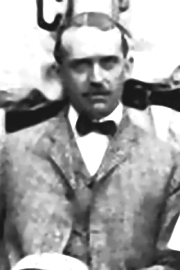
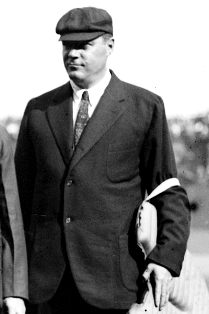
Bill Dinneen pitched in the major leagues for 12 seasons, and a month after his playing career ended he began his 28-year tenure as an American League umpire

Bill Dinneen

Bill Dinneen

In 1910, he told Joseph Samuel “Joe” Jackson, sports editor of The Washington Post, how major league clubs should allocate money:

“’If I were a club owner, I would invest $15,000 in a scout and $5,00 in a manger  And old manager can run a team of real baseball players  But the best leader in the world can’t make bad material good  Every major league team needs a thoroughbred judge of raw material more than a teacher of baseball tricks’’’

Jackson said Dinneen’s observation confirmed what he thought while watching the Philadelphia Athletics beat the Chicago Cubs four games to one in that year’s World Series

“His remarks come merely to emphasize what the world’s series showed—that a club that is hitting the ball over the lot, and giving its pitchers support, will set at naught all schemes to beat it by carefully thought out plans that might be applicable if the other fellows would stop making so many base hits”

“Babe Ruth has a Locker full of Charms”

13 May

Eddie Collins had spent 25 years in the major leagues as a player, coach and manager by 1930 when he spoke to a writer for “Every Week Magazine” about superstitions.

Eddie Collins

Eddie Collins

The article noted:

“Collins, by the way, has been credited with being one of the most superstitious players in the national game.  His habit of sticking a piece of chewing gum on the button of his cap has almost become a tradition.  If the pitcher had two strikes on him, Eddie would jerk off the cap, yank the gum from the bottom, stick it in his mouth and chew violently.”

But, Collins, a graduate of Columbia University, didn’t consider himself superstitious and told the magazine:

 “The average man playing professional baseball today is too well-educated actually to believe you can make home runs by picking up hairpins or adopting any of the other numerous superstitions which have come to be so much part of the game. “

As for the obvious superstitions he and many other players, educated or not, subscribed to, Collins said they were merely “eccentricities,” and that “Having them gives confidence.”

That said:

“The late George Stallings was one of the most sensible men baseball has produced.  He was the personification of common sense and one of the last persons in the world you would credit with being superstitious.  Nevertheless, a single scrap of paper tossed on the ground in front of the dugout meant all sorts of bad things to George. It upset him completely and his managerial skill seemed to fade.”

George Stallings

George Stallings

Joe Sewell of the Cleveland Indians was another “college man,” someone who “generally loses any belief in omens.”  But, Sewell “after his last crack at the bat during practice” insisted on running towards third and touching the bag before anyone else did.  One day in Cleveland, the too educated to be superstitious Sewell started towards third, only to see Collins, also too educated to believe in superstitions, had:

“(D)ashed out of the Athletics’ dugout and touched the sack ahead of Joe and Joe didn’t get a hit during the afternoon.”

Joe Sewell

Joe Sewell

Next was Urban Shocker, who insisted no one touched his glove during a game.  Despite being “too wise a man to believe” such a thing, Collins told how during a game against the Athletics, “Eddie Rommel spotted the glove and knowing Shocker’s eccentric regard for it, walked over and picked it up, examined it and then tossed it back on the turf.”  The “too wise” Shocker:

“(S)aw red.  He became visibly unsettled.  He blew up the next inning.”

As for the game’s biggest star:

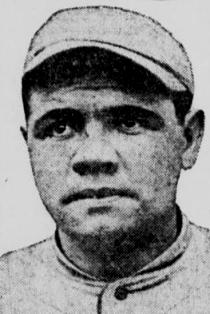
Babe Ruth has a locker full of charms, fetishes and tokens; fastened to the door is a wooden horseshoe with a four-leaf clover carved on it, and on top stands a totem pole and other curious objects guaranteed by enthusiastic donors to bring luck.”

Babe Ruth

Babe Ruth

Collins said the previous season when the Athletics were on their way to Chicago for game 3 of the World Series with the Cubs:

“(T)here was a fan on the train with us  who had a great fondness for canned pineapple.  He insisted the players eat some the morning of the game predicting we’d win if we did.  Well, we did, and we won.”

Collins said he, and the rest of the Athletics, too smart for superstition:

“Had pineapple every morning the rest of the series.”

Lost Advertisements–Fit for a King

1 May

fitAn ad for Old Underoof Whiskey from April of 1910.  Chicago White Sox owner Charles Comiskey–and Chicago fans–had great expectations for the club.  After a disappointing 78-74 record and a fourth-place finish in 1909, Hugh Duffy was hired to replace Billy Sullivan as manager.

Comiskey also replaced his entire starting infield, purchasing the contracts of three minor leaguers: first baseman Chick Gandil, second baseman Rollie Zeider, and shortstop Lena Blackburne, and installing utility infielder Billy Purtell at third.

The new 1910 White Sox infield.

The new 1910 White Sox infield.

The Chicago Tribune said the Sox were now:

“Resplendent with brand new darns where were worn the biggest holes last year.”

Comiskey was confident enough to tell reporters the team “(W)ill lose their name of hitless wonders this year. I am confident we will be as strong as any club in the league in this department.”

He also maintained that Ed Walsh, Doc White, Jim Scott, and Frank Smith, who would start the opener on April 14, comprised “(T)he strongest staff of pitchers in any league.”

The Sox did not disappoint on opening day.  Behind Smith’s one-hitter, the Sox defeated the St. Louis Browns 3 to 0.

The Chicago Inter Ocean said the “New Sox lived up to every inch of the reputation they have gained this spring.” The Tribune dubbed the team “Commy’s Comets,” and said:

“When the dazzling display was over Comiskey’s face resembled the noonday sun wreathed in an aureole of smiles, which extended beyond the rings of Saturn and half the distance to the milky way.”

Old Underoof commemorated the victory with a new ad:

commy1910

The Sox quickly returned to earth and lost their next four games.  Things never got much better.  A month into the season they were 10 games out of first place; they finished 68-85, in sixth-place 35.5 games behind the Philadelphia Athletics.

With a league-worst .211 batting average, the they failed to ” lose their name of hitless wonders,” as Comiskey predicted.

As for “the strongest staff of pitchers in any league,” they could not overcome the horrible support they received all season.  Despite a 2.03 team ERA, second only to Philadelphia’s 1.79, only Doc White (15-13) had a winning record.

Walsh, who led the league with a 1.27 ERA,  was 18-20, and Scott was 8-18 with a 2.43 ERA.

Frank Smith, the 30-year-old hero of the opener, who had won 25 games with a 1.80 ERA in 1909, was 4-9, despite a 2.03 ERA and three shutouts, when he was traded with Billy Purtell to the Boston Red Sox in August.


Tragic Exits 3

23 Mar

Eddie Meade

Edward “Eddie” Meade appeared headed to the big leagues.  After beginning the 1926 season with the Kinston Eagles in the Virginia League, the 24-year-old left-hander was acquired at midseason by the St. Paul Saints of the American Association and posted a 12-7 record with a 3.40 ERA in 22 games.

Meade began the 1927 season with a 6-0 shutout of the Louisville Colonels on April 17.  The same week he recorded his first victory, The Associated Press said he was about to become a member of the defending American League champions:

“The Yankees talked of possible reinforcements in the shape of Eddie Meade, of St. Paul, called the best young pitcher in the American Association.”

Eddie Meade

Eddie Meade

During the same week, Meade became ill; although the nature of the illness was never disclosed.  Eight days later he started a game with the Columbus Senators but was pulled after giving up six runs in the fifth inning of 9 to 8 loss.  Five days later he pitched in relief against Louisville, but The Minneapolis Journal said he lasted less than an inning due to his “impaired physical condition.”

When the Saints left Minnesota for a series in Kansas City on May 16, Meade stayed behind.  The following evening Meade checked into St. Paul’s Boardman Hotel and shot himself to death.

The day after his suicide, The Journal said, “it was learned today that Meade was slated to go to the New York Yankees in the fall.”

St. Paul Manager Nick Allen told The Associated Press:

“He was one of the hardest working youngsters we ever had on the club and the outlook for his future was bright, as he had only two years in baseball.  The only motive he could have had for such action would be mental depression.  He was not married.  The nature of his illness was no cause for alarm, but he apparently believed it otherwise.”

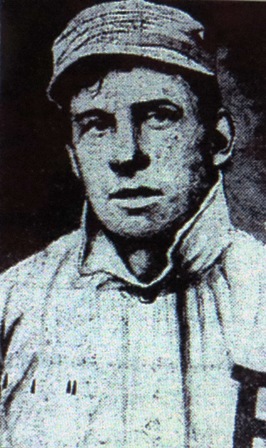
Tommy Coates

Thomas A. “Tommy” Coates was born in Omro, Wisconsin on February 18, 1886 (Baseball Reference lists his middle initial as “O” but birth and death records  list it as “A”).

After starring, along with his older brother Hiram, on Omro High School’s undefeated baseball team in 1901—The Omro Herald called the team “possibly the best in the state”—Coates played industrial league and semi-pro ball in Central and Northern Wisconsin.

After playing in Rhinelander, Wisconsin in 1908, The Oshkosh Northwestern said:

“Coates had lots of confidence in himself, and during the winter months the Omro boy came to the city one day and sought out “Pink” Hawley. Hawley agreed to give him a trial.”

Emerson Pink Hawley, a Wisconsin native who pitched in the major leagues for a decade, was the manager of the Oshkosh Indians in the Wisconsin-Illinois League.

Tommy Coates

Tommy Coates

 “Coates came to this city from his home at Omro (for his tryout).  He donned baseball togs and he ‘made good’ from the start.”

Coates, who The Northwestern said  was “tall (and) built something like the great Ty Cobb,” became the Indians starting left fielder one week into the season and went on to lead  the team with a .299 batting average (he hit .002 better than his 19-year-old teammate Heinie Groh).

In September, The Sporting News reported that with just one season of professional experience, Coates “Looks good to Connie Mack,” and was drafted by the Philadelphia Athletics. He was the only member of the Indians drafted by a big league club in 1909.

At season’s end in September, Coates, with an invitation to train with Mack’s club in the spring, spent most of his time hunting.

On October 11 Coates was in a row-boat with a friend, hunting in a marsh near Omro.  The friend told The Omro Herald:

“Tom saw a mud hen rise up on the right hand side.  He turned about quickly and took hold of his gun which was at his left side and pulled it toward him…I turned about as soon as I heard the shot, and to my horror saw Tom lunge forward.”

Coates accidentally discharged his gun, shooting himself in the left eye.

Twelve days after the Oshkosh Indians received a $300 check from Connie Mack—his draft price—Coates was dead.

The Northwestern said:

“He was quiet and unassuming. After making a sensational play in the field or batting out the hit that won the game…the Oshkosh fans could not induce Coates to doff his hat.  He would return to the bench with face covered with blushes.”

[…]

“His more ardent admirers were confident he would make good in the American League, and one of their first thoughts upon hearing of the unfortunate accident, was the promising career he had before him.”

“Why not bring one of the Big League Teams to Phoenix for Spring Training?”

18 Feb

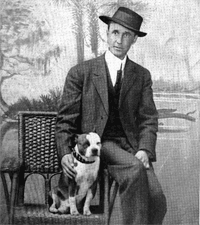
Grover Cleveland Land was a visionary.

In 1921 The Arizona Republican asked the question the former catcher had put to several major league clubs:

“Why not bring one of the big league teams to Phoenix for spring training?”

Land, a Kentucky native who spent the last 40 years of his life as a Phoenix resident,  was encouraged by a report that Connie Mack had announced that his Philadelphia Athletics would no longer train in Lake Charles, Louisiana;  according to The Associated Press Mack said “certain things happened at the Louisiana resort last March that handicapped” the team.

Grover Land

Grover Land

Land, the former catcher for the Cleveland Naps and the Brooklyn Tip-Tops, said:

“I have played ball in every section of the country, and I have yet to find a climate more suited for baseball training than I find right here in Phoenix…Major league managers have been sending their players to Texas and other southern states for many years and I can safely state that there is not one manager entirely satisfied with the present training camp sites.  Fully one-third of the training period is hampered by rain and storms and by the time the training season is ended the players are just beginning to round into shape.”

He said he understood that “local boosters” had made some effort to bring teams to Arizona in the past—the Chicago White Sox, Cubs, and Pittsburgh Pirates had played spring exhibition games in the state several times since 1909—but Land said he would “make an effort to induce one of my manager friends to come down here…I am certain that if one of the managers could be induced to come here for a few weeks Phoenix would have no difficulty getting on the sport pages.”

He said the local chamber of commerce was getting behind the push, and that he had “already written to one of the major league managers and I have been corresponding with several sports writers in the east,’ to make the case for Phoenix.

“If the local fans get behind the move and convince Connie Mack that they want his team here next spring I have every confidence that the Philadelphia Athletics will do their 1922 training in Phoenix.”

Land was a bit overconfident in regard to Philadelphia; Mack chose to take the Athletics to Eagle Pass, Texas in the spring of 1922.

No team would train in Arizona until 1929—the Detroit Tigers came to the state for one season—but chose California the following year.

The Detroit Tigers in Arizona, 1929

The Detroit Tigers in Arizona, 1929

But Land, who died in 1958, lived long enough to see his adopted home become the spring training location for four clubs.