Tag Archives: Philadelphia Athletics

“Signals had a lot to do with our Winning the Championship”

16 Jan

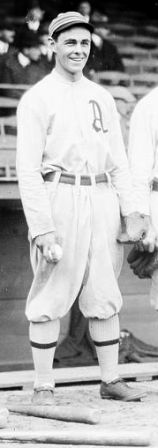
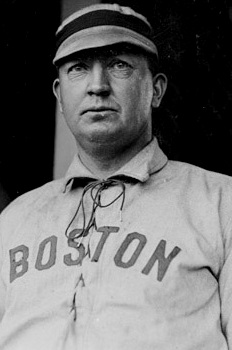
George Stallings had been accused of being a sign stealer.  And, when he finally won his first and only championship with the miracle Boston Braves in 1914—the team was 35-43 and in eighth place on July 18—his shortstop, Walter “Rabbit” Maranville claimed sign stealing was a part of the team’s success.

Rabbit Maranville

Rabbit Maranville

The Boston Post quoted Maranville speaking to a group from Boston College during the winter after the team’s World Series victory:

“Signals had a lot to do with our winning the championship.  We had signals of our own, of course, and so far as I know they never were solved consistently.  We were able to get the meaning of the signals of the other team in nearly every other city of the league.  In St. Louis we knew almost every move that the other fellow was going to make, and that helped a lot.  Their signals were very easy.  Other teams had harder signals, but we managed to get most of them, while the other side was doing the guessing.”

Whether or not sign stealing played a part, the Braves were 9-1 (with one game ending in a tie) in their last 11 games against the St. Louis Cardinals and their “very easy” signals.

While Stallings never confirmed Maranville’s claim, he did tell The Boston Globe that winter that took great pains to ensure that their signs weren’t stolen in the World Series:

George Stallings

George Stallings

“Although we had a set of signals that I don’t think any ballclub in the world could have gotten on to we heard rumors that the (Philadelphia) Athletics had been tipped off to them.  We framed up an entire new set, and a coacher or base runner could have looked square into the catcher’s glove and never had gotten these.  (Connie) Mack’s men failed to get a sign of ours in the series so far as I know.”

“Boys of ’76”

5 Jan

On February, 2, 1925, The National League magnates “paused in (their) schedule deliberations” to honor the league’s past, and kick-off the diamond Jubilee celebration.

Thomas Stevens Rice, of The Brooklyn Eagle said:

“In the very same rooms in which it was organized on Feb. 2, 1876, the National League of Professional Baseball Clubs met again yesterday.  These rooms are in what is now called the Broadway Central Hotel, then called the Grand Central Hotel.”

The Associated Press said:

“In the same room in which Morgan G. Bulkeley, of Hartford, Conn., was elected the first president of the National League, the baseball men, paid tribute to the character and courage of those pioneers a half century ago.”

Dozens of dignitaries were on hand, including, John McGraw, Christy Mathewson, John Montgomery Ward, and Governor John Tener

But, the stars that day were six of the surviving players who appeared during the league’s inaugural season:

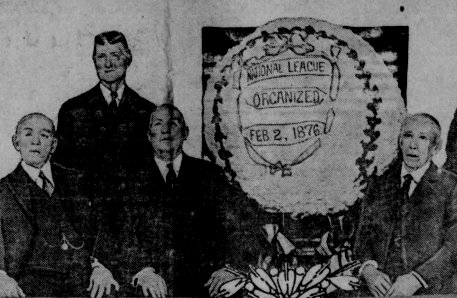
George Washington Bradley, 72, who won 45 games for the St. Louis Brown Stockings; John “Jack” Manning, 71, who hit .264 and won 18 games as an outfielder and pitcher for the Boston Red Stockings; Alonzo “Lon” Knight, 71, an outfielder and pitcher for the Philadelphia Athletics in 1876 and hit .250 and won 10 games, and three members of the Hartford Dark Blues, Tommy Bond, 68, a 31-game winner; Tom York, 74, who played leftfield and hit .259, and John “Jack” Burdock, 72, an infielder who hit. 259. Also present was the only surviving umpire from the 1876 season–Calvin J. Stambaugh.

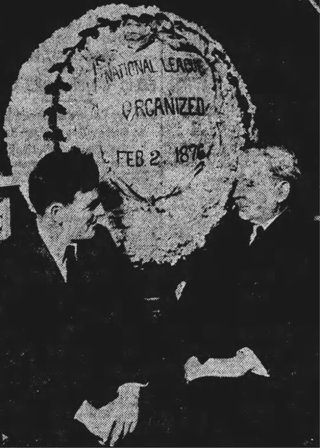
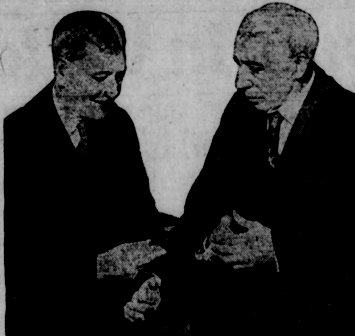
Calvin Stambaugh, right, the last surviving umpire from 1876 and Frank Wilson, a national League umpire from 1923 until his death in 1928.

Calvin Stambaugh, right, the last surviving umpire from 1876 and Frank Wilson, a national League umpire from 1923 until his death in 1928.

Other surviving 1876 players, including George Wright and and Al Reach cited “advancing age” for their inability to attend.

feb21925pix

Seated from left: York, Bradley, and Manning. Standing: Bond.

 Bozeman Bulger of The New York World said, in relating a conversation between too of the attendees, the event was notable for another reason as well:

“(S)everal of us younger men, moving over closer, discovered a contradiction of a tradition long cherished, that old-timers never could admit any improvement in the game or in the quality of the players.

“‘Have you seen this young fellow, Babe Ruth?’ Bradley asked of Manning.

“‘Yes, indeed,’ admitted Mr. Manning, ‘and don’t let anybody tell you that we ever had a man who could hit a ball as hard as that boy.  I doubt if there will ever be another one.'”

Bulger said the “Boys of ’76” also talked about how they “fought crookedness when a salary of $1,800 a year was considered big pay for a star.”  Bradley, who after baseball became a Philadelphia police officer, said:

“‘Oh, we had crooked fellows following us around back in ’76.  They pretended to make heroes out of us and would hang around the hotels.’

“‘One day Mr. (Chicago White Stockings President, William) Hulbert, a very learned man, advised me to keep away from these men.  He explained how they could ruin a boy and lead others into temptation . I was often approached, but thanks to that wise counsel, I kept myself straight, and I thank God for it today.  It’s worth a lot to me to look you younger men in the eye and feel that in turning the game over to you, we gave you something that was honorable.  It’s up to the players to keep it honorable.”

Tom York summed up his feelings about the game in 1876:

“‘Say, do you remember how proud we used to be after winning a game, when we walked home still wearing our uniform and carrying a bat–and the kids following us?  Ball players–all except Babe Ruth–miss that nowadays.”


bondmanning

Bond and Manning talk pitching at the Golden Jubilee kickoff event in 1925.


Things I Learned on the Way to Looking up other Things #13

22 Dec

Chief Meyers on the Plight of the Native American, 1913

John W. McConaughy, the former sports editor of The St. Louis Post-Dispatch, was no longer writing about baseball regularly as the New York Giants prepared to face the Philadelphia Athletics in the 1913 World Series.  McConaughy, who was the Washington correspondent for The New York Journal, was enlisted by the paper to write about some of the key figures of the series.

The result was, in the case of John “Chief” Meyers, a profile that went beyond a typical baseball story:
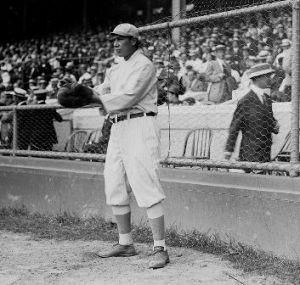
Chief Meyers

Chief Meyers

“Meyers is one of the coolest, shrewdest and quickest thinking catchers that ever came to the big leagues.  He has both gray matter and gumption, and the one is useless without the other in baseball as elsewhere.  He has a fund of general information that runs from national politics to the philosophy of Plato, and a delicately adjusted sense of humor, and these two combine to give him a good perspective of the national game.”

[…]

He is ready to fight any time for justice and fair play and he is so good-natured that he isn’t seriously annoyed when the fans perpetrate that bum war-whoop every time he comes to bat.

[…]

“One day in Cincinnati he asked the writer to go out to the art museum with him.  We came upon a bronze—an Indian turning to shoot an arrow at his pursuers.

“’There’s the idea.’ He said, pointing to the warrior.  ‘They never learned how to fight.  They had nothing but the willingness.  If Tecumseh had been as big a man as Napoleon he would have killed off the medicine men as his first official act, learned the white man’s style of warfare—and there would have been an Indian nation here today.

“’I don’t mean that the white man would not have been here, too.  But with a few leaders—real big men—our fathers would have come to see that the white man’s type of civilization was the highest, just as the (Japanese) have done.  We would have had great states and communities in the union, and we would have been useful, progressive citizens.

“’As it is the Indian is robbed by agents and shifted from reservation to reservation whenever anyone happens to want their land.  Tribe after tribe is scattered, and in another hundred years my people will have gone the way of the Aztecs.’

“Still, there will always probably be a few fans who will think it bright to pull the war-whoop when the Chief comes to bat.”

Tom Lynch Cracks Down, 1910

In June of 1910, The Associated Press said that after a 5 to 4 New York Giants victory over the St. Louis Cardinals, umpires Jim Johnstone and August Moran “stood in front of the press box and made remarks about the baseball writers.”

National League President Thomas Lynch, who had announced his intention to “break this habit of having players call the arbitrators bad names” said in response:

“I also will not stand for umpires talking back to spectators or taking it upon themselves to criticize newspaper men.”
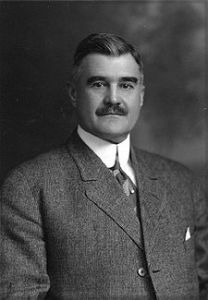
National League President Thomas Lynch

National League President Thomas Lynch

He fined Johnstone and Moran $25 and $15 respectively for the incident.

In that era of newspapermen as frustrated poets, George E. Phair, then of The Milwaukee Sentinel, was one of the most prolific, often including a poem in his articles.  He dedicated the following verse to the National League President:

Old Thomas Lynch, who runs a league,

     Would propagate urbanity;

In fact, Sir Thomas would intrigue

     To curb the umps’ profanity.

He warns his umpires while within

     The baseball scribes vicinity

To speak no words that reek of sin,

     But emulate divinity.

He tells them not to harm the scribes,

     Nor flout at their ability;

Nor pester them with jokes or jibes;

     Nor laugh at their senility.

He plasters fines upon his umps

     For showing their ferocity

And calling scribblers ‘mutts’ and ‘chumps’

      With Teddy-like verbosity.

The veteran Sir Thomas is

     Most generous and affable,

But we’re inclined to think that his

     Solicitude is laughable.

The ump may blunder now and then

     And break into profanity;

The scribbler jabs him with his pen

     And drives him to urbanity.

Comiskey Tells a Tommy McCarthy Story, 1899

George Erskine Stackhouse, the baseball editor of the editor of The New York Tribune, spoke to Charles Comiskey in 1899 and found him in a “somewhat reminiscent mood.”  Comiskey told a story Tommy McCarthy when the two were with the St. Louis Browns:
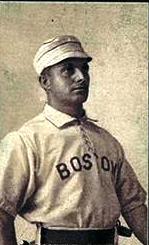
Tommy McCarthy

Tommy McCarthy

“I heard in Chicago the other day that tom is in Boston, as fat as a Tammany alderman, and making money out of a big bowling alley.  (Hugh) Duffy owned an interest in it, but they say Tom bought him out.  I had Tom with me in St. Louis.  And say, St. Louis is the best town on earth for a winner.  They used to distribute among the players every season watches and rings and studs and pins enough to stock a jewelry store.  There was a diamond medal offered one year for the best base runner on the Browns.

“Tom McCarthy was quite a boy to steal bases, and after the medal was offered he wouldn’t run out his hits.  If he made a two-bagger, he would stop at first, and if he slammed the ball for a triple, he would manage to bring up at second, so as to get a chance to steal a base.  Of course, after a bit, I got on to him, and I had to warn him that if he didn’t stretch those hits I would have to lay him off altogether.  That helped some, but he was always hanging back when he thought he could get away with it.  I remember once that he had a chance to go down to second on a wild throw to first, and what does he do but toss his head and drop off his cap, so that he could stop and come back after it and stick at first.  He won that medal.”

“Take a Chance, any time, and Fight all the Time”

19 Dec

John W. McConaughy was just 19 when he became the sports editor of The St. Louis Post-Dispatch in 1903.  Over the next 30 years he worked as the Washington Correspondent for The New York Evening Journal, was the production manager for William Randolph Hearst’s film company, Cosmopolitan Productions, and was a member of the Creel Committee, created by President Woodrow Wilson to influence public opinion at home and abroad during World War I.  He also published several books on crime, politics and sports, including: “From Cain to Capone,” “Who rules America?: A Century of Invisible Government,” and “Big Jim Jeffries: His Twelve Greatest Battles.”

But, he continued to write about baseball long after he left St. Louis, including a profile of New York Giants Manager John McGraw on the eve of the 1913 World Series for The Evening Journal:

“The most distinctive and aggressive personality in baseball—this is John J. McGraw, the wonderful leader of the Giants.  He has been at one and the same time the most abused and most admired man in the national game.

John McGraw

John McGraw

“He has been called a rowdy and a Napoleon in equal parts.  He has been mixed up in more rows than any big league manager; but he has also been mixed up in more pennants… (Connie)Mack is his only rival for the title of greatest manager in the game and no two men in the world were ever more widely apart in character and methods than these two.  The old fox of Philadelphia has been dealt with elsewhere.  His system is carefully constructive work, leaving nothing to chance.

“McGraw’s motto is:

“’Take a chance, any time, and fight all the time.’

“He believes especially in fighting, but he is of the mind of Polonius in not advocating fighting as an end.  It is always a means with McGraw.  There is method in his mixing.  He has been represented as running amuck through baseball for the love of a rough-house.  Nothing is further from the truth.  When McGraw has a row on the ball field he figures that he is going to win something material at some time as a result.

“For instance, you never hear of any of the Giants being suspended or fined for battling with the umpires these days.  Why?  Because McGraw discovered that the magnates meant business in their manifestos against bully-ragging the arbiters and the chief of the Giants decided that a star on the field was worth six on the bench, recovering from the effects of ea sing their mind to an umpire.

“’I’ll do all the kicking from now on,’ he told his warriors.  ‘If any man is benched by an umpire I’ll fine him myself.  Let ‘em put me out of the game.  I’m not out there playing.’”

McConaughy said the two things McGraw looked for when evaluating players was “speed and brains,” but only the first one was non-negotiable:

“’It is possible to get good baseball out of a bonehead,’ he said once, ‘if you never expect him to think. Whenever there is any thinking to be done do it for him, and land on him with both feet if he tries to do any himself.

“By following this system he has actually made popular heroes out of notoriously slow-witted athletes.  He is out there on the coaching line thinking for them.”

McGraw, he said, was the “quickest and most daring thinker” in the game:

“It is characteristic of his aggressive mind that he is the only baseball leader who has no use for the sacrifice hit.  There is no doubt that he has lost many ball games by not using it, but there is also no doubt that he has won many a game by discarding it.  He follows offensive tactics of the dashing kind.  He is all for the hit-and-run and the double steal.  He believes in hitters and always has at least one a better than average hitting club, and his argument is that there is no sense in getting .300 hitters and ordering them to chuck away a one-in-three chance for a clean hit to advance a man a base at the cost of an out.”

McConaughy said McGraw was the ultimate player’s manager:

“He is the boss-he gives the orders and takes the blame.  He never breaks into print with anything like criticism of any man on his team no matter how much to blame any man may be for any disaster.

“He demands strict obedience and whole-hearted loyalty from his men, and he stands by them against all comers all the time and under all circumstances.  It doesn’t make any difference if every fan and sporting writer on the circuit has turned down his thumbs on a ballplayer.  This is usually a good reason, in McGraw’s system for moving him up a few places in the batting order and making him a regular player in a prominent position.

“There is scarcely a manager in the country who would have clung to (Fred) Merkle under the terrific panning that unfortunate man was let in for by his historic play at second base.  McGraw’s answer to the storm of abuse was to make him regular first baseman of the club, a place he has filled with credit.”

While McGraw did always defend Merkle for “his historic play, “he did not make him the “regular first baseman,” during “the storm of abuse” immediately following “Merkle’s Boner” in September of 1908, but  rather after the release of Fred Tenney following the 1909 season.

McConaughy summed up McGraw:

“His men are always looking for a chance to swear by him, and the fans around the circuit are equally keen for a chance to swear at him.”

Connie Mack, who McConaughy said was McGraw’s “only rival” for the title of baseball’s best manager, guided his Philadelphia Athletics to a four games to one victory over McGraw’s Giants in the 1913 world Series.

McGraw and Mack two years earlier at the 1911 World Series.

McGraw and Mack two years earlier at the 1911 World Series.

“Is Napoleon Lajoie a Hoodoo?”

14 Nov

Napoleon Lajoie had his share of superstitions and sought to avoid “Hoodoo,” like most players of his era.  But, as Lajoie was winding down his long career, hitting un-Lajoie like .246 for a horrible Philadelphia Athletics team (36-117) in 1916, The Philadelphia Bulletin presented a case that Lajoie himself was the problem:

“Is Napoleon Lajoie a hoodoo?

Napoleon Lajoie

Napoleon Lajoie

“Several baseball managers and ‘Larry’ himself would like to know the answer.  And here is why:

“Lajoie, for many years recognized as the king of second basemen and dubbed ‘King Larry,’ now has visions of the waning of his baseball star of fame, and he has never played on a pennant-winning team…For years he hit well over the .300 mark—once over .400—was one of the most dangerous men to pitch to in a pinch, and fielded his position around second base in a finished, manner—so finished in fact, that he won the distinction of being the classiest second-sacker in baseball.  Every move of the big Frenchman was grace personified.

“Notwithstanding the fact that he was a star of the first magnitude, ranking with Hans Wagner of Pittsburgh—and they are the two real stars of baseball of former years—he never was able to help his team to the pennant.  So, when Lajoie was sold to Connie Mack dopesters and Larry himself thought he eventually would get into a World Series.  But alas!

“Larry joined the Athletics in the spring of 1915, and while his admirers were expecting him to get back his batting eye, which had apparently been dimmed while he was in Cleveland, Connie Mack decided to tear down his wonderful machine.  (Eddie) Collins, (Ed) Plank, (Charles “Chief”) Bender, (Jack) Coombs, and (Jack) Barry were sold (or released), while (Frank) Baker played bush league ball because Connie would not meet his salary demands, and the famous $100,000 infield of the Athletics was wrecked and the run making machine of the world champions was put out of commission.  And the hopes of Larry and his enthusiastic followers went glimmering.  He is on a tail-end team, just like he was at Cleveland.

“And worst of all from Lajoie’s point of view, the Cleveland team has been holding down first place in the American League for many weeks and is a contender for the pennant.

“The question, ‘Is Napoleon Lajoie a hoodoo?’ Again presents itself.”

While Cleveland was in first place as late as July 12, the Lajoie-hoodoo-free Indians still faltered and finished seventh in 1916.

After Philadelphia’s disastrous season—they finished 54 and a half games back—Lajoie accepted the position of player-manager with the Toronto Maple Leafs in the International League.  The 42-year-old second baseman hit a league-leading .380 and led the Maple Leafs to the championship in 1917—the first, and only of his career.

“The Annual Spring Typhoon has Blown up Again”

10 Nov

In 1906, despite being, on paper, the best team in the American League, the Cleveland Naps finished in third place, five games behind the Chicago White Sox.  The club had three twenty game winners—Addie Joss, Bob Rhoads, and Otto Hess—and four regulars who  hit better than .300—Napoleon Lajoie, William “Bunk” Congalton, Elmer Flick and Claude Rossman,

As the 1907 season approached, Grantland Rice, of The Cleveland News said the team was now a victim of the success of individual players:

“The annual spring typhoon has blown up again—only a bit worse than ever.  In nearly every big league camp well-known athletes are breaking into loud roars over the pay question, and there promises to be quite a batch of trouble before the storm is cleared away.  In this respect Cleveland heads the list, although Napland owners have one of the highest salary lists in the game.  Up to date Joss, Rhoads, (Terry) Turner and Congalton have balked, while neither Flick nor Hess have returned a signed contract.”

Grantland Rice

Grantland Rice

Rice said the club’s negotiations with Joss and Rhoads were at an impasse, and “just how it will end is a matter of uncertainty.”  The news of the team’s trouble signing their stars led Rice to a discussion of “just how much a major leaguer is supposed to receive for his work each season.”

“When a youngster breaks in he is never given less, or at least rarely so, than he received in his minor league berth.  His pay is boosted the greater part of the time, so the average debutante’s pay roll ranges closely around $1,800 providing he is recognized as a first class man.

“If he delivers the goods his first year out he can figure on about $2,000 or $2,200 for his next season, and then if he becomes established as a regular, his income should be somewhere in the immediate vicinity of $2,500.

“From this point upward it all depends on their rankings as stars.  You hear considerable about $5,000 contracts and better, but as a matter of cold, clammy fact, but few athletes draw over $3,000 or $3,500 at best.

“In the epoch of war salaries $3,500 or $4,000 was a fairly common figure—but no more.

“A high grade slabman along the order of Joss, Rhoads (Nick) Altrock, etc…will rake in about $3,000 now.  In his weekly letter in a Toledo paper (The News-Bee), Joss stated that he was offered $3,000 for his season’s work, but that he demanded more—just how much he didn’t say.

“George Stone drew $3,000 or there abouts last season and now that he has fought his way to the premiership in the School of Slugs he demands $5,000, at which figure Mr. (Jimmy) McAleer balks strenuously.  (Johnny) Kling also asks for $5,000, which sum Charley Murphy says he will not receive.

“From this list we jump to the drawing cards of the game such as Lajoie, (Honus) Wagner, (Wee Willie) Keeler, (Christy) Mathewson, etc…

“Lajoie’s figures range somewhere above $8,000 and something shy of the $9,000 mark.

“Wagner is supposed to draw $5,000 for his work.

“If reports sent out from New York are true, Keeler’s yearly ante is close to $6,000, while Mathewson draws in about the same.

Hal Chase won’t miss $3,500 very far.

“But the high-priced teams are not pennant winners by a jug full.

(Charles) Comiskey and (Connie) Mack hew closer to the line than any others in Ban Johnson’s circle, and yet these two have won more pennants than all the rest put together.  In fact, they’ve gotten away with all but the two which Boston nailed.

“Mack had one of the cheapest, if not the cheapest team in the American League through 1905, the last year he copped the pennant.  Comiskey’s world champions of 1906 were far below Cleveland, New York or even Boston, from the salary standpoint.

“It looks funny to figure the cellar champions of a league paid more than the holders of the world’s title, but if all the figures were given out, the White Sox payroll would loom up under Boston’s to a certainty.

“The full salary cost of running a big league club varies from $40,000 to $50,000, or maybe $55,000 a year.

“A set of figures somewhere between $45,000 and $50,000 would probably hit at the higher average.

“There was a time when Boston’s payroll was close to $70,000 and (Clark) Griffith’s was only a notch below—but this golden era for the ballplayer has passed.”

According to The Washington Post, Joss had earned $3,2000 in 1906 ($2,700 and a $500 bonus), the biography, “Addie Joss:  King of Pitchers,” said he was paid $4,000 in 1907—Joss, who was 21-9 with a 1.72 ERA in 1906, followed that up with a league leading 27 wins (against 11 loses, with a 1.83 ERA) in 1907.

Addie Joss

Addie Joss

Fellow twenty game winners Rhoads and Hess both saw their production slip (15-14, 6-6), and only two regulars—Flick .302 and Lajoie .301—hit better than .300, and the team’s batting average slipped 28 points from the previous seasons.

The Naps finished fourth in 1907.

Things I Learned on the Way to Looking up other Things #12

3 Nov

The Cost of Superstitions, 1913

John Phalen “Stuffy” McInnis his .324 and drove in 90 runs for the 1913 Philadelphia Athletics, but the first baseman hit just .118—2 for 17—during the World Series.

Stuffy McInnis

Stuffy McInnis

The Washington Post told how one superstition among the athletics players might have contributed to McInnis’ slump:

“Those boys believe that they can change the luck at a crucial moment by hurling their bats in the air and letting them fall where they will.  Probably you fans have often seen them do it.  They also believe that they can keep up their good luck by continuing this practice.

“During the first game, in which (Frank “Home Run”) Baker hit a home run, the Athletics started tossing their bats the minute the ball was hit.  As the bats came down Stuffy McGinnis couldn’t get out of the way in time and one of them struck him in the ankle, causing a painful bruise.  He limped to first base and for a while (Connie) Mack was afraid he couldn’t go on with the game.”

Despite McInnis’ slump, the Athletics beat the Giants four games to one.

The Case against the Spitball, 1905

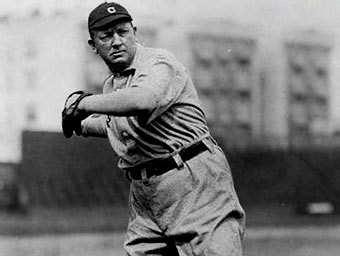
Baseball’s greatest pitcher hated the games most controversial pitch.  In 1905 Denton True “Cy” Young was quoted in The Sporting Life saying it wouldn’t be long before the pitch disappeared entirely:

“I don’t think the ‘spit ball’ is going to cut a much a figure as was thought early in the season.  Many of the pitchers that were using it at the start of the campaign have cut it now, and from now on the twirlers that use it will be dropping it one by one.  I used it against Philadelphia and Washington and had it working nicely, but it hurt my arm and I have cut it altogether.  An old pitcher like myself has no business using it at all.”

Cy Young

Cy Young

Young said the pitch injured his forearm and said he was not alone.  He claimed Jack Chesbro, George Mullin, (Guy) “Doc” White all received similar injuries.   And Washington’s Case Patten, who a year earlier so loved the pitch The St. Louis Republic said he was often “giving the ball a shower bath preparatory to flinging,” was now saying the pitch “lamed his arm.”

Young said even for those who weren’t injured, the spitter would ultimately lead to pitchers losing “control of his curve ball and his fast ones.”

While Chesbro disagreed with Young’s claim that his arm problems were the result of throwing spitballs, his effectiveness diminished greatly after the injury.

Young’s prediction of the demise of the pitch was premature.  At the time of his statement, Chicago White Sox pitcher “Big Ed” Walsh was perfecting the pitch, which he learned from teammate Elmer Stricklett—who had also been instrumental in Chesbro’s use of the spitter.   Walsh started throwing the spitball regularly in 1906.

Ed Walsh circa

Ed Walsh circa

A month before his death, on his 78th birthday and bed-ridden, Walsh remained an advocate for the pitch Cy Young detested.  He told a reporter for The Associated Press:

“I admire the pitchers today who throw the pitch.  Some people call ‘em cheaters.  They’re not.  They’re just guys doing everything they can to win.”

Wahoo Sam’s Scouting Report, 1914

Coming off of the New York Giants off-season world tour with the Chicago White Sox, the consensus opinion seemed to be that Giants Manager John McGraw did not make a mistake in signing Jim Thorpe, the world’s greatest all-around athlete, to a three-year contract worth–depending on the source—from $5,000 to $6,500 per season.  Many doubted Thorpe’s prospects after he hit just .143 in 19 games for the Giants in 1913.

Jim Thorpe

Jim Thorpe

But, not to worry, said McGraw:

“All Thorpe needed was every day action, instead of idleness, although of course sitting on the bench all summer gave him a chance to learn lots of things that will stand him in good stead later on.”

The baseball world generally agreed with McGraw’s assessment.

Hugh Fullerton predicted Thorpe would be “the most sensational baseball player of 1914.”

Damon Runyon declared Thorpe was “now a star.”

Gustave (G.W.) Axelson, Sports Editor of The Chicago Record-Herald, who traveled with the teams, said of Thorpe’s development during the trip:

“The fans in the United States will see an entirely different kind of player when Thorpe Lines up for the season. “

White Sox pitcher Joe Benz, who played against Thorpe on the tour, agreed saying Thorpe “improved greatly” and would be of “great assistance to the Giants,” in 1914.

But, “Wahoo” Sam Crawford, the Detroit Tigers outfielder who traveled with the tour as a member of the White Sox disagreed with all the glowing accounts of Thorpe’s progress.  The Detroit Times said:

“Thorpe’s speed is all that commends him, according to Sam.  He is not a particularly good fielder, and he cannot hit.  He is not a natural hitter at all, but he gives the bat a little upward chop as he swings at the ball in a way that Crawford never saw any man do before.

“Furthermore Thorpe doesn’t seem to have that baseball instinct that is so necessary for a big league player, say Crawford.  He is a very chesty fellow for a man who has yet to prove that he is of big league caliber, is the assertion made by Wahoo Sam.”

Sam Crawford

Sam Crawford

Crawford’s assessment was the most accurate.  Despite the fanfare that accompanied Thorpe’s return from the tour, Thorpe was never better than a mediocre outfielder (career .951 fielding percentage) and he hit just .252 over parts of nine major league seasons.

“The Fans there Like me. I Think so Anyway.”

31 Oct

In 1909 the Cleveland Naps traded pitchers Charlie Chech, Jack Ryan and $12,500 to the Boston Red Sox for Cy Young;  Young would turn 42-years-old before the beginning of the season.

Young was happy with the trade and told The Cleveland News:

“I’m glad to get back to the city where I started my career in 1890.  The fans there like me.  I think so anyway.  I believed they pulled for me there when I pitched against their own team.  I will give (Napoleon) Lajoie all I have and I think I’m good for several years.”

Cy Young

Cy Young

Addie Joss, the Naps ace, was also happy about the trade:

“Not only has Cleveland secured one of the best pitchers in the game today, but at the same time has added to the club a man who has done much for the good of baseball, and who is honored and respected everywhere he has ever played.  I have always contended, and always will, that Cy is the greatest pitcher the game has ever produced.”

Elmer Ellsworth Bates, the sports editor of The Cleveland Press, told some stories about the Indians new pitcher.

Ellsworth said a visitor to Young’s farm in Paoli, Pennsylvania asked the pitcher which of his then 478 victories did he “recall with the most satisfaction.”

“’The first game I ever pitched for Cleveland, back in 1890 (an 8 to 1 victory August 6),’ replied Old Cy, unhesitatingly.  ‘I doubt if a base ball crowd ever looked on a more typical rube than I appeared to be that day in a makeshift uniform six or seven sizes too small.  I didn’t have much money then, but I would not have lost that game to Chicago for the prettiest $1,000 bill ever printed.”

Bates said Young was “probably the most modest ‘big man’” in the game:

“At the Colonial (Hotel in Cleveland) one day last summer a young man took a chair next to the great pitcher and began paying him fulsome praise.

“’You are the swiftest pitcher I ever saw,’ he said.

“’Then,’ said Old Cy.  ‘I guess you never saw Amos Rusie.  My fastball looks like a slow freight trying to keep up with the Twentieth Century Limited Express compared to Rusie’s.’

“’But your slow ball is a peach.’

“’Young man,’ remarked Old Cy, gravely.  ‘If I could pitch the slow ball Eddie Beatin, the old Cleveland twirler, used to hand up to the batters I’d let them knock $1,000 a year off my salary.”

Bates also said it was “a matter of record” that Young was unaware he had pitched a perfect game against Connie Mack’s  Philadelphia Athletics on May 5, 1904:

“’I knew Connie’s boys hadn’t made a hit,’ said Old Cy the next day, but I couldn’t understand why the crowd was making such a demonstration.’

“’Well you’ve done it,’ said (manager and third baseman) Jimmy Collins, as we started for the dressing room after the crowd had let me go.’

“’Done what, Jimmy?’ I asked.  ‘Pitched a no-hit game?’

“’Better than that; not a man reached first.’

“’Then I knew what the racket was about.’”

“The Poet-Pitcher”

17 Sep

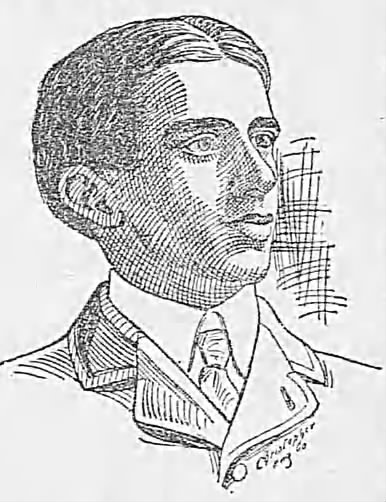
Edward Benninghaus Kenna came from a prominent West Virginia Family; his father, John Edward Kenna was a United States Senator.  Another West Virginia Senator, William Edwin Chilton was often referred to as Kenna’s uncle—he was his father’s former law partner and best friend, but they were not related.

Edward B. Kenna, circa 1900

Edward B. Kenna,1900

He was, according to The Kansas City Star:

“(A)n unusually well-educated young man,.  He spent four years at Mount St. Mary’s College and was graduated there in 1898.  His post graduate course of one year was taken at Georgetown University, and the following three years he spent at West Virginia University, studying law.”

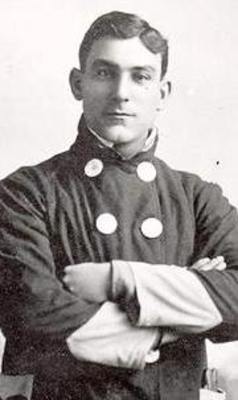
Kenna played football and baseball at all three schools—and coached both sports at Richmond College in 1900, the same season he made his professional debut with the Toledo Mud Hens in the Interstate League.

He was also a poet who had two anthologies of his poems published and was later the editor of The Charleston Gazette.  While most current sources say his nickname was “The Pitching Poet,” during his lifetime he was nearly always referred to by the slightly less lyrical “The Poet-Pitcher.”

Despite his education, and pedigree, The Star said:

“Seeing Kenna on the ball field one would not think that he was the possessor of so many distinctions.  He does not attempt to hold himself aloof from his teammates, but on the contrary is one of the most energetic (players) in the pursuit of victory and when not in the pitcher’s box is on the coacher’s line haranguing the opposing players and urging the members of his own team to their best efforts.  Coaching is one of his hobbies and he is particularly successful at this line of work.  He finds special enjoyment in ‘kidding’ the bleacher element…He says that base ball is not an uplifting pursuit either morally or intellectually, but is an enjoyable one.”

He pitched two games in the major leagues—with the Philadelphia Athletics in 1902–but said the two most interesting games of his career were back-to-back starts in 1904 while he was a member of the Denver Grizzlies in the Western League.

When Kenna joined the Louisville Colonels in the following season, The Louisville Times told the story of the games—both against the Des Moines Prohibitionists:

“(He) was touched up for nineteen safe hits, and yet his opponents failed to get a runner over the pan.  In one inning he was hit for a triple, a double and three singles, and still his opponents failed to get a man home.

“The first batter up hit for a triple, but was nailed trying to stretch it into a homer.  The next man doubled down the left field line, but was afterward caught off second by the poet.  The next three batters hit safely, and then Kenna got down to work and fanned the next batter with the bases full.

“Two days later Kenna was sent in against the same team.  For eight innings he did great work (allowing no hits) and his teammates made but one error.  He had perfect control and during this period gave only one base on balls.  The Denver team managed to get one runner across the pan, which looked as good as a hundred when the ninth inning was about to close.  The bard fanned the first two batter, but the third reached first on a fluke (a second error).  Then (Bob) Ganley, who is now with Pittsburgh, stepped to the plate and drove out a home run, which won the game.  Only one hit was made off his delivery, and yet Kenna lost the contest by one score.”

He was 16-13 for the Colonels in 1905 when, on September 1, he and seven other members of the team were injured in Kansas City when an electric trolley car crashed into the wagon they were riding  to the ballpark.  Kenna was the most seriously injured, and  reportedly suffered broken bones in his right (pitching) hand, a fractured left arm, a concussion, broken nose and an eye injury.  The Kansas City Star said he was listed in serious condition at a local hospital.  Despite the extent of his injuries—which ended his season– Kenna sent a telegram to family members in Washington D.C., saying simply

“Nothing serious; strained arm.  Don’t worry.  Ed.”

He never fully recovered.  He returned to Louisville in 1906, and struggled, finishing the season 12-21, but he hit .325 in 166 at bats.  Given his new found success as a hitter—his best previously recorded average was .225—Kenna decided he was through as a pitcher:

The Louisville Times said:

“Kenna announces that from now on he will be an outfielder, and he hopes (team President George) Tebeau will play him in right field on the Louisville team next season.  Kenna is simply tired of pitching.”

The Colonels accommodated him, but he struggled at the plate and was released in July after hitting just .143.

Edward Kenna, circa 1910

Edward Kenna, circa 1910

Kenna returned to West Virginia, newspapers, and poetry.  About the time his book “Songs of the Open Air, and Other Poems” was published in early 1912, he left his job at the paper, and went to Florida to attempt to recover from what was described simply as “a heart condition.”  He died in Florida on March 22.

Sporting Life said of the thirty four-year-old’s funeral in Charleston:

“(It) was one of the largest ever seen here.  All races and creeds showed their deep grief for this beloved man.”

Kenna’s younger brother John Edward Kenna Jr. was also a right-handed pitcher; he was 15-6 for the Chattanooga Lookouts in the South Atlantic League in 1909 and 7-7 with the Worcester Busters in the New England League in 1910—also born in Charleston on January 6, 1883, he died there on May 5, 1956.

“It’s Strange how these Stars of Balldom have such Beliefs”

27 Aug

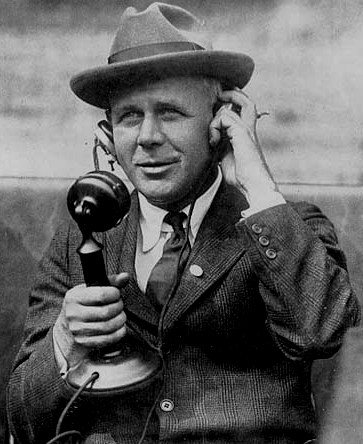
Throughout his career as an American League umpire, Billy Evans, who had covered baseball for The Youngstown Vindicator continued to write syndicated newspaper articles.  He was fascinated by the superstitions that controlled the actions of so many players.

Billy Evans

Billy Evans

He followed a 1907 article about the subject, with more stories the following year:

“Of all professions, that of baseball player is the most superstitious…Of course, there are many superstitions in common, yet most of the players have pet ideas of their own on which they place much reliance.  The data of origin of many of the superstitions is a deep, dark mystery.”

Evans said:

“There is certainly nothing out of the ordinary to be seen in a load of hay, yet most players welcome the sight of one during the playing season.  In the dictionary of baseball a load of hay signifies two hits that afternoon for the discoverer, and history tells us there is nothing dearer to a player’s heart than base hits…While its supposed strange magic often fails, still the players retain faith in it.  On the other hand, the sight of a load of empty barrels is always dreaded, for some it means a shutout, to others merely defeat.”

Of one popular superstition of the time, Evans said there was “no greater believer in shaking up the bats when a rally is on” than Cleveland Naps pitcher Charles “Heinie” Berger:

“Ordinarily a team keeps its bats lined up in front of the bench in a fairly tidy manner.  According to Heinie’s code that is all well and good when everything is moving along smoothly, but when a rally appears to be in the air, the proper way to encourage it, according to Berger, is to scatter the bats in every direction.”

Heinie Berger

Heinie Berger

Evans told the story of the Naps’ August 21, 1908, game, although some of the details regarding the scoring wrong, he got most of the facts correct:

“One day last summer during an important game at Philadelphia, the Athletics got away with a seven-run lead in the first two innings.  When they added another in the third, it certainly looked as if things were all off so far as Cleveland was concerned.  Until the seventh inning the Naps bench was not unlike a funeral.  Two runs in the seventh stirred up a little hope, and caused Heinie to heave a few big sticks in different directions.  His actions caused Umpire Jack Sheridan (Sheridan and Evans both worked the game, Sheridan was behind the plate) was to offer a mild rebuke and incidentally warn Heinie that he wanted nothing but silence during the rest of the afternoon.”

Cleveland scored two runs the following inning, and had the tying run on base:

“Heinie proceeded to scatter the two dozen or more bats in all directions.  That was too much for the veteran Sheridan, and after he had made Berger replace all the bats back in a straight line, he tied a can on the Teuton and chased him from the lot.

“Berger viewed the remainder of the game from the bleachers, failing to carry out completely the edict of the umpire.  When the Naps scored the two men on the sacks and tied up the game he was happy.  Heinie was confident that the bat superstition had aided in the victory that he was sure would result, now that the score was tied.  When the Athletics scored a run in the eighth that proved to be the winner his confidence in the theory was not shaken in the least. He blamed the defeat on Sheridan, claiming that as soon as the umpire ejected him from the game the spell was broken.”

Evans also wrote about his favorite superstitious player, “Wild Bill” Donovan, pitcher for the Detroit Tigers.  Evans had previously mentioned Donovan’s fear of throwing a shutout during his first start of each season, and his actions in one game in particular, but now gave a more detailed account:

“It all seems rather foolish, yet I have worked back of Donovan on two such occasions and have every reason to believe that Bill makes it possible for his opponents to score.  In one of the games Detroit had the affair clinched 8 to 0 in the eighth.  With one down and a man on second Charley Hickman stepped to the plate.  A straight fast one is the most delicious kind of dessert for Charley, although he likes almost any old thing in the shape of curves and slants.

“There is no more strategic pitcher in the league than Donovan, yet he started off the reel to hand them up to Hick’s liking.  After fouling off three, Hick met a fast one on the nose and was blowing hard at third by the time the ball was relayed back to the infield.  He scored a moment later, but Detroit too the game easily, 8 to 2.  Bill had escaped the much despised shutout.  By the way that year was the most successful of Donovan’s career, and, of course, merely served to strengthen his belief.”

Bill Donovan

Bill Donovan

Again, Evans got nearly all the details correct—except the final score was 9 to 2.  The May 24, 1907, game was Donovan’s first start of his best season in baseball (25-4, 2.19 ERA for the American League Pennant winners), and he did lose a shutout to Washington in the eighth inning on a Hickman triple.

Evans said a superstition often attributed to Cy Young, was not a superstition at all:

“The veteran Cy Young, the grand old man of them all, is one of the few players who doesn’t take much stock in omens of good or bad luck.  Cy, however, has one big hobby.  He always prefers to pitch on dark days…The dark day idea is no superstition with Cy.  No one except the batters perhaps realizes how hard it is to hit his fast ball when the light is dim.  It is really a pleasure for him to work out of turn on such days, for he knows what a big handicap he has over his opponents.”

Evans said another Hall of Fame pitcher had a bizarre habit, that while perhaps not a superstition, bears mentioning:

Jack Chesbro, the famous spitter, is always of the opinion that someone is slipping a doctored ball over on him, and quite often asks for a new one when the cover doesn’t taste just right.”

The umpire concluded:

“It’s strange how these stars of balldom have such beliefs and stick to them, but they do.  The ball player lives in a world of his own, more than any other profession with the possible exception of the actors.”