Lost Advertisements—Louisville Slugger, World War II—Sports Aid Preparedness

7 Feb

???????????????????????????????

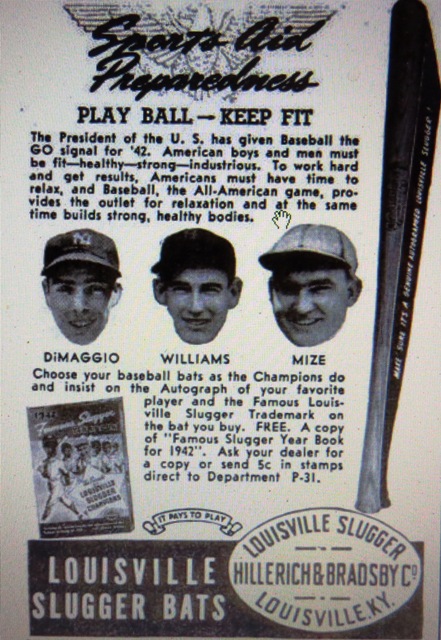
1942 Louisville Slugger Advertisement featuring Hall of Famers Joe DiMaggio, Ted Williams and Johnny Mize.

“The President of the U.S. has given baseball the GO signal for ’42.  American boys and men must be fit—healthy—strong—industrious.  To work hard and get results, Americans must have time to relax, and baseball, the All-American game, provides the outlet for relaxation and at the same time builds strong, healthy bodies.”

“Choose your bats as the champions do and insist on the autograph of your favorite player and the Famous Louisville Slugger trademark on the bat you buy.”

A Thousand Words–Satchel Paige, Chicago White Sox

6 Feb

???????????????????????????????

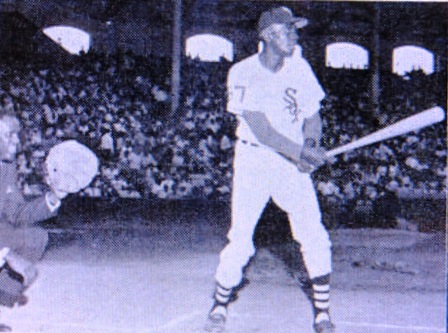
What if?  Satchel Paige in a White Sox uniform.  From 1938-1947 the Sox never finished better than 3rd, add Satchel Paige to those teams, which already had some good pitching including Ted Lyons, Eddie LopatThornton Lee, Monty Stratton and Orval Grove, and Sox fans might have had something to cheer about.  But of course, by the time Paige had a chance to play in the Major Leagues he was at least 42-years-old.  Paige would have helped at the box office as well.  For example, on July 18, 1942 the Sox drew slightly better than 24,000 for a doubleheader with the Detroit Tigers, across town at Wrigley Field a nearly identical amount came out to watch Paige pitch the first five innings for the Memphis Red Sox against the New York Cuban Stars.

Instead, all White Sox fans have is this rare photo taken in 1965 when Paige appeared with the Indianapolis Clowns at Comiskey Park (Chicago Cubs outfielder George Altman is the catcher in the picture).

——-

in 1935, Gene Coughlin, a sports writer for The Los Angeles Evening Post-Record wrote a column that went largely ignored, calling on organized baseball to break the color barrier which “not only makes (baseball) look ridiculous but is at the same time passing up increased business.”  Coughlin predicted that if a Pacific Coast League team were to sign Paige, it “would be good for an extra 10.000 in attendance every time he goes to the mound.  And he became good despite the inane prejudice that drives the colored baseball player to the sandlots and keeps him there.”

Coughlin’s column concluded:

“When you come right down to it, that baseball doesn’t give a darn whether it is pitched or caught by a white hand or a black one.  It is a symbol of game, a sport, and not a symbol of class distinction or color.”

Twelve years later organized baseball finally agreed.

Moriarty and Cobb

5 Feb

While the Detroit Tigers captain “jinx” almost cost George Moriarty his captaincy in 1912, he was also nearly traded to the Cleveland Naps in December of 1911.  The reason given for the Tiger’s desire to trade Moriarty was an alleged fight with Tigers star Ty Cobb.

Whether the fight actually took place is questionable, and an oft-told story about Cobb and Moriarty that grew out of the fight rumor is almost certainly untrue.

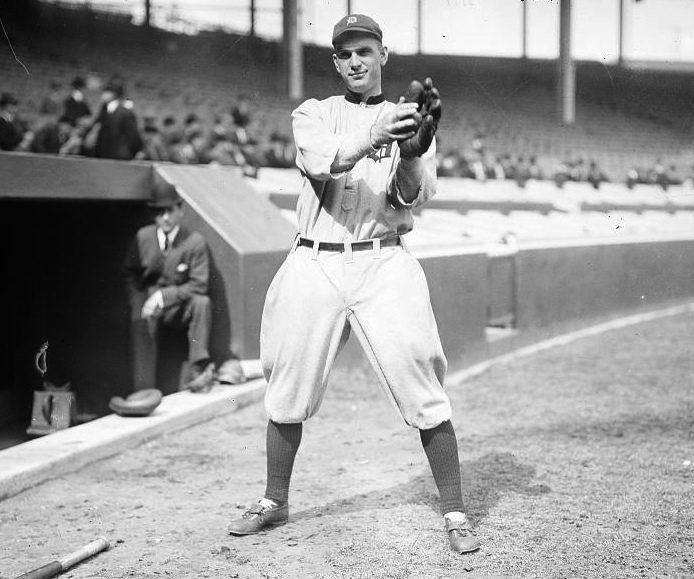
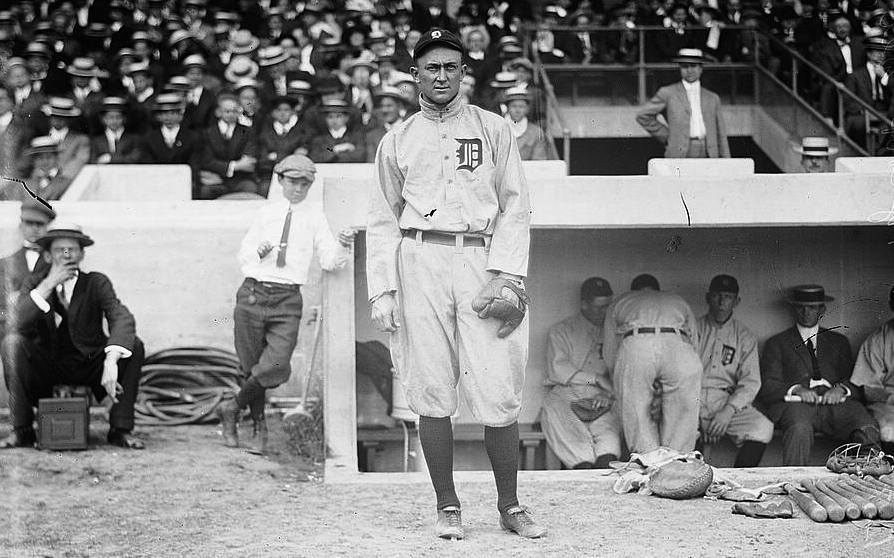
George Moriarty

George Moriarty

In December of 1911, The Associated Press reported the “Real reason for proposed trading of Moriarty.” The wire service said:

 “A battle royal between George Moriarty and Tyrus Cobb one day late in the season of 1911, is the reason why Detroit now wishes to dispose of the star third sacker.  Moriarty and Cobb started their argument upon the field at Detroit, and followed it up with an angry controversy at the club office.  Finally Cobb grabbed a bat and threatened to hit the big third baseman.  The latter armed himself in a similar manner, and they started to beat each other up.”

Ty Cobb

Ty Cobb

The story said the fight was broken up by teammates, and “Cobb then issued his ultimatum which was that he would not play with the Tigers if Moriarty was on the team, unless Moriarty apologized to him.”

Within days, both players and Tigers management denied that there had been any fight.  Cobb said:

“There has been a lot of talk that Moriarty and I almost had a fight in the clubhouse last season.  George and I are the best of friends.  We roomed together in the spring and were on the friendliest terms throughout the season.  The story that I put it up to (Tigers owner Frank) Navin to sell or trade George is a fabrication.  In the first place I had no grounds for such action, and in the second place I wouldn’t take such a step if I did have.  I wouldn’t put the Detroit club in a compromising position.”

While the story of a fight was told and retold over the next twenty years, Cobb and Moriarty always denied it happened.

The story that is still included in nearly every mention of Moriarty is that as he and Cobb were preparing to fight, Moriarty said “A fellow like you needs a bat to even things up when fighting an Irishman.”

The quote first appeared in a 1932 column by New York World-Telegram sportswriter Joe Williams when, as an American League umpire, Moriarty’s reputation as a fighter was renewed.  The Associated Press said after a double-header sweep by the Cleveland Indians, Chicago White Sox catcher

Charlie Berry followed the umpire into the runway of the clubhouse, accusing him of ‘missing’ a third strike on Earl Averill just before the Indian broke up the second game with a ninth-inning triple.

“Berry challenged Moriarty to a fight…Milt Gaston, Chicago pitcher, advanced himself.  The umpire felled Gaston…Then Berry, Frank Grube and Lew Fonseca rushed Moriarty, beating him until he was rescued by the Indians.”

In response to mentions of a fight with Cobb in the reports of the 1932 fight, Moriarty renewed his denial of a fight with Cobb, a denial he had also made in 1927 when he replaced Cobb as Detroit manager:

“Say anything else you like about me, but don’t spread the report that Ty and I fought.  We were roommates, and while we may have disagreed we never came to blows.”

Cobb and Moriarity relished their reputations as fighters, the fact that both continued to deny they fought long after it mattered would indicate that they often retold story is more wishful thinking than fact.

One more bit of trivia about Moriarity:  His grandson Michael Moriarty starred as Henry Wiggen in one of the greatest baseball movies, “Bang the Drum Slowly” with Robert De Niro.

Moriarty and De Niro in "Bang the Drum Slowly"

Moriarty and De Niro in “Bang the Drum Slowly”

“Victim of Hoodoo”

4 Feb

In a game filled with stories of superstition, jinxes, “hoodoo,” and general irrationality, the Detroit Tigers seem to be the subject of an out-sized number of such stories during major league baseball’s first four decades.

Tigers’ pitcher George Mullin, whose story I told in October, was one of the most superstitious players in the history of the game, and he was not alone in Detroit.

This story begins in 1904, but took off in 1911, first in the Detroit newspapers and then across the country.  The Headline in The Duluth News-Times said:

“Moriarity (sic) is Victim of Hoodoo that follows Detroit Captains.”

“Moriarity” was George Moriarty, who had been named captain of the Tigers for 1911.  The story said Moriarty was the victim of a “Jinx” that dated back to 1904 when Bobby “Link” Lowe was acquired by the Tigers and named captain:

“His sterling playing qualities and the friendship that all the players had for him, together with his knowledge of baseball brought him the appointment of captain.  Bob got into a slump and Bob did not get out of it.”

Bobby "Link" Lowe

Bobby “Link” Lowe

In 1905, the Tigers named Bill Coughlin captain, the story continued:

“Coughlin, whom everybody liked and who could play ball as well as the majority of them and think faster than most of them… (His) playing started down grade.  Bill bit his fingernails tore out his black wavy hair in bunches, lost sleep and worried several pounds off…Bill never got back to form.”

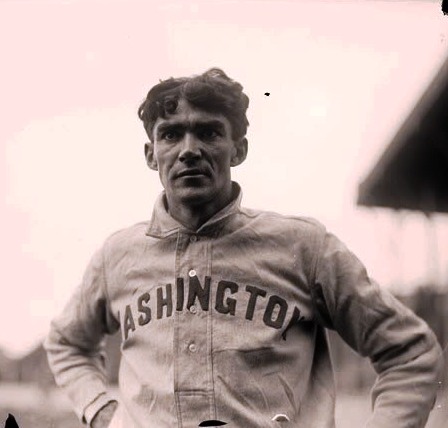
Bill Coughlin

Bill Coughlin

After Coughlin was replaced at third base by Moriarty in 1909, Detroit manager Hughie Jennings named William Herman “Germany” Schaefer captain for the 1909 season.  The story said of him:

“Herman with his ever penetrating optimism, humor and baseball wisdom …appeared to be the right man in the right place as captain…but Herman’s playing ability decreased to such an extent that Detroit gladly grasped at the chance to trade Schaefer.”

Germany Schaefer

Germany Schaefer

Hughie Jennings was enough of a believer in the jinx, even before it became grist for the newspapers, that after trading Schaefer in August of 1909, he chose not to name a captain for the remainder of the season, or for 1910.  Jennings decided to again name a captain in 1911:

“On the Southern training trip Jennings came to realize the necessity of a field leader… (Moriarty) was cool-headed and had the qualities of a leader…the choice seemed like a good one…But soon after the opening of the season it became apparent that Moriarty caught the hoodoo…The duties of the position have weighted in Moriarty until his playing ability has fallen away below par.”

After the 1911 season, Jennings took the situation seriously enough to again consider eliminating the position of captain.  The Detroit Free Press said, “In all probability the Tigers will have to struggle along without a captain next season,” citing Moriarty’s “Frightfully bad year,” after being named captain.

George Moriarty

George Moriarty

In the end, Moriarty was again captain of the Tigers in 1912 and served in that capacity through 1915.

Like most “jinxes,” there really was no jinx, none of the players performed significantly worse than their career averages except for Lowe—but he was 38-years-old when he was acquired by Detroit in 1904 and had missed most of 1903 with a badly injured knee.

Coughlin had shown great promise with the Washington Senators, hitting .275 and .301 in 1901 and 1902, but by the time he was named Tiger captain in 1905 he had back-to-back seasons of .245 and .255, right around his career .252 average.

Schaefer was a .257 career hitter, and his numbers during his half-season as captain were similar to his career numbers.

Moriarty hit .243 during his season with the captain “hoodoo;” his career average was .251, and most of his 1911 numbers were similar to his performance throughout his career.

More on Moriarty tomorrow.

A Thousand Words–Honus Wagner and Claude Hendrix

1 Feb

???????????????????????????????

Honus Wagner participating in his 2nd favorite sport with pitcher Claude Hendrix.

William A. Phelon, poet and sportswriter for The Chicago Daily News, Chicago Tribune, New York Morning Telegraph, Cincinnati Times-Star and St. Louis Star—where this poem about Honus Wagner appeared in 1904.

 Hans Wagner, Hans Wagner, we see you lead once more

The Sluggers of the National League—if leather spher’s had gore

The blood of many a fractured globe would dew the faces where

Your mighty whacks, from shoulder swung, went whizzing through the air!

Hans Wagner, Hans Wagner—how oft we’ve felt the shivers

To see you striding to the plate, to knock our hopes to shivers!

How oft we’ve heard the call, “Two strikes,” to make us yelp and smile,

And then our blood was frozen up—you’ve smashed the thing a mile!

Hans Wagner, Hans Wagner, whene’er that ball you spank

We wonder if you think about the coin you’ve placed in bank?

For every time a mighty drive brings roaring cheer on cheer,

You’ve added to your chances for a boost in pay next year!

Hans Wagner, Hans Wagner, your habits are the best—

You never store bad whiskey in the space beneath your vest—

The midnight jag attracts you not—you murmur “Aber nit—

If I should get von chag dis nacht, zu morgen I’d not hit!”

Hans Wagner, Hans Wagner, you’ve saved a load of dough

The products of the scheme by which you give the slabman woe!

You’ve made a record that will live, you’ve gained tremendous fame—

A slugger of the A1 class—a credit to the game.

King Tut

30 Jan

For almost 30 years Richard “King Tut” King was the clown prince of Negro League baseball and one of its biggest drawing cards.  King, born in 1905 in Philadelphia spent his youth playing in sandlot and semi-pro leagues.

He is listed as having made seven plate appearances for the Atlantic City Bacharach Giants in 1931—the rest of his nearly 30-year career was spent primarily as an entertainer.

Richard "King Tut" King

Richard “King Tut” King

King joined Charlie Henry’s Louisville-based Zulu Cannibal Giants in 1934.  The Cannibals wore grass skirts, red wigs and face paint.  Players were identified by “native” names, as with this lineup printed in The Meriden (CT) Daily Journal in advance of the team’s 1935 appearance:

“The Cannibals will lineup as follows:  Wahoo, right field, Limpopo, first base, Rufigi, center field, Tanna, left field; Taklooie, third base; Bissagoss, shortstop, Kangkol, second base, Nyass, Catcher; Kalahare, Pembra, Moke, Impo and Tankafu pitchers.”

Sometime during the 1935 season after the Cannibals had played a game with the Miami Giants, King, tired of irregular paydays with the cash-strapped Cannibals, stayed in Miami and joined the Giants.

The following season the Giants became the Ethiopian Clowns—later the Cincinnati Clowns and finally the Indianapolis Clowns– and King spent the next 22 years with the team.

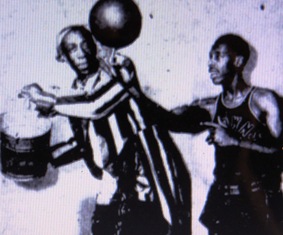
He became most famous for his pantomime “shadow ball” routine with Spec Bebop, a ball juggling act with “Goose” Tatum, and playing with an over-sized first baseman’s mitt.

Richard "King Tut" King, left and Goose Tatum at Crosley Field, Cincinnati, performing the ball juggling routine

Richard “King Tut” King, left and Goose Tatum at Crosley Field, Cincinnati 1946, performing the ball juggling routine

For the most part, he did not participate in games.  As a result, it’s unclear exactly what his skill level was.

In 1948, Hall of Fame sportswriter Sam Lacy wrote in The Baltimore Afro-American said King:

“ Hasn’t hit a ball since they found his namesake’s tomb.”

Bob Motley, who was a Negro League umpire from 1947-1958, said in his biography:

“King Tut was actually a heck of a ballplayer and could put some serious wood on the ball.  I don’t particularly think he was major-league caliber, but he was good.”

At 45-years-old, King was pressed into duty as the regular first baseman on the Clowns’ 1949 barnstorming tour, The Associated Press said:

“Heretofore little has been known about his hitting prowess, since during the regular season the Clowns have used him only as a fun maker…at Atchison the other night, he slammed out three hits in five trips to the plate, including a long home run over the left field wall to slug the Clowns to a 9-6 victory over the mighty Kansas City Monarchs.”

While tremendously popular with fans across the country, and the top-billed member of the team in promotional materials throughout his career, the Black Press was not always in agreement about King’s act.

Near the end of his career, The Baltimore Afro-American said:

“Tut is a natural clown and a natural ballplayer…one of baseball’s most popular players among the fans as well as with his teammates.”

On the other hand, when King entertained the crowd at the 1947 East-West All-Star Game at Comiskey Park, he included two of his regular routines.   Frank “Fay” Young of The Chicago Defender, often called “The dean of Black sportswriters,” was not amused:

“(T)here are thousands who did not approve of King Tut’s crap shooting stunt or his shimmy in the grass skirt.  He could have left that part of his act at home.  The East vs. West classic is a high-class sport event.  Let’s keep it that way.”

Frank "Fay" Young, The Chicago Defender

Frank “Fay” Young, The Chicago Defender

King remained a huge drawing card throughout the 1950s; he spent each off-season appearing regularly with New York Broadway Clowns and New York Colored Clowns basketball teams, and occasionally with the Harlem Globetrotters.  He and Spec Bebop were part of the Jackie Robinson’s All-Star’s barnstorming tour in 1953.

King with Curtis "Junior" Johnson in a 1952 New York Broadway Clowns promotional photo

King with Curtis “Junior” Johnson in a 1952 New York Broadway Clowns promotional photo

On August 29, 1958, King was honored for what The Afro-American called “A million miles and a billion laughs,” at Connie Mack Stadium in Philadelphia.  Jackie Robinson sent a congratulatory telegram and many Negro League legends were on hand, including Bill Yancey, Toussaint Allen, Mahlon Duckett, Bill Cash, Chaney White. Buddy Burbage, and Hank Miller.

King’s career came to an abrupt end before the 1959 season.  Jet Magazine reported:

“(King) suffered a memory lapse en route to spring training at St. Petersburg, Fl, was picked up by police and returned by air to Philadelphia where he was hospitalized.”

King was committed to the Pennsylvania State Hospital at Byberry; he died there in 1966.

Kauff and Perritt

29 Jan

Benny Kauff and Pol Perritt were two of the reasons why the New York giants won the National League Pennant in 1917.  Kauff led the team with a .308 average and Perritt was 17-7 with a 1.88 ERA.  Both came to the Giants by way of the Federal League, and with the help of “Sinister Dick” Kinsella, John McGraw’s right-hand man.
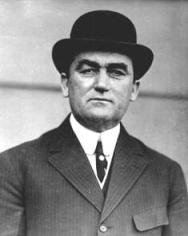
"Sinister Dick" Kinsella

“Sinister Dick” Kinsella

Kinsella was the former baseball magnate of Springfield, Illinois who went east to serve as McGraw’s chief scout.  He was a key player in the incident that led to Giants’ catcher Larry McLean’s banishment from organized baseball.

After the 1914 season, McGraw set his sights on the Indianapolis Hoosiers’ Kauff, who was being called the “Ty Cobb of the Federal League.”  Kauff led the league with a .370 average, 120 runs, 211 hits and 75 stolen bases.

When the debt-ridden Hoosiers were transferred to Newark for the 1915 season Kauff’s contract was sold to the Brooklyn Tip-Tops, and he joined the team in Browns Wells, Mississippi.

At the same time, Perritt coming off a 16-13 season was prepared to jump the St. Louis Cardinals and join the Pittsburgh Rebels in the Federal League.
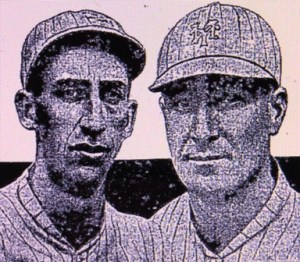
Pol Perritt and Benny Kauff, 1917

Pol Perritt and Benny Kauff, 1917

Sportswriter Frank G. Menke of Hearst’s International News Service picks up the story:

“Dick Kinsella, scout for the Giants, according to the story we get, hustled to Browns Wells and got a job on a plantation…Kinsella didn’t dare to put up at the same hotel because he was known by Manager Lee Magee, Business Manager Dick Carroll and others of the Brookfeds.”

Kinsella, according to Menke, was pretending to be a farm hand and also observing Kauff’s workouts and reporting back to McGraw who, along with Jack Hendricks of the Indianapolis Indians in the American Association (who held Kauff’s rights) was sending coded telegrams to Kauff signed “Father.”  Kauff received telegrams saying, “Mother wishes to see her boy,” and “All is forgiven.”

According to Menke, the telegrams were intended to inform Kauff that McGraw wanted him with the Giants and:

“The “everything forgiven” telegram was to tip Kauff off that if he jumped the National Commission probably would let him play.”

While Kauff was in Mississippi, Pol Perritt was in the process of  jumping to the Federal League.

According to Menke, Kinsella left Mississippi in the middle of the operation to secure Kauff in order to talk to Perritt.  What Kinsella said to Perritt is unknown, but Perritt’s meeting with Pittsburgh manager Rebel Oakes pretty much put an end to any chance of joining the Federal League.  The Associated Press said:

“Pitcher ‘Pol’ Perritt who jumped to the Pittsburgh Federal recently had a fist fight with Manager ‘Rebel’ Oakes…Those who saw the fight say that the pitcher delivered one blow that knocked Oakes over a chair…Friends and acquaintances interceded and hushed up the whole affair before police arrived on the scene.”

The story said Perritt was meeting with Cardinals’ management to “flop back to organized ball,” within weeks the Cardinals sold Perritt’s contract to the Giants, The AP said:

“Carefully guarded by “Sinister Dick” Kinsella…Perritt was delivered to John J. McGraw this noon…Kinsella brought his man in from Shreveport without struggle, and states that he did not even sight a Federal submarine during the entire journey.”

An alternate version of the story, published in The New York Times said it was McGraw who met with Perritt rather than Kinsella and highlighted the manager’s journey to meet the pitcher:

“McGraw had to travel forty miles on one railroad, nine miles on another, and then drive nine miles through the mud to get to Perritt’s home in Louisiana.”

Perritt was in the fold.  After a 12-18 season in 1915, he would win 18, 17 and 18 from 1916-18.

Kauff would be a bit more complicated.

While Kinsella was gone from Mississippi securing Perritt, Kauff signed a $6000 contract with Brooklyn, which he immediately regretted and contacted McGraw.
kinsellamcgraw

Dick Kinsella and John McGraw, 1920

According to Menke, Kauff:

“Related the difficulty he had with Robert B. Ward, president of the Brookfeds, over the contract.  The Giants people thought that owing to Kauff’s trouble—or alleged trouble—over the Brookfed contract that he was not legally under contract.”

Menke said the Giants signed Kauff for $7000 a year for three years with a $7000 bonus.

National League President John Tener voided the contract and Kauff was forced to return to the Tip Tops; he again led the league with a .342 average.

McGraw finally got his second man at the close of the 1915 season.  After the Federal League folded and Kauff was reinstated to organized baseball he signed a two-year contract for $6500 a season and a $5000 bonus with the Giants.

New York had finished in eighth place in 1915. They improved to fourth in 1916 and won the pennant by 10 games in 1917. McGraw’s Giants lost the to the Chicago White Sox four games to two in the World Series.  Perritt appeared in three games in relief, and Kauff hit a disappointing .160, despite two home runs in the Giants’ game four victory.

After the 1917 World Series Perritt and Kauff faded fast.

Perritt was 18-13 in 1918, but would only win four more games over the following three seasons with the Giants and Detroit Tigers; he was out of professional baseball before his 30th birthday.

Kauff’s demise is better known; his professional career came to an end at age thirty, the result of allegations of his involvement with gamblers, in general, and 1919 World series fixer Arthur Rothstein in particular.  Kauff, who owned an automobile accessory business with his half-brother and Giant teammate Jesse Barnes, was charged with stealing and reselling an automobile.  Although he was acquitted at trial, Kenesaw Mountain Landis banned Kauff for life.  Kauff’s oft-told story is told best in two excellent books by David Pietrusza:  Rothstein: The Life, Times, and Murder of the Criminal Genius Who Fixed the 1919 World Series and Judge and Jury: The Life and Times of Judge Kenesaw Mountain Landis.

Perritt died in Shreveport, Louisiana in 1947; Kauff died in Columbus, Ohio in 1961.

“One of the Two Greatest Sluggers”

28 Jan

On July 19, 1920, Babe Ruth hit his 30th home run of the season off Dickie Kerr of the Chicago White Sox, breaking the Major League record he had set the previous season.  Perry Werden, working as an umpire in the South Dakota League was largely forgotten.

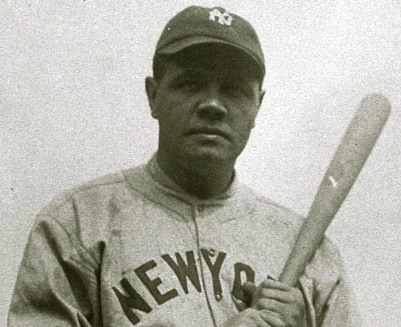
Babe Ruth

Babe Ruth

The Minneapolis Tribune, as a point of local pride, reminded readers that Ruth had not eclipsed the record set in their town:

“Beyond all doubt the mark made yesterday is a major league record of all time but the Babe has yet to equal the mark of 45 made by Perry Werden of the Minneapolis Western League club in 1895.”

Some reporters, like Al Spink of The Sporting News, dismissed Werden because “the park at Minneapolis, which was an unusually small inclosure (sic), with the right and left field fences close in.”  Regardless, Werden was back in the public eye; his forgotten record was revived as fans followed Ruth’s record season.  The Associated Press said:

“(Werden) admits that Babe Ruth has a harder swing than he had when he made his mark. ‘There is no doubt that Babe has it on all of them—modern and ancient’ says Werden”

When Ruth hit numbers 45 and 46, one in each game of a double-header at Fenway Park, The Associated Press said:

“(Ruth) broke all known world’s records for circuit drives in a single season.”

Werden, in his role as “the former holder of the home run record for organized baseball” was often asked about Ruth over the next decade.  Werden called Ruth “One of the two greatest sluggers that I have seen in fifty years.”

Perry Werden, 1930

Perry Werden, 1930

The only player Werden considered Ruth’s equal?   Ed Delahanty.

Werden told The North American Newspaper Alliance, in a nationally syndicated story:

“Ed Delahanty would have equaled or bettered the home run record of Babe Ruth if the lively ball had been in use…If Delahanty had any weakness no pitcher ever found out what it was.  He hit left-handers as easy and effectively as he did right-handers, and it made no difference to him where they threw the ball—high, low, inside, outside, curve fast ball or slow ball—they all looked alike to Big Ed.”

Werden said while playing first base for the Saint Louis Browns he saw just how hard Delahanty could hit:

“The Phillies had a runner on first base, and when Delahanty came up to bat we played in close for him, thinking he would bunt.  That was a mistake we never made again when Delahanty batted.  Instead of bunting he hit a ground ball so hard that it tore a shoe off George Pinkney, our third baseman, in addition to fracturing his right ankle.”

As further proof Werden said “Even with the lively ball…it was thirty-six years before Delahanty’s record of hitting four home runs in a single game was equaled by Lou Gehrig.”  Werden didn’t mention that Bobby Lowe had accomplished the same feat two years before Delahanty.

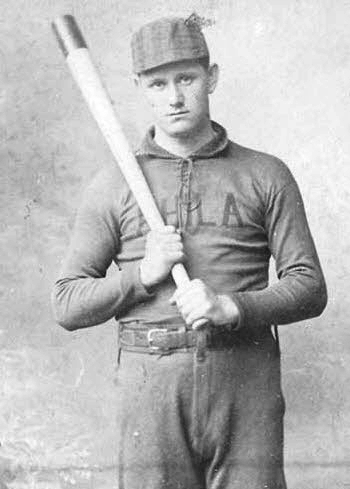
Ed Delahanty

Ed Delahanty

While Werden will never join Delahanty and Ruth in the Hall of Fame, he is remembered as one of the greatest minor league players of the 19th Century.  He died in Minneapolis in 1934.

“King of the Natural Hitters”

25 Jan

Percival Wheritt “Perry” “Moose” Werden began his baseball career as a pitcher for the semi-professional team of his employer; the Ira Perry Pie Company in Saint Louis.  He was discovered by the St. Louis Browns who offered him a contract but ultimately signed with the Saint Louis Maroons in the Union Association.

(An oft-repeated story that Werden’s discovery involved him leaving a pie wagon unattended to join a game, resulting in the wagon being destroyed is almost certainly apocryphal, although it has been repeated as fact with little or no support by several writers)

In 1884 the 22-year-old was 12-1 with a 1.97 for the Maroons who at 94-19 won the Union Association pennant by 21 games; despite the strong start, Werden would never pitch in the Major Leagues again.

The Maroons joined the National League the following season and Werden ended up with the Memphis Reds in the Southern League.  He was primarily a catcher a first baseman, and his career as a pitcher pretty much ended; he appeared on the mound in only three games that season and had only 14 more minor league appearances over the next 10 years because of arm trouble.

Perry Werden, 1908

Perry Werden, 1908

From 1886-88, Werden played with five minor league teams and played three games in the National League with Washington in 1888.  In 1889, Werden joined the Toledo Black Pirates in the International League, where he became a great hitter.

Werden hit .394 for Toledo; in 424 at-bats, he had 167 hits, which was the hit record for the franchise for nearly 100 years, finally broken by Greg “Boomer” Wells in 1982 (Wells had 182 hits in 541 at-bats).

Toledo became a Major League franchise the following season, joining the American Association as the Maumees, Werden was the their starting first baseman, hit .295 and led the team in hits, runs, triples, and RBIs.  The Maumees finished 68-64 in their only season.

Werden was sold by Toledo to the Baltimore Orioles in 1891 and had another solid season, leading the team in hits, triples and RBI’s.  The following season he was signed by the Saint Louis Browns to replace Charles Comiskey at first base; Comiskey had jumped the Browns to join the Cincinnati Reds.

Werden hit .256 and .290 in two seasons with the Browns.  In 1894, he returned to the minor leagues with the Minneapolis Minnies in the Western League.  That’s where he became a legend.

In 1894, Werden exploded.  He hit .417 with 43 home runs.  In 1895, he improved to .428 with 45 home runs.

The Western League was no doubt a hitter’s league; eight players with at least 100 at-bats hit .400 or better in 1894 and 11 did so in 1895.  And the Minnies home field, Athletic Park, where Werden hit most of his home runs, was by all estimates a hitter’s paradise with a short (some sources say 250 feet) fence.

Regardless, 45 home runs would remain a professional baseball record until 1920. The Duluth News-Tribune said several years later that Werden hit seven home runs in a double-header in 1895; under the headline “Perry Werden was King of the Natural Hitters:”

“It was one of the greatest batting feats ever seen on a baseball lot anywhere.”

Werden had one last season in the Major Leagues.  At 35-years-old in 1897, he hit .301 for the Louisville Colonels, then returned to the minor leagues where he continued to hit well; .330 for his minor league career.

Werden became an umpire in the American Association in 1907, and became a baseball pioneer in 1908 when he joined the Indianapolis Indians in the same league; he was one of the first full-time coaches in professional baseball.  The Associated Press said:

“Perry Werden will go to Indianapolis to act as assistant manager, coach and advisor in general of the Indianapolis baseball club this year.”

In October The Indianapolis News declared Werden a success in the new role:

“Werden was one of the biggest factors in bringing Indianapolis her first pennant since 1902.  Without his services it’s highly probable the flag would have flown elsewhere”

The Indianapolis Star predicted that Werden’s “novel position,” would become the norm with the Indians, and throughout baseball.

Werden eventually returned to umpiring, working in the western, Dakota, South Dakota and Northern leagues.

His 43 home run season became news again in 1920 as Babe Ruth was closing in on Werden’s professional record.  Werden said there was one player in his era who was Ruth’s equal as a hitter.  Who was it?

Read about it on Monday.

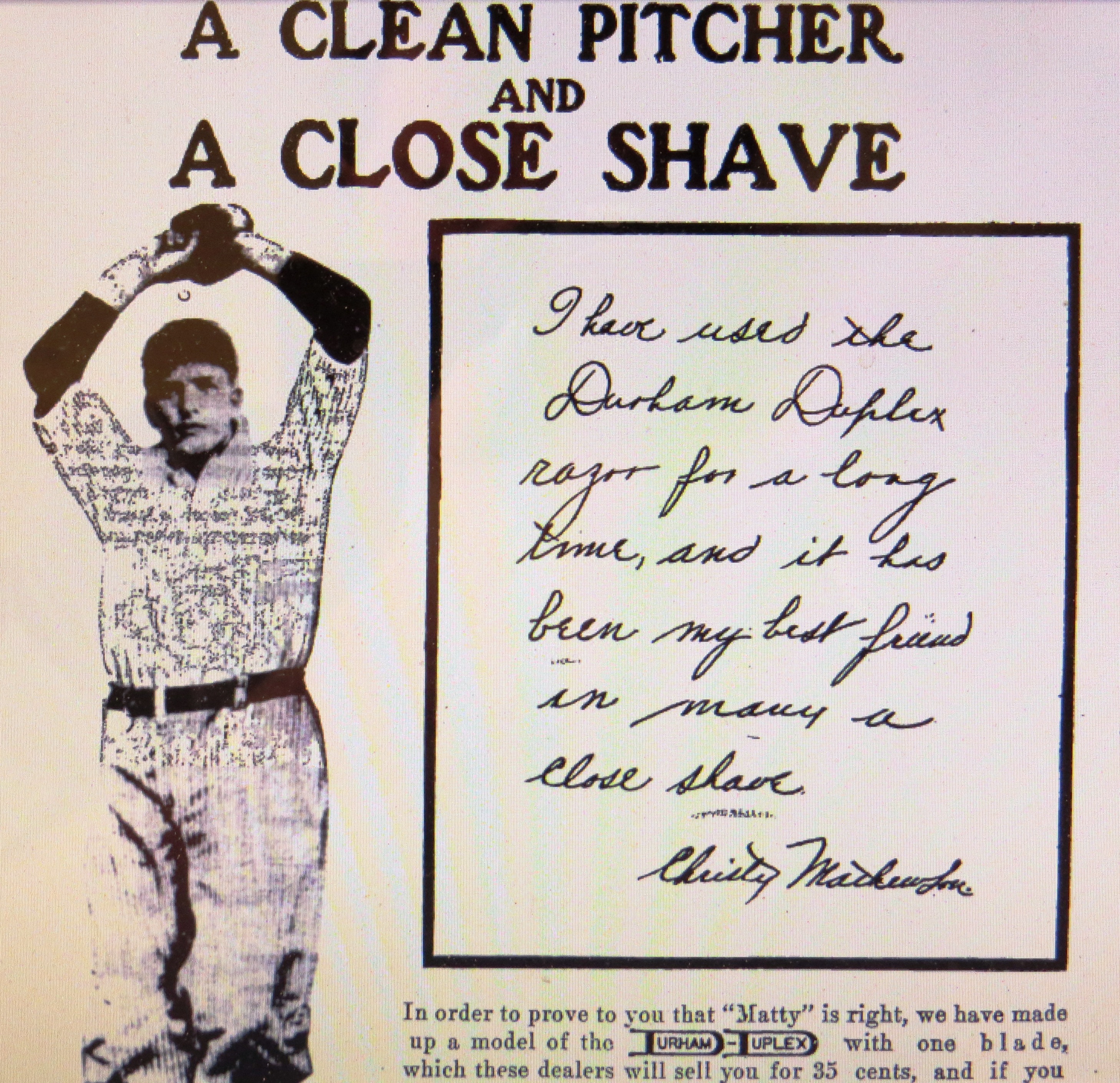
A Thousand Words–Lost Advertisements, Christy Mathewson

24 Jan

mattyad

“A Clean Pitcher and a Close Shave.”  Hall of Fame pitcher Christy Mathewson for the Durham Duplex razor.  “Big Six” says:

“I have used the Durham Duplex Razor for a long time, and it has been my best friend in many a close shave.”

Mathewson won 372 games for The New York Giants and one for the Cincinnati Reds from 1900-1916, including four 30-win seasons, and was a member of the first Hall of Fame induction class.

“Christy Mathewson brought something to baseball no one else had ever given the game. He handed the game a certain touch of class, an indefinable lift in culture, brains, and personality.’”
— Grantland Rice