Tag Archives: Boston Red Sox

Lost Advertisements-Tris Speaker and Larry Doyle, Lewis 66

20 Jan

1913whiskey

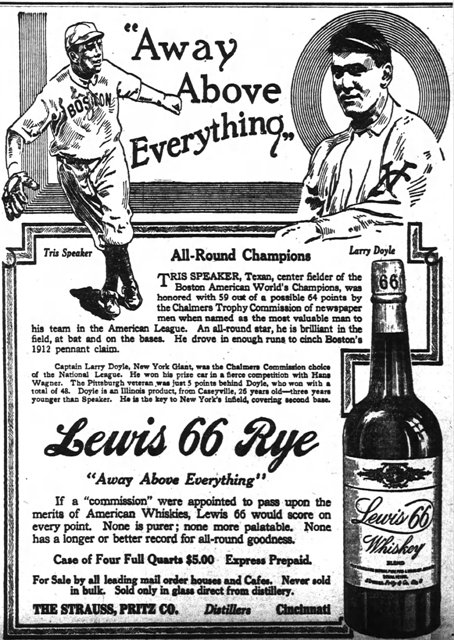
A 1913 advertisement for Lewis 66 Rye Whiskey from The Strauss, Pritz Company, a Cincinnati-based distiller featuring Tris Speaker and Larry Doyle:

“Tris Speaker, Texan, center fielder of the Boston American World’s Champions, was honored with 59 out of a possible 64 points by the Chalmers Trophy Commission of newspaper men when named as the most valuable man to his team in the American League.  An all-round star, he is brilliant in the field, at bat, and on the bases.  He drove in enough runs to cinch Boston’s 1912 pennant claim.

Captain Larry Doyle, New York Giant, was the Chalmers choice of the National League.  He won his prize car in a fierce competition with Hans Wagner.  The Pittsburgh veteran was just 5 points behind Doyle, who won with a total of 48.  Doyle is an Illinois product, from Caseyville, 26 years old–three years younger than Speaker.  He is the key to New York’s infield, covering second base.”

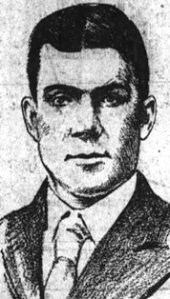
Larry Doyle

Larry Doyle

The cars–each a 1913 Chalmers 36– were presented before World Series games at each player’s home ballpark by company president Hugh Chalmers.  Former Cincinnati sportswriter turned advertising executive and chairman of the Chalmers Commission, Ren Mulford introduced the automobile executive at the Polo Grounds for Doyle’s presentation, and said:

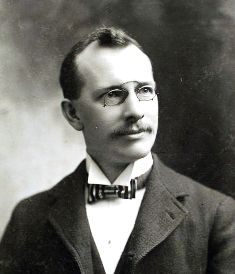
Ren Mulford

Ren Mulford

“What (Sir Thomas) Lipton is to Yachting, and what (William Kissam) Vanderbilt is to automobile road racing, Hugh Chalmers is to baseball.  The Chalmers trophy is now a recognized baseball classic.”

The “recognized baseball classic” was discontinued after the 1914 season.


Lost Pictures–The Best Eyes in Baseball

4 Dec

eyeszimmerman

eyesdaubert

eysspeaker

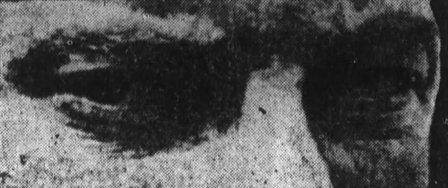
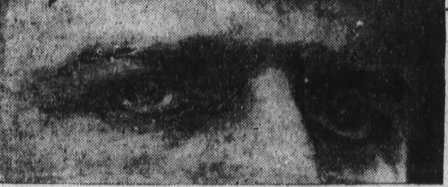
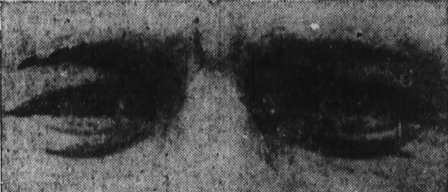
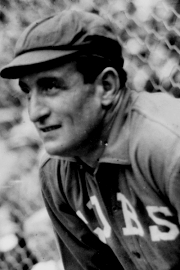
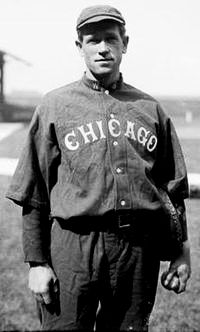
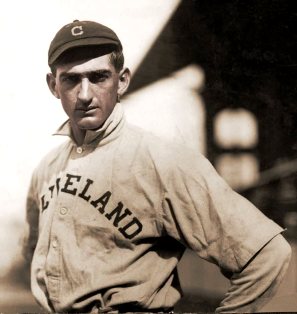
Above, three sets of eyes, 1916.

Harold “Speed” Johnson of The Chicago Herald said:

“It’s the eye and not the wallop that counts in the national Pastime.  Some eyes are more durable than others.  Larry Lajoie possesses such a pair; so does Hans Wagner, Terry Turner, Tris Speaker, Jake Daubert, Frank Schulte, Larry Doyle, Heine Zimmerman, Tyrus Cobb, Joe Jackson and Bill Hinchman.”

Johnson informed his readers that “Most of these birds refrain from reading during the offseason, thereby sparing their eyes.”

As for the three sets pictured above, Jonson said:

“Heine Zimmerman is another notable example of the batter who possesses the keen optics.  He eccentric third sacker of the Chicago Cubs, when at peace with the world, is one the greatest natural sluggers of all time.  His eyes never have troubled him but his temperament frequently has caused him to slump, swinging frantically at any old pitch.  Right now Heinie is seeing in exceptionally good form as witness his average of .336 for 48 combats.”

[…]

“There is nothing wrong with Jake Daubert’s glims as a slant at the latest averages will indicate…His heavy cannonading has been a principal factor in the upward climb of the Robins…For a pair of eyes that have been in use as long as Jake’s in the big set they’re holding out famously.”

[…]

 “Nine seasons of big league milling haven’ dulled the lamps of Tristram Speaker who right now is going better than he did in his banner years with the Boston Red Sox.  Not only is the big Texan rattling fences  at Dunn Field, Cleveland, where for seven years he averaged .381 on visits with the Bostonese, but he is keeping up his terrific pace abroad.”

Zimmerman’s temperament caught up with him again.  He wore out his welcome in Chicago in August of 1916, was traded to the New York Giants and finished the season with a .286 average.

Daubert’s eyes held out.  He hit .316 and led Brooklyn to the National League pennant.

Speaker kept hitting at Dunn Field and everywhere else, finishing the season with a major league-leading .386 average.

“Age is a Hard Master”

21 Sep

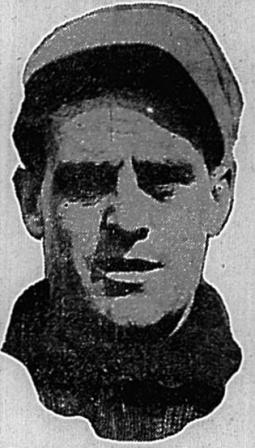
“Turkey Mike” Donlin spent his later years trying to earn a living as an actor; his limited success on the stage and screen forced him to accept several baseball jobs as well.  In 1922, he was hired as a scout by the Boston Red Sox—it was his most active season in the game since his final game with the New York Giants in 1914.

Mike Donlin

                Mike Donlin

Like most players of his era, he had a general disdain for the current state of the game.  He shared his disgust with a reporter from The Associated Press (AP) when he arrived in San Francisco after a trip through Texas:

“In the Texas League I found a majority of the players ill with a strange disease consisting of absolute refusal to run out flies or ground balls that look like easy outs. That kind of baseball is beyond me.

“I saw Texas League players getting as high as $700 a month loafing on balls hit to the infield and running to the bench on high flies.  They couldn’t do it and get away with it in my time.

“When I was starting $300 a month was a big salary and believe me, we earned all we got.  We ran out all our hits in those days and, not only that, we had to fight every inch of the way, not alone with spirit, but with our fists.”

The money seemed to bother him as much as the lack of hustle.

While in San Francisco he met Willie Kamm, who the Seals had agreed to sell for the then record amount of $100,000 (and three players) to the Chicago White Sox.  Donlin, who said the St. Louis Perfectos purchased him from Santa Cruz in the California League for $500 in 1899.

According to The AP when they were introduced Donlin said:

“I wanted to meet you, young fellow, because you’re the highest priced minor leaguer ever sold, and I’m the cheapest.”

Always short of money and never  one to refuse a paycheck, and perhaps encouraged by what he considered to be the lesser quality of current players, Donlin accepted an offer to join the Rock Island Islanders of the Mississippi Valley League for two games while he was scouting in the Midwest during August.

According to The Rock Island Argus, Donlin “one of the most picturesque characters the national pastime has ever produced,” was signed to a one-day contract to “keep within the league rules.”  There is no record of what the Islanders paid Donlin for the one-day stunt.

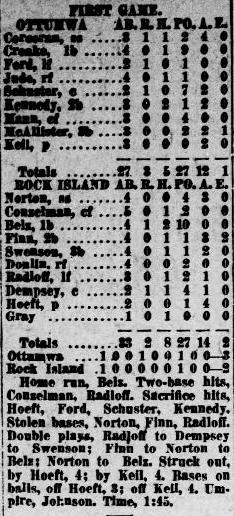
He played in both games as the Islanders dropped a doubleheader to the Ottumwa Cardinals.  The Argus said of his performance:

“Even Mike Donlin, once peerless performer for the New York Giants, fizzled as a mascot.  Mike donned an Islander uniform as per announcement and was seen in right field in both games.  Age is a hard master.”

Donlin “handled two chances cleanly” in the first game, but was 0 for 4 at the plate with two strikeouts, a foul out to third and a fly out which “sent the centerfielder to the scoreboard to haul (it) in.”

He fared slightly better in the second, going 1 for 3 with two ground outs and a single on a “Texas Leaguer into right field territory.”  No balls were hit to him in the second game.

donlin1

      The Box Scores

donlin2


He was no more successful as a scout than he was as a player that week in Rock Island.

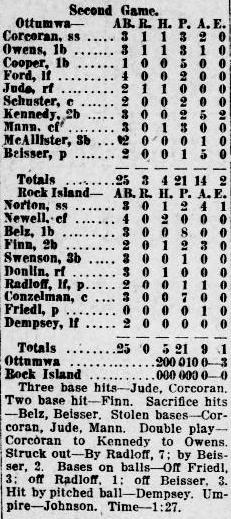
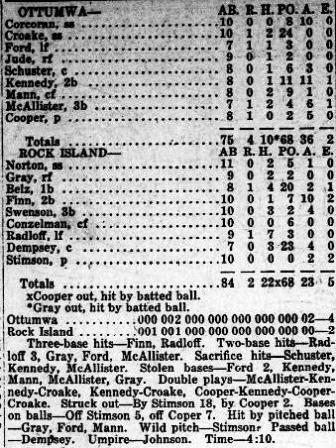
Two days before he played with the team, Donlin watched the Islanders’ Carl Stimson pitch a 23-inning complete game against Ottumwa.  Stimson lost the game 4 to 2—he committed two errors in the 23rd inning—but allowed only 10 hits and struck out 18.

The 27-year-old Stimson was a sub .500 pitcher (10-15) who had come to Rock Island in a trade with the Waterloo Hawks just a month earlier, but Donlin was impressed with the performance and Stimson’s 6’ 5” frame—Stimson also might have benefitted from a minor illness his wife suffered that month, The Argus said he left the team for several days to attend to her and Donlin was not able to stay long enough to watch him pitch a second time.

The 23-inning game box score

       The 23-inning game box score

Despite only seeing him once, The Argus said Donlin was “convinced that Carl is worthy of a trial in the big show,” and recommended that the Red Sox purchase his contract.

Stimson joined the Red Sox the following spring, but was slowed by an ear infection and finally joined the club in June.  Donlin’s discovery appeared in just two games over one month in the big leagues, giving up 12 hits, five walks, and 10 earned runs over four innings before being released.

Donlin continued making appearances on the stage, had small acting roles in dozens of movies, occasionally worked as a scout, and struggled to make a living.  In 1927, he began to suffer from a heart ailment and remained broke and in poor health and until his death in 1933.

Lost Advertisements–“162,859 Excited Fans”

7 Sep

mecca

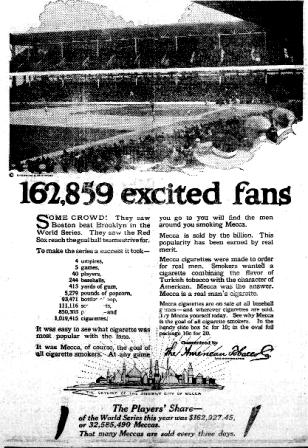
An advertisement for Mecca Cigarettes that appeared shortly after the 1916 World Series:

162,859 Excited Fans

“Some Crowd!  They saw Boston beat Brooklyn in the World Series.  They saw the Red Sox reach the goal ball teams strive for.”

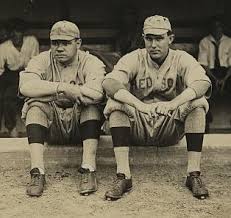
The Red Sox won the series 4 games to 1–Babe Ruth won one, a 14-inning complete game, and Ernie Shore won two, the first and fifth games.

Babe Ruth and Ernie Shore

          Babe Ruth and Ernie Shore

“To make the series a success it took–

4 umpires,

5 games,

40 players

244 baseball,

413 yards of gum,

5,279 pounds of popcorn,

93,471 bottles of pop,

111,116 score cards,

850,303 peanuts–and

1,019,415 cigarettes…

The Players’ Share–of the World Series this year was $162,927.45, or 32,585,490 Meccas.

That many Meccas are sold every three days.”

Winners shares for the Red Sox were $3,910.26, the Robins losing shares were $2,834.82.

Murphy’s “Billion Dollar Team”

17 Aug

“Money will not buy a pennant winner;” so said William George “Billy” Murphy, the sports editor of The St. Louis Star.  In 1914, he set out to select a team that not even “John D. Rockefeller… (With) all his wealth could buy a club that would win a World’s championship from the one we have picked…The Billion Dollar Team.”

Murphy said:

“You fans of towns that have never won a flag, how would you feel to wake up some morning and find that Dame Fortune had so arranged matters that this club had suddenly been picked to represent your fair city.”

Jimmy Archer, catcher

Behind the plate he acknowledged “There are many who would doubtless pick (John) Chief Meyers…but considering the Indian’s slowness of foot and propensity for clogging up the bases and stealing when the bags are full, we must remark we cannot see the “Chief” for a minute with Jimmy Archer, who, although not so good a hitter, is faster, a quicker thinker, greater fielder and better pegger.”

Jimmy Archer

Jimmy Archer

Murphy was in the minority questioning the baseball intelligence of Meyers, who was widely considered one of the most intelligent and articulate players of his era.  He also rated Ray Schalk and Wally Schang as superior, saying:

“In the writer’s humble opinion they are much more valuable men to their team than Meyers.”

Walter Johnson, pitcher

“There will hardly be a dissenting vote cast against Walter Johnson.  Unquestionably he is the greatest of all the pitchers.

(Charles Chief) Bender and (Christy) Mathewson are also great—great when they should show class—in championship games.  Every nerve, every fiber of their brains, every muscle necessary to their craft, is at its best when big games are being fought.

“Wonderful as they are, we must pick Johnson, who also has class and is game to the core.”

Hal Chase, first base

“For first base, there is only Hal Chase.  He is a great hitter, marvelous fielder, can run the sacks, and is a brilliant tactician.

(John) ‘Stuffy’ McInnis, Jake Daubert, Eddie Konetchy, Fred Merkle, and Jack (Dots) Miller are all stars, but they are ‘also rans’ in the class with Prince Hal of the White Sox.”

Prince Hal of the White Sox

Prince Hal of the White Sox

Eddie Collins, second base

“At second base, Eddie Collins in the potentate.  Johnny Evers, Larry Doyle, and Larry Lajoie occupy seats in the second sackers’ hall of fame, but Collins rules over the roost.”

Honus Wagner, shortstop

“At short, notwithstanding his age, the palm goes to Hans Wagner.  Taken all in all he is still the greatest man at the position in the game.  He can do everything and does it better than any of his contemporaries.  When will we look upon his like again?”

Frank Baker, third base

“At third base, there is that wonderful silent son of swat, Frank Baker, the conqueror of the wonderful Mathewson and Richard (Rube) Marquard.”

Joe Jackson, right field

“In right field we have Joe Jackson, the young Southerner with the Cleveland club.  He is one of the greatest batsmen in the game today and is a fielder and base runner of unusual ability.”

Joe Jackson

Joe Jackson

Ty Cobb, center field

“In center, there is Tyrus Raymond Cobb, the Royston, Georgia marvel, who is the greatest player baseball has ever known.”

Tris Speaker, left field

“And in left field, there is Tris Speaker of the Boston Red Sox—second only to Cobb.”

Lost Advertisements–Fit for a King

1 May

fitAn ad for Old Underoof Whiskey from April of 1910.  Chicago White Sox owner Charles Comiskey–and Chicago fans–had great expectations for the club.  After a disappointing 78-74 record and a fourth-place finish in 1909, Hugh Duffy was hired to replace Billy Sullivan as manager.

Comiskey also replaced his entire starting infield, purchasing the contracts of three minor leaguers: first baseman Chick Gandil, second baseman Rollie Zeider, and shortstop Lena Blackburne, and installing utility infielder Billy Purtell at third.

The new 1910 White Sox infield.

The new 1910 White Sox infield.

The Chicago Tribune said the Sox were now:

“Resplendent with brand new darns where were worn the biggest holes last year.”

Comiskey was confident enough to tell reporters the team “(W)ill lose their name of hitless wonders this year. I am confident we will be as strong as any club in the league in this department.”

He also maintained that Ed Walsh, Doc White, Jim Scott, and Frank Smith, who would start the opener on April 14, comprised “(T)he strongest staff of pitchers in any league.”

The Sox did not disappoint on opening day.  Behind Smith’s one-hitter, the Sox defeated the St. Louis Browns 3 to 0.

The Chicago Inter Ocean said the “New Sox lived up to every inch of the reputation they have gained this spring.” The Tribune dubbed the team “Commy’s Comets,” and said:

“When the dazzling display was over Comiskey’s face resembled the noonday sun wreathed in an aureole of smiles, which extended beyond the rings of Saturn and half the distance to the milky way.”

Old Underoof commemorated the victory with a new ad:

commy1910

The Sox quickly returned to earth and lost their next four games.  Things never got much better.  A month into the season they were 10 games out of first place; they finished 68-85, in sixth-place 35.5 games behind the Philadelphia Athletics.

With a league-worst .211 batting average, the they failed to ” lose their name of hitless wonders,” as Comiskey predicted.

As for “the strongest staff of pitchers in any league,” they could not overcome the horrible support they received all season.  Despite a 2.03 team ERA, second only to Philadelphia’s 1.79, only Doc White (15-13) had a winning record.

Walsh, who led the league with a 1.27 ERA,  was 18-20, and Scott was 8-18 with a 2.43 ERA.

Frank Smith, the 30-year-old hero of the opener, who had won 25 games with a 1.80 ERA in 1909, was 4-9, despite a 2.03 ERA and three shutouts, when he was traded with Billy Purtell to the Boston Red Sox in August.


Things I Learned on the Way to Looking up other Things #14

29 Apr

Wishful Thinking in Boston–1921

Arthur Duffey was a former track athlete—he finished fourth in 100 yard dash in the 1900 Olympics—turned sports columnist for The Boston Post.

Arthur Duffey

Arthur Duffey

Like many in Boston, he hoped Babe Ruth would be unable again put up the type of numbers he did in 1920—54 home runs, 135 RBI, .376 average– after being sold by the Red Sox to the New York Yankees.

Ruth

Ruth

Duffey had received word in March of 1921 that his hopes would be realized:

“According to all reports from Hot Springs way where Babe Ruth is putting in his preliminary canters for the coming American League race, Babe evidently believes in that old slogan about ‘Living to eat instead of eating to live,’ for the Bambino is pounds overweight and not a few predict that he is going to have his troubles in getting down to anything like his baseball scale of last season…(Ruth) has no doubt been living the life of Reilly since he has proven himself the ‘King of Swat.’ But, is he going to eat himself out of another chance to beat that home run record?”

Ruth managed to “eat himself” into a season that included new career highs for games (152), at-bats (540), runs (177), home runs (59), RBI (168), and batting average (.378).  The Yankees won the American League pennant and the Red Sox finished their second straight fifth-place, Ruth-less season.

Wishful Thinking about honesty, 1901

George Erskine Stackhouse, sports editor of The New York Tribune, assured readers of “Leslie’s Weekly Illustrated” magazine, that there was no corruption in baseball:

“Baseball is honest.  Some peculiar things happen in baseball at times, but I have watched the game very closely for a great many years and believe that it is at least as close to perfect honesty as any professional sport in the world.”

George Erskine Stackhouse

George Erskine Stackhouse

Stackhouse also refused to believe that gamblers had any role in the game:

“Baseball has no side-show features, such as betting and the like, and soon as the average ‘fan’ thought the games dishonest he would lose all interest in the sport.”

But, Stackhouse assured his readers he was not naïve, but everyone involved in baseball had learned their lesson from the scandals of the 19th Century:

“I do not mean to say that there are not players and club owners who would not be tricky if they dared.  They simply don’t dare.

“The lesson dealt out to the early evil-doers who were charged with selling games in the interest of certain gamblers, has had a splendid effect.  The sentence hangs over those men yet, and the disgrace will remain with their children and their children’s children.  I believe that there have been hundreds of fake horse races, prize fights, wrestling matches, and professional running races to one really crooked baseball game.”

Stackhouse died in 1903 at the age of 42, content in the knowledge that baseball remained “close to perfect honesty.”

“The Next Babe Ruth”

18 Mar

After he hit 11 home runs in 1918, and for the next two decades, stories about the discovery of “The Next Babe Ruth” became commonplace in newspapers across the country.

One of the first was Joe Doyle, “The Babe Ruth of Great Lakes,” signed by the St. Louis Cardinals in November of 1918.  Doyle was the star of the team representing Camp Dewey at Great Lakes Navel Training Station where, The St. Louis Globe-Democrat said he made a name for himself, hitting “a dozen home runs and nine triples…(and) flogging a home run over the Camp Dewey Drill Hall, a smash that might be compared to a lift over the left fences of any major league park.”

Doyle began his professional career the following spring with the Houston Buffaloes in the Texas League and played his entire career in Texas.  “The Babe Ruth of Great Lakes” hit just eight home runs over five minor league seasons.

Ben Paschal had the distinction of being declared “The Next Babe Ruth” twice.  When the Boston Red Sox purchased Paschal from the South Atlantic League’s Charlotte Hornets in July of 1920, Manager Ed Barrow told The Boston Herald he had acquired “A second Babe Ruth.”

Paschal joined the Red Sox after Charlotte’s season ended in September.  He had 10 hit in 28 at-bats, but no extra base hits, and was returned to Charlotte after the season.

After four more excellent seasons in the South Atlantic League and Southern Association (he hit .335 with 68 home runs from 1921-1924) he was  purchased by the New York Yankees for $20,000 in August of 1924.

Ben Paschal

Ben Paschal

Paschal was again dubbed the “Second Babe Ruth” by newspapers.  His second stint as the second Ruth was longer and more successful than his first.  From 1924-1929 he hit .309 in with 24 home runs in 750 at-bats as an outfielder playing behind Ruth and Bob Meusel (Meusel was himself dubbed “Another Babe Ruth” by Manager Miller Huggins when he joined the Yankees in 1920).  On Opening Day in 1927 the Second Babe Ruth pinch-hit for Ruth (who was 0-3 and struck out twice) in the sixth inning; Paschal singled, and the Yankees went on to an 8 to 3 victory over the Philadelphia Athletics.

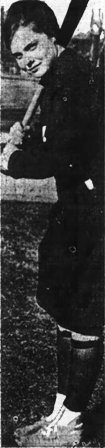
Then there was Dorothy Hodgens.  In 1921, Hodgens was a 20-year-old student at Wilson College in Chambersburg, Pennsylvania.  Hodgens briefly became a celebrity and was called the “feminine Babe Ruth” by many newspapers after The Associated Press (AP) reported that while growing up in Philadelphia Napoleon Lajoie said she was “the only girl he ever knew who could play ball.”

After her picture appeared in papers across the country, Hodgens, who played several sports at the school, was interviewed by The Harrisburg Evening News as she was “ready to enter a basketball game:”

“Yes, I’m terribly fond of baseball, and I’ve been playing it ever since I’ve been a bit of a youngster.”

She said Lajoie was a neighbor in Philadelphia when she was a child:

“Lajoie used to come out and pitch ball with the boys and girls in the neighborhood.  He told me I was the only girl he ever knew who could pitch and gave me a box of league balls that I have treasured ever since.”

Dorothy Hodgens "The Feminine Babe Ruth."

Dorothy Hodgens “The Feminine Babe Ruth.”

While she said her real ambition was to become an actress, Hodgens said, “I never expect to give up baseball entirely though, and I certainly think that every girl should learn to play the game.”

The “Feminine Babe Ruth” disappeared from the public eye shortly afterward.

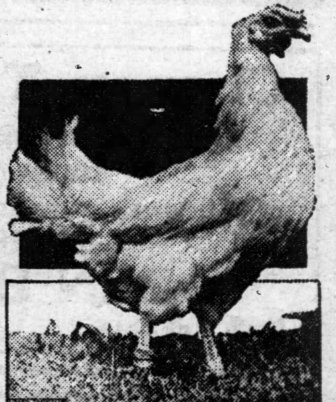
And finally, there was “Another Babe Ruth” who had a brief moment in the limelight in the fall of 1920.  This one was a three-and-a-half pound white Leghorn Chicken who was named “Babe Ruth,” and had just established a new record.

"Babe Ruth"

“Babe Ruth”

The AP said:

“(T)he home run king has a rival…She bats 326 eggs, and this beats the record of 314 (for a single year).  By experienced poultrymen, her record of 326 perfect eggs is considered the most remarkable in the history of the poultry industry.”

There was no report of how she performed the following season.

“The Longest Three-bagger on Record”

11 Feb

Babe Ruth was the reason American League Umpire Billy Evans called for a rule change after the 1918 season.

Billy Evans

Billy Evans

Ruth tied Philadelphia Athletics outfielder Clarence “Tillie” Walker for the league lead with 11 home runs, but Ruth was not given credit for what would have been number 12 on July 8.

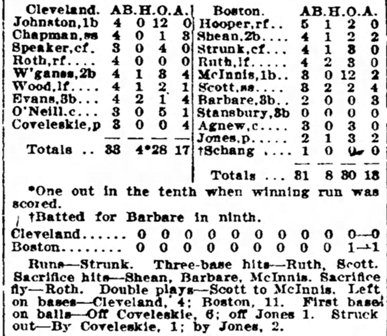
Ruth’s Red Sox were in a scoreless tie with the Cleveland Indians in the tenth innings of the first game of a doubleheader.  Stan Coveleski gave up a single to Amos Strunk with one out, and Ruth came to the plate.

The Boston Post said:

“Coveleski will probably hear the crash of Ruth’s bat for many a day.  The ball sped like a bullet far into the right field bleachers almost to the top.”

The Boston Globe said:

“It is getting so now that Ruth is the man of the hour every day.  His mighty crash into the right field bleachers in the 10th inning drove Strunk home.”

Ruth’s blast landed more than half way up into the right field bleachers, and The Boston Herald said a ball had never been hit further at Fenway Park, but noted, because Strunk had crossed the plate with the winning run “The best the scorers could give Ruth was a triple;” or, as The Post called it “The longest three-bagger on record.”

The box score

The box score

That winter, in his nationally syndicated column, Evans called Ruth’s “triple:”

“(O)ne of the longest drives I have ever seen.

“If there was a real, genuine, sure-enough home run, that wallop was the last word.  It was the longest drive Ruth made for the season, yet in the records he is credited with only a three-base hit.”

Ruth hit

Ruth hit “The longest three-bagger on record.”

To Evans, the solution was simple:

“I believe a more just scoring would have had the final result 2 to 0 in favor of Boston.  I believe a rule should be made which said that when a ball was knocked over the fence, or into the bleachers in an extra-inning game, all runners on the bases, as well as the batsman, should be entitles to score.”

For any present day fan, Evans’ suggestion sounds like common sense.  But, in 1918 it was criticized in many quarters.  One of the biggest critics of the potential rule change was William Blythe Hanna of The New York Herald.  Hanna said the rule change would go against everything the game stood for:

“Nothing could smack more of sophism than such advocacy.  Ball games end when the winning run crosses the plate, and any juggling with the rules to give a man a home run under the circumstances noted would be making the game subordinate to individual feats, which, of course, would be contrary to all the well-founded tenets of sport, discipline and organization.  It is surprising that a man of Evans’ intelligence could take so specious, so fallacious a view.”

Evans suggested his proposed rule change again in a column the following year, and sportswriter Fred Lieb of The New York Sun—a non-voting member of the rules committee—introduced the proposal.  The final roadblock was committee member and National League umpire Hank O‘Day, who according to Lieb insisted “I’m telling you, it is illegal.  You can’t score runs after the game is over!”

Despite O’Day’s objection the rule change was officially enacted by the Rules Committee on February 9, 1920 in Chicago.  Hanna had his final word on the rule the following day in The Herald:

 “This is a radical departure, and it is by no means a sure thing that is was based on sound reasoning.”

“Throw Strikes. Home Plate Don’t Move.”

19 Jan

Satchel Paige told Dave Condon of The Chicago Tribune that early in 1965, with the help of his wife Lahoma, and 17-year-old daughter Pamela he “wrote letters to everyone in baseball just looking for a steady job.  Anything.”

After not one professional team responded, the spring and early summer were like most during his 40-year career as a pitcher—Paige traveled wherever there was a chance for a paycheck.

He had made appearances with the Harlem Globetrotters in the winter and spring and then hit the road; pitching for the barnstorming Indianapolis Clowns and whoever else would call.  In May, The Chicago Defender said Abe Saperstein, who was managing Paige’s appearances, took out an ad in The Sporting News:

“(T)he man, who may have been the greatest pitcher of all time, is letting it be known that he has glove and is willing to travel.  All that is necessary to secure his services is to contact Saperstein.”

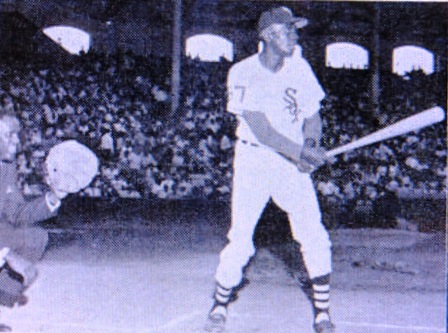
One night Paige would be at Chicago’s Comiskey Park, in a White Sox uniform, pitching for the Clowns in front of a large crowd, or across town in Wrigley Field where 30,000 fans came out; another night would find him in Hastings, Pennsylvania taking “the mound for the Hastings VFW club,” or Wheatfield, Indiana pitching “for the Band Boosters against the Wheatfield Young Farmers,” in front of a few hundred people.
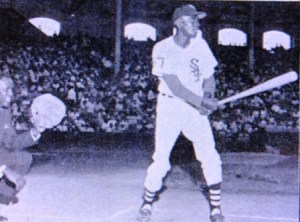
Paige at Comiskey Park in 1965--Chicago Cubs outfielder George Altman is the catcher.

Paige at Comiskey Park in 1965–Chicago Cubs outfielder George Altman is the catcher.

Things began to look up in late July when the Cleveland Indians inducted Paige into the team’s Hall of Fame between games of a Sunday doubleheader with the Yankees; in front of the team’s largest crowd of the season:  56,634.  According to United Press International:

“Satch tossed examples of his blooper, drooper and hesitation pitches to (former Indians teammate) Jim Hegan, now a Yankee coach and explained his philosophy of pitching thus: ‘Just take the ball and throw it where you want to.  Throw strikes.  Home plate don’t move.”

In August, he accepted an offer to pitch for and manage a team in Anchorage, Alaska called the Earthquakers.  In reality, Paige simply went to Alaska for a short series of exhibition games, and had no intention of staying there—he was already booked to appear at the old-timers game scheduled in September to mark the first season of the Houston Astrodome.  But he did his best to sell it as a possible long-term move.  He told a reporter for The Associated Press:

“Lately, I’ve wanted to leave barnstorming baseball to settle down somewhat to help the sport.  Anchorage seems to be the place to do it.”

In addition to his appearance in a handful of games in Alaska, his arrival in the state also resulted in a chance meeting that was reported in the press.

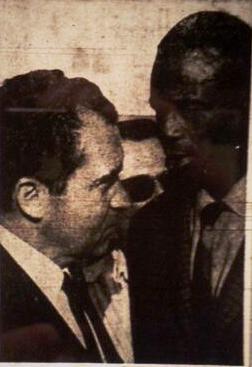
As a crowd of local residents gathered at the Anchorage airport to greet Paige, another plane arrived for refueling.  It carried former Vice President Richard M. Nixon on his way to Tokyo.  Nixon walked into the terminal while the plane was refueled, and when he asked about the crowd he was told they were waiting for Paige’s arrival.  Nixon joined the line to greet the pitcher.  The man who would be the leader of the free world in a little more than three years told a reporter from The Associated Press:

“I always like to meet celebrities.”
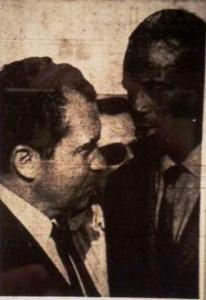
Nixon and Paige meet in Alaska

Nixon and Paige meet in Alaska

His commitment in Alaska over, Paige made it to the Astrodome on September 6.  The two-inning game, featuring a team of “immortals” versus “Texas All-Stars,” was an incredible collection of legends—more than 50 former players participated; twelve were already members of the Hall of Fame.  The Houston Post said of the player introductions:

Joe DiMaggio, the Yankee Clipper, got a deafening cheer.  So did Satchel Paige, peerless Negro hurler.”

The paper said the only others to receive a reception near that for Paige and DiMaggio were Dizzy Dean and native Texan Monty Stratton.
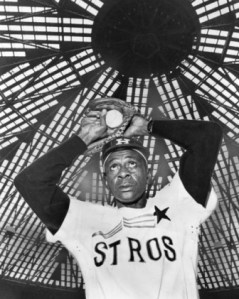
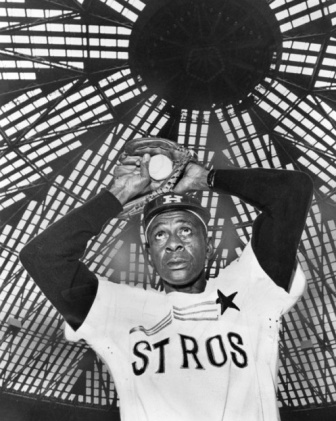
Paige in the Astrodome

Paige in the Astrodome

Perhaps it was the reception in Houston that caused one of the letters Paige, and his wife and daughter had written months earlier to finally be answered.

Charles Oscar Finley, who made his fortune in the insurance business and bought controlling interest of the Kansas City A’s before the 1961 season, was the one who finally responded.

That the signing of Paige appears to have been a spur of the moment decision for Finley after reading about the reception in Houston, is supported by the fact that it was announced by the marketing savvy Finley at what The Kansas City Times described as a “hastily called news conference,” which Finley, who was in Chicago, did not attend.

He appeared with General Manager Hank Peters and told reporters “I thought they were kidding” when Finley called and offered him a contract.

He said he was ready to pitch and brushed aside questions about his age:

“I think I can still pitch and help this club.  So what difference does it make what my age is if I can?”

Bill Veeck, who had signed Paige with the Cleveland Indians in 1948 and the St. Louis Browns in 1951, told The Times he hoped it wasn’t just a publicity stunt by Finley:

“I am hopeful he will be used as he should be—as a pitcher. Leroy should surprise a few people as he has for a long time.”
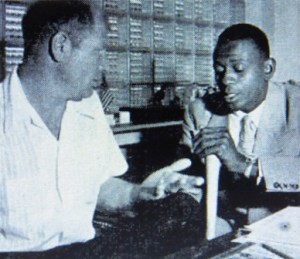
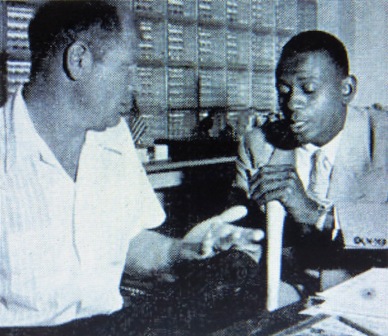
Veeck and Paige

Veeck and Paige

The controversial Veeck, more than a decade away from his return to the game, told The Kansas City Star he blamed himself for the pitcher’s  long absence:

“When I left Cleveland the first thing the new owners did was get rid of Satch.  When I sold the St. Louis Browns (and the team relocated to Baltimore), the same thing happened.  That’s nothing more than guilt by association.”

The signing of the 59-year-old Paige, who joined a team that included five 19 and 20-year-old pitchers who appeared in at least one game that year—Jim “Catfish” Hunter, John “Blue Moon” Odom, Ron Tompkins, Tom Harrison and Don Buschorn—inspired a short poem published in The Star:

“They’re either too

Young or too old,

When Charlie puts ‘em

In A’s Green and Gold.”

Papers across the country carried a photograph of Paige, seated on a chair, with one of Finley’s young pitchers, Catfish Hunter, on his knee.  While the photo was straight from Finley’s marketing plan, the impact of one future Hall of Famer on another, forty years his junior, seems to have been real.
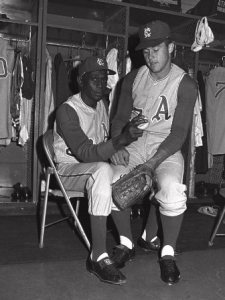
Paige and Hunter

Paige and Hunter

The Star spoke to Paige about his pitching philosophy one afternoon as Hunter stood nearby.  The paper said:

“Hunter listened intently as Satchel expounded his pitching theories.”

Paige was equally impressed with the 19-year-old, telling The Star:

“This young man has shown me a lot of poise.  He has a great future in this game.”

The next two weeks were filled with pictures of, and stories about, Paige in a rocking chair, a nurse seated nearby, watching the A’s play, and while a “Satchel Paige Night” was scheduled, there appeared little chance the pitcher would be used as anything but a prop for publicity.  Then Finley announced that his new pitcher would start on his night, September 25 against the Boston Red Sox.

What took place on the mound on September 25 has been written about many times. With his six children and wife Lahoma—pregnant with number seven—sitting in the owner’s box with Finley, Paige pitched three shutout innings, allowing just one hit—a Carl Yastrzemski double.

The only disappointment was the anemic crowd—just 9,289 Kansas City fans turned out to see a legend, the second largest crowd during that six-game home stand was 2,874.

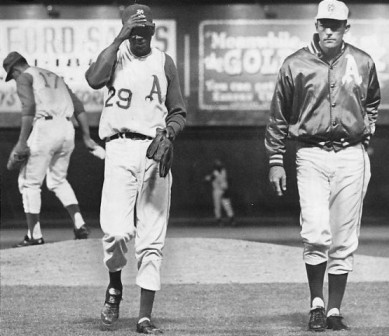
As Paige took the mound in the fourth inning, A’s Manager Haywood Sullivan, who was not consulted before Paige’s signing or before Finley announced he would pitch that night, came to the mound to remove Paige.  The pitcher walked off to a standing ovation.
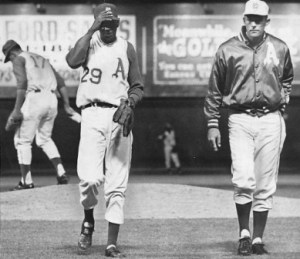
Paige walks off the field with Manager Haywood Sullivan while Diego Segui warms up.

Paige walks off the field with Manager Haywood Sullivan while Diego Segui warms up.

Paige returned to the clubhouse.  The Star said:

“In the clubhouse he was down to his long underwear, and talking about helping the A‘s out of the basement when someone rushed in a and screamed, ‘Satch, they want you back on the field.’

“The lights were out.  More than 9,000 matches flickered in the darkness, and on ‘Salute to Satchel Paige Night,’ they sang ‘Rockin’ Chair,’ ‘Darling I am Growing Old,’ and “The Old Gray Mare.”

After returning to the clubhouse, Paige was greeted by Finley, who called him “a real credit to the game.”  Paige “shook the owner’s hand” and said “I want to thank you for bringing me here.”

Whether he truly believed it or not, Paige told reporters he planned to pitch again in 1965.

“Everybody doubted me on the ballclub.  They’ll have more confidence in me now.”

He did not appear in another game but stayed with the club for the remainder of the season.  Two days after his three-inning performance, he was with the team in Baltimore.

A discouraging word had not been uttered by Paige during his time with the A’s.  Perhaps being in Baltimore—where his big league career effectively ended after Veeck sold the Browns—or maybe just the realization that a man capable of throwing three shutout innings at age 59 was not given an opportunity by a major league club the previous 12 seasons, changed that.

Lou Hatter wrote in The Baltimore Sun:

“Satchel Paige, the slender pitching ancient signed 2 ½ weeks ago by Kansas City, bared a deep-rooted wound here last night for the first time.”

Paige said to Hatter:

“You can put it this way.  You can say I resent being overlooked by organized baseball all these years while I threw away most of my best years pitching for a barnstorming club…All they ask me, though, is how old am I.  But nobody asks me why I stayed out of the major leagues for 15 [sic 12] years.  That’s a long time isn’t it?  That’s a lifetime for most professional players.

“Let me ask another question. When Baltimore bought the St. Louis ballclub, why did they turn me loose?

“When I went to the Miami club (again pitching for Bill Veeck with the International League Marlins) and was a top pitcher for three years (11, 10 and 10 win seasons with ERAs of 1.86, 2.42 and 2.95), how come nobody picked me up?…I know the answer, but I won’t tell that neither—like I won’t tell my age.”

Despite Finley telling reporters throughout September that Paige would return to the A’s in 1966, if not as a player, then as a coach, he was released in September. The next time he appeared on the mound at Kansas City’s Municipal Stadium, it was again as a member of the barnstorming Indianapolis Clowns.
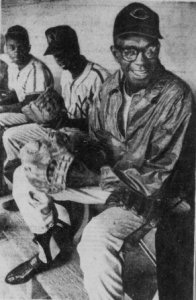
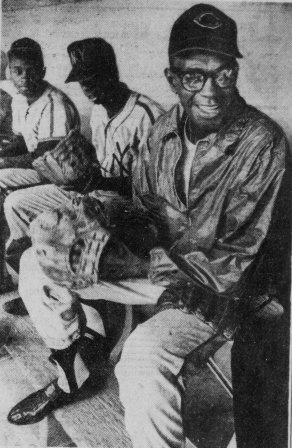
Paige back in Kansas City as a member of the Indianapolis Clowns in 1966.

Paige back in Kansas City as a member of the Indianapolis Clowns in 1966.