Tag Archives: Chicago Cubs

Lost Advertisements–Opening Day, 1911

28 Mar

1911openingday

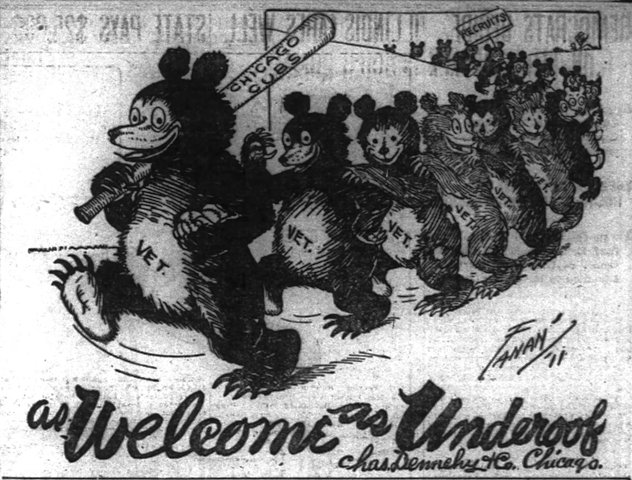
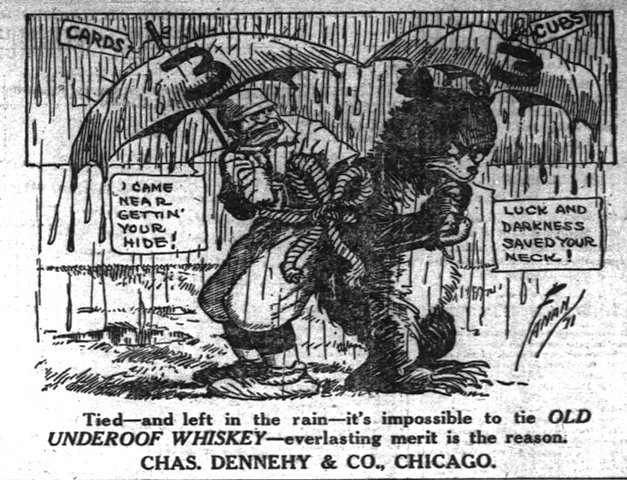
The above advertisement for Charles Dennehy Company, distributor of Old Underoof Whiskey,  appeared in The Chicago Inter Ocean on Opening Day, April 12, 1911.  The defending National League Champion Cubs met the St. Louis Cardinals at Chicago’s West Side Grounds.

The Chicago Tribune said:

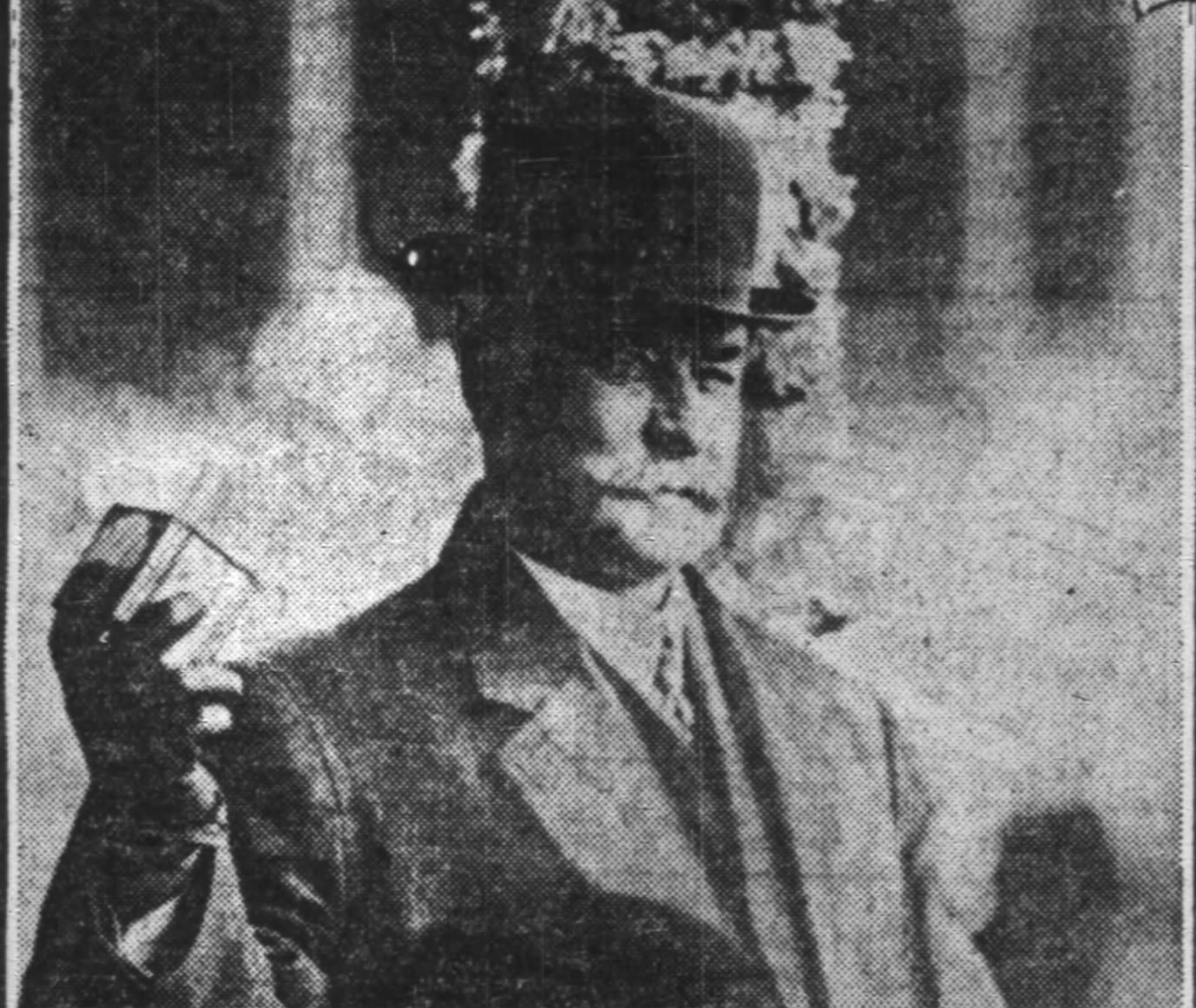
“Threatening clouds and misty atmosphere did not prevent the baseball public from of Chicago turning out for the opening.  There was almost a parkful [sic] of people there before the teams had begun their preliminary practice.  A brass band livened things up before the game started, and between innings a novelty in opening features was the presence of a woman who stood on the roof of the players’ bench and sang popular songs.  Mayor Elect Carter H. Harrison Jr.  from an upper box tossed out the ball that started the contest.  The entire park was draped with American flags.”

Carter Harrison at 1911 Cubs opener

Carter Harrison at 1911 Cubs opener

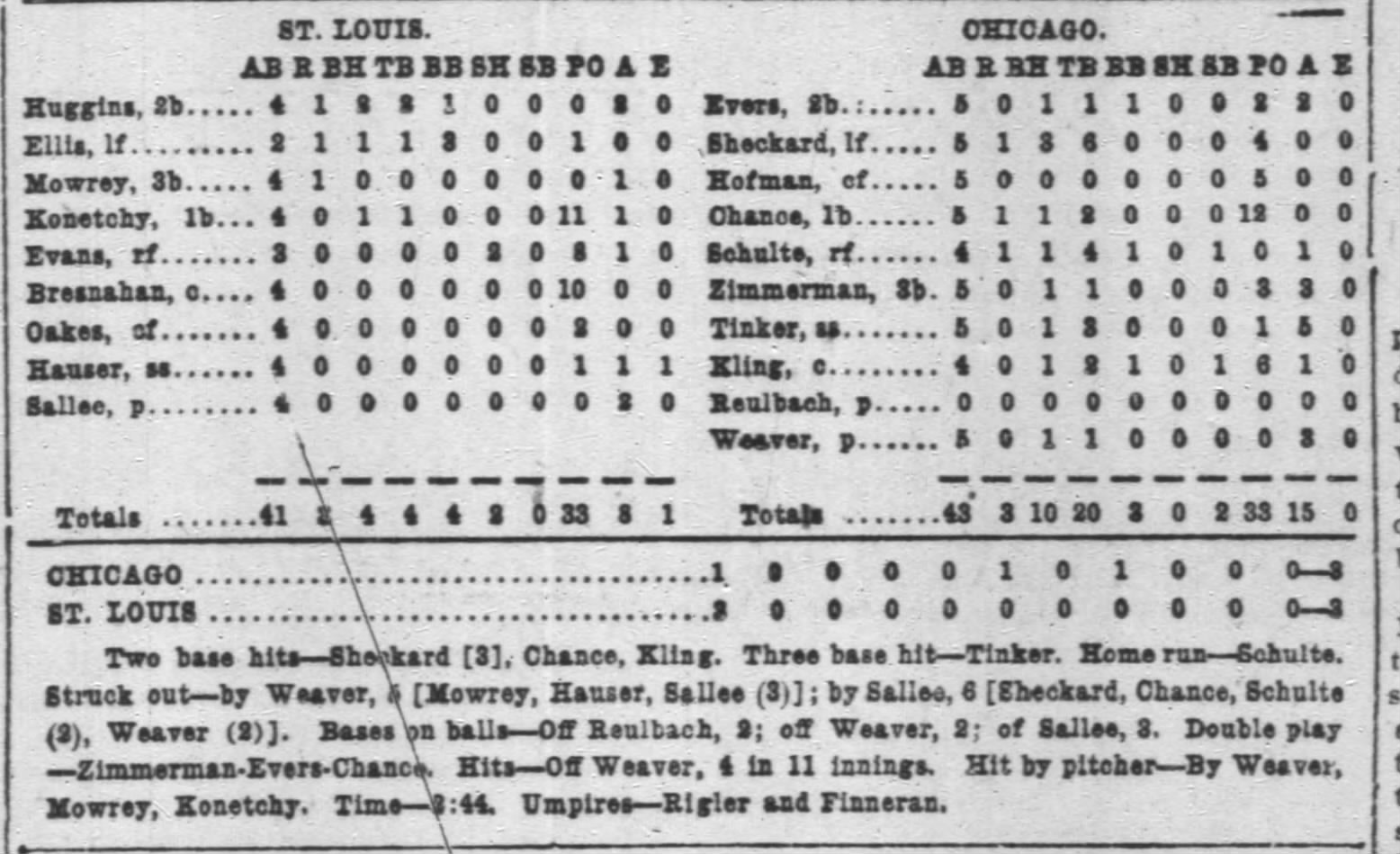
The game was called after 11 innings.  The Inter Ocean said:

“Sometime, somewhere there may be such an opening game as was played at the West Side grounds yesterday when the thirty-sixth season of the National League was introduced with a 3 to 3 tie by the Chicago Cubs and the St. Louis Cardinals, but never again will a seventh position club of the season before hang the hoodoo on the league champions as Roger Bresnahan‘s crew did the trick on the Peerless Leader’s squad…It was a sin and a shame.”

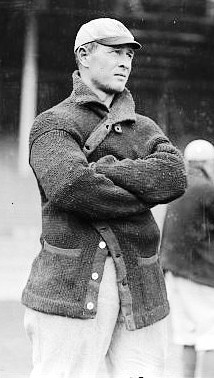
Frank Chance, "The Peerless Leader"

Frank Chance, “The Peerless Leader”

The Cardinals scored three runs in the first; starter Ed Reulbach–The Inter Ocean said he “was one wild critter–was pulled by Manager Frank Chance after throwing 10 straight balls to open the game, and was replaced by Orlie Weaver who finished the game.

The Tribune said the tie was the result of two “grievous errors of the mind.”

The first happened when Cubs third baseman Heinie Zimmerman fielded Bresnahan’s first-inning ground ball with runners on second and third:  “All Heine needed to do was toss the ball to the plate and one runner would have been caught, but he heaved to first base instead and the man coming from third (Mike Mowrey) scored, after he had actually stopped running.”

The other “grievous error” was made by second baseman Johnny Evers “incredible as it may seem, for Johnny is often talked of as the brainiest man on the team.”  Evers tried to score from first on Jimmy Sheckard‘s double in the first inning.  Cardinals first baseman Ed Konetchy took the relay throw and “there are none in the National League who can throw harder and  with greater accuracy”  Evers was thrown out by “ten feet” at the plate.

The Tribune said Chance “knows now that he acted against his better judgment in putting Ed Reulbach in to pitch the first game of the season.”  Reulbach had only appeared in 24 games in 1910 and was recovering from diphtheria (some recent references say Reulbach missed part of 1910 because his son had diphtheria–but several contemporaneous accounts say he suffered from the bacterial infection as well).

The box score

The box score


The Cubs went on to win 92 games in 1911, but finished in second place, seven and a half games behind the New York Giants.  The Cardinals finished fifth at 75-74.

Reulbach was 16-9 with a 2.96 ERA, but continued to struggle with control all season, walking 103 batters in 221 and 2/3 innings.

Below is another Old Underoof advertisement that appeared in The Chicago Examiner:

1911openingday2

Lost Advertisements–Old Underoof–White Sox, Cubs and “The Battle of the Century”

27 Jan

oldunderroof1910jj


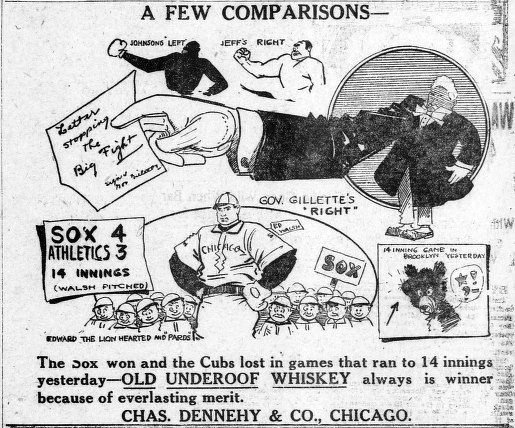
An advertisement for Old Underoof Whiskey from June 16, 1910–“A Few Comparisons.”  Most of the Old Underoof ads were exclusively about baseball, but this one also mentions the biggest sports story of that week.  California Governor James Norris Gillett  (the ad misspelled it “Gillette”) had just issued an order to stop the Jack Johnson vs Jim Jeffries “Battle of the Century,” scheduled for July 4 in San Francisco.  The San Francisco Chronicle said that despite $300,000 worth of tickets having been sold, and the construction of a new stadium for the bout being nearly completed, Gillett bowed to “Pleas to the governor to stop the fight.”  The San Francisco Church Federation was the most vocal opponent to the fight.

On the same day, the Chicago White Sox and Cubs both played 14 innings.

The seventh place White Sox, behind a complete game from “Big Ed” Walsh defeated the Philadelphia Athletics 4 to 3; he also drove in the winning run with one out in the fourteenth.

The first place Cubs lost 3 to 2.  Eros Bolivar “Cy” Barger pitched a complete game for the Brooklyn Superbas, and like Walsh, drove in the winning run with one out in the fourteenth.

The fight was moved to Reno, Nevada and Johnson won by TKO in the 15th round.

The White Sox finished in sixth place with a 68-85 record.  Walsh was 18-20 and led the American League with a 1.27 ERA

The Cubs remained in first place and won the National League pennant by 13 games.  The Athletics beat them four games to one in the World Series.


“Zimmer was not to be frightened.”

20 Jan

On March 28, 1907 the New York Giants took the field against the Philadelphia Athletics in the second game of a five-game exhibition series at New Orleans’ Athletic Park.

The umpire was new.  Charles Louis “Chief’ Zimmer, after a 19-year career a major league catcher had tried his hand at managing in 1906.  His Little Rock Travelers finished last in the Southern Association with a 40-98 record.
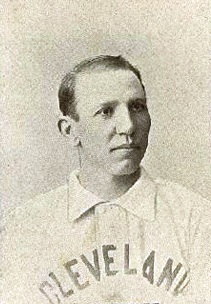
Chief Zimmer

Chief Zimmer

The Atlanta Constitution said:

“Zimmer underestimated the strength of the league, and brought men into it who did not have the goods to deliver.”

After Zimmer was dismissed by Little Rock he joined the Southern Association’s umpire staff.

The Giants/Athletics series would be among his first games as a professional umpire.

The Giants won the first game 4 to 3.  The Giants scored two runs with two outs in the bottom of the ninth off Jack Coombs for the victory.  The Philadelphia Inquirer said:

“Zimmer umpired a god game… (but) the rowdy element in the Giants broke loose frequently, and the Chief had many disputed with some of the men.”

The second game did not go as well.  The Inquirer said:

“The Giants were the first at bat, and the first two men were retired. (Art) Devlin and (Cy) Seymour then signaled safely to the outfield, each moving up a base on (Rube) Oldring’s throw…(Frank) Bowerman was then up to the bat.  (Eddie) Plank soon had two strikes and one ball on him.”

With a one and two count the Giants claimed Plank balked when he threw to third and picked Devlin off.  Zimmer said he didn’t.  Roger Bresnahan and Mike Donlin, coaching at first and third, “rushed at Zimmer from the coaching lines and a wordy war ensued.”  Manager John McGraw came out of the dugout and ‘a half hour was consumed in ‘beefing.’”
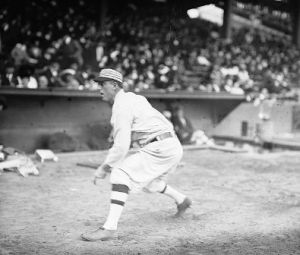
Eddie Plank

Eddie Plank

Zimmer finally ordered McGraw back to the bench and:

“Play was about to start again when a remark made by McGraw caused Zimmer to order McGraw off the grounds.  The New York manager refused to go, and a lively tilt between him and Zimmer took place, the entire New York gang surrounding the “Chief” in an effort to bulldoze him.  But Zimmer was not to be frightened.”

New Orleans police officers came out on the field as Zimmer declared the game a forfeit after a half inning.

McGraw said his team would not play in the game scheduled two days later if Zimmer was the umpire.  The Inquirer said Athletics Captain Harry Davis “informed McGraw that inasmuch as the giants had turned down Zimmer as the umpire the series might as well be called off.”  New Orleans Pelicans owner Charlie Frank also threatened to bar the Giants from Athletic Park.

On March 30 McGraw arrived at Athletic Park with only nine players consisting of “nearly all the youngsters in camp.”

With both teams on the field, Zimmer approached the Giants dugout and asked for the team’s lineup and was told the Giants would not play if he were not replaced as umpire.  Zimmer announced that the Giants had again forfeited and the Giants left the ballpark.  Frank’s New Orleans Pelicans took their place and pitcher Mark “Moxie” Manuel defeated the Athletics and Rube Waddell 4 to 2.
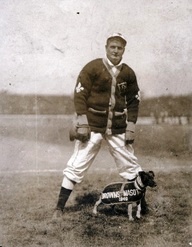
Waddell--lost to the New Orleans Pelicans

Rube Waddell–lost to the New Orleans Pelicans

The series was over.

Before the Giants left New Orleans that evening, McGraw confronted Thomas Shibe, business manager of the Athletics and son of team president Ben Shibe, in the lobby of the St. Charles Hotel.  The Inquirer said:

“Manager McGraw backed up the entire New York team, insulted Thomas Shibe…by calling him vile names.  McGraw alleged that Tom had informed several persons that he had heard McGraw using insulting language to Umpire Zimmer… pursuing the same cowardly tactics which have made him famous over all the base ball circuit (McGraw)did not keep within reach of Shibe.  He kept well within the group of rowdies which make up his team, and thus being forfeited from any attack from Tom, naturally was as brave as a lion.”

The paper said McGraw disappeared from the scene as soon as members of the Athletics arrived in the lobby.

Frank Leonardo Hough, baseball writer for The Inquirer, took McGraw to task for his actions, and charged the New York press with allowing McGraw and Giants’ management to intimidate them out of “writing the truth” about the team:

“The press of no other city in the Union would stand for the tactics employed by the Giants.  Such a condition of affairs would be impossible in Boston or in Philadelphia.  There are any number of thoroughly equipped baseball reporters in New York City—reporters who know the game from A to Z, who, if permitted to write the game as they see it, would be the peers of any bunch of critics the country over.  But, unfortunately they are under an awful handicap.  Let them criticize the Giants to the latter’s disadvantage and their occupation is gone.  They will be made to feel the displeasure of the august heads of the Giants by being debarred from the Polo Grounds.

“Now and then a paper will stand by its representative, but only in rare cases.  Charley Dryden, Sam Crane, Joe Vila, Eddie Hurst and numerous others were barred from the grounds.”

Hough said some reporters “stand on their manhood, and take up other fields of newspaper endeavors. But the majority of them, less favored perhaps, cannot afford to fight with the bread and butter, and consequently they are compelled to go along, glossing over the Giants’ bad breaks or bad playing as lightly as possible, while others crook the pregnant hinges of the knee until they become almost hunchbacked and ignore everything and anything that might reflect upon the Giants.  That is the reason why the New Yorkers are the best uninformed baseball public in the country.”

No disciplinary action was taken against McGraw; Giants owner John T. Brush was said to have reimbursed Charlie Frank for $1,000 in lost revenue. The Giants finished in fourth place in 1907, the Athletics third, as the Chicago Cubs ran away with the National League pennant, beating the second place Pittsburgh Pirates by 17 games.

Hough continued to write about baseball for The Inquirer despite being an investor in the Athletics (Hough and Sam “Butch” Jones of The Associated Press each held a 12 ½ percent stake in the team beginning in 1901—Jones became a full-time Athletics employee in 1906, Hough remained a sportswriter during the twelve years he held his stock).  He sold his stake to Connie Mack in 1912 and died in 1913.

Chief Zimmer’s tenure as an umpire did not improve much after his first experience in New Orleans.  He opened the season as a member of the Southern association staff, but on July 9 announced his resignation.  His final game was on July 13 in Nashville.

Ovie, Oh, Ovie

17 Jan

Arm trouble ended Orval Overall’s career early.  When he left baseball for the first time after the 1910 season he had a 104-66 record, won 20 games twice, and went to the World Series four times with the Chicago Cubs (3-1 in eight appearances).

orvie

Orval Overall

After a visit to John D. “Bonesetter” Reese, a self-trained Youngstown, Ohio-based practitioner of alternative medicine, who while popular among many of the era’s major stars, was condemned by medical professionals.  Despite being “healed,” Overall was unable to come to terms with the Cubs and sat out the 1911 season.

Remaining in his native California, Overall worked at the gold mine he owned with Cubs teammate Mordecai “Three Finger” Brown in Three Rivers and pitched for Stockton team in the “outlaw” California League.  His success in California during the fall of 1911 gave the Chicago press hope he would return to the Cubs in 1912.  The Chicago Inter Ocean said:

“Orval Overall’s arm seems to get better every time he pitches a game.  Last week the former Cub whom Manager (Frank) Chance is trying to persuade to return to the West Side team struck out seventeen men twirling against the All-Sacramento team for Cy Moreing’s Stockton outlaws.”

Later in the fall Overall hurt his arm again.  He returned to “Bonesetter” Reese in December and told The Youngstown Vindicator he was finished with organized baseball, and would “Confine himself to his mining business and with occasional independent ball.”

Overall pitched a few games for a semi-pro team in Visalia; thirty minutes from his mine.

Orville Overall

Orville Overall

In February of 1913, he petitioned the National Commission to reinstate him and declare him a free agent because the Cubs “omitted to send him a contract” in 1912.  The commission granted his reinstatement but returned him to the Cubs.

Overall pitched in just 11 games, with a 4-5 record and .3.31 ERA; he was released to the San Francisco Seals in the Pacific Coast League (PCL) in early August.

Overall’s return to the West Coast was an event, and Seals fans even attempted to tell the club when the popular pitcher should make his first start.  The San Francisco Chronicle said:

“Orval Overall, the famous California pitcher, who built up such a reputation with the Chicago Cubs, will pitch for San Francisco today against Venice (Tigers).  A petition signed by sixty Seal fans was sent to (Manager) Del Howard yesterday, with the request that Overall’s first appearance be billed for Sunday afternoon.”

Howard chose to start Overall the day before the fans requested, nevertheless, the game drew a crowd of nearly 10,000 and The Chronicle said: “they gave him a reception long to be remembered.”

Overall gave up five runs, and was lifted in the ninth inning for a pinch hitter.  The Seals lost 8-5 in 11 innings.  He ended the season 8-9 with a 2.14 ERA.

At the end of the 1913 season, Overall announced his retirement.  San Francisco fans were not convinced and said The Chronicle said he “was being counted upon to be one of the mainstays in the box.” But chose to take a job with Maier Brewing Company “in the South” (Venice, CA—still a separate city from Los Angeles at the time.  The Maier family also owned the PCL’s Venice Tigers).  San Francisco fans were not convinced, and there was speculation for the next four months that Overall would return.

Reporter L. W. Nelson, The San Francisco Call’s resident poet composed a verse to try to coax the pitcher back:

Ovie, Oh, Ovie

Ovie, oh, Ovie, come home to us now,

For the season is soon to begin,

And we need you, yes, badly, to show the folks how

The Seals, when they have you, can win!

Ovie, oh, Ovie, sign up with us quick,

Put your name on the contract from Cal,

For we know you can make all others looks sick,

If you pitch for our Seal crew, old pal!

Ovie, we know it is your fondest dream

To work down in Venice for Maier,

Midst the Milwaukee water, the lager and steam—

We know you would like it down there!

Ovie, oh, Ovie, sign up to play ball,

And don’t try your beer selling skill,

For the job in the brew’ry won’t help us at all,

But your pitching most certainly will!

(“Cal” was Seals owner James Calvin Ewing)

As late as March 1914 Overall hinted that he might return, but the pleas and the poem did not sway him.

He left the beer business after a year to manage his family’s large lemon and orange growing operation near Visalia, which would make him quite wealthy.  He became a banker and dabbled in politics and competitive trap shooting.  He died in 1947.

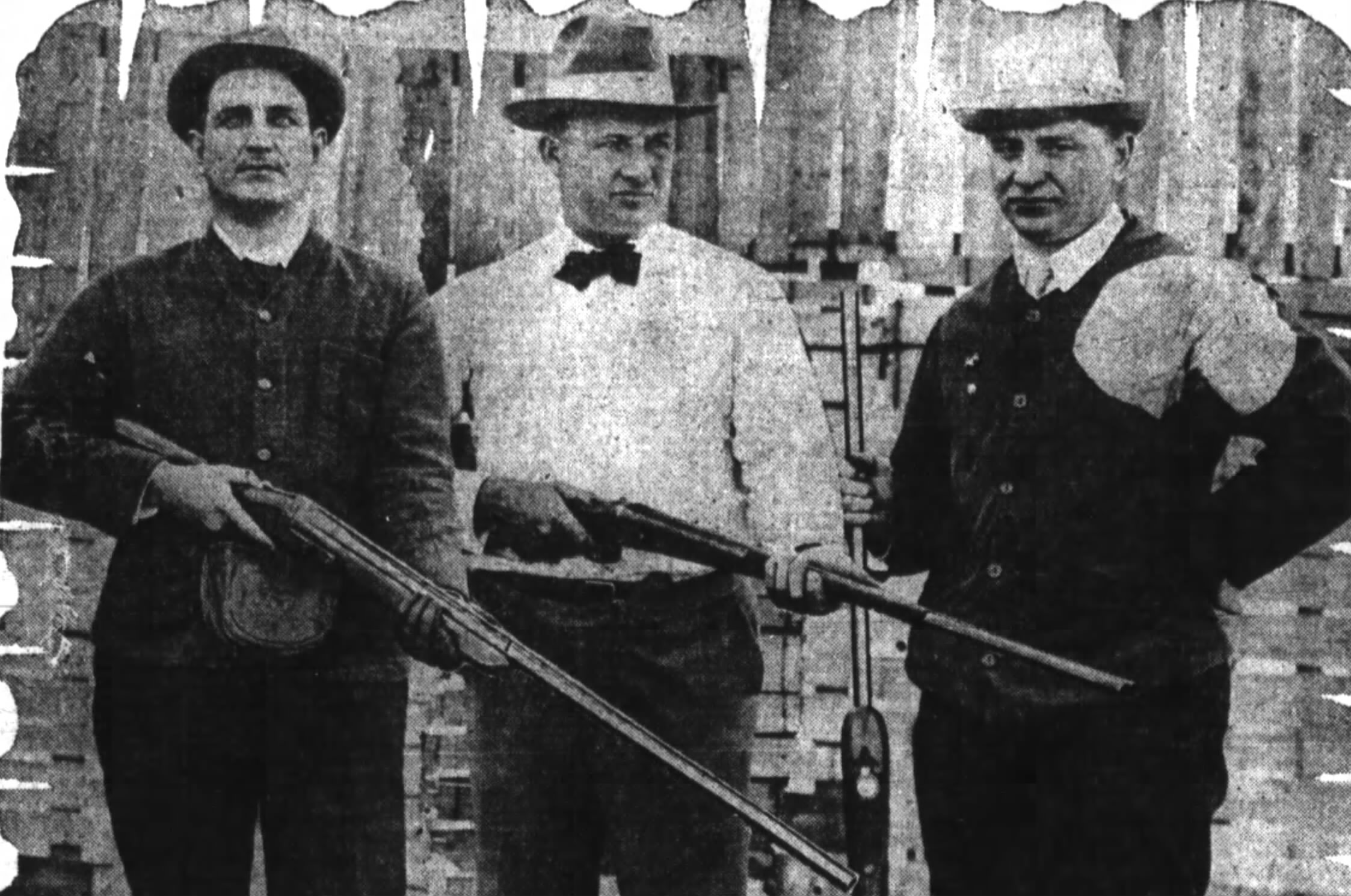
Overall (center) was president of the California-Nevada Trap Shooters Association (1918)

Overall (center) was president of the California-Nevada Trap Shooters Association (1918)

Lost Team Photos–1904 Chicago White Sox

31 Dec

1904cws


A rare photo of 1904 Chicago White Sox.  Standing left to right:  George Davis (SS), Guy “Doc” White (P), Roy Patterson (P), Gus Dundon (2B), Lee Tannehill (3B), Jimmy “Nixey” Callahan (MGR and LF), Frank Isbell (INF), John “Jiggs” Donahue (1B), Danny Green (RF), Nick Altrock (P), and Ed McFarland (C).  Kneeling: Fielder Jones (CF), Billy Sullivan (C) and James “Ducky” Holmes (OF).

Jones replaced Callahan as manager shortly after this picture was taken.  The Sox finished in 3rd place with an 89-65 record, improved to 2nd the following season and won the American League pennant, and beat the Chicago Cubs in the Worlds Series in 1906.


Lost Advertisements–“Yell For Your Team–And Help Them Win”

6 Dec

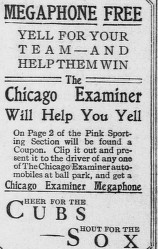
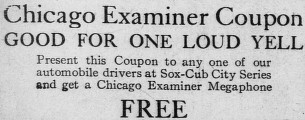
cubssoxmegaphoneA 1912 advertisement for a free megaphone available from “the driver of any one of The Chicago Examiner automobiles at ballpark.”

The Chicago Cubs and White Sox played 25 City Series’ between 1903 and 1942 (not including their World Series in 1906).  The first, in 1903 ended in a tie–both teams winning seven games before the series was forced to end because the player’s contracts had expired.  The Cubs won in 1905 and 1909, but the Sox won 18 of the next 22.

The 1912 series began with a 0-0 tie.  White Sox pitcher “Big Ed” Walsh held the Cubs to just one hit–a Joe Tinker double.   Cubs pitcher Jimmy Lavender held the Sox to six.

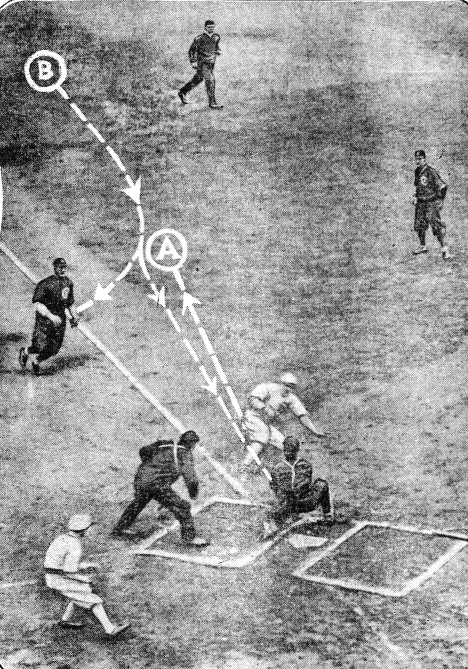
The highlight of the game came in the second inning.  With “Ping” Bodie on third and Rollie Zeider at bat.  The Chicago Tribune said:

“Zeider took a spitter for one ball, then hit the second for a high bounder to (Heinie) Zimmerman.  Bodie tried to score, but Zimmerman ran in stabbed the ball with his bare hand and got Bodie at the plate.”

The picture shows where Zimmerman was playing Zeider (B) and where he fielded the ball (A).

The picture shows where Zimmerman was playing Zeider (B) and where he fielded the ball (A).  Ping Bodie is tagged out by Cubs catcher Jimmy Archer.

The second game of the series also ended in a tie, 3 to 3.  The Cubs then won three straight, but the White Sox came back and won four in a row to take the series.

The 31-year-old Walsh, who was 27-17 in 62 games (41 starts, 32 complete games) and 393 innings pitched,  appeared in six games for the Sox, starting four.  He would only win 13 more games over parts of the next five seasons.

cubssoxmegaphone1912

1912 Cubs/Sox Megaphone coupon from The Chicago Examiner

“A Game before the Kings and Many Nobles”

24 Oct

While traveling around the world as a member of A. G. Spalding’s 1888-1889 world tour, John Montgomery Ward wrote a series of dispatches for The New York World.  On February 23, 1889 the team played in Rome:

“In the picturesque Piazzi di Siena of the grounds of the Villa Borghese today the American baseball teams played a highly exciting game.  This is one of the favorite resorts of Roman citizens.  Never before in all my experience on the diamond have I seen so many distinguished persons among the crowd of baseball spectators as were in attendance here this afternoon.  The nobility was out in all its glory, and in there center stood his Majesty King Humbert.  He was dressed in a civilian’s suit and apparently enjoyed the sport. “

King Humbert "enjoyed the sport"

King Humbert “apparently enjoyed the sport”

Ward listed every member of the royal party and other “Roman princely families” who were present at the game.

“Nearly all the local literary and artistic celebrities were in the unprecedented royal and papal assemblage, and the applause at times would have stirred the heart of the most enthusiastic admirer of the American national game.  The last time the Piazzi di Siena was used was on the occasion of the marriage of the King’s brother, when the celebration was held on these magnificent grounds.

“The day was beautiful and the players were in fine condition.  During the preliminary practice the crowd of 5000 people was simply amazed at the skill displayed by the boys in batting, throwing and catching the ball.  The game itself was extremely well played, and resulted 3 to 2 in favor of Chicago.   The batting was lively, but nothing could pass the fielders, who played with remarkable energy.”

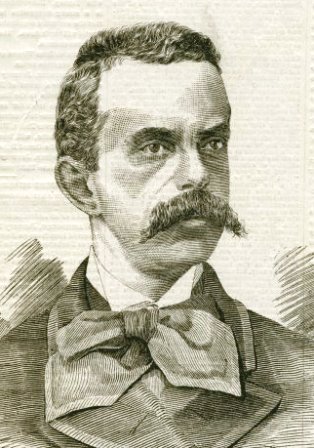
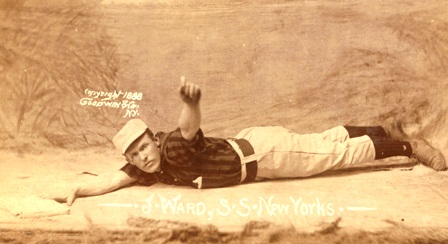
John Montgomery Ward

John Montgomery Ward

On the day of the game in Rome Ward said the players received word that National league owners were instituting the Brush Salary Classification Plan; a system developed by Indianapolis Hoosiers owner John Tomlinson Brush,  which rated players and placed them into five categories, each with a capped salary.  The Brush Plan, along with the Reserve Clause, would be the major impetus for the formation of the Players League:

“I interviewed every one of the men on the subject.  The scheme, as it is now understood by us, is regarded as a great mistake.  President Spalding, Captain Anson and Ned Hanlon concur in this opinion and say the plan is impossible and will not last long.”

Another issue that rankled players in Rome was the news that National League owners were demanding that the players return to the states by April 1 to prepare for the 1889 season; Ward said of the demands:

“From letter received by various members of the All-American team it is evident that certain managers are endeavoring to force the players to report for duty by April 1st.  For the information of these magnanimous gentlemen I will say that every player in the party will play the trip out.”

The All-Americans returned on April 6.

Frank Chance’s first Concussion

23 Oct

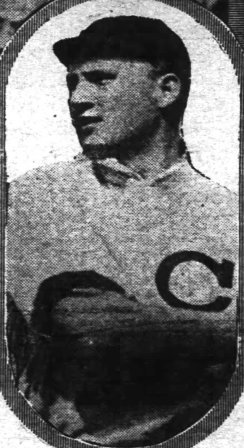
By 1912 Hall of Famer Frank Chance had been hit in the head so many times by pitches that he had developed blood clots on his brain and left the Cubs near the end of the season for surgery, and left him deaf in one ear.

Frank Chance

Frank Chance

Chance, who was known to crowd the plate, was hit by pitches 137 times during his big league career; on May 30 1904 he was hit five times in a double-header—one of which rendered him unconscious– with the Cincinnati Reds.

It appears his plate-crowding ways, and his propensity for being beaned, predated his professional career.  In April of 1894 the 17-year-old was catching for a team in his hometown of Fresno, California against a team in nearby Visalia.  The Sacramento Record-Union said:

“Frank Chance, Fresno’s catcher, was hit on the head by Charles Button, Visalia’s pitcher, in baseball game this afternoon.  Chance was knocked senseless, and believed to have suffered concussion of the brain.  He regained consciousness and vomited freely, and is better.  The outcome of the accident is mere conjecture.”

Four years later Chance began his professional career as a catcher for the Fresno franchise in the Pacific Coast league.

Lost Advertisements–“The Man Who Led the National League”

18 Oct

chancecoke

A  Coca-Cola advertisement that appeared before the 1910 season featuring Chicago Cubs first baseman/manager Frank Chance:

“The man who lead the National League –first basemen, with a percentage of .994.”

In 1909 Chance committed six errors, with 947 total chances in 92 games.

“You may use my name as one of your many customers who have derived benefits from drinking Coca-Cola.”

“In Baseball there is no such Advantage”

8 Oct

John Henry Mohardt was, with George Gipp, a member of the backfield on Knute Rockne‘s undefeated 1920 Notre Dame football team, and would go on to play for the Chicago Cardinals, Racine Legion and Chicago Bears in the NFL.

He also played baseball in at Notre Dame and was a highly sought after prospect.  Contemporary reports said he received offers from the Pittsburgh Pirates, Cleveland Indiana, Cincinnati Reds, Chicago Cubs, St. Louis Cardinals and Detroit Tigers.  He signed with the Tigers and manager Ty Cobb.

When it was announced that he would open the season as a member of the Tigers Mohardt was asked by reporters which sport was more difficult:

“Baseball, of course.  Football is team play, baseball largely individual effort.

“In football there is time enough to get set after each signal.  The calling of the signal tells you just what you are expected to do to put over the play.  Every player has a chance to firmly concentrate on his task.

“In baseball there is no such advantage.  There is never an opportunity to get set.

“In baseball the great weight is on the individual.  When I go to bat I am up there along.  I cannot depend on anybody but myself for help. “

Johnny Mohardt

Johnny Mohardt

Mohardt had never played football before entering Notre Dame and “Inside a week he was a first-string player,” as a result he said:

“It is easy to make football players, but from what I know of baseball it is necessary to have natural ability and also be able to think quickly.  Developing football players is easy.  If a fellow is physically fit the coach will do the rest.

“I have seen Coach Rockne make stars almost overnight at Notre Dame.  Every season brings forth scores of new stars in the football world.  In baseball I understand a new star a year is the exception.”

Mohardt was not the exception; he was 1 for 1 with a walk and 2 runs scored for the Tigers in five games in April, and after he was released hit .185 in 21 games for the Syracuse Stars in the International League—then returned to football.

Mohardt became a physician, served in the military in World War II and died in 1961.

An excellent biography of Mohardt written by Dan Cichalski appears on Gary Joseph Cieradkowski’s Infinite Baseball Card Set blog.