Tag Archives: Chicago White Sox

Lost Advertisements–Old Underoof–White Sox, Cubs and “The Battle of the Century”

27 Jan

oldunderroof1910jj


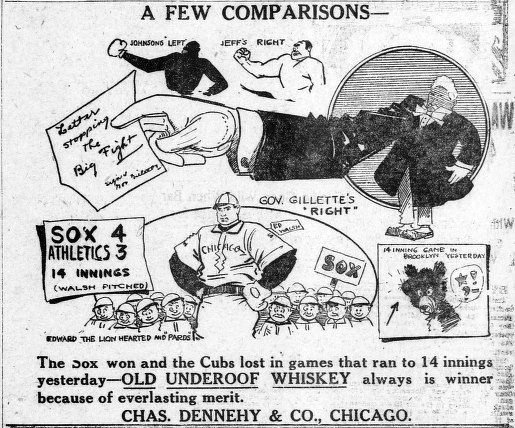
An advertisement for Old Underoof Whiskey from June 16, 1910–“A Few Comparisons.”  Most of the Old Underoof ads were exclusively about baseball, but this one also mentions the biggest sports story of that week.  California Governor James Norris Gillett  (the ad misspelled it “Gillette”) had just issued an order to stop the Jack Johnson vs Jim Jeffries “Battle of the Century,” scheduled for July 4 in San Francisco.  The San Francisco Chronicle said that despite $300,000 worth of tickets having been sold, and the construction of a new stadium for the bout being nearly completed, Gillett bowed to “Pleas to the governor to stop the fight.”  The San Francisco Church Federation was the most vocal opponent to the fight.

On the same day, the Chicago White Sox and Cubs both played 14 innings.

The seventh place White Sox, behind a complete game from “Big Ed” Walsh defeated the Philadelphia Athletics 4 to 3; he also drove in the winning run with one out in the fourteenth.

The first place Cubs lost 3 to 2.  Eros Bolivar “Cy” Barger pitched a complete game for the Brooklyn Superbas, and like Walsh, drove in the winning run with one out in the fourteenth.

The fight was moved to Reno, Nevada and Johnson won by TKO in the 15th round.

The White Sox finished in sixth place with a 68-85 record.  Walsh was 18-20 and led the American League with a 1.27 ERA

The Cubs remained in first place and won the National League pennant by 13 games.  The Athletics beat them four games to one in the World Series.


The Color Line and the PCL

22 Jan

In the spring of 1913 Walter “Judge” McCredie brought Rube Foster’s Chicago American Giants to the West Coast to play five games against his Portland Beavers of the Pacific Coast League (PCL).  The American Giants won four of the games and also split a two-game series against Nick Williams’ Portland Colts of the Northwestern League.

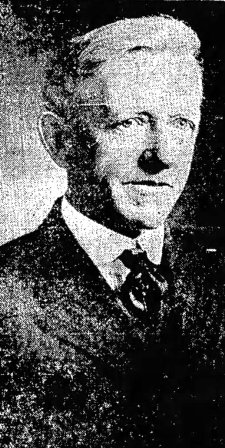
Walter "Judge" McCredie

Walter “Judge” McCredie

When McCredie made arrangements with Foster for the American Giants to return west in 1914 it created a stir in the PCL.  Joe Murphy of The San Francisco Call wrote:

“Some of the magnates and officials of the Pacific Coast League are bitterly opposed to Manager Walter McCredie’s plan of playing a series of games with the Chicago Giants, an aggregation of colored ball players.  The Beavers played the colored tossers during their training trip last season and were badly beaten by them.”

Murphy said “no official action can be taken against McCredie to prevent his team engaging in games with the dusky tossers,” but said several prominent PCL figures “do not mince any words” regarding the games.

Dan Long, who had managed the San Francisco Seals from 1908 through 1912, was now a West Coast scout for the Chicago White Sox and booked the team’s 1914 spring games in California.  Long said he turned down a request for the Sox to play the American Giants:

“Colored players are barred in organized baseball, and I can see no reason why white players should even meet them in exhibition games, if they are barred by the baseball powers.  Baseball is a sport that must be elevated, and it is up to the managers and players to keep it free from criticism.

“I never arranged or played in any games with colored players, and I doubt Mr. (Charles) Comiskey, owner of the White Sox, would allow his team to play with the colored men.”

James Calvin “Cal” Ewing, the owner of the San Francisco Seals, who was one of the PCL’s founders and a former president of the league, was equally as outspoken:

“If I were a player working for McCredie, and he asked me to go out and play against these colored fellows, I would refuse to do it for him.

“There are two classes I bar from playing on my ball park—colored tossers and bloomer girls.  They will never use any park I control.”

Cal Ewing

Cal Ewing

Allan T. Baum, entering his third season as the PCL’s president said he was against the games, but was powerless to act because the games were played outside of the league’s regular season:

“I have no jurisdiction in the matter, but my sentiments are strongly against it.  I am sure that there is not another manager in the league who would consider playing with the Chicago Giants.”

Lester Aglar Walton, managing editor of the East Coast’s largest circulation black newspaper, The New York Age, responded to “the vicious article” from the West Coast:

“Joe Murphy, in an heroic effort to start needless agitation relative to the drawing of the color line in organized ball, does a journalistic stunt which, while humorous for the absurdities contained therein, is a curious document for the lamentable ignorance which this writer and other show on the subject.”

Walton said the color line was borne solely out of fear:

“The cowardly practice of using the color prejudice subterfuge as a cloak to hide the white man’s fear in open competition with the colored man in various avenues of endeavor will someday lose its effectiveness.  The truth of the matter is some white managers and players are not opposed to playing colored teams solely on account of color, for if their aversion was based purely on color the Indian would not be permitted to join organized baseball, nor would teams of the two major leagues journey every winter to Cuba to engage in games with native players, many of whom are as black as the ace of spades.”

“Manager Walter McCredie is the only game white man in the Pacific Coast League.  He is not afraid to permit his team to meet a strong colored nine and fight it out on the diamond.  There would not be a word of complaint today about the beavers and Giants playing a series of exhibition games had not the colored team given undisputed evidence of its supremacy last spring.”

Lester Aglar Watson

Lester Aglar Watson

McCredie claimed he wasn’t making a social statement.

He told The Portland Oregonian he needed to schedule the games in order to compete with teams like San Francisco in the regular season.  The Seals, he said, were preparing for the season by playing the White Sox, and taking in between $15,000 and $20,000 in the process:

“Yet they rave because I book the Beavers for four or five games against the Negroes, although they furnish the only stiff opposition available.

“It is to laugh.  Likewise the statement that playing against the Negroes hurts baseball.  It might, were we to consider them on an equal footing because of the strong race prejudice that exists here on the Coast. But the games are nothing more or less than training affairs.”

Despite the objections, Foster and his team arrived on the West Coast in March of 1914.

The rest of the story on Friday

Lost Team Photos–1904 Chicago White Sox

31 Dec

1904cws


A rare photo of 1904 Chicago White Sox.  Standing left to right:  George Davis (SS), Guy “Doc” White (P), Roy Patterson (P), Gus Dundon (2B), Lee Tannehill (3B), Jimmy “Nixey” Callahan (MGR and LF), Frank Isbell (INF), John “Jiggs” Donahue (1B), Danny Green (RF), Nick Altrock (P), and Ed McFarland (C).  Kneeling: Fielder Jones (CF), Billy Sullivan (C) and James “Ducky” Holmes (OF).

Jones replaced Callahan as manager shortly after this picture was taken.  The Sox finished in 3rd place with an 89-65 record, improved to 2nd the following season and won the American League pennant, and beat the Chicago Cubs in the Worlds Series in 1906.


Lost Advertisements–“Yell For Your Team–And Help Them Win”

6 Dec

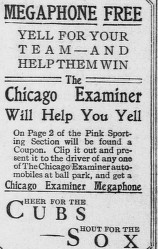
cubssoxmegaphoneA 1912 advertisement for a free megaphone available from “the driver of any one of The Chicago Examiner automobiles at ballpark.”

The Chicago Cubs and White Sox played 25 City Series’ between 1903 and 1942 (not including their World Series in 1906).  The first, in 1903 ended in a tie–both teams winning seven games before the series was forced to end because the player’s contracts had expired.  The Cubs won in 1905 and 1909, but the Sox won 18 of the next 22.

The 1912 series began with a 0-0 tie.  White Sox pitcher “Big Ed” Walsh held the Cubs to just one hit–a Joe Tinker double.   Cubs pitcher Jimmy Lavender held the Sox to six.

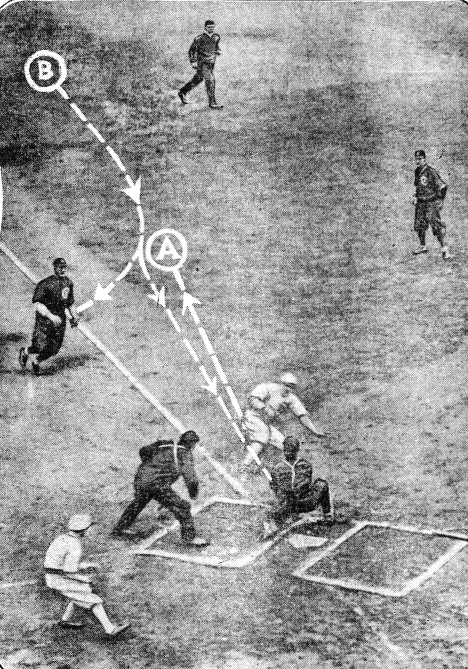
The highlight of the game came in the second inning.  With “Ping” Bodie on third and Rollie Zeider at bat.  The Chicago Tribune said:

“Zeider took a spitter for one ball, then hit the second for a high bounder to (Heinie) Zimmerman.  Bodie tried to score, but Zimmerman ran in stabbed the ball with his bare hand and got Bodie at the plate.”

The picture shows where Zimmerman was playing Zeider (B) and where he fielded the ball (A).

The picture shows where Zimmerman was playing Zeider (B) and where he fielded the ball (A).  Ping Bodie is tagged out by Cubs catcher Jimmy Archer.

The second game of the series also ended in a tie, 3 to 3.  The Cubs then won three straight, but the White Sox came back and won four in a row to take the series.

The 31-year-old Walsh, who was 27-17 in 62 games (41 starts, 32 complete games) and 393 innings pitched,  appeared in six games for the Sox, starting four.  He would only win 13 more games over parts of the next five seasons.

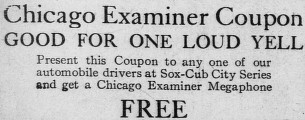
cubssoxmegaphone1912

1912 Cubs/Sox Megaphone coupon from The Chicago Examiner

“The Great Baseball Question has been what will Capt. Comiskey do next Season”

3 Dec

In January of 1890 The St. Louis Globe-Democrat said what was on the minds of every baseball executive, writer, and fan:  “The great baseball question has been what will Capt. Comiskey do next Season”

For weeks there was speculation about whether Charles Comiskey, captain and manager of the St. Louis Browns, would remain in the American Association or join the Players’ National League of Professional Baseball Clubs (Players League), the league borne out of baseball’s first union the Brotherhood of Professional Base-Ball Players.

Charles Comiskey, against slang in baseball stories.

Charles Comiskey

On January 15, in a letter to The Sporting News, Comiskey announced his decision:

“During the past few weeks many interviews have appeared with me in different newspapers of the country relative to my having signed a contract with the St. Louis and Chicago Brotherhood clubs.  Up to this writing I am mind and fancy free.  But before Saturday night, January 18, I will have signed a contract to play at first base for the Chicago Brotherhood team.  I take this step for the reason that I am in sympathy with the Brotherhood.

“I believe its aims are for the best welfare and interest of the professional players.  I believe that if the players do not this time stand true to their colors and maintain their organization they will from this day forward be at the mercy of the corporations who have been running the game, who drafted the reserve rule and give birth to the obnoxious classification system.

“I have taken all the chances of success and failure into consideration, and I believe that if the players stand true to themselves they will score the grandest success ever achieved in the baseball world.

“But besides having the welfare of the players at heart I have other reasons for wanting to play in Chicago.  My parents and all my relatives reside there, and the all the property I own is located in the city.  I was raised there and have a natural liking for the place.  But, outside of all these reasons, my relations with the management of the St. Louis club have, during the past year been so unpleasant I do not care to renew them.  I have many friends in St. Louis, and for their sake I hate to leave here, but the other reasons out-balance this friendship, so I will cast my lines with the Chicago club.

“This is the first letter I have written on the subject which seems to have interested the baseball world throughout the whole of the present winter.

“Yours respectfully, Chas. Comiskey”

A week before the season began The Chicago Tribune said Comiskey’s new club “on paper, is the greatest team ever organized.”   Despite the hype, Comiskey’s Chicago Pirates finished in fourth place.  The Players League lasted only one season and dissolved in November of 1890.

Comiskey’s backing of the Brotherhood against “the corporations who have been running the game” would probably have come as a surprise to many of those who played for him when he owned the Chicago White Sox.  Arnold “Chick” Gandil, banned from baseball for his role in the 1919 Black Sox scandal said of Comiskey in a 1956 article in “Sports Illustrated:”

“ He was a sarcastic, belittling man who was the tightest owner in baseball. If a player objected to his miserly terms, Comiskey told him: “You can take it or leave it.” Under baseball’s slave laws, what could a fellow do but take it? I recall only one act of generosity on Comiskey’s part. After we won the World Series in 1917, he splurged with a case of champagne.”

Chick Gandil

Chick Gandil

“Evans, who, at the Least, is Incompetent”

2 Dec

William George “Billy” Evans was nicknamed “The Boy Umpire” when he was hired by the American League at the age of 22.  After 21 seasons  he became a front office executive, working for the Cleveland Indians, Boston Red Sox and Detroit Tigers; he was also president of the Southern Association, authored two baseball books and in 1973, 17 years after his death, was elected to the Baseball Hall of Fame.
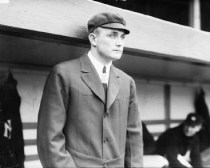
Billy Evans

Billy Evans

But during his first season as an umpire, 1906, he was not held in high esteem in Chicago.

On September 10 the White Sox were in second place, a game behind the New York Highlanders.  The Sox trailed the Tigers 2 to 1 in the 9th inning.  Chicago shortstop George Davis laid down a bunt and was called out at first by Evans.  Every Chicago paper said Evans beat the throw by “at least a step.”

The call precipitated a near riot.  The Chicago Tribune said:

“Instantly a shower of bottles from the first base bleachers drove the umpire, coacher, and players away from the vicinity of the base.”

After the next two batters were retired:

“Evans walked off the field amid another volley of bottle from the third base stand.”

The Tribune and The Chicago Inter Ocean said Evans and fellow umpire Tommy Connolly were mobbed by fans as they attempted to leave the ballpark with a police escort.  Both papers said “one or two blows” from fans connected with the umpire during his retreat.

The Inter Ocean said, “Evans has been the most heartily reviled arbiter that ever worked in any league.”

The Tribune said two weeks earlier Evans cost the Sox a game in Philadelphia.  After Chicago scored two runs in the top of the sixth inning to take a 5 to 4 lead, Evans “let the Athletics take advantage of his inexperience,” and stopped the game on account of rain with two men out in the bottom of the inning.  The Inter Ocean said, “(Sox Manager Fielder) Jones and (second baseman Frank) Isbell nearly came to blows with the umpire and members of the Athletic team.”

After a half hour, the game was called and the score reverted back to the end of the 5th inning, giving Philadelphia a 4 to 3 victory.

The next day, September 11, the Sox played the St. Louis Browns at South Side Park.  Evans worked the game along with Jack Sheridan.  The newspapers said Sox owner Charles Comiskey had discontinued the sale of “bottled goods” at the park that day.

The Browns won 7 to 3, and the Chicago press put much of the blame for the loss on the rookie umpire.

The Tribune said:

President (Ban) Johnson’s persistence in sending Evans, who, at the least, is incompetent, is giving baseball a black eye in Chicago.  Half the crowd believes the charges that Evans is working under instructions from Johnson to beat Chicago.  These charges undoubtedly are founded on mere prejudice, yet, had Evans been under instructions and trying to beat Chicago, he could not have done better than he did yesterday.”

The Inter Ocean said the Browns “were aided and abetted by Umpire Evans, the boy wonder…Why Ban Johnson insists upon sending the joke to officiate at important games is more than any sane man can see.”

But the Evans’ most ardent critic was William A. Phelon, sports editor of The Chicago Journal:

“Umpire Evans is the worst that ever yet came down this or any other pike in the history of the modern universe…And Ban says he is the best in the game.  We are not selfish and we are willing to let some other city endure him.  We can get over the shock of his removal.  If he doesn’t move he may have a statue down on the lake front, a statue 200 feet high made of bottles.  Give us liberty, give us death, give us any old thing, but, by the snakes of old Ireland, give us an umpire!”

Phelon also said Evans “seems to be a gentlemanly individual, whose place in life is evidently a long ways from the profession of umpiring.”
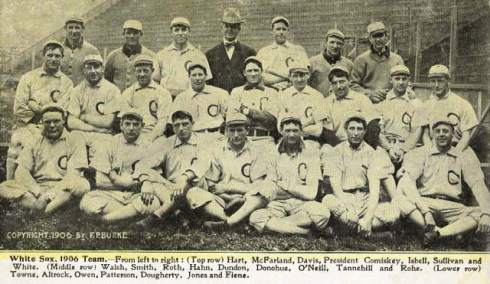
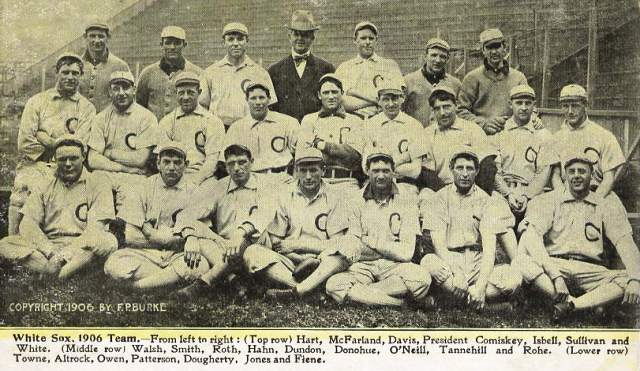
1906 White Sox

Despite the blame heaped on the young umpire in the press, the White Sox went 17-7 the rest of the season and won the pennant by three games.  They went on to beat the Chicago Cubs 4 games to 2 in the World Series.

Things got better for Evans as well.  He worked his first World Series in 1909—the youngest umpire to do so– and participated in five more from 1912 to 1923.  He was the third umpire to be elected to the Hall of Fame; Connolly and Bill Klem were the first two.

Morrie Rath

25 Nov

In August of 1913, the Chicago White Sox sold second baseman Morris “Morrie” Rath to the Kansas City Blues of the American Association.

Morrie Rath

Morrie Rath

The Chicago Eagle said the sale wasn’t the result of Rath’s .200 batting average, or 16 errors, but because of his performance coaching first base during a game in Philadelphia earlier in the month:

“Morris was coaching at first base and (Manager Nixey) Callahan was at third.  (Harry) Lord was at bat.  He hit a bounder to one of the infielders and as it was a slow hit he figured he could beat it out.  He ran with every ounce of speed and strength that he possessed.  The play was mighty close.

Harry Lord

Harry Lord

“’Out,’ cried the umpire.

“Lord figuratively hit the ceiling.  He threw his cap down and jumped upon it.  He picked it up and threw it down again.  He howled and he scowled.  He allowed that if there ever was a blind umpire that he was working on the bases that day.  He assured the ump that in all his experience as a ball player it was the worst decision he ever saw.  Then up spoke Rath.  His voice was as gentle as could be:

“’Yes, you were out Harry.’

“And Lord collapsed.  That beat the other thing.  Never in his experience as a ball player had he heard another player agree with the umpire when it meant that one of his pals was out instead of safe.  That was beyond the comprehension of Lord.  He just wilted and staggered to the bench.

“By this time Callahan was over there.  There was fire in his eye, and he was fighting mad.  ‘Of all the—‘ he started in and then stopped.  For the umpire was laughing.

‘What’s the matter?’ howled Cal.

‘Why Rath here agrees that he was out,’ laughed the ump.

“What did Cal do?  What could he do?  He also was dazed.  It was a new one on him.  He had been around ball fields for many years, but never before had a member of his team taken sides with the ump against a teammate.”

It was a long road back to the big leagues for Rath.  He played for Kansas City until June of 1915 when he was sold to the Toronto Maple Leafs.  In 1916, He joined the Salt Lake City Bees in the Pacific Coast League, after hitting .300 and .341 he was drafted by the Cincinnati Reds after the 1917 season in the Rule 5 Draft.

After spending 1918 in the United States Navy where he was captain of the baseball team at the Philadelphia Navy Yard, Rath finally joined the Reds for the 1919 season.  He was Cincinnati’s regular third baseman in 1919 and 1920 and appeared in all eight games of the 1919 World Series against his former team.

Rath finished his career with the San Francisco Seals in the Pacific Coast League in 1921.

After his career, he operated a sporting goods store in Upper Darby, Pennsylvania.  In 1945, suffering from ill-health, he committed suicide.

Lost Advertisements–“Kid” Gleason for Cat’s Paw Rubber Heels

22 Nov

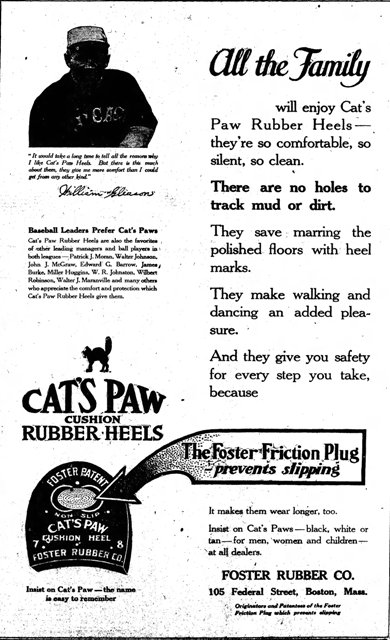
cat'spawA 1920 advertisement featuring William “Kid” Gleason, manager of the defending American League Champion Chicago White Sox–the ad appeared in July, two months before the first grand jury was convened to investigate the 1919 World Series.

“It would take a long time to tell all the reasons why I like the Cat’s Paw Heels.  But there is this much about them, they give me more comfort than I could get from any other brand.”  William Gleason

Baseball Leaders Prefer Cat’s Paws

Cat’s Paw Rubber Heels are also the favorites of other leading managers and ball players in both leagues–Patrick J. Moran, Walter Johnson, John J. McGraw, Edward G. Barrow, James Burke, Miller Huggins, W.R. Johnston, Wilbert Robinson, Walter J. Maranville and many others who appreciate the comfort and protection which Cat’s Paw Rubber Heels give them.

“In the ‘90s Nobody ever Thought Anything of telling the Manager to go Chase Himself”

6 Nov

Bill Lange played only seven seasons in the National League—all with Chicago–but his reputation lived on long after he walked away from the game in 1899 at 28 years-old.  Two of his biggest supporters, Connie Mack and Clark Griffith, remained influential until their deaths in the mid 1950s, and both helped to keep Lange’s legend alive until his death in 1950.

Long after his retirement to enter the insurance and real estate business in his native San Francisco, Lange remained extremely popular in Chicago;  he was frequently quoted by Chicago sportswriters (most often his friend Hugh Fullerton), and was even retained The Chicago Examiner’s  “World Series expert” in the early and mid teens.

Bill Lange

Bill Lange

In 1909, when the White Sox were training in San Francisco, Lange told a reporter for The Chicago Inter Ocean that “the batsmen of the present time had not advanced in any way” over the hitters of his day—and Lange felt they took too many pitches:

“I have noticed that the habit nowadays is to be altogether too scientific.  And that science is ruining the batters.  There used to be such things as .400 hitters in the big leagues and now the managers are spending fortunes in the hopes of finding a .250 hitter.  The reason they are so hard to find is because the batsmen don’t follow their natural inclinations to wallop the ball, but stall around at the plate in the artificial hope of drawing a pass instead of breaking a board in the back fence.

“No batter, who has any eye at all, ought ever to wait when he has three balls and one strike on him, unless the pitcher is uncommonly wild.  Think of the advantage of hitting when three balls have been called.  You are dead sure that the next one will be over the plate if the pitcher can get it there.  If he doesn’t, let it go and take your base.  But if you let a good one go then you are up against another proposition.

“Then the batsman is in a worse hole than the pitcher and his chances of making a safe hit are at least 4 to 1 against him, for a nervy pitcher will take a chance on a curve or a high one in the hope of making the batsman bite.  He wouldn’t dare do that very often when the count was only three and one.  The batsman who waits too long is just giving himself the worst of the deal.”

Unlike many players of his generation, Lange did note that some aspects of the game had improved since he played:

“We didn’t hustle like the players of the today do.  We would shirk morning practice all the time, so we could sleep late.  And take it from me, a lot of us needed the sleep, for most all of the boys belonged to the Ancient Order of Owls.

“The teams of today report at the grounds at 9:30 in the morning and work to beat the band for two hours. In the old days, after we had stalled the manager off as long as possible, we would finally show up for morning practice.  I don’t know all the systems the players on other teams had for dodging morning work, but with the old Chicago bunch we left it up to (Bill) Dahlen to break up the practice after about ten minutes of hustling.

“Dahlen could turn the trick might easily.  All he had to do was whiz four or five low throws at Anson’s shins.  ‘Pop’ used to bawl Dahlen out for a few minutes, but Bill would keep up the bum throwing until Anse would say ‘Enough.’  Nothing like that goes in the big or small leagues now.  It is a question of work and buckle down to business.  In the ‘90s nobody ever thought anything of telling the manager to go chase himself.  I haven’t heard of anybody doing anything like that in late years, and getting away with it.”

Bill Dahlen

Bill Dahlen

Lange on pitching, tomorrow.

Lost Pictures–Hatton Ogle

17 Oct

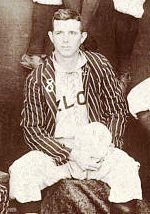
hattonoglepix

Hatton Geter Ogle (Texas papers often misspelled his last name “Ogles”) pitched in the Texas League from 1909 to 1916.  He was most likely born in 1885 (Baseball Reference lists his birth date as 1883, but North Carolina and Texas records disagree).

The six-foot, 185 pound Ogle began his professional career with the Wilson Tobacconists in the Eastern Carolina League;  complete records are not available, but in July The Raleigh Times said he “has pitched and won 11 games, having a clean slate.”

The Dallas Morning News said former pitcher Cy Mulkey watched him play in Wilson and signed him to a 1909 contract for the Dallas Giants;  Mulkey compared him to Texas League star Harry Ables.

Ogle moved to Texas after the 1908 season and took a job teaching school near Dallas, in Coppell; his off-season job earned him the nickname “professor’ in Texas papers–he continued teaching in the off-season through at least 1915.

He was just 7-14 with Dallas in 1909 and joined the Waco Navigators in 1910.  After an 11-22 season in 1910, Ogle had a three-year run as one of the best pitchers in the Texas League.

From 1911 until 1913 he was 21-11, 17-14, and 19-12.

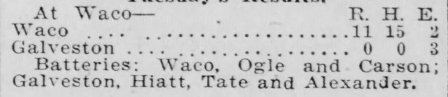
In 1912 he pitched in two exhibition games against the Chicago White Sox, on March 17 and March 30, allowing just two runs and six hits in nine innings.  He also had his first no-hitter that season, an 11-0 victory over the Galveston Pirates.

The Waco-News Tribune said:

“(Ogle’s) principal asset was his head, but when the occasion made it necessary ‘the professor’ shows his usual assortment of curves and speed.”

He continued pitching in the Texas League with Waco, the Houston Buffaloes, the Austin Senators and San Antonio Bronchos, through the 1916 season; he added a second no-hitter for Waco in 1914, defeating Austin 6-0 on April 26.

After an 8-17 season in 1916 his career was over.  He returned to the classroom until 1918 when he contracted tuberculosis and moved to El Paso, Texas, where he died five years later, on May 27, 1923.

The Waco News-Tribune–seven years after his career ended, and four years after Waco’s Texas League franchise had folded–simply said in Ogle’s small obituary:

“(He) was one of the popular tossers of the old Waco Navigators.”

Ogle's 1912 no-hitter

Ogle’s 1912 no-hitter

Ogle's 1914 no-hitter

Ogle’s 1914 no-hitter