Tag Archives: Hall of Fame

“I Prophesy he will Hit your Curves”

21 Apr

In February of 1905 it was announced that the baseball team from Waseda University in Tokyo, “champions of Japan,” were coming to America.  The San Francisco Call said:

“The fact that there is a great war going on in their country (The Russo-Japanese War) does not prevent the Japanese from the enjoyment of their sports.  (Athletic) Manager (R.W.) Barrett of Stanford concluded arrangements today with the baseball team of Waseda University for a series of international games.”

The trip to the states was organized by a Japanese professor named Isso Abe and an American professor named Fred Merrifield.  The two were an unlikely pair brought together by their love for the game, which had been introduced to Japan 35 years earlier. Abe, a Unitarian minister and professor of economics, is regarded as the father of socialism in Japan; he established the nation’s first socialist political party in 1901, the same year he helped form the baseball team at Waseda. “The Unitarian Register” said “Dr. Abe believes in baseball, not only as a healthy and inspiring sport, but also as means of promoting international goodwill.” Merrifield was a recent graduate of the University of Chicago, where he was also captain of the baseball team. He was a religious scholar who was in Japan learning the language and working on behalf of the American Baptist Foreign Mission Society.

The Waseda University team upon their arrival in San Francisco

The Waseda University team upon their arrival in San Francisco

While the team was traveling to the United States, The Chicago Daily News published a letter from Merrifield describing the growing popularity of the game in Japan, “The universities, colleges, middle schools and even those of lower grade,” all had teams; he also described the differences he saw in the Japanese game:

“The Japanese students ordinarily wear white uniforms in their play, with blue socks or ‘tabi’ for footwear…The native baseballs are a trifle smaller than our own and do not keep their shape and hardness as well.  The American balls, bats etc… are not strangers, however, to these children of progress.  All this apparatus may not be understood at once, but it is here and is used until it is mastered. “It sometimes sounds queer to hear the umpire call, ‘Strike-ball!’ instead of ‘Strike!’ simply, But the wonder is that they use English terms on the diamond.  In fact, all the common words of the game are spoken in English, but woe betide the man who tries to make out the Japanese words of coaching.  While you’re thinking what it all means the man is under you at second.

“The other day I was coaching a new pitcher on ‘drops,’ ‘placing’ etc…, and was acting as batter to help his eye.  At a suitable stage in the process I turned to instruct the catcher on some point or other.  The point was understood, and we were about to resume our positions, when zip came the ball past my ear and caught the unfortunate catcher squarely on the cheekbone.  Two more points are illustrated:  The catcher scarcely moved a muscle, and never a sound came from his lips.  He quietly walked away to bathe his swollen face.  That is a bit of Japanese stoicism, for we all know how a straight ball stings.  Again, the pitcher had been working so hard to master that new finger movement and ‘locate’ his batter that he all but did the opposite to fellow player.  That is Japanese persistence and eagerness.  Just a bit of it.”

Merrifield said Japanese players had another quality he admired:

“They may not be good hitters yet and may not know much about curves, but they listen to the umpire and know how to accept decisions without a question…I have seen ball after ball skim the batter’s eyes, and ‘Strike!’ from the umpire would not affect his temperament in the least. “The pitcher might put several telling drops over the outer corner, and if the slow eyed umpire said ‘Ball!’ ball it remained without a murmur, although one acquainted with the situation knew of the disappointment suppressed because the game was in the balance.”

Merrifield had just watched his friend set sail for the United States with the first team of Japanese players, a team he helped mold, to play on American soil, and was optimistic about the future of the game in Japan:

“Give the Japanese player a little more training in the fine points of the game, and I prophesy he will hit your curves, slide the field with the best and make his share of the fun.  And then, after bowing politely to the umpire, he will go home and teach his younger brother to do still better at the great game of baseball.”

The team arrived in San Francisco on April 20.  The reception by the West Coast press was positive, but stories of the team’s tour were replete with the decidedly insensitive language of the day; for example, the team was repeatedly referred to as “the brown ball tossers.”  The San Francisco Call said:

“(T)he brightest stars from the green diamond of the Mikado tripped merrily down the gangplank of the Manchuria when she docked yesterday…These brawny young athletes traveled those thousands of miles from their realm of far Nippon just for the pleasure of matching their skill against the best teams the American colleges can pit against them.  They are all titles young men and come here for the pleasure of lining out base hits and catching flies only.  They will also study the methods in vogue here and pay special attention to the manner in which the great national pastime is played.”

The day after their arrival, the Waseda team took the field in Palo Alto for their first practice, The San Francisco Chronicle said:

“The practice was attended by a large number of curious undergraduates, who were anxious to size up the work of the team from the Orient…The team appeared in neat suits, cut after the regulation styles, light brown in color, with the word ‘Waseda’ worked across the breast of the shirt.  Pitcher (Atsushi) Kono exercised a few moments…and then the entire squad trotted out upon the diamond and lined up for a bit of fielding practice.  The men worked hard, accepting all chances, and their work was as good as has been seen on the Stanford diamond this season. “During practice Captain (Shin) Hashido of the Waseda aggregation met several members of the varsity team.  As the captain could not speak English and none of the local men were conversant with Japanese, the conversation was limited to a warm handshake and a welcoming smile.”
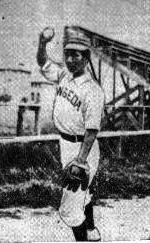
Atsushi Kono

Atsushi Kono

The Waseda and Stanford teams played their first game on April 29 in front of a crowd of about 200—including “Five hundred Japanese rooters, with Waseda banners” who came from San Francisco. Kono pitched for Waseda, as he would in all 26 of the team’s games during the tour, and gave up 11 hits in the 9 to 1 loss.  The Chronicle said:

“(T)hough (Kono) allowed eleven safe swats to be made, he kept them well scattered, and were it not for the wildness of his teammates the score would have been much smaller.  Kono besides pitching good ball, was in the game every minute, and kept his head better than the rest of the nine.  It was a hit from his bat that scored Captain Hashido, and save the team from a shutout.”

Shin Hashido

Shin Hashido

Four days later the two teams met again at San Francisco’s Recreation Park in front of a crowd of more than 2000, which The Chronicle said was “more than two-thirds Japanese.”  Stanford won again, this time 3 to 1.  The Call said:

“The representatives of the Mikado are weakest at the bat, being unable to connect with the curve ball which has reached such a high state of development in this country.”

The Chronicle said there were still some aspects of the rules which were lost in translation:

“Some funny mistakes, owing to a misapprehension of the rules, were made by the Japanese here; for instance, they construed the fly-ball rule to mean that in no case could a runner leave a base while a fly was in the air, and this error cost them a run in their last game with Stanford…appeal was made to the English-speaking professor, who gave their version of the rule.  They know better now.”

The team continued to play games on the West Coast through June, meeting military and semi-pro teams, college clubs and even one high school opponent (they defeated Los Angeles High 5 to 3).  The assessment of the Waseda club’s abilities throughout the trip, were summed up by a headline in The Call after the Japanese team was shut out 5 to 0 by the University of California, Berkeley:

“Japs field like a Bunch of the Big Leaguers but Are Unable to Hit.”

1905 Waseda University team

1905 Waseda University team

Over the course of the 26 games played on American soil, Waseda University won seven.  They arrived back in Japan on July 6. The tour opened the door for regular international competition between Japanese and American teams until World War I, either in their respective countries or in Hawaii.

While Abe became more involved in Japanese politics (he served as a member of the National Diet from 1928-1940), and also served as Waseda’s Dean, he remained an ardent supporter of baseball, and returned to the states with several subsequent teams from the University.

Kono returned to Japan and introduced the country to the pitcher’s wind up and a change-up, which he picked up on the tour.  In 1936 he organized the Nagoya club in Japan’s first professional league—his team won the first professional game played in Japan on April 29 of that year.

Hashido eventually became a baseball writer and author in Japan, he and Kono are both members of the Japanese Baseball Hall of Fame.

Merrifield continued his work with the American Baptist Missionary union in Japan and in Michigan; he later returned the University of Chicago as a professor of New Testament History and eventually became the baseball coach (1921).  In April of 1920 he took the University of Chicago team on a tour of Japan, the U of C Maroons were 8-4 with two ties on the trip–including a 4-2-1 mark against Waseda.
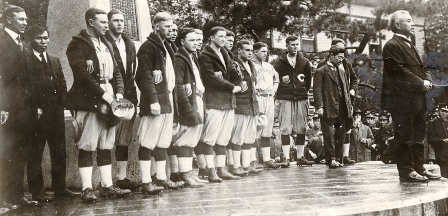
The 1920 University of Chicago Baseball team in Japan, Isso Abe is at the front, introducing the team at the welcome celebration.
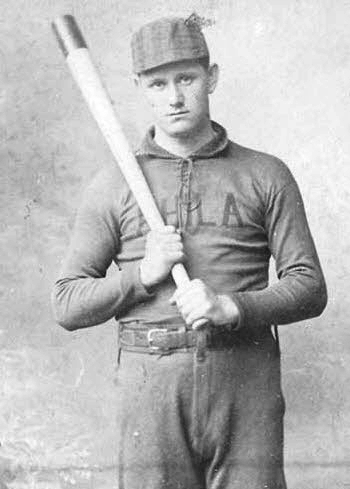
The 1920 University of Chicago Baseball team in Japan, Isso Abe is at the front, introducing the team at the welcome celebration.
Lost Team Photos–Delhanty’s Last

11 Apr

1903senators

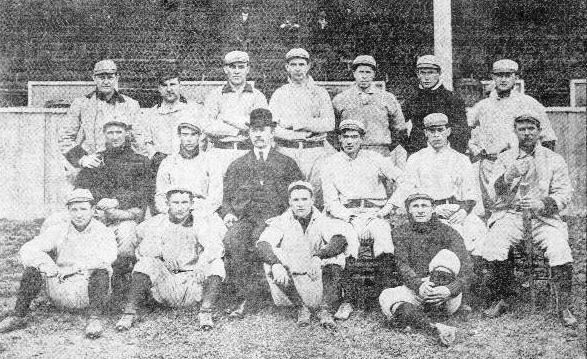
The 1903 Washington Senators.  Photo was taken the day before the Senators 3 to 1 victory in the home opener against the New York Highlanders at National Park.

The Senators–sixth place finishers in 1901 and 1902–were in eighth place by May 8 and never gave up their spot in the American League cellar.  The horrible season was made worse when the club’s best player Ed Delahanty was swept over Niagara Falls and  died on July 2–Delahanty’s death has been chronicled by many excellent sources.

When this photo was taken, Delahanty had been forced to rejoin the Senators after having signed in the off season with the New York Giants–he was badly hurt financially by the peace agreement between the American and National Leagues–Delahanty, who made $4,000 in Washington in 1902 had signed for between $6,000 and $8,000 (contemporaneous sources disagreed on the amount) and a large advance, which he was forced to return.  Despite his financial woes, Delahanty still managed to hit .333 for the last-place team at the time of his death.

The photo above is the last team picture which included the future Hall of Famer:

First row: James “Ducky” Holmes, William “Rabbit” Robinson, Gene DeMontreville, Lew Drill

Second row: William “Boileryard” Clarke, Wyatt “Watty” Lee, Manager Tom Loftus, Bill Coughlin, Joe Martin, Jimmy Ryan

Standing:  Delehanty, Albert “Kip” Selbach, Al Orth, George “Scoops” Carey, Casey Patten, John “Happy” Townsend, Charles Moran

Loftus was let go as manager after the 43-94 season.  The team would not finish better than seventh place in the American League until 1912.

Ed Delahanty

Ed Delahanty

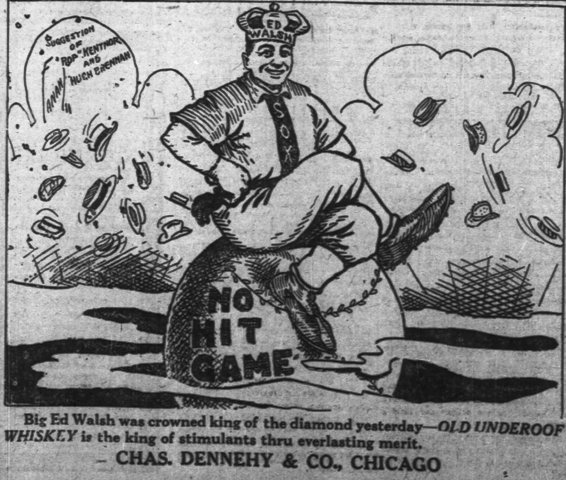
Lost Advertisements–“Big Ed” Walsh No-Hitter, Old Underoof Whiskey

7 Mar

walshnohitter

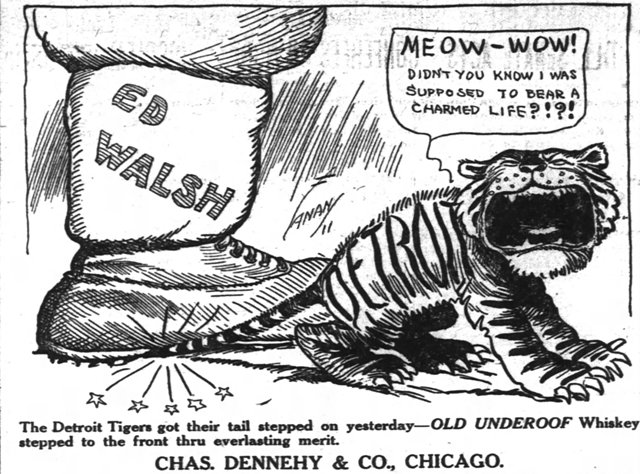
A 1911 advertisement for Old Underoof Whiskey which appeared in Chicago News papers the day after Edward Augustine “Big Ed” Walsh threw his first nine-inning no-hitter (Walsh gave up no hits in a 5-inning 8 to 1 victory over the New York Highlanders on May 26, 1907).  Walsh had also thrown five one-hitters, including one two weeks earlier against the Detroit Tigers.

Old Underoof commemorated that effort as well:

walshonehitter

The Chicago Inter Ocean said of the no-hitter:

“Never in His long and brilliant career in the box has Big Ed shone as he did on the hill in yesterday’s game.”

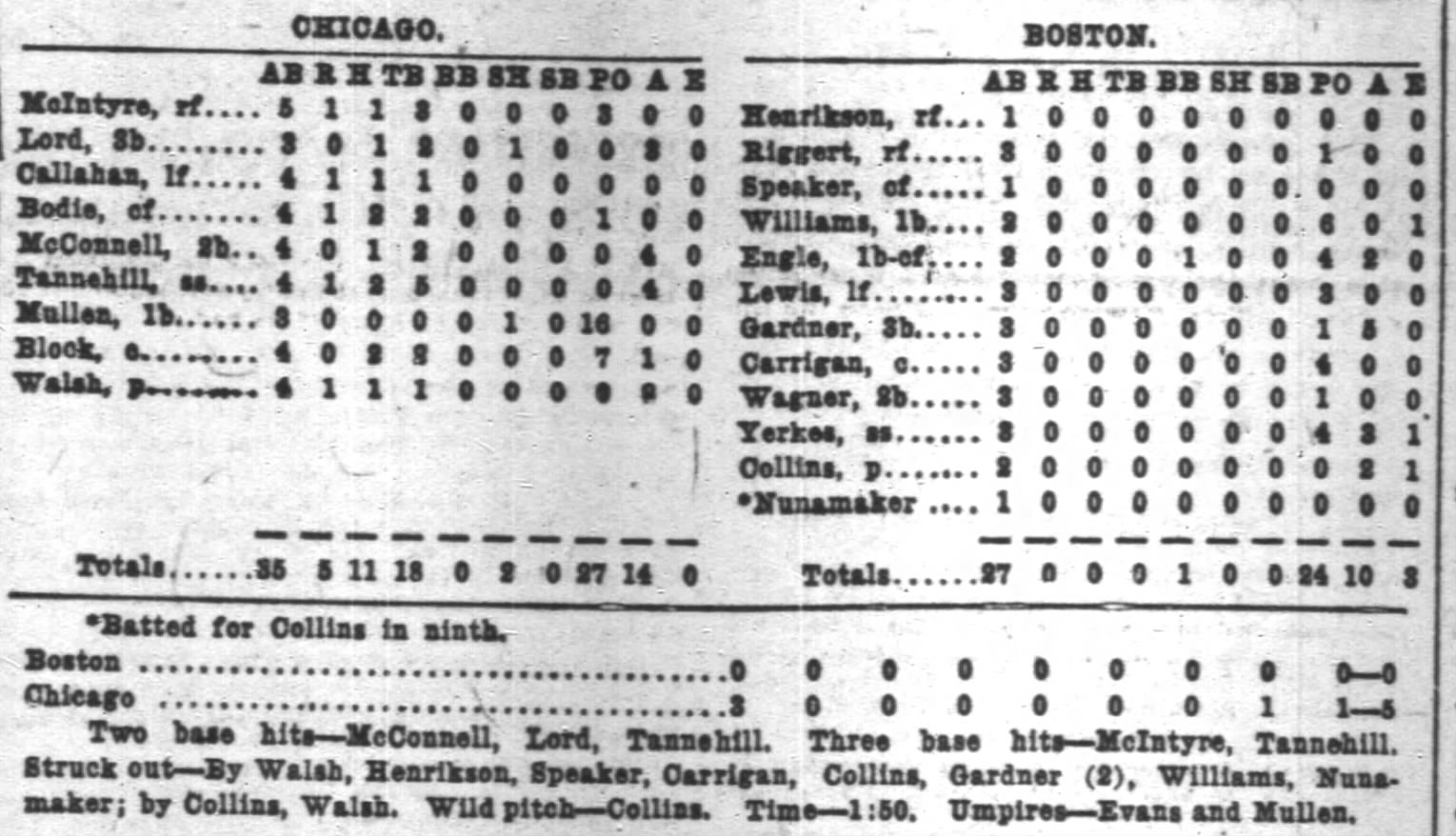
Walsh faced only 27 Boston Red Sox batters, but gave up a fourth inning walk to Clyde Engle.  The Inter Ocean said umpire Billy Evans’ call that led to the walk was “questionable.”  And that two plays helped preserve the  spitballer’s no-hitter:

“(T)here were two times when the monarch of all he expectorated nearly lost his charm.  Once the ball was driven out right over the second sack.  Lee Tannehill rushed back, scooped it up and threw out the runner easily.  Lee must have had a margin of at least three-eighths of an inch in his favor.  Another time Ping Bodie saved Ed’s dinner dishes by rushing in with the greatest burst of speed at his command and licking up the ball a little above his ankles.”

The other incident of note in the game took place in the third inning when Tannehill hit a line drive to right center field in the third inning, The Chicago Tribune said Red Sox center fielder Tris Speaker and right fielder Olaf  Henriksen came together “in a terrific collision” which knocked both unconscious and out of the game.  Henriksen got the worst of it, and was briefly hospitalized with a broken rib and injured ankle.  Speaker “was first to recover and emerged from the accident with a severe shaking up and a lame shoulder.”

The box score

The box score

Walsh came one batter away from joining Cy Young and Addie Joss as the only two modern era pitchers to that point to throw a perfect game–Joss’ perfect game was against the White Sox in 1908, Walsh was pitching for Chicago and only gave up one hit and struck out 15 in the loss.

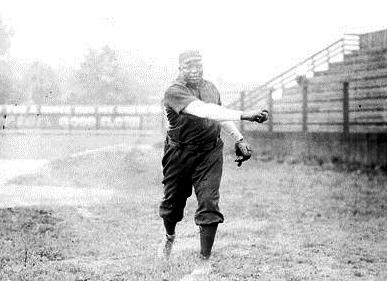
Ed Walsh circa 1904

Ed Walsh,  circa 1904

Walsh was 27-18 with a 2.22 ERA in 1911, leading the league with 255 strikeouts, in a league-leading  368 and two-thirds innings.  The Hall of Famer pitched until 1917 compiling a 195-126 record and 1.82 ERA.

He supported making the spitball legal again after the pitch was banned after the 1920 season.  The Associated Press quoted him in his 1959 obituary:

“Everything else favors the hitters.  Ball Parks are smaller and baseballs are livelier.  They’ve practically got the pitchers working in straitjackets.  Bah!  They still allow the knuckle ball and that is three times as hard to control.”

Monte Irvin–Happy 95th Birthday

25 Feb

Montford Merrill “Monte” Irvin was born on this date in 1919.

Monte Irvin (r) with Jackie Robinson at The Jackie Robinson Store 111 West 125th Street in Harlem, 1953

Monte Irvin (r) with Jackie Robinson at The Jackie Robinson Store 111 West 125th Street in Harlem, 1953

“We used to look at each other and say, ‘We play the same game with the same rules, the same bat, the same ball, the same field. What the hell does color have to do with it? You don’t play with color. You play with talent.”  Monte Irvin

“Fatty Weakened and Portland scored four runs”

24 Jan

Walter “Judge” McCredie went ahead with the scheduled spring series in California between his Portland Beavers and the Chicago American Giants despite criticism from Pacific Coast League (PCL) President Allan T. Baum and other league executives.

Much of the concern was the result of the Negro League team beating the Beavers four out of five games in the spring of 1913.

The results of the 1914 series were much different.  Foster, and most of the rest of the pitching staff were injured, and catcher Bruce Petway missed most of the games with a bad ankle.

The series began in Santa Maria with an 11-inning 8 to 8 tie.  “Smokey” Joe Williams, of the New York Lincoln Giants joined Rube Foster’s club for the series.  The Beavers pounded him for 14 hits.

"Smokey" Joe Williams

“Smokey” Joe Williams

Portland won the second game in Santa Maria 5 to 0.  Harry Krause (who would win 22 games for Portland in 1914) shut out the American Giants on eight hits; Lee Wade struck out 9, but allowed 11 hits and took the loss.  The Portland Oregonian said Krause’s:

“Southpaw slants and spitballs stood the Negro Giants, of Chicago, on their heads.”

The series moved to Santa Cruz.

Portland beat “Smokey” Joe Williams again in game 3; 6 to 2.  The Santa Cruz Evening News said Williams “Had a nice curve, plenty of speed, but was a little wild.”  The American Giants loaded the bases with two outs in the ninth, but 19-year-old rookie Elmer Hanson struck out pinch hitter Frank Duncan to end the game.

Watsonville was the site of the fourth, and final, game.

The Santa Cruz Evening News said while McCredie and Foster made the trip together to Watsonville, McCredie asked which pitcher Foster was starting the next day:

“Foster replied that he did not know, as all were ailing, one way or another.

“McCredie suggested that he (Foster) pitch.  Foster said that he would pitch if McCredie would play, and an agreement was made.”

McCredie’s last season as a regular was 1909.  After playing in 61 games in 1910, he had appeared in just eight games from 1911-1913.

“(McCredie and Foster) appeared on the ball field in uniform and the Portlanders went to bat first, big Foster began to pitch and retired the side…Then it was that McCredie got cold feet.

“He refused to carry out his side of the agreement to play, and all coaxing and teasing and jibes from  both teams could not feaze him.”

Foster pitched five innings of one-hit ball, but in the sixth “Fatty weakened and Portland scored four runs.”

Rube Foster

Rube Foster

After the final game The Oregonian said:

“Perhaps it was taking unfair advantage, but in the recent Beaver-Negro series the Portland Coasters knew in advance nearly everything the twirlers tossed up the plate.

(James) Hi West and (Irv) Higginbotham were out on the coaching line every game stealing the catcher’s signs.”

The American Giants salvaged their West Coast trip in their series against Nick Williams’ Portland Colts. They won the opener on March 28 in Santa Rosa 6 to 0 behind a “Smokey” Joe Williams no-hitter.  Williams struck out nine of Portland’s  Northwestern Leaguers.  The Oregonian said:

“Williams, a tall, rakish looking mulatto (Williams’ mother was a member of the Comanche nation) set the Colts down without a hit or a run.”

The American Giants committed two errors, including one by third baseman Bill Francis.  The paper said:

(Duke) Whitt rolled one infield grounder toward third that might have been construed a safety, but the scorers graciously agreed to swallow race prejudices.  It was scored as an error.”

The series then went to Chico, California, and Medford and Grants Pass, Oregon, before finishing in Portland.

The Colts only managed one victory, beating the Giants 9 to 8 in Medford.  Although the colts won the game The Oregonian said the highlights were two long home runs hit by American Giants shortstop John Henry “Pop” Lloyd, including “one of the longest hits ever seen on the local field.”

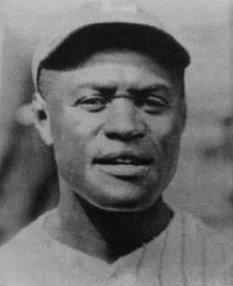
John Henry lloyd

John Henry Lloyd

The American Giants continued the spring tradition of traveling west to play Portland teams through the 1916 season.

Walter “Judge” McCredie later created some doubt that playing Foster’s team was simply a business relationship and not an expression of his opinion of the color line in baseball.  When he was criticised by PCL executives in 1914 he said: “the games are nothing more or less than training affairs.”  Later that season his attempt to sign a Hawaiian player of Chinese decent named Lang Akana was thwarted by PCL officials and his own players who threatened to revolt. In 1915 McCredie was quoted in The Chicago Defender:

“I don’t think the color of the skin ought to be a barrier in baseball…If I had my say the Afro-American would be welcome inside the fold.  I would like to have two such ball players as Petway and Lloyd of the Chicago Colored Giants who play out here every spring.  I think Lloyd is another Hans Wagner around shortstop and Petway is one of the greatest catchers in the world.”

It wouldn’t be until 1917 that a Chinese player would play professional baseball.

Lost Advertisements–Mike Martin’s Liniment

27 Dec

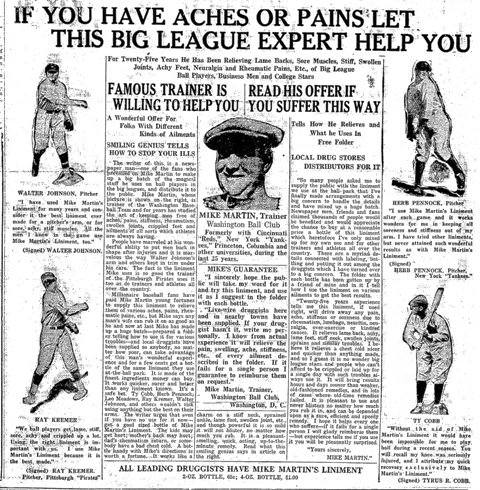
martinlinMike Martin spent 40 years with the Washington Senators as a trainer and scout; he was one of baseball’s first full-time trainers.  Martin was working as the athletic trainer at Columbia University when Clark Griffith hired him to work with the New York Highlanders, he followed Griffith to Cincinnati and then finally to Washington.

Martin began marketing the liniment he used on Walter Johnson and the rest of the Senators staff in the 1920s.  This 1925 ad featured testimonials from his good friend, Senator pitcher Walter Johnson, Herb Pennock of the Yankees, Ray Kremer of the Pirates and Ty Cobb (who rarely met a “cure” he couldn’t endorse):

“I have used mike Martin’s Liniment for many years and consider it the best liniment ever made for a pitcher’s arm, or for sore, achy, stiff muscles.  All the men i know in the game use Mike Martin’s Liniment too.”

(Signed) Walter Johnson

“I use Mike Martin’s Liniment after each game and it works wonders for me in keeping all soreness and stiffness out of my arm.  I have tried other liniments, but never attained such wonderful results as with Mike Martin’s Liniment.”

(Signed) Herb Pennock 

“We ball players get lame, stiff, sore, achy and crippled a lot.  Using the right liniment is important with us.  I use Mike Martin’s Liniment because it is the best made.”

(Signed) Ray Kremer

“Without the aid of Mike Martin’s Liniment it would have been impossible for me to play ball during the recent season.  You will recall my knee was seriously injured, and I attribute my quick recovery exclusively to Mike Martin’s Liniment.”

(Signed) Tyrus R. Cobb

mikemartin1930

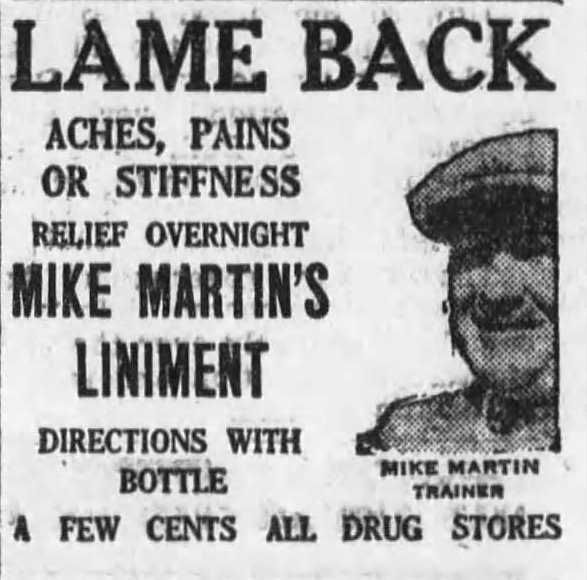
1930 advertisement

Martin remained the Washington trainer until 1946 when Griffith made him a scout.  He was still working for the Senators, and his liniment was still a popular product, in June of 1952 when the 67-year-old Martin was killed in a traffic accident near his Maryland home while driving to Griffith Stadium.


“Such Men are Demoralizing Agents in any Team”

19 Dec

Henry Chadwick is called by many “The Father of Baseball.”  Is Hall of Fame plaque calls him “Baseball’s preeminent pioneer.”  Chadwick is credited with creating the box score and writing baseball’s first rule book.  He was also a sportswriter for more than 50 years.  In 1880 he wrote an article for The New York Clipper about what qualities teams should looks for in the players they sign.  O.P. Caylor of The Cincinnati Enquirer said Chadwick “Never wrote more truth in so little space:”

“In the first place, what a manager must avoid is the engagement of players is the habit of indulging in intoxicating liquors.  Such men are demoralizing agents in any team in which they allowed to play, as the experience of 1879, especially in the League arena, fully proved.  Not only is a drunken professional his own enemy, but his presence in a team is also necessarily destructive of its morals.  In fact, temperate habits among professional ball players are more essential to success than is any special skill they may possess in playing their several positions; for a poor player who is a temperate man and earnest in his work is more serviceable than any man who is a fine player can be who is under the influence of drinking habits.

“Secondly, quick-tempered, passionate men are unfit to be in a nine made up to play for the side.  Hot temper is not only opposed to clear judgment, but it entirely prevents a man under its influence from playing for the side.  Such men, when they ‘get their mad up’ at anything, do not hesitate a moment to indulge their spite at a brother player at the cost of even the loss of the match.

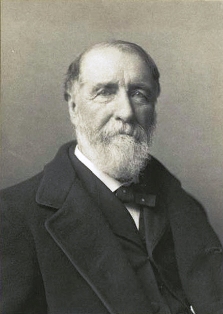
Henry Chadwick

Henry Chadwick

“Thirdly, in making up a team for carrying out this policy, you must avoid putting players in it who have any ambitious views for preferment, such as a desire to be made captain of the nine or manager of the team.  It is impossible for such men to play for the side.  They are so busy in organizing cliques against the powers that be, and in maneuvering for the desired place, that they think of little else, and they play the game only with this one object in view.  This has always been a cause of difficulty in teams in which there are two or more ex-captains or ex-managers.  The player who has once tasted the fruit of authority is rarely amenable to control when occupying a subordinate position unless it be under some ruler whom he knows to be his superior as a captain or manager.  Ex-captains or ex-managers might serve under Harry Wright, for instance, but they would be restive under the rule of a less experienced and capable man.

“Fourthly, players who have an “itching palm’ should be avoided in the make-up of a team selected for carrying out the policy of playing for the side.  Men of this class are always (on the alert) for opportunities to do a little outside business in a quiet way which will help to increase their pecuniary receipts of the season.

“Fifthly, the longer players are kept in the service of one club the more they may be relied upon to play for the side, as a general rule; and it is not an unfair conclusion to arrive at that that player who is ready to leave the service of a good club at the temptation of the offer of a couple of hundred dollars a year more salary, is a man whose heart is not in his work sufficiently to make him a good player for his side.  In fact, this club feeling—that is, a feeling of special interest in the success of his club outside of any interested motive of a more personal nature—is one of the foundation stones of the policy of playing for the side.  Players who possess none of this kind of feeling are of that class who are ready to exclaim ‘I don’t care a snap for the club; I go in to play my best for my record, and if this helps to win games, well and good; but you bet I ain’t a-going to spoil my average just to win a match for no club in the league.  That’s the kind of a player I am, and don’t you forget it.’”

Lost Advertisements–“Now he is a Man with a Sound Body”

13 Dec

georgewrightcelery

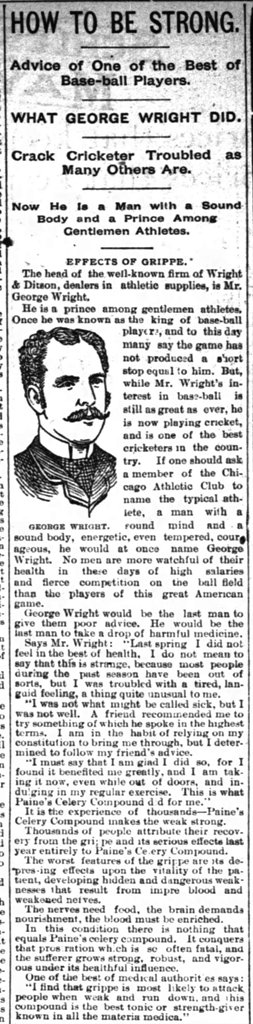
An 1890s advertisement featuring George Wright, which appeared in newspapers across the country, and presented as a regular news story, for Paine’s Celery Compound:

“He is a prince among gentlemen athletes. Once he was known as the king of base-ball players, and to this day many say the game has not produced a shortstop to equal him. But, while Mr. Wright’s interest in base-ball is still as great as ever, he is now playing cricket, and is one of the best cricketers in the country.”

Paine’s, like many patent medicines of the late nineteenth century, claimed to be a cure for the grippe (influenza):

“Says Mr. Wright: ‘Last spring I did not feel in the best of health. I do not mean to say that this is strange, because most people during the past season have been out of sorts, but I was troubled with a tired, languid feeling, a thing quite unusual to me.

“I was not what might be called sick, but I was not well. a friend recommended me to try something of which he spoke in the highest terms. I am in the habit of relying on my constitution to bring me through, but I determined to follow my friend’s advice.

“I must say that I am glad I did so, for I found it benefited me greatly, and I am taking it now, even while out-of-doors and indulging in my regular exercise. This is what Paine’s Celery Compound did for me.”

George Wright

George Wright

The ad said Paine’s “makes the weak strong,” and that “Thousands of people attribute their recovery from the grippe” to the compound.

According to The Journal of the American Medical Association, Paine’s contained fifteen different types of vegetables, but that “loses much of its impressiveness when it is seen that the total amount of vegetable extractives is less than 1.5 percent.” The Journal also noted that the compound contained 19.85 percent alcohol, which may account for Wright’s assertion that it “benefited me greatly.”

“Hilariously and Shockingly Drunk”

11 Dec

The Philadelphia Athletics were in second place, two games behind the St. Louis Browns in the American association pennant race in June of 1889; but The Philadelphia Times said the team was underachieving, and blamed it on drinking:

“Watch your men, Manager (Bill) Sharsig.

“It is a matter of notorious publicity that a portion of the best players on the Athletic Base Ball Club are not living up to their contracts.  They drink, carouse and make exhibitions of drunkenness that are disgusting the people who so liberally contribute to the support of the national game, and unless the management put an immediate stop to such proceedings the club will be certain to finish the season with a balance on the wrong side of the ledger.”

The paper said because it was “unjust to criticize the club as a whole” they would name the guilty parties:

“It is an open secret that (Denny) Lyons, (Curt) Welch, (Mike) Mattimore, (Henry) Larkin, (Harry) Stovey and sometimes (Frank) Fennelly and (Lou) Bierbauer are frequently in a beastly state of intoxication, and it is easy to prove when and where they have recently been seen so in public places.”

The Times singled out Welch, who was out of the lineup because Sharsig said he was ill:

“Sick he may be, and those who saw him in company with Lyons last Tuesday morning at the early hour of 3 O’clock wonder that he is not laid up.  That model pair were sitting on the curbstone on the South Penn Square side of the City Hall, hilariously and shockingly drunk.

“Saloon-keeper Irwin, who keeps on Juniper Street, told a friend that Welch and another ballplayer became so vulgarly and obscenely boisterous in his place on Monday night that he had to order them out.”

Curt Welch

Curt Welch

The Times said the Athletics loss on June 16—they were defeated 9 to 5 by the Browns—“was largely due to errors made by Welch, Stovey, Larkin and Lyons, all of whom showed traces of their Saturday night’s outing.”

The team’s activities were not limited to Philadelphia, from “every city on the circuit came stories of debauches and sprees,” involving the Athletics:

Chris von der Ahe, of the champion Browns, is responsible for the statement that on the last trip made by the Athletics to St. Louis six of the players became so drunk and noisy in the big Anheuser-Busch saloon that the proprietor had to have then ejected, and a ballplayer on another club that chanced to meet the Athletics in East St. Louis said yesterday that he never saw so many drunken men on one team and that their unseemly conduct was the subject of general talk around the depot.  From Baltimore and Brooklyn come well authenticated stories of boisterous sprees and hilarious conduct in public places.”

The Times said even the most famous umpire of the era, “Honest John” Gaffney, “whom a ballplayer has no truer friend,” commented on the state of the Athletics:

“He says that he has repeatedly seen some of them come up to bat so drunk that they could hardly stand.”

John Gaffney

John Gaffney

The paper said Sharsig, “an exceedingly clever gentleman,” had completely lost control of the team:

“The ballplayers all like him and avow their willingness to do for him whatever he asks, but he is apparently unable to keep them sober even at home and when away they are absolutely beyond his control.  He does not believe in imposing fines…Stovey, Welch and Larkin know that it would be hard to fill their places and laugh at threatened dismissal.”

The Athletics lost six straight games after the story appeared, and 16 of their next 22.  They ended the season in third place with a record of 75-58.

Manager Bill Sharsig

Manager Bill Sharsig

Mattimore was released in August.  Larkin, Bierbauer and Stovey jumped to the Players League after the season ended, and Fennelly was sold to the Brooklyn Gladiators.

Sharsig’s 1890 team led the American Association until July 17, then faded badly and finished in eighth place.  There was no mention in the Philadelphia press about whether drunkenness contributed to the 1890 collapse.

Lost Advertisements–“Yell For Your Team–And Help Them Win”

6 Dec

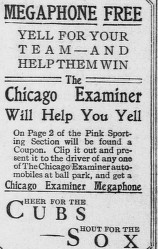
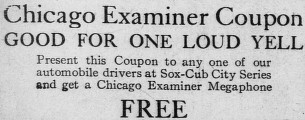
cubssoxmegaphoneA 1912 advertisement for a free megaphone available from “the driver of any one of The Chicago Examiner automobiles at ballpark.”

The Chicago Cubs and White Sox played 25 City Series’ between 1903 and 1942 (not including their World Series in 1906).  The first, in 1903 ended in a tie–both teams winning seven games before the series was forced to end because the player’s contracts had expired.  The Cubs won in 1905 and 1909, but the Sox won 18 of the next 22.

The 1912 series began with a 0-0 tie.  White Sox pitcher “Big Ed” Walsh held the Cubs to just one hit–a Joe Tinker double.   Cubs pitcher Jimmy Lavender held the Sox to six.

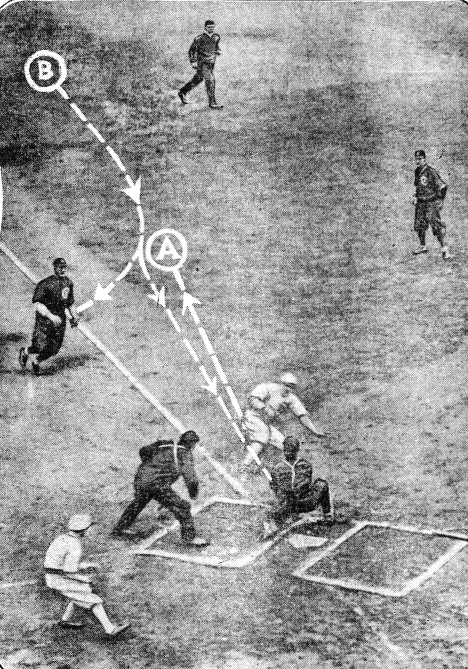
The highlight of the game came in the second inning.  With “Ping” Bodie on third and Rollie Zeider at bat.  The Chicago Tribune said:

“Zeider took a spitter for one ball, then hit the second for a high bounder to (Heinie) Zimmerman.  Bodie tried to score, but Zimmerman ran in stabbed the ball with his bare hand and got Bodie at the plate.”

The picture shows where Zimmerman was playing Zeider (B) and where he fielded the ball (A).

The picture shows where Zimmerman was playing Zeider (B) and where he fielded the ball (A).  Ping Bodie is tagged out by Cubs catcher Jimmy Archer.

The second game of the series also ended in a tie, 3 to 3.  The Cubs then won three straight, but the White Sox came back and won four in a row to take the series.

The 31-year-old Walsh, who was 27-17 in 62 games (41 starts, 32 complete games) and 393 innings pitched,  appeared in six games for the Sox, starting four.  He would only win 13 more games over parts of the next five seasons.

cubssoxmegaphone1912

1912 Cubs/Sox Megaphone coupon from The Chicago Examiner