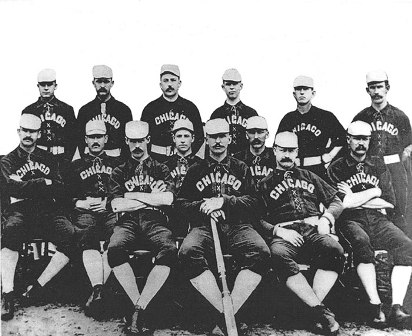
Tag Archives: Ty Cobb

Lost Advertisements–American Giants in Nashville

16 Oct

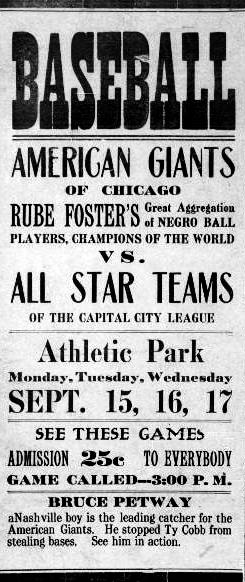
1913amgiants

A 1913 advertisement for a three-game series in Nashville between the Chicago American Giants and “all-star teams” comprised of players from the city’s semi-pro league:

Rube Foster‘s Great Aggregation of Negro Ball Players, Champions of the World vs.  All Star Teams of the Capital City League

The games were scheduled for Nashville’s Athletic Park (Sulphur Dell), on September 15, 16, and 17.

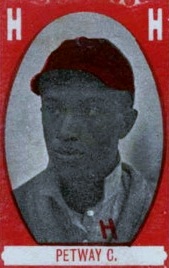
In addition to Foster, the primary drawing card was Bruce Petway:

“A Nashville boy is the leading catcher for the American Giants.  He stopped Ty Cobb from stealing bases.  See him in action.”

The Cobb reference is from the 1910 tour of Cuba by the Detroit Tigers–depending on the source, Petway playing for the Havana Reds threw Cobb out attempting to steal between one and three times.

petway

The American Giants with “Big Bill” Gatewood on the mound won the first game of the series 12 to 1.

The next two games were rained out and were rescheduled as a September 19 doubleheader.  Bill Lindsey beat the locals 6 to 5 in the first game and Foster shut them out 4 to 0 in the second.


Collins’ “Ten Commandments”

5 Oct

The Philadelphia Inquirer said in February of 1916, Eddie Collins of the Chicago White Sox, had broken “into the ‘Gospel League,’ after  the second baseman gave a temperance speech in front of “500 persons” at the Epworth Methodist Church in Palmyra, New Jersey church.

collins2

Eddie Collins

Despite Collins telling his audience he wasn’t  “contemplating a pulpit career,” the paper said they “(A)pplauded like World Series fans when he handed ‘booze’ some wallops that would have done credit to Billy Sunday.”

Collins’ talk focused on the evils of alcohol:

“I come to bring a message to your young people, from a baseball player’s viewpoint, of the necessity of clean living and I will be glad if anything I say will help any of you fight the battle of life…Temperate living in necessary for success in any field of action.”

He also praised his former manager from the pulpit:

“Life is a whole lot like playing baseball under Connie Mack’s orders.  Mack is the greatest baseball general the world has ever known and any man who has ever played on the old Athletics honors respects and loves the boss.”

Sunday said he approved of Collins taking to pulpit and providing a “boost” for baseball:

“The way to make the great game respectable is for every player to be respectable himself.”

The Inquirer told readers the following day that the Columbia University graduate had little in common with the evangelist who often mangled the language:

“The statement that Eddie Collins is emulating Billy Sunday is entirely erroneous…Eddie had a perfect record at the bat and fielded cleanly with the King’s English.”

Billy Sunday, evangelist

Billy Sunday, evangelist

Within a week, The Philadelphia Press said:

“Eddie Collins’ dip into evangelism has had a home-run effect among church people throughout the country, and he now is swamped with invitations to address church congregations, bible classes, and Sunday school meeting.

“The requests have swept in upon him at his home in Lansdowne (Pennsylvania) in such a deluge that he said today he had reached the point where he would have to give up base ball if he were to meet all the engagements asked.”

Collins told a reporter:

“I am gratified to learn that my little talk of last Sunday and my rules of life amounted to something but I don’t rank as an evangelist and can’t follow that calling.”

Instead of leaving the diamond for the pulpit, Collins printed and had distributed to churches, several thousand copies of part of the talk, what he called “The Ten Rules of Life.”

Some reporters, including William Peet of The Washington Herald, referred to the list as “Collins’ Ten Commandments:”

First: Safeguard your honor

Second: Don’t overeat

Third: Be a good loser

Fourth: Smile

Fifth: Keep good hours

Sixth: Have courage to do right

Seventh: Don’t think you know it all

Eighth: Be prompt

Ninth: Don’t drink alcoholic drinks

Tenth: Think clean thoughts.

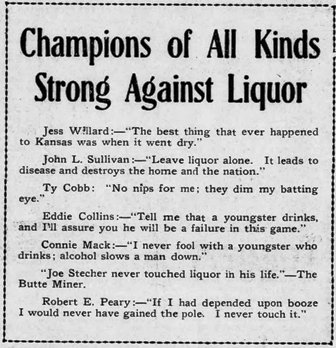
Collins’ statements about alcohol were used by various temperance organizations seeking prohibition.  Ads like the one below with quotes from Collins, Ty Cobb, and Connie Mack, and Admiral Robert Peary, as well as boxers Jess Willard, John L. Sullivan, and Joe Stecher appeared in newspapers and handbills distributed throughout the country.

temperance

Murphy’s “Billion Dollar Team”

17 Aug

“Money will not buy a pennant winner;” so said William George “Billy” Murphy, the sports editor of The St. Louis Star.  In 1914, he set out to select a team that not even “John D. Rockefeller… (With) all his wealth could buy a club that would win a World’s championship from the one we have picked…The Billion Dollar Team.”

Murphy said:

“You fans of towns that have never won a flag, how would you feel to wake up some morning and find that Dame Fortune had so arranged matters that this club had suddenly been picked to represent your fair city.”

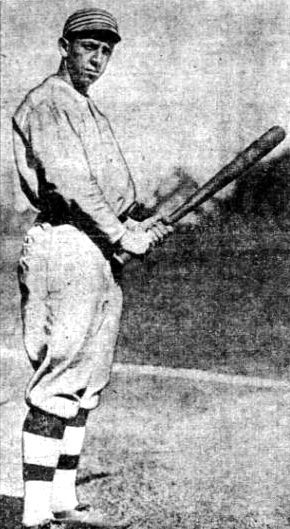
Jimmy Archer, catcher

Behind the plate he acknowledged “There are many who would doubtless pick (John) Chief Meyers…but considering the Indian’s slowness of foot and propensity for clogging up the bases and stealing when the bags are full, we must remark we cannot see the “Chief” for a minute with Jimmy Archer, who, although not so good a hitter, is faster, a quicker thinker, greater fielder and better pegger.”

Jimmy Archer

Jimmy Archer

Murphy was in the minority questioning the baseball intelligence of Meyers, who was widely considered one of the most intelligent and articulate players of his era.  He also rated Ray Schalk and Wally Schang as superior, saying:

“In the writer’s humble opinion they are much more valuable men to their team than Meyers.”

Walter Johnson, pitcher

“There will hardly be a dissenting vote cast against Walter Johnson.  Unquestionably he is the greatest of all the pitchers.

(Charles Chief) Bender and (Christy) Mathewson are also great—great when they should show class—in championship games.  Every nerve, every fiber of their brains, every muscle necessary to their craft, is at its best when big games are being fought.

“Wonderful as they are, we must pick Johnson, who also has class and is game to the core.”

Hal Chase, first base

“For first base, there is only Hal Chase.  He is a great hitter, marvelous fielder, can run the sacks, and is a brilliant tactician.

(John) ‘Stuffy’ McInnis, Jake Daubert, Eddie Konetchy, Fred Merkle, and Jack (Dots) Miller are all stars, but they are ‘also rans’ in the class with Prince Hal of the White Sox.”

Prince Hal of the White Sox

Prince Hal of the White Sox

Eddie Collins, second base

“At second base, Eddie Collins in the potentate.  Johnny Evers, Larry Doyle, and Larry Lajoie occupy seats in the second sackers’ hall of fame, but Collins rules over the roost.”

Honus Wagner, shortstop

“At short, notwithstanding his age, the palm goes to Hans Wagner.  Taken all in all he is still the greatest man at the position in the game.  He can do everything and does it better than any of his contemporaries.  When will we look upon his like again?”

Frank Baker, third base

“At third base, there is that wonderful silent son of swat, Frank Baker, the conqueror of the wonderful Mathewson and Richard (Rube) Marquard.”

Joe Jackson, right field

“In right field we have Joe Jackson, the young Southerner with the Cleveland club.  He is one of the greatest batsmen in the game today and is a fielder and base runner of unusual ability.”

Joe Jackson

Joe Jackson

Ty Cobb, center field

“In center, there is Tyrus Raymond Cobb, the Royston, Georgia marvel, who is the greatest player baseball has ever known.”

Tris Speaker, left field

“And in left field, there is Tris Speaker of the Boston Red Sox—second only to Cobb.”

Grantland Rice’s “All-Time All-Star Round up”

10 Aug

In December of 1917, thirty-eight-year-old sportswriter Grantland Rice of The New York Tribune enlisted in the army–he spent fourteen months in Europe.  Before he left he laid out the case, over two weeks, for an all-time all-star team in the pages of the paper:

“As we expect to be held to a restricted output very shortly, due to the exigencies and demands of the artillery game, this seemed to be a fairly fitting period to unfold the results.”
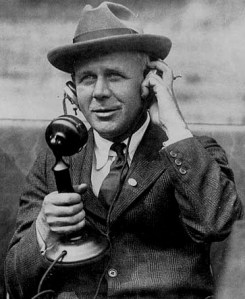
Grantland Rice

Grantland Rice

Rice said the selections were “not solely from our own limited observation, extending over a period of some eighteen or twenty years,” but included input from players, managers and sportswriters, including  “such veterans” as Frank Bancroft and Clark Griffith, and baseball writers Joe Vila of The New York Sun, Bill Hanna of The New York Herald and Sam Crane, the former major league infielder turned sportswriter of The New York Journal.

Rice said only one of the nine selections “(S)eems to rest in doubt.  The others were almost unanimously backed.”

The selections:

Pitcher:  Christy Mathewson

A. G. Spalding, John (Montgomery) Ward, Larry Corcoran, Charley Radbourn, John Clarkson, (Thomas) Toad Ramsey, Tim Keefe, Bill Hoffer, Amos Rusie, (Mordecai) Miner Brown, Addie Joss, Ed Walsh–the array is almost endless.

“In the matter of physical stamina, Cy Young has outclassed the field.  Cy won more games than almost any others ever pitched.

“(But) For all the pitching mixtures and ingredients, stamina, steadiness, brilliancy, brains, control, speed, curves, coolness, courage, is generally agreed that no man has ever yet surpassed Christy Mathewson…there has never been another who had more brains or as fine control.”


[…]

“It might be argued that Radbourn or (Walter) Johnson or (Grover Cleveland) Alexander was a greater pitcher than Mathewson.

But we’ll string with Matty against the field.”

Radbourn was the second choice.  Bancroft said:

“Radbourn was more like Mathewson than any pitcher I ever saw.  I mean by that, that like Matty, he depended largely upon brains and courage and control, like Matty he had fine speed and the rest of it.  Radbourn was a great pitcher, the best of the old school beyond any doubt.”

Catcher:  William “Buck” Ewing

“Here we come to a long array—Frank (Silver) Flint, Charley Bennett, (Charles “Chief”) Zimmer, (James “Deacon”) McGuire, (Wilbert) Robinson, (Marty) Bergen(Johnny) Kling, (Roger) Bresnahan and various others.

“But the bulk of the votes went to Buck Ewing.”
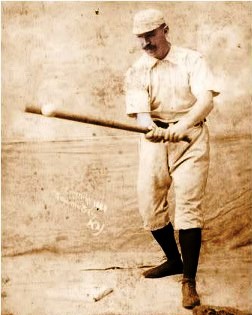
Buck Ewing

Buck Ewing

[…]

“Wherein did Ewing excel?

“He was a great mechanical catcher.  He had a wonderful arm and no man was surer of the bat…he had a keen brain, uncanny judgment, and those who worked with him say that he had no rival at diagnosing the  weakness of opposing batsman, or at handling his pitchers with rare skill.”

Kling was the second choice:

“Kling was fairly close…a fine thrower, hard hitter, and brilliant strategist…But as brilliant as Kling was over a span of years, we found no one who placed him over the immortal Buck.”

1B Fred Tenney

First Base was the one position with “the greatest difference of opinion,” among Rice and the others:

“From Charlie Comiskey to George Sisler is a long gap—and in that gap it seems that no one man has ever risen to undisputed heights… There are logical arguments to be offered that Hal Chase or Frank Chance should displace Fred Tenney at first.

But in the way of batting and fielding records Tenney wins….Of the present array, George Sisler is the one who has the best chance of replacing Tenney.”

2B Eddie Collins

 “There was no great argument about second base.

“The vote was almost unanimous.

“From the days of Ross Barnes, a great hitter and a good second baseman on through 1917, the game has known many stars.  But for all-around ability the game has known but one Eddie Collins.”

Rice said the competition was between Collins, Napoleon Lajoie and Johnny Evers:

“Of these Lajoie was the greatest hitter and most graceful workman.

“Of these Evers was the greatest fighter and the more eternally mentally alert.

“But for batting and base running, fielding skill, speed and the entire combination, Collins was voted on top.”

 SS Honus Wagner

“Here, with possibly one exception, is the easiest pick of the lot.  The game has been replete with star shortstops with George Wright in 1875 to (Walter “Rabbit”) Maranville, (George “Buck”) Weaver…There were (Jack) Glasscock and (John Montgomery) Ward, (Hardy) Richards0n, (Hugh) Jennings, (Herman)Long, (Joe) Tinker and (Jack) Barry.

“But there has been only one Hans Wagner.”
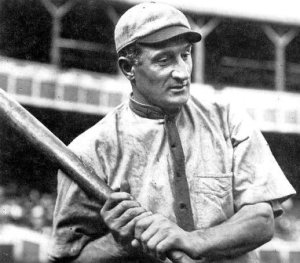
Honus Wagner

Honus Wagner

Jennings and Long were rated second and third,  “But, with the entire list  considered there is no question but that Wagner stands at the top.”

3B Jimmy Collins

Rice said:

“From the days of (Ned) Williamson(Jerry) Denny, and (Ezra) Sutton, over thirty years ago, great third basemen have only appeared at widely separated intervals.

“There have been fewer great third basemen in baseball than at any other position, for there have been periods when five or six years would pass without an undoubted star.”

The final decision came down to “John McGraw vs. Jimmy Collins.”  McGraw was “a great hitter, a fine bunter and a star base runner,” while “Collins was a marvel and a marvel over a long stretch…he was good enough to carve out a .330 or a .340 clip (and) when it came to infield play at third he certainly had no superior…So taking his combined fielding and batting ability against that of McGraw and Collins wins the place.  McGraw was a trifle his superior on the attack. But as a fielder there was no great comparison, Collins leading by a number of strides.”


OF Ty Cobb

“The supply here is overwhelming…Yet the remarkable part is that when we offered our selection to a jury of old players, managers and veteran scribes there was hardly a dissenting vote.”

[…]

“Number one answers itself.  A man who can lead the league nine years in succession at bat.

“A man who can lead his league at bat in ten out of eleven seasons.

“A man who can run up the record for base hits and runs scored in a year—also runs driven in.

“Well, the name Ty Cobb answers the rest of it.”

OF Tris Speaker

 “The man who gives Cobb the hardest battle is Tris Speaker.  Veteran observers like Clark Griffith all say that Speaker is the greatest defensive outfielder baseball has ever exploited…Speaker can cover more ground before a ball is pitched than any man.  And if he guesses incorrectly, which he seldom does, he can go a mile to retrieve his error in judgment…And to this impressive defensive strength must be added the fact he is a powerful hitter, not only a normal .350 man, but one who can tear the hide off the ball for extra bases.”
Tris Speaker "hardest hit"

Tris Speaker 

OF “Wee Willie” Keeler

Mike Kelly and Joe KelleyJimmy Sheckard and Fred Clarke—the slugging (Ed) Delehanty—the rare Bill LangeBilly Hamilton.

“The remaining list is a great one, but how can Wee Willie Keeler be put aside?

“Ask Joe Kelley, or John McGraw, or others who played with Keeler and who remember his work.

“Keeler was one of the most scientific batsmen that ever chopped a timely single over third or first…And Keeler was also a great defensive outfielder, a fine ground coverer—a great thrower—a star in every department of play.

“Mike Kelly was a marvel, more of an all-around sensation, but those who watched the work of both figure Keeler on top.”

Rice said of the nine selections:

“The above is the verdict arrived at after discussions with managers, players and writers who have seen a big section of the long parade, and who are therefore able to compare the stars of today with the best men of forgotten years.

“Out of the thousands of fine players who have made up the roll call of the game since 1870 it would seem impossible to pick nine men and award them the olive wreath.  In several instances the margin among three or four is slight.

“But as far a s deductions, observations, records and opinions go, the cast named isn’t very far away from an all-time all-star round up, picked for ability, stamina, brains, aggressiveness and team value.

“If it doesn’t stick, just what name from above could you drop?”

Lost Advertisements–Lajoie for Nuxated Iron

7 Aug

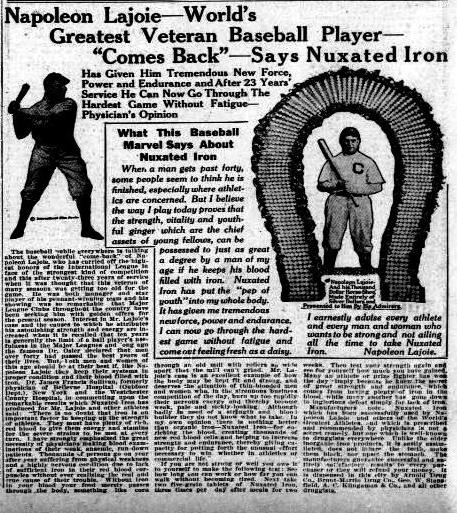
lajoienuxated


Not to be outdone by Ty Cobb, Harry Hooper and Joe Jackson who also endorsed the new “miracle drug” from DAE Health Laboratories in Detroit in 1916, Napoleon Lajoie took his turn in an advertisement for Nuxated Iron.

Napoleon Lajoie–World’s Greatest Veteran Baseball Player–‘Comes Back’ says Nuxated Iron Has Given him Tremendous New Force, Power and Endurance After 23 Years’ Service He Can Now Go Through The Hardest Game Without Fatigue–Physicians’s Opinion

Lajoie’s testimonial for the product said:

“When a man gets past forty, some people seem to think he is finished, especially where athletics are concerned.  But I believe the way I play today proves that the strength, vitality and youthful ginger which are the chief assets of young fellows, can be possessed to just as a great a degree by a man of my age if he keeps his body full of iron.  Nuxated Iron has put the ‘pep of youth’ into my whole body.”

Most doctors disagreed with Lajoie’s assessment.

The Journal of the American Medical Association took notice of the Nuxated Iron ad campaign and in October of 1916 had this to say about the “miracle drug:”

“Newspapers whose advertising ethics are still in the formative stage have, for some months past, been singing—at so much a song—the praised of “Nuxated Iron.”  The public has been that this nostrum is what makes Ty Cobb, “the greatest baseball batter of all time,” a “winner” and is what helped Jess Willard “to whip Frank Moran” besides being the “untold secret” of Willard’s “great triumph over Jack Johnson.”

All that DAE would say about the ingredients were:

“Formula—The valuable blood, nerve force and tissue building properties of this preparation are due to organic iron in the form of ferrum peptonate in combination with nux vomica (strychnine) phosphoglycerate and other valuable ingredients.

But alas, The AMA Journal was not impressed with the claims made by Nuxated Iron’s endorsements:

“The Journal felt that it owed it to the public to find out just how much iron and nux vomica there were in ‘Nuxated Iron.’  Packages of the nostrum…were subjected to analysis.”

What the analysis found was that the formula that made Ty Cobb a “winner,” offered no health benefits:

“There is only one-twenty-fifth of a grain of iron in each ‘Nuxated Iron’ tablet, while the amount of nux vomica…is practically negligible…In a dollar bottle of ‘Nuxated Iron’ the purchaser gets, according to our analysis, less than 2 ½ grams of iron; in 100 Blaud’s Pills, which can be purchased at any drug store for from 50 to 75 cents, there are 48 grains of iron.”

To sum up their analysis The Journal called the claims made by Nuxated Iron “the sheerest advertising buncombe.”

Cobb was said to have earned as much as $1000 for his endorsement, there is no record of what Lajoie was paid.

Nuxated Iron remained on the market until at least 1921; although by then they had sought a higher power to endorse the product.

Portions of this post appeared in one about the Cobb advertisement for Nuxated Iron, published February 15, 2013.


Griff’s Invention

5 Aug

Bob “Buster” Bescher arrived in Cincinnati a right-handed hitter.  In 1909, he led the National League with 54 stolen bases but hit just .240.

Bescher

Bescher

Bescher’s manager, Clark Griffith would compare him to Ty Cobb in an interview with Harry Salsinger of The Detroit News:

“If Bescher could hit he would probably set a pace for base-stealing that would never be equaled…Bescher gets away like Cobb, and his success lies mostly in getting away.  He is running in his first few steps.  He has a great pair of limbs and is in stride at the jump.  He is lightning fast.”

The Cincinnati Enquirer said:

“Bescher is a big, strong fellow, naturally left-handed, who was, unfortunately, coached to bat right-handed when he was a kid.”

Griffith set out to change that before the 1910 season.  In January, The Enquirer said:

“A device for batting practice was shipped to Bob Bescher at his home in London (Ohio) by Manager Griffith yesterday.  The arrangement was constructed according to Griff’s order, and it was designed to give Buster practice in batting left-handed before he goes South with the club six weeks or so hence.”

Clark Griffith

Clark Griffith

The paper described Griffith’s invention:

“The device consists of a ball of regulation size, but fitted with an extra cover, to which stout rubber cords are attached, one on each side.  One of the cords is to be fastened to the floor and the other to the ceiling, allowing the ball to swing loosely at about the height of the batter’s waist.  When the ball is struck with a bat, the flexible cord allows it to swing several yards and it returns with great force, coming back at about the speed of a pitched ball.  Then it is time for Buster to get busy with the club and soak it out again.”

A diagram of Griffith's invention.

A diagram of Griffith’s invention.

The Enquirer said Griffith hoped Bescher would add “30 or 40 points” to his average batting left-handed.

“He is the best base runner in the National League…Griff has sent him instructions to hit only left-handed with the new machine, and he hopes that Bob will be a regular Ty Cobb when he reports in March.”

Bescher batted almost exclusively left-handed during spring training in Hot Springs, Arkansas and became a switch-hitter that season, and seems to have benefitted from Griffith’s invention—but never became a “regular Ty Cobb.”

He improved his average to .250 in 1910 and again led the league with 70 stolen bases.  The next two seasons he hit .275 and a career-high .281, leading the league with 81 and 67 steals.

Bescher

Bescher

In 1913, Bescher slowed, hitting just .258 and stealing 38 bases.  He bounced from the New York Giants to the St. Louis Cardinals and Cleveland Indians over the next five seasons, never hitting better than .270 or stealing more than 39 bases.  He played minor league ball through the 1925 season.

“Three of the Greatest Pitchers the Game ever has Produced”

15 Jul

In 1915, Frank G. Menke, who wrote for the Heart Newspaper’s International News Service told readers:

“The color line drawn so tightly around major league baseball has barred from major league fields three of the greatest pitchers the game ever has produced.”

The three were John Donaldson, Frank Wickware, and Jose Mendez.

In May, Donaldson, who pitched for the All Nations, had thrown 30 consecutive no-hit innings against Kansas City based semi-pro clubs.

Sketchy contemporary accounts with some transposed numbers in newspaper articles seem to have led to confusion about Donaldson’s feat in later years: some sources claim the streak was over two games—a regulation contest and a 21-inning game , but it appears from the earliest reports in The Kansas City Times and The Indianapolis Freeman that he pitched a nine-inning and 12-inning no-hitter against the Schmelzers, a powerful semi-pro club sponsored by the Schmelzer Arms Sporting Goods Company in Kansas City and another no-hitter against a team called the KCK (Kansas City, Kansas) All-Stars.  (Later in the summer of 1915, Schmelzers became the sponsor of the All Nations after the club lost their original sponsor, Hopkins Brothers Sporting Goods).

John Donaldson

John Donaldson

Menke quoted New York Giants Manager John McGraw’s assessment of the All Nations’ star after having watched him pitch in Cuba:

“If Donaldson were a white man, or if the unwritten law of baseball didn’t bar Negroes from the major leagues, I would give $50,000 for him—and think I was getting a bargain.”

Menke said of Wickware of the Chicago American Giants:

“(He) is another Negro pitcher who would rank with the Walter Johnsons, Joe Woods and Grover Alexanders if he were a white man…Wickware has marvelous speed, a weird set of curves and wonderful control.  And he has a trick that has made him feared among batters.  He throws what seems like a ‘bean ball,’ but his control is so perfect that he never yet has hit a batter in the head.  But when the batters see the ball, propelled with mighty force, come for their heads, they jump away, and the ball, taking its proper and well-timed curve, arches over the plate for a strike.”

Frank Wickware

Frank Wickware

The final pitcher on Menke’s list was Mendez,  another member of the All Nations:

“He’s known as “The Black Matty” and his work has been almost as brilliant as that of “The Big Six” of the Giants.  Mendez is only of medium height (5′ 9”), but he has terrific power in his arm.

“The Cuban Negro has a canny brain and he always has used it.  He has mixed his fastball with his slow one, has an assortment of beautiful curves and perfect control…Like Mathewson, he never pitches air-tight ball unless he has to.  He conserves his strength.  But when he needs to pitch hitless ball he does it.  When he needs to strike out a man he usually succeeds.”

Jose Mendez

Jose Mendez

Incredibly, a story about three pitchers who deserved notice by the major leagues written by an influential white sportswriter received barely a notice in the black press.

The Indianapolis Freeman ran the story with no further comment, and no mention of who wrote the original story, simply attributing it to The Indiana Daily Times which had run Menke’s piece.

The Chicago Defender and The Pittsburgh Courier ignored the story entirely.  The New York Age didn’t mention Menke’s story, but the same week did make a pitch for black players—not with the positive portrayal of three great pitchers as Menke had done, but by highlighting the bad behavior of some major leaguers.

Lester Aglar Walton, who wrote about baseball and theater for The Age and later became the United States Ambassador to Liberia, said:

“(I)f baseball magnates are not color prejudiced can it be that they have misgivings as to how Negro players would conduct themselves on and off the field if permitted to play in the big leagues?  However, if this is their chief cause of concern and the stumbling block in the way of crack Negro players, big league managers should be reminded of the Ty Cobbs, Larry McLeans and others who have distinguished themselves by acts of ruffianism on and off the diamond.”

Lester Aglar Watson

Lester Aglar Watson

Walton related the story of McLean’s recent fight with Giants Manager John McGraw and coach “Sinister” Dick Kinsella in the Buckingham Hotel in St. Louis.

“(H)ad McLean been a colored player the incident in St. Louis would have brought about the disbarment of all Negroes from hotels in St. Louis—had a policy of accommodating Negroes existed.”

Larry McLean

Larry McLean

Walton also noted that when white teams met black teams on the field after the regular season, “The mixing of the races does not provoke racial conflicts and the best of feelings exist” among the players.

Then, he asked the men who owned major league clubs:

“The question is therefore put up to big league magnates that if the Indian with his dark skin and the Cuban are permitted to play in the big leagues, and if there is not the least possibility of the record for ruffianism established by the Ty Cobbs and Larry McLeans being eclipsed, why not give the Negro player a chance?”

As would be the case for three more decades, there was no reply.

Lost Advertisements–Bull Durham’s Fan for a Fan

29 May

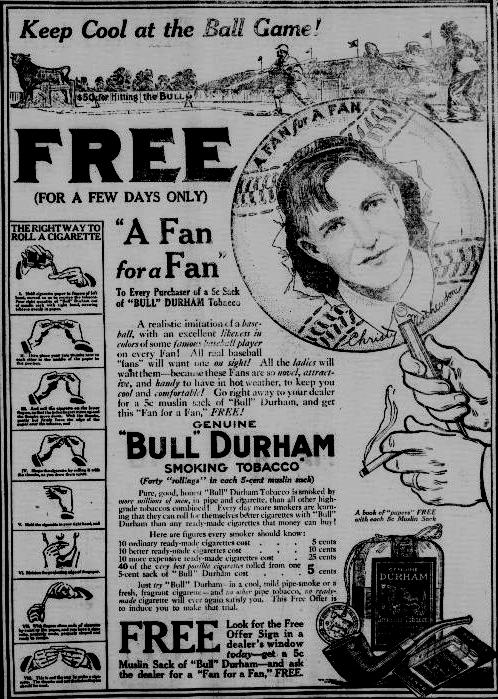
1913fan

A 1913 advertisement for the “A Fan for A Fan” offer from Bull Durham Tobacco:

Keep Cool at the Ballgame

 Free (for a few days only)

A Fan for a Fan

 To Every Purchaser of a 5 cent sack of “Bull” Durham Tobacco

A realistic imitation of a baseball, with an excellent likeness in colors of some famous baseball player in every fan!  All real baseball “fans” will want this on site!  All the ladies will want them–because these fans are so novel, attractive, and handy to have in hot weather to keep you cool and comfortable!  Go right away to your dealer for a 5 cent muslin sack of “Bull” Durham, and get this “Fam for a Fan,” Free!

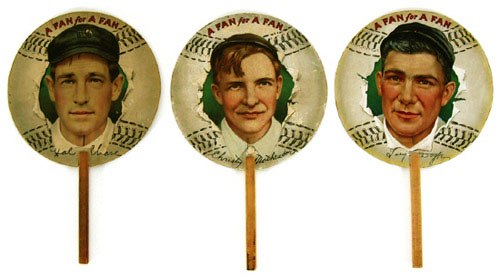
In addition to the Christy Mathewson fan featured in the ad,  Ty Cobb, Hal Chase, Frank Baker, and Larry Doyle were also available; the fans themselves included a facsimile signature of the player and no mention of Bull Durham.  Apparently they are rare enough that auctions date them only to “Circa 1910,” and make no mention of them being distributed by the tobacco company.

fan

Chase, Mathewson and Doyle fans from a 2005 auction; the three sold for $3,480.


The Definitive Cobb Biography

11 May

Myths.  Baseball books are full of them.

Perhaps the most enduring myths are about Ty Cobb.  A prototype of a villain in spikes from central casting:  Dirty player– check, virulent racist—check, miserly and bitter in old age—check.

That is the Ty Cobb cemented into our consciousness.

So much so in fact, it is difficult to find a discussion on the internet regarding the merits of Pete Rose’s case for the Hall of Fame without a member of the pro-Rose faction, at some point, making the “Yeah, but Ty Cobb did (fill in the blank)” argument.

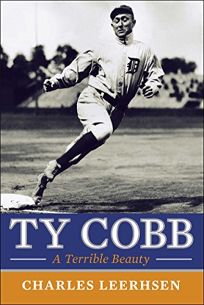
Or, as Charles Leerhsen puts it, in “Ty Cobb: A Terrible Beauty” (which will be released tomorrow), “This Cobb was someone (fans) could shake their heads at, denounce, and feel superior to.”

cobb


The clues were there that Cobb might just be more than the sum of the single-dimensional parts previous biographies claimed to reveal.

Not long ago, I wrote about Cobb’s embrace of fellow Royston, Georgia native, and former Negro League player and newspaperman Fred Downer at Wrigley Field in 1953—the same day Cobb spoke glowingly to reporters about Dodgers’ catcher Roy Campanella.

No less an authority than Wendell Smith—the legendary reporter from The Pittsburgh Courier who by then had joined The Chicago Herald-American as the first black sportswriter at a white-owned paper—said after that day at Wrigley that reports of Cobb’s racism were always “merely a matter of hearsay,” and “He gives no indication today of intolerance.”

Yet, the hearsay has always outpaced the reality; until now.

Through exhaustive research and a compelling narrative, Leerhsen demonstrates that the one-dimensional Cobb of lore is, at best, a caricature.   The stories that have been told and retold for years about racially motivated physical attacks were poorly sourced and greatly exaggerated.  Statements like the one about Campanella and several that Leerhsen has compiled were ignored.

The author even manages to add context to the often told stories of the death of Cobb’s father and Cobb’s relationship with mascot Ulysses Harrison (bonus points here because unlike many of the versions of this story elsewhere he gets Harrison’s name correct).

Leehrsen’s three-dimensional Cobb is more interesting than the one presented previously.  This Cobb was quick to anger, perhaps overly sensitive, certainly no less flawed than many of his contemporaries, but more complex, more introspective and much more difficult to shake our heads at.

An excellent read, well worth your time.

Fred Downer

30 Mar

In August of 1953, “Jet Magazine” said people were talking about:

 “That affectionate hug baseball immortal Ty Cobb gave Chicago news dealer Fred Downer.”

By then, Frederick Douglas Downer was largely forgotten.

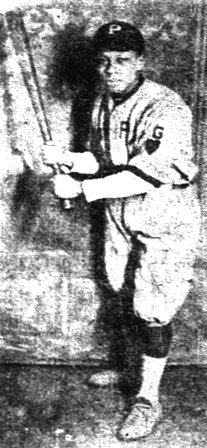
Before playing as a professional, he was, according to The Pittsburgh Courier, the “star” of the Morehouse College baseball team in Atlanta.

Fred Downer

Fred Downer

His first professional experience was with the Atlanta Cubs in 1919—the team was colloquially called the Atlanta Black Crackers for years, and newspapers referred to them by both names until 1922 when the “Cubs” name was permanently dropped.  Years later, Downer told The Chicago Defender he also played with the Knoxville Giants during this period.

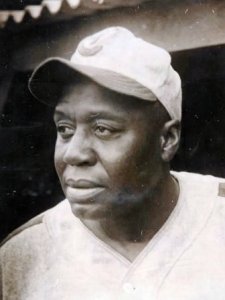
In 1921, Downer and Gerard Williams, his teammate at Morehouse and with the Atlanta Cubs, went north to join the Pittsburgh Keystones.   Downer is listed by several sources as the club’s manager, but in the 1970s he told The Defender said he “played under the management of (William) Dizzy Dismukes.”  Dismukes was also the Keystones’ manager the following year when the team entered the Negro National League.

Downer appears to have played independent and semi-pro ball during 1922.

While not listed on any extant rosters, Downer spent some time with the Cleveland Tate Stars in 1923—in an interview given in 1972 Elander “Vic” Harris, who debuted with the Tate Stars as an 18-year-old that season, said Downer, who he had gotten to know in Pittsburgh was with the club. Harris told The Van Nuys (CA) News he tried out as a first baseman but was installed in the outfield, leading to Downer being let go.

Downer returned to Pittsburgh and assumed management of the Keystones in 1924. After a single season in the Negro National League, the Keystones had dropped out, and the team continued operations as a semi-pro club.

Downer, and another Georgian who also played with the 1923 Cleveland Tate Stars, Mathis Williams, managed and played for the semi-pro version in 1924 and ’25.  The Keystones barely treaded water financially.

Mathis Williams

Mathis Williams

In June of 1925 The Pittsburgh Courier said:

“Of the colored clubs in action, none but the Homestead Grays are making any money…Fred Downer and his Pittsburgh Keystones are practically a thing of the past.”

Within a month the team disbanded and Downer was through as a player.

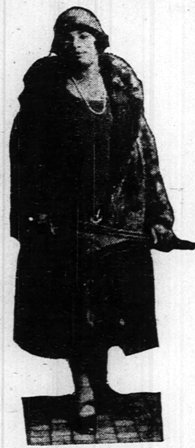
The following year, he and his wife Marian Foster Downer, a reporter for The Pittsburgh Courier—and later The Chicago Defender— relocated to Chicago.  She continued to write for The Courier’s society page while Fred began covering baseball and boxing for the paper and acted as The Courier’s Midwest circulation manager.

In addition to covering most major Midwest-based events–including the annual Negro League East-West All-Star Game and several championship fights—Downer started the Atlas News and Photo Service which distributed content to Black newspapers.


Marian Foster Downer also wrote about sports for The Defender.  Her article on the 1935 East-West All-Star Game—won by the West 11-8 on George “Mule” Suttles’ three-run home run after Webster McDonald walked Josh Gibson to face him—was headlined:

Mule Suttles

Mule Suttles

Our Girl Scribe Sees Mule’s Hit

Marian Foster Downer--The Defender's "Girl Scribe"

Marian Foster Downer–The Defender’s “Girl Scribe”

In 1945, Fred Downer proposed a new path for Negro League baseball, writing in a Chicago-based magazine called “New Vistas:”

“If the white majors won’t hire good colored players, then the Negroes should build their own parks and hire the best players regardless of race.  This will build up competition, and competition will break down many barriers.”

Downer was covering the World Series at Wrigley Field in 1932 and was on-hand for Babe Ruth’s “called shot.”  The Courier’s Sports Editor Wendell Smith said Downer was “One of Babe’s most staunch and loyal supporters,” and was determined to find the ball.

 “His decision to find the ball Ruth hit resulted in a search that has been a detailed and intensive as any by a ‘G-man.’  Fred scoured every baseball haunt in the Chicago area.”

According to Smith, Downer expanded his search throughout the Midwest, with no luck.

Downer later told The Chicago Defender he found the ball and bought it from a former Chicagoan who had moved to Michigan.  He called the ball “one of his prized possessions.”

The actual provenance of the ball and its current whereabouts are unknown.

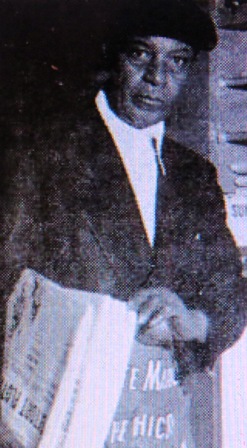
Twenty-one years after he witnessed Ruth’s “called shot,” Downer—by then he had left  The Courier and owned three newsstands on Chicago’s South Side– was again at Wrigley Field where he had an encounter that raised questions in the Black press about a long-held opinion of another baseball legend.

Ty Cobb stopped in Chicago on his way back to his California home from Cooperstown, to attend a game between the Cubs and the Brooklyn Dodgers.

Downer was born in Cobb’s hometown of Royston, Georgia in 1896.  The Defender said of the relationship between the two:

“(Downer) got his start in baseball chasing fly balls for Ty Cobb as a kid.”

The California Eagle said:

“Downer was raised around the Cobb’s household in Royston, Georgia.”

Wendell Smith, then with The Chicago Herald-American, said of Cobb’s day at Wrigley:

“(T)here were two things said about (Cobb) that were, apparently, the gospel truth:

  • He could hit any living pitcher.

  • He would hit any living Negro.”

Smith said the second “truth” was “merely a matter of hearsay.”

And, he said:

“(H)e gives no indication today of intolerance.”

In addition to his embrace of Downer, Cobb was asked which players on the field most impressed him:

“’Why that catcher there, he said, pointing to Roy Campanella.  ‘He’s the best ball player I’ve seen in many a year…That fella’s a great catcher,’ he volunteered.  ‘The very best in the game.  He reminds me a little of Roger Bresnahan.  If he can stick around for five or six more years they’ll have to put him alongside the game’s all-time catchers.’”

Downer continued to operate his newsstands well into his 70s.  At the corner of 53rd Street and Lake Park Avenue, The Defender said, he would:

“(S)ell morning newspapers (and) answer hundreds of questions pertaining to his long career.”

Fred Downer

Fred Downer

Frederick Douglas Downer died in Chicago on March 10, 1986.