Tag Archives: Walter Johnson

“Pulling a Lave Cross,” Eddie Collins on the Life of a Ballplayer

24 Feb

In 1914, Eddie Collins contributed an article about the life of a major leaguer in The National Sunday Magazine, a syndicated insert that appeared in several papers across the country.
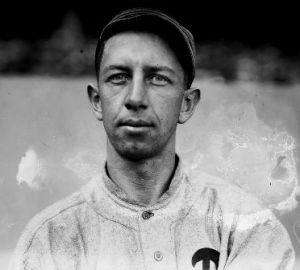
Eddie Collins

Eddie Collins

He described the beginning of his first road trip in the big leagues:

“It happened two days after I had joined the Philadelphia Athletics.  As ‘Mr. Sullivan,’ (Collins initially played under the name Edward T. Sullivan), still being an undergraduate at Columbia, I had watched two games from the grandstand at Shibe Park.

“The series over, Manager (Connie) Mack told me to report at the railroad station in time to catch a train that was leaving at six o’clock.  The Athletics were to make a quick September (1906) swing around the circuit.”

Collins said he was “about the first one at the depot,” and “eager as a boy” to begin his big league career.

Once on the train, he described the reaction of the players the first time the porter announced that dinner would be served:

“What transpired, immediately, might have led one to believe that the porter had insulted nearly everyone in the car.  There was a stampede.  Every one of the Athletics was up and rushing down the aisle, throwing aside magazines and newspapers, tumbling and pitching toward the door. The porter was knocked over and it is no exaggeration to state that one of our players—a very fleshy outfielder with elephantine tread (Topsy Hartsel)—walked over him in his haste.

“’What’s the matter with those fellows?’ I asked a veteran who had not joined the stampede.

“In justice to him, be it explained that he had a sprained ankle and couldn’t run.

“’They’re pulling a Lave Cross,’ he threw over his shoulder, as he hobbled after the others as fast as his lame ankle would permit.

“I came to know what ‘Pulling a Lave Cross’ meant.”

Lave Cross
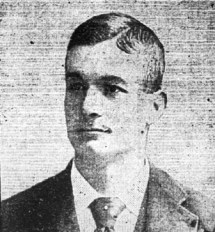
Lave Cross

Collins explained the term, which referenced the former Athletics player:

“He was in the big leagues for years and during that period, he was never beaten into a dining car or eating room of any sort.  He always caught the first cab out of the station; he always was the first to plunge into the sleeper and select the best berth.  He never ran second where personal comforts or tastes were at stake.  During all his years, and the competition is keen, he was supreme.”

Collins said while Cross’ behavior might have been extreme, “haste” was “a habit inbred in all successful” ballplayers:

“I have noticed that after the game we all dress like firemen getting three alarms, race back the hotel, race into the dining room, race through our meal.  Then we saunter out into the lobby and kill two or three hours trying to see which foot we can stand on longer.  At first I marveled at this, then I found myself racing along with the rest of them.”

Calling himself, and his colleagues “rather peculiar individual(s)” Collins said of ballplayers:

“On the field, all his energies and thoughts are concentrated on one idea—the winning of the game.  His day’s work done, however, he throws that all off.  His first desire is to avoid the crowds and excitement.  Then he persistently refuses to talk baseball.  If you want to make yourself unpopular with big league ballplayers, drop into their hotel some night and try to talk baseball to them. “

Collins next provided readers with “some idea of ballplayers out of spangles,” to bring them into “closer touch.”

Honus Wagner, he said, was not a fan of fans:

“Down in Carnegie (PA) there are about twenty unfortunates…who are taken care of solely through Wagner’s generosity.  He has a heart as big as his clumsy looking body, but he hates the baseball ‘bug.’  Frequently wealthy fans have called at Wagner’s hotel on the road and tried to engage him in conversation.  Generally he will excuse himself and going over to the elevator boy will sit and chat with him for an hour at a time.  Wagner’s worst enemy will not tell you he is conceited, but he hates the fans prying into his affairs.”

Honus Wagner
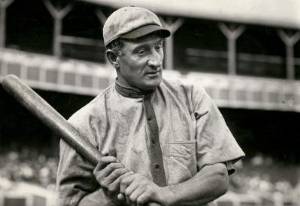
Honus Wagner

Connie Mack, he said, “is the same kind of man” as Wagner:

“Connie is forever handing out touches to old time players.  He is always thinking of anybody connected with baseball from the bat boys up. I know he insisted out little hunchback mascot (Louis Van Zelst) getting a share of the World Series’ money—not that any players objected—but it was Connie’s thought first.

“’Little Van comes in on this,’ he said.”

Louis Van Zelst
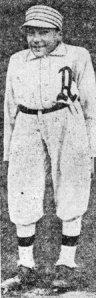
Louis Van Zelst


Collins also talked about how his teammates occupied themselves on the road:

“You will never find Chief Bender, our Indian pitcher, hanging around the hotel.  Too many original fans are apt to salute him with a war-whoop.  Besides, he is golf mad and when not on the diamond, he is to be found on the links… (Carroll “Boardwalk”) Brown, the young pitcher who did so well for us last year, is a billiard expert… (Stuffy) McInnis and (Eddie) Murphy are the ‘movie fiends’ of our club and are the only ones (Collins said many players were scared to go to the movies because they thought it would damage their eyes).  They can call the name of every star as soon as they see the face on the screen. Jack Barry, our shortstop, is inordinately fond of Hebrew literature and Biblical history.  This, although he, as well as his name, is Irish.”

Collins also shared his manager’s rules for the Athletics when the team was traveling:

 “It is one of Mack’s rules that we are only allowed to play cards on the trains…Connie is against card playing, which only leads to-night after night sessions, ill feelings and finally, disruption. I could tell you of at least one American League team that was broken by card games…Everybody has to be in bed by half past eleven and report in Mack’s room at half past ten in the morning.  For an hour Mack talks baseball, planning our campaign for the day.”

After Mack’s meeting, it was time to eat, and Collins shared his insights on ballplayers and food:

He said a “young pitcher on our club” should be a star, but “he has a weakness for roast beef,” and “persists in stuffing himself at noon time.”  He didn’t name the pitcher.

 “Walter Johnson, the greatest pitcher in baseball, also has a noonday weakness.  It is ice cream, but he seems to thrive on it.  Jack Barry feels off-color if he does not get his slice of pie…On the day he is going to pitch, Eddie Plank, our veteran left-hander, always eats tomato soup.  He thinks he would lose if he did not observe this ritual.”

Collins concluded:

“There is great temptation for the young minor league player, being put up at first class hotels…to eat his head off.  I honestly believe that more good youngsters have been ruined for big league work simply from overeating than any other extraneous cause.”

Other than their general disdain for ‘bugs,’ Collins said, in the end, players of the current era were unrecognizable from their counterparts of a generation earlier:

“Ballplayers today are scrupulously careful never to offend anyone in any way.  Especially do they take pride in being Chesterfields when women are around.”
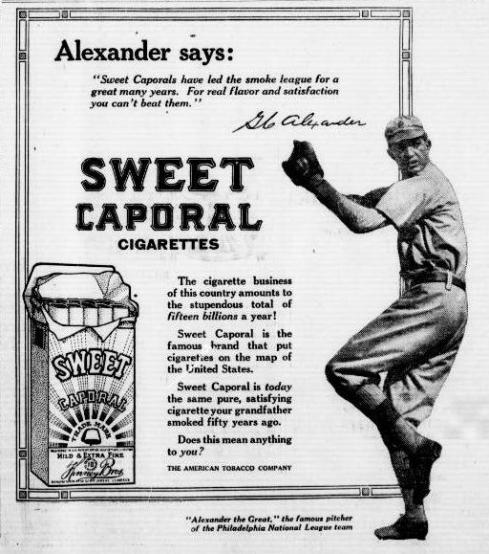
Lost Advertisements–Grover Cleveland Alexander, Sweet Caporal

19 Feb

alexandercaporal

A Sweet Caporal advertisement featuring Grover Cleveland Alexander:

  “Sweet Caporals have led the smoke league for a great many years.  For real flavor and satisfaction you can’t beat them.”

Shortly before the 1915 season, Damon Runyon, writing in The New York American compared Alexander and Walter Johnson:

Damon Runyon

Damon Runyon

“Whenever we see Grover Cleveland Alexander pitching at top form, we conclude that he is the greatest right-handed pitcher in the land, and we cling to that conclusion until Walter Perry Johnson comes along with a line of his best pelting.  Then we decide that Walter is the greatest, and we hold that decision to the day that ‘Alex’ reappears.

“In short, our mind–probably none to stable at best–does a heap of vacillating between these Western wonders, and we are certain of only just one thing with respect to their ability–which is that it’s either Grover or Walter who is the greatest righthander…You may think that (Christy) Mathewson, or (Dick) Rudolph, or Bill James or Willie (Bill) Doak is greatest, and we have no doubt that you can produce just as many arguments in support of your belief…but it is our opinion that Johnson and Alexander today stand head and shoulders above all the rest.”

Runyon said that neither, however, were better than Mathewson when Matty was at his best:

“They are both great pitchers, but there have probably been many just as great–and there has been only one Mathewson.”

Runyon also claimed that players who faced both Alexander and Johnson agreed that one was the better pitcher:

“Ball players who have hit against both men–or rather who haven’t hit against them, for there is never much hitting against Walter or Grover–say that the Nebraskan is the better of the two.  They say he has as much ‘stuff’and knows how to use it better than Johnson.”

Morris' ride, Walter Johnson

Walter Johnson

Most important to Runyon, he said, was that he preferred watching Alexander pitch:

“As a matter of personal choice, however, we would rather watch Alexander work than Johnson:  To us, it seems that he has more natural grace in the box…than the big Washington propeller.  There are mighty few pitchers who come under the head of things of beauty when they are working, but ‘Alex’ is one of them.”

As for a forecast for the coming season, Runyon said:

“Some fans are dreaming this year of seeing Alexander and Johnson as opponents in the first game of the 1915 world’s series, but they are mostly Philadelphia and Washington fans who are having those dreams, and we doubt if the dreams will come true.”

Both pitchers were dominant that season.

Johnson was 27-13 with a 1.55 ERA for a team, true to Runyon’s prediction, could only dream of a pennant–finishing fourth.

Alexander, however, was 31-10 with 1.22 ERA and did pitch the first game of the World Series for the pennant-winning Philadelphia Phillies–he won the opener 3 to 1, beating Ernie Shore and the  Red Sox, but Boston came back and won four straight, including Dutch Leonard‘s 2 to 1 victory over Alexander in Game 3.

Lost Advertisements–Walter Johnson Car Ads

9 Nov

johnsoncolecar

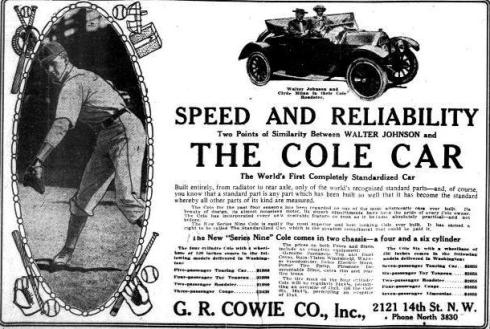
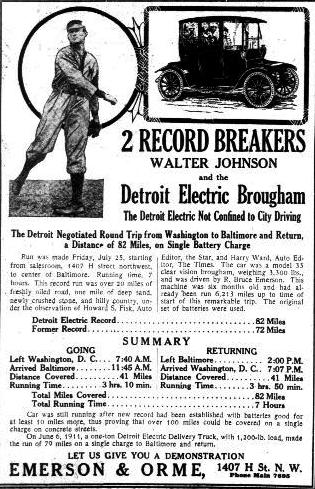
Two 1913 advertisements for automobiles featuring Walter Johnson.

Above, an ad for a Washington D.C. Cole dealership–the picture at the top is of Johnson and outfielder Clyde Milan “In their Cole Roadster”:

Speed and Reliability

Two points of similarity between Walter Johnson and 

The Cole Car

The world’s first completely standardized car

The second ad, below, is for the local Detroit Electric dealership:

2 Record Breakers

Walter Johnson 

and the

Detroit Electric Brougham

johnsondetroitelectric

Johnson remained on the mound longer than Cole stayed in business; the car maker closed in 1925.  Detroit Electric continued building cars until 1939 and the company was revived in 2008.

Lost Advertisements–“Fireball” Johnson

30 Oct

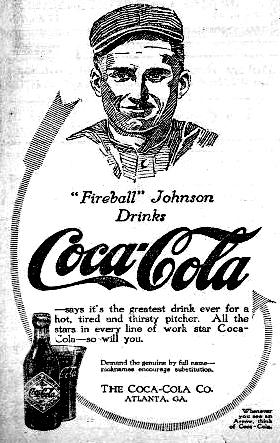
walterjonsoncoke1915

“‘Fireball’  Johnson Drinks Coca-Cola–Says it’s the greatest drink ever for a hot, tired, and thirsty pitcher. All the stars in every  line of work star Coca-Cola–so will you.”

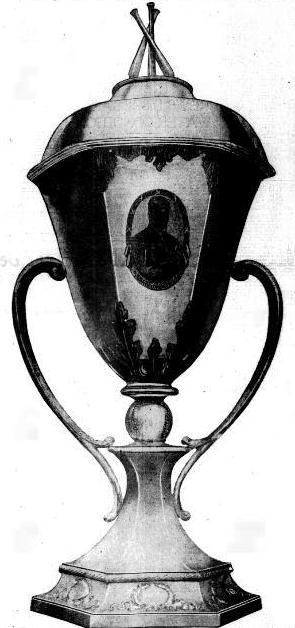
In 1913, The Washington Times presented Walter Johnson with a cup honoring him as “Greatest Pitcher in the World,” and published a special section including quotes from his contemporaries:

Cup presented to Johnson by The Washington Times

Cup presented to Johnson by The Washington Times

Napoleon Lajoie:

“I like to bat against Johnson.  There’s some satisfaction hitting against a hurler of such pronounced class.  When I make a hit off Johnson I know it’s well-earned, and the sound of a good, solid swat made off one of Walter’s curves is the most welcome music I hear during the season.”

George Stovall:

“I consider Walter Johnson the greatest pitcher in the game today and one of the finest fellows on and off the ball field.”

Nixey Callahan:

“You may say anything good for me regarding Walter Johnson that you care to. I consider him one of the greatest pitchers that the game has ever known and an ornament to the profession in every way.”

Russ Ford:

“He is the King Pin of them all, and yet remains just the same quiet, good fellow who broke in six years ago.”

Joe Birmingham

“May your curve always break and your speed never diminish.”

Things I Learned on the Way to Looking Up Other Things #16

21 Oct

Pirates Slump, 1921

The first place Pittsburgh Pirates were preparing for a doubleheader with the New York Giants on August 24, 1921, when the team took time out to pose for a photo.  The Pittsburgh Leader said:

“Someone happened to mention, as the photographer moved away, that for a whole team to watch the little birdie at once was a jinx.”

The team promptly went out and dropped the doubleheader, then lost three more to the Giants.  The paper said of the five straight losses:

“It doesn’t prove the jinx exists.  But it does prove that to imbue a man or a team of men, with the idea that they can’t win a ballgame generally means that they won’t win.  For their pep and enthusiasm has been stolen.”

The Pirates finished second, four games behind the Giants.

Anson’s All-Time Team, 1918

While visiting St. Paul, Minnesota in the summer of 1918, Cap Anson was asked by a reporter for The Associated Press to name his all-time all-star team.  The reporter said the team was most “notable for including in its makeup not one” current player:

"Cap" Anson

                        “Cap” Anson

“According to Captain Anson, at  least four outfielders of old times are better than (Ty) Cobb or (Tris) Speaker and (John) Clarkson, (Amos) Rusie, and (Jim) McCormick, he thinks were better pitchers than (Grover Cleveland)  Alexander  or (Walter) Johnson.  His line-up would be:

Catchers—William “Buck” Ewing and Mike “King” Kelly

Pitchers—Amos Rusie, John Clarkson, and Jim McCormick

First Base—Captain Anson, himself

Second Base—Fred Pfeffer

Third Base—Ned Williamson

Shortstop—Ross Barnes

Outfielders—Bill Lange, George Gore, Jimmy Ryan and Hugh Duffy

Cy Young’s Five Rules, 1907

Forty-year-old Cy Young won 21 games for the Boston Americans in 1907 and his longevity became a popular topic of newspaper copy until he pitched his final major league game four years later.

Cy Young

                                             Cy Young

During that 1907 season he gave a reporter for The Boston Post his advice for young players:

“(T)o the young player who seeks his advice about getting in condition and being able to stay in the game as long as the veteran himself, Cy lays down a few simple rules, which are as follows:

  1.  Live a temperate life
  2. Don’t abuse yourself if you want to attain success
  3. Don’t try to bait the umpires; abusing the arbitrators does a player no good and harms him in the eyes of the umpires, players and public in general
  4. Play the game for all you are worth at all times
  5. Render faithful service to your employers

Regarding his “rule” about umpires, Young said:

“What’s the use in kicking?  The umpire won’t change his decision, and kicking will give him another chance to get back at you for your silly abuse.”

“Here was the King of all the Tramps I’d ever seen”

7 Oct

In 1947, Grantland Rice of The New York Herald-Tribune told a story about how he came to know one of the most colorful pitchers of the first decade of the 20th Century:

“Baseball, above all other games, has known more than its share in the way of masterpieces of eccentricity.  Many of these I happen to know.”

Grantland Rice

Grantland Rice

Rice went on to list some of his favorites—Rube Waddell, Crazy Schmit, Dizzy Dean—“Also, Flint Rhem, Babe Herman, Bobo Newsom, Germany Schaefer, Shoeless Joe Jackson, Arlie Latham—nits, wits, and half-wits—but all great ballplayers.”  But, said Rice, “one of the leaders in this colorful field” had been all but forgotten:

“His name was (Arthur) Bugs Raymond, the pitcher John McGraw always insisted had the finest pitching motion he ever saw, including Walter Johnson.”

[…]

“I remember Bugs because I happened to have a small part in his pitching career.  I was working in Atlanta (for The Journal) when I happened to read a story that came out of Shreveport (Louisiana), about a young pitcher named Raymond who had made and won the following bet:

“That he could eat a whole turkey, drink two bottles of scotch—and win a doubleheader.  He did it.  I didn’t believe it at the time, but I believed it later.  I recommended to either (Atlanta Crackers owner) Abner Powell or (manager) Billy Smith (44 years is a long time) that Raymond looked like a good buy.  Good copy is always scarce.  Raymond sounded like good copy.”

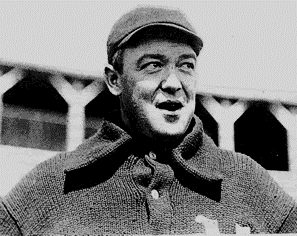
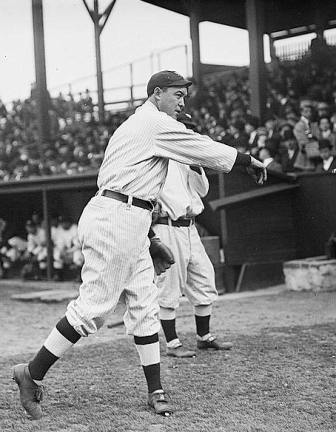
Bugs Raymond

Bugs Raymond

Rice’s story about the bet is likely apocryphal, there is no mention of it in contemporary newspapers in Shreveport, or in Jackson, Mississippi where Raymond played in the Cotton States League before coming to Atlanta–he also names the wrong manager–Smith came to Atlanta the following season.  While Raymond probably didn’t make the bet Rice claimed, he did, on at least one occasion win both ends of a doubleheader, and he was wildly popular in Mississippi.  After he was sold to Atlanta in July of 1905, The Jackson News said:

“The regret over Raymond’s departure was not one-sided.  The big fellow was all broken up over the transaction.”

The paper said that although Raymond would make $200 a month in Atlanta and have a chance to return to the major leagues, leaving Jackson was difficult for him:

“During his engagement with the Jackson team he has made a host of friends and was undoubtedly the most popular player who ever donned a home uniform.  The plain fact is Raymond almost owned the town.  Nothing was too good for him and he always made a hatful of money on the big games, a shower of silver and greenbacks being the inevitable result of a victory in a doubleheader.”

Rice’s story about Raymond also took another real event and embellished it–either by design or through the fog of forty years.

After finishing the 1905 season with a 10-6 record for the Crackers, Raymond was picked by new Manager Billy Smith to start for Atlanta in an exhibition against the Boston Americans on March 26, 1906.

In Rice’s colorful version, he gave the incorrect date for the exhibition and wrongly claimed that he met Raymond face-to-face for the first time on the morning of the game:

“By some odd chance, before starting a mile-and-a-half walk to the ballpark, I happened to be taking a drink at some wayside bar in preparation for the trip.  A heavy hand fell on my shoulder and, as I looked around, there was an unkempt-looking fellow, around 200 pounds who wore no necktie and hadn’t shaved in at least two days.  Here was the king of all the tramps I’d ever seen.

“’How about buying me a drink, fellow?’ was his opening remark.  I bought him a drink.  Then I had to buy him another drink.

“’How do we get out to this ballpark?’ he asked.

“’We walk,’ I said, ‘if you are going with me.’ Then a sudden morbid thought hit me.  ‘Isn’t your name Raymond?’ I asked.

“’Yes,” he said ‘Bugs Raymond.’

“I figured then what my recommendation to the Atlanta team was worth.  Something less than two cents.

“’Do you happen to know,’ I suggested, ‘that you are pitching today against the Boston Americans?’

“’I never heard of ‘em,’ Bugs said.  ‘Where’s Boston?’

“On the walk to the ballpark that afternoon Bugs spent most of the trek throwing rocks at pigeons, telegraph poles and any target in sight.  People I had known in Atlanta gave me an odd look after taking a brief glance at my unshaven, rough and rowdy looking companion.”

Once at the ballpark, Rice said:

“Raymond started the game by insulting Jimmy Collins…and every star of the Boston team.  He would walk from the pitcher’s box up towards the plate and let them know, in forcible and smoking language, what he thought they were.”

In Rice’s version, the cocky, seemingly drunk Raymond shuts Boston out 3-0 on three hits.  He got those details wrong as well, and Raymond’s performance was just as incredible without the embellishments.

Bugs Raymond

Bugs Raymond

The Atlanta Constitution said on the day after the game:

“No better than bush leaguers looked the Boston Americans…yesterday afternoon at Piedmont Park, when ‘Bugs’ Raymond came near to scoring a no-hit game against the bean-eating crew, who escaped a shut-out through two errors made by (Morris “Mike”) Jacobs in the eighth inning.

“Score—Atlanta 4, Boston 2.

“’Bugs’ was there with the goods.  Boston hitter after hitter stepped up to the plate, pounded the pan, looked fierce for awhile, and then went the easy out route.

“’Bugs’ was in his glory.  It was in the eighth inning before a single hit or run was scored off his delivery

Both Boston hits were ground balls Atlanta shortstop Frank “Whitey” Morse beaten out by  Collins and Myron ”Moose” Grimshaw:

“As inning after inning went by, the Boston sporting writers along with the team began to think of the possibility of defeat, and, about the seventh inning, when it looked strangely like a shutout game, they pulled out their books of excuses and began to look for the proper one to use in Tuesday morning’s newspapers.

“The one finally agreed upon at a conference of all four writers read like this:

“’The eyes of the Boston players were dimmed by the flying moisture from the spit-ball delivery of one ‘Bugs’ Raymond, who let himself out at full steam, while our pitchers were waiting for the opening of the coming season.  It does a major league club good to be beaten every now and then, anyway.”

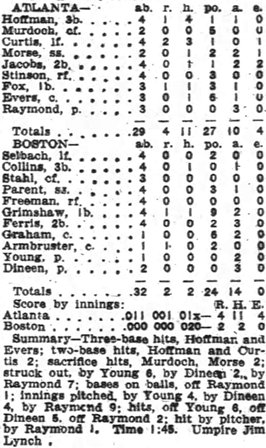
The Box Score

                 The Box Score

Given Raymond’s alcoholism, there might be some truth Rice’s embellishments although there is no evidence for most of his version.

The performance against Boston was quickly forgotten as Raymond just as quickly wore out his welcome with Manager Billy Smith.  On May 6 he was suspended indefinitely because, as The Constitution put it “(Raymond) looks with delight in wine when it is red.”  On May 31, Atlanta sold Raymond to the Savannah Indians in the South Atlantic leagues. An 18-8 mark there, followed by a 35-11 season with the Charleston Sea Gulls in the same league in 1907, earned Raymond his return to the big leagues with the St. Louis Cardinals.

By 1912, the pitcher, about whom Rice claimed John McGraw said “Even half sober Raymond would have been one of the greatest,” was dead.

“He was the Greatest Receiving Catcher”

23 Sep

Freeman Ossee “Schreck” Schrecongost’s was most famous for being Rube Waddell’s catcher with the Philadelphia Athletics.

Ossee Schrecongost

                Ossee Schrecongost

Years later, Connie Mack told Harry Grayson of the Newspaper Enterprise Association that Schrecongost was “the fizz powder in the pinwheel that was Waddell.”  He also told the reporter that Waddell’s catcher “was the wilder of the two in many respects.”

Schrecongost lived at least as hard as Waddell and caused his manager as many headaches, but more than 30 years after his final game, Mack said he did “more with gloved hand than any other catcher who has come along.”

Allan Gould, the long-time sports editor for The Associated Press said of the catcher:

“Schreck had the eccentric habit of doing as much of his backstopping as possible with his gloved hand only. This worried Mack, who considered it careless workmanship until Schreck convinced his manager he could do a better job one-handed than with two.”

His teammates felt the same.

Three years after Schrecongost’s final major league game, Harry Davis told Gordon Mackay of The Philadelphia Times:

Walter Johnson is some grand pitcher with a barrel of speed.  But I’ll tell you one old boy who would sit on a chair and catch the big fellow.  That’s old Schreck.  He’d catch Walter with that big glove on his fin, and then after he had eaten up the old smoke to the limit he’d yell to the big chap to put something on the ball.

“I’ve seen Rube Waddell cross Ossee six or seven times, and Schreck wouldn’t pay the least bit of attention to it.  Suddenly Schreck would go out to the box and tell the Rube with a bunch of billingsgate trimmings that would make your hair curl that he stop crossing him.

Rube Waddell

                                 Rube Waddell

“There never was a backstop like old Ossee.  He could catch all the speed merchants in our league with one hand, and then only use the other one to throw with.  He was the greatest receiving catcher, receiving alone, I mean, who ever tripped down the pike.  He was a wonder, that old boy.”

Davis wasn’t Schreck’s only teammate who claimed he was a “wonder,” Tully “Topsy” Hartsell told The Philadelphia Press he saw the catcher perform “the greatest stunt” he had ever seen in 1904:

 “Schreck had a bad finger, and the other catcher (Michael) Doc Powers, was also laid up.  The third catcher, who was Pete Noonan, was doing all the backstopping.  He got hurt one day and Schreck had to go in in the first inning.  He couldn’t let the ball strike his wounded and uncovered hand, and Topsy says he caught the whole game only using his gloved hand.

“’Not only did he (only) use the glove to catch them,’ said Topsy, “’ but there wasn’t a stolen base or passed ball by him.  That’s the greatest catching feat I ever saw.”

Forever tied to Waddell, who died at age 37 on April 1, 1914, Schrecongost died just three months later, on July 9, at age 39.

The Associated Press said in his obituary:

“Grief over the death of the brilliant but eccentric Waddell…probably had much to do with hastening the end of the former great catcher.  Schreck told friends at the time that he ‘did not care to live now.  The Rube is gone and I am all in.  I might as well join him.’”

“Daily Chats with Famous Ballplayers”

18 Sep

In 1916, a series of two to three paragraph items called “Daily Chats with Famous Ballplayers” (some papers called the feature different names) appeared in several smaller West Coast and Midwest newspapers.

Some highlights:

Oscar “Ossie” Vitt, third baseman for the Detroit Tigers, who survived a beaning from Walter Johnson of the Washington Senators on August 10, 1915:

“The world stopped moving when the ball nicked my bean.  Johnson thought I was killed and I guess I thought so myself for awhile, so far as I was able to think at all.

Ossie Vitt

Ossie Vitt

“My head proved to be the goods alright and wasn’t worse for wear.  But it upset Johnson so much that he couldn’t locate the plate and we pounded him all over the lot (Vitt was hit leading off the first inning—Johnson gave up eight runs after that in six innings and lost 8 to 2 to Detroit).”

St. Louis Cardinals pitcher Henry “Hi” Jasper on the superstition of teammate Harry “Slim” Sallee:

“Sal’s pet superstition is that it’s bad luck for him to warm up with any catcher but the one who is to work in the game with him.

“If the playing backstop has batted last and has to put on his shin guards and armour before warming up, Sal will never throw a ball to the plate to any man who may come out of the dugout with a mitt.  He will throw either to the first or third baseman.”

Pittsburgh Pirates pitcher Al Mamaux on a lesson learned during a loss to the Chicago Cubs in September of 1914:

“Smart old timers can always make it tough for youngsters just breaking in.  I remember one day when I was the goat for a trick pulled by Roger Bresnahan.”

Mamaux

Al Mamaux

Mamaux said Chicago had two runners on base and Bresnahan was coaching third.

“(He was) talking real friendly like to me (then) hailed me suddenly as the ball was returned to me.  ‘Say Al, toss me that ball I want to look at it,’ said Roger.  I didn’t give it a second thought…tossed it towards him and I’ll be darned if he didn’t step to one side and yell to the runners to beat it home.  Each advanced a base and would have scored if Jimmy Viox hadn’t run his head off to recover the ball.  Believe me that one cured me.”

George Stallings, on suspensions and how badly the Boston Braves needed George Stallings:

“You don’t have to call an umpire all the names in the calendar to draw a suspension.  I got three days off for just remarking to (Charles “Cy”) Rigler that he ought to go to jail for umpiring a game like he did the other day.

George Stallings

George Stallings

“Nothing that I could say or do would make any difference.  What I can say though right now is that the action of (National League) President (John) Tener, coming as it does, with the race so close, appears peculiar to say the least (Tener said the suspension was for a series of altercations that Stallings and his players had with umpires during the two months before the August suspension was announced).

“Without any braggadocio I can say that my suspension will cripple my club considerably.  I know what my presence means to the club and so does President Tener.”

Boston won all three games during Stallings’ suspension and regained second place, but finished the season in third, five and half games behind the Brooklyn Robins.

Murphy’s “Billion Dollar Team”

17 Aug

“Money will not buy a pennant winner;” so said William George “Billy” Murphy, the sports editor of The St. Louis Star.  In 1914, he set out to select a team that not even “John D. Rockefeller… (With) all his wealth could buy a club that would win a World’s championship from the one we have picked…The Billion Dollar Team.”

Murphy said:

“You fans of towns that have never won a flag, how would you feel to wake up some morning and find that Dame Fortune had so arranged matters that this club had suddenly been picked to represent your fair city.”

Jimmy Archer, catcher

Behind the plate he acknowledged “There are many who would doubtless pick (John) Chief Meyers…but considering the Indian’s slowness of foot and propensity for clogging up the bases and stealing when the bags are full, we must remark we cannot see the “Chief” for a minute with Jimmy Archer, who, although not so good a hitter, is faster, a quicker thinker, greater fielder and better pegger.”

Jimmy Archer

Jimmy Archer

Murphy was in the minority questioning the baseball intelligence of Meyers, who was widely considered one of the most intelligent and articulate players of his era.  He also rated Ray Schalk and Wally Schang as superior, saying:

“In the writer’s humble opinion they are much more valuable men to their team than Meyers.”

Walter Johnson, pitcher

“There will hardly be a dissenting vote cast against Walter Johnson.  Unquestionably he is the greatest of all the pitchers.

(Charles Chief) Bender and (Christy) Mathewson are also great—great when they should show class—in championship games.  Every nerve, every fiber of their brains, every muscle necessary to their craft, is at its best when big games are being fought.

“Wonderful as they are, we must pick Johnson, who also has class and is game to the core.”

Hal Chase, first base

“For first base, there is only Hal Chase.  He is a great hitter, marvelous fielder, can run the sacks, and is a brilliant tactician.

(John) ‘Stuffy’ McInnis, Jake Daubert, Eddie Konetchy, Fred Merkle, and Jack (Dots) Miller are all stars, but they are ‘also rans’ in the class with Prince Hal of the White Sox.”

Prince Hal of the White Sox

Prince Hal of the White Sox

Eddie Collins, second base

“At second base, Eddie Collins in the potentate.  Johnny Evers, Larry Doyle, and Larry Lajoie occupy seats in the second sackers’ hall of fame, but Collins rules over the roost.”

Honus Wagner, shortstop

“At short, notwithstanding his age, the palm goes to Hans Wagner.  Taken all in all he is still the greatest man at the position in the game.  He can do everything and does it better than any of his contemporaries.  When will we look upon his like again?”

Frank Baker, third base

“At third base, there is that wonderful silent son of swat, Frank Baker, the conqueror of the wonderful Mathewson and Richard (Rube) Marquard.”

Joe Jackson, right field

“In right field we have Joe Jackson, the young Southerner with the Cleveland club.  He is one of the greatest batsmen in the game today and is a fielder and base runner of unusual ability.”

Joe Jackson

Joe Jackson

Ty Cobb, center field

“In center, there is Tyrus Raymond Cobb, the Royston, Georgia marvel, who is the greatest player baseball has ever known.”

Tris Speaker, left field

“And in left field, there is Tris Speaker of the Boston Red Sox—second only to Cobb.”

Grantland Rice’s “All-Time All-Star Round up”

10 Aug

In December of 1917, thirty-eight-year-old sportswriter Grantland Rice of The New York Tribune enlisted in the army–he spent fourteen months in Europe.  Before he left he laid out the case, over two weeks, for an all-time all-star team in the pages of the paper:

“As we expect to be held to a restricted output very shortly, due to the exigencies and demands of the artillery game, this seemed to be a fairly fitting period to unfold the results.”

Grantland Rice

Grantland Rice

Rice said the selections were “not solely from our own limited observation, extending over a period of some eighteen or twenty years,” but included input from players, managers and sportswriters, including  “such veterans” as Frank Bancroft and Clark Griffith, and baseball writers Joe Vila of The New York Sun, Bill Hanna of The New York Herald and Sam Crane, the former major league infielder turned sportswriter of The New York Journal.

Rice said only one of the nine selections “(S)eems to rest in doubt.  The others were almost unanimously backed.”

The selections:

Pitcher:  Christy Mathewson

A. G. Spalding, John (Montgomery) Ward, Larry Corcoran, Charley Radbourn, John Clarkson, (Thomas) Toad Ramsey, Tim Keefe, Bill Hoffer, Amos Rusie, (Mordecai) Miner Brown, Addie Joss, Ed Walsh–the array is almost endless.

“In the matter of physical stamina, Cy Young has outclassed the field.  Cy won more games than almost any others ever pitched.

“(But) For all the pitching mixtures and ingredients, stamina, steadiness, brilliancy, brains, control, speed, curves, coolness, courage, is generally agreed that no man has ever yet surpassed Christy Mathewson…there has never been another who had more brains or as fine control.”


[…]

“It might be argued that Radbourn or (Walter) Johnson or (Grover Cleveland) Alexander was a greater pitcher than Mathewson.

But we’ll string with Matty against the field.”

Radbourn was the second choice.  Bancroft said:

“Radbourn was more like Mathewson than any pitcher I ever saw.  I mean by that, that like Matty, he depended largely upon brains and courage and control, like Matty he had fine speed and the rest of it.  Radbourn was a great pitcher, the best of the old school beyond any doubt.”

Catcher:  William “Buck” Ewing

“Here we come to a long array—Frank (Silver) Flint, Charley Bennett, (Charles “Chief”) Zimmer, (James “Deacon”) McGuire, (Wilbert) Robinson, (Marty) Bergen(Johnny) Kling, (Roger) Bresnahan and various others.

“But the bulk of the votes went to Buck Ewing.”

Buck Ewing

Buck Ewing

[…]

“Wherein did Ewing excel?

“He was a great mechanical catcher.  He had a wonderful arm and no man was surer of the bat…he had a keen brain, uncanny judgment, and those who worked with him say that he had no rival at diagnosing the  weakness of opposing batsman, or at handling his pitchers with rare skill.”

Kling was the second choice:

“Kling was fairly close…a fine thrower, hard hitter, and brilliant strategist…But as brilliant as Kling was over a span of years, we found no one who placed him over the immortal Buck.”

1B Fred Tenney

First Base was the one position with “the greatest difference of opinion,” among Rice and the others:

“From Charlie Comiskey to George Sisler is a long gap—and in that gap it seems that no one man has ever risen to undisputed heights… There are logical arguments to be offered that Hal Chase or Frank Chance should displace Fred Tenney at first.

But in the way of batting and fielding records Tenney wins….Of the present array, George Sisler is the one who has the best chance of replacing Tenney.”

2B Eddie Collins

 “There was no great argument about second base.

“The vote was almost unanimous.

“From the days of Ross Barnes, a great hitter and a good second baseman on through 1917, the game has known many stars.  But for all-around ability the game has known but one Eddie Collins.”

Rice said the competition was between Collins, Napoleon Lajoie and Johnny Evers:

“Of these Lajoie was the greatest hitter and most graceful workman.

“Of these Evers was the greatest fighter and the more eternally mentally alert.

“But for batting and base running, fielding skill, speed and the entire combination, Collins was voted on top.”

 SS Honus Wagner

“Here, with possibly one exception, is the easiest pick of the lot.  The game has been replete with star shortstops with George Wright in 1875 to (Walter “Rabbit”) Maranville, (George “Buck”) Weaver…There were (Jack) Glasscock and (John Montgomery) Ward, (Hardy) Richards0n, (Hugh) Jennings, (Herman)Long, (Joe) Tinker and (Jack) Barry.

“But there has been only one Hans Wagner.”

Honus Wagner

Honus Wagner

Jennings and Long were rated second and third,  “But, with the entire list  considered there is no question but that Wagner stands at the top.”

3B Jimmy Collins

Rice said:

“From the days of (Ned) Williamson(Jerry) Denny, and (Ezra) Sutton, over thirty years ago, great third basemen have only appeared at widely separated intervals.

“There have been fewer great third basemen in baseball than at any other position, for there have been periods when five or six years would pass without an undoubted star.”

The final decision came down to “John McGraw vs. Jimmy Collins.”  McGraw was “a great hitter, a fine bunter and a star base runner,” while “Collins was a marvel and a marvel over a long stretch…he was good enough to carve out a .330 or a .340 clip (and) when it came to infield play at third he certainly had no superior…So taking his combined fielding and batting ability against that of McGraw and Collins wins the place.  McGraw was a trifle his superior on the attack. But as a fielder there was no great comparison, Collins leading by a number of strides.”


OF Ty Cobb

“The supply here is overwhelming…Yet the remarkable part is that when we offered our selection to a jury of old players, managers and veteran scribes there was hardly a dissenting vote.”

[…]

“Number one answers itself.  A man who can lead the league nine years in succession at bat.

“A man who can lead his league at bat in ten out of eleven seasons.

“A man who can run up the record for base hits and runs scored in a year—also runs driven in.

“Well, the name Ty Cobb answers the rest of it.”

OF Tris Speaker

 “The man who gives Cobb the hardest battle is Tris Speaker.  Veteran observers like Clark Griffith all say that Speaker is the greatest defensive outfielder baseball has ever exploited…Speaker can cover more ground before a ball is pitched than any man.  And if he guesses incorrectly, which he seldom does, he can go a mile to retrieve his error in judgment…And to this impressive defensive strength must be added the fact he is a powerful hitter, not only a normal .350 man, but one who can tear the hide off the ball for extra bases.”

Tris Speaker "hardest hit"

Tris Speaker 

OF “Wee Willie” Keeler

Mike Kelly and Joe KelleyJimmy Sheckard and Fred Clarke—the slugging (Ed) Delehanty—the rare Bill LangeBilly Hamilton.

“The remaining list is a great one, but how can Wee Willie Keeler be put aside?

“Ask Joe Kelley, or John McGraw, or others who played with Keeler and who remember his work.

“Keeler was one of the most scientific batsmen that ever chopped a timely single over third or first…And Keeler was also a great defensive outfielder, a fine ground coverer—a great thrower—a star in every department of play.

“Mike Kelly was a marvel, more of an all-around sensation, but those who watched the work of both figure Keeler on top.”

Rice said of the nine selections:

“The above is the verdict arrived at after discussions with managers, players and writers who have seen a big section of the long parade, and who are therefore able to compare the stars of today with the best men of forgotten years.

“Out of the thousands of fine players who have made up the roll call of the game since 1870 it would seem impossible to pick nine men and award them the olive wreath.  In several instances the margin among three or four is slight.

“But as far a s deductions, observations, records and opinions go, the cast named isn’t very far away from an all-time all-star round up, picked for ability, stamina, brains, aggressiveness and team value.

“If it doesn’t stick, just what name from above could you drop?”