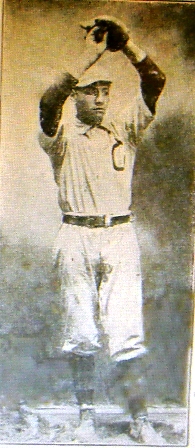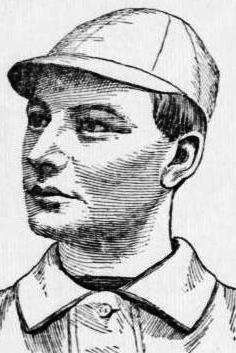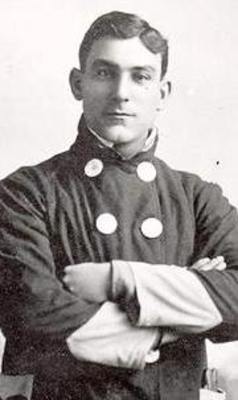
Tag Archives: Chief Bender

Things I Learned on the Way to Looking Up Other Things #18

7 Mar

Tener on Anson

In 1917, John Tener wrote an article in “Baseball Magazine” about Cap Anson, his former manager with the Chicago White Stockings.
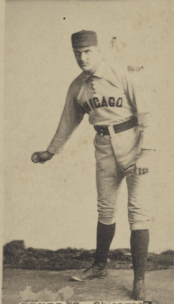
John Tener

John Tener

The former pitcher and outfielder, who went on to serve in the United States Congress and as Governor of Pennsylvania, and who in 1917 was president of the National League said:

“Pop Anson was the Greatest Batter who ever lived.  You may look up his record, compare it with others and draw your own conclusions.  When I say this I am well aware of the claims of Ed Delehanty, Hans Wagner and many other great hitters.  I give them all due credit, but in my opinion, Anson was the greatest of them all.

"Cap" Anson

Anson

“He was, first of all, a free hitter. He loved batting…He had that true eye which enabled him to hit the ball squarely on the nose.  His hits were line drives.  They were solid smashes with the full force of his muscular shoulders behind them.”

[…]

“He was an excellent judge of the precise fraction of a second that he needed to swing that heavy bat of his against the best the pitcher could offer.  He didn’t exactly place his hits, but he contrived to drive the ball behind the base runner about where he wanted to drive it…He was big and strong and heavy.  Some hitters of the present day fatten their averages by their nimbleness in reaching first.  Anson drove the ball solidly into the outfield and took his time in going to first.”

Conte on Mendez

Jose Pepe Conte was a well-known sportswriter in Havana, Cuba. Frank Menke of Heart Newspaper’s International News Service (INS) said of him:
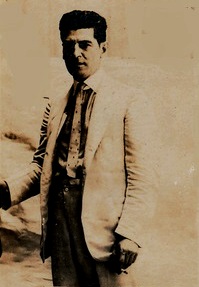
Jose Pepe Conte

Jose Pepe Conte

“Pepe is a fellow who knows heaps and heaps about ancient history, European customs, chemistry, baseball and prize fighting.”

The Pittsburgh Press called him:

“(A) Cuban newspaperman, political personage, and unearther of baseball talent.”

In 1912, the INS distributed an article Conte wrote about the pitcher he thought was the best ever:

“American baseball fans can talk all they want about their (Chief) Benders, (Christy) Mathewsons, (Ed) Walshes and (Mordecai) Browns, but down in our country we have a pitcher that none of the best batters in the country can touch. This is the famous Black Tornado, (Jose) Mendez.  Talk about speed.  Why, when he cuts loose at his hardest clip the ball bounces out of the catcher’s mitt Talk about speed, Mendez has to pitch most of the time without curves because we haven’t a catcher who can hold him.  To make things better, Mendez can bat like (Ty) Cobb.  He has won his own games on various occasions with smashes over the fences for home runs.  He weighs about 154 pounds and is a little fellow.”

Jose Mendez

Jose Mendez

[…]

“No one has been found who can hold him when he really extends himself.  He has shown his skill in the past when he has faced the best batters of the Cubs and Detroit teams when those teams were champions, and when the Athletics went there last year.  Mendez has more curves than any pitcher in America, and if some inventive genius could produce a whitening process whereby we could get the fellow into the big leagues he could win a pennant for either tail-end team in either league.”
Sullivan on Comiskey

In his book, “The National Game,” Al Spink said Ted Sullivan was “the best judge of a ball player in America, the man of widest vision in the baseball world, who predicted much for the National game years ago, and whose predictions have all come true.”
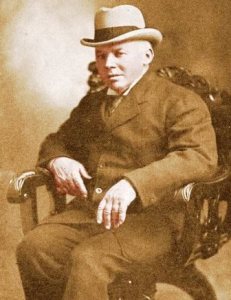
Ted Sullivan

Ted Sullivan

Sullivan was a player, manager, executive, and in 1921, he wrote a series of articles for The Washington Times called “The Best of my Sport Reminiscences.”  He said of Charles Comiskey, who he was crediting with “discovering” at St. Mary’s College in Kansas:
Charles Comiskey

Charles Comiskey

“As a player, Comiskey was easily the best first baseman of his time…His intuition in defining the thoughts of his opponents and making his play accordingly placed him head and shoulders over any man that played that position before or after.

“Comiskey was with John Ward and King Kelly one of the greatest of base runners.  I do not mean dress parade base running, either, merely to show the crowd he could run.  Comiskey’s base running was done at a place in the game when it meant victory for his side.  He was far from being the machine batter that Anson, Roger Connor and some others were; but as a run-getter, which means the combination of hitting, waiting, bunting and running, he outclassed all others.  Jack Doyle, when in his prime with Baltimore and New York, was the nearest approach to Comiskey in brainwork.  There are no others.”
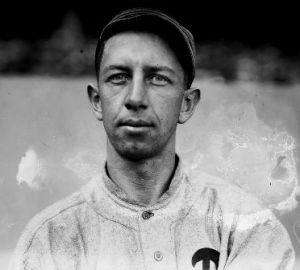
“Pulling a Lave Cross,” Eddie Collins on the Life of a Ballplayer

24 Feb

In 1914, Eddie Collins contributed an article about the life of a major leaguer in The National Sunday Magazine, a syndicated insert that appeared in several papers across the country.

Eddie Collins

Eddie Collins

He described the beginning of his first road trip in the big leagues:

“It happened two days after I had joined the Philadelphia Athletics.  As ‘Mr. Sullivan,’ (Collins initially played under the name Edward T. Sullivan), still being an undergraduate at Columbia, I had watched two games from the grandstand at Shibe Park.

“The series over, Manager (Connie) Mack told me to report at the railroad station in time to catch a train that was leaving at six o’clock.  The Athletics were to make a quick September (1906) swing around the circuit.”

Collins said he was “about the first one at the depot,” and “eager as a boy” to begin his big league career.

Once on the train, he described the reaction of the players the first time the porter announced that dinner would be served:

“What transpired, immediately, might have led one to believe that the porter had insulted nearly everyone in the car.  There was a stampede.  Every one of the Athletics was up and rushing down the aisle, throwing aside magazines and newspapers, tumbling and pitching toward the door. The porter was knocked over and it is no exaggeration to state that one of our players—a very fleshy outfielder with elephantine tread (Topsy Hartsel)—walked over him in his haste.

“’What’s the matter with those fellows?’ I asked a veteran who had not joined the stampede.

“In justice to him, be it explained that he had a sprained ankle and couldn’t run.

“’They’re pulling a Lave Cross,’ he threw over his shoulder, as he hobbled after the others as fast as his lame ankle would permit.

“I came to know what ‘Pulling a Lave Cross’ meant.”

Lave Cross

Lave Cross

Collins explained the term, which referenced the former Athletics player:

“He was in the big leagues for years and during that period, he was never beaten into a dining car or eating room of any sort.  He always caught the first cab out of the station; he always was the first to plunge into the sleeper and select the best berth.  He never ran second where personal comforts or tastes were at stake.  During all his years, and the competition is keen, he was supreme.”

Collins said while Cross’ behavior might have been extreme, “haste” was “a habit inbred in all successful” ballplayers:

“I have noticed that after the game we all dress like firemen getting three alarms, race back the hotel, race into the dining room, race through our meal.  Then we saunter out into the lobby and kill two or three hours trying to see which foot we can stand on longer.  At first I marveled at this, then I found myself racing along with the rest of them.”

Calling himself, and his colleagues “rather peculiar individual(s)” Collins said of ballplayers:

“On the field, all his energies and thoughts are concentrated on one idea—the winning of the game.  His day’s work done, however, he throws that all off.  His first desire is to avoid the crowds and excitement.  Then he persistently refuses to talk baseball.  If you want to make yourself unpopular with big league ballplayers, drop into their hotel some night and try to talk baseball to them. “

Collins next provided readers with “some idea of ballplayers out of spangles,” to bring them into “closer touch.”

Honus Wagner, he said, was not a fan of fans:

“Down in Carnegie (PA) there are about twenty unfortunates…who are taken care of solely through Wagner’s generosity.  He has a heart as big as his clumsy looking body, but he hates the baseball ‘bug.’  Frequently wealthy fans have called at Wagner’s hotel on the road and tried to engage him in conversation.  Generally he will excuse himself and going over to the elevator boy will sit and chat with him for an hour at a time.  Wagner’s worst enemy will not tell you he is conceited, but he hates the fans prying into his affairs.”

Honus Wagner

Honus Wagner

Connie Mack, he said, “is the same kind of man” as Wagner:

“Connie is forever handing out touches to old time players.  He is always thinking of anybody connected with baseball from the bat boys up. I know he insisted out little hunchback mascot (Louis Van Zelst) getting a share of the World Series’ money—not that any players objected—but it was Connie’s thought first.

“’Little Van comes in on this,’ he said.”

Louis Van Zelst

Louis Van Zelst


Collins also talked about how his teammates occupied themselves on the road:

“You will never find Chief Bender, our Indian pitcher, hanging around the hotel.  Too many original fans are apt to salute him with a war-whoop.  Besides, he is golf mad and when not on the diamond, he is to be found on the links… (Carroll “Boardwalk”) Brown, the young pitcher who did so well for us last year, is a billiard expert… (Stuffy) McInnis and (Eddie) Murphy are the ‘movie fiends’ of our club and are the only ones (Collins said many players were scared to go to the movies because they thought it would damage their eyes).  They can call the name of every star as soon as they see the face on the screen. Jack Barry, our shortstop, is inordinately fond of Hebrew literature and Biblical history.  This, although he, as well as his name, is Irish.”

Collins also shared his manager’s rules for the Athletics when the team was traveling:

 “It is one of Mack’s rules that we are only allowed to play cards on the trains…Connie is against card playing, which only leads to-night after night sessions, ill feelings and finally, disruption. I could tell you of at least one American League team that was broken by card games…Everybody has to be in bed by half past eleven and report in Mack’s room at half past ten in the morning.  For an hour Mack talks baseball, planning our campaign for the day.”

After Mack’s meeting, it was time to eat, and Collins shared his insights on ballplayers and food:

He said a “young pitcher on our club” should be a star, but “he has a weakness for roast beef,” and “persists in stuffing himself at noon time.”  He didn’t name the pitcher.

 “Walter Johnson, the greatest pitcher in baseball, also has a noonday weakness.  It is ice cream, but he seems to thrive on it.  Jack Barry feels off-color if he does not get his slice of pie…On the day he is going to pitch, Eddie Plank, our veteran left-hander, always eats tomato soup.  He thinks he would lose if he did not observe this ritual.”

Collins concluded:

“There is great temptation for the young minor league player, being put up at first class hotels…to eat his head off.  I honestly believe that more good youngsters have been ruined for big league work simply from overeating than any other extraneous cause.”

Other than their general disdain for ‘bugs,’ Collins said, in the end, players of the current era were unrecognizable from their counterparts of a generation earlier:

“Ballplayers today are scrupulously careful never to offend anyone in any way.  Especially do they take pride in being Chesterfields when women are around.”

Connie Mack vs Herman W. Souse

6 Nov

In his autobiography “My 66 Years in the Big leagues,Connie Mack said, “My first great disappointment came in 1912.”

Connie Mack

                          Connie Mack

After two straight World Series victories, Mack’s Athletics stumbled to a disappointing third-place finish.  With his team 15 ½ games out of first on September 6, Mack suspended pitcher Charles “Chief” Bender and Reuben “Rube” Oldring for, as The Philadelphia Inquirer  put it:

 “(T)heir failure to live up to the training requirements, as demanded by Mack and all common sense baseball managers.”

Chief Bender

                                Chief Bender

The Inquirer said “Mack refused to discuss this matter further,” but just days later in Detroit he gave what The New York World called “a sermon” on the reason for the suspensions:

“Booze and baseball don’t mix; never did, and never will. A pitcher who thinks he can fan Herman W. Souse is simply pitching to the greatest home run hitter he ever faced.

“Once in awhile you hear of some marvel who can stay out all night, drink all the breweries dry, wreck a few taxi cabs and otherwise enjoy himself, and then step in the box and pitch a wonderful game of ball.  Players who haven’t any more sense point to Rube Waddell, Bugs Raymond and that brand and say: ‘Ah, those were the good old days.  None of these high-priced managers and their red tape then.  And what wonderful players we produced in those days.’

“Well, look at Waddell—one of the most remarkable pitchers nature ever produced.  But Waddell, with all his talent, couldn’t stay in the major leagues.  Why?  Because he stood there and pitched himself to Old Man Barleycorn, and finally every one he threw was slammed over the fence.  And that’s the way all go.  Is it so wonderful, after all?

“No, sir, the day of the stewed ballplayer has gone and it won’t come back.  If the members of my team want to drink, all right.  But they can’t drink and play ball at the same time.  That’s settled.  They can do whatever they prefer, but they can’t do both.

“There are no exceptions to my rule, either.  Any manager will tell you the same.  A short life and a merry one—that’s it.  And the merrier it is the shorter it will be in the big leagues.”

In December of 1912, The Philadelphia Record said Bender had written a letter to Mack asking his manager “to please forgive him.”

According to The Inquirer, he was forgiven and set to return to the Athletics in 1913:

“This winter Bender has spent nearly all the daylight hours automobiling and hunting in the South.  He looks stronger than ever.”

The “stronger,” sober Bender appeared in 48 games, 21 as a starter, and posted a 21-10 record with a 2.21 ERA, and helped lead the Athletics to their third championship in four seasons.

In “My 66 Years in the Big leagues” Mack said of him:

“Let me say here that I consider Chief Bender the greatest one-game pitcher, the greatest money pitcher baseball ever has known.”

Armando Marsans’ Tall Tale

19 Oct

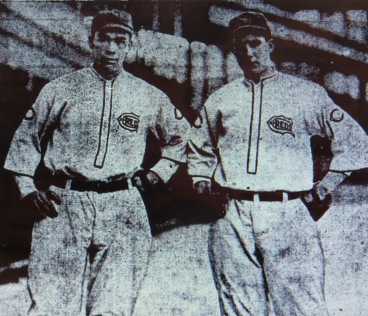
Baseball writers were fascinated by every utterance of the Cincinnati Reds’ two Cuban players, Armando Marsans and Rafael Almeida.  Marsans was the more popular—and more successful—of the two.   He was also the product of well-to-do background.

marsansandalmeida

                           Marsans and Almeida

William A. Phelon of The Cincinnati Times-Star illustrated the cultural difference between the Reds’ two Cuban players:

“(S)omeone asked Almeida and Marsans if they wouldn’t like tickets to a grand opera.  ‘Si, si, accented Marsans, delightedly.  I love grand opera—eet ees fines’ of all entertainment for a gentleman.’

‘I thank you much,” negatived Almeida, “but I care not to go.  To me, grand opera eet sound like de screech of de beeg tomcat, and about so much sensible.’”

Perhaps made up on his own, perhaps captivated by the erudite Marsans, perhaps in on the joke—it wasn’t always clear when Phelon was in on the joke—he quoted Marsans spinning a tale of a Cuban legend in his column in 1912:

“I have seen all the great ballplayers of the present time.  I have been in post-season series against (Napoleon) Lajoie and (Joe) Jackson and have made trips just to see Ty Cobb.  They are wonderful ballplayers, but I give you my word that the greatest I ever looked upon was an Indian named Canella, and popularly called Cinnamon.

“Canella was of a strange Indian race that is supposed to be extinct—the Sibboneys [sic Ciboney] of Cuba, who populated the island when the Spaniards came.  The historians and scientific books all say that they are extinct, and it would doubtless be so, if it were not for the fact that they still live in eastern Cuba and have a little city of their own.  They are tall men with ancient Greek faces—nothing but the color of the Indian to make resemble such men and (John “Chief”) Meyers and (Charles “Chief”) Bender—and they are an athletic people, more agile and active by far than we.  Baseball is their own pet diversion, and Canella, known as Cinnamon, was the greatest of them all.

“Canella, who cannot be over 27 even now, came out a few years ago, and at once became the marvel of eastern Cuba.  He was a pitcher, and a star on the slab, but he was also a batsman, lightening base runner, and clever outfielder.  The records of six years ago show Canella, in some 60 games hit .446 and stole 55 bases.  Havana’s best clubs went up against him and found him invincible while he turned the tide of the closest games with his own batting.

“Canella received no offers from the big American leagues, They took it for granted he was a light colored negro, and when his friends explained that he was an Indian the Americans laughed and said ‘There are no Indians in Cuba—the Spaniards killed them all 400 years ago.’

Armando Marsans

Armando Marsans

“So Canella kept right on playing in Cuba, and he seemed to improve each succeeding season.  At least he became so terrible that even the Havana and Almendares clubs sought excuses to avoid meeting him, and the weaker clubs would face him and get shut out every time.  Finally, some influential Cubans managed to make an American magnate understand that Canella was no Negro, and all was arranged for his tryout in the coming spring.  And then came the news that Canella’s arm was gone, and he could never pitch again.

“It seems that the Indians of Sibboney [sic] still practice the games of their forefathers, and of their favorite sports which is throwing the javelin,  Coming home for a visit, Canella saw the young men of the tribe practicing the spear throw.  Laughingly, he said ‘It is many years since I have done thix—let me try.’ And picking up a slender spear, he hurled it with all his might—and something went snap, crack, in his upper arm as he let go of the javelin.  The arm, so long accustomed to throwing the baseball, gave way when he tried to throw the spear, and never since has Canella been able to throw a ball from the pitching slab as far as the catcher.  It was a shame because Cinnamon Canella was the greatest pitcher, the finest batter, and the fastest base runner that I have ever gazed upon.”

Murphy’s “Billion Dollar Team”

17 Aug

“Money will not buy a pennant winner;” so said William George “Billy” Murphy, the sports editor of The St. Louis Star.  In 1914, he set out to select a team that not even “John D. Rockefeller… (With) all his wealth could buy a club that would win a World’s championship from the one we have picked…The Billion Dollar Team.”

Murphy said:

“You fans of towns that have never won a flag, how would you feel to wake up some morning and find that Dame Fortune had so arranged matters that this club had suddenly been picked to represent your fair city.”

Jimmy Archer, catcher

Behind the plate he acknowledged “There are many who would doubtless pick (John) Chief Meyers…but considering the Indian’s slowness of foot and propensity for clogging up the bases and stealing when the bags are full, we must remark we cannot see the “Chief” for a minute with Jimmy Archer, who, although not so good a hitter, is faster, a quicker thinker, greater fielder and better pegger.”

Jimmy Archer

Jimmy Archer

Murphy was in the minority questioning the baseball intelligence of Meyers, who was widely considered one of the most intelligent and articulate players of his era.  He also rated Ray Schalk and Wally Schang as superior, saying:

“In the writer’s humble opinion they are much more valuable men to their team than Meyers.”

Walter Johnson, pitcher

“There will hardly be a dissenting vote cast against Walter Johnson.  Unquestionably he is the greatest of all the pitchers.

(Charles Chief) Bender and (Christy) Mathewson are also great—great when they should show class—in championship games.  Every nerve, every fiber of their brains, every muscle necessary to their craft, is at its best when big games are being fought.

“Wonderful as they are, we must pick Johnson, who also has class and is game to the core.”

Hal Chase, first base

“For first base, there is only Hal Chase.  He is a great hitter, marvelous fielder, can run the sacks, and is a brilliant tactician.

(John) ‘Stuffy’ McInnis, Jake Daubert, Eddie Konetchy, Fred Merkle, and Jack (Dots) Miller are all stars, but they are ‘also rans’ in the class with Prince Hal of the White Sox.”

Prince Hal of the White Sox

Prince Hal of the White Sox

Eddie Collins, second base

“At second base, Eddie Collins in the potentate.  Johnny Evers, Larry Doyle, and Larry Lajoie occupy seats in the second sackers’ hall of fame, but Collins rules over the roost.”

Honus Wagner, shortstop

“At short, notwithstanding his age, the palm goes to Hans Wagner.  Taken all in all he is still the greatest man at the position in the game.  He can do everything and does it better than any of his contemporaries.  When will we look upon his like again?”

Frank Baker, third base

“At third base, there is that wonderful silent son of swat, Frank Baker, the conqueror of the wonderful Mathewson and Richard (Rube) Marquard.”

Joe Jackson, right field

“In right field we have Joe Jackson, the young Southerner with the Cleveland club.  He is one of the greatest batsmen in the game today and is a fielder and base runner of unusual ability.”

Joe Jackson

Joe Jackson

Ty Cobb, center field

“In center, there is Tyrus Raymond Cobb, the Royston, Georgia marvel, who is the greatest player baseball has ever known.”

Tris Speaker, left field

“And in left field, there is Tris Speaker of the Boston Red Sox—second only to Cobb.”

Charlie Roy

27 May

Robert Charles “Charlie” Roy was one of the most sought after prospects in the country in the winter of 1905.  Raised on the White Earth Reservation in Minnesota, Roy was a pitcher for the Carlisle Indian School baseball team.

The Minneapolis Journal said of the 21-year-old:

“He has been pitching altogether four years, and he puts remarkable speed into the ball.”

In December of 1905, it was reported that Roy was about to sign with the Cincinnati Reds, but just days later he chose to return to Carlisle

The manager of the Carlisle baseball team in the spring of 1906 was Philadelphia Phillies pitcher Charles “Togie” Pittinger–who won 23 games for Philadelphia in 1905.

In March, it was announced  that Roy had signed a contract with the Phillies on the recommendation of Pittinger.  The Philadelphia Record said Pittinger compared the pitcher’s abilities to those of one of Roy’s childhood friends, another Carlisle product:

“He thinks Roy has every earmark of developing into one of the best pitchers in either major league, and predicts for him as bright a baseball career as that of (Chief) Bender.”

Cincinnati protested the signing and claimed Roy had “Verbally agreed,” to a contract the previous December and belonged to Reds.  As the National League considered which team he belonged to, Roy worked out with Phillies.

Charlie Roy, Carlisle Indian School, 1906

Any thought that he’d instantly join the team and be the next Bender was dispelled by Phillies Manager Hugh Duffy who was quoted in The Pittsburgh Press that Philadelphia would not appeal if Cincinnati won the claim because:

“Roy lacks the experience necessary to make him a success in the big league.  He is still green, and until the greenness wears off he will be of no value to big league team.”

The National League ruled that Roy was the property of Philadelphia, and regardless of Duffy’s assessment he made his debut for the Phillies in late June.  Roy only appeared in seven games, posted a 0-1 record with a 4.91 ERA and was sent to the Newark Sailors in the Eastern League.

Charlie Roy

Charlie Roy

He was 2-4 with Newark and was 2-4 again early in 1907 when he was released by the Sailors.  He signed with the Wilmington Peaches of the Tri-State League, although there is no record of him appearing in a game.  He finished the 1907 season with the Steubenville Stubs in the Pennsylvania-Ohio-Maryland League, appearing in 15 games.

Despite dropping from the Major Leagues to a class “D” league in 18 months, the 23-year-old pitcher was still considered a good prospect. The Pittsburgh Post-Gazette said after he won his first start for the Stubs, a 7-2 three-hitter against the Braddock Infants:

“He has plenty of speed and fine curves and looks like a winner.”

But near the close of the 1907 season it was clear he’d never be another Bender.  Despite being drafted by Boston Doves, The Associated Press reported that he would refuse to report to the National League club in the spring:

 “Charlie Roy, The Indian Twirler…has quit baseball to go into the evangelist field.”

Some papers reported the pitcher’s decision more impoliticly.

The Harrisburg Telegraph:

“(Roy) says he has had all the National League game he wanted, and rather than report he will go back to the plains and throw mud balls at his fellow Indians.”

The Sporting Life:

 “(Roy) intends to forsake the diamond after the close of this season and equip himself for evangelistic labors among the redskins of the Northwest.”

Roy returned to the White Earth Reservation to preach and eventually settled in Blackfoot, Idaho  where he died in 1950.

A shorter version of this post appeared on October 30, 2012.

“Is Napoleon Lajoie a Hoodoo?”

14 Nov

Napoleon Lajoie had his share of superstitions and sought to avoid “Hoodoo,” like most players of his era.  But, as Lajoie was winding down his long career, hitting un-Lajoie like .246 for a horrible Philadelphia Athletics team (36-117) in 1916, The Philadelphia Bulletin presented a case that Lajoie himself was the problem:

“Is Napoleon Lajoie a hoodoo?

Napoleon Lajoie

Napoleon Lajoie

“Several baseball managers and ‘Larry’ himself would like to know the answer.  And here is why:

“Lajoie, for many years recognized as the king of second basemen and dubbed ‘King Larry,’ now has visions of the waning of his baseball star of fame, and he has never played on a pennant-winning team…For years he hit well over the .300 mark—once over .400—was one of the most dangerous men to pitch to in a pinch, and fielded his position around second base in a finished, manner—so finished in fact, that he won the distinction of being the classiest second-sacker in baseball.  Every move of the big Frenchman was grace personified.

“Notwithstanding the fact that he was a star of the first magnitude, ranking with Hans Wagner of Pittsburgh—and they are the two real stars of baseball of former years—he never was able to help his team to the pennant.  So, when Lajoie was sold to Connie Mack dopesters and Larry himself thought he eventually would get into a World Series.  But alas!

“Larry joined the Athletics in the spring of 1915, and while his admirers were expecting him to get back his batting eye, which had apparently been dimmed while he was in Cleveland, Connie Mack decided to tear down his wonderful machine.  (Eddie) Collins, (Ed) Plank, (Charles “Chief”) Bender, (Jack) Coombs, and (Jack) Barry were sold (or released), while (Frank) Baker played bush league ball because Connie would not meet his salary demands, and the famous $100,000 infield of the Athletics was wrecked and the run making machine of the world champions was put out of commission.  And the hopes of Larry and his enthusiastic followers went glimmering.  He is on a tail-end team, just like he was at Cleveland.

“And worst of all from Lajoie’s point of view, the Cleveland team has been holding down first place in the American League for many weeks and is a contender for the pennant.

“The question, ‘Is Napoleon Lajoie a hoodoo?’ Again presents itself.”

While Cleveland was in first place as late as July 12, the Lajoie-hoodoo-free Indians still faltered and finished seventh in 1916.

After Philadelphia’s disastrous season—they finished 54 and a half games back—Lajoie accepted the position of player-manager with the Toronto Maple Leafs in the International League.  The 42-year-old second baseman hit a league-leading .380 and led the Maple Leafs to the championship in 1917—the first, and only of his career.

Lost Advertisements–Athletics/Cubs 1910 World Series

13 Sep

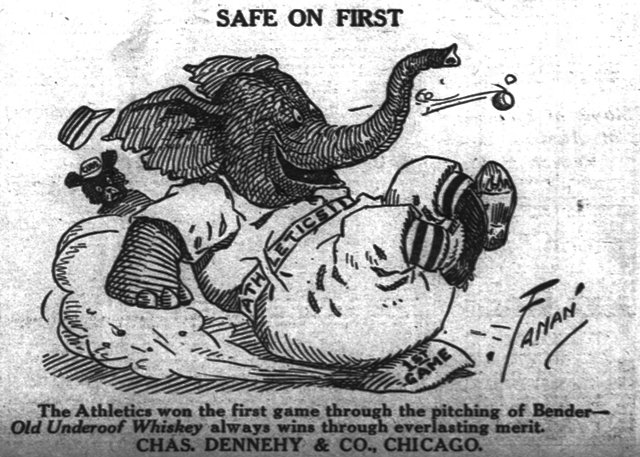
1910ws2

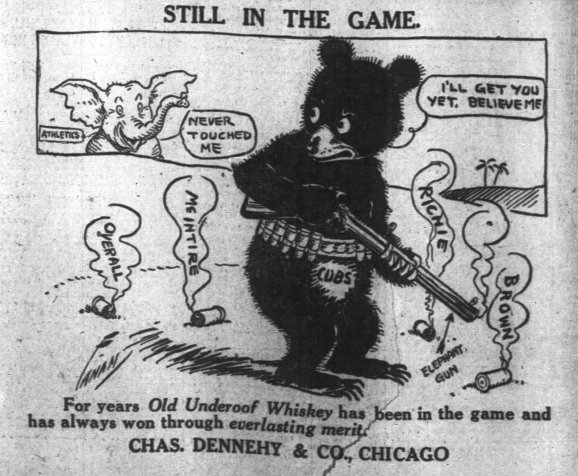
Three advertisements for Old Underoof Whiskey that appeared in Chicago during the 1910 World Series between the Cubs and the Philadelphia Athletics.  The first “Safe On First,”  above, appeared after Charles “Chief” Bender beat the Cubs 4 to 1, giving up only three hits in game one.  The second “Still In The Game,” below, appeared before game three.  The bear is holding as “elephant gun” with four spent shells on the ground–(Orval) Overall, (Harry) McIntire, (Lew) Richie, and (Mordecai) Brown–the four pitchers who gave up 13 runs to the Athletics and the first two games.


The final one, bottom, “No They are Not Dead” appeared before game four.  The Cubs, down 3 games to 0 beat the Athletics 4 to 3 in 10 innings, Brown relieved Leonard “King” Cole in the ninth and got the decision over Bender.  The following day Jack Coombs beat the Cubs and Brown 7 to 2 to take the series four games to one.


1910ws3


1910wscubs

“Chief” Bender’s Catcher

3 Sep

Umpire Billy Evans, in one of his syndicated newspaper columns in the fall of 1910, said: “Most every ball player is more or less superstitious, but the pitchers, I believe, are more susceptible to beliefs uncanny than any of the other diamond athletes.”

Evans singled out Charles “Chief” Bender, who had just completed a 23-5 season with a 1.58 ERA for the World Champion Philadelphia Athletics, as one of the most “susceptible.”

Chief Bender

Chief Bender

According to Evans, Bender preferred throwing to catcher Ira Thomas over the team’s other two catchers Jack Lapp and Paddy Livingston:

“Bender has won lots of games with other catchers doing the receiving, but he never seems quite so steady as when Thomas is paired up with him.”

Evans said the preference extended to warming up as well:

“While there are scores and scores of pitchers who have their favorite catchers, still they are content to let one of the other receivers warm them up between innings, but not so with the Chief.  When Bender starts a game he absolutely refuses to throw to anyone other than Thomas.

“It is often the case that when the side is retired, the catcher happens to be a base runner.  Naturally much time is consumed by him in hurrying from the base he occupied to the bench to get his mask, glove and protector, and then back to the plate.  It is customary for most managers under such circumstances, to send one of the other catchers up to the plate to keep the pitcher warmed up.  I have seen Bender refuse at least a dozen times during the past summer to warm up with one of the Athletics other than Thomas.  He waits for Ira and takes a chance on getting cold in preference to putting the “jinx” on himself by tossing the ball to someone else.”

Bender's favorite catcher Ira Thomas

Bender’s favorite catcher Ira Thomas

The feeling was mutual.  In a 1911 article in The Pittsburgh Press, Thomas, who in addition to Bender also caught Jack Coombs (31-9, 1.30 ERA), Cy Morgan (18-12, 1.55 ERA), and Eddie Plank (16-10, 2.01 ERA) in 1910, said of Bender:

“I don’t take my hat off to…any other pitcher when Chief Bender is around.  He is a wonder of wonders.  No one can show me where there is a better pitcher in general.

“Bender has everything a pitcher needs and in a series of seven games he is almost invincible.”

Thomas remained with the Athletics organization for another 40 years as a coach, minor league manager and scout; he finished his scouting career with the Yankees, retiring in 1956.  He died in 1958.

Bender left Philadelphia in 1914 when he jump the Athletics for the Federal League; he returned to the Athletics organization in the 1930s.  He died in 1954.

Bender and Thomas shared a baseball card--the 1912 T202 Hassan Triple Folder

Bender and Thomas shared a baseball card–the 1912 T202 Hassan Triple Folder

The two remained close for the rest of their lives and often appeared together at baseball banquets.  One story Bender always told; the “greatest thrill” of his career, his May 12, 1910 no-hitter against the Cleveland Naps (this version was related in The Trenton Evening Times in 1936).  With two outs in the ninth Cleveland’s Elmer Flick hit a pop-up in front of home plate, the ball initially popped out of Thomas’ mitt before he secured it for the final out:

“Watching Ira juggle that ball and then hold it was my greatest thrill.”

“Calvo has been the Victim of a Cruel and Merciless Conspiracy”

4 Jun

When he signed 18-year-old Jacinto “Jack” Calvo Gonzalez, Washington Senators manager/owner Clark Griffith was no stranger to Cuban players, having managed Armando Marsáns and Rafael Almeida with the Cincinnati Reds, but Calvo’s signing was the beginning of Griffith’s 40-plus year commitment to signing players from Cuba.  During his tenure the Senators signed more than half of the 63 Cuban players in the major leagues.

Calvo was “discovered” while playing with Almendares in the Cuban National League, where he hit .342 in 19 games.  He made even more of an impression during a series Almendares played against the New Orleans Pelicans of the Southern Association, Calvo hit .400 and his older brother Tomas hit .385.

???????????????????????????????

He also hit .400 during a six-game series with the Philadelphia Athletics, The Associated Press said he didn’t compile those numbers facing minor league pitchers picked up for the series, but “against (Eddie) Plank, (Jack) Coombs, and (Charles “Chief”) Bender.”

When rumors circulated that Washington might have signed Calvo, Bender said:

“I never saw a faster youngster in my life; he can hit too, and looks for the entire world like a class ball player…If Griffith has signed him he will never regret it, for there is no chance for him to be a failure.”

By December of 1912 Griffith had Calvo under contract.  The Pittsburgh Press said:

“The young Cuban sent a letter to Griff, written in Spanish.  ‘They did not teach Spanish where I went to school,’ said The Old Fox, ‘so I can’t translate the missive.  However, as he signed his contract I guess everything is alright.’”

The Boston Red Sox signed Tomas Calvo later in December.

While Tomas never made it in Boston, Jacinto made his debut with the Senators on May 9; he hit only .242, but everyone noticed his arm.  After a June game with the St. Louis Browns, The Associated Press said:

“The youngster astonished the bugs yesterday with his remarkable throwing arm.  At one time he heaved the ball from the right field fence directly to (Germany) Schaefer’s hands at second.”

On August 13 Calvo was sent to the Atlanta Crackers in the Southern Association and made his first appearance with the team the following day, batting seventh, going 1 for 4.  The Atlanta Constitution said “He’s fast, fields pretty well, throws like a shot and meets the ball squarely.”

Calvo only lasted 10 days in Atlanta.  He was hit on the right arm with a pitch thrown by Charles “Curly” Brown of the Montgomery Rebels.  He was returned to the Senators and did not appear in another game that season.  (Some sources show Calvo with the Long Branch Cubans in the New York New Jersey League—it was most likely his brother Tomas, an infielder, rather than career outfielder Jacinto, who played shortstop for the team in 94 games).

Calvo started the 1914 season with the Los Angeles Angels in the Pacific Coast League.  After only 11 games (he was 4-8 with one double, one triple and a stolen base) he was sent to the Victoria Bees in the Northwestern League.  Later in the season a story came out explaining his abrupt departure from Los Angeles.

Calvo with the Washington Senators

Calvo with the Washington Senators

The Spokane Spokesman-Review said, “Calvo has been the victim of a cruel and merciless conspiracy,” despite the fact that “in the exhibition games last spring against the White Sox Calvo loomed up head and shoulders above the other Angel gardeners, out hitting them by a wide margin and displaying more speed on the bags than the whole Angel team combined.”

The paper claimed that a female reporter:

“(o)n one of the local papers…dragged out of him the fact that his father was a rich sugar planter in Havana, and that he played baseball for fun and not for money…That was the beginning of the end for little Calvo. “

The story said fans began harassing Calvo, and:

“Instead of coming to his rescue, the players on the Angel team ‘rode’ the boy unmercifully.  It was pathetic to see the friendless little Cuban trying to get into the good graces of his teammates.  One day, in the clubhouse the boy sat down on a bench and cried before them all.  His spirit was broken.”

Calvo hit .289 for Victoria in 1914, and spent the spring of 1915 with the Senators before being release before the beginning of the season.  After his release he played with his brother Tomas for the Long Branch Cubans, by then a member of the Independent Negro League; he also played for Havana in the Cuban-American Negro Clubs Series.

Calvo next played for the Vancouver Beavers in the Northwestern League and the San Francisco Seals in the Pacific Coast League, hitting .329 in 1916, and slipping to .263 in 1917. After the 1917 season, the outfielder returned, unsigned, the contract sent to him by Seals owner Charlie Graham.

Calvo had been very popular in San Francisco during his nearly two seasons with the Seals, but was criticised by fans and local press for his holdout, especially because he was holding out on the even more popular Graham.  The San Francisco Chronicle said:

“He sent his terms, and as they were exactly what he asked for before.  (Charlie) Graham is wondering why the Cuban went to the trouble to wire at all.”  The paper criticised Calvo for “asking for more money than he got last year,” while “better players than he have submitted to a salary slash on account of war conditions.”

San Francisco Seals owner Charlie Graham

San Francisco Seals owner Charlie Graham

The Chronicle lamented the fact that Seals outfielder Biff Schaller would miss the entire season with an injury, otherwise “Calvo could have stayed in Havana for all that anyone here cares.”

As it turned out, Calvo did stay in Havana.  For all of 1918 and ’19, not returning to the states until 1920.  Tomorrow–Jacinto Calvo’s return.