Tag Archives: Nap Lajoie

Lost Advertisements–Anheuser-Busch, Washington Senators

5 Feb


ab1910sox

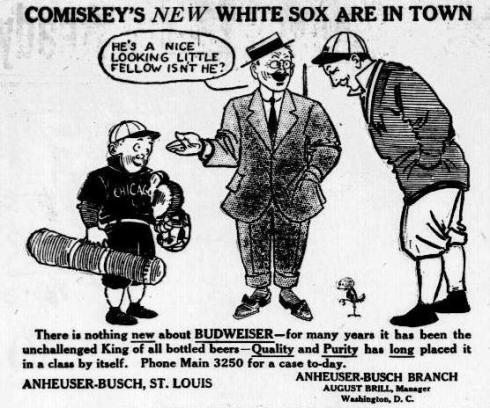
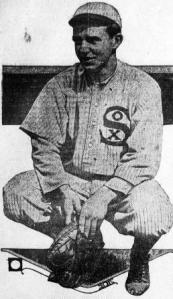
In 1910, a series of Anheuser-Busch ads  appeared in several Washington D.C. papers. The ad above appeared when the Chicago White Sox faced the Senators in early May:

Comiskey’s New White Sox are in Town

The headline referred to Charles Comiskey‘s shakeup of his team, which included the appointment of Hugh Duffy as manager, and a new starting infield; first baseman Chick Gandil, second baseman Rollie Zeider, and shortstop Lena Blackburne, and Billy Purtell at third.

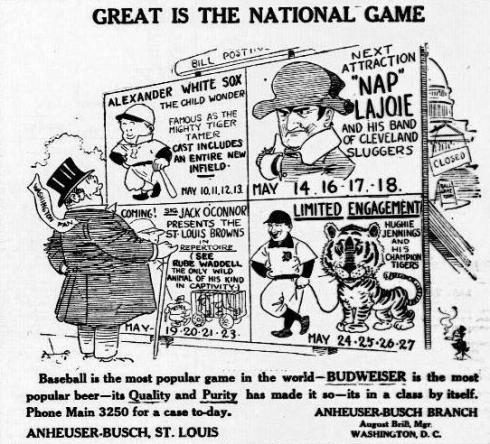
An advertisement later that week featured caricatures of Napoleon Lajoie and Hughie Jennings, and described Rube Waddell as “The only wild animal of his kind in captivity:”

ab1910nap

The ads were similar in style and content to those for Old Underoof Whiskey that appeared in Chicago papers during the same period–all advertised upcoming games, commented on the behavior of fans and players, and chronicled the year’s pennant races–with one exception.

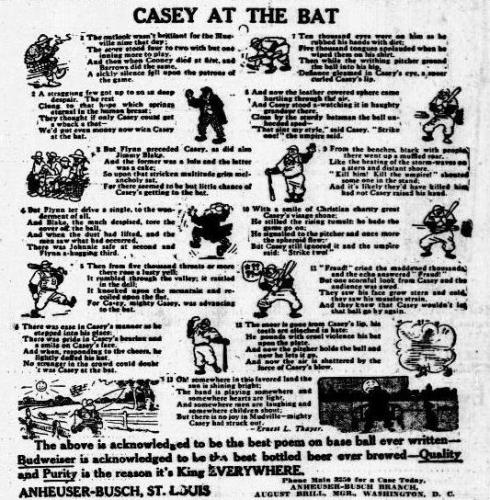
A July ad featured the full text, with illustrations, of Ernest Thayer’s “Casey at the Bat:”

ab1910casey

They only appeared for one season.


Ray Schalk on “Baseball Brains”

1 Feb

After the Chicago White Sox defeated the New York Giants in the 1917 World Series, Sox catcher Ray “Cracker” Schalk took to the pages of “Baseball Magazine” with his opinion of statistics:

Ray Schalk

Ray Schalk

“Offhand I would say that fielding averages are pretty bad, pitchers’ averages rather punk, batting averages merely fair.  But the worst of all are catchers’ averages.

“How are you going to tell a good catcher?  By his batting average?  By his fielding average?  By the runs he scores?  Of course all these things are important.  But they haven’t any direct connection with good, bad or indifferent catching as such.  A catcher may or may not be a good batter or base runner.  And whatever his hitting or run getting ability he may be a great or mediocre catcher.”

Schalk said it was “easy…from the records” to determine an outfielder or shortstop’s ability:

“But a man might be the best catcher the world ever saw or the worst, and there would be no way under heaven to gain that information from the season’s statistics.

“First of all, a catcher must have baseball brains.  It isn’t enough to say brains; you must add the adjective ‘baseball’ to describe what you mean.”

Schalk noted that many of his contemporaries were educated:

“I admit this is the day of the college player in baseball.  I admit that the better education a man has, other things being equal, the better ball player he will be.  But he might know a lot of philosophy or Greek literature and be a frost on foul flies.  Ty Cobb has the ideal baseball brains.  But Ty isn’t a college man.  On the other hand I used to play in the minors with a graduate of a well-known university who was a brilliant scholar and a good natural athlete.  But he was positively the limit in playing baseball.  He would do the most incomprehensible things.  In fact, he was impossible.

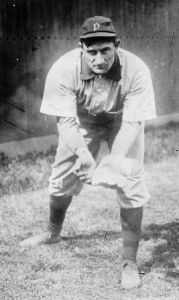
Hans Wagner and Nap Lajoie are not college men, have not enjoyed as liberal an education, perhaps, as most of the rest of us.  But if any medical laboratory wants a sample of a real baseball brain, let him open negotiations with the Dutchman or the Frenchman for the use of his skull when he is thru with it.

Honus Wagner

Honus Wagner

“I believe there are fellows with a natural born instinct to play baseball.  They invariably do the right thing at the right time.  That is what I mean by baseball brains.  Furthermore, such a brain must above all act quickly.  There are many thousands of people, even in the stands, who understand good baseball and could dope out the proper thing for a fielder or a batter to do under given conditions.  But that isn’t enough.  The man with a baseball brain must not only do the right thing but he must do it instantly.  It is quickness of thought quite as much as correctness which marks the star player.  Hal Chase and Ty Cobb are scintillating examples of quick thought on the diamond.”

And, said Schalk, “quick thought” was most important behind the plate:

“Now the catcher, above all men, must have a good baseball brain.  Most of his work, the most important part of his work, is hidden from the spectators’ eye.  The man in the stands can seldom follow what is going on in the catcher’s brain.  But the catcher, much more than the pitcher, holds the game in the hollow of his hand.  The catcher, much more than the pitcher, is the keystone of the baseball arch.”

The man who thought statistics didn’t have “any direct connection” to a catcher’s value made it into the Hall of Fame in 1955.  He has the lowest career average (.253) among enshrined catchers.

Armando Marsans’ Tall Tale

19 Oct

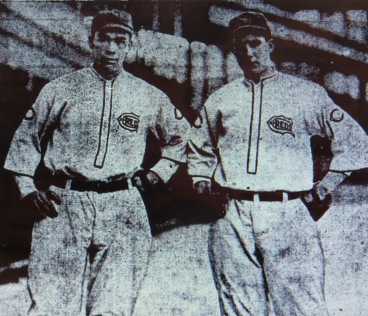
Baseball writers were fascinated by every utterance of the Cincinnati Reds’ two Cuban players, Armando Marsans and Rafael Almeida.  Marsans was the more popular—and more successful—of the two.   He was also the product of well-to-do background.

marsansandalmeida

                           Marsans and Almeida

William A. Phelon of The Cincinnati Times-Star illustrated the cultural difference between the Reds’ two Cuban players:

“(S)omeone asked Almeida and Marsans if they wouldn’t like tickets to a grand opera.  ‘Si, si, accented Marsans, delightedly.  I love grand opera—eet ees fines’ of all entertainment for a gentleman.’

‘I thank you much,” negatived Almeida, “but I care not to go.  To me, grand opera eet sound like de screech of de beeg tomcat, and about so much sensible.’”

Perhaps made up on his own, perhaps captivated by the erudite Marsans, perhaps in on the joke—it wasn’t always clear when Phelon was in on the joke—he quoted Marsans spinning a tale of a Cuban legend in his column in 1912:

“I have seen all the great ballplayers of the present time.  I have been in post-season series against (Napoleon) Lajoie and (Joe) Jackson and have made trips just to see Ty Cobb.  They are wonderful ballplayers, but I give you my word that the greatest I ever looked upon was an Indian named Canella, and popularly called Cinnamon.

“Canella was of a strange Indian race that is supposed to be extinct—the Sibboneys [sic Ciboney] of Cuba, who populated the island when the Spaniards came.  The historians and scientific books all say that they are extinct, and it would doubtless be so, if it were not for the fact that they still live in eastern Cuba and have a little city of their own.  They are tall men with ancient Greek faces—nothing but the color of the Indian to make resemble such men and (John “Chief”) Meyers and (Charles “Chief”) Bender—and they are an athletic people, more agile and active by far than we.  Baseball is their own pet diversion, and Canella, known as Cinnamon, was the greatest of them all.

“Canella, who cannot be over 27 even now, came out a few years ago, and at once became the marvel of eastern Cuba.  He was a pitcher, and a star on the slab, but he was also a batsman, lightening base runner, and clever outfielder.  The records of six years ago show Canella, in some 60 games hit .446 and stole 55 bases.  Havana’s best clubs went up against him and found him invincible while he turned the tide of the closest games with his own batting.

“Canella received no offers from the big American leagues, They took it for granted he was a light colored negro, and when his friends explained that he was an Indian the Americans laughed and said ‘There are no Indians in Cuba—the Spaniards killed them all 400 years ago.’

Armando Marsans

Armando Marsans

“So Canella kept right on playing in Cuba, and he seemed to improve each succeeding season.  At least he became so terrible that even the Havana and Almendares clubs sought excuses to avoid meeting him, and the weaker clubs would face him and get shut out every time.  Finally, some influential Cubans managed to make an American magnate understand that Canella was no Negro, and all was arranged for his tryout in the coming spring.  And then came the news that Canella’s arm was gone, and he could never pitch again.

“It seems that the Indians of Sibboney [sic] still practice the games of their forefathers, and of their favorite sports which is throwing the javelin,  Coming home for a visit, Canella saw the young men of the tribe practicing the spear throw.  Laughingly, he said ‘It is many years since I have done thix—let me try.’ And picking up a slender spear, he hurled it with all his might—and something went snap, crack, in his upper arm as he let go of the javelin.  The arm, so long accustomed to throwing the baseball, gave way when he tried to throw the spear, and never since has Canella been able to throw a ball from the pitching slab as far as the catcher.  It was a shame because Cinnamon Canella was the greatest pitcher, the finest batter, and the fastest base runner that I have ever gazed upon.”

Lost Advertisements–Lajoie for Nuxated Iron

7 Aug

lajoienuxated


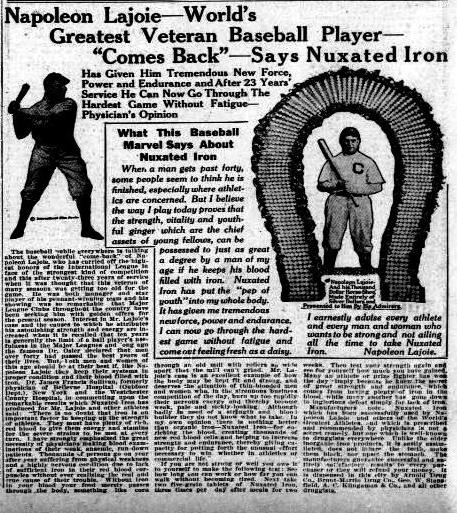
Not to be outdone by Ty Cobb, Harry Hooper and Joe Jackson who also endorsed the new “miracle drug” from DAE Health Laboratories in Detroit in 1916, Napoleon Lajoie took his turn in an advertisement for Nuxated Iron.

Napoleon Lajoie–World’s Greatest Veteran Baseball Player–‘Comes Back’ says Nuxated Iron Has Given him Tremendous New Force, Power and Endurance After 23 Years’ Service He Can Now Go Through The Hardest Game Without Fatigue–Physicians’s Opinion

Lajoie’s testimonial for the product said:

“When a man gets past forty, some people seem to think he is finished, especially where athletics are concerned.  But I believe the way I play today proves that the strength, vitality and youthful ginger which are the chief assets of young fellows, can be possessed to just as a great a degree by a man of my age if he keeps his body full of iron.  Nuxated Iron has put the ‘pep of youth’ into my whole body.”

Most doctors disagreed with Lajoie’s assessment.

The Journal of the American Medical Association took notice of the Nuxated Iron ad campaign and in October of 1916 had this to say about the “miracle drug:”

“Newspapers whose advertising ethics are still in the formative stage have, for some months past, been singing—at so much a song—the praised of “Nuxated Iron.”  The public has been that this nostrum is what makes Ty Cobb, “the greatest baseball batter of all time,” a “winner” and is what helped Jess Willard “to whip Frank Moran” besides being the “untold secret” of Willard’s “great triumph over Jack Johnson.”

All that DAE would say about the ingredients were:

“Formula—The valuable blood, nerve force and tissue building properties of this preparation are due to organic iron in the form of ferrum peptonate in combination with nux vomica (strychnine) phosphoglycerate and other valuable ingredients.

But alas, The AMA Journal was not impressed with the claims made by Nuxated Iron’s endorsements:

“The Journal felt that it owed it to the public to find out just how much iron and nux vomica there were in ‘Nuxated Iron.’  Packages of the nostrum…were subjected to analysis.”

What the analysis found was that the formula that made Ty Cobb a “winner,” offered no health benefits:

“There is only one-twenty-fifth of a grain of iron in each ‘Nuxated Iron’ tablet, while the amount of nux vomica…is practically negligible…In a dollar bottle of ‘Nuxated Iron’ the purchaser gets, according to our analysis, less than 2 ½ grams of iron; in 100 Blaud’s Pills, which can be purchased at any drug store for from 50 to 75 cents, there are 48 grains of iron.”

To sum up their analysis The Journal called the claims made by Nuxated Iron “the sheerest advertising buncombe.”

Cobb was said to have earned as much as $1000 for his endorsement, there is no record of what Lajoie was paid.

Nuxated Iron remained on the market until at least 1921; although by then they had sought a higher power to endorse the product.

Portions of this post appeared in one about the Cobb advertisement for Nuxated Iron, published February 15, 2013.


“A Lajoie Bunt”

22 Jul

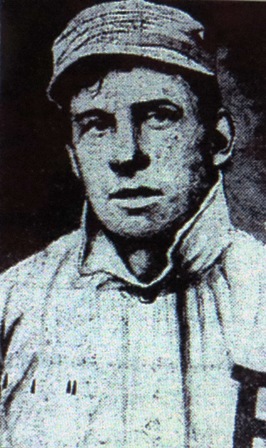
Francis “Red” Donahue was a teammate of Napoleon Lajoie in Philadelphia and Cleveland.  During a road trip in New York with the Indians in 1904 he told a story to Elmer Ellsworth Bates of The Cleveland News:

“I never come to New York without recalling the first time (Fred) Dutch Hartman of the old New York team ever saw Lajoie in a game.  Hartman had just began playing third base for the Giants and he had to be coached all the time by his teammates.

Fred "Dutch" Hartman

Fred “Dutch” Hartman

“The Phillies came over here and when Larry came to bat Hartman appealed to his fellow players for instructions.

“‘Play in for this fellow,’ was the tip.  ‘He’s liable to bunt.’

“Hartman went in about 30 feet and pushing his cap back on his head waited for the bunt.  The pitcher swung up a nice one and Larry smashed it.  The ball went away at awful speed.  It brushed the top of Hartman’s head, struck squarely in the middle of his cap and carried that piece of headgear with it clear out against the left field fence.  The other 17 players roared, but Hartman couldn’t see the joke.

Napoleon Lajoie

Napoleon Lajoie

“‘I thought you said he would bunt,’ said he.

”That was a Lajoie bunt’ said (Giants center fielder George) Van Haltren.  Wait and see him hit one with no cap to interfere with the ball.”


“He is a $900 Man”

6 Jul

Frank Leonardo Hough had a major conflict of interest. While sports editor for The Philadelphia Inquirer, he also held a 12.5% interest in the Philadelphia Athletics from the club’s inaugural season until 1912—he also served as the team secretary for several seasons while working at the paper. Another Philadelphia sports writer, Sam Jones of The Associated Press also held a 12.5% interest in the team.

Frank L. Hough

Frank L. Hough

Perhaps it was Hough’s close association with an American League team that made him one of the most vocal advocates for the rights of current and former National League players while the leagues battled for stars.

In 1902, he told his readers the story of how William “Bill” Duggleby, who jumped from the Phillies to the Athletics after the 1901 season, was treated—Hough said he was, “Human Chattel”–while a member of the Phillies:

“These are the facts:

“William Duggleby, pitcher played with the Auburn Club, of the New York State League, during the season of 1897. In the fall of that year, he was drafted by the Philadelphia Ball Club.”

According to Hough, Duggleby was offered $900 for the season, a $25 raise from his salary in Auburn.

Hough pitched just nine games for the Phillies in 1898 and, “was farmed or rented,” to minor league clubs for the remainder of 1898 and in 1899 and 1900.

“Thus it will be seen that although he was under the absolute control of the Philadelphia Club from 1897, he played only a few games in the season of 1898 with that organization. He had no control over his own services. He could not even say where he would play, or where he would not play. That matter was determined by the treasurer of the Philadelphia Ball Club.”

William Duggleby

William Duggleby

Hough noted that while Duggleby, “developed considerable skill,” and had three good seasons in the Eastern League (12-11, 22-16, 17-10) drawing considerable interest from a “half dozen” major league teams, he only received $900 from the Phillies each season:

“The clubs that rented Duggleby did not know him in the financial end of the transaction at all.

“Had Duggleby the right to sign wherever he could have made the best bargain he would have undoubtedly received at least $1800 a season for his services—just twice as much as received under the White Slave system of the National League.”

Hough said Duggleby likely only had six to 10 years total earning power and “lost three years in which he should have received a salary somewhere commensurate to his ability.”

That, however, said Hough, was not the worst of it. In 1900, Duggleby was with the Toronto Canucks, who paid the Phillies, “$225 per month for his services,” while Duggleby was paid just $150 a month.

“No convict from a Texas or Georgia penitentiary was ever rented or leased to break stone on a quarry or repair roadways in colder blood than was Duggleby to the Toronto Club.

“If Duggleby was not a white slave in a free country, what in the name of all that is fair was he?…Of course, Duggleby did not have to wear ball and chain—that might have interfered with his playing ability. But he had no more control over his actions than would the most hardened criminal consigned to the quarries.”

Just days after Hough made the case for Duggleby’s victimhood—and after he appeared in just two games for the Athletics— the pitcher returned to the Phillies. Said to have been paid $3250 by the Athletics, Duggleby accepted a $2400 contract with the Phillies. He told Sporting Life:

“There was no great reason for my going with the American League in the first place, but after I had given my word to go with Connie Mack’s team I did not feel like breaking it. Then came the decision in the (Napoleon) Lajoie case, and a notice from Manager (Bill) Shettsline to report to him or meet with the same fate as Lajoie. I went to see Shetts at once and asked him if the club really intended to proceed against all players that were under reserve. He assured me that they would. Well, under the circumstances I saw nothing for me to do but go back to the National.”

Hough’s tone changed considerably after Duggleby left the Athletics; in addition to his paper referring to the pitcher in a headline as a “Vertebraeless Youth,” he said:

“Without awaiting the outcome of the efforts to be made today to secure an appeal (in the Lajoie case)… (Duggleby) runs to cover like a frightened hound…Evidently the treasurer of the Philadelphia Ball Club sized up Duggleby right in the first place. He is a $900 man.”

Duggleby, who posted a 20-12 record for the Phillies in 1901, only had one winning season after (18-17 in 1905). He pitched in the major leagues until 1907.

Duggleby had one other distinction: During his initial trial with the Phillies in 1898, he hit a grand slam in his first major league at-bat on April 21–for 70 years he remained the only player to hit a grand slam in his first game until Bobby Bonds hit one during his debut (his third at-bat) on June 25, 1968; Jeremy Hermida equaled the feat in his first major league at-bat in 2005.

Hough remained a stockholder and officer with the Athletics while simultaneously reporting on baseball for The Inquirer, until he sold his interest to Connie Mack in 1912. He was the paper’s sports editor until his death the following year. (While Hough’s middle name was said to be Leonardo throughout his life, his Pennsylvania death certificate lists it as Lewis)

“The Next Babe Ruth”

18 Mar

After he hit 11 home runs in 1918, and for the next two decades, stories about the discovery of “The Next Babe Ruth” became commonplace in newspapers across the country.

One of the first was Joe Doyle, “The Babe Ruth of Great Lakes,” signed by the St. Louis Cardinals in November of 1918.  Doyle was the star of the team representing Camp Dewey at Great Lakes Navel Training Station where, The St. Louis Globe-Democrat said he made a name for himself, hitting “a dozen home runs and nine triples…(and) flogging a home run over the Camp Dewey Drill Hall, a smash that might be compared to a lift over the left fences of any major league park.”

Doyle began his professional career the following spring with the Houston Buffaloes in the Texas League and played his entire career in Texas.  “The Babe Ruth of Great Lakes” hit just eight home runs over five minor league seasons.

Ben Paschal had the distinction of being declared “The Next Babe Ruth” twice.  When the Boston Red Sox purchased Paschal from the South Atlantic League’s Charlotte Hornets in July of 1920, Manager Ed Barrow told The Boston Herald he had acquired “A second Babe Ruth.”

Paschal joined the Red Sox after Charlotte’s season ended in September.  He had 10 hit in 28 at-bats, but no extra base hits, and was returned to Charlotte after the season.

After four more excellent seasons in the South Atlantic League and Southern Association (he hit .335 with 68 home runs from 1921-1924) he was  purchased by the New York Yankees for $20,000 in August of 1924.

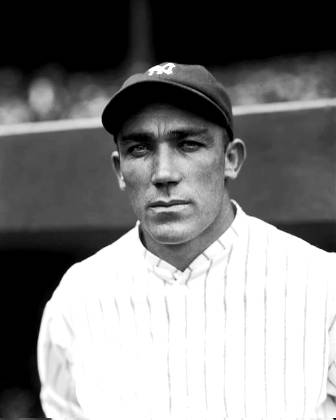
Ben Paschal

Ben Paschal

Paschal was again dubbed the “Second Babe Ruth” by newspapers.  His second stint as the second Ruth was longer and more successful than his first.  From 1924-1929 he hit .309 in with 24 home runs in 750 at-bats as an outfielder playing behind Ruth and Bob Meusel (Meusel was himself dubbed “Another Babe Ruth” by Manager Miller Huggins when he joined the Yankees in 1920).  On Opening Day in 1927 the Second Babe Ruth pinch-hit for Ruth (who was 0-3 and struck out twice) in the sixth inning; Paschal singled, and the Yankees went on to an 8 to 3 victory over the Philadelphia Athletics.

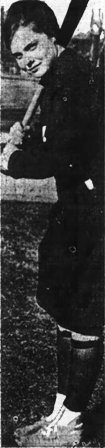
Then there was Dorothy Hodgens.  In 1921, Hodgens was a 20-year-old student at Wilson College in Chambersburg, Pennsylvania.  Hodgens briefly became a celebrity and was called the “feminine Babe Ruth” by many newspapers after The Associated Press (AP) reported that while growing up in Philadelphia Napoleon Lajoie said she was “the only girl he ever knew who could play ball.”

After her picture appeared in papers across the country, Hodgens, who played several sports at the school, was interviewed by The Harrisburg Evening News as she was “ready to enter a basketball game:”

“Yes, I’m terribly fond of baseball, and I’ve been playing it ever since I’ve been a bit of a youngster.”

She said Lajoie was a neighbor in Philadelphia when she was a child:

“Lajoie used to come out and pitch ball with the boys and girls in the neighborhood.  He told me I was the only girl he ever knew who could pitch and gave me a box of league balls that I have treasured ever since.”

Dorothy Hodgens "The Feminine Babe Ruth."

Dorothy Hodgens “The Feminine Babe Ruth.”

While she said her real ambition was to become an actress, Hodgens said, “I never expect to give up baseball entirely though, and I certainly think that every girl should learn to play the game.”

The “Feminine Babe Ruth” disappeared from the public eye shortly afterward.

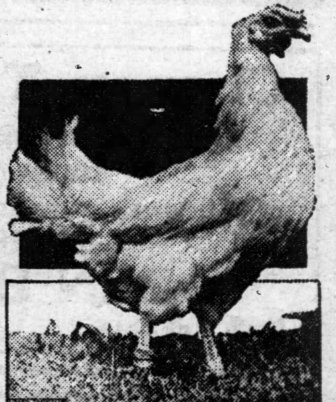
And finally, there was “Another Babe Ruth” who had a brief moment in the limelight in the fall of 1920.  This one was a three-and-a-half pound white Leghorn Chicken who was named “Babe Ruth,” and had just established a new record.

"Babe Ruth"

“Babe Ruth”

The AP said:

“(T)he home run king has a rival…She bats 326 eggs, and this beats the record of 314 (for a single year).  By experienced poultrymen, her record of 326 perfect eggs is considered the most remarkable in the history of the poultry industry.”

There was no report of how she performed the following season.

“Is Napoleon Lajoie a Hoodoo?”

14 Nov

Napoleon Lajoie had his share of superstitions and sought to avoid “Hoodoo,” like most players of his era.  But, as Lajoie was winding down his long career, hitting un-Lajoie like .246 for a horrible Philadelphia Athletics team (36-117) in 1916, The Philadelphia Bulletin presented a case that Lajoie himself was the problem:

“Is Napoleon Lajoie a hoodoo?

Napoleon Lajoie

Napoleon Lajoie

“Several baseball managers and ‘Larry’ himself would like to know the answer.  And here is why:

“Lajoie, for many years recognized as the king of second basemen and dubbed ‘King Larry,’ now has visions of the waning of his baseball star of fame, and he has never played on a pennant-winning team…For years he hit well over the .300 mark—once over .400—was one of the most dangerous men to pitch to in a pinch, and fielded his position around second base in a finished, manner—so finished in fact, that he won the distinction of being the classiest second-sacker in baseball.  Every move of the big Frenchman was grace personified.

“Notwithstanding the fact that he was a star of the first magnitude, ranking with Hans Wagner of Pittsburgh—and they are the two real stars of baseball of former years—he never was able to help his team to the pennant.  So, when Lajoie was sold to Connie Mack dopesters and Larry himself thought he eventually would get into a World Series.  But alas!

“Larry joined the Athletics in the spring of 1915, and while his admirers were expecting him to get back his batting eye, which had apparently been dimmed while he was in Cleveland, Connie Mack decided to tear down his wonderful machine.  (Eddie) Collins, (Ed) Plank, (Charles “Chief”) Bender, (Jack) Coombs, and (Jack) Barry were sold (or released), while (Frank) Baker played bush league ball because Connie would not meet his salary demands, and the famous $100,000 infield of the Athletics was wrecked and the run making machine of the world champions was put out of commission.  And the hopes of Larry and his enthusiastic followers went glimmering.  He is on a tail-end team, just like he was at Cleveland.

“And worst of all from Lajoie’s point of view, the Cleveland team has been holding down first place in the American League for many weeks and is a contender for the pennant.

“The question, ‘Is Napoleon Lajoie a hoodoo?’ Again presents itself.”

While Cleveland was in first place as late as July 12, the Lajoie-hoodoo-free Indians still faltered and finished seventh in 1916.

After Philadelphia’s disastrous season—they finished 54 and a half games back—Lajoie accepted the position of player-manager with the Toronto Maple Leafs in the International League.  The 42-year-old second baseman hit a league-leading .380 and led the Maple Leafs to the championship in 1917—the first, and only of his career.

“The Annual Spring Typhoon has Blown up Again”

10 Nov

In 1906, despite being, on paper, the best team in the American League, the Cleveland Naps finished in third place, five games behind the Chicago White Sox.  The club had three twenty game winners—Addie Joss, Bob Rhoads, and Otto Hess—and four regulars who  hit better than .300—Napoleon Lajoie, William “Bunk” Congalton, Elmer Flick and Claude Rossman,

As the 1907 season approached, Grantland Rice, of The Cleveland News said the team was now a victim of the success of individual players:

“The annual spring typhoon has blown up again—only a bit worse than ever.  In nearly every big league camp well-known athletes are breaking into loud roars over the pay question, and there promises to be quite a batch of trouble before the storm is cleared away.  In this respect Cleveland heads the list, although Napland owners have one of the highest salary lists in the game.  Up to date Joss, Rhoads, (Terry) Turner and Congalton have balked, while neither Flick nor Hess have returned a signed contract.”
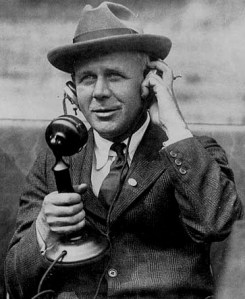
Grantland Rice

Grantland Rice

Rice said the club’s negotiations with Joss and Rhoads were at an impasse, and “just how it will end is a matter of uncertainty.”  The news of the team’s trouble signing their stars led Rice to a discussion of “just how much a major leaguer is supposed to receive for his work each season.”

“When a youngster breaks in he is never given less, or at least rarely so, than he received in his minor league berth.  His pay is boosted the greater part of the time, so the average debutante’s pay roll ranges closely around $1,800 providing he is recognized as a first class man.

“If he delivers the goods his first year out he can figure on about $2,000 or $2,200 for his next season, and then if he becomes established as a regular, his income should be somewhere in the immediate vicinity of $2,500.

“From this point upward it all depends on their rankings as stars.  You hear considerable about $5,000 contracts and better, but as a matter of cold, clammy fact, but few athletes draw over $3,000 or $3,500 at best.

“In the epoch of war salaries $3,500 or $4,000 was a fairly common figure—but no more.

“A high grade slabman along the order of Joss, Rhoads (Nick) Altrock, etc…will rake in about $3,000 now.  In his weekly letter in a Toledo paper (The News-Bee), Joss stated that he was offered $3,000 for his season’s work, but that he demanded more—just how much he didn’t say.

“George Stone drew $3,000 or there abouts last season and now that he has fought his way to the premiership in the School of Slugs he demands $5,000, at which figure Mr. (Jimmy) McAleer balks strenuously.  (Johnny) Kling also asks for $5,000, which sum Charley Murphy says he will not receive.

“From this list we jump to the drawing cards of the game such as Lajoie, (Honus) Wagner, (Wee Willie) Keeler, (Christy) Mathewson, etc…

“Lajoie’s figures range somewhere above $8,000 and something shy of the $9,000 mark.

“Wagner is supposed to draw $5,000 for his work.

“If reports sent out from New York are true, Keeler’s yearly ante is close to $6,000, while Mathewson draws in about the same.

Hal Chase won’t miss $3,500 very far.

“But the high-priced teams are not pennant winners by a jug full.

(Charles) Comiskey and (Connie) Mack hew closer to the line than any others in Ban Johnson’s circle, and yet these two have won more pennants than all the rest put together.  In fact, they’ve gotten away with all but the two which Boston nailed.

“Mack had one of the cheapest, if not the cheapest team in the American League through 1905, the last year he copped the pennant.  Comiskey’s world champions of 1906 were far below Cleveland, New York or even Boston, from the salary standpoint.

“It looks funny to figure the cellar champions of a league paid more than the holders of the world’s title, but if all the figures were given out, the White Sox payroll would loom up under Boston’s to a certainty.

“The full salary cost of running a big league club varies from $40,000 to $50,000, or maybe $55,000 a year.

“A set of figures somewhere between $45,000 and $50,000 would probably hit at the higher average.

“There was a time when Boston’s payroll was close to $70,000 and (Clark) Griffith’s was only a notch below—but this golden era for the ballplayer has passed.”

According to The Washington Post, Joss had earned $3,2000 in 1906 ($2,700 and a $500 bonus), the biography, “Addie Joss:  King of Pitchers,” said he was paid $4,000 in 1907—Joss, who was 21-9 with a 1.72 ERA in 1906, followed that up with a league leading 27 wins (against 11 loses, with a 1.83 ERA) in 1907.
Addie Joss

Addie Joss

Fellow twenty game winners Rhoads and Hess both saw their production slip (15-14, 6-6), and only two regulars—Flick .302 and Lajoie .301—hit better than .300, and the team’s batting average slipped 28 points from the previous seasons.

The Naps finished fourth in 1907.

Jim Delahanty’s Idea

10 Oct

Before the 1911 season, Hugh Fullerton, in The Chicago Examiner, told the story about Jim Delahanty’s plan to improve his hitting.  The Detroit Tigers second baseman was having a conversation with teammates:

Jim Delahanty

Jim Delahanty

“’I think,’ said Delahanty, ‘that if someone would kick me between the eyes real hard, I’d lead the league in hitting.’

“’What’s the angle of that remark?’ Asked Sam Crawford.

“’If I were you,’ said Davy Jones, ‘I’d hire a mule to kick me three of four times, and maybe I’d hit 1000 per cent.

“’I’ll tell you what I mean,’ said Del.  ‘When I went to the Atlantic League I was just a fair hitter—fair, bordering on rotten.  If I hit .225 I felt pretty good, and if I fell below that I wasn’t much surprised.

‘”Well, I had been going along fairly well for a few weeks, when one day I started stealing second.  I intended at first to slide behind the bag, but the baseman changed position, and I tried to switch and slide in front.’

“’The result was I slid awkwardly, and as he touched me out and blocked me his knee hit me bang between the eyes.  I saw forty million stars, and got up dizzy and feeling funny.’

“’Everything seemed changed, and I seemed to be looking through a veil all the time.  Everything on mu right side looked uphill and everything on the left downhill.  For about ten days I was the worst hitter in the world, not excepting Jack Pfiester.  It worried me.’

Jack Pfiester

Jack Pfiester

“’I think in three weeks I got two base hits, and what seemed funny to me was that I made both these hits off curve balls that fooled me.  The fact is my eyes had been banged out of gear and I was swinging about four inches below where the ball really was, and the only times I hit it was when it fooled me.’

“I was all upset and ready to quit when one day I drew a base on balls and tried to steal.  The shortstop was coming to cover the bag, and as I slid his knee caught me right between the eyes and knocked me cold.

“’When I batted the next time I saw the ball perfectly, or thought I did, and up I went into the .250 class.  A year later I got another crack between the eyes—and immediately improved still further in hitting.  Now I’m waiting for the kick that will put me in the .350 class.’

“Crawford was silent for some time.  Then he said:

‘”Say, did (Napoleon) Lajoie ever mention being hit between the eyes with a pile driver?’”

A .283 lifetime hitter, Delahanty had his best season at the plate in 1911, with career bests in nearly every offensive category, including average (.339) and RBI (94).

There is no record of him having received the desired blow to the head before the season began.