Tag Archives: Lost Advertisements

Lost Advertisements–The Official Baseball of the California and Pacific Leagues

20 Dec

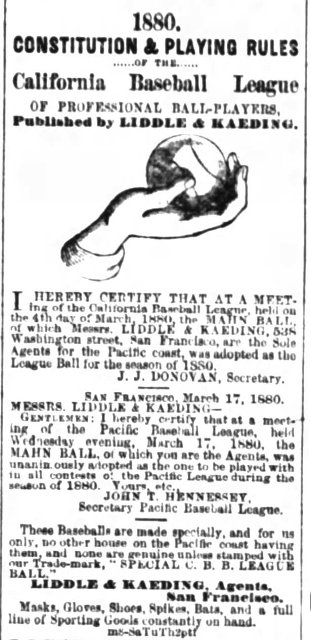
1880calAn 1880 advertisement for Liddle & Kaeding, a San Francisco sporting goods company.  In addition to being the publishers of the California League’s Constitution and rules, the company was the West Coast distributor of the official baseball for both the California and Pacific Leagues; the Mahn “double-cover” ball, developed by Louis Mahn in Massachusetts.

“At a meeting of the California Baseball League… the Mahn Ball of which Messers. Liddle & Kaeding…are the sole agents for the Pacific coast was adopted as the League Ball for the season of 1880.”

J. J. Donovan, Secretary

“At a meeting of  the Pacific Baseball League…the Mahn Ball, of which you are the Agents, was unanimously adopted as the one to be played with in all contests of the Pacific league during the season of 1880.

John T. Hennessy, Secretary Pacific Baseball League

“These Baseballs are made specially, and for us only, no other house on the Pacific coast having them, and none are genuine unless stamped with out trademark, ‘SPECIAL C.B.B. LEAGUE BALL.'”
Lost Advertisements–“Now he is a Man with a Sound Body”

13 Dec

georgewrightcelery

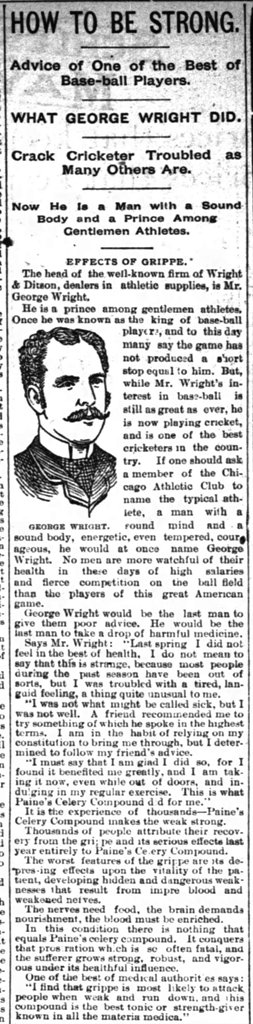
An 1890s advertisement featuring George Wright, which appeared in newspapers across the country, and presented as a regular news story, for Paine’s Celery Compound:

“He is a prince among gentlemen athletes. Once he was known as the king of base-ball players, and to this day many say the game has not produced a shortstop to equal him. But, while Mr. Wright’s interest in base-ball is still as great as ever, he is now playing cricket, and is one of the best cricketers in the country.”

Paine’s, like many patent medicines of the late nineteenth century, claimed to be a cure for the grippe (influenza):

“Says Mr. Wright: ‘Last spring I did not feel in the best of health. I do not mean to say that this is strange, because most people during the past season have been out of sorts, but I was troubled with a tired, languid feeling, a thing quite unusual to me.

“I was not what might be called sick, but I was not well. a friend recommended me to try something of which he spoke in the highest terms. I am in the habit of relying on my constitution to bring me through, but I determined to follow my friend’s advice.

“I must say that I am glad I did so, for I found it benefited me greatly, and I am taking it now, even while out-of-doors and indulging in my regular exercise. This is what Paine’s Celery Compound did for me.”

George Wright

George Wright

The ad said Paine’s “makes the weak strong,” and that “Thousands of people attribute their recovery from the grippe” to the compound.

According to The Journal of the American Medical Association, Paine’s contained fifteen different types of vegetables, but that “loses much of its impressiveness when it is seen that the total amount of vegetable extractives is less than 1.5 percent.” The Journal also noted that the compound contained 19.85 percent alcohol, which may account for Wright’s assertion that it “benefited me greatly.”

Lost Advertisements–“Yell For Your Team–And Help Them Win”

6 Dec

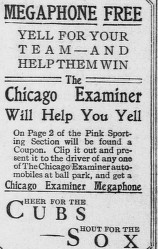
cubssoxmegaphoneA 1912 advertisement for a free megaphone available from “the driver of any one of The Chicago Examiner automobiles at ballpark.”

The Chicago Cubs and White Sox played 25 City Series’ between 1903 and 1942 (not including their World Series in 1906).  The first, in 1903 ended in a tie–both teams winning seven games before the series was forced to end because the player’s contracts had expired.  The Cubs won in 1905 and 1909, but the Sox won 18 of the next 22.

The 1912 series began with a 0-0 tie.  White Sox pitcher “Big Ed” Walsh held the Cubs to just one hit–a Joe Tinker double.   Cubs pitcher Jimmy Lavender held the Sox to six.

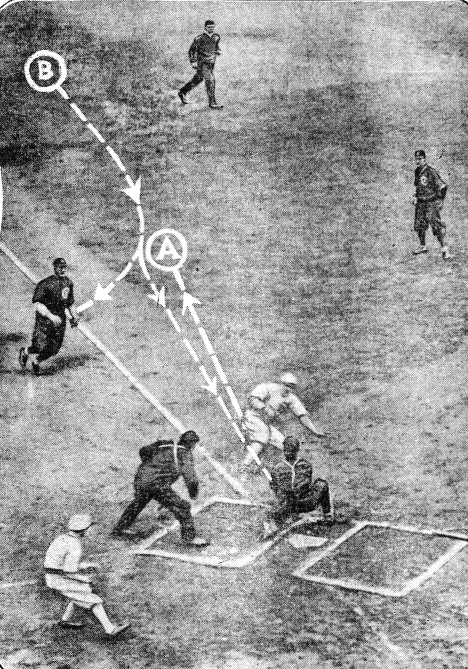
The highlight of the game came in the second inning.  With “Ping” Bodie on third and Rollie Zeider at bat.  The Chicago Tribune said:

“Zeider took a spitter for one ball, then hit the second for a high bounder to (Heinie) Zimmerman.  Bodie tried to score, but Zimmerman ran in stabbed the ball with his bare hand and got Bodie at the plate.”

The picture shows where Zimmerman was playing Zeider (B) and where he fielded the ball (A).

The picture shows where Zimmerman was playing Zeider (B) and where he fielded the ball (A).  Ping Bodie is tagged out by Cubs catcher Jimmy Archer.

The second game of the series also ended in a tie, 3 to 3.  The Cubs then won three straight, but the White Sox came back and won four in a row to take the series.

The 31-year-old Walsh, who was 27-17 in 62 games (41 starts, 32 complete games) and 393 innings pitched,  appeared in six games for the Sox, starting four.  He would only win 13 more games over parts of the next five seasons.

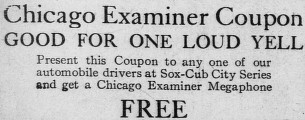
cubssoxmegaphone1912

1912 Cubs/Sox Megaphone coupon from The Chicago Examiner

Lost Advertisements–President McKinley, Spalding League Ball

29 Nov

mckinleyspalding


An April 1897 advertisement for the Spalding.  The advertisement appeared in several papers across the country–including The Chicago Inter Ocean and The Chicago Daily News.

President McKinley Formally opened the Base Ball Season yesterday at Washington with the Spalding Official League Ball…

It seems very appropriate for the American game of Base Ball to be formally opened by the President of the United States, as was done yesterday at Washington by President William McKinley, in breaking the seal and tossing to the umpire the Spalding Official League Ball.”

While the advertisement ran on April 23 so did a story from The Associated Press which said the president was a no-show:

“It was expected that President McKinley would favor the Senators with his presence, he having promised the Washington players if his duties did not prevent he would toss the first ball to the umpire, but he evidently was too busy entertaining office-seekers, and as a result players and spectators alike were greatly disappointed.”

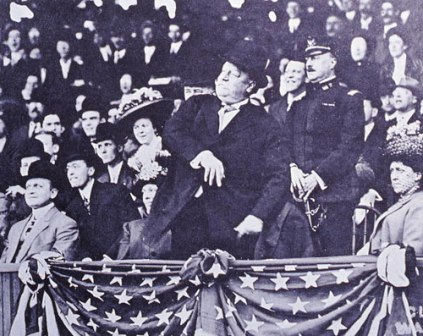
The Brooklyn Bridegrooms defeated the Senators 5 to 4.  It would be 13 years before  William Howard Taft became the first president to throw out the first ball on April 14, 1910, in Washington.

William Howard Taft throws out the first pitch in 1910

William Howard Taft throws out the first pitch in 1910

Lost Advertisements–“Kid” Gleason for Cat’s Paw Rubber Heels

22 Nov

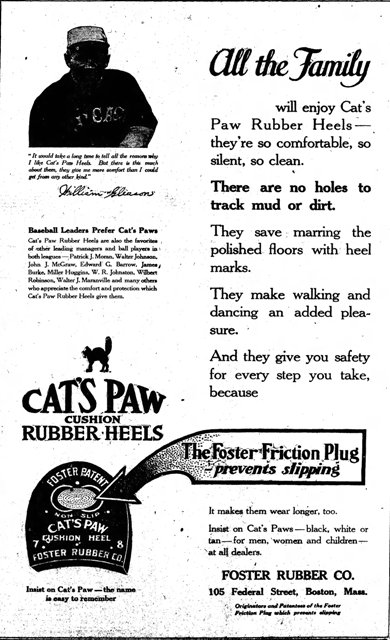
cat'spawA 1920 advertisement featuring William “Kid” Gleason, manager of the defending American League Champion Chicago White Sox–the ad appeared in July, two months before the first grand jury was convened to investigate the 1919 World Series.

“It would take a long time to tell all the reasons why I like the Cat’s Paw Heels.  But there is this much about them, they give me more comfort than I could get from any other brand.”  William Gleason

Baseball Leaders Prefer Cat’s Paws

Cat’s Paw Rubber Heels are also the favorites of other leading managers and ball players in both leagues–Patrick J. Moran, Walter Johnson, John J. McGraw, Edward G. Barrow, James Burke, Miller Huggins, W.R. Johnston, Wilbert Robinson, Walter J. Maranville and many others who appreciate the comfort and protection which Cat’s Paw Rubber Heels give them.

Lost Advertisements–25 Pictures of the Baseball Stars

15 Nov

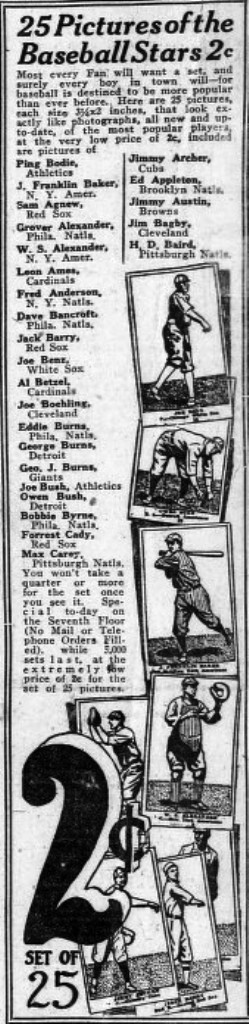
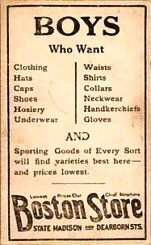
bostonstoreadAn April 1917 advertisement for the Boston Store baseball card set at the chain’s Chicago store located on Madison Street between State and Dearborn. The 200 card set was sold in groups of 25 for 2 cents. This ad was for cards numbers 1 through 25.


bostonstore

“Most every Fan will want a set, and surely every boy in town will–for baseball is destined to be more popular than ever before.  Here are 25 pictures, each size 3 1/4 x 2 inches, that look exactly like photographs, all new and up-to-date, of the most popular players at the very low price of 2 cents.

“You won’t take a quarter or more for the set once you see it.  Special to-day on Seventh Floor (No Mail or Telephone Orders Filled).  While 5,000 sets last at the extremely low price of 2 cents for the set of 25 pictures.”


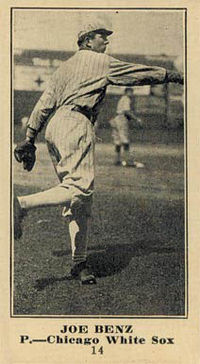
Joe Benz, Chicago White Sox, Boston Store card

Joe Benz, Chicago White Sox, Boston Store card

The Boston Store card reverse

The Boston Store card reverse


The First 25:

Sam Agnew

Grover C. Alexander

W.E. Alexander

Leon Ames

Fred Anderson

Ed Appleton

Jimmy Archer

Jimmy Austin

Jim Bagby

H.D. Baird

Frank Baker

Dave Bancroft

Jack Barry

Joe Benz

Al Betzel

Ping Bodie

Joe Boehling

Eddie Burns

George Burns

George J. Burns

Joe Bush

Owen Bush

Bobbie Byrne

Forrest Cady

Max Carey


Lost Advertisements — “The Spalding”

1 Nov

thespalding

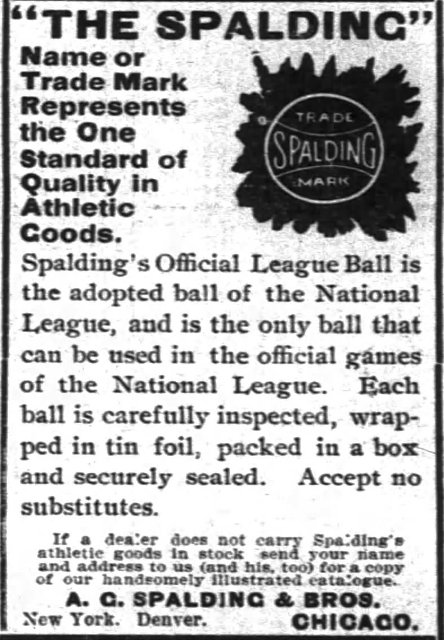
An advertisement from 1899 for the official ball of the National League:

“The Spalding” Name or Trademark Represents the one Standard of Quality in Athletic Goods

“Spalding’s Official League Ball is the adopted ball of the National League, and is the only ball that can be used in the official games of the National league.  Each ball is carefully inspected, wrapped in tin foil, packed in a box and securely sealed.  Accept no substitutions.”

Lost Advertisements–Ready! Lajoie Baseball Guide

25 Oct

lajoieguide

Above is a 1906 advertisement for an Atlanta hardware store offering the inaugural edition of “Napoleon Lajoie‘s Baseball Guide.”  The Lajoie Guide was intended to compete with the well established Spalding and Reach Guides, and sold for 10 cents, but despite Lajoie’s popularity the guide failed to catch on and was only published for three years.

In addition to the standard recap of professional baseball leagues across the country, and many photos, the Lajoie guide included a significant amount of information specific to its name sake.  An advertisement for the Cincinnati-based Queen City Tobacco Company said:

Lajoie Chews Red Devil Tobacco

Ask him if he don’t

reddevil

Grantland Rice wrote for the guide, and the first edition included a Rice-penned poem called “For Lajoie’s in Town:”

We’ve gazed on Mr. Roosevelt,

Who rules this whole wide land.

We’ve looked at Carrie Nation, 

And shook Jim Corbett’s hand

We’ve eaten bread with Robert Fitz

And chummed with George Tebeau.

We’ve drank out beer with Mr. Schlitz.

Great notable we know.

We’ve interviewed Friend Morgan,

Thrown talk at old John D.

We’ve opened wine with Sullivan

And seen Prince Hennery.

King Edward is a bosom pal,

Langtry our school-day girl.

Dick Croker smiles in our face,

We’ll give Boss Fame a whirl

*     *     *     *     *     *     *     *

Around the shrine of heroes

There’s little we’ve not seen.

We’ve talked to all, both great and small,

Of high and lowly mien.

But this group pales beneath the looks

Of one of far renown.

Hats off!The greatest comes today,

For Lajoie’s in town.

T. Roosevelt’s backed off the boards,

A plater is king Ed.

Langtry a chorus lady now,

The others are all dead.

For Lajoie, pride of several leagues!

Lajoie, the mighty man!

Lajoie, his bat and fielding glove

Knocks out the wholes blamed clan.

The 1906 Lajoie Guide

The 1906 Lajoie Guide

Lost Advertisements–“The Man Who Led the National League”

18 Oct

chancecoke

A  Coca-Cola advertisement that appeared before the 1910 season featuring Chicago Cubs first baseman/manager Frank Chance:

“The man who lead the National League –first basemen, with a percentage of .994.”

In 1909 Chance committed six errors, with 947 total chances in 92 games.

“You may use my name as one of your many customers who have derived benefits from drinking Coca-Cola.”

Lost Advertisements–Hans Wagner Says!!!

11 Oct

hans


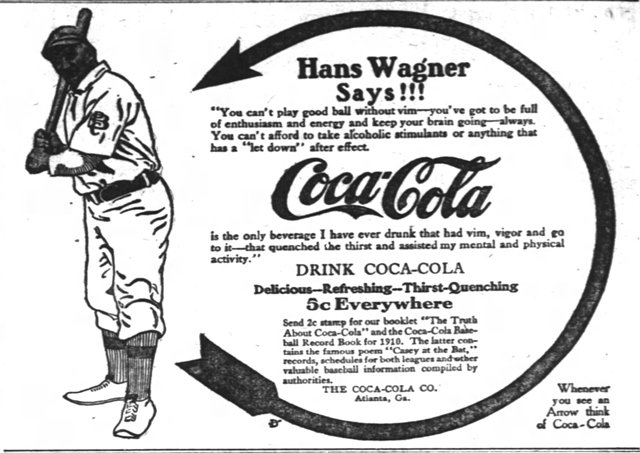
A 1910 advertisement for Coca-Cola featuring Honus Wagner (a 1908 Wagner Coke ad was featured in an earlier post).

You can’t play good ball without vim–you’ve got to be full of enthusiasm and energy and keep your brain going–always.

You can’t afford to take alcoholic  stimulants or anything that has a “let-down” after effect.

Coca-cola

is the only beverage I have ever drunk that had vim, vigor and go to it–that quenched the thirst and assisted my mental and physical activity.